Spark as Service in cloud on Yarn
Hadoop Meetup
bharatb@qubole.com, rgupta@qubole.com
May 15, 2015
Agenda
• Spark on Yarn
• Autoscaling Spark Apps and Cluster
management
• Hive Integration with Spark
• Persistent History Server
Spark on Yarn
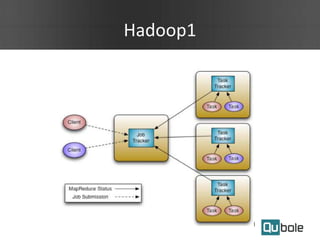
Hadoop1
Disadvantages of hadoop1
• Limited to only MR
• Separate Map and Reduce slots =>
underutilization
• JT is heavily loaded for job scheduling,
monitoring and resource allocation.
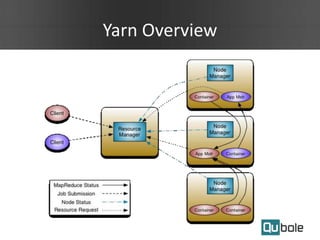
Yarn Overview
Advantages of Spark on Yarn
• General cluster for running multiple
workflows. AM can have custom logic for
scheduling
• AM can ask for more containers when
required and give up containers when free
• This become even better when yarn clusters
can autoscale
• Get features like spot nodes etc which brings
additional challenges
Advantages of Spark on Yarn
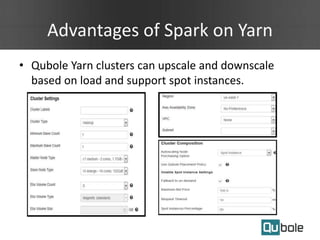
• Qubole Yarn clusters can upscale and downscale
based on load and support spot instances.
Autoscaling Spark Applications
Spark Provisioning: Problems
• Spark Application starts with fixed number of
resources and hold on to them till its alive
• Sometimes its difficult to estimate resources
required by a job since AM is long running
• It becomes limiting spl when Yarn clusters can
autoscale.
Dynamic Provisioning
• Speed up spark commands by using free
resources in yarn cluster and also by releasing
resources when free to RM.
Spark on Yarn basics
Driver
AM
Executor-1 Executor-n
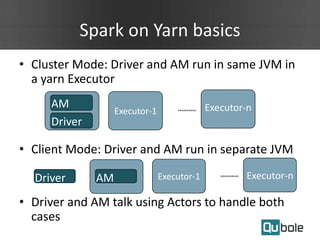
• Cluster Mode: Driver and AM run in same JVM in
a yarn Executor
• Client Mode: Driver and AM run in separate JVM
• Driver and AM talk using Actors to handle both
cases
Driver AM Executor-1 Executor-n
Dynamic Provisioning: Problem
Statement
• Two parts:
– Spark AM has no way to ask for additional
containers and give up free containers
– Automating the process of requesting containers
and releasing containers. Cached data in
containers make this difficult
Dynamic Provisioning: Part1
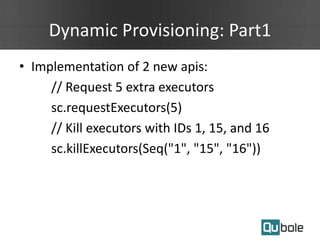
• Implementation of 2 new apis:
// Request 5 extra executors
sc.requestExecutors(5)
// Kill executors with IDs 1, 15, and 16
sc.killExecutors(Seq("1", "15", "16"))
requestExecutors
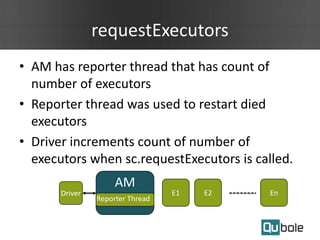
AM
Reporter Thread
E1 E2 En
• AM has reporter thread that has count of
number of executors
• Reporter thread was used to restart died
executors
• Driver increments count of number of
executors when sc.requestExecutors is called.
Driver
removeExecutors
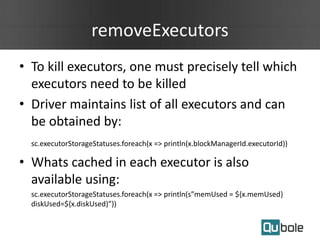
• To kill executors, one must precisely tell which
executors need to be killed
• Driver maintains list of all executors and can
be obtained by:
sc.executorStorageStatuses.foreach(x => println(x.blockManagerId.executorId))
• Whats cached in each executor is also
available using:
sc.executorStorageStatuses.foreach(x => println(s”memUsed = ${x.memUsed}
diskUsed=${x.diskUsed)”))
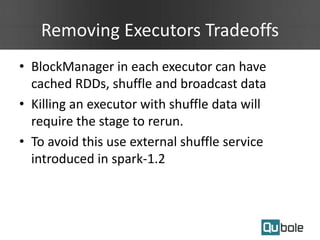
Removing Executors Tradeoffs
• BlockManager in each executor can have
cached RDDs, shuffle and broadcast data
• Killing an executor with shuffle data will
require the stage to rerun.
• To avoid this use external shuffle service
introduced in spark-1.2
Dynamic Provisioning: Part2
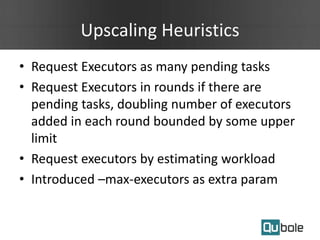
Upscaling Heuristics
• Request Executors as many pending tasks
• Request Executors in rounds if there are
pending tasks, doubling number of executors
added in each round bounded by some upper
limit
• Request executors by estimating workload
• Introduced –max-executors as extra param
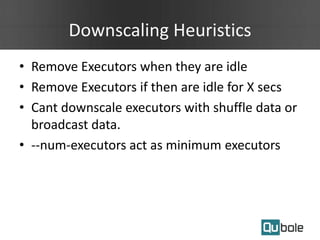
Downscaling Heuristics
• Remove Executors when they are idle
• Remove Executors if then are idle for X secs
• Cant downscale executors with shuffle data or
broadcast data.
• --num-executors act as minimum executors
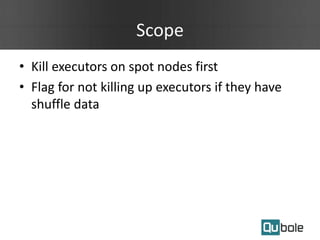
Scope
• Kill executors on spot nodes first
• Flag for not killing up executors if they have
shuffle data
Where is the code?
• https://github.com/apache/spark/pull/2840
• https://github.com/apache/spark/pull/2746
Spark Hive Integration
What is involved?
• Spark programs should be able to access hive
metastore
• Other Qubole services can be producers or
consumers of data and metadata(hive, presto,
pig etc)
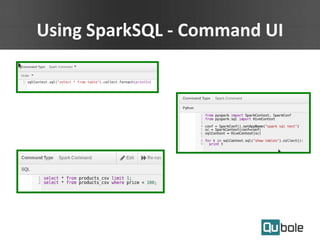
Using SparkSQL - Command UI
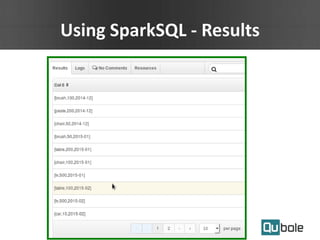
Using SparkSQL - Results
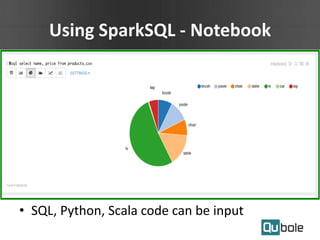
Using SparkSQL - Notebook
• SQL, Python, Scala code can be input
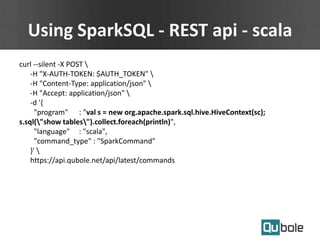
Using SparkSQL - REST api - scala
curl --silent -X POST 
-H "X-AUTH-TOKEN: $AUTH_TOKEN" 
-H "Content-Type: application/json" 
-H "Accept: application/json" 
-d '{
"program" : "val s = new org.apache.spark.sql.hive.HiveContext(sc);
s.sql("show tables").collect.foreach(println)",
"language" : "scala",
"command_type" : "SparkCommand"
}' 
https://api.qubole.net/api/latest/commands
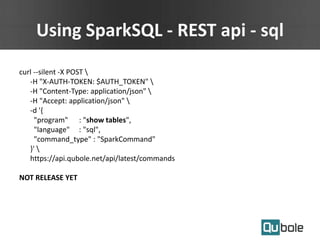
Using SparkSQL - REST api - sql
curl --silent -X POST 
-H "X-AUTH-TOKEN: $AUTH_TOKEN" 
-H "Content-Type: application/json" 
-H "Accept: application/json" 
-d '{
"program" : "show tables",
"language" : "sql",
"command_type" : "SparkCommand"
}' 
https://api.qubole.net/api/latest/commands
NOT RELEASE YET
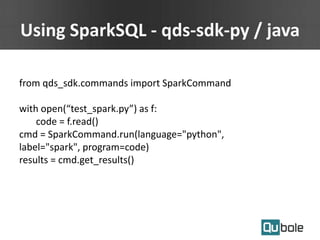
Using SparkSQL - qds-sdk-py / java
from qds_sdk.commands import SparkCommand
with open(“test_spark.py”) as f:
code = f.read()
cmd = SparkCommand.run(language="python",
label="spark", program=code)
results = cmd.get_results()
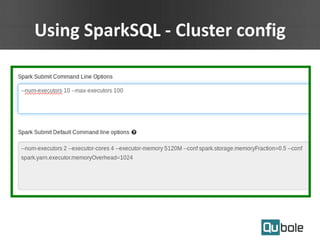
Using SparkSQL - Cluster config
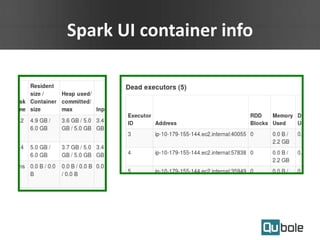
Spark UI container info
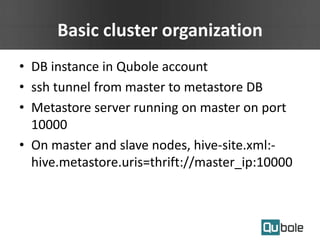
Basic cluster organization
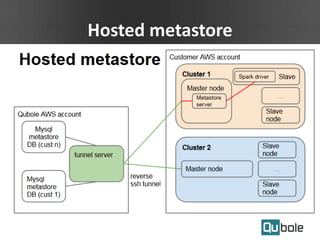
• DB instance in Qubole account
• ssh tunnel from master to metastore DB
• Metastore server running on master on port
10000
• On master and slave nodes, hive-site.xml:-
hive.metastore.uris=thrift://master_ip:10000
Hosted metastore
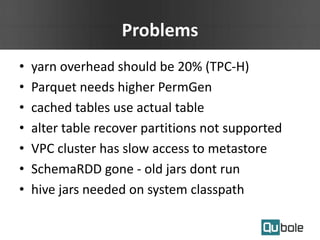
Problems
• yarn overhead should be 20% (TPC-H)
• Parquet needs higher PermGen
• cached tables use actual table
• alter table recover partitions not supported
• VPC cluster has slow access to metastore
• SchemaRDD gone - old jars dont run
• hive jars needed on system classpath
Future/Near future
• Run with Qubole’s hive codebase
• Metastore caching
• Benchmarking
Future/Near future
• Persistent History Server
• Fast access to spark AM running in customer
cluster
Thank You

Building Spark as Service in Cloud

  • 1.
    Spark as Servicein cloud on Yarn Hadoop Meetup bharatb@qubole.com, rgupta@qubole.com May 15, 2015
  • 2.
    Agenda • Spark onYarn • Autoscaling Spark Apps and Cluster management • Hive Integration with Spark • Persistent History Server
  • 3.
  • 4.
  • 5.
    Disadvantages of hadoop1 •Limited to only MR • Separate Map and Reduce slots => underutilization • JT is heavily loaded for job scheduling, monitoring and resource allocation.
  • 6.
  • 7.
    Advantages of Sparkon Yarn • General cluster for running multiple workflows. AM can have custom logic for scheduling • AM can ask for more containers when required and give up containers when free • This become even better when yarn clusters can autoscale • Get features like spot nodes etc which brings additional challenges
  • 8.
    Advantages of Sparkon Yarn • Qubole Yarn clusters can upscale and downscale based on load and support spot instances.
  • 9.
  • 10.
    Spark Provisioning: Problems •Spark Application starts with fixed number of resources and hold on to them till its alive • Sometimes its difficult to estimate resources required by a job since AM is long running • It becomes limiting spl when Yarn clusters can autoscale.
  • 11.
    Dynamic Provisioning • Speedup spark commands by using free resources in yarn cluster and also by releasing resources when free to RM.
  • 12.
    Spark on Yarnbasics Driver AM Executor-1 Executor-n • Cluster Mode: Driver and AM run in same JVM in a yarn Executor • Client Mode: Driver and AM run in separate JVM • Driver and AM talk using Actors to handle both cases Driver AM Executor-1 Executor-n
  • 13.
    Dynamic Provisioning: Problem Statement •Two parts: – Spark AM has no way to ask for additional containers and give up free containers – Automating the process of requesting containers and releasing containers. Cached data in containers make this difficult
  • 14.
  • 15.
    Dynamic Provisioning: Part1 •Implementation of 2 new apis: // Request 5 extra executors sc.requestExecutors(5) // Kill executors with IDs 1, 15, and 16 sc.killExecutors(Seq("1", "15", "16"))
  • 16.
    requestExecutors AM Reporter Thread E1 E2En • AM has reporter thread that has count of number of executors • Reporter thread was used to restart died executors • Driver increments count of number of executors when sc.requestExecutors is called. Driver
  • 17.
    removeExecutors • To killexecutors, one must precisely tell which executors need to be killed • Driver maintains list of all executors and can be obtained by: sc.executorStorageStatuses.foreach(x => println(x.blockManagerId.executorId)) • Whats cached in each executor is also available using: sc.executorStorageStatuses.foreach(x => println(s”memUsed = ${x.memUsed} diskUsed=${x.diskUsed)”))
  • 18.
    Removing Executors Tradeoffs •BlockManager in each executor can have cached RDDs, shuffle and broadcast data • Killing an executor with shuffle data will require the stage to rerun. • To avoid this use external shuffle service introduced in spark-1.2
  • 19.
  • 20.
    Upscaling Heuristics • RequestExecutors as many pending tasks • Request Executors in rounds if there are pending tasks, doubling number of executors added in each round bounded by some upper limit • Request executors by estimating workload • Introduced –max-executors as extra param
  • 21.
    Downscaling Heuristics • RemoveExecutors when they are idle • Remove Executors if then are idle for X secs • Cant downscale executors with shuffle data or broadcast data. • --num-executors act as minimum executors
  • 22.
    Scope • Kill executorson spot nodes first • Flag for not killing up executors if they have shuffle data
  • 23.
    Where is thecode? • https://github.com/apache/spark/pull/2840 • https://github.com/apache/spark/pull/2746
  • 24.
  • 25.
    What is involved? •Spark programs should be able to access hive metastore • Other Qubole services can be producers or consumers of data and metadata(hive, presto, pig etc)
  • 26.
    Using SparkSQL -Command UI
  • 27.
  • 28.
    Using SparkSQL -Notebook • SQL, Python, Scala code can be input
  • 29.
    Using SparkSQL -REST api - scala curl --silent -X POST -H "X-AUTH-TOKEN: $AUTH_TOKEN" -H "Content-Type: application/json" -H "Accept: application/json" -d '{ "program" : "val s = new org.apache.spark.sql.hive.HiveContext(sc); s.sql("show tables").collect.foreach(println)", "language" : "scala", "command_type" : "SparkCommand" }' https://api.qubole.net/api/latest/commands
  • 30.
    Using SparkSQL -REST api - sql curl --silent -X POST -H "X-AUTH-TOKEN: $AUTH_TOKEN" -H "Content-Type: application/json" -H "Accept: application/json" -d '{ "program" : "show tables", "language" : "sql", "command_type" : "SparkCommand" }' https://api.qubole.net/api/latest/commands NOT RELEASE YET
  • 31.
    Using SparkSQL -qds-sdk-py / java from qds_sdk.commands import SparkCommand with open(“test_spark.py”) as f: code = f.read() cmd = SparkCommand.run(language="python", label="spark", program=code) results = cmd.get_results()
  • 32.
    Using SparkSQL -Cluster config
  • 33.
  • 34.
    Basic cluster organization •DB instance in Qubole account • ssh tunnel from master to metastore DB • Metastore server running on master on port 10000 • On master and slave nodes, hive-site.xml:- hive.metastore.uris=thrift://master_ip:10000
  • 35.
  • 36.
    Problems • yarn overheadshould be 20% (TPC-H) • Parquet needs higher PermGen • cached tables use actual table • alter table recover partitions not supported • VPC cluster has slow access to metastore • SchemaRDD gone - old jars dont run • hive jars needed on system classpath
  • 37.
    Future/Near future • Runwith Qubole’s hive codebase • Metastore caching • Benchmarking
  • 38.
    Future/Near future • PersistentHistory Server • Fast access to spark AM running in customer cluster
  • 39.

Editor's Notes

  • #2 Intro- self, Qubole. In this video, we will see how users setup a Qubole Cluster in 3 simple steps.. Those 3 steps are…
  • #4 Intro- self, Qubole. In this video, we will see how users setup a Qubole Cluster in 3 simple steps.. Those 3 steps are…
  • #10 Intro- self, Qubole. In this video, we will see how users setup a Qubole Cluster in 3 simple steps.. Those 3 steps are…
  • #15 Intro- self, Qubole. In this video, we will see how users setup a Qubole Cluster in 3 simple steps.. Those 3 steps are…
  • #20 Intro- self, Qubole. In this video, we will see how users setup a Qubole Cluster in 3 simple steps.. Those 3 steps are…
  • #25 Intro- self, Qubole. In this video, we will see how users setup a Qubole Cluster in 3 simple steps.. Those 3 steps are…
  • #40 Intro- self, Qubole. In this video, we will see how users setup a Qubole Cluster in 3 simple steps.. Those 3 steps are…