Building Models of Social Processes 
From the Ground Up: 
Two Case Studies 
Jane F. Gilgun, PhD, LICSW 
Professor, School of Social Work 
University of Minnesota, Twin Cities, USA
Topics 
• Theories 
•Models 
• Top Down Models 
• Ground Up Models 
• Social Work Specific Models
Theories 
• A statement of relationships between 
two or more concepts
Theories 
• A statement of relationships between 
two or more concepts 
• Transportable from situation to 
situation
Theories 
• A statement of relationships between 
two or more concepts 
• Transportable from situation to 
situation 
• In practice, we test them for fit in new 
situations
Uses of Theories 
• Helps us see what we might not have seen 
otherwise 
• Guidance in research 
• Sensitizing concepts 
• May prevent us from seeing other aspects of 
phenomena 
• Importance of looking for “negative” cases
Uses of Theories 
• Helps us see what we might not have seen 
otherwise 
• Guidance in research 
• Sensitizing concepts 
• Develop them 
• Refine and/or Refute them 
• To come up with those that fit phenomena as we 
interpret them
Models 
• Statement of relationships of how things work 
• Composed or concepts
Models 
• Statement of relationships of how things work 
• Composed of concepts 
• Typically account for processes 
• Helps us see what we might not otherwise see
Models 
• Statement of relationships of how things work 
• Composed or concepts 
• Typically account for processes 
• Helps us see what we might not otherwise see 
• Test them for fit 
• Modify them when “evidence” (our 
constructions and interpretations) supports the 
change
Intervention Research 
• Ideal way to build models of practice 
• Deductive and inductive 
• Continual evaluation—formative 
• Purpose to create a more workable model 
• Adaptable to persons and situations 
• Requires the use of 
• The four cornerstones of evidence-based practice 
• Common factors model
Examples of Theories 
• Emotional expressiveness is the single most 
important factor that differentiates persons with 
risks for violence and who do not become violent 
from persons with risk for violence and who 
become violent. 
• Beliefs account for why persons become violent 
independent of their risk profiles.
Examples of Models 
• Factors associated with good outcomes 
when children have experienced complex 
trauma 
• Intervention with perpetrators of 
interpersonal violence
Factors 
• Definition of Good Outcomes 
• Definition of Complex Trauma 
• Factors 
• Therapeutic alliance 
• Parents’ actions 
• Motivations 
• Resources 
• External factors
Interventions 
with Perpetrators 
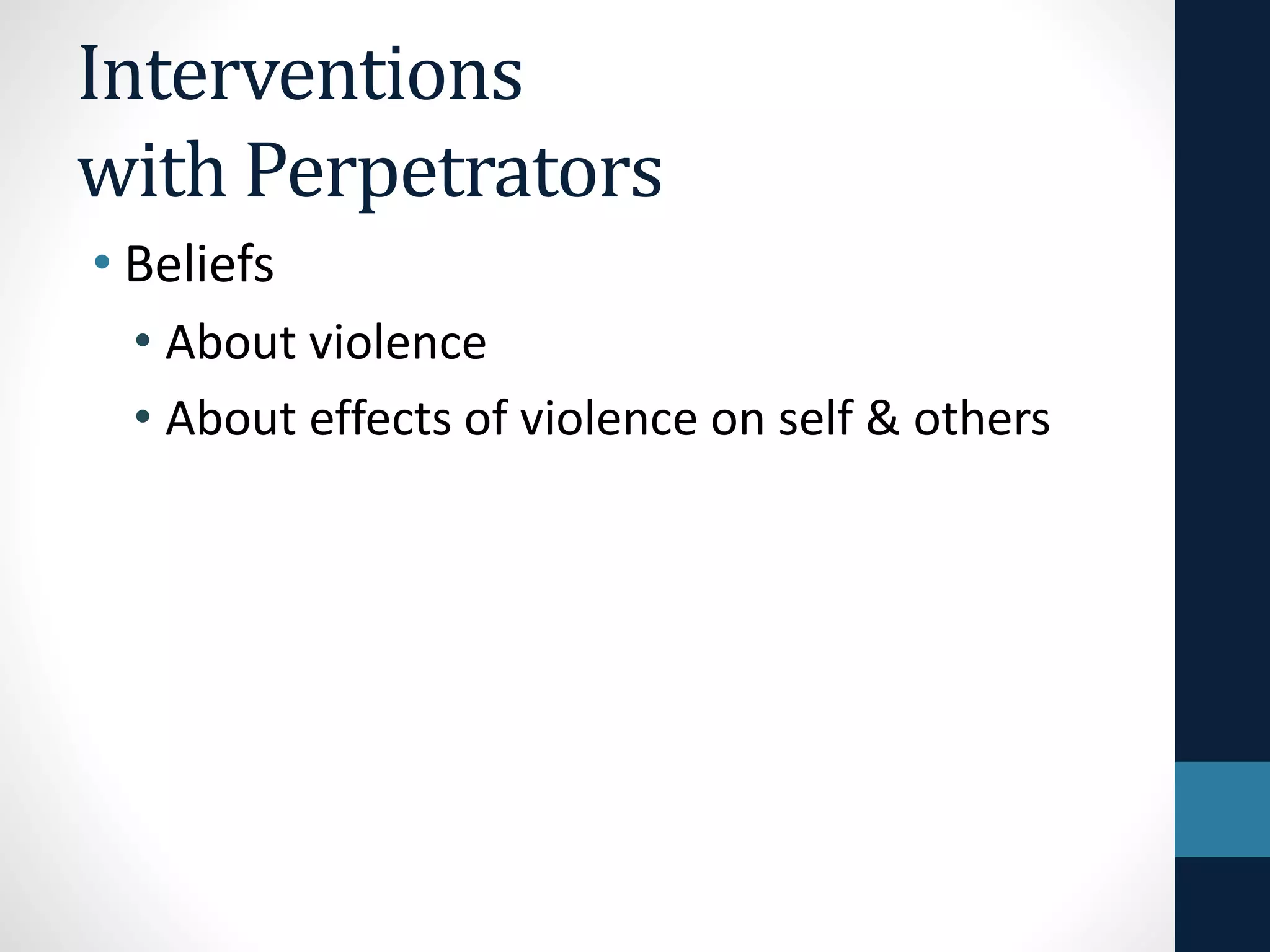
• Beliefs 
• About violence 
• About effects of violence on self & others
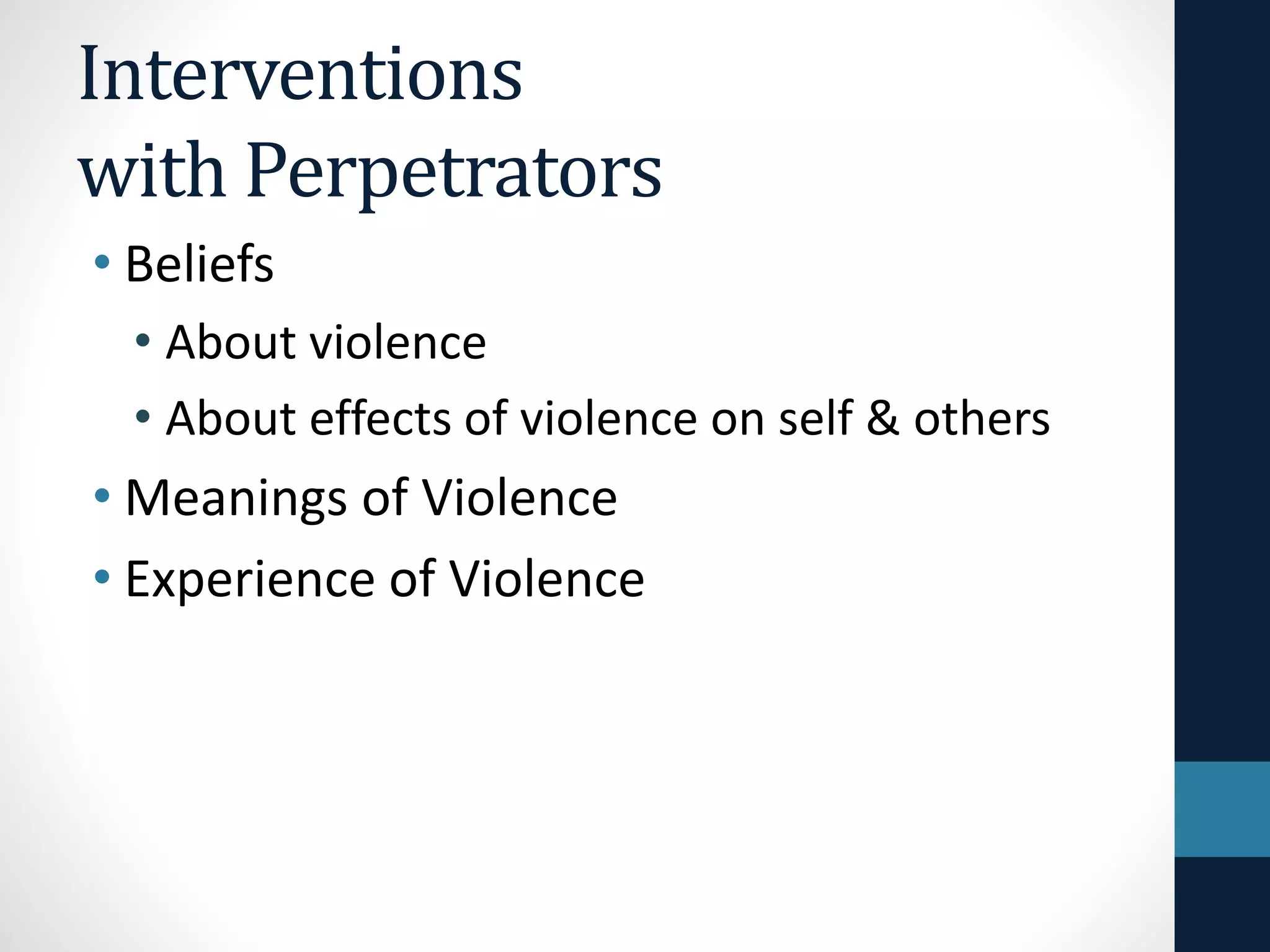
Interventions 
with Perpetrators 
• Beliefs 
• About violence 
• About effects of violence on self & others 
• Meanings of Violence 
• Experience of Violence
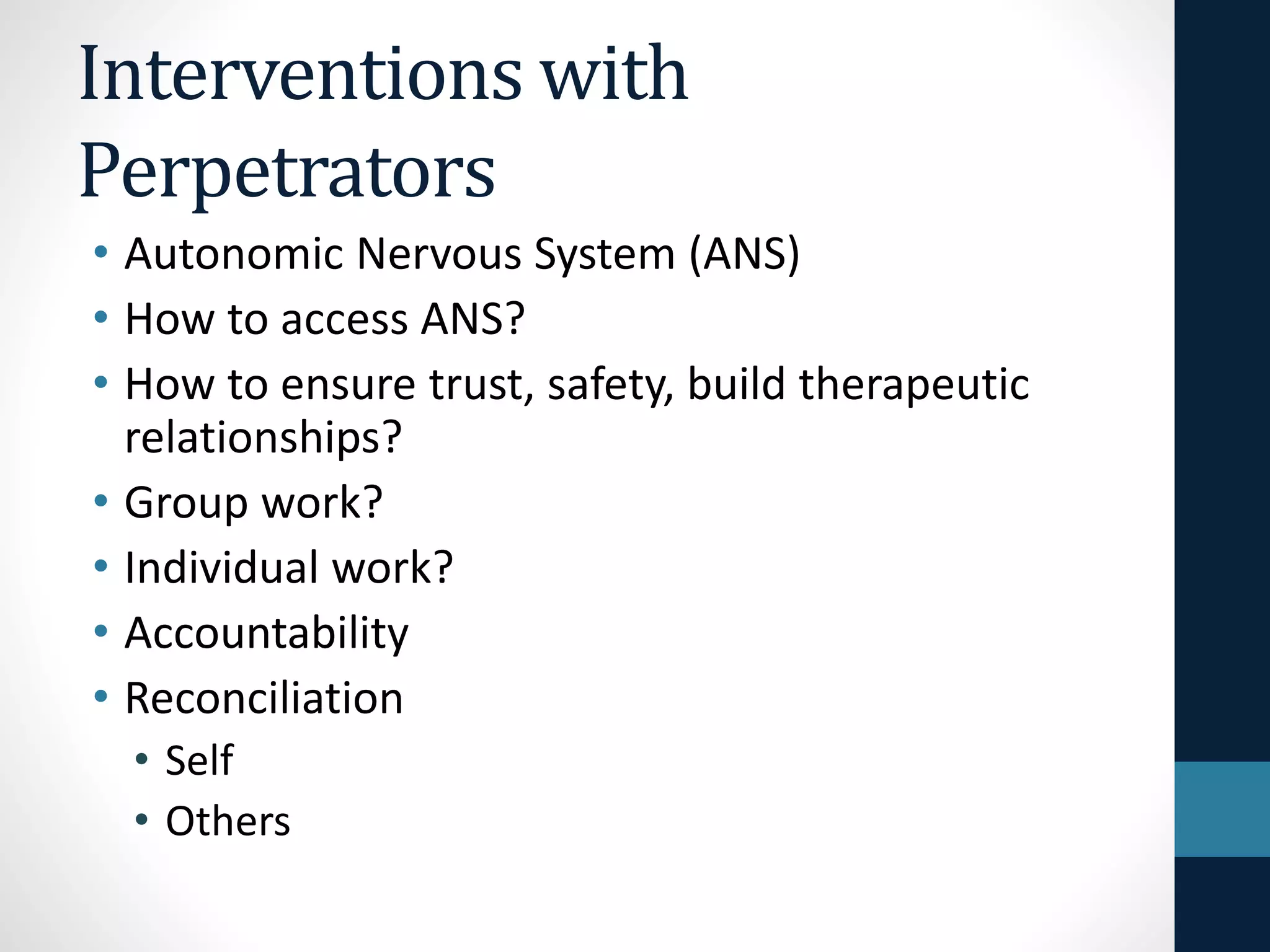
Interventions with 
Perpetrators 
• Autonomic Nervous System (ANS) 
• How to access ANS? 
• How to ensure trust, safety, build therapeutic 
relationships? 
• Group work? 
• Individual work? 
• Accountability 
• Reconciliation 
• Self 
• Others
Two Types of Model Building 
•Top Down 
•Bottom Up
Top Down 
• “Deductive” 
• Examples of Types 
• Logic Models 
• Theories of Change
Top Down 
• “Deductive” 
• Examples of Types 
• Logic Models 
• Theories of Change 
• Many Possible Variations Re 
• Philosophies of science 
• Participants
Top Down 
• “Deductive” 
• Examples of Types 
• Logic Models 
• Theories of Change 
• Many Possible Variations Re 
• Philosophies of science 
• Participants 
• Typically 
• Outsider perspectives 
• Executives & Supervisors
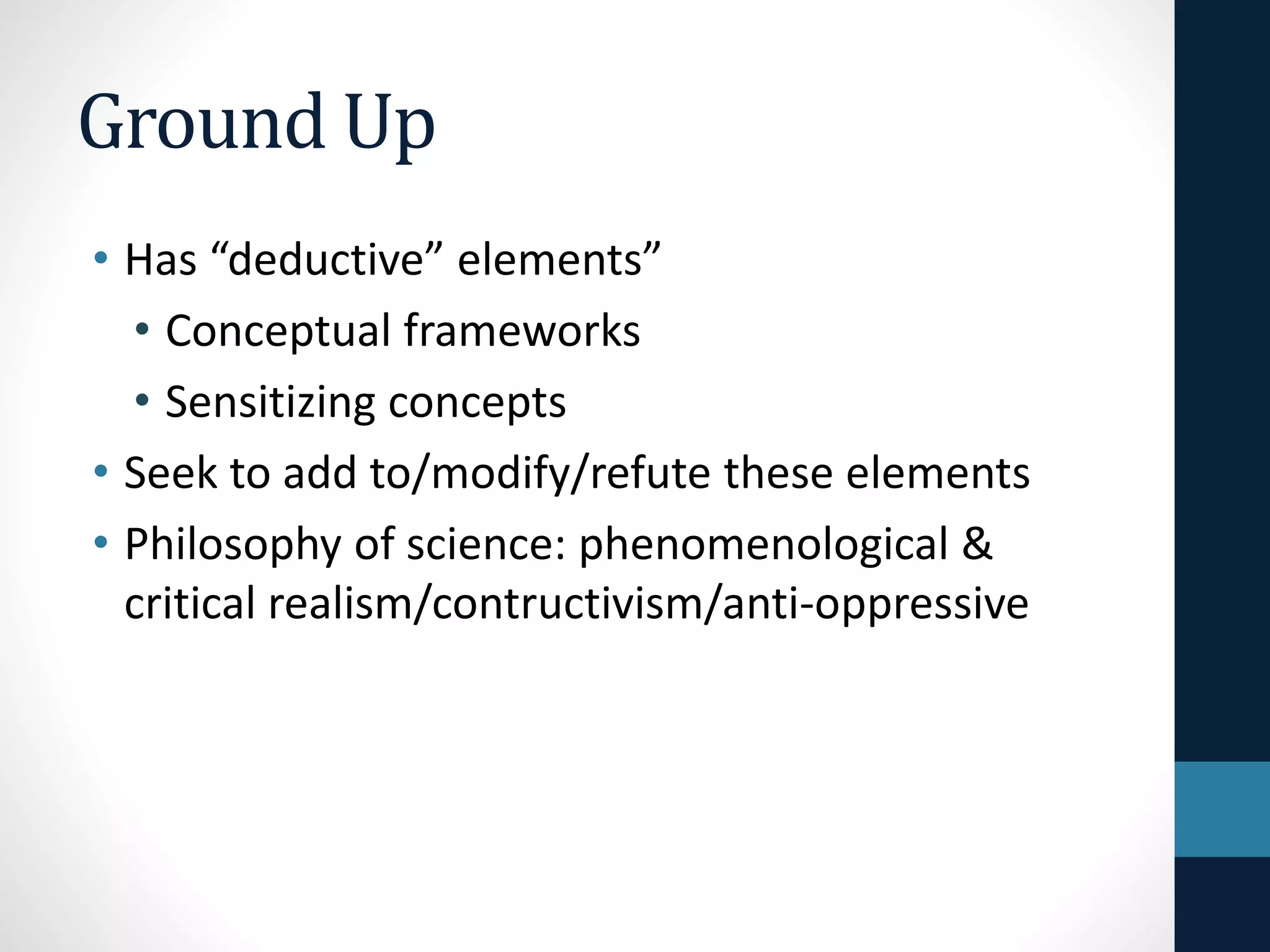
Ground Up 
• Has “deductive” elements” 
• Conceptual frameworks 
• Sensitizing concepts
Ground Up 
• Has “deductive” elements” 
• Conceptual frameworks 
• Sensitizing concepts 
• Seek to add to/modify/refute these elements 
• Philosophy of science: phenomenological & 
critical realism/contructivism/anti-oppressive
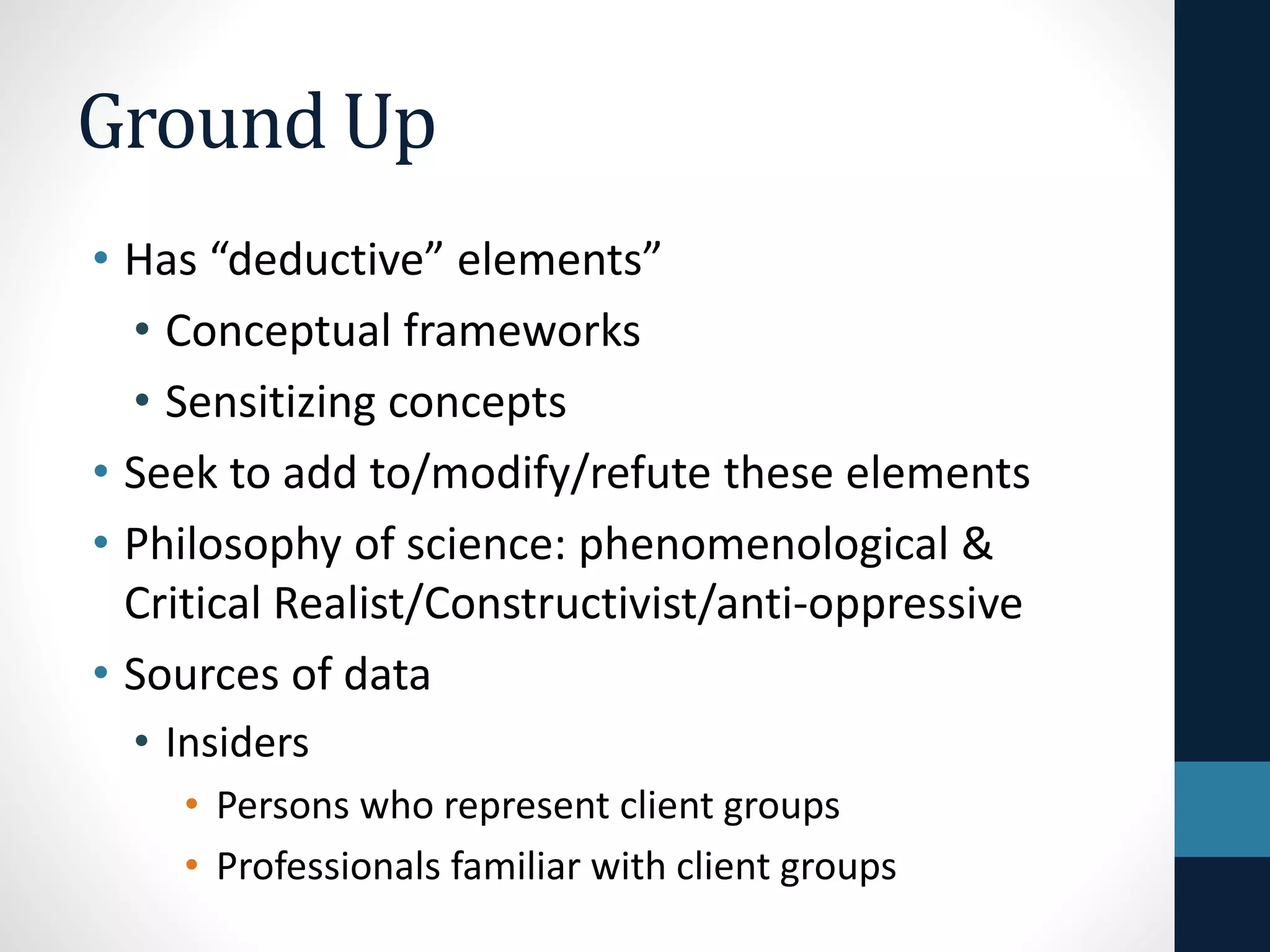
Ground Up 
• Has “deductive” elements” 
• Conceptual frameworks 
• Sensitizing concepts 
• Seek to add to/modify/refute these elements 
• Philosophy of science: phenomenological & 
Critical Realist/Constructivist/anti-oppressive 
• Sources of data 
• Insiders 
• Persons who represent client groups 
• Professionals familiar with client groups
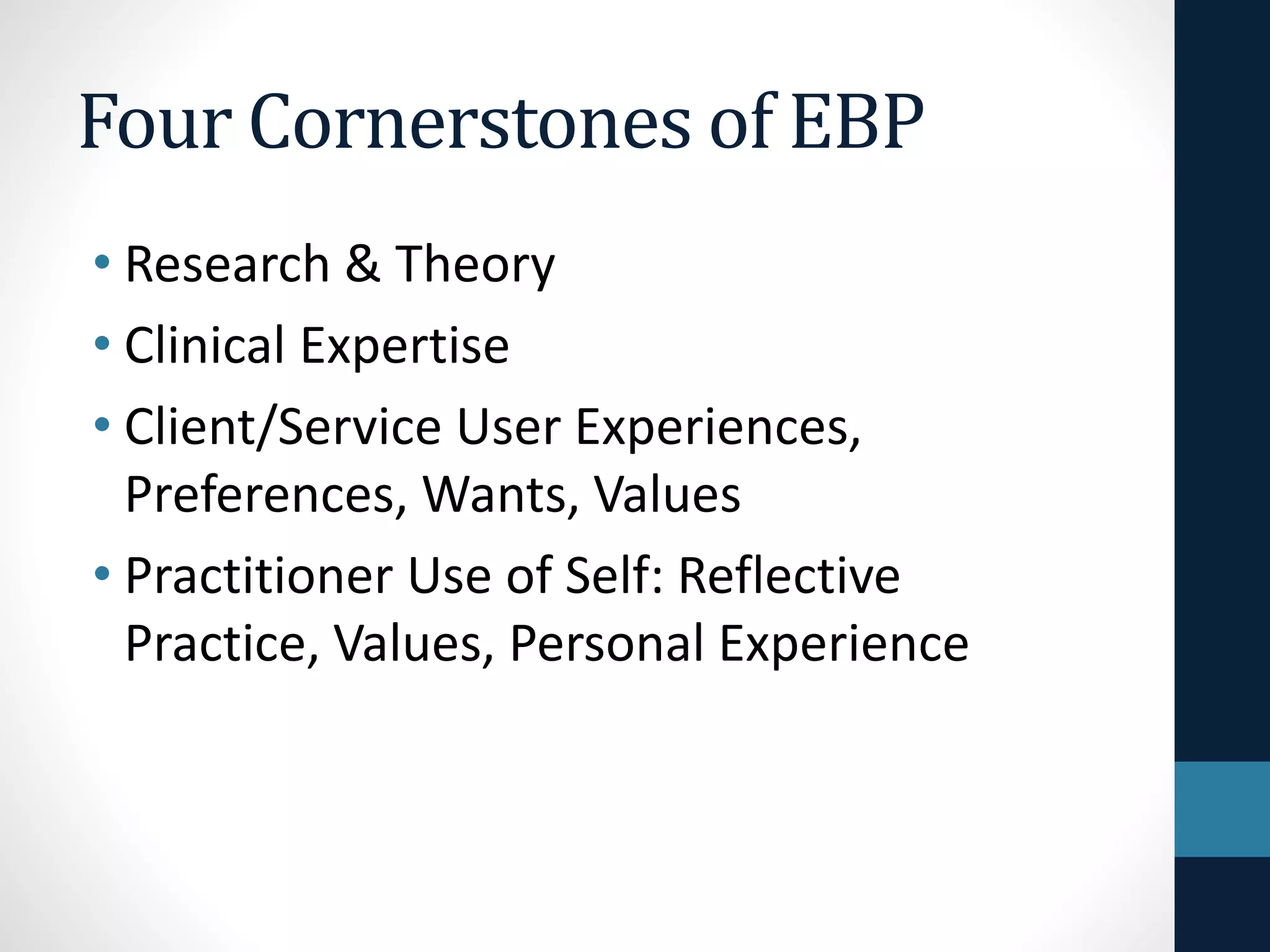
Four Cornerstones of EBP 
• Research & Theory 
• Clinical Expertise 
• Client/Service User Experiences, 
Preferences, Wants, Values 
• Practitioner Use of Self: Reflective 
Practice, Values, Personal Experience
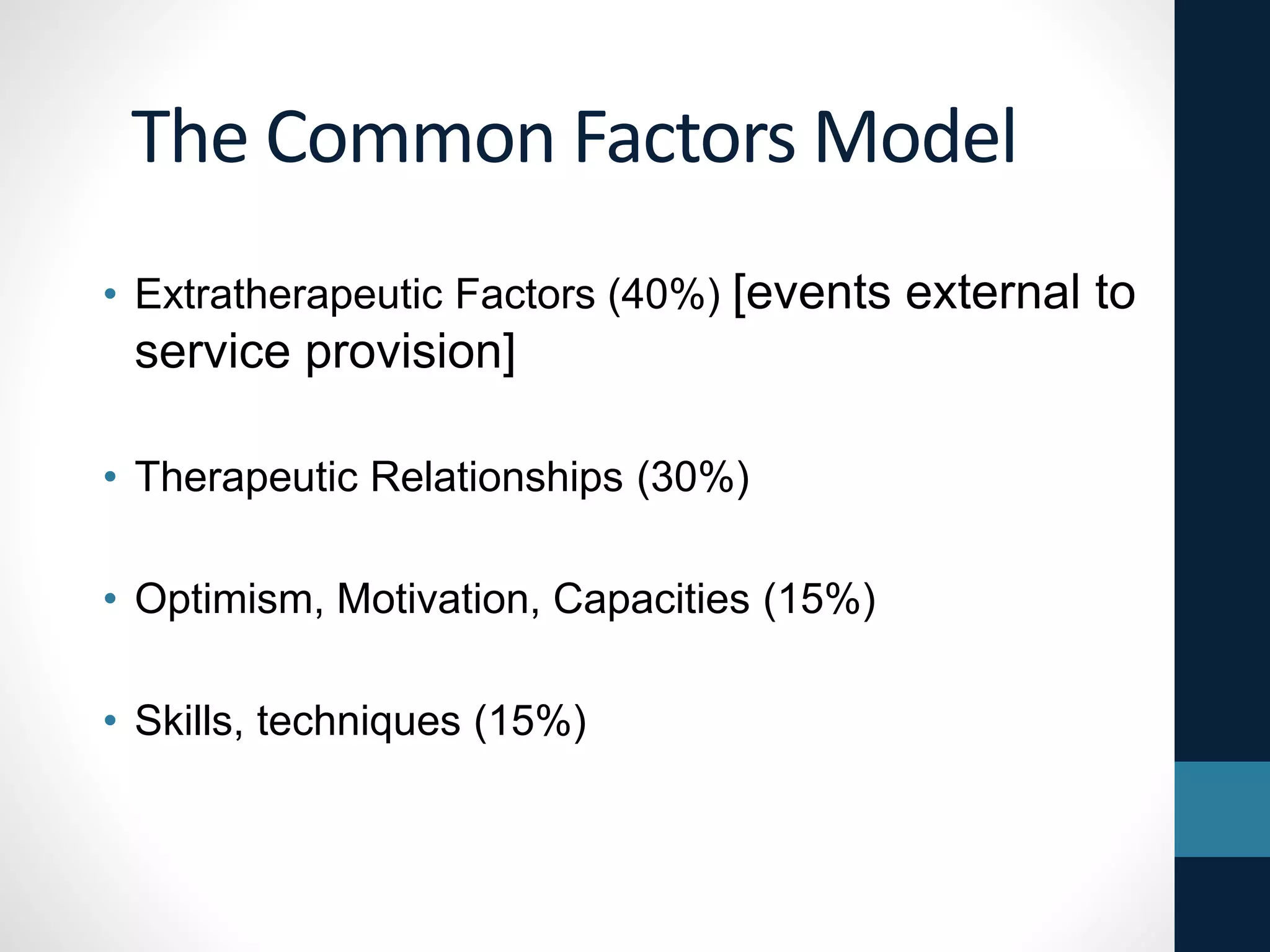
The Common Factors Model 
• Extratherapeutic Factors (40%) [events external to 
service provision] 
• Therapeutic Relationships (30%) 
• Optimism, Motivation, Capacities (15%) 
• Skills, techniques (15%)
Motivation 
& Expectancies 
15% 
Therapeutic 
Extratherapeutic 
Effects 40% 
Technique 
15%
Social Work Specific Models 
• Questions are participant-defined 
• Perspectives of participants 
• Researchers seek to understand 
multiple perspectives within 
person-environment interactions 
• Emancipatory
Social Work Specific Models 
• Based upon researcher immersion into 
social settings 
• Explicit about ethics and values such as 
anti-oppressive practice and social justice 
• Clarity about the links between general 
statements about findings and the data on 
which these are based
Discussion 
• What do you think? 
• Social Work Specific? 
• The Undefined Alternative 
• Post-Positivistic 
• A definition of science that excludes the scientific 
method? 
• Non-reflective? 
• Non-experiential 
• Lack of transparency about values?
References 
Benner, P. (Ed.) (1994). Interpretive phenomenology. Thousand Oaks, 
CA: Sage. 
Blow, Adrian J., Douglas Sprenkle, & Sean D. Davis (2007). Is who 
delivers the treatment more important than the treatment itself? The 
role of the therapist in common factors. Journal of Marital & Family 
Therapy, 333(3), 298-317. 
Blumer, H. (1986). What is wrong with social theory? In Herbert 
Blumer (1986), Symbolic interactionism. (pp. 140-152) Berkeley: 
University of California Press. 
John S. Brekke (2012). Shaping a science of social work. Research on 
Social Work Practice, 22(5) 455-464 
Bryant, A., and Charmaz, K. (2007) (Eds). Sage handbook of grounded 
theory (pp. 1-28). Thousand Oaks, CA: Sage. 
Bulmer, M. (1984). The Chicago School of Sociology. Chicago: 
University of Chicago Press. 
Charmaz, K. (2006). Constructing grounded theory: A practical guide 
through qualitative analysis. Thousand Oaks, CA: Sage.
Corbin, J. and Straus, A. (2008). Basics of qualitative 
research (3rd ed.). Thousand Oaks, CA: Sage. 
Cressey, D. (1953). Other people's money. Belmont, CA: 
Wadsworth. 
D’Cruz, H.,Gillingham, P. and Melendez, S. (2007). 
Reflexivity, its meanings and relevance for social work: A 
critical review of the literature. British Journal of Social 
Work, 37(1), 73-90. 
Denzin, N.K. (1997). Coffee with Anselm. Qualitative Family 
Research, 11(1&2), 1-4. 
http://www.scribd.com/doc/27352636/Coffee-with- 
Anselm Downloaded 4 February 2014. 
Denzin, Norman K. (2010). Grounded and indigenous 
theories and the politics of pragmatism. Sociological 
Inquiry, 80(2), 286-312.
Deegan, M.J. (1990). Jane Addams and the men of the Chicago School 
of Sociology, 1892-1918. New Brunswick: Transaction. 
Dewey, J. (1910). How we think. Amherst, NY: Prometheus. 
Dominelli, L. (1996). Deprofessionalizing social work: Anti-oppressive 
practice, competencies and postmodernism. British Journal of Social 
Work, 26, 153-175. 
Forte, J.A. (2004). Symbolic interactionism and social work: A forgotten 
legacy. Part 2. Families in Society, 85(4), 421-530. 
Frazier, E. F. (1932). The Negro family in Chicago. Chicago: University of 
Chicago Press. 
Gilgun, J. F. (1995). We shared something special: The moral discourse 
of incest perpetrators. Journal of Marriage and the Family, 57, 265- 
281. 
Gilgun, J. F. (2005a). Qualitative research and family psychology. 
Journal of Family Psychology,19(1), 40-50. 
Gilgun, J. F. (2005b). The four cornerstones of evidence-based practice 
in social work. Research on Social Work Practice, 15(1), 52-61. 
Gilgun, J. F. (2008). Lived experience, reflexivity, and research on 
perpetrators of interpersonal violence. Qualitative Social Work, 7(2), 
181-197.
Gilgun, J. F. (2012a). Enduring themes in qualitative family research. 
Journal of Family Theory and Review, 4, 80-95. 
Gilgun, J. F. (2012b) Hand into glove: Grounded theory, deductive 
qualitative analysis and social work research and practice. In Anne E. 
Fortune, William Reid, & Robert Miller (Eds.). Qualitative Methods in Social 
Work (2nd ed.) (pp. 107-134New York: Columbia University Press. 
Gilgun, Jane F. (2014). Writing up qualitative research. In Patricia Leavy 
(Ed.). The Oxford handbook of qualitative research methods (pp. 658-676). 
New York: Oxford University Press. 
Gilgun, Jane F. (2014). The legacy of the Chicago School: Deductive 
qualitative analysis and Social work research. Amazon. 
Gilgun, Jane F. & Roberta G. Sands (2012). The contributions of qualitative 
approaches to developmental intervention research. Qualitative Social 
Work. 11(4) ,349-361. 
Gilgun, J. F., Klein, C., & Pranis, K. (2000). The significance of 
resources in models of risk. Journal of Interpersonal Violence, 
14, 627–646. 
Glaser, B. (1978). Theoretical sensitivity. Mill Valley, CA: Sociology Press. 
Glaser, B., & Strauss, A.L. (1967). The discovery of grounded theory. New 
York: Aldine 
Houston, S. (2001). Beyond social constructionism: Critical realism and 
social work. British Journal of Social Work, 31, 841-861.
Lambert, M. (1992). Implications of outcome research for psychotherapy 
integration. In J. Norcross & J. Goldstein (Eds.), Handbook of 
psychotherapy integration (pp. 94-129) NY: Basic. 
Lindesmith, A. R. (l947). Opiate addiction. Bloomington, IN: Principia. 
Longhofer, J., and Floersch, J. (2012). The coming crisis in social work: 
Some thoughts on social work and science. Research on Social Work 
Practice, 22(5), 499-519. 
Maxell, Joseph A. (2004). Using qualitative methods for causal 
explanation. Field Methods (16), 243-264, 
Olesen, V., Droes, N., Hatton, D., Chico, N. and Schatzman, L. (1994). 
In A. Bryman and R. G. Burgess (Eds.) Analyzing qualitative data (pp. 
111-128). London: Routledge. 
Oliver, C. (2012). Critical realist grounded theory: A new approach for 
social work research. British Journal of Social Work, 42, 371-387. 
Patton, Michael Q. (2011). Developmental evaluation. New York: 
Guilford. 
Popper, K. R. (1969). Conjectures and refutations: The growth of 
scientific knowledge. London: Routledge and Kegan Paul. 
Rothman, Jack & & Edwin J. Thomas (Eds.). Intervention research: Design and 
development for Human services. New York: Haworth. 
Strauss, A. L. (1987). Qualitative analysis for social scientists. New York: 
Cambridge University Press.
Strauss, Anselm (1992). A personal history of grounded 
theory. Qualitative Family Research, 5 (2), 1-2. 
http://www.scribd.com/doc/44659994/Anselm-Strauss- 
Writes-A-Personal-History-of-Grounded-Theory-Other- 
Articles. Downloaded 4 February 2014. 
Strier, R. (2007). Anti-oppressive research in social work: A 
preliminary definition. British Journal of Social Work, 37(5), 
857-871. 
Thomas, W. I., and Znaniecki, F. (1918-1920/1927). The 
Polish peasant in Europe and America, Vol. 1-2. New York: 
Knopf. First published in 1918-1920. 
Thyer, Bruce (2001). What is the role of theory in research 
on social work practice? Journal of Social Work Education, 
37(1), 9-25. 
Webb, S., and Webb, B. (1932). Methods of social study. 
Longman, Greens. 
Znaniecki, F. (l934). The method of sociology. New York: 
Farrar and Rinehart.

Building Models of Social Processes from the Ground Up: Two Case Studies

  • 1.
    Building Models ofSocial Processes From the Ground Up: Two Case Studies Jane F. Gilgun, PhD, LICSW Professor, School of Social Work University of Minnesota, Twin Cities, USA
  • 2.
    Topics • Theories •Models • Top Down Models • Ground Up Models • Social Work Specific Models
  • 3.
    Theories • Astatement of relationships between two or more concepts
  • 4.
    Theories • Astatement of relationships between two or more concepts • Transportable from situation to situation
  • 5.
    Theories • Astatement of relationships between two or more concepts • Transportable from situation to situation • In practice, we test them for fit in new situations
  • 6.
    Uses of Theories • Helps us see what we might not have seen otherwise • Guidance in research • Sensitizing concepts • May prevent us from seeing other aspects of phenomena • Importance of looking for “negative” cases
  • 7.
    Uses of Theories • Helps us see what we might not have seen otherwise • Guidance in research • Sensitizing concepts • Develop them • Refine and/or Refute them • To come up with those that fit phenomena as we interpret them
  • 8.
    Models • Statementof relationships of how things work • Composed or concepts
  • 9.
    Models • Statementof relationships of how things work • Composed of concepts • Typically account for processes • Helps us see what we might not otherwise see
  • 10.
    Models • Statementof relationships of how things work • Composed or concepts • Typically account for processes • Helps us see what we might not otherwise see • Test them for fit • Modify them when “evidence” (our constructions and interpretations) supports the change
  • 11.
    Intervention Research •Ideal way to build models of practice • Deductive and inductive • Continual evaluation—formative • Purpose to create a more workable model • Adaptable to persons and situations • Requires the use of • The four cornerstones of evidence-based practice • Common factors model
  • 12.
    Examples of Theories • Emotional expressiveness is the single most important factor that differentiates persons with risks for violence and who do not become violent from persons with risk for violence and who become violent. • Beliefs account for why persons become violent independent of their risk profiles.
  • 13.
    Examples of Models • Factors associated with good outcomes when children have experienced complex trauma • Intervention with perpetrators of interpersonal violence
  • 14.
    Factors • Definitionof Good Outcomes • Definition of Complex Trauma • Factors • Therapeutic alliance • Parents’ actions • Motivations • Resources • External factors
  • 15.
    Interventions with Perpetrators • Beliefs • About violence • About effects of violence on self & others
  • 16.
    Interventions with Perpetrators • Beliefs • About violence • About effects of violence on self & others • Meanings of Violence • Experience of Violence
  • 17.
    Interventions with Perpetrators • Autonomic Nervous System (ANS) • How to access ANS? • How to ensure trust, safety, build therapeutic relationships? • Group work? • Individual work? • Accountability • Reconciliation • Self • Others
  • 18.
    Two Types ofModel Building •Top Down •Bottom Up
  • 19.
    Top Down •“Deductive” • Examples of Types • Logic Models • Theories of Change
  • 20.
    Top Down •“Deductive” • Examples of Types • Logic Models • Theories of Change • Many Possible Variations Re • Philosophies of science • Participants
  • 21.
    Top Down •“Deductive” • Examples of Types • Logic Models • Theories of Change • Many Possible Variations Re • Philosophies of science • Participants • Typically • Outsider perspectives • Executives & Supervisors
  • 22.
    Ground Up •Has “deductive” elements” • Conceptual frameworks • Sensitizing concepts
  • 23.
    Ground Up •Has “deductive” elements” • Conceptual frameworks • Sensitizing concepts • Seek to add to/modify/refute these elements • Philosophy of science: phenomenological & critical realism/contructivism/anti-oppressive
  • 24.
    Ground Up •Has “deductive” elements” • Conceptual frameworks • Sensitizing concepts • Seek to add to/modify/refute these elements • Philosophy of science: phenomenological & Critical Realist/Constructivist/anti-oppressive • Sources of data • Insiders • Persons who represent client groups • Professionals familiar with client groups
  • 25.
    Four Cornerstones ofEBP • Research & Theory • Clinical Expertise • Client/Service User Experiences, Preferences, Wants, Values • Practitioner Use of Self: Reflective Practice, Values, Personal Experience
  • 26.
    The Common FactorsModel • Extratherapeutic Factors (40%) [events external to service provision] • Therapeutic Relationships (30%) • Optimism, Motivation, Capacities (15%) • Skills, techniques (15%)
  • 27.
    Motivation & Expectancies 15% Therapeutic Extratherapeutic Effects 40% Technique 15%
  • 28.
    Social Work SpecificModels • Questions are participant-defined • Perspectives of participants • Researchers seek to understand multiple perspectives within person-environment interactions • Emancipatory
  • 29.
    Social Work SpecificModels • Based upon researcher immersion into social settings • Explicit about ethics and values such as anti-oppressive practice and social justice • Clarity about the links between general statements about findings and the data on which these are based
  • 30.
    Discussion • Whatdo you think? • Social Work Specific? • The Undefined Alternative • Post-Positivistic • A definition of science that excludes the scientific method? • Non-reflective? • Non-experiential • Lack of transparency about values?
  • 31.
    References Benner, P.(Ed.) (1994). Interpretive phenomenology. Thousand Oaks, CA: Sage. Blow, Adrian J., Douglas Sprenkle, & Sean D. Davis (2007). Is who delivers the treatment more important than the treatment itself? The role of the therapist in common factors. Journal of Marital & Family Therapy, 333(3), 298-317. Blumer, H. (1986). What is wrong with social theory? In Herbert Blumer (1986), Symbolic interactionism. (pp. 140-152) Berkeley: University of California Press. John S. Brekke (2012). Shaping a science of social work. Research on Social Work Practice, 22(5) 455-464 Bryant, A., and Charmaz, K. (2007) (Eds). Sage handbook of grounded theory (pp. 1-28). Thousand Oaks, CA: Sage. Bulmer, M. (1984). The Chicago School of Sociology. Chicago: University of Chicago Press. Charmaz, K. (2006). Constructing grounded theory: A practical guide through qualitative analysis. Thousand Oaks, CA: Sage.
  • 32.
    Corbin, J. andStraus, A. (2008). Basics of qualitative research (3rd ed.). Thousand Oaks, CA: Sage. Cressey, D. (1953). Other people's money. Belmont, CA: Wadsworth. D’Cruz, H.,Gillingham, P. and Melendez, S. (2007). Reflexivity, its meanings and relevance for social work: A critical review of the literature. British Journal of Social Work, 37(1), 73-90. Denzin, N.K. (1997). Coffee with Anselm. Qualitative Family Research, 11(1&2), 1-4. http://www.scribd.com/doc/27352636/Coffee-with- Anselm Downloaded 4 February 2014. Denzin, Norman K. (2010). Grounded and indigenous theories and the politics of pragmatism. Sociological Inquiry, 80(2), 286-312.
  • 33.
    Deegan, M.J. (1990).Jane Addams and the men of the Chicago School of Sociology, 1892-1918. New Brunswick: Transaction. Dewey, J. (1910). How we think. Amherst, NY: Prometheus. Dominelli, L. (1996). Deprofessionalizing social work: Anti-oppressive practice, competencies and postmodernism. British Journal of Social Work, 26, 153-175. Forte, J.A. (2004). Symbolic interactionism and social work: A forgotten legacy. Part 2. Families in Society, 85(4), 421-530. Frazier, E. F. (1932). The Negro family in Chicago. Chicago: University of Chicago Press. Gilgun, J. F. (1995). We shared something special: The moral discourse of incest perpetrators. Journal of Marriage and the Family, 57, 265- 281. Gilgun, J. F. (2005a). Qualitative research and family psychology. Journal of Family Psychology,19(1), 40-50. Gilgun, J. F. (2005b). The four cornerstones of evidence-based practice in social work. Research on Social Work Practice, 15(1), 52-61. Gilgun, J. F. (2008). Lived experience, reflexivity, and research on perpetrators of interpersonal violence. Qualitative Social Work, 7(2), 181-197.
  • 34.
    Gilgun, J. F.(2012a). Enduring themes in qualitative family research. Journal of Family Theory and Review, 4, 80-95. Gilgun, J. F. (2012b) Hand into glove: Grounded theory, deductive qualitative analysis and social work research and practice. In Anne E. Fortune, William Reid, & Robert Miller (Eds.). Qualitative Methods in Social Work (2nd ed.) (pp. 107-134New York: Columbia University Press. Gilgun, Jane F. (2014). Writing up qualitative research. In Patricia Leavy (Ed.). The Oxford handbook of qualitative research methods (pp. 658-676). New York: Oxford University Press. Gilgun, Jane F. (2014). The legacy of the Chicago School: Deductive qualitative analysis and Social work research. Amazon. Gilgun, Jane F. & Roberta G. Sands (2012). The contributions of qualitative approaches to developmental intervention research. Qualitative Social Work. 11(4) ,349-361. Gilgun, J. F., Klein, C., & Pranis, K. (2000). The significance of resources in models of risk. Journal of Interpersonal Violence, 14, 627–646. Glaser, B. (1978). Theoretical sensitivity. Mill Valley, CA: Sociology Press. Glaser, B., & Strauss, A.L. (1967). The discovery of grounded theory. New York: Aldine Houston, S. (2001). Beyond social constructionism: Critical realism and social work. British Journal of Social Work, 31, 841-861.
  • 35.
    Lambert, M. (1992).Implications of outcome research for psychotherapy integration. In J. Norcross & J. Goldstein (Eds.), Handbook of psychotherapy integration (pp. 94-129) NY: Basic. Lindesmith, A. R. (l947). Opiate addiction. Bloomington, IN: Principia. Longhofer, J., and Floersch, J. (2012). The coming crisis in social work: Some thoughts on social work and science. Research on Social Work Practice, 22(5), 499-519. Maxell, Joseph A. (2004). Using qualitative methods for causal explanation. Field Methods (16), 243-264, Olesen, V., Droes, N., Hatton, D., Chico, N. and Schatzman, L. (1994). In A. Bryman and R. G. Burgess (Eds.) Analyzing qualitative data (pp. 111-128). London: Routledge. Oliver, C. (2012). Critical realist grounded theory: A new approach for social work research. British Journal of Social Work, 42, 371-387. Patton, Michael Q. (2011). Developmental evaluation. New York: Guilford. Popper, K. R. (1969). Conjectures and refutations: The growth of scientific knowledge. London: Routledge and Kegan Paul. Rothman, Jack & & Edwin J. Thomas (Eds.). Intervention research: Design and development for Human services. New York: Haworth. Strauss, A. L. (1987). Qualitative analysis for social scientists. New York: Cambridge University Press.
  • 36.
    Strauss, Anselm (1992).A personal history of grounded theory. Qualitative Family Research, 5 (2), 1-2. http://www.scribd.com/doc/44659994/Anselm-Strauss- Writes-A-Personal-History-of-Grounded-Theory-Other- Articles. Downloaded 4 February 2014. Strier, R. (2007). Anti-oppressive research in social work: A preliminary definition. British Journal of Social Work, 37(5), 857-871. Thomas, W. I., and Znaniecki, F. (1918-1920/1927). The Polish peasant in Europe and America, Vol. 1-2. New York: Knopf. First published in 1918-1920. Thyer, Bruce (2001). What is the role of theory in research on social work practice? Journal of Social Work Education, 37(1), 9-25. Webb, S., and Webb, B. (1932). Methods of social study. Longman, Greens. Znaniecki, F. (l934). The method of sociology. New York: Farrar and Rinehart.