CHAPTER 1
Introduction to
understanding social
work theory
INTRODUCTION
 This chapter introduces you to some of the key
themes discussed in this book. In particular we
will explore different definitions of social work
and see that these draw upon different
explanations about its nature and purpose.
 In turn, this leads to the view that social work is
a ‘contested activity’ based on different
knowledge sources, ideas and beliefs that we
draw upon to help us make sense and which
influence our view of what social work is and
what we think social work should do.
In other words, we begin to see
the relationship between thinking
and doing, or more specifically,
how social work theory can
influence our practice, and the
importance of
recognising the influence of these
ideas, knowledge sources and
beliefs, through critical thinking
and reflection.
BY THE END OF THE CHAPTER, YOU SHOULD BE ABLE TO
:
1) Recognise social work as a contested activity based on
different views about itsnature and purpose;
2) Understand the approach known as ‘social
constructionism’ which draws attention to the different
ideas or constructions about the nature and purpose of
social work as arising from different world views;
3) Identify what is meant by the term ‘theory’ and its
relationship to informing practice;
4) Recognise the importance of critical thinking and
reflective practice.
DEFINING SOCIAL WORK
 To begin with, let us consider definitions about
‘what social work is’ as in doing so,
this helps to reveal the range of ‘theories’ or ideas
and beliefs we draw upon to construct our view.
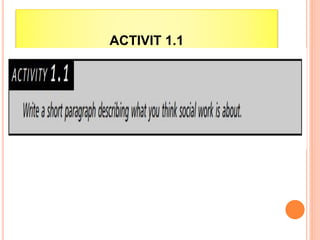
ACTIVIT 1.1
FOR THE AUTHOR'S DEFINITION
 coming up with a satisfactory definition was
surprisingly difficult! But, I would begin to define
social work as:
--A paid professional activity which involves
working with both adults and children to help them
try and resolve practical and interpersonal
difficulties in order to enable them to function and
participate more effectively.
 This can be on an individual basis or within
families, or working with groups or communities to
improve their inter-social or personal competencies
through the provision of a range of services and
interventions.
OTHER DEFINITIONS
 A professional doing a varied and worthwhile job which
focuses on improving people’s well-being . . .helping
vulnerable people to make crucial decisions to regain
control of their lives.
 They may be parents and children who are struggling in
the face of deprivation, disability or abusive behaviour;
people with mental health problems; those with physical
or learning disabilities; people with drug or alcohol
problems; people suffering from HIV/ AIDS; older people
who need support or refugees and homeless people
In contrast, an alternative definition may have
emphasized more the types of reasons
why social workers are involved in people’s
lives, such as poverty, ill health, abuse and
family breakdown or offending, for instance.
These definitions seem to hint more at
people’s social circumstances.
This second approach towards defining social
work is typified by Jones’ (2002) account,
which describes social work as:
DEINITION BY JONES’ (2002)
overwhelmingly a class-specific activity
. . . whether the client is old or young,
able-bodied or with a special need, an
offender, a single parent, an abused
child or partner, black or white, clients
are most likely to be poor and most
likely to be drawn from those sections of
the population which enjoy the least
status, security and power
 A third type of definition may have concentrated more
on the skills, tasks or interventions you associate with
social work, such as listening, advocacy, assessment,
care management or using the law.
 This is the view adopted by Trevithick (2005), who
states: that social work involves working with some of
the most complex problems and perplexing areas of
human experience and, for this reason,
 Social work is – and has to be – a highly skilled activity
. . . (these) skills and interventions can be used in
practice to enhance our effectiveness and help bring
about positive outcomes.
In highlighting skills and interventions,
this definition suggests social work is
an
applied, interactive activity that draws
upon the use of particular knowledge
sources and beliefs, and the use of
practical and interpersonal skills about
how to work effectively with people
and problem-solve.
FORMAL DEFINITIONS OF SOCIAL WORK
 We can see from the above that trying to define social
work can be problematic and points to competing views
about its role and purpose.
 Indeed in their definition, Pierson and Thomas (2002) go
on to suggest that social work is an increasingly complex
activity.
 To begin with however, they define social work as the
paid professional activity that aims to assist people in
overcoming serious difficulties in their lives by providing
care, protection or counseling or through social support,
advocacy and
community work (p448).
SOCIAL WORK AS A CONTESTED ACTIVITY
 It can be argued that the range and emphasis taken in
the different definitions outlined above demonstrate
social work to be a contested activity with competing
views about its purpose and role.
 One reason for this, as Parton (1996) argues, is that
social work provides an essentially mediating role
between the individual and society; it
occupies, alongside other welfare professions, the middle
‘space’ in between.
 Social work takes place within a variety of different
practice settings, which can
include for instance, residential homes, hospitals, young
offender teams and child protection teams.
 In addition social work utilises a range of skills and tasks
that include practical ones such as problem-solving,
administrative tasks and the use of assessment protocols
as well as more interpersonal skills such as listening and
interviewing
UNDERSTANDING THE ROLE OF THEORY TO INFORM
OURPRACTICE
 So far, I have introduced the term ‘theory’ in
inverted commas to refer to the range of
knowledge, or ideas, skills and beliefs we draw
upon to help us make sense of ‘what social work
is’, which in turn influences our view of ‘how to
do social work’.
 In this section I will introduce a definition of what
is meant by the term ‘theory’ and its central
importance in helping us inform our view of
social work. (These ideas are discussed more
fully in Chapter 2
 To begin with however, a theory can be
described as representing a set of related ideas
and assumptions that are drawn upon to help
explain a particular phenomenon.
 A theory represents therefore an explanatory
framework which attempts to help us make
sense of the phenomenon in question – in this
case, the context of social work.
 These explanations provide us with an
opportunity to hypothesize, or make a judgment,
about what we think is going on. It also provide
us with an explanation that can aid our
understanding of what the matter is.
 For instance, we may be working with a mother who is
struggling to deal with her nine-year-old son’s challenging
behaviour. The boy has been diagnosed as having
attention deficit hyperactivity disorder (ADHD).
 In attempting to work effectively with this family, we may
draw upon biological explanations to help us understand
the diagnosis of ADHD and some of its effects and how it
can be managed, e.g. drugtherapy.
 However, we may also draw upon a behavioural
explanation in working with the mother to help her deal
more effectively, through a behavioural method of
intervention, in managing her son’s behaviour.
 So, in thinking about our work with this family, we might
also draw on attachment theory, as another
psychological explanation that could help us in our work,
and which seeks to help us understand the relationship
between the mother and her son
SOCIAL CONSTRUCTIONISM
 One way of managing the ‘fluidity’ of the
idea that social work is a contested activity
is the adoption of the approach known as
social constructionism.
 This approach sees different ideas or
constructions about the nature and purpose
of social work as arising from different world
views – that is, the bigger picture about
what kind of society or community we favour
and our view about the role of the state in
welfare.
FIGURE 1.1 A SOCIAL CONSTRUCTIONIST APPROACH TOWARD
UNDERSTANDING SOCIAL WORK
 Figure 1.1 represents how social work can be viewed
from a social constructionist approach.
 The outer circle represents the role of the state in
welfare, with common examples (not a comprehensive
list) .
 The inner circle represents the role and responsibility of
social work and that questions of values and ethics are
central to its purpose.
Figure 1.1 A social constructionist approach toward understanding social
CRITICAL THINKING
 An important assumption of the social
constructionist approach is that there are
alternative ways of making meaning and hence of
knowing.
 The implication of this approach therefore is that we
should be critical of ways of knowing as there are
always competing ways of understanding and
making meaning
 Critical thinking thus refers to the process of becoming
more aware of the ideas and encompassing beliefs which
frame our understanding of social work and their
influence on our practice. As Brookfield (1987) states:
Broookfield (1987) goes onto identify four essential
components of critical thinking:
1) identifying and challenging assumptions;
2) challenging the importance of context;
3) imagining and exploring alternatives (which leads to);
4) reflective scepticism. (p7–9)
 In their book Critical thinking for social work, Brown and Rutter
(2006) acknowledge the work of Brookfield (1987) and
develop the ideas of Ford et al. (2004, 2005), identifying a
critical thinker as one encompassing a number of requisite
intellectual resources (Brown and Rutter, 2006, pp2–9).
 Background knowledge of the situation in question.
(In social work, this includes our formal knowledge of social
work and our practice experience that helps us develop a
depth of knowledge and understanding.)
 Possession of critical concepts.
(This involves an understanding of the ideas and language
associated with critical thinking and argument.)
 Knowledge of critical thinking standards.
(This involves established standards for appraisal and
evaluation of arguments, theory and research and use of
judgment.)
 Knowledge of strategies and ways to find
things out.(This involves devising strategies or
procedures which help guide our behaviour or thinking.)
 Habits of mind.
(This final point emphasizes a value position that a
critical thinker also requires certain qualities or ‘habits of
mind’ that enable these intellectual resources to be
developed.
 Given the central importance of values and ethics in
informing socialwork practice, social workers are well
placed to develop ‘habits of mind’ which
support and encourage critical thinking.)
USING REFLECTION TO INFORM PRACTICE
Critical thinking and reflective
practice have been used together
to suggest a dynamic process of
thinking about and engaging with
the ideas and beliefs which inform
and influence practice in social
work.
Indeed the two concepts support
each other,
REFLECTION
 Reflection is therefore an engaging process that
involves asking questions about our practice and
its influences, but the process should also be
proactive.
 Being reflective allows us to think critically about
the knowledge, skills and beliefs that inform our
practice and thus evaluate their impact.
 It is a way of improving our practice as well as
making us aware of ‘what worked’
 Thus critical thinking is the ability to interrogate the
ideas, beliefs and assumptions which we use in our work
and recognize alternative views, whereas reflective
practice is the process of ‘active’ engagement with those
ideas and alternative views as a means of improving our
practice.
 As social workers we are thus constantly engaged in
alternative viewpoints, or even contested views
END

CHAPTER 1 SW.pptx

  • 2.
  • 4.
    INTRODUCTION  This chapterintroduces you to some of the key themes discussed in this book. In particular we will explore different definitions of social work and see that these draw upon different explanations about its nature and purpose.  In turn, this leads to the view that social work is a ‘contested activity’ based on different knowledge sources, ideas and beliefs that we draw upon to help us make sense and which influence our view of what social work is and what we think social work should do.
  • 5.
    In other words,we begin to see the relationship between thinking and doing, or more specifically, how social work theory can influence our practice, and the importance of recognising the influence of these ideas, knowledge sources and beliefs, through critical thinking and reflection.
  • 6.
    BY THE ENDOF THE CHAPTER, YOU SHOULD BE ABLE TO : 1) Recognise social work as a contested activity based on different views about itsnature and purpose; 2) Understand the approach known as ‘social constructionism’ which draws attention to the different ideas or constructions about the nature and purpose of social work as arising from different world views; 3) Identify what is meant by the term ‘theory’ and its relationship to informing practice; 4) Recognise the importance of critical thinking and reflective practice.
  • 7.
    DEFINING SOCIAL WORK To begin with, let us consider definitions about ‘what social work is’ as in doing so, this helps to reveal the range of ‘theories’ or ideas and beliefs we draw upon to construct our view.
  • 8.
  • 9.
    FOR THE AUTHOR'SDEFINITION  coming up with a satisfactory definition was surprisingly difficult! But, I would begin to define social work as: --A paid professional activity which involves working with both adults and children to help them try and resolve practical and interpersonal difficulties in order to enable them to function and participate more effectively.  This can be on an individual basis or within families, or working with groups or communities to improve their inter-social or personal competencies through the provision of a range of services and interventions.
  • 10.
    OTHER DEFINITIONS  Aprofessional doing a varied and worthwhile job which focuses on improving people’s well-being . . .helping vulnerable people to make crucial decisions to regain control of their lives.  They may be parents and children who are struggling in the face of deprivation, disability or abusive behaviour; people with mental health problems; those with physical or learning disabilities; people with drug or alcohol problems; people suffering from HIV/ AIDS; older people who need support or refugees and homeless people
  • 11.
    In contrast, analternative definition may have emphasized more the types of reasons why social workers are involved in people’s lives, such as poverty, ill health, abuse and family breakdown or offending, for instance. These definitions seem to hint more at people’s social circumstances. This second approach towards defining social work is typified by Jones’ (2002) account, which describes social work as:
  • 12.
    DEINITION BY JONES’(2002) overwhelmingly a class-specific activity . . . whether the client is old or young, able-bodied or with a special need, an offender, a single parent, an abused child or partner, black or white, clients are most likely to be poor and most likely to be drawn from those sections of the population which enjoy the least status, security and power
  • 13.
     A thirdtype of definition may have concentrated more on the skills, tasks or interventions you associate with social work, such as listening, advocacy, assessment, care management or using the law.  This is the view adopted by Trevithick (2005), who states: that social work involves working with some of the most complex problems and perplexing areas of human experience and, for this reason,  Social work is – and has to be – a highly skilled activity . . . (these) skills and interventions can be used in practice to enhance our effectiveness and help bring about positive outcomes.
  • 14.
    In highlighting skillsand interventions, this definition suggests social work is an applied, interactive activity that draws upon the use of particular knowledge sources and beliefs, and the use of practical and interpersonal skills about how to work effectively with people and problem-solve.
  • 15.
    FORMAL DEFINITIONS OFSOCIAL WORK  We can see from the above that trying to define social work can be problematic and points to competing views about its role and purpose.  Indeed in their definition, Pierson and Thomas (2002) go on to suggest that social work is an increasingly complex activity.  To begin with however, they define social work as the paid professional activity that aims to assist people in overcoming serious difficulties in their lives by providing care, protection or counseling or through social support, advocacy and community work (p448).
  • 16.
    SOCIAL WORK ASA CONTESTED ACTIVITY  It can be argued that the range and emphasis taken in the different definitions outlined above demonstrate social work to be a contested activity with competing views about its purpose and role.  One reason for this, as Parton (1996) argues, is that social work provides an essentially mediating role between the individual and society; it occupies, alongside other welfare professions, the middle ‘space’ in between.
  • 17.
     Social worktakes place within a variety of different practice settings, which can include for instance, residential homes, hospitals, young offender teams and child protection teams.  In addition social work utilises a range of skills and tasks that include practical ones such as problem-solving, administrative tasks and the use of assessment protocols as well as more interpersonal skills such as listening and interviewing
  • 18.
    UNDERSTANDING THE ROLEOF THEORY TO INFORM OURPRACTICE  So far, I have introduced the term ‘theory’ in inverted commas to refer to the range of knowledge, or ideas, skills and beliefs we draw upon to help us make sense of ‘what social work is’, which in turn influences our view of ‘how to do social work’.  In this section I will introduce a definition of what is meant by the term ‘theory’ and its central importance in helping us inform our view of social work. (These ideas are discussed more fully in Chapter 2
  • 19.
     To beginwith however, a theory can be described as representing a set of related ideas and assumptions that are drawn upon to help explain a particular phenomenon.  A theory represents therefore an explanatory framework which attempts to help us make sense of the phenomenon in question – in this case, the context of social work.  These explanations provide us with an opportunity to hypothesize, or make a judgment, about what we think is going on. It also provide us with an explanation that can aid our understanding of what the matter is.
  • 20.
     For instance,we may be working with a mother who is struggling to deal with her nine-year-old son’s challenging behaviour. The boy has been diagnosed as having attention deficit hyperactivity disorder (ADHD).  In attempting to work effectively with this family, we may draw upon biological explanations to help us understand the diagnosis of ADHD and some of its effects and how it can be managed, e.g. drugtherapy.  However, we may also draw upon a behavioural explanation in working with the mother to help her deal more effectively, through a behavioural method of intervention, in managing her son’s behaviour.  So, in thinking about our work with this family, we might also draw on attachment theory, as another psychological explanation that could help us in our work, and which seeks to help us understand the relationship between the mother and her son
  • 21.
    SOCIAL CONSTRUCTIONISM  Oneway of managing the ‘fluidity’ of the idea that social work is a contested activity is the adoption of the approach known as social constructionism.  This approach sees different ideas or constructions about the nature and purpose of social work as arising from different world views – that is, the bigger picture about what kind of society or community we favour and our view about the role of the state in welfare.
  • 22.
    FIGURE 1.1 ASOCIAL CONSTRUCTIONIST APPROACH TOWARD UNDERSTANDING SOCIAL WORK  Figure 1.1 represents how social work can be viewed from a social constructionist approach.  The outer circle represents the role of the state in welfare, with common examples (not a comprehensive list) .  The inner circle represents the role and responsibility of social work and that questions of values and ethics are central to its purpose.
  • 23.
    Figure 1.1 Asocial constructionist approach toward understanding social
  • 24.
    CRITICAL THINKING  Animportant assumption of the social constructionist approach is that there are alternative ways of making meaning and hence of knowing.  The implication of this approach therefore is that we should be critical of ways of knowing as there are always competing ways of understanding and making meaning
  • 25.
     Critical thinkingthus refers to the process of becoming more aware of the ideas and encompassing beliefs which frame our understanding of social work and their influence on our practice. As Brookfield (1987) states: Broookfield (1987) goes onto identify four essential components of critical thinking: 1) identifying and challenging assumptions; 2) challenging the importance of context; 3) imagining and exploring alternatives (which leads to); 4) reflective scepticism. (p7–9)
  • 26.
     In theirbook Critical thinking for social work, Brown and Rutter (2006) acknowledge the work of Brookfield (1987) and develop the ideas of Ford et al. (2004, 2005), identifying a critical thinker as one encompassing a number of requisite intellectual resources (Brown and Rutter, 2006, pp2–9).  Background knowledge of the situation in question. (In social work, this includes our formal knowledge of social work and our practice experience that helps us develop a depth of knowledge and understanding.)  Possession of critical concepts. (This involves an understanding of the ideas and language associated with critical thinking and argument.)  Knowledge of critical thinking standards. (This involves established standards for appraisal and evaluation of arguments, theory and research and use of judgment.)
  • 27.
     Knowledge ofstrategies and ways to find things out.(This involves devising strategies or procedures which help guide our behaviour or thinking.)  Habits of mind. (This final point emphasizes a value position that a critical thinker also requires certain qualities or ‘habits of mind’ that enable these intellectual resources to be developed.  Given the central importance of values and ethics in informing socialwork practice, social workers are well placed to develop ‘habits of mind’ which support and encourage critical thinking.)
  • 28.
    USING REFLECTION TOINFORM PRACTICE Critical thinking and reflective practice have been used together to suggest a dynamic process of thinking about and engaging with the ideas and beliefs which inform and influence practice in social work. Indeed the two concepts support each other,
  • 29.
    REFLECTION  Reflection istherefore an engaging process that involves asking questions about our practice and its influences, but the process should also be proactive.  Being reflective allows us to think critically about the knowledge, skills and beliefs that inform our practice and thus evaluate their impact.  It is a way of improving our practice as well as making us aware of ‘what worked’
  • 30.
     Thus criticalthinking is the ability to interrogate the ideas, beliefs and assumptions which we use in our work and recognize alternative views, whereas reflective practice is the process of ‘active’ engagement with those ideas and alternative views as a means of improving our practice.  As social workers we are thus constantly engaged in alternative viewpoints, or even contested views
  • 31.