Building Effective Visualization Tools for Everyday Business:
Web Visualization Framework
1
Cyberinfrastructure for Network Science Center
Department of Intelligent Systems Engineering
School of Informatics, Computing, and Engineering
Indiana University, Bloomington, USA
October 18, 2017
Olga Scrivner
with contributions by Adam Simpson, Gagandeep Singh, Jivitesh Poojary, Sara Bouchard, and Katy Börner
2
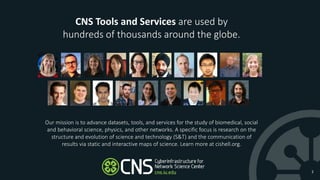
Our mission is to advance datasets, tools, and services for the study of biomedical, social
and behavioral science, physics, and other networks. A specific focus is research on the
structure and evolution of science and technology (S&T) and the communication of
results via static and interactive maps of science. Learn more at cishell.org.
CNS Tools and Services are used by
hundreds of thousands around the globe.
Visual Analytics
3
44
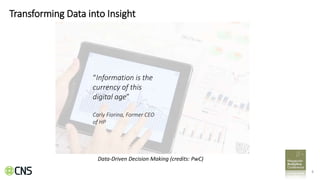
Transforming Data into Insight
Data-Driven Decision Making (credits: PwC)
“Information is the
currency of this
digital age”
Carly Fiorina, Former CEO
of HP
55
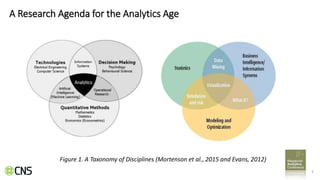
A Research Agenda for the Analytics Age
Figure 1. A Taxonomy of Disciplines (Mortenson et al., 2015 and Evans, 2012)
66
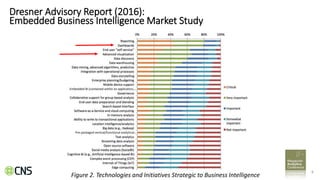
Dresner Advisory Report (2016):
Embedded Business Intelligence Market Study
Figure 2. Technologies and Initiatives Strategic to Business Intelligence
77
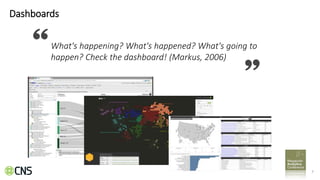
Dashboards
What's happening? What's happened? What's going to
happen? Check the dashboard! (Markus, 2006)
88
Data Visualization
The goal is to turn data into
information, and information
into insight.
(Carly Fiorina, 2004)
The purpose of visualization
is insight, not pictures.
(Ben Shneiderman, 1999)
9
10
11
12
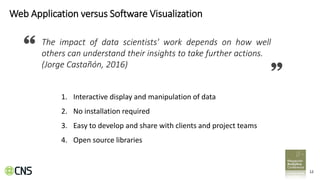
Web Application versus Software Visualization
1. Interactive display and manipulation of data
2. No installation required
3. Easy to develop and share with clients and project teams
4. Open source libraries
The impact of data scientists' work depends on how well
others can understand their insights to take further actions.
(Jorge Castañón, 2016)
13
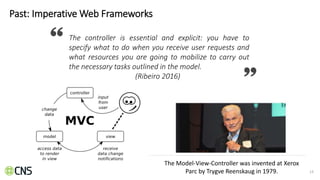
Past: Imperative Web Frameworks
The controller is essential and explicit: you have to
specify what to do when you receive user requests and
what resources you are going to mobilize to carry out
the necessary tasks outlined in the model.
(Ribeiro 2016)
The Model-View-Controller was invented at Xerox
Parc by Trygve Reenskaug in 1979.
14
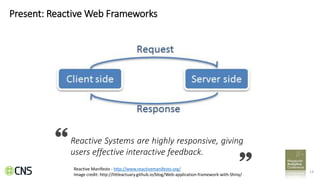
Present: Reactive Web Frameworks
Reactive Systems are highly responsive, giving
users effective interactive feedback.
Reactive Manifesto - http://www.reactivemanifesto.org/
Image credit: http://littleactuary.github.io/blog/Web-application-framework-with-Shiny/
15
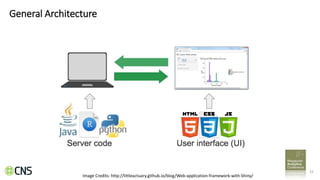
General Architecture
Image Credits: http://littleactuary.github.io/blog/Web-application-framework-with-Shiny/
Web Visualization Framework:
Shiny
16
17
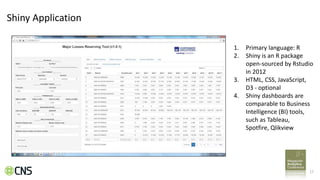
Shiny Application
1. Primary language: R
2. Shiny is an R package
open-sourced by Rstudio
in 2012
3. HTML, CSS, JavaScript,
D3 - optional
4. Shiny dashboards are
comparable to Business
Intelligence (BI) tools,
such as Tableau,
Spotfire, Qlikview
18
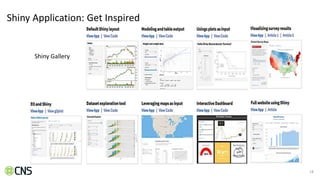
Shiny Application: Get Inspired
Shiny Gallery
CNS Shiny Framework:
Examples
19
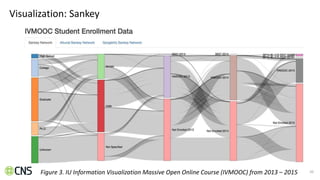
Visualization: Sankey
20Figure 3. IU Information Visualization Massive Open Online Course (IVMOOC) from 2013 – 2015
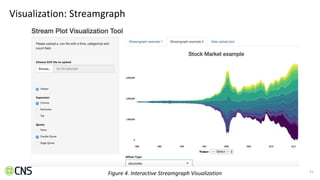
Visualization: Streamgraph
21
Figure 4. Interactive Streamgraph Visualization
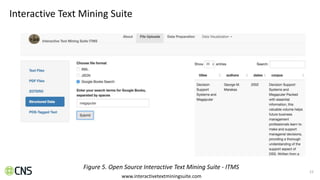
Interactive Text Mining Suite
22
www.interactivetextminingsuite.com
Figure 5. Open Source Interactive Text Mining Suite - ITMS
Web Visualization Framework:
WVF
23
24
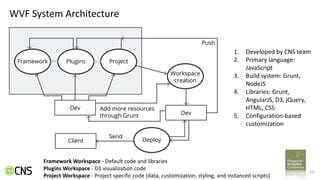
WVF System Architecture
1. Developed by CNS team
2. Primary language:
JavaScript
3. Build system: Grunt,
NodeJS
4. Libraries: Grunt,
AngularJS, D3, jQuery,
HTML, CSS
5. Configuration-based
customization
Framework Workspace - Default code and libraries
Plugins Workspace - D3 visualization code
Project Workspace - Project specific code (data, customization, styling, and instanced scripts)
CNS WVF Framework:
Examples
25
26
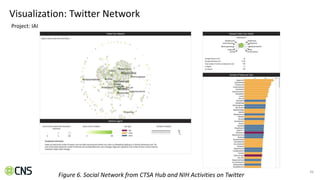
Visualization: Twitter Network
Project: IAI
Figure 6. Social Network from CTSA Hub and NIH Activities on Twitter
27
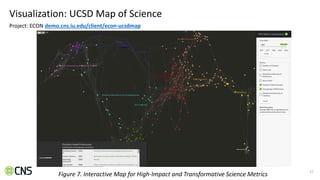
Visualization: UCSD Map of Science
Project: ECON demo.cns.iu.edu/client/econ-ucsdmap
Figure 7. Interactive Map for High-Impact and Transformative Science Metrics
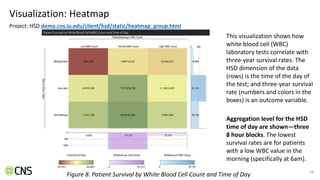
Visualization: Heatmap
28
Project: HSD demo.cns.iu.edu/client/hsd/static/heatmap_group.html
This visualization shows how
white blood cell (WBC)
laboratory tests correlate with
three-year survival rates. The
HSD dimension of the data
(rows) is the time of the day of
the test; and three-year survival
rate (numbers and colors in the
boxes) is an outcome variable.
Aggregation level for the HSD
time of day are shown—three
8 hour blocks. The lowest
survival rates are for patients
with a low WBC value in the
morning (specifically at 6am).
Figure 8. Patient Survival by White Blood Cell Count and Time of Day
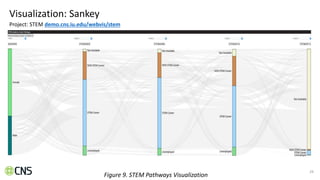
Visualization: Sankey
29
Project: STEM demo.cns.iu.edu/webvis/stem
Figure 9. STEM Pathways Visualization
30
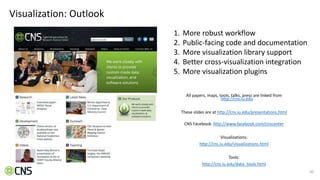
Visualization: Outlook
1. More robust workflow
2. Public-facing code and documentation
3. More visualization library support
4. Better cross-visualization integration
5. More visualization plugins
All papers, maps, tools, talks, press are linked from
http://cns.iu.edu
These slides are at http://cns.iu.edu/presentations.html
CNS Facebook: http://www.facebook.com/cnscenter
Visualizations:
http://cns.iu.edu/visualizations.html
Tools:
http://cns.iu.edu/data_tools.html
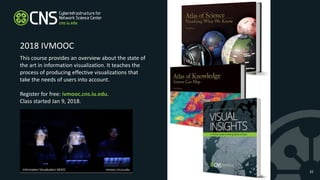
2018 IVMOOC
31
This course provides an overview about the state of
the art in information visualization. It teaches the
process of producing effective visualizations that
take the needs of users into account.
Register for free: ivmooc.cns.iu.edu.
Class started Jan 9, 2018.
32
References
Börner, Katy, Chen, Chaomei, and Boyack, Kevin. (2003). Visualizing
Knowledge Domains. In Blaise Cronin (Ed.), ARIST, Medford, NJ:
Information Today, Volume 37, Chapter 5, pp. 179-255.
http://ivl.slis.indiana.edu/km/pub/2003-borner-arist.pdf
Shiffrin, Richard M. and Börner, Katy (Eds.) (2004). Mapping Knowledge
Domains. Proceedings of the National Academy of Sciences of the United
States of America, 101(Suppl_1).
http://www.pnas.org/content/vol101/suppl_1
Börner, Katy (2010) Atlas of Science: Visualizing What We Know. The
MIT Press. http://scimaps.org/atlas
Scharnhorst, Andrea, Börner, Katy, van den Besselaar, Peter (2012)
Models of Science Dynamics. Springer Verlag.
Katy Börner, Michael Conlon, Jon Corson-Rikert, Cornell, Ying Ding (2012)
VIVO: A Semantic Approach to Scholarly Networking and Discovery.
Morgan & Claypool.
Katy Börner and David E Polley (2014) Visual Insights: A Practical Guide
to Making Sense of Data. The MIT Press.
Börner, Katy (2015) Atlas of Knowledge: Anyone Can Map. The MIT
Press. http://scimaps.org/atlas2 33
References
Jorge Castañón. 2016. Shiny: a Data Scientist’s Best Friend. http://datascience.ibm.com/blog/shiny-a-data-
scientist-best-friend/
Carly Fiorina. 2004. Information: the currency of the digital age .
http://www.hp.com/hpinfo/execteam/speeches/fiorina/04openworld.html
Michael J. Mortenson, Neil F. Doherty, Stewart Robinson. (2015). Operational research from Taylorism to
Terabytes: A research agenda for the analytics age. European Journal of Operational Research, 241, 3, 583-
595.
Aaron Marcus. (2006). Dashboards in your future. Interactions 13, 1 (January 2006), 48-60.
Bradley Nice. (2012). Front-End vs Back-End vs Full Stack Development. March 2012.
https://medium.com/level-up-web/front-end-vs-back-end-vs-full-stack-development-78267f545121
Dresner Advisory Report. (2016). Embedded Business Intelligence Market Study.
http://www.marketwired.com/press-release/dresner-advisory-services-publishes-2016-embedded-business-
intelligence-market-study-2174046.htm
Java - https://www.planet-source-code.com/vb/default.asp?lngWId=14
Python - https://realpython.com/learn/python-first-steps/
34
Thank you!
35
@obscrivn @cnscenter
PRESENTED BY:
Olga Scrivner
Call (812) 349-8853
or email obscrivn@indiana.edu
Indiana University - Bloomington
1320 E. 10th St., Wells Library
Bloomington, IN 47405 USA

Building Effective Visualization Shiny WVF

  • 1.
    Building Effective VisualizationTools for Everyday Business: Web Visualization Framework 1 Cyberinfrastructure for Network Science Center Department of Intelligent Systems Engineering School of Informatics, Computing, and Engineering Indiana University, Bloomington, USA October 18, 2017 Olga Scrivner with contributions by Adam Simpson, Gagandeep Singh, Jivitesh Poojary, Sara Bouchard, and Katy Börner
  • 2.
    2 Our mission isto advance datasets, tools, and services for the study of biomedical, social and behavioral science, physics, and other networks. A specific focus is research on the structure and evolution of science and technology (S&T) and the communication of results via static and interactive maps of science. Learn more at cishell.org. CNS Tools and Services are used by hundreds of thousands around the globe.
  • 3.
  • 4.
    44 Transforming Data intoInsight Data-Driven Decision Making (credits: PwC) “Information is the currency of this digital age” Carly Fiorina, Former CEO of HP
  • 5.
    55 A Research Agendafor the Analytics Age Figure 1. A Taxonomy of Disciplines (Mortenson et al., 2015 and Evans, 2012)
  • 6.
    66 Dresner Advisory Report(2016): Embedded Business Intelligence Market Study Figure 2. Technologies and Initiatives Strategic to Business Intelligence
  • 7.
    77 Dashboards What's happening? What'shappened? What's going to happen? Check the dashboard! (Markus, 2006)
  • 8.
    88 Data Visualization The goalis to turn data into information, and information into insight. (Carly Fiorina, 2004) The purpose of visualization is insight, not pictures. (Ben Shneiderman, 1999)
  • 9.
  • 10.
  • 11.
  • 12.
    12 Web Application versusSoftware Visualization 1. Interactive display and manipulation of data 2. No installation required 3. Easy to develop and share with clients and project teams 4. Open source libraries The impact of data scientists' work depends on how well others can understand their insights to take further actions. (Jorge Castañón, 2016)
  • 13.
    13 Past: Imperative WebFrameworks The controller is essential and explicit: you have to specify what to do when you receive user requests and what resources you are going to mobilize to carry out the necessary tasks outlined in the model. (Ribeiro 2016) The Model-View-Controller was invented at Xerox Parc by Trygve Reenskaug in 1979.
  • 14.
    14 Present: Reactive WebFrameworks Reactive Systems are highly responsive, giving users effective interactive feedback. Reactive Manifesto - http://www.reactivemanifesto.org/ Image credit: http://littleactuary.github.io/blog/Web-application-framework-with-Shiny/
  • 15.
    15 General Architecture Image Credits:http://littleactuary.github.io/blog/Web-application-framework-with-Shiny/
  • 16.
  • 17.
    17 Shiny Application 1. Primarylanguage: R 2. Shiny is an R package open-sourced by Rstudio in 2012 3. HTML, CSS, JavaScript, D3 - optional 4. Shiny dashboards are comparable to Business Intelligence (BI) tools, such as Tableau, Spotfire, Qlikview
  • 18.
    18 Shiny Application: GetInspired Shiny Gallery
  • 19.
  • 20.
    Visualization: Sankey 20Figure 3.IU Information Visualization Massive Open Online Course (IVMOOC) from 2013 – 2015

  • 21.
    Visualization: Streamgraph 21 Figure 4.Interactive Streamgraph Visualization
  • 22.
    Interactive Text MiningSuite 22 www.interactivetextminingsuite.com Figure 5. Open Source Interactive Text Mining Suite - ITMS
  • 23.
  • 24.
    24 WVF System Architecture 1.Developed by CNS team 2. Primary language: JavaScript 3. Build system: Grunt, NodeJS 4. Libraries: Grunt, AngularJS, D3, jQuery, HTML, CSS 5. Configuration-based customization Framework Workspace - Default code and libraries Plugins Workspace - D3 visualization code Project Workspace - Project specific code (data, customization, styling, and instanced scripts)
  • 25.
  • 26.
    26 Visualization: Twitter Network Project:IAI Figure 6. Social Network from CTSA Hub and NIH Activities on Twitter
  • 27.
    27 Visualization: UCSD Mapof Science Project: ECON demo.cns.iu.edu/client/econ-ucsdmap Figure 7. Interactive Map for High-Impact and Transformative Science Metrics
  • 28.
    Visualization: Heatmap 28 Project: HSDdemo.cns.iu.edu/client/hsd/static/heatmap_group.html This visualization shows how white blood cell (WBC) laboratory tests correlate with three-year survival rates. The HSD dimension of the data (rows) is the time of the day of the test; and three-year survival rate (numbers and colors in the boxes) is an outcome variable. Aggregation level for the HSD time of day are shown—three 8 hour blocks. The lowest survival rates are for patients with a low WBC value in the morning (specifically at 6am). Figure 8. Patient Survival by White Blood Cell Count and Time of Day
  • 29.
    Visualization: Sankey 29 Project: STEMdemo.cns.iu.edu/webvis/stem Figure 9. STEM Pathways Visualization
  • 30.
    30 Visualization: Outlook 1. Morerobust workflow 2. Public-facing code and documentation 3. More visualization library support 4. Better cross-visualization integration 5. More visualization plugins All papers, maps, tools, talks, press are linked from http://cns.iu.edu These slides are at http://cns.iu.edu/presentations.html CNS Facebook: http://www.facebook.com/cnscenter Visualizations: http://cns.iu.edu/visualizations.html Tools: http://cns.iu.edu/data_tools.html
  • 31.
    2018 IVMOOC 31 This courseprovides an overview about the state of the art in information visualization. It teaches the process of producing effective visualizations that take the needs of users into account. Register for free: ivmooc.cns.iu.edu. Class started Jan 9, 2018.
  • 32.
  • 33.
    References Börner, Katy, Chen,Chaomei, and Boyack, Kevin. (2003). Visualizing Knowledge Domains. In Blaise Cronin (Ed.), ARIST, Medford, NJ: Information Today, Volume 37, Chapter 5, pp. 179-255. http://ivl.slis.indiana.edu/km/pub/2003-borner-arist.pdf Shiffrin, Richard M. and Börner, Katy (Eds.) (2004). Mapping Knowledge Domains. Proceedings of the National Academy of Sciences of the United States of America, 101(Suppl_1). http://www.pnas.org/content/vol101/suppl_1 Börner, Katy (2010) Atlas of Science: Visualizing What We Know. The MIT Press. http://scimaps.org/atlas Scharnhorst, Andrea, Börner, Katy, van den Besselaar, Peter (2012) Models of Science Dynamics. Springer Verlag. Katy Börner, Michael Conlon, Jon Corson-Rikert, Cornell, Ying Ding (2012) VIVO: A Semantic Approach to Scholarly Networking and Discovery. Morgan & Claypool. Katy Börner and David E Polley (2014) Visual Insights: A Practical Guide to Making Sense of Data. The MIT Press. Börner, Katy (2015) Atlas of Knowledge: Anyone Can Map. The MIT Press. http://scimaps.org/atlas2 33
  • 34.
    References Jorge Castañón. 2016.Shiny: a Data Scientist’s Best Friend. http://datascience.ibm.com/blog/shiny-a-data- scientist-best-friend/ Carly Fiorina. 2004. Information: the currency of the digital age . http://www.hp.com/hpinfo/execteam/speeches/fiorina/04openworld.html Michael J. Mortenson, Neil F. Doherty, Stewart Robinson. (2015). Operational research from Taylorism to Terabytes: A research agenda for the analytics age. European Journal of Operational Research, 241, 3, 583- 595. Aaron Marcus. (2006). Dashboards in your future. Interactions 13, 1 (January 2006), 48-60. Bradley Nice. (2012). Front-End vs Back-End vs Full Stack Development. March 2012. https://medium.com/level-up-web/front-end-vs-back-end-vs-full-stack-development-78267f545121 Dresner Advisory Report. (2016). Embedded Business Intelligence Market Study. http://www.marketwired.com/press-release/dresner-advisory-services-publishes-2016-embedded-business- intelligence-market-study-2174046.htm Java - https://www.planet-source-code.com/vb/default.asp?lngWId=14 Python - https://realpython.com/learn/python-first-steps/ 34
  • 35.
  • 36.
    PRESENTED BY: Olga Scrivner Call(812) 349-8853 or email obscrivn@indiana.edu Indiana University - Bloomington 1320 E. 10th St., Wells Library Bloomington, IN 47405 USA