Trust Management :
Multimodal Data Perspective
Krishnaprasad Thirunarayan (T. K. Prasad)
Professor, Department of Computer Science and Engineering
Kno.e.sis - Ohio Center of Excellence in Knowledge-enabled Computing
Wright State University, Dayton, OH-45435
June 1, 2015 Trust Management: T. K. Prasad 1
Broad Outline
• Real-life Motivational Examples (Why?)
• Trust : Characteristics and Related Concepts (What?)
• Trust Ontology (What?)
– Type, Value, Process, Scope
• Gleaning Trustworthiness (How?) + Robustness to Attack
– Practical Examples of Trust Metrics
– Comparative Analysis of Bayesian Approaches to Trust
• Research Challenges (Why-What-How?)
– APPLICATIONS: E.g., Sensor Networks, Social Networks, Interpersonal
– ISSUES: E.g., Credibility, Scalability, Resiliency (Distributed Consensus)
• Details of Bayesian Approach to Multi-level Trust
June 1, 2015 Trust Management: T. K. Prasad 2
Real-life Motivational Examples
June 1, 2015 Trust Management: T. K. Prasad 3
(Why track trust?)
Interpersonal
• With which neighbor should we leave our
children over the weekend when we are
required to be at the hospital?
• Who should be named as a guardian for our
children in the Will?
June 1, 2015 Trust Management: T. K. Prasad 4
Social
• To click or not to click a http://bit.ly-URL
• To rely or not to rely on a product review
(when only a few reviews are present, or the
reviews are conflicting)?
June 1, 2015 Trust Management: T. K. Prasad 5
Sensors
June 1, 2015 Trust Management: T. K. Prasad 6
• Weather sensor network predicts a potential tornado in
the vicinity of a city.
• Issue: Should we mobilize emergency response teams
ahead of time?
• Van’s TCS (Traction Control System) indicator light came
on intermittently, while driving.
• Issue: Which is faulty: the indicator light or the traction
control system?
• Van’s Check Engine light came on, while driving.
• Issue: Which is faulty: the indicator light or the
transmission control system ?
Man-Machine Hybrid
Collaborative Systems
The 2002 Uberlingen Mid-air Collision (between
Bashkirian Airlines Flight 2937 and DHL Flight
611) occurred because the pilot of one of the
planes trusted the human air traffic controller
(who was ill-informed about the unfolding
situation), instead of the electronic TCAS system
(which was providing conflicting but correct
course of action to avoid collision).
http://en.wikipedia.org/wiki/2002_Uberlingen_mid-air_collision
June 1, 2015 Trust Management: T. K. Prasad 7
Man-Machine Hybrid
Collaborative Systems
In hybrid situations, artificial agents
should reason about the
trustworthiness and deceptive
actions of their human counter
parts. People and agents in virtual
communities will deceive, and will
be deceived.
June 1, 2015 Trust Management: T. K. Prasad 8
Castelfranchi and Tan, 2002
Common Issues and Context
• Uncertainty
– About the validity of a claim or
assumption
• Vulnerability
– Past Experience
• Need for action
Critical decision with potential for loss
June 1, 2015 Trust Management: T. K. Prasad 9
Why Track Trust?
• In Mobile Ad Hoc Networks (MANETs),
trust enables dynamic determination of
secure routes.
– Efficiency: To improve throughput
• By avoiding nodes facing bad channel condition
– Robustness : To detect malicious nodes
• When attackers enter the network in spite of
secure key distribution/authentication
June 1, 2015 Trust Management: T. K. Prasad 10
Why Track Trust?
• In sensor networks, it allows detection of
faults and transient bad behaviors due to
environmental effects.
• In cognitive radio networks, it can enable
selection of optimal channel (less noisy,
less crowded channels).
June 1, 2015 Trust Management: T. K. Prasad 11
Why Track Trust?
• In E-commerce:
–To predict future behavior in a
reliable manner.
–To incentivize “good” behavior and
discourage “bad” behavior.
–To detect malicious entities.
June 1, 2015 Trust Management: T. K. Prasad 12
The Two Sides of Trust
• Trustor assesses trustee for
dependability.
• Trustee casts itself in positive light to
trustor.
• Trust is a function of trustee's
perceived trustworthiness and the
trustor's propensity to trust.
June 1, 2015 Trust Management: T. K. Prasad 13
Trust and Related Concepts
June 1, 2015 Trust Management: T. K. Prasad 15
(What is trust?)
Trust Definition : Psychology slant
Trust is the psychological state
comprising a willingness to be
vulnerable in expectation of a
valued result.
June 1, 2015 Trust Management: T. K. Prasad
Ontology of Trust, Huang and Fox, 2006
Josang et al’s Decision Trust
16
Trust Definition : Psychology slant
Trust in a person is a commitment to
an action based on a belief that the
future actions of that person will
lead to good outcome.
June 1, 2015 Trust Management: T. K. Prasad
Golbeck and Hendler, 2006
17
Trust Definition : Probability slant
Trust (or, symmetrically, distrust)
is a level of subjective probability
with which an agent assesses
that another agent will perform
a particular action, both before
and independently of such an
action being monitored …
June 1, 2015 Trust Management: T. K. Prasad
Can we Trust Trust?, Diego Gambetta, 2000
Josang et al’s Reliability Trust
18
Trustworthiness Definition :
Psychology Slant
Trustworthiness is a collection of
qualities of an agent that leads them
to be considered as deserving of
trust from others (in one or more
environments, under different
conditions, and to different degrees).
June 1, 2015 Trust Management: T. K. Prasad
http://www.iarpa.gov/rfi_trust.html
19
Trustworthiness Definition :
Probability slant
Trustworthiness is the objective
probability that the trustee
performs a particular action on
which the interests of the
trustor depend.
June 1, 2015 Trust Management: T. K. Prasad
Solhaug et al, 2007
20
Trust vs Trustworthiness : My View
Trust Disposition
Depends on
Potentially Quantified Trustworthiness Qualities
+
Context-based Trust Threshold
E.g.*, In the context of trusting strangers, people in the
West will trust for lower levels of trustworthiness than
people in the Gulf.
June 1, 2015 Trust Management: T. K. Prasad
*Bohnet et al, 5/2010
21
Reputation is Overloaded
Community-based Reputation
vs.
Temporal Reputation
(Cf. Community endorsement of merit,
achievement, reliability, etc.)
(Cf. Sustained good behavior over time elicits
temporal reputation-based trust.)
June 1, 2015 Trust Management: T. K. Prasad 25
Trust vs. Reputation
Reputation can be a basis for trust.
However, they are different notions*.
• I trust you because of your good reputation.
• I trust you despite your bad reputation.
• Do you still trust Toyota brand?
June 1, 2015 Trust Management: T. K. Prasad
*Josang et al, 2007
26
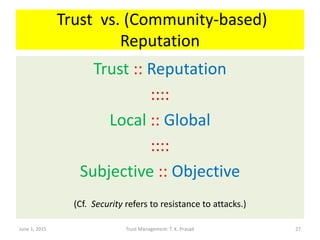
Trust vs. (Community-based)
Reputation
Trust :: Reputation
::::
Local :: Global
::::
Subjective :: Objective
(Cf. Security refers to resistance to attacks.)
June 1, 2015 Trust Management: T. K. Prasad 27
Trust is well-known,
but is not well-understood.
The utility of a notion
testifies not to its clarity but
rather to the philosophical
importance of clarifying it.
-- Nelson Goodman
(Fact, Fiction and Forecast, 1955)
June 1, 2015 Trust Management: T. K. Prasad 29
Trust Ontology
June 1, 2015 Trust Management: T. K. Prasad 30
(What is trust?)
Illustration of Knowledge Representation and Reasoning:
Relating Semantics to Data Structures and Algorithms
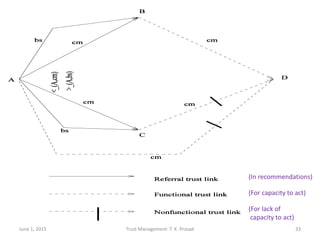
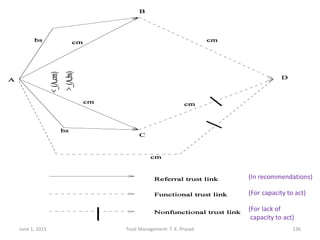
Example Trust Network -
Different Trust Links with Local Order on out-links
• Alice trusts Bob for recommending good car
mechanic.
• Bob trusts Dick to be a good car mechanic.
• Charlie does not trust Dick to be a good car
mechanic.
• Alice trusts Bob more than Charlie, for
recommending good car mechanic.
• Alice trusts Charlie more than Bob, for
recommending good baby sitter.
June 1, 2015 Trust Management: T. K. Prasad
*Thirunarayan et al, IICAI 2009
31
Digression: Illustration of Knowledge
Representation and Reasoning
• Abstract and encode clearly delineated “subarea”
of knowledge in a formal language.
– Trust Networks => node-labeled, edge-labeled
directed graph (DATA STRUCTURES)
• Specify the meaning in terms of how “network
elements” relate to or compose with each other.
– Semantics of Trust, Trust Metrics => using logic or
probabilistic basis, constraints, etc. (SEMANTICS)
• Develop efficient graph-based procedures
– Trust value determination/querying (INFERENCE
ALGORITHMS)
June 1, 2015 Trust Management: T. K. Prasad 32
June 1, 2015 Trust Management: T. K. Prasad 33
(In recommendations)
(For capacity to act)
(For lack of
capacity to act)
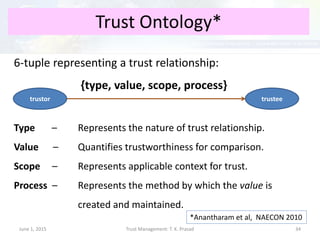
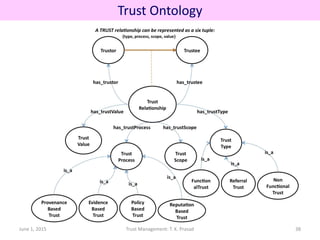
Trust Ontology*
6-tuple representing a trust relationship:
{type, value, scope, process}
Type – Represents the nature of trust relationship.
Value – Quantifies trustworthiness for comparison.
Scope – Represents applicable context for trust.
Process – Represents the method by which the value is
created and maintained.
trustor trustee
June 1, 2015 Trust Management: T. K. Prasad
*Anantharam et al, NAECON 2010
34
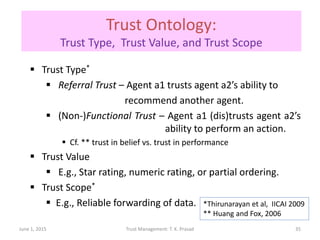
Trust Ontology:
Trust Type, Trust Value, and Trust Scope
 Trust Type*
 Referral Trust – Agent a1 trusts agent a2’s ability to
recommend another agent.
 (Non-)Functional Trust – Agent a1 (dis)trusts agent a2’s
ability to perform an action.
 Cf. ** trust in belief vs. trust in performance
 Trust Value
 E.g., Star rating, numeric rating, or partial ordering.
 Trust Scope*
 E.g., Reliable forwarding of data.
June 1, 2015 Trust Management: T. K. Prasad
*Thirunarayan et al, IICAI 2009
** Huang and Fox, 2006
35
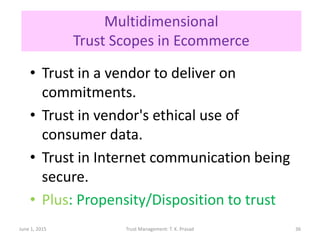
Multidimensional
Trust Scopes in Ecommerce
• Trust in a vendor to deliver on
commitments.
• Trust in vendor's ethical use of
consumer data.
• Trust in Internet communication being
secure.
• Plus: Propensity/Disposition to trust
June 1, 2015 Trust Management: T. K. Prasad 36
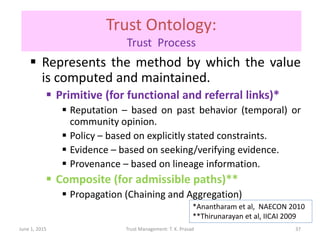
Trust Ontology:
Trust Process
 Represents the method by which the value
is computed and maintained.
 Primitive (for functional and referral links)*
 Reputation – based on past behavior (temporal) or
community opinion.
 Policy – based on explicitly stated constraints.
 Evidence – based on seeking/verifying evidence.
 Provenance – based on lineage information.
 Composite (for admissible paths)**
 Propagation (Chaining and Aggregation)
June 1, 2015 Trust Management: T. K. Prasad
*Anantharam et al, NAECON 2010
**Thirunarayan et al, IICAI 2009
37
June 1, 2015 Trust Management: T. K. Prasad
Trust Ontology
38
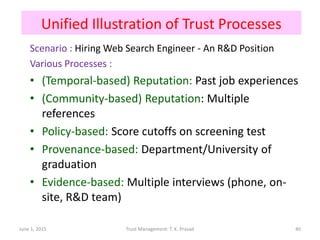
Unified Illustration of Trust Processes
Scenario : Hiring Web Search Engineer - An R&D Position
Various Processes :
• (Temporal-based) Reputation: Past job experiences
• (Community-based) Reputation: Multiple
references
• Policy-based: Score cutoffs on screening test
• Provenance-based: Department/University of
graduation
• Evidence-based: Multiple interviews (phone, on-
site, R&D team)
June 1, 2015 Trust Management: T. K. Prasad 40
Deception
• Deception is the betrayal of trust.
–Ironically, trust makes us prone to
deception.
–Knowing what features are used to
glean trustworthiness can also assist
in avoiding detection while deceiving.
June 1, 2015 Trust Management: T. K. Prasad 41
Gleaning Trustworthiness :
Practical Examples
June 1, 2015 Trust Management: T. K. Prasad 42
(How to determine trustworthiness?)
Trust Metrics and Trust Models
• Trust Metric => How is primitive trust
represented and computed?
• E.g., Real number, Finite levels, Partial Order.
• Trust Model => How is composite trust
computed or propagated?
June 1, 2015 Trust Management: T. K. Prasad 43
Y. L. Sun, et al, 2/2008
Trust Models : Ideal Approach
• Capture semantics of trust using
– axioms for trust propagation, or
– catalog of equivalent trust networks.
• Develop trust computation rules
for propagation (that is, chaining
and aggregation) that satisfy the
axioms or equivalence relation.
June 1, 2015 Trust Management: T. K. Prasad 44
Direct Trust : Functional and Referral
Reputation-based Process
June 1, 2015 Trust Management: T. K. Prasad 45
(Using large number of observations)
Using Large Number of Observations
• Over time (<= Referral + Functional) :
Temporal Reputation-based Process
– Mobile Ad-Hoc Networks
– Sensor Networks
• Quantitative information
(Numeric data)
• Over agents (<= Referral + Functional) :
Community Reputation-based Process
– Product Rating Systems
• Quantitative + Qualitative information
(Numeric + text data)
June 1, 2015 Trust Management: T. K. Prasad 47
Desiderata for Trustworthiness
Computation Function
• Initialization Problem : How do we get initial value?
• Update Problem : How do we reflect the observed
behavior in the current value dynamically?
• Trusting Trust* Issue: How do we mirror uncertainty
in our estimates as a function of observations?
• Law of Large Numbers: The average of the results obtained from a
large number of trials should be close to the expected value.
• Efficiency Problem : How do we store and update
values efficiently?
June 1, 2015 Trust Management: T. K. Prasad
*Ken Thompson’s Turing Award Lecture: “Reflections on Trusting Trust”
48
Mathematical Background
June 1, 2015 Trust Management: T. K. Prasad 49
Beta PDF for Reputation
Beta-distribution : Gently
• Consider a (potentially unfair) coin that comes up
HEADS with probability p and TAILS with probability
(1 – p).
• Suppose we perform ( r + s ) coin tosses and the coin
turns up with HEADS r times and with TAILS s times.
• What is the best estimate of the distribution of the
probability p given these observations?
=> Beta-distribution with parameters ( r+1, s+1 )
June 1, 2015 Trust Management: T. K. Prasad
f(p; r+1, s+1)
50
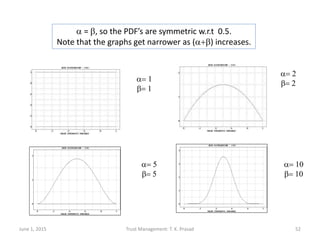
Beta Probability Density Function(PDF)
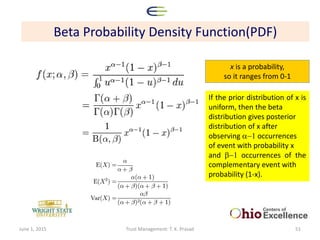
x is a probability,
so it ranges from 0-1
If the prior distribution of x is
uniform, then the beta
distribution gives posterior
distribution of x after
observing a-1 occurrences
of event with probability x
and b-1 occurrences of the
complementary event with
probability (1-x).
June 1, 2015 Trust Management: T. K. Prasad 51
a= 5
b= 5
a= 1
b= 1
a= 2
b= 2
a= 10
b= 10
a = b, so the PDF’s are symmetric w.r.t 0.5.
Note that the graphs get narrower as (a+b) increases.
June 1, 2015 Trust Management: T. K. Prasad 52
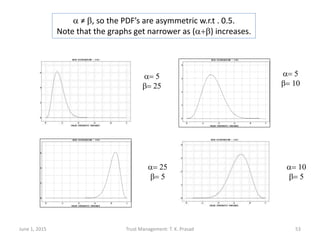
a= 5
b= 25
a= 5
b= 10
a= 25
b= 5
a= 10
b= 5
a ≠ b, so the PDF’s are asymmetric w.r.t . 0.5.
Note that the graphs get narrower as (a+b) increases.
June 1, 2015 Trust Management: T. K. Prasad 53
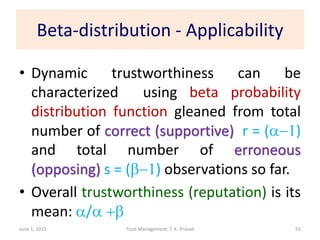
Beta-distribution - Applicability
• Dynamic trustworthiness can be
characterized using beta probability
distribution function gleaned from total
number of correct (supportive) r = (a-1)
and total number of erroneous
(opposing) s = (b-1) observations so far.
• Overall trustworthiness (reputation) is its
mean: a/a +b
June 1, 2015 Trust Management: T. K. Prasad 55
Why Beta-distribution?
• Intuitively satisfactory, mathematically precise, and
computationally tractable
• Initialization Problem : Assumes that all probability values
are equally likely.
• Update Problem : Updates (a, b) by incrementing a for
every correct (supportive) observation and b for every
erroneous (opposing) observation.
• Trusting Trust Issue: The graph peaks around the mean, and
the variance diminishes as the number of observations
increase, if the agent is well-behaved.
• Efficiency Problem: Only two numbers stored/updated.
June 1, 2015 Trust Management: T. K. Prasad 56
Information Theoretic Interpretation
of Trustworthiness Probability
• Intuitively, probability values of 0 and 1 imply
certainty, while probability value of 0.5 implies
a lot of uncertainty.
• This can be formalized by mapping probability
in [0,1] to trust value in [–1,1], using
information theoretic approach.
June 1, 2015 Trust Management: T. K. Prasad
Y. L. Sun, et al, 2/2008
57
Information Theoretic Interpretation
of Trustworthiness Probability
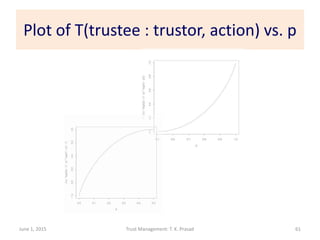
• T(trustee : trustor, action) =
if 0.5 <= p
then 1 – H(p) /* 0.5 <= p <= 1 */
else H(p) – 1 /* 0 <= p <= 0.5 */
where
H(p) = – p log2(p) – (1 – p) log2(1 – p)
June 1, 2015 Trust Management: T. K. Prasad 58
Plot of T(trustee : trustor, action) vs. p
June 1, 2015 Trust Management: T. K. Prasad 61
Direct Trust : Functional
Policy-based Process
June 1, 2015 Trust Management: T. K. Prasad 62
(Using Trustworthiness Qualities)
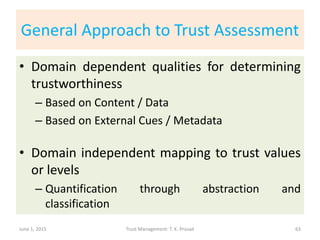
General Approach to Trust Assessment
• Domain dependent qualities for determining
trustworthiness
– Based on Content / Data
– Based on External Cues / Metadata
• Domain independent mapping to trust values
or levels
– Quantification through abstraction and
classification
June 1, 2015 Trust Management: T. K. Prasad 63
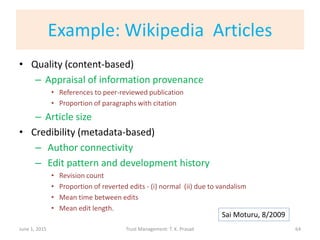
Example: Wikipedia Articles
• Quality (content-based)
– Appraisal of information provenance
• References to peer-reviewed publication
• Proportion of paragraphs with citation
– Article size
• Credibility (metadata-based)
– Author connectivity
– Edit pattern and development history
• Revision count
• Proportion of reverted edits - (i) normal (ii) due to vandalism
• Mean time between edits
• Mean edit length.
June 1, 2015 Trust Management: T. K. Prasad 64
Sai Moturu, 8/2009
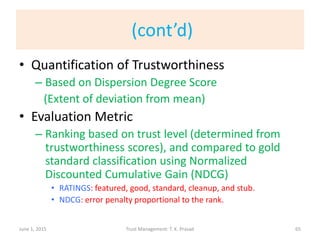
(cont’d)
• Quantification of Trustworthiness
– Based on Dispersion Degree Score
(Extent of deviation from mean)
• Evaluation Metric
– Ranking based on trust level (determined from
trustworthiness scores), and compared to gold
standard classification using Normalized
Discounted Cumulative Gain (NDCG)
• RATINGS: featured, good, standard, cleanup, and stub.
• NDCG: error penalty proportional to the rank.
June 1, 2015 Trust Management: T. K. Prasad 65
Indirect Trust : Referral + Functional
Variety of Trust Metrics and Models
June 1, 2015 Trust Management: T. K. Prasad 67
(Using Propagation – Chaining and Aggregation over Paths)
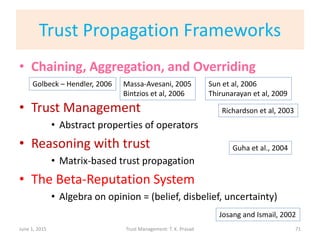
Trust Propagation Frameworks
• Chaining, Aggregation, and Overriding
• Trust Management
• Abstract properties of operators
• Reasoning with trust
• Matrix-based trust propagation
• The Beta-Reputation System
• Algebra on opinion = (belief, disbelief, uncertainty)
June 1, 2015 Trust Management: T. K. Prasad
Guha et al., 2004
Richardson et al, 2003
Josang and Ismail, 2002
71
Massa-Avesani, 2005
Bintzios et al, 2006
Golbeck – Hendler, 2006 Sun et al, 2006
Thirunarayan et al, 2009
Trust Propagation Algorithms
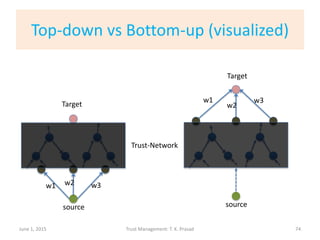
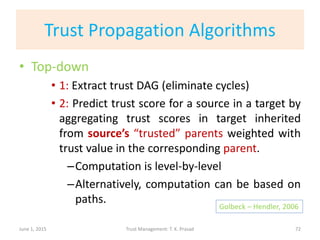
• Top-down
• 1: Extract trust DAG (eliminate cycles)
• 2: Predict trust score for a source in a target by
aggregating trust scores in target inherited
from source’s “trusted” parents weighted with
trust value in the corresponding parent.
–Computation is level-by-level
–Alternatively, computation can be based on
paths.
June 1, 2015 Trust Management: T. K. Prasad
Golbeck – Hendler, 2006
72
Trust Propagation Algorithms
• Bottom-up
• 1: Extract trust DAG (eliminate cycles)
• 2: Predict trust score for a source in a target by
aggregating trust scores in target inherited
from target’s “trusted” neighbors weighted
with trust value in the corresponding neighbor.
–Computation is level-by-level
–Alternatively, computation can be based on
paths.
June 1, 2015 Trust Management: T. K. Prasad
Massa-Avesani, 2005
Bintzios et al, 2006
73
Top-down vs Bottom-up (visualized)
June 1, 2015 Trust Management: T. K. Prasad 74
source
Target
source
Target
w3
w2
w1
w3w2w1
Trust-Network
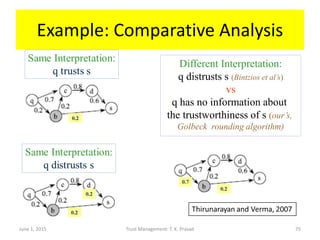
Example: Comparative Analysis
June 1, 2015 Trust Management: T. K. Prasad 75
Different Interpretation:
q distrusts s (Bintzios et al’s)
vs
q has no information about
the trustworthiness of s (our’s,
Golbeck rounding algorithm)
Indirect Trust : Referral + Functional
Variety of Bayesian Trust Models
June 1, 2015 Trust Management: T. K. Prasad 79
With Applications to Mobile Ad hoc Networks
Wireless Sensor Networks, etc.
Direct Trust : Functional and Referral
• Direct Trust for Packet Forwarding
• S = Number of packets forwarded
• F = Number of packets dropped
• S + F = Total number of requests for packet forwarding
• Direct Trust for Recommendations
• S = Number of times observed direct trust for packet
forwarding approximates expected indirect trust for
packet forwarding (trust over transit path : r+f)
• F = Number of times observed direct trust for packet
forwarding does not approximate expected indirect
trust for packet forwarding (trust over transit path : r+f)
June 1, 2015 Trust Management: T. K. Prasad 80
Indirect Trust : Functional and Referral
• Indirect Trust for Packet Forwarding
– Used when direct trust is not available
»(overriding behavior)
• Chain links for a path from a recommender to the target
– Multiplicative
• Aggregate over multiple (parallel) paths from
recommenders to the target
– Unclear, in general
• Indirect Trust for Recommendations
• Obtained implicitly through computed referral trust
June 1, 2015 Trust Management: T. K. Prasad 81
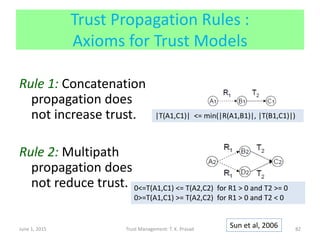
Trust Propagation Rules :
Axioms for Trust Models
Rule 1: Concatenation
propagation does
not increase trust.
Rule 2: Multipath
propagation does
not reduce trust.
June 1, 2015 Trust Management: T. K. Prasad 82
Sun et al, 2006
|T(A1,C1)| <= min(|R(A1,B1)|, |T(B1,C1)|)
0<=T(A1,C1) <= T(A2,C2) for R1 > 0 and T2 >= 0
0>=T(A1,C1) >= T(A2,C2) for R1 > 0 and T2 < 0
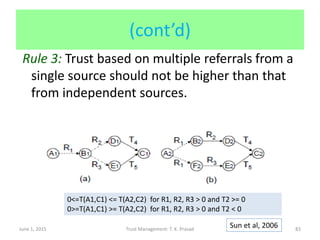
(cont’d)
Rule 3: Trust based on multiple referrals from a
single source should not be higher than that
from independent sources.
June 1, 2015 Trust Management: T. K. Prasad 83
Sun et al, 2006
0<=T(A1,C1) <= T(A2,C2) for R1, R2, R3 > 0 and T2 >= 0
0>=T(A1,C1) >= T(A2,C2) for R1, R2, R3 > 0 and T2 < 0
Trust Propagation Rules :
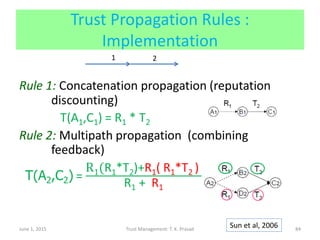
Implementation
June 1, 2015 Trust Management: T. K. Prasad
Sun et al, 2006
1 2
84
Trust Paths Visualized for Scalability:
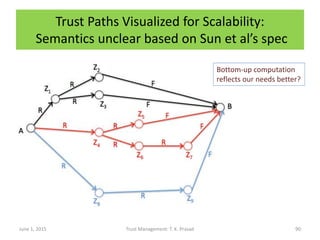
Semantics unclear based on Sun et al’s spec
June 1, 2015 Trust Management: T. K. Prasad 90
Bottom-up computation
reflects our needs better?
Trust : Functional and Referral
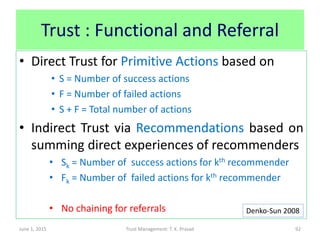
• Direct Trust for Primitive Actions based on
• S = Number of success actions
• F = Number of failed actions
• S + F = Total number of actions
• Indirect Trust via Recommendations based on
summing direct experiences of recommenders
• Sk = Number of success actions for kth recommender
• Fk = Number of failed actions for kth recommender
• No chaining for referrals
June 1, 2015 Trust Management: T. K. Prasad 92
Denko-Sun 2008
Cumulative Trust using
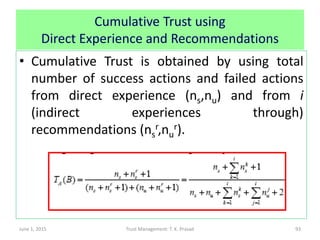
Direct Experience and Recommendations
• Cumulative Trust is obtained by using total
number of success actions and failed actions
from direct experience (ns,nu) and from i
(indirect experiences through)
recommendations (ns
r,nu
r).
June 1, 2015 Trust Management: T. K. Prasad 93
Contents of [Ganeriwal et al, 2007] Paper
• (a,b)-parameters to compute trust of i in j is
obtained by combining direct observations
(aj,bj) with indirect observations (aj
k,bj
k) from
k weighted by (ak,bk) using [Josang-Ismail,
2002] chaining/discounting rule.
• Obtains cumulative trust by combining direct trust from
a functional link and indirect trusts using paths
containing one referral link and one functional link.
• However, it does not distinguish functional and referral
trust.
June 1, 2015 Trust Management: T. K. Prasad 94
Security Issues:
Threats and Vulnerabilities
June 1, 2015 Trust Management: T. K. Prasad 104
Attacks and Robustness Analysis
Attacks
• Trust Management is an attractive target for
malicious nodes.
 Bad mouthing attack (Defamation)
 Dishonest recommendations on good nodes (calling them
bad)
 Ballot stuffing attack (Collusion)
 Dishonest recommendations on bad nodes (calling them
good)
 Sybil attack
 Creating Fake Ids
 Newcomer attack
 Registering as new nodes
June 1, 2015 Trust Management: T. K. Prasad 105
Attacks
• Inconsistency in time-domain
 On-Off attack
 Malicious node behaves good and bad alternatively to
avoid detection
 Sleeper attack
 Malicious node acquires high trust by behaving good
and then striking by behaving bad
 Inconsistency in node-domain
 Conflicting Behavior Attack
 Provide one recommendation to one set of peers and a
conflicting recommendation to a disjoint set of peers
June 1, 2015 Trust Management: T. K. Prasad 106
Security : Robustness w.r.t Attacks
 Bad mouthing attack
 Example: Competent nodes downplay competitions.
 Example: Can diminish throughput due to lost capacity.
 Approach:
 Separate functional and referral trust, updating
referral trust to track good recommendations
 Trust composition rules ensure that low or
negative referral trust does not impact decision
 Low trust nodes can be branded as malicious and
avoided. (Not viable if majority collude.)
June 1, 2015 Trust Management: T. K. Prasad 107
Security : Robustness w.r.t Attacks
 Ballot stuffing attack
 Example: Malicious nodes collude to recommend each
other.
 Example: Can cause unexpected loss of throughput.
 Approach:
 Feedback : Cross-check actual functional
performance with expected behavior via referral,
and update (reward/penalize) referral trust (in
parent) accordingly (in addition to updating
functional trust (in target))
June 1, 2015 Trust Management: T. K. Prasad 108
Security : Robustness w.r.t. Attacks
 Sybil attack
 Create Fake Ids to take blame for malicious
behavior (dropping packets)
 Newcomer attack
 Register as new node to erase past history
 Approach
 Requires separate (key-based or security token-
based) authentication mechanism (with TTP) to
overcome these attacks.
June 1, 2015 Trust Management: T. K. Prasad 109
Security : Robustness w.r.t Attacks
 On-Off attack
 Sleeper attack
 Example: Due to malice or environmental changes
 Approach:
 Use forgetting factor (0<=b<=1):
k good/bad actions at t1
= k * b(t2 – t1) good/bad actions at t2 (> t1)
June 1, 2015 Trust Management: T. K. Prasad 110
Forgetting Factor
k good/bad actions at t1 = k * b(t2 – t1) good/bad actions at t2 (> t1)
• High b value (0.9) enhances memorized time
window, while low b value (0.001) reduces it.
– High b enables malicious nodes (on-off/sleeper
attackers) to use prior good actions to mask
subsequent intentional bad actions.
• Reduces reliability.
– Low b forces legitimate nodes to be avoided due
to short spurts of unintentional bad actions.
• Reduces throughput.
June 1, 2015 Trust Management: T. K. Prasad 111
Adaptive Forgetting Factor
• Intuition: Bad actions are remembered for a
longer duration than good actions.
• Actions performed with high trust forgotten quicker than
actions performed with low trust.
Choose b equal to ( 1 – p )
Choose b = 0.01 when p in [0.5,1] else 0.9
 Example: Similar ideas used in Ushahidi
 Note: Effectively, more good actions are
necessary to compensate for fewer bad actions,
to recover trust.
June 1, 2015 Trust Management: T. K. Prasad 112
Security : Robustness w.r.t. Attacks
 Conflicting Behavior Attack
 Malicious node divide and conquer, by behaving
differently (resp. by providing different
recommendations) to different peers, causing
peers to provide conflicting recommendations to
source about the malicious node (resp. about
some target), reducing source’s referral trust in
some peers.
 Eventually, this causes recommendations of some peers
to be ignored incorrectly.
June 1, 2015 Trust Management: T. K. Prasad 113
Example
• Peer Node Set 1: 1, 2, 3, and 4
• Peer Node Set 2: 5, 6, 7, and 8
• Malicious node 0 behaves well towards nodes in
Set 1 but behaves badly towards nodes in Set 2.
• When node 9 seeks recommendations from
nodes in Set 1 U Set 2 on node 0, node 9 receives
conflicting recommendations on malicious node
0, causing referral trust in nodes in Set 1 or
nodes in Set 2 to be lowered.
=> Eventually throughput lowered
June 1, 2015 Trust Management: T. K. Prasad 114
Security : Robustness w.r.t. Attacks
 Conflicting Behavior Attack
 Issue: Can recommenders get feedback
to reduce trust in malicious node?
Otherwise, referral trust cannot be
relied upon for detecting malicious
nodes.
June 1, 2015 Trust Management: T. K. Prasad 115
June 1, 2015 Trust Management: T. K. Prasad 119
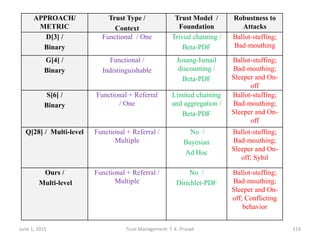
APPROACH/
METRIC
Trust Type /
Context
Trust Model /
Foundation
Robustness to
Attacks
D[3] /
Binary
Functional / One Trivial chaining /
Beta-PDF
Ballot-stuffing;
Bad-mouthing
G[4] /
Binary
Functional /
Indistinguishable
Josang-Ismail
discounting /
Beta-PDF
Ballot-stuffing;
Bad-mouthing;
Sleeper and On-
off
S[6] /
Binary
Functional + Referral
/ One
Limited chaining
and aggregation /
Beta-PDF
Ballot-stuffing;
Bad-mouthing;
Sleeper and On-
off
Q[28] / Multi-level Functional + Referral /
Multiple
No /
Bayesian
Ad Hoc
Ballot-stuffing;
Bad-mouthing;
Sleeper and On-
off; Sybil
Ours /
Multi-level
Functional + Referral /
Multiple
No /
Dirichlet-PDF
Ballot-stuffing;
Bad-mouthing;
Sleeper and On-
off; Conflicting
behavior
Research Challenges
June 1, 2015 Trust Management: T. K. Prasad 120
(What-Why-How of trust?)
HARD PROBLEMS
Generic Directions
• Finding online substitutes for traditional cues
to derive measures of trust.
• Creating efficient and secure systems for
managing and deriving trust, in order to
support decision making.
June 1, 2015 Trust Management: T. K. Prasad
Josang et al, 2007
121
Robustness Issue
You can fool some of the
people all of the time, and all
of the people some of the
time, but you cannot fool all
of the people all of the time.
Abraham Lincoln,
16th president of US (1809 - 1865)
June 1, 2015 Trust Management: T. K. Prasad 122
Trust : Social Networks vs
Machine Networks
• In social networks such as Facebook, trust is
often subjective, while in machine networks
and social networks such as Twitter, trust can
be given an objective basis and approximated
by trustworthiness.
• Reputation is the perception that an agent
creates through past actions about its
intentions and norms.
– Reputation can be a basis for trust.
June 1, 2015 Trust Management: T. K. Prasad 123
Sensor Networks
June 1, 2015 Trust Management: T. K. Prasad 124
Strengthened Trust
Trust
June 1, 2015 Trust Management: T. K. Prasad 125
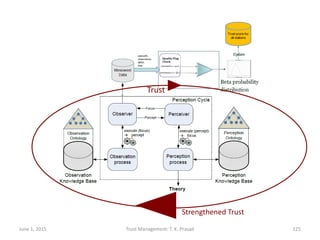
Concrete Application
• Applied Beta-PDF to Mesowest Weather Data
– Used quality flags (OK, CAUTION, SUSPECT)
associated with observations from a sensor
station over time to derive reputation of a sensor
and trustworthiness of a perceptual theory that
explains the observation.
– Perception cycle used data from ~800 stations,
collected for a blizzard during 4/1-6/03.
June 1, 2015 Trust Management: T. K. Prasad 126
Concrete Application
• Perception Cycle
– http://harp.cs.wright.edu/perception/
• Trusted Perception Cycle
– http://www.youtube.com/watch?v=lTxzghCjGgU
June 1, 2015 Trust Management: T. K. Prasad 127
Research Issues
• Outlier Detection
– Homogeneous Networks
• Statistical Techniques
– Heterogeneous Networks (sensor + social)
• Domain Models
• Distinguishing between abnormal phenomenon
(observation), malfunction (of a sensor), and
compromised behavior (of a sensor)
– Abnormal situations
– Faulty behaviors
– Malicious attacks
June 1, 2015 Trust Management: T. K. Prasad 129
Ganeriwal et al, 2008
Social Networks
June 1, 2015 Trust Management: T. K. Prasad 130
Our Research
• Study semantic issues relevant to trust
• Proposed model of trust/trust metrics to
formalize indirect trust
June 1, 2015 Trust Management: T. K. Prasad 131
Quote
• Guha et al:
While continuous-valued trusts are
mathematically clean, from the standpoint
of usability, most real-world systems will
in fact use discrete values at which one
user can rate another.
• E.g., Epinions, Ebay, Amazon, Facebook, etc all
use small sets for (dis)trust/rating values.
June 1, 2015 Trust Management: T. K. Prasad 133
Our Approach
 Trust formalized in terms of partial orders
(with emphasis on relative magnitude)
 Local but realistic semantics
 Distinguishes functional and referral trust
 Distinguishes direct and inferred trust
 Direct trust overrides conflicting inferred trust
 Represents ambiguity explicitly
June 1, 2015 Trust Management: T. K. Prasad
Thirunarayan et al , 2009
Formalizing the Framework
• Given a trust network (Nodes AN, Edges RL U
PFL U NFL with Trust Scopes TSF, Local
Orderings ⪯ANxAN), specify when a source can
trust, distrust, or be ambiguous about a
target, reflecting local semantics of:
• Functional and referral trust links
• Direct and inferred trust
• Locality
135June 1, 2015 Trust Management: T. K. Prasad
June 1, 2015 Trust Management: T. K. Prasad 136
(In recommendations)
(For capacity to act)
(For lack of
capacity to act)
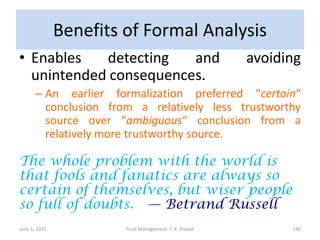
Benefits of Formal Analysis
• Enables detecting and avoiding
unintended consequences.
– An earlier formalization preferred “certain“
conclusion from a relatively less trustworthy
source over “ambiguous“ conclusion from a
relatively more trustworthy source.
The whole problem with the world is
that fools and fanatics are always so
certain of themselves, but wiser people
so full of doubts. — Betrand Russell
June 1, 2015 Trust Management: T. K. Prasad 140