Web and Complex
Systems Lab
Dr. Derek Doran
August 2015
http://knoesis.wright.edu/doran
Lab Summary
Theme: Investigating both theoretical and practical aspects of
complex systems analysis and control.
Emphasis: Quantitative and structural modeling, Web systems,
modeling complexity in emerging domains
Areas of interest:
- Social Informatics
- Systems Optimization
- Network Science Theory
Students: 3 full-time GRAs; 1 UGRA, 1 summer researcher
Funding: From NSF, I/UCRC, SocInfo Startup, Internal WSU Competition
Collaborations: Bell Labs, AFRL, WSU Depts. of ICCSM and Professional Psych.,
7 Cups of Tea Inc., Univ. of Pavia
Understanding and Mitigating Web Robot
(IoT) Traffic on Web Systems
 Preparing for the IoT future (present)
 2012: 60% of http traffic on the Web driven by a machine
rather than a human
 We are approaching an age where most devices will be
always online — the 60% proportion will only get higher
 Yet Web and cloud platform optimizations rely on statistical
patterns seen only in human driven traffic
 Result: Band-aid solutions… we provision bigger clouds, faster
servers, more energy…
Funding: NSF CSR [CRII award winner]
Understanding robot traffic, and building new optimizations for
servers and clouds, may drastically improve their efficiency
and decrease their energy footprint
• IoT Traffic Detection
• Traffic classification and characterization
• Statistical Analysis
• Synthetic traffic generation
• IoT demand modeling
• New System Optimizations
• Robot-resilient predictive Web
caching
Research Tasks
Funding: NSF CSR [CRII award winner]
Wide Area Geospatial Awareness
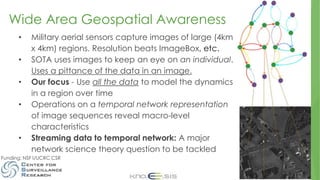
• Military aerial sensors capture images of large (4km
x 4km) regions. Resolution beats ImageBox, etc.
• SOTA uses images to keep an eye on an individual.
Uses a pittance of the data in an image.
• Our focus - Use all the data to model the dynamics
in a region over time
• Operations on a temporal network representation
of image sequences reveal macro-level
characteristics
• Streaming data to temporal network: A major
network science theory question to be tackled
Funding: NSF I/UCRC CSR
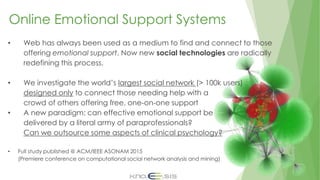
Online Emotional Support Systems
• Web has always been used as a medium to find and connect to those
offering emotional support. Now new social technologies are radically
redefining this process.
• We investigate the world’s largest social network (> 100k users)
designed only to connect those needing help with a
crowd of others offering free, one-on-one support
• A new paradigm: can effective emotional support be
delivered by a literal army of paraprofessionals?
Can we outsource some aspects of clinical psychology?
• Full study published @ ACM/IEEE ASONAM 2015
(Premiere conference on computational social network analysis and mining)
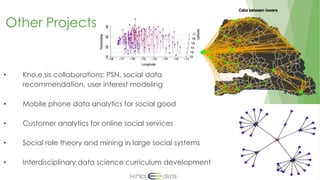
Other Projects
• Kno.e.sis collaborations: PSN, social data
recommendation, user interest modeling
• Mobile phone data analytics for social good
• Customer analytics for online social services
• Social role theory and mining in large social systems
• Interdisciplinary data science curriculum development

Web and Complex Systems Lab @ Kno.e.sis

  • 1.
    Web and Complex SystemsLab Dr. Derek Doran August 2015 http://knoesis.wright.edu/doran
  • 2.
    Lab Summary Theme: Investigatingboth theoretical and practical aspects of complex systems analysis and control. Emphasis: Quantitative and structural modeling, Web systems, modeling complexity in emerging domains Areas of interest: - Social Informatics - Systems Optimization - Network Science Theory Students: 3 full-time GRAs; 1 UGRA, 1 summer researcher Funding: From NSF, I/UCRC, SocInfo Startup, Internal WSU Competition Collaborations: Bell Labs, AFRL, WSU Depts. of ICCSM and Professional Psych., 7 Cups of Tea Inc., Univ. of Pavia
  • 3.
    Understanding and MitigatingWeb Robot (IoT) Traffic on Web Systems  Preparing for the IoT future (present)  2012: 60% of http traffic on the Web driven by a machine rather than a human  We are approaching an age where most devices will be always online — the 60% proportion will only get higher  Yet Web and cloud platform optimizations rely on statistical patterns seen only in human driven traffic  Result: Band-aid solutions… we provision bigger clouds, faster servers, more energy… Funding: NSF CSR [CRII award winner]
  • 4.
    Understanding robot traffic,and building new optimizations for servers and clouds, may drastically improve their efficiency and decrease their energy footprint • IoT Traffic Detection • Traffic classification and characterization • Statistical Analysis • Synthetic traffic generation • IoT demand modeling • New System Optimizations • Robot-resilient predictive Web caching Research Tasks Funding: NSF CSR [CRII award winner]
  • 5.
    Wide Area GeospatialAwareness • Military aerial sensors capture images of large (4km x 4km) regions. Resolution beats ImageBox, etc. • SOTA uses images to keep an eye on an individual. Uses a pittance of the data in an image. • Our focus - Use all the data to model the dynamics in a region over time • Operations on a temporal network representation of image sequences reveal macro-level characteristics • Streaming data to temporal network: A major network science theory question to be tackled Funding: NSF I/UCRC CSR
  • 6.
    Online Emotional SupportSystems • Web has always been used as a medium to find and connect to those offering emotional support. Now new social technologies are radically redefining this process. • We investigate the world’s largest social network (> 100k users) designed only to connect those needing help with a crowd of others offering free, one-on-one support • A new paradigm: can effective emotional support be delivered by a literal army of paraprofessionals? Can we outsource some aspects of clinical psychology? • Full study published @ ACM/IEEE ASONAM 2015 (Premiere conference on computational social network analysis and mining)
  • 7.
    Other Projects • Kno.e.siscollaborations: PSN, social data recommendation, user interest modeling • Mobile phone data analytics for social good • Customer analytics for online social services • Social role theory and mining in large social systems • Interdisciplinary data science curriculum development