High Performance Cyberinfrastructure to Support Data-Intensive Biomedical Research Instruments Invited Talk Association of University Research Parks BioParks 2008 "From Discovery to Innovation" Salk Institute La Jolla, CA June 16, 2008 Dr. Larry Smarr Director, California Institute for Telecommunications and Information Technology Harry E. Gruber Professor,  Dept. of Computer Science and Engineering Jacobs School of Engineering, UCSD ASSOCIATION OF UNIVERSITY RESEARCH PARKS BioParks 2008 San Diego, California June 16, 2008
Abstract Calit2 is using 10 gigabit/s optical paths to connect people and devices on local, regional, national, and global scales. On campus this cyberinfrastructure connects a variety of data-intensive biomedical instruments (DNA arrays, genome sequencers, mass spectrographs) to distributed computing/storage.
Calit2 Continues to Pursue  Its Initial Mission: Envisioning How the Extension of  Innovative  Telecommunications and Information Technologies Throughout the Physical World  will  Transform  Critical Applications  Important to the California  Economy  and  its Citizens’  Quality Of Life .  Calit2 Review Report: p.1
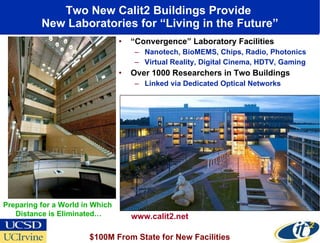
Two New Calit2 Buildings Provide  New Laboratories for “Living in the Future” “ Convergence” Laboratory Facilities Nanotech, BioMEMS, Chips, Radio, Photonics Virtual Reality, Digital Cinema, HDTV, Gaming Over 1000 Researchers in Two Buildings Linked via Dedicated Optical Networks UC Irvine www.calit2.net Preparing for a World in Which  Distance is Eliminated… $100M From State for New Facilities
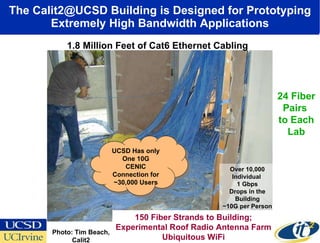
The Calit2@UCSD Building is Designed for Prototyping Extremely High Bandwidth Applications 1.8 Million Feet of Cat6 Ethernet Cabling 150 Fiber Strands to Building; Experimental Roof Radio Antenna Farm Ubiquitous WiFi Photo: Tim Beach, Calit2 Over 10,000 Individual  1 Gbps Drops in the Building ~10G per Person  UCSD Has only One 10G CENIC Connection for ~30,000 Users 24 Fiber Pairs  to Each Lab
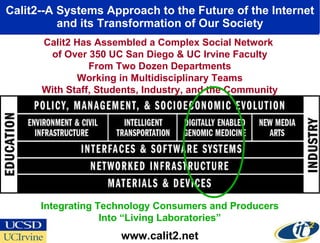
Calit2--A Systems Approach to the Future of the Internet and its Transformation of Our Society www.calit2.net Calit2 Has Assembled a Complex Social Network  of Over 350 UC San Diego & UC Irvine Faculty From Two Dozen Departments Working in Multidisciplinary Teams With Staff, Students, Industry, and the Community Integrating Technology Consumers and Producers Into “Living Laboratories”
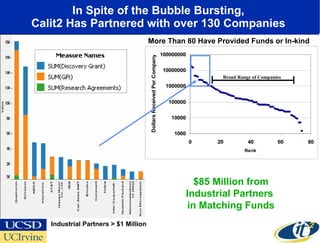
In Spite of the Bubble Bursting,  Calit2 Has Partnered with over 130 Companies  Industrial Partners > $1 Million $85 Million from Industrial Partners  in Matching Funds Broad Range of Companies More Than 80 Have Provided Funds or In-kind
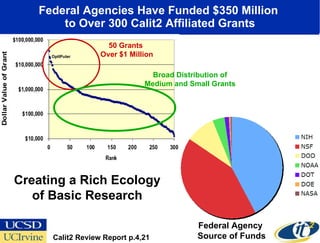
Federal Agencies Have Funded $350 Million  to Over 300 Calit2 Affiliated Grants Federal Agency  Source of Funds Creating a Rich Ecology of Basic Research 50 Grants  Over $1 Million Broad Distribution of Medium and Small Grants OptIPuter Calit2 Review Report p.4,21
Calit2 Brings Computer Scientists and Engineers  Together with Biomedical Researchers Some Areas of Concentration: Algorithmic and System Biology Bioinformatics Metagenomics Cancer Genomics Human Genomic Variation and Disease Proteomics Mitochondrial Evolution Biomedical Instruments Multi-Scale Cellular Imaging Information Theory and Biological Systems Telemedicine UC Irvine UC Irvine Southern California Telemedicine Learning Center (TLC)  National Biomedical Computation  Resource  an NIH supported resource center
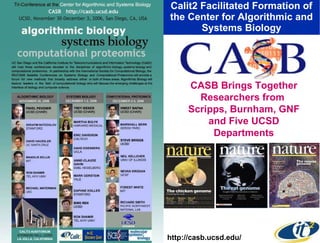
Calit2 Facilitated Formation of the Center for Algorithmic and Systems Biology http://casb.ucsd.edu/ CASB Brings Together Researchers from  Scripps, Burnham, GNF and Five UCSD Departments
Challenge: What is the Appropriate Data Infrastructure for a 21 st  Century Data-Intensive BioMedical Campus? Needed: a High Performance Biological Data Storage, Analysis, and Dissemination Cyberinfrastructure that Connects:  Genomic and Metagenomic Sequences MicroArrays Proteomics Cellular Pathways Federated Repositories of Multi-Scale Images Full Body to Microscopy  With Interactive Remote Control of Scientific Instruments Multi-level Storage and Scalable Computing Scalable Laboratory Visualization and Analysis Facilities High Definition Collaboration Facilities
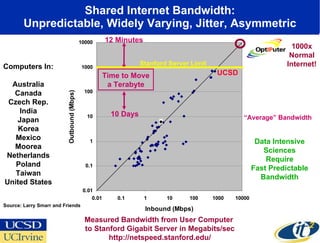
Shared Internet Bandwidth: Unpredictable, Widely Varying, Jitter, Asymmetric Measured Bandwidth from User Computer  to Stanford Gigabit Server in Megabits/sec http://netspeed.stanford.edu/ Computers In: Australia Canada Czech Rep. India Japan Korea Mexico Moorea Netherlands Poland Taiwan United States Data Intensive Sciences Require Fast Predictable Bandwidth UCSD Source: Larry Smarr and Friends Stanford Server Limit “ Average” Bandwidth 1000x Normal Internet! Time to Move a Terabyte 10 Days 12 Minutes
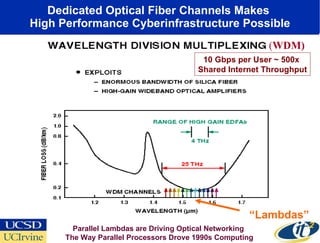
Dedicated Optical Fiber Channels Makes  High Performance Cyberinfrastructure Possible ( WDM) Parallel Lambdas are Driving Optical Networking  The Way Parallel Processors Drove 1990s Computing 10 Gbps per User ~ 500x  Shared Internet Throughput “ Lambdas”
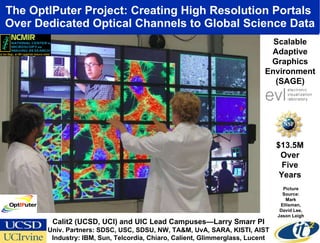
The OptIPuter Project: Creating High Resolution Portals  Over Dedicated Optical Channels to Global Science Data Picture Source: Mark Ellisman, David Lee, Jason Leigh Calit2 (UCSD, UCI) and UIC Lead Campuses—Larry Smarr PI Univ. Partners: SDSC, USC, SDSU, NW, TA&M, UvA, SARA, KISTI, AIST Industry: IBM, Sun, Telcordia, Chiaro, Calient, Glimmerglass, Lucent $13.5M Over Five Years Scalable Adaptive Graphics Environment (SAGE)
UCSD Planned Optical Networked Biomedical Researchers and Instruments Connects at 10 Gbps : Microarrays Genome Sequencers Mass Spectrometry Light and Electron Microscopes Whole Body Imagers Computing Storage UCSD Research Park Natural Sciences Building Creates Campus–Wide “ Data Utility” Cellular & Molecular Medicine West  National Center for Microscopy & Imaging Biomedical Research  Center for  Molecular Genetics  Pharmaceutical Sciences Building Cellular & Molecular Medicine East CryoElectron Microscopy Facility  Radiology Imaging Lab  Bioengineering [email_address] San Diego Supercomputer Center
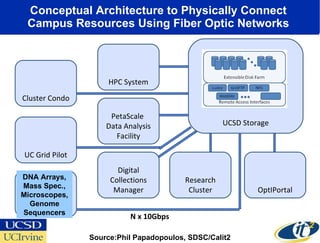
Conceptual Architecture to Physically Connect  Campus Resources Using Fiber Optic Networks  UCSD Storage OptIPortal Research Cluster Digital Collections Manager PetaScale  Data Analysis Facility HPC System Cluster Condo UC Grid Pilot Research Instrument N x 10Gbps Source:Phil Papadopoulos, SDSC/Calit2 DNA Arrays, Mass Spec., Microscopes, Genome Sequencers
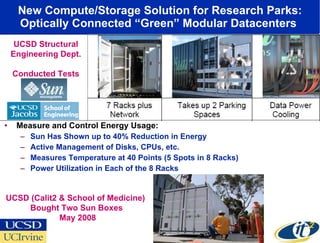
New Compute/Storage Solution for Research Parks: Optically Connected “Green” Modular Datacenters  Measure and Control Energy Usage: Sun Has Shown up to 40% Reduction in Energy Active Management of Disks, CPUs, etc. Measures Temperature at 40 Points (5 Spots in 8 Racks) Power Utilization in Each of the 8 Racks UCSD Structural Engineering Dept.  Conducted Tests May 2007 UCSD (Calit2 & School of Medicine)  Bought Two Sun Boxes May 2008
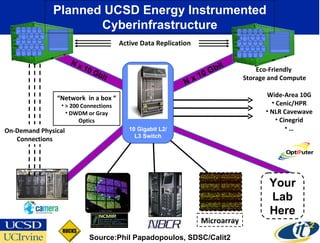
N x 10 Gbit N x 10 Gbit 10 Gigabit L2/L3 Switch Eco-Friendly  Storage and Compute Microarray Your Lab Here Planned UCSD Energy Instrumented Cyberinfrastructure On-Demand Physical Connections “ Network  in a box “ > 200 Connections DWDM or Gray Optics Active Data Replication Source:Phil Papadopoulos, SDSC/Calit2 Wide-Area 10G Cenic/HPR NLR Cavewave Cinegrid …
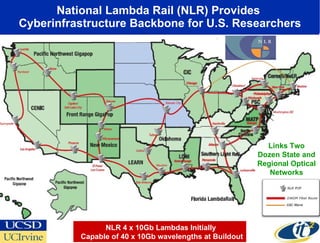
National Lambda Rail (NLR) Provides  Cyberinfrastructure Backbone for U.S. Researchers NLR 4 x 10Gb Lambdas Initially Capable of 40 x 10Gb wavelengths at Buildout Links Two Dozen State and Regional Optical Networks
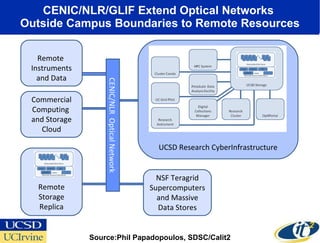
CENIC/NLR/GLIF Extend Optical Networks  Outside Campus Boundaries to Remote Resources UCSD Research CyberInfrastructure Remote  Instruments and Data Commercial Computing  and Storage Cloud Remote Storage Replica CENIC/NLR  Optical Network NSF Teragrid Supercomputers and Massive Data Stores Source:Phil Papadopoulos, SDSC/Calit2
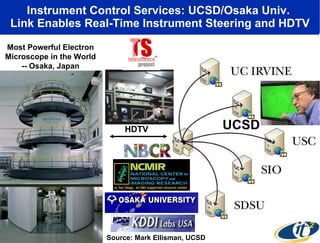
Instrument Control Services: UCSD/Osaka Univ.  Link Enables Real-Time Instrument Steering and HDTV Most Powerful Electron Microscope in the World -- Osaka, Japan Source: Mark Ellisman, UCSD UCSD HDTV
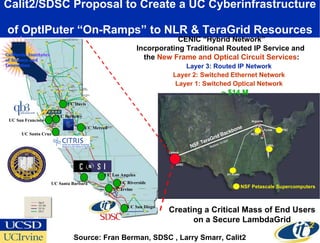
Calit2/SDSC Proposal to Create a UC Cyberinfrastructure  of OptIPuter “On-Ramps” to NLR & TeraGrid Resources NSF Petascale Supercomputers  UC San Francisco  UC San Diego  UC Riverside  UC Irvine  UC Davis  UC Berkeley UC Santa Cruz UC Santa Barbara  UC Los Angeles  UC Merced Source: Fran Berman, SDSC , Larry Smarr, Calit2 Creating a Critical Mass of End Users on a Secure LambdaGrid CENIC “Hybrid Network” Incorporating Traditional Routed IP Service and  the  New Frame and Optical Circuit Services : Layer 3: Routed IP Network Layer 2: Switched Ethernet Network Layer 1: Switched Optical Network ~ $14 M
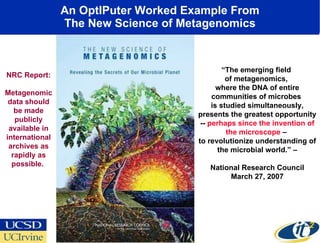
An OptIPuter Worked Example From The New Science of Metagenomics “ The emerging field  of metagenomics,  where the DNA of entire communities of microbes  is studied simultaneously, presents the greatest opportunity --  perhaps since the invention of the microscope  –  to revolutionize understanding of the microbial world.” – National Research Council March 27, 2007 NRC Report: Metagenomic data should be made publicly available in international archives as rapidly as possible.
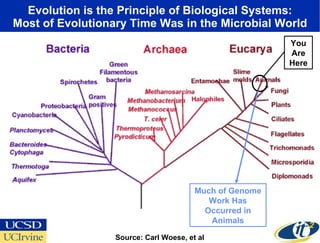
Evolution is the Principle of Biological Systems: Most of Evolutionary Time Was in the Microbial World Source: Carl Woese, et al You Are Here Much of Genome Work Has Occurred in Animals
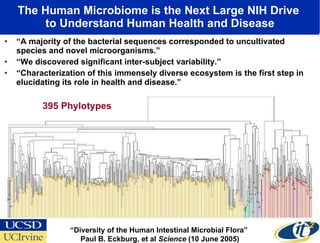
The Human Microbiome is the Next Large NIH Drive  to Understand Human Health and Disease “ A majority of the bacterial sequences corresponded to uncultivated species and novel microorganisms.”  “ We discovered significant inter-subject variability.”  “ Characterization of this immensely diverse ecosystem is the first step in elucidating its role in health and disease.” “ Diversity of the Human Intestinal Microbial Flora”  Paul B. Eckburg, et al  Science  (10 June 2005) 395 Phylotypes
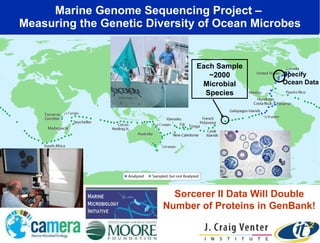
Marine Genome Sequencing Project –  Measuring the Genetic Diversity of Ocean Microbes Sorcerer II Data Will Double Number of Proteins in GenBank! Specify  Ocean Data  Each Sample ~2000 Microbial Species
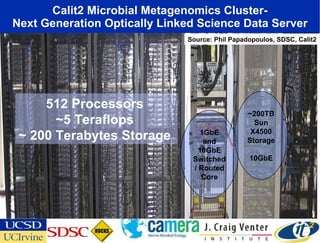
Calit2 Microbial Metagenomics Cluster- Next Generation Optically Linked Science Data Server 512 Processors  ~5 Teraflops  ~ 200 Terabytes Storage  1GbE and 10GbE Switched/ Routed Core ~200TB Sun X4500 Storage 10GbE Source: Phil Papadopoulos, SDSC, Calit2
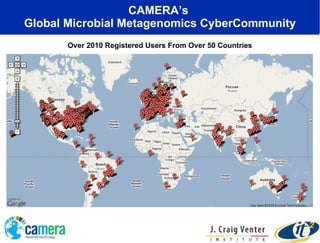
CAMERA’s  Global Microbial Metagenomics CyberCommunity Over 2010 Registered Users From Over 50 Countries
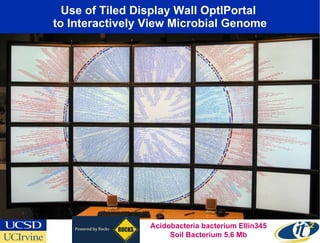
Use of Tiled Display Wall OptIPortal  to Interactively View Microbial Genome Acidobacteria bacterium Ellin345 Soil Bacterium 5.6 Mb
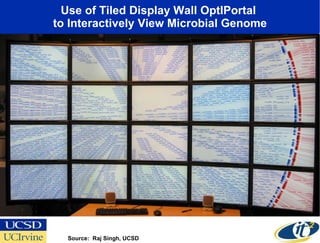
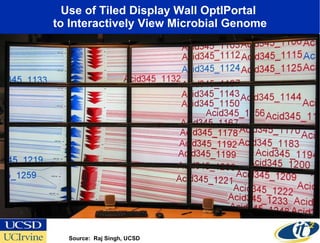
Use of Tiled Display Wall OptIPortal  to Interactively View Microbial Genome Source:  Raj Singh, UCSD
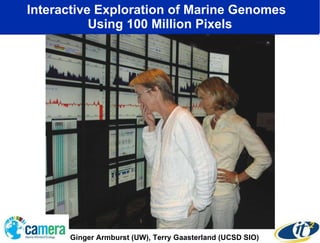
Interactive Exploration of Marine Genomes  Using 100 Million Pixels Ginger Armburst (UW), Terry Gaasterland (UCSD SIO)
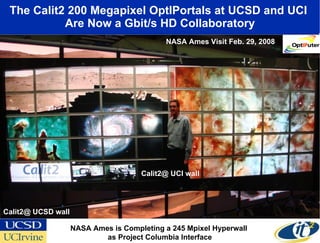
The Calit2 200 Megapixel OptIPortals at UCSD and UCI  Are Now a Gbit/s HD Collaboratory Calit2@ UCSD wall NASA Ames is Completing a 245 Mpixel Hyperwall  as Project Columbia Interface NASA Ames Visit Feb. 29, 2008 Calit2@ UCI wall
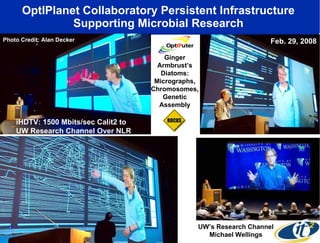
OptIPlanet Collaboratory Persistent Infrastructure  Supporting Microbial Research  Ginger Armbrust’s Diatoms: Micrographs, Chromosomes, Genetic Assembly Photo Credit: Alan Decker UW’s Research Channel Michael Wellings Feb. 29, 2008 iHDTV: 1500 Mbits/sec Calit2 to UW Research Channel Over NLR
OptIPortals Are Being Adopted Globally [email_address] UZurich SARA- Netherlands Brno-Czech Republic [email_address] U. Melbourne, Australia [email_address] KISTI-Korea [email_address] AIST-Japan CNIC-China NCHC-Taiwan Osaka U-Japan

High Performance Cyberinfrastructure to Support Data-Intensive Biomedical Research Instruments

  • 1.
    High Performance Cyberinfrastructureto Support Data-Intensive Biomedical Research Instruments Invited Talk Association of University Research Parks BioParks 2008 "From Discovery to Innovation" Salk Institute La Jolla, CA June 16, 2008 Dr. Larry Smarr Director, California Institute for Telecommunications and Information Technology Harry E. Gruber Professor, Dept. of Computer Science and Engineering Jacobs School of Engineering, UCSD ASSOCIATION OF UNIVERSITY RESEARCH PARKS BioParks 2008 San Diego, California June 16, 2008
  • 2.
    Abstract Calit2 isusing 10 gigabit/s optical paths to connect people and devices on local, regional, national, and global scales. On campus this cyberinfrastructure connects a variety of data-intensive biomedical instruments (DNA arrays, genome sequencers, mass spectrographs) to distributed computing/storage.
  • 3.
    Calit2 Continues toPursue Its Initial Mission: Envisioning How the Extension of Innovative Telecommunications and Information Technologies Throughout the Physical World will Transform Critical Applications Important to the California Economy and its Citizens’ Quality Of Life . Calit2 Review Report: p.1
  • 4.
    Two New Calit2Buildings Provide New Laboratories for “Living in the Future” “ Convergence” Laboratory Facilities Nanotech, BioMEMS, Chips, Radio, Photonics Virtual Reality, Digital Cinema, HDTV, Gaming Over 1000 Researchers in Two Buildings Linked via Dedicated Optical Networks UC Irvine www.calit2.net Preparing for a World in Which Distance is Eliminated… $100M From State for New Facilities
  • 5.
    The Calit2@UCSD Buildingis Designed for Prototyping Extremely High Bandwidth Applications 1.8 Million Feet of Cat6 Ethernet Cabling 150 Fiber Strands to Building; Experimental Roof Radio Antenna Farm Ubiquitous WiFi Photo: Tim Beach, Calit2 Over 10,000 Individual 1 Gbps Drops in the Building ~10G per Person UCSD Has only One 10G CENIC Connection for ~30,000 Users 24 Fiber Pairs to Each Lab
  • 6.
    Calit2--A Systems Approachto the Future of the Internet and its Transformation of Our Society www.calit2.net Calit2 Has Assembled a Complex Social Network of Over 350 UC San Diego & UC Irvine Faculty From Two Dozen Departments Working in Multidisciplinary Teams With Staff, Students, Industry, and the Community Integrating Technology Consumers and Producers Into “Living Laboratories”
  • 7.
    In Spite ofthe Bubble Bursting, Calit2 Has Partnered with over 130 Companies Industrial Partners > $1 Million $85 Million from Industrial Partners in Matching Funds Broad Range of Companies More Than 80 Have Provided Funds or In-kind
  • 8.
    Federal Agencies HaveFunded $350 Million to Over 300 Calit2 Affiliated Grants Federal Agency Source of Funds Creating a Rich Ecology of Basic Research 50 Grants Over $1 Million Broad Distribution of Medium and Small Grants OptIPuter Calit2 Review Report p.4,21
  • 9.
    Calit2 Brings ComputerScientists and Engineers Together with Biomedical Researchers Some Areas of Concentration: Algorithmic and System Biology Bioinformatics Metagenomics Cancer Genomics Human Genomic Variation and Disease Proteomics Mitochondrial Evolution Biomedical Instruments Multi-Scale Cellular Imaging Information Theory and Biological Systems Telemedicine UC Irvine UC Irvine Southern California Telemedicine Learning Center (TLC) National Biomedical Computation Resource an NIH supported resource center
  • 10.
    Calit2 Facilitated Formationof the Center for Algorithmic and Systems Biology http://casb.ucsd.edu/ CASB Brings Together Researchers from Scripps, Burnham, GNF and Five UCSD Departments
  • 11.
    Challenge: What isthe Appropriate Data Infrastructure for a 21 st Century Data-Intensive BioMedical Campus? Needed: a High Performance Biological Data Storage, Analysis, and Dissemination Cyberinfrastructure that Connects: Genomic and Metagenomic Sequences MicroArrays Proteomics Cellular Pathways Federated Repositories of Multi-Scale Images Full Body to Microscopy With Interactive Remote Control of Scientific Instruments Multi-level Storage and Scalable Computing Scalable Laboratory Visualization and Analysis Facilities High Definition Collaboration Facilities
  • 12.
    Shared Internet Bandwidth:Unpredictable, Widely Varying, Jitter, Asymmetric Measured Bandwidth from User Computer to Stanford Gigabit Server in Megabits/sec http://netspeed.stanford.edu/ Computers In: Australia Canada Czech Rep. India Japan Korea Mexico Moorea Netherlands Poland Taiwan United States Data Intensive Sciences Require Fast Predictable Bandwidth UCSD Source: Larry Smarr and Friends Stanford Server Limit “ Average” Bandwidth 1000x Normal Internet! Time to Move a Terabyte 10 Days 12 Minutes
  • 13.
    Dedicated Optical FiberChannels Makes High Performance Cyberinfrastructure Possible ( WDM) Parallel Lambdas are Driving Optical Networking The Way Parallel Processors Drove 1990s Computing 10 Gbps per User ~ 500x Shared Internet Throughput “ Lambdas”
  • 14.
    The OptIPuter Project:Creating High Resolution Portals Over Dedicated Optical Channels to Global Science Data Picture Source: Mark Ellisman, David Lee, Jason Leigh Calit2 (UCSD, UCI) and UIC Lead Campuses—Larry Smarr PI Univ. Partners: SDSC, USC, SDSU, NW, TA&M, UvA, SARA, KISTI, AIST Industry: IBM, Sun, Telcordia, Chiaro, Calient, Glimmerglass, Lucent $13.5M Over Five Years Scalable Adaptive Graphics Environment (SAGE)
  • 15.
    UCSD Planned OpticalNetworked Biomedical Researchers and Instruments Connects at 10 Gbps : Microarrays Genome Sequencers Mass Spectrometry Light and Electron Microscopes Whole Body Imagers Computing Storage UCSD Research Park Natural Sciences Building Creates Campus–Wide “ Data Utility” Cellular & Molecular Medicine West National Center for Microscopy & Imaging Biomedical Research Center for Molecular Genetics Pharmaceutical Sciences Building Cellular & Molecular Medicine East CryoElectron Microscopy Facility Radiology Imaging Lab Bioengineering [email_address] San Diego Supercomputer Center
  • 16.
    Conceptual Architecture toPhysically Connect Campus Resources Using Fiber Optic Networks UCSD Storage OptIPortal Research Cluster Digital Collections Manager PetaScale Data Analysis Facility HPC System Cluster Condo UC Grid Pilot Research Instrument N x 10Gbps Source:Phil Papadopoulos, SDSC/Calit2 DNA Arrays, Mass Spec., Microscopes, Genome Sequencers
  • 17.
    New Compute/Storage Solutionfor Research Parks: Optically Connected “Green” Modular Datacenters Measure and Control Energy Usage: Sun Has Shown up to 40% Reduction in Energy Active Management of Disks, CPUs, etc. Measures Temperature at 40 Points (5 Spots in 8 Racks) Power Utilization in Each of the 8 Racks UCSD Structural Engineering Dept. Conducted Tests May 2007 UCSD (Calit2 & School of Medicine) Bought Two Sun Boxes May 2008
  • 18.
    N x 10Gbit N x 10 Gbit 10 Gigabit L2/L3 Switch Eco-Friendly Storage and Compute Microarray Your Lab Here Planned UCSD Energy Instrumented Cyberinfrastructure On-Demand Physical Connections “ Network in a box “ > 200 Connections DWDM or Gray Optics Active Data Replication Source:Phil Papadopoulos, SDSC/Calit2 Wide-Area 10G Cenic/HPR NLR Cavewave Cinegrid …
  • 19.
    National Lambda Rail(NLR) Provides Cyberinfrastructure Backbone for U.S. Researchers NLR 4 x 10Gb Lambdas Initially Capable of 40 x 10Gb wavelengths at Buildout Links Two Dozen State and Regional Optical Networks
  • 20.
    CENIC/NLR/GLIF Extend OpticalNetworks Outside Campus Boundaries to Remote Resources UCSD Research CyberInfrastructure Remote Instruments and Data Commercial Computing and Storage Cloud Remote Storage Replica CENIC/NLR Optical Network NSF Teragrid Supercomputers and Massive Data Stores Source:Phil Papadopoulos, SDSC/Calit2
  • 21.
    Instrument Control Services:UCSD/Osaka Univ. Link Enables Real-Time Instrument Steering and HDTV Most Powerful Electron Microscope in the World -- Osaka, Japan Source: Mark Ellisman, UCSD UCSD HDTV
  • 22.
    Calit2/SDSC Proposal toCreate a UC Cyberinfrastructure of OptIPuter “On-Ramps” to NLR & TeraGrid Resources NSF Petascale Supercomputers UC San Francisco UC San Diego UC Riverside UC Irvine UC Davis UC Berkeley UC Santa Cruz UC Santa Barbara UC Los Angeles UC Merced Source: Fran Berman, SDSC , Larry Smarr, Calit2 Creating a Critical Mass of End Users on a Secure LambdaGrid CENIC “Hybrid Network” Incorporating Traditional Routed IP Service and the New Frame and Optical Circuit Services : Layer 3: Routed IP Network Layer 2: Switched Ethernet Network Layer 1: Switched Optical Network ~ $14 M
  • 23.
    An OptIPuter WorkedExample From The New Science of Metagenomics “ The emerging field of metagenomics, where the DNA of entire communities of microbes is studied simultaneously, presents the greatest opportunity -- perhaps since the invention of the microscope – to revolutionize understanding of the microbial world.” – National Research Council March 27, 2007 NRC Report: Metagenomic data should be made publicly available in international archives as rapidly as possible.
  • 24.
    Evolution is thePrinciple of Biological Systems: Most of Evolutionary Time Was in the Microbial World Source: Carl Woese, et al You Are Here Much of Genome Work Has Occurred in Animals
  • 25.
    The Human Microbiomeis the Next Large NIH Drive to Understand Human Health and Disease “ A majority of the bacterial sequences corresponded to uncultivated species and novel microorganisms.” “ We discovered significant inter-subject variability.” “ Characterization of this immensely diverse ecosystem is the first step in elucidating its role in health and disease.” “ Diversity of the Human Intestinal Microbial Flora” Paul B. Eckburg, et al Science (10 June 2005) 395 Phylotypes
  • 26.
    Marine Genome SequencingProject – Measuring the Genetic Diversity of Ocean Microbes Sorcerer II Data Will Double Number of Proteins in GenBank! Specify Ocean Data Each Sample ~2000 Microbial Species
  • 27.
    Calit2 Microbial MetagenomicsCluster- Next Generation Optically Linked Science Data Server 512 Processors ~5 Teraflops ~ 200 Terabytes Storage 1GbE and 10GbE Switched/ Routed Core ~200TB Sun X4500 Storage 10GbE Source: Phil Papadopoulos, SDSC, Calit2
  • 28.
    CAMERA’s GlobalMicrobial Metagenomics CyberCommunity Over 2010 Registered Users From Over 50 Countries
  • 29.
    Use of TiledDisplay Wall OptIPortal to Interactively View Microbial Genome Acidobacteria bacterium Ellin345 Soil Bacterium 5.6 Mb
  • 30.
    Use of TiledDisplay Wall OptIPortal to Interactively View Microbial Genome Source: Raj Singh, UCSD
  • 31.
    Use of TiledDisplay Wall OptIPortal to Interactively View Microbial Genome Source: Raj Singh, UCSD
  • 32.
    Interactive Exploration ofMarine Genomes Using 100 Million Pixels Ginger Armburst (UW), Terry Gaasterland (UCSD SIO)
  • 33.
    The Calit2 200Megapixel OptIPortals at UCSD and UCI Are Now a Gbit/s HD Collaboratory Calit2@ UCSD wall NASA Ames is Completing a 245 Mpixel Hyperwall as Project Columbia Interface NASA Ames Visit Feb. 29, 2008 Calit2@ UCI wall
  • 34.
    OptIPlanet Collaboratory PersistentInfrastructure Supporting Microbial Research Ginger Armbrust’s Diatoms: Micrographs, Chromosomes, Genetic Assembly Photo Credit: Alan Decker UW’s Research Channel Michael Wellings Feb. 29, 2008 iHDTV: 1500 Mbits/sec Calit2 to UW Research Channel Over NLR
  • 35.
    OptIPortals Are BeingAdopted Globally [email_address] UZurich SARA- Netherlands Brno-Czech Republic [email_address] U. Melbourne, Australia [email_address] KISTI-Korea [email_address] AIST-Japan CNIC-China NCHC-Taiwan Osaka U-Japan

Editor's Notes

  • #19 Packet network in a box --- E1200. Passive DWDM enables huge bandwidth.
  • #22 Accomplishment Instrument to OptIPuter resources data distribution architecture
  • #28 This is a production cluster with it’s own Force10 e1200 switch. It is connected to quartzite and is labeled as the “CAMERA Force10 E1200”. We built CAMERA this way because of technology deployed successfully in Quartzite
  • #36 Maybe add another slide to indicate which science groups are using this or working with this