EMPLOYEE VALUE PROPOSITION.
How and why your EVP plays a critical role in your
employer brand communications.
Welcome.
Today’s facilitator:
N. Robert Johnson, APR
Practice Leader, Workforce Communications Practice
Expectation setting.
Interested in a specific topic? Let us know.
• New ways of thinking about employer
brand, employee communications and
employee engagement
• Ideas that you can use
• All within 30 minutes
Recap of last webinar.
Creating Employer Brand Value. The plan to
develop and demonstrate employer brand value in
your organization.
• Measurable outcomes create employer brand value
• “Taking on” is the mantra: align employer brand
communications to issue (attraction, retention, etc.)
• Senior-level support and budget allocations are critical
elements
Today’s webinar.
Employee Value
Proposition.
How and why your EVP plays a critical role
in your employer brand communications.
But first ….
What is an employee value proposition?
It’s the employment deal that is derived
from the employee experience – everyday
experiences, rewards, growth opportunity –
and, in our world of talent communications,
it’s the foundation of an organization’s
reputation as a place to work.
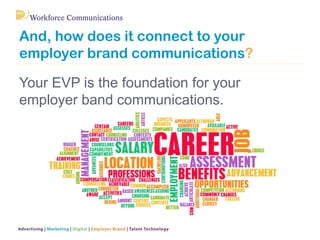
Your EVP is the foundation for your
employer band communications.
And, how does it connect to your
employer brand communications?
A heroic story.
Question: Which of the following is most
“heroic” for organizational success?
• Cultivating a culture to deliver on
business strategy
• Fostering behaviors that deliver on
business strategy
• Managers who “walk the talk”
Answer.
All of the Above
(uh, duh Bob!)
Companies with a clear employee value
proposition outperform their competitors.
The challenge is that many companies don’t have
or communicate a clear employee value
proposition.
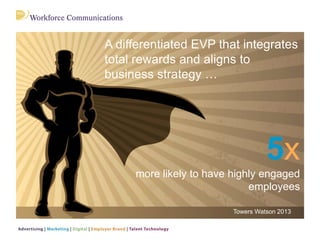
A differentiated EVP that integrates
total rewards and aligns to
business strategy …
5x
more likely to have highly engaged
employees
Towers Watson 2013
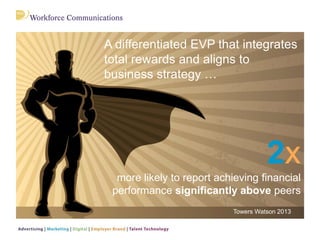
A differentiated EVP that integrates
total rewards and aligns to
business strategy …
2x
more likely to report achieving financial
performance significantly above peers
Towers Watson 2013
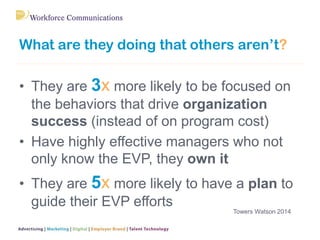
What are they doing that others aren’t?
• They are 3x more likely to be focused on
the behaviors that drive organization
success (instead of on program cost)
• Have highly effective managers who not
only know the EVP, they own it
• They are 5x more likely to have a plan to
guide their EVP efforts
Towers Watson 2014
How do we get there?
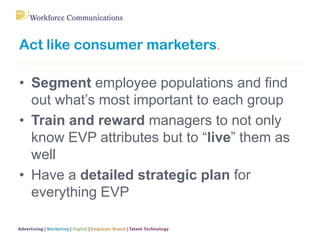
Act like consumer marketers.
• Segment employee populations and find
out what’s most important to each group
• Train and reward managers to not only
know EVP attributes but to “live” them as
well
• Have a detailed strategic plan for
everything EVP
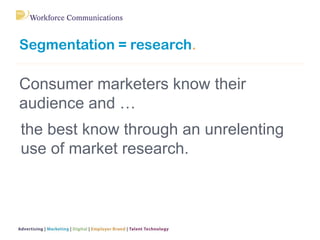
Segmentation = research.
Consumer marketers know their
audience and …
the best know through an unrelenting
use of market research.
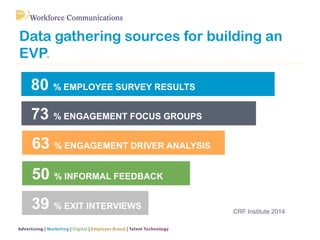
Data gathering sources for building an
EVP.
80 % EMPLOYEE SURVEY RESULTS
73 % ENGAGEMENT FOCUS GROUPS
63 % ENGAGEMENT DRIVER ANALYSIS
50 % INFORMAL FEEDBACK
39 % EXIT INTERVIEWS
CRF Institute 2014
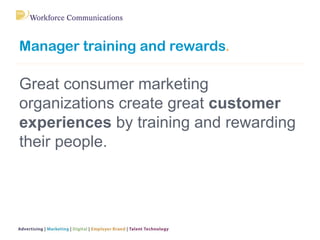
Manager training and rewards.
Great consumer marketing
organizations create great customer
experiences by training and rewarding
their people.
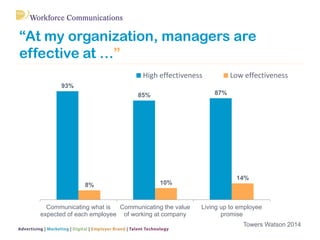
“At my organization, managers are
effective at …”
93%
85% 87%
8% 10%
14%
Communicating what is
expected of each employee
Communicating the value
of working at company
Living up to employee
promise
High effectiveness Low effectiveness
Towers Watson 2014
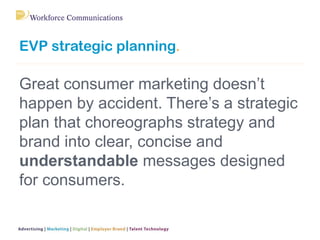
EVP strategic planning.
Great consumer marketing doesn’t
happen by accident. There’s a strategic
plan that choreographs strategy and
brand into clear, concise and
understandable messages designed
for consumers.
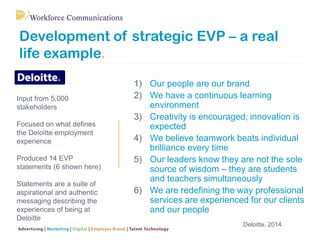
Development of strategic EVP – a real
life example.
1) Our people are our brand
2) We have a continuous learning
environment
3) Creativity is encouraged; innovation is
expected
4) We believe teamwork beats individual
brilliance every time
5) Our leaders know they are not the sole
source of wisdom – they are students
and teachers simultaneously
6) We are redefining the way professional
services are experienced for our clients
and our people
Input from 5,000
stakeholders
Focused on what defines
the Deloitte employment
experience
Produced 14 EVP
statements (6 shown here)
Statements are a suite of
aspirational and authentic
messaging describing the
experiences of being at
Deloitte
Deloitte. 2014
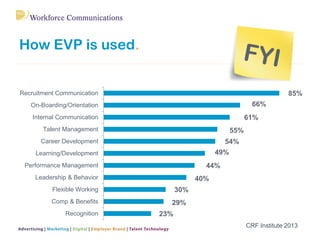
How EVP is used.
23%
29%
30%
40%
44%
49%
54%
55%
61%
66%
85%
Recognition
Comp & Benefits
Flexible Working
Leadership & Behavior
Performance Management
Learning/Development
Career Development
Talent Management
Internal Communication
On-Boarding/Orientation
Recruitment Communication
CRF Institute 2013
Summary – strategic EVP delivers.
Companies with a clear and differentiated
EVP outperform their competitors. It also
helps to …
• Attract passive candidates
• Re-engage your workforce
• Breaks “one-size-fits-all” model, allowing for
connections with niche candidates
• Changes the conversation (e.g. away from comp)
• Revitalizes talent recruitment
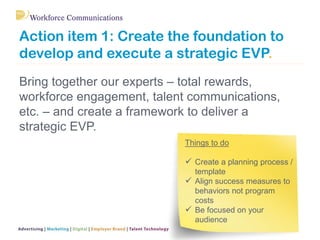
Action item 1: Create the foundation to
develop and execute a strategic EVP.
Bring together our experts – total rewards,
workforce engagement, talent communications,
etc. – and create a framework to deliver a
strategic EVP.
Things to do
 Create a planning process /
template
 Align success measures to
behaviors not program
costs
 Be focused on your
audience
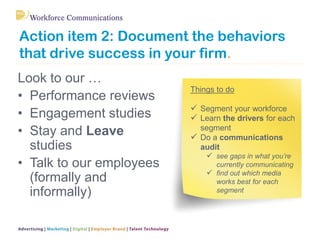
Action item 2: Document the behaviors
that drive success in your firm.
Look to our …
• Performance reviews
• Engagement studies
• Stay and Leave
studies
• Talk to our employees
(formally and
informally)
Things to do
 Segment your workforce
 Learn the drivers for each
segment
 Do a communications
audit
 see gaps in what you’re
currently communicating
 find out which media
works best for each
segment
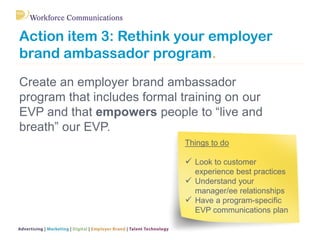
Action item 3: Rethink your employer
brand ambassador program.
Create an employer brand ambassador
program that includes formal training on our
EVP and that empowers people to “live and
breath” our EVP.
Things to do
 Look to customer
experience best practices
 Understand your
manager/ee relationships
 Have a program-specific
EVP communications plan
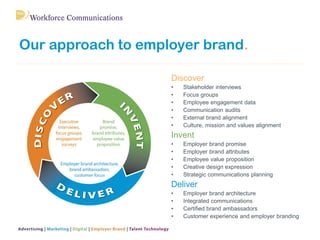
Our approach to employer brand.
Discover
• Stakeholder interviews
• Focus groups
• Employee engagement data
• Communication audits
• External brand alignment
• Culture, mission and values alignment
Invent
• Employer brand promise
• Employer brand attributes
• Employee value proposition
• Creative design expression
• Strategic communications planning
Deliver
• Employer brand architecture
• Integrated communications
• Certified brand ambassadors
• Customer experience and employer branding
To be determined – Stay tuned!
Thank you!
Offline questions?
Contact me at 216.685.4486
or nrjohnson@davidgroup.com
Our next webinar.

Employee Value Proposition. How and why your EVP plays a critical role in your employer brand communications.

  • 1.
    EMPLOYEE VALUE PROPOSITION. Howand why your EVP plays a critical role in your employer brand communications.
  • 2.
    Welcome. Today’s facilitator: N. RobertJohnson, APR Practice Leader, Workforce Communications Practice
  • 3.
    Expectation setting. Interested ina specific topic? Let us know. • New ways of thinking about employer brand, employee communications and employee engagement • Ideas that you can use • All within 30 minutes
  • 4.
    Recap of lastwebinar. Creating Employer Brand Value. The plan to develop and demonstrate employer brand value in your organization. • Measurable outcomes create employer brand value • “Taking on” is the mantra: align employer brand communications to issue (attraction, retention, etc.) • Senior-level support and budget allocations are critical elements
  • 5.
    Today’s webinar. Employee Value Proposition. Howand why your EVP plays a critical role in your employer brand communications.
  • 6.
    But first …. Whatis an employee value proposition? It’s the employment deal that is derived from the employee experience – everyday experiences, rewards, growth opportunity – and, in our world of talent communications, it’s the foundation of an organization’s reputation as a place to work.
  • 7.
    Your EVP isthe foundation for your employer band communications. And, how does it connect to your employer brand communications?
  • 8.
  • 9.
    Question: Which ofthe following is most “heroic” for organizational success? • Cultivating a culture to deliver on business strategy • Fostering behaviors that deliver on business strategy • Managers who “walk the talk”
  • 10.
    Answer. All of theAbove (uh, duh Bob!)
  • 11.
    Companies with aclear employee value proposition outperform their competitors. The challenge is that many companies don’t have or communicate a clear employee value proposition.
  • 12.
    A differentiated EVPthat integrates total rewards and aligns to business strategy … 5x more likely to have highly engaged employees Towers Watson 2013
  • 13.
    A differentiated EVPthat integrates total rewards and aligns to business strategy … 2x more likely to report achieving financial performance significantly above peers Towers Watson 2013
  • 14.
    What are theydoing that others aren’t? • They are 3x more likely to be focused on the behaviors that drive organization success (instead of on program cost) • Have highly effective managers who not only know the EVP, they own it • They are 5x more likely to have a plan to guide their EVP efforts Towers Watson 2014
  • 15.
    How do weget there?
  • 16.
    Act like consumermarketers. • Segment employee populations and find out what’s most important to each group • Train and reward managers to not only know EVP attributes but to “live” them as well • Have a detailed strategic plan for everything EVP
  • 17.
    Segmentation = research. Consumermarketers know their audience and … the best know through an unrelenting use of market research.
  • 18.
    Data gathering sourcesfor building an EVP. 80 % EMPLOYEE SURVEY RESULTS 73 % ENGAGEMENT FOCUS GROUPS 63 % ENGAGEMENT DRIVER ANALYSIS 50 % INFORMAL FEEDBACK 39 % EXIT INTERVIEWS CRF Institute 2014
  • 19.
    Manager training andrewards. Great consumer marketing organizations create great customer experiences by training and rewarding their people.
  • 20.
    “At my organization,managers are effective at …” 93% 85% 87% 8% 10% 14% Communicating what is expected of each employee Communicating the value of working at company Living up to employee promise High effectiveness Low effectiveness Towers Watson 2014
  • 21.
    EVP strategic planning. Greatconsumer marketing doesn’t happen by accident. There’s a strategic plan that choreographs strategy and brand into clear, concise and understandable messages designed for consumers.
  • 22.
    Development of strategicEVP – a real life example. 1) Our people are our brand 2) We have a continuous learning environment 3) Creativity is encouraged; innovation is expected 4) We believe teamwork beats individual brilliance every time 5) Our leaders know they are not the sole source of wisdom – they are students and teachers simultaneously 6) We are redefining the way professional services are experienced for our clients and our people Input from 5,000 stakeholders Focused on what defines the Deloitte employment experience Produced 14 EVP statements (6 shown here) Statements are a suite of aspirational and authentic messaging describing the experiences of being at Deloitte Deloitte. 2014
  • 23.
    How EVP isused. 23% 29% 30% 40% 44% 49% 54% 55% 61% 66% 85% Recognition Comp & Benefits Flexible Working Leadership & Behavior Performance Management Learning/Development Career Development Talent Management Internal Communication On-Boarding/Orientation Recruitment Communication CRF Institute 2013
  • 24.
    Summary – strategicEVP delivers. Companies with a clear and differentiated EVP outperform their competitors. It also helps to … • Attract passive candidates • Re-engage your workforce • Breaks “one-size-fits-all” model, allowing for connections with niche candidates • Changes the conversation (e.g. away from comp) • Revitalizes talent recruitment
  • 25.
    Action item 1:Create the foundation to develop and execute a strategic EVP. Bring together our experts – total rewards, workforce engagement, talent communications, etc. – and create a framework to deliver a strategic EVP. Things to do  Create a planning process / template  Align success measures to behaviors not program costs  Be focused on your audience
  • 26.
    Action item 2:Document the behaviors that drive success in your firm. Look to our … • Performance reviews • Engagement studies • Stay and Leave studies • Talk to our employees (formally and informally) Things to do  Segment your workforce  Learn the drivers for each segment  Do a communications audit  see gaps in what you’re currently communicating  find out which media works best for each segment
  • 27.
    Action item 3:Rethink your employer brand ambassador program. Create an employer brand ambassador program that includes formal training on our EVP and that empowers people to “live and breath” our EVP. Things to do  Look to customer experience best practices  Understand your manager/ee relationships  Have a program-specific EVP communications plan
  • 28.
    Our approach toemployer brand. Discover • Stakeholder interviews • Focus groups • Employee engagement data • Communication audits • External brand alignment • Culture, mission and values alignment Invent • Employer brand promise • Employer brand attributes • Employee value proposition • Creative design expression • Strategic communications planning Deliver • Employer brand architecture • Integrated communications • Certified brand ambassadors • Customer experience and employer branding
  • 29.
    To be determined– Stay tuned! Thank you! Offline questions? Contact me at 216.685.4486 or nrjohnson@davidgroup.com Our next webinar.