Let the Right Ones In:
Scholar-Librarian Collaborations in
Building Digital Humanities
Research
Harriett Green
University of Illinois at Urbana-Champaign

University of Michigan Libraries
October 28, 2013
green19@illinois.edu

@greenharr
How researchers and librarians can
collaborate
•
•
•
•

why librarians and DH?
collaborations with Professor Underwood
collaborations with other researchers
researcher-librarian collaborations in digital
humanities  New opportunities for library
and information professionals to embed
themselves in the scholarly research workflow
green19@illinois.edu

@greenharr
What is the digital humanities?
“The application of algorithmically facilitated
search, retrieval, and critical processes
that, originating in humanities-based work, have been
demonstrated to have application far beyond.
Associated with critical theory, this area is typified by
interpretative studies that assist in our intellectual and
aesthetic understanding of humanistic works.”
A Companion to Digital Humanities, edited by Susan
Schreibman, Ray Siemens, and John Unsworth (2004)

green19@illinois.edu

@greenharr

3
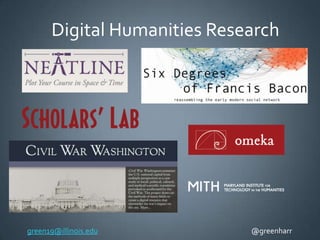
Digital Humanities Research

green19@illinois.edu

@greenharr
Collaboratories
“A center without walls, in which researchers can
perform their research without regard to physical
location-interacting with colleagues, accessing
instrumentation, sharing data and computational
resources, and accessing information in digital
libraries.”
—W.A. Wulf, “The Collaboratory Opportunity,”
Science (1993)

green19@illinois.edu

@greenharr

5
What is the role of the library in DH?
“[The] Digital Humanities revolution promotes a
fundamental reshaping of the research and
teaching landscape. It recasts the scholar as
curator and the curator as scholar, and, in so doing,
sets out both to reinvigorate scholarly practice by
means of an expanded set of possibilities and
demands, and to renew the scholarly mission of
museums, libraries, and archives.”
—Digital Humanities Manifesto 2.0 , 2009
(http://www.humanitiesblast.com/manifesto/Manif
esto_V2.pdf)
green19@illinois.edu

@greenharr
collaborations with Ted
• Mellon text-mining project: SEASR, Nora,
MONK
• Hathi Trust Research Center
• Graduate Training

green19@illinois.edu

@greenharr
Collaborations with other scholars
• Teaching: Omeka, digital publishing, Scalar
• Research consultations: Humanities data and
DH tools
• Scholarly Commons
• NEH-funded research collaboration:
Emblematica Online
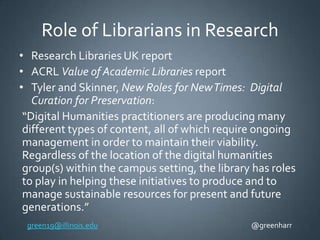
Role of Librarians in Research
• Research Libraries UK report
• ACRL Value of Academic Libraries report
• Tyler and Skinner, New Roles for New Times: Digital
Curation for Preservation:
“Digital Humanities practitioners are producing many
different types of content, all of which require ongoing
management in order to maintain their viability.
Regardless of the location of the digital humanities
group(s) within the campus setting, the library has roles
to play in helping these initiatives to produce and to
manage sustainable resources for present and future
generations.”
green19@illinois.edu

@greenharr
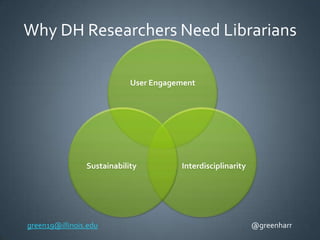
Why DH Researchers Need Librarians
User Engagement

Sustainability

green19@illinois.edu

Interdisciplinarity

@greenharr
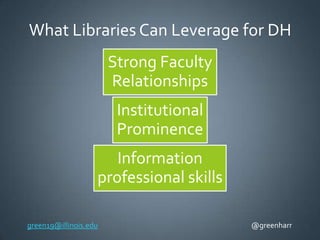
What Libraries Can Leverage for DH
Strong Faculty
Relationships

Institutional
Prominence
Information
professional skills
green19@illinois.edu

@greenharr
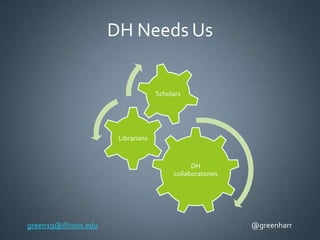
DH Needs Us

Scholars

Librarians

DH
collaboratories

green19@illinois.edu

@greenharr
Thank you!
Harriett Green
English and Digital Humanities Librarian
University of Illinois at Urbana-Champaign

green19@illinois.edu
Twitter: @greenharr
Handout:
https://uofi.box.com/hgreen-umichhandout

UMichigan Library Emergent Research slides

  • 1.
    Let the RightOnes In: Scholar-Librarian Collaborations in Building Digital Humanities Research Harriett Green University of Illinois at Urbana-Champaign University of Michigan Libraries October 28, 2013 green19@illinois.edu @greenharr
  • 2.
    How researchers andlibrarians can collaborate • • • • why librarians and DH? collaborations with Professor Underwood collaborations with other researchers researcher-librarian collaborations in digital humanities  New opportunities for library and information professionals to embed themselves in the scholarly research workflow green19@illinois.edu @greenharr
  • 3.
    What is thedigital humanities? “The application of algorithmically facilitated search, retrieval, and critical processes that, originating in humanities-based work, have been demonstrated to have application far beyond. Associated with critical theory, this area is typified by interpretative studies that assist in our intellectual and aesthetic understanding of humanistic works.” A Companion to Digital Humanities, edited by Susan Schreibman, Ray Siemens, and John Unsworth (2004) green19@illinois.edu @greenharr 3
  • 4.
  • 5.
    Collaboratories “A center withoutwalls, in which researchers can perform their research without regard to physical location-interacting with colleagues, accessing instrumentation, sharing data and computational resources, and accessing information in digital libraries.” —W.A. Wulf, “The Collaboratory Opportunity,” Science (1993) green19@illinois.edu @greenharr 5
  • 6.
    What is therole of the library in DH? “[The] Digital Humanities revolution promotes a fundamental reshaping of the research and teaching landscape. It recasts the scholar as curator and the curator as scholar, and, in so doing, sets out both to reinvigorate scholarly practice by means of an expanded set of possibilities and demands, and to renew the scholarly mission of museums, libraries, and archives.” —Digital Humanities Manifesto 2.0 , 2009 (http://www.humanitiesblast.com/manifesto/Manif esto_V2.pdf) green19@illinois.edu @greenharr
  • 7.
    collaborations with Ted •Mellon text-mining project: SEASR, Nora, MONK • Hathi Trust Research Center • Graduate Training green19@illinois.edu @greenharr
  • 8.
    Collaborations with otherscholars • Teaching: Omeka, digital publishing, Scalar • Research consultations: Humanities data and DH tools • Scholarly Commons • NEH-funded research collaboration: Emblematica Online
  • 9.
    Role of Librariansin Research • Research Libraries UK report • ACRL Value of Academic Libraries report • Tyler and Skinner, New Roles for New Times: Digital Curation for Preservation: “Digital Humanities practitioners are producing many different types of content, all of which require ongoing management in order to maintain their viability. Regardless of the location of the digital humanities group(s) within the campus setting, the library has roles to play in helping these initiatives to produce and to manage sustainable resources for present and future generations.” green19@illinois.edu @greenharr
  • 10.
    Why DH ResearchersNeed Librarians User Engagement Sustainability green19@illinois.edu Interdisciplinarity @greenharr
  • 11.
    What Libraries CanLeverage for DH Strong Faculty Relationships Institutional Prominence Information professional skills green19@illinois.edu @greenharr
  • 12.
  • 13.
    Thank you! Harriett Green Englishand Digital Humanities Librarian University of Illinois at Urbana-Champaign green19@illinois.edu Twitter: @greenharr Handout: https://uofi.box.com/hgreen-umichhandout

Editor's Notes

  • #5 The American Memory archive at the Library of Congress; proprietary databases such as Eighteenth Century Collections Online and ARTStor; Google Books: digital collections are becoming increasingly instrumental in how humanities scholars find and use research resources. For the past couple decades, the focus was on quantity: How much material can a library or museum digitize and post online? (Zick 689) But now we in libraries ask: How can digital collections meet scholars’ research needs? In answer to this question, I’d like to briefly talk about The Bamboo Technology Project and within it, my study of humanities scholars and digital collections.