International Accounting for
Managers
Lecture 5
Budgeting
(Gowthorpe, Chapter 16)
for life in buildings
Budgeting
•The most familiar financial document and
most familiar financial procedure for the
non-financial professional.
•A measure of your status in an organisation
– you know you have some authority when
you have a budget.
•There’s much more to it than simply
numbers.
Reading
•We’ll cover
•FUNCTIONAL BUDGETS
•CASH BUDGETS
•FLEXIBLE BUDGETS
•CONTINUOUS (ROLLING) BUDGETING
AND ZERO BASE BUDGETING, as
opposed to incremental budgeting (pp321
and 322).
•BUDGETS AND HUMAN BEHAVIOUR.
Budgeting
•We won’t have anything to do with
•PUBLIC SECTOR BUDGETS – includes
PPBS.
•“BEYOND BUDGETING” (p334).
•ACTIVITY BASED BUDGETING.
Budgeting
•“No firm plans to fail, but failing
firms have often failed to plan”
•“A budget is a financial plan covering
the whole enterprise over a specific
period of time and accounts for all the
enterprise’s resources. It aims to
allocate those resources in the most
beneficial manner.”
Budget period
•In most organisations, budgets are
prepared for 12 months, from the start of
one 12-month accounting period to its end,
but note the rise of
CONTINUOUS(ROLLING) BUDGETING –
more on this later.
•Some individual budgets, e.g. R&D
(research and development), might go on
for a number of years, especially in large-
scale industries such as public works,
shipbuilding, aero engines, etc.
Approaches
• Incremental budgeting; still common in public
sector. Does not encourage value-adding
activities. Simple approach; cash-limit driven. Can
lead to SLACK. However it’s quick and cheap.
• Top-down budget; dictatorial style; common in the
smaller business; discourages initiative, and
depends on the top manager’s skill. Stifling, but
has its place!
• Bottom-up budget; recommended – allows initiative
and responsibility to be shared. Facilitates
participatory approaches.
The Planning Process
•Identify the overall objectives of the
organisation.
•Identify potential strategies.
•Evaluate alternative strategic options.
•Select course of action.
•Implement long-term plan.
•Monitor actual results.
•Respond to divergences from plan.
Why Produce Budgets?
• Planning.
• Co-ordination.
• Communication.
• Motivation.
• Control.
• Evaluation.
• Some authors add;
• Delegation.
• Authorisation.
Planning
• Failure to plan is an explanation often advanced for
the widespread collapse of the so-called “dotcoms”
in 2001/2.
• About 20 years ago, a number of organisations
questioned the use of budgets, and moved to
BEYOND BUDGETING. This has not found popular
acceptance, and we will not consider the matter
further. The “tighter” economic conditions since
2008 have seen a notable reduction of interest in
“beyond budgeting”.
Co-Ordination
•Co-ordination is a major reason for
budgeting.
•In a large, divisionalised, departmentalised
organisation, it is essential to co-ordinate
activities for the benefit of the organisation
as a whole.
•There needs to be a system for ensuring
everyone sticks to the aims of their firm.
Co Ordination
•There is no point in a sales manager
drafting an ambitious budget if there isn’t
enough inventory to sell.
•There is no point in a production manager
budgeting for production if the factors of
production are not available, or if the
inventory won’t sell.
•Budgets therefore demand discussion
between departments to work in the firm’s
best interests.
Communication
•This takes place in several ways.
•Top management uses the budget to
communicate its strategic objectives for
the budget period.
•At more junior levels, individual
managers will clearly have to interface
with more senior managers to negotiate
and agree budget targets and
allocations.
Communication
•A wider aspect of communication is
that the budget is often the only time
in which individual departmental
managers talk to other managers
outside their own department.
•This is of course necessary to co-
ordinate the activities of the
organisation.
Motivation
•A good budget should MOTIVATE staff
to perform well.
•People perform better if they have a
target to aim at. The target must be
ATTAINABLE.
•Risk of complacency or despondency if
no motivation.
•The benefit of a target is increased
where people have a say in the setting
of targets.
Motivation
•A good way of improving motivation is
to let somebody set their own target
(within limits) This will be reviewed by
an individual’s line manager to ensure it
is in keeping within the firm’s overall
objectives and that it is sufficiently
challenging.
•The person responsible for the budget
then feels that s/he owns their budget.
Control
•The budget is an integral part
of a business’ control system.
•Managers can use the budget
to trace what belongs to an
organisation and the use to
which it is put.
•Budgets allow management by
exception.
Evaluation
•Establishing a target allows us to compare
actual performance with the budget.
•A manager’s performance can then be
evaluated according to how well s/he did
compared to the budget.
•If a manager proves competent at handling
a junior role, they may be rewarded with
promotion.
Delegation and Authorisation
•Some authors add these – such
qualities can be easily seen in
most budgets, especially bottom-
up budgets.
Budget preparation
•The next few slides guide us through
a typical budget preparation exercise
in a commercial organisation.
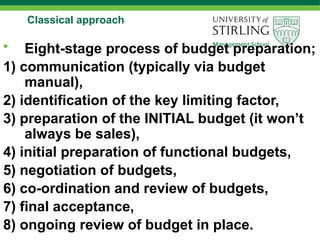
Classical approach
• Eight-stage process of budget preparation;
1) communication (typically via budget
manual),
2) identification of the key limiting factor,
3) preparation of the INITIAL budget (it won’t
always be sales),
4) initial preparation of functional budgets,
5) negotiation of budgets,
6) co-ordination and review of budgets,
7) final acceptance,
8) ongoing review of budget in place.
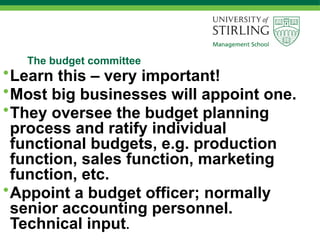
The budget committee
•Learn this – very important!
•Most big businesses will appoint one.
•They oversee the budget planning
process and ratify individual
functional budgets, e.g. production
function, sales function, marketing
function, etc.
•Appoint a budget officer; normally
senior accounting personnel.
Technical input.
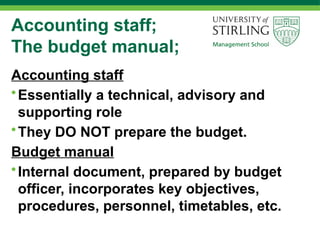
Accounting staff;
The budget manual;
Accounting staff
•Essentially a technical, advisory and
supporting role
•They DO NOT prepare the budget.
Budget manual
•Internal document, prepared by budget
officer, incorporates key objectives,
procedures, personnel, timetables, etc.
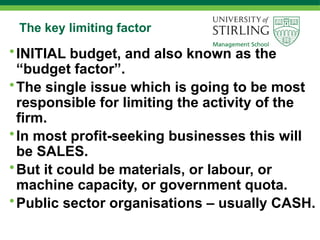
The key limiting factor
•INITIAL budget, and also known as the
“budget factor”.
•The single issue which is going to be most
responsible for limiting the activity of the
firm.
•In most profit-seeking businesses this will
be SALES.
•But it could be materials, or labour, or
machine capacity, or government quota.
•Public sector organisations – usually CASH.
The first budget
•There are many difficulties
inherent in preparing the sales
budget – a lot of external
variables exist, such as customer
demand, competitor activity and
general economic conditions.
Initial preparation of functional budgets
•This should originate at the most junior
level of management, e.g. factory
foreman/supervisor.
•This person knows their own section
better than anyone else. They will be
interested in the small, everyday
details, e.g. idle time, machine
breakdown and maintenance,
absenteeism, etc.
Initial preparation of
functional budgets
•Participation in this way ought to fuel
motivation.
•How does one actually insert the figures?
Details contained in budget manual, and co-
ordination necessary with sales function.
Incremental approaches are common.
•Generally, production budget succeeds sales
budget, and materials budget follows
production budget.
Negotiation
•Review of the budget should reduce the
risk of BUDGET SLACK.
•A balance should be taken; arrogance
on the part of senior management may
be repaid with poorer performance and
ultimately high job turnover, which
would benefit competitors.
Co-ordination and review.
•The budget officer should keep a
careful watch that budgets are co-
ordinated with each other to avoid
wastage and delay.
•As budgets progress up the functional
ladder, less attention is paid to small
details. Top managers are more
interested in global totals, budgets
might even be prepared to the nearest
£1,000,000.
Final acceptance
•The MASTER BUDGET is the ultimate output.
For Board level ratification.
•Budgeted Statement of Profit or Loss,
Budgeted Statement of Financial Position,
Budgeted Statement of Cash Flows
•Cash budget also incorporated with this.
•Global totals; different informational needs –
top directors concerned with strategy.
Ongoing review
•Budgets should not be left in a drawer to
gather dust!
•Comparisons between the budget and the
actual are made and sent to individual
managers, who are asked to comment on
the differences (known as variances).
•How often should this be done? Daily?
•Too frequent? Don’t notice change.
Ongoing review
•May be necessary to FLEX the budget
to reflect actual level of output; easily
done via a spreadsheet.
•This is FLEXIBLE BUDGETING.
•The preparation of the budget is the
START of the process; it is not an end
in itself.
Flexible budgeting
•A problem with conventional fixed
budgets is their inflexibility.
•So we can ameliorate this difficulty with
some FLEXIBILITY.
•FLEXIBLE BUDGETS incorporate a
range of budget totals, based on
differing levels of activity. Very
important to remember basic details of
how costs vary with activity.
Continuous (rolling) budgets
•Obsolescence is a key problem in
budgeting for 12 months.
•Obsolescence leads to lack of respect
for the budget, even to completely
ignoring it.
•This can be obviated by the “3 + 9”
quarterly-updated CONTINUOUS OR
ROLLING BUDGET.
Continuous (rolling) budgeting
•In this technique, we always look ahead 12
months at the end of each 3 month period.
•So budgets are kept frequently up to date
and thus more credible.
•But continuous budgeting has its critics –
what do you do about colleagues who are
jaded by having to supply budget figures
every 3 months?
Zero base budgeting
•Big contrast to the commonplace
INCREMENTAL approach. Managers
start with an allocation of zero.
•ZBB is very good at cutting excess
costs.
•Seen in both public and private sector
organisations.
•Encourages a questioning attitude.
Zero base budgeting
•Very expensive and time consuming.
•Requires high level negotiating skills;
handle carefully!
•Sometimes regarded as a periodic
“purge”.
•Not achieved universal uptake.
Incremental Budgets
•Still useful where the environment is
stable.
•Cheaper, due to speed and simplicity
•Information already available
•Easy to understand by non-financial
managers. Needs little, if any, technical
accounting support.
Incremental Budgets
Problems
•Builds on wasteful practices of prior
years.
•Encourages spending up to the budget
limit (poor behaviour).
•Ignores cost drivers.
•Unsuitable in dynamic environments.
•Encourages BUDGET SLACK.
Cash budgeting
• Objective here is to identify potential cash
shortfalls and also large cash surpluses.
• We can then do something about them.
• You need some idea of the nature, amount and
timing of cash inflows and cash outflows.
• Ignore anything which isn’t cash, e.g.
depreciation, general provisions, etc.
• Borrowing money from a bank to set up a
business? You’ll need a BUSINESS PLAN, which
is basically the same thing as a cash budget.
Cash budgeting
•They need frequent review; wise to do it on a
weekly basis for about 6-8 week time
horizons. Use some element of SENSITIVITY
ANALYSIS.
•Revise frequently.
•Take steps to obviate or mitigate cash
shortage, e.g. extension of overdraft, delay
purchasing non-current assets, accelerate
inflows, delay cash outflows, but beware
poor reputation from late payment policy.
Cash budgets
•Set up your cash budget with income in
the top row (there may be more than one
source of income), leaving a line for total
income if need be.
•Then set up your rows for expenses.
Ignore non-cash items. The most well
known non-cash item is depreciation, so
watch out for it!
Cash budgets
•Other non-cash items include
accruals, and general provisions for
things like bad debts. Don’t include
them in your cash budget.
•In a cash budget, we’re only
interested in cash receipts and cash
payments.
Cash budgets
• Formats differ, but in many cases, the final part
of the cash budget will be the cash balance
figure.
• You will always be given a figure of opening
cash. Add or subtract the net cash position for
the week/month and get a new balance.
Cash budgets
•You may find that the new balance shows a
negative figure bigger than the size of the
permitted overdraft.
•So, action must be taken. The next slide
gives a list of possible steps which could
be taken to alleviate a potential cash
shortage.
Suggestions to alleviate a cash shortage
• Accelerate receivables.
• Delay payables.
• Defer/cancel spending on new Non
Current Assets.
• Arrange an extension to the overdraft.
• Lease – don’t buy.
• If you must buy new assets, pay via
instalments.
Cash budgets
• Of course, you will need to make any requests for delay of
payables or acceleration of receivables in a way to
preserve good terms of trade.
• A good cash budget may persuade a lender to offer
temporary credit.
• If possible, one could sell an asset or introduce funds
from private resources.
• It’s unwise to delay payments to official agencies. They
are after the money quickly and are not interested in
taking a long-term view.
Budgets and human behaviour
•Given the importance of the budget process,
and the linkage between budget performance
and manager remuneration, dysfunctional
behaviour is hardly surprising!
•Here are some brief details on facets of
misbehaviour. In most circumstances, we are
talking about GOAL INCONGRUENCE as a
key influence. Pages 332-334.
Budget slack
•The most commonly identified
misbehaviour.
•Occurs where a manager wants to earn a
bonus (or kudos) and enjoy an easy life.
•So, they build “padding” into the budget,
the budget is easily achievable; they might,
of course, pretend it’s tricky to meet!
Incremental budgeting encourages slack.
•Standard solutions include; staff rotation,
ZBB, higher targets, etc.
Budget passing
•Refers to a situation where a manager
tries to pass on costs from their
department onto other departments.
•Objective is to keep costs down in his/her
own department.
•Difficult to cure, but justifies the
existence of clear lines of demarcation.
Budget-constrained style of
operation
•More of a fault with a system than a fault of
any person.
•Refers to a situation where little or nothing
gets done unless it’s in the budget.
•“What gets measured, gets done”.
•So it can lead to ignoring other, essential
aspects of business, such as delivery times,
quality, innovation etc.
Budget-constrained
style of operation (2)
•Will result in a rigidity of thought and action.
•The budget becomes an annual ritual.
•Short term focus.
•Leads managers to spend to the budget –
why do so many public authorities carry out
so much work in February and March?
Profit conscious style
•Argued that it’s better at creating value
than budget-constrained systems
•However, it can lead to too much cost
cutting, and a reluctance to invest in
new plant & machinery, so discourages
efficiency gains.

LECTURE accounting information system of

  • 1.
    International Accounting for Managers Lecture5 Budgeting (Gowthorpe, Chapter 16) for life in buildings
  • 2.
    Budgeting •The most familiarfinancial document and most familiar financial procedure for the non-financial professional. •A measure of your status in an organisation – you know you have some authority when you have a budget. •There’s much more to it than simply numbers.
  • 3.
    Reading •We’ll cover •FUNCTIONAL BUDGETS •CASHBUDGETS •FLEXIBLE BUDGETS •CONTINUOUS (ROLLING) BUDGETING AND ZERO BASE BUDGETING, as opposed to incremental budgeting (pp321 and 322). •BUDGETS AND HUMAN BEHAVIOUR.
  • 4.
    Budgeting •We won’t haveanything to do with •PUBLIC SECTOR BUDGETS – includes PPBS. •“BEYOND BUDGETING” (p334). •ACTIVITY BASED BUDGETING.
  • 5.
    Budgeting •“No firm plansto fail, but failing firms have often failed to plan” •“A budget is a financial plan covering the whole enterprise over a specific period of time and accounts for all the enterprise’s resources. It aims to allocate those resources in the most beneficial manner.”
  • 6.
    Budget period •In mostorganisations, budgets are prepared for 12 months, from the start of one 12-month accounting period to its end, but note the rise of CONTINUOUS(ROLLING) BUDGETING – more on this later. •Some individual budgets, e.g. R&D (research and development), might go on for a number of years, especially in large- scale industries such as public works, shipbuilding, aero engines, etc.
  • 7.
    Approaches • Incremental budgeting;still common in public sector. Does not encourage value-adding activities. Simple approach; cash-limit driven. Can lead to SLACK. However it’s quick and cheap. • Top-down budget; dictatorial style; common in the smaller business; discourages initiative, and depends on the top manager’s skill. Stifling, but has its place! • Bottom-up budget; recommended – allows initiative and responsibility to be shared. Facilitates participatory approaches.
  • 8.
    The Planning Process •Identifythe overall objectives of the organisation. •Identify potential strategies. •Evaluate alternative strategic options. •Select course of action. •Implement long-term plan. •Monitor actual results. •Respond to divergences from plan.
  • 9.
    Why Produce Budgets? •Planning. • Co-ordination. • Communication. • Motivation. • Control. • Evaluation. • Some authors add; • Delegation. • Authorisation.
  • 10.
    Planning • Failure toplan is an explanation often advanced for the widespread collapse of the so-called “dotcoms” in 2001/2. • About 20 years ago, a number of organisations questioned the use of budgets, and moved to BEYOND BUDGETING. This has not found popular acceptance, and we will not consider the matter further. The “tighter” economic conditions since 2008 have seen a notable reduction of interest in “beyond budgeting”.
  • 11.
    Co-Ordination •Co-ordination is amajor reason for budgeting. •In a large, divisionalised, departmentalised organisation, it is essential to co-ordinate activities for the benefit of the organisation as a whole. •There needs to be a system for ensuring everyone sticks to the aims of their firm.
  • 12.
    Co Ordination •There isno point in a sales manager drafting an ambitious budget if there isn’t enough inventory to sell. •There is no point in a production manager budgeting for production if the factors of production are not available, or if the inventory won’t sell. •Budgets therefore demand discussion between departments to work in the firm’s best interests.
  • 13.
    Communication •This takes placein several ways. •Top management uses the budget to communicate its strategic objectives for the budget period. •At more junior levels, individual managers will clearly have to interface with more senior managers to negotiate and agree budget targets and allocations.
  • 14.
    Communication •A wider aspectof communication is that the budget is often the only time in which individual departmental managers talk to other managers outside their own department. •This is of course necessary to co- ordinate the activities of the organisation.
  • 15.
    Motivation •A good budgetshould MOTIVATE staff to perform well. •People perform better if they have a target to aim at. The target must be ATTAINABLE. •Risk of complacency or despondency if no motivation. •The benefit of a target is increased where people have a say in the setting of targets.
  • 16.
    Motivation •A good wayof improving motivation is to let somebody set their own target (within limits) This will be reviewed by an individual’s line manager to ensure it is in keeping within the firm’s overall objectives and that it is sufficiently challenging. •The person responsible for the budget then feels that s/he owns their budget.
  • 17.
    Control •The budget isan integral part of a business’ control system. •Managers can use the budget to trace what belongs to an organisation and the use to which it is put. •Budgets allow management by exception.
  • 18.
    Evaluation •Establishing a targetallows us to compare actual performance with the budget. •A manager’s performance can then be evaluated according to how well s/he did compared to the budget. •If a manager proves competent at handling a junior role, they may be rewarded with promotion.
  • 19.
    Delegation and Authorisation •Someauthors add these – such qualities can be easily seen in most budgets, especially bottom- up budgets.
  • 20.
    Budget preparation •The nextfew slides guide us through a typical budget preparation exercise in a commercial organisation.
  • 21.
    Classical approach • Eight-stageprocess of budget preparation; 1) communication (typically via budget manual), 2) identification of the key limiting factor, 3) preparation of the INITIAL budget (it won’t always be sales), 4) initial preparation of functional budgets, 5) negotiation of budgets, 6) co-ordination and review of budgets, 7) final acceptance, 8) ongoing review of budget in place.
  • 22.
    The budget committee •Learnthis – very important! •Most big businesses will appoint one. •They oversee the budget planning process and ratify individual functional budgets, e.g. production function, sales function, marketing function, etc. •Appoint a budget officer; normally senior accounting personnel. Technical input.
  • 23.
    Accounting staff; The budgetmanual; Accounting staff •Essentially a technical, advisory and supporting role •They DO NOT prepare the budget. Budget manual •Internal document, prepared by budget officer, incorporates key objectives, procedures, personnel, timetables, etc.
  • 24.
    The key limitingfactor •INITIAL budget, and also known as the “budget factor”. •The single issue which is going to be most responsible for limiting the activity of the firm. •In most profit-seeking businesses this will be SALES. •But it could be materials, or labour, or machine capacity, or government quota. •Public sector organisations – usually CASH.
  • 25.
    The first budget •Thereare many difficulties inherent in preparing the sales budget – a lot of external variables exist, such as customer demand, competitor activity and general economic conditions.
  • 26.
    Initial preparation offunctional budgets •This should originate at the most junior level of management, e.g. factory foreman/supervisor. •This person knows their own section better than anyone else. They will be interested in the small, everyday details, e.g. idle time, machine breakdown and maintenance, absenteeism, etc.
  • 27.
    Initial preparation of functionalbudgets •Participation in this way ought to fuel motivation. •How does one actually insert the figures? Details contained in budget manual, and co- ordination necessary with sales function. Incremental approaches are common. •Generally, production budget succeeds sales budget, and materials budget follows production budget.
  • 28.
    Negotiation •Review of thebudget should reduce the risk of BUDGET SLACK. •A balance should be taken; arrogance on the part of senior management may be repaid with poorer performance and ultimately high job turnover, which would benefit competitors.
  • 29.
    Co-ordination and review. •Thebudget officer should keep a careful watch that budgets are co- ordinated with each other to avoid wastage and delay. •As budgets progress up the functional ladder, less attention is paid to small details. Top managers are more interested in global totals, budgets might even be prepared to the nearest £1,000,000.
  • 30.
    Final acceptance •The MASTERBUDGET is the ultimate output. For Board level ratification. •Budgeted Statement of Profit or Loss, Budgeted Statement of Financial Position, Budgeted Statement of Cash Flows •Cash budget also incorporated with this. •Global totals; different informational needs – top directors concerned with strategy.
  • 31.
    Ongoing review •Budgets shouldnot be left in a drawer to gather dust! •Comparisons between the budget and the actual are made and sent to individual managers, who are asked to comment on the differences (known as variances). •How often should this be done? Daily? •Too frequent? Don’t notice change.
  • 32.
    Ongoing review •May benecessary to FLEX the budget to reflect actual level of output; easily done via a spreadsheet. •This is FLEXIBLE BUDGETING. •The preparation of the budget is the START of the process; it is not an end in itself.
  • 33.
    Flexible budgeting •A problemwith conventional fixed budgets is their inflexibility. •So we can ameliorate this difficulty with some FLEXIBILITY. •FLEXIBLE BUDGETS incorporate a range of budget totals, based on differing levels of activity. Very important to remember basic details of how costs vary with activity.
  • 34.
    Continuous (rolling) budgets •Obsolescenceis a key problem in budgeting for 12 months. •Obsolescence leads to lack of respect for the budget, even to completely ignoring it. •This can be obviated by the “3 + 9” quarterly-updated CONTINUOUS OR ROLLING BUDGET.
  • 35.
    Continuous (rolling) budgeting •Inthis technique, we always look ahead 12 months at the end of each 3 month period. •So budgets are kept frequently up to date and thus more credible. •But continuous budgeting has its critics – what do you do about colleagues who are jaded by having to supply budget figures every 3 months?
  • 36.
    Zero base budgeting •Bigcontrast to the commonplace INCREMENTAL approach. Managers start with an allocation of zero. •ZBB is very good at cutting excess costs. •Seen in both public and private sector organisations. •Encourages a questioning attitude.
  • 37.
    Zero base budgeting •Veryexpensive and time consuming. •Requires high level negotiating skills; handle carefully! •Sometimes regarded as a periodic “purge”. •Not achieved universal uptake.
  • 38.
    Incremental Budgets •Still usefulwhere the environment is stable. •Cheaper, due to speed and simplicity •Information already available •Easy to understand by non-financial managers. Needs little, if any, technical accounting support.
  • 39.
    Incremental Budgets Problems •Builds onwasteful practices of prior years. •Encourages spending up to the budget limit (poor behaviour). •Ignores cost drivers. •Unsuitable in dynamic environments. •Encourages BUDGET SLACK.
  • 40.
    Cash budgeting • Objectivehere is to identify potential cash shortfalls and also large cash surpluses. • We can then do something about them. • You need some idea of the nature, amount and timing of cash inflows and cash outflows. • Ignore anything which isn’t cash, e.g. depreciation, general provisions, etc. • Borrowing money from a bank to set up a business? You’ll need a BUSINESS PLAN, which is basically the same thing as a cash budget.
  • 41.
    Cash budgeting •They needfrequent review; wise to do it on a weekly basis for about 6-8 week time horizons. Use some element of SENSITIVITY ANALYSIS. •Revise frequently. •Take steps to obviate or mitigate cash shortage, e.g. extension of overdraft, delay purchasing non-current assets, accelerate inflows, delay cash outflows, but beware poor reputation from late payment policy.
  • 42.
    Cash budgets •Set upyour cash budget with income in the top row (there may be more than one source of income), leaving a line for total income if need be. •Then set up your rows for expenses. Ignore non-cash items. The most well known non-cash item is depreciation, so watch out for it!
  • 43.
    Cash budgets •Other non-cashitems include accruals, and general provisions for things like bad debts. Don’t include them in your cash budget. •In a cash budget, we’re only interested in cash receipts and cash payments.
  • 44.
    Cash budgets • Formatsdiffer, but in many cases, the final part of the cash budget will be the cash balance figure. • You will always be given a figure of opening cash. Add or subtract the net cash position for the week/month and get a new balance.
  • 45.
    Cash budgets •You mayfind that the new balance shows a negative figure bigger than the size of the permitted overdraft. •So, action must be taken. The next slide gives a list of possible steps which could be taken to alleviate a potential cash shortage.
  • 46.
    Suggestions to alleviatea cash shortage • Accelerate receivables. • Delay payables. • Defer/cancel spending on new Non Current Assets. • Arrange an extension to the overdraft. • Lease – don’t buy. • If you must buy new assets, pay via instalments.
  • 47.
    Cash budgets • Ofcourse, you will need to make any requests for delay of payables or acceleration of receivables in a way to preserve good terms of trade. • A good cash budget may persuade a lender to offer temporary credit. • If possible, one could sell an asset or introduce funds from private resources. • It’s unwise to delay payments to official agencies. They are after the money quickly and are not interested in taking a long-term view.
  • 48.
    Budgets and humanbehaviour •Given the importance of the budget process, and the linkage between budget performance and manager remuneration, dysfunctional behaviour is hardly surprising! •Here are some brief details on facets of misbehaviour. In most circumstances, we are talking about GOAL INCONGRUENCE as a key influence. Pages 332-334.
  • 49.
    Budget slack •The mostcommonly identified misbehaviour. •Occurs where a manager wants to earn a bonus (or kudos) and enjoy an easy life. •So, they build “padding” into the budget, the budget is easily achievable; they might, of course, pretend it’s tricky to meet! Incremental budgeting encourages slack. •Standard solutions include; staff rotation, ZBB, higher targets, etc.
  • 50.
    Budget passing •Refers toa situation where a manager tries to pass on costs from their department onto other departments. •Objective is to keep costs down in his/her own department. •Difficult to cure, but justifies the existence of clear lines of demarcation.
  • 51.
    Budget-constrained style of operation •Moreof a fault with a system than a fault of any person. •Refers to a situation where little or nothing gets done unless it’s in the budget. •“What gets measured, gets done”. •So it can lead to ignoring other, essential aspects of business, such as delivery times, quality, innovation etc.
  • 52.
    Budget-constrained style of operation(2) •Will result in a rigidity of thought and action. •The budget becomes an annual ritual. •Short term focus. •Leads managers to spend to the budget – why do so many public authorities carry out so much work in February and March?
  • 53.
    Profit conscious style •Arguedthat it’s better at creating value than budget-constrained systems •However, it can lead to too much cost cutting, and a reluctance to invest in new plant & machinery, so discourages efficiency gains.