Audrey ( 1642095 )
Lecturer : Santi Yopie, SE., MM., CMA.,
PROJECT+., CIBA., CPA., BKP.
 Budget is an estimate of costs, revenues, and resources
over a specified period, reflecting a reading of future
financial conditions and goals.
 A budget is a comprehensive financial plan for
achieving the financial and operational goals of an
organization. Used correctly, a budget is the map of the
company's strategic plan. In creating the budget, the
company is developing its objectives for the acquisition
and use of its resources.
 Control is the process of setting standards, receiving
feedback on actual performance, and taking corrective
action whenever actual performance deviates from
planned performance.
 Budget as a Control Tool
A budget serves as a control tool to provide standards for
evaluating performance. A budget can cover :
1. Profit planning – forecast of revenues and expenses.
2.Cash budgeting – forecast of cash needs and sources.
3.Balance sheet forecasting – anticipating future assets,
liability and net worth position of the business.
1. A budget can keep you out of debt or help you get out of
debt.
2. A budget can help you meet your savings goals. It
includes a mechanism for setting aside money for savings
and investments.
3. A budget reveals areas where you're spending too much
money so you can refocus on your most important goals.
4. A budget is a guide that tells you whether you're going in
the direction you want to be headed in financially. A budget
lets you control your money instead of your money
controlling you.
5. A budget helps you prepare for emergencies or large or
unanticipated expenses that might otherwise knock you for
a loop financially.
Master Budget is a master budget is an expensive business
strategy that documents expected future sales, productions
levels, purchases, future expenses incurred, capital
investments, and even loads to be acquired and repaid. The
master budget includes all other financial budgets as wells
as a budgeted income statement and balance sheet.
Operating Budget is an operating budget shows the
company's projected revenue and associated expenses for an
upcoming period (usually the next year) and is often
presented in an income statement format.
Financial Budget is a financial budget is a projection of
incomes and outflows of the organization for the long-term
as well as short-term.
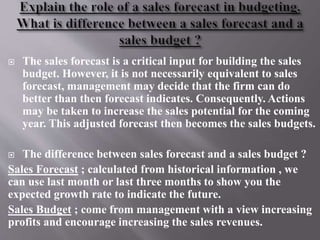
 The sales forecast is a critical input for building the sales
budget. However, it is not necessarily equivalent to sales
forecast, management may decide that the firm can do
better than then forecast indicates. Consequently. Actions
may be taken to increase the sales potential for the coming
year. This adjusted forecast then becomes the sales budgets.
 The difference between sales forecast and a sales budget ?
Sales Forecast ; calculated from historical information , we
can use last month or last three months to show you the
expected growth rate to indicate the future.
Sales Budget ; come from management with a view increasing
profits and encourage increasing the sales revenues.
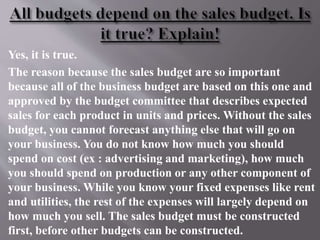
Yes, it is true.
The reason because the sales budget are so important
because all of the business budget are based on this one and
approved by the budget committee that describes expected
sales for each product in units and prices. Without the sales
budget, you cannot forecast anything else that will go on
your business. You do not know how much you should
spend on cost (ex : advertising and marketing), how much
you should spend on production or any other component of
your business. While you know your fixed expenses like rent
and utilities, the rest of the expenses will largely depend on
how much you sell. The sales budget must be constructed
first, before other budgets can be constructed.
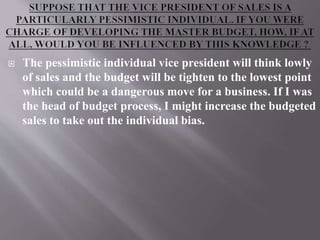
 The pessimistic individual vice president will think lowly
of sales and the budget will be tighten to the lowest point
which could be a dangerous move for a business. If I was
the head of budget process, I might increase the budgeted
sales to take out the individual bias.
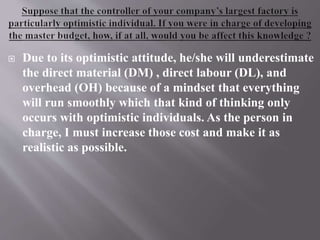
 Due to its optimistic attitude, he/she will underestimate
the direct material (DM) , direct labour (DL), and
overhead (OH) because of a mindset that everything
will run smoothly which that kind of thinking only
occurs with optimistic individuals. As the person in
charge, I must increase those cost and make it as
realistic as possible.
 The learning curve is the relationship between unit cost
of production and increasing number of units. As the
time go on, the number of units produced in the time
period will increase and the cost per unit will decrease.
The budgets affected will be the direct materials
purchases budget, the direct labor budget, and the
overhead budget.
The preparation of cash budget is an important
management task. While some small businesses may be
able to survive for a time without budgeting, savvy
business owners will realize its importance. A cash budget
can protect a company from being unprepared for
seasonal fluctuations in cash flow or prepare a company
to take advantage of unexpected quantity discounts from
suppliers. Many small businesses find it helpful to
prepare monthly cash budgets and to analyze any
variances between the budgeted and actual amount on a
monthly basis. This enables small business owners and
managers to stay on top of any unexpected cash uses.
Criticisms of the master budget can be classified into
several categories.
The traditional master budget is :
1. Department oriented and does not recognize the
interdependencies among department.
2. Static, not dynamic.
3. Results, not process, oriented.
Static Budget is a static budget is fixed for the entire
period covered by the budget, with no changes based on
actual activity.
The problem with a static budget is the absence of
flexibility to adjust to unpredictable changes. In
industry, fixed budgets are appropriate for those
departments whose workload does not have a direct
current relationship to sales, production, or some other
volume determinant related to the department’s
operations. The work of the departments is determined
by management decision rather than by sales volume.
1. A flexible budget shows costs for varying levels of
activity.
- Useful for planning.
- Useful for sensitivity analysis.
2. A flexible budget can be constructed for the actual level
of activity.
- Useful for control.
- Compares actual costs to budgeted amounts for actual
level of activity.
The activity-based budget begins with output and then determines
the resources necessary to create that output. Ideally, the
organization translates its vision into a strategy with definable
objectives in order to create value. Ways of creating value include
growing market share, improving sales rates, reducing expenses,
increasing profit margin, increasing productivity, and reducing the
cost of capital. We can see how clearly ABB is related to
performance evaluation and, in particular, to economic value
added. We can look at a department’s budget from three
perspectives: a traditional approach, a flexible budgeting relies on
the use of line items, such as salaries, supplies, depreciation on
equipment, and so on. The flexible budget uses knowledge of cost
behavior to split the line items into fixed and variable components.
The activity-based budget works backward from activities and
their drivers to the underlying costs.
Audrey 1642095 akman

Audrey 1642095 akman

  • 1.
    Audrey ( 1642095) Lecturer : Santi Yopie, SE., MM., CMA., PROJECT+., CIBA., CPA., BKP.
  • 2.
     Budget isan estimate of costs, revenues, and resources over a specified period, reflecting a reading of future financial conditions and goals.  A budget is a comprehensive financial plan for achieving the financial and operational goals of an organization. Used correctly, a budget is the map of the company's strategic plan. In creating the budget, the company is developing its objectives for the acquisition and use of its resources.
  • 3.
     Control isthe process of setting standards, receiving feedback on actual performance, and taking corrective action whenever actual performance deviates from planned performance.  Budget as a Control Tool A budget serves as a control tool to provide standards for evaluating performance. A budget can cover : 1. Profit planning – forecast of revenues and expenses. 2.Cash budgeting – forecast of cash needs and sources. 3.Balance sheet forecasting – anticipating future assets, liability and net worth position of the business.
  • 4.
    1. A budgetcan keep you out of debt or help you get out of debt. 2. A budget can help you meet your savings goals. It includes a mechanism for setting aside money for savings and investments. 3. A budget reveals areas where you're spending too much money so you can refocus on your most important goals. 4. A budget is a guide that tells you whether you're going in the direction you want to be headed in financially. A budget lets you control your money instead of your money controlling you. 5. A budget helps you prepare for emergencies or large or unanticipated expenses that might otherwise knock you for a loop financially.
  • 5.
    Master Budget isa master budget is an expensive business strategy that documents expected future sales, productions levels, purchases, future expenses incurred, capital investments, and even loads to be acquired and repaid. The master budget includes all other financial budgets as wells as a budgeted income statement and balance sheet. Operating Budget is an operating budget shows the company's projected revenue and associated expenses for an upcoming period (usually the next year) and is often presented in an income statement format. Financial Budget is a financial budget is a projection of incomes and outflows of the organization for the long-term as well as short-term.
  • 6.
     The salesforecast is a critical input for building the sales budget. However, it is not necessarily equivalent to sales forecast, management may decide that the firm can do better than then forecast indicates. Consequently. Actions may be taken to increase the sales potential for the coming year. This adjusted forecast then becomes the sales budgets.  The difference between sales forecast and a sales budget ? Sales Forecast ; calculated from historical information , we can use last month or last three months to show you the expected growth rate to indicate the future. Sales Budget ; come from management with a view increasing profits and encourage increasing the sales revenues.
  • 7.
    Yes, it istrue. The reason because the sales budget are so important because all of the business budget are based on this one and approved by the budget committee that describes expected sales for each product in units and prices. Without the sales budget, you cannot forecast anything else that will go on your business. You do not know how much you should spend on cost (ex : advertising and marketing), how much you should spend on production or any other component of your business. While you know your fixed expenses like rent and utilities, the rest of the expenses will largely depend on how much you sell. The sales budget must be constructed first, before other budgets can be constructed.
  • 8.
     The pessimisticindividual vice president will think lowly of sales and the budget will be tighten to the lowest point which could be a dangerous move for a business. If I was the head of budget process, I might increase the budgeted sales to take out the individual bias.
  • 9.
     Due toits optimistic attitude, he/she will underestimate the direct material (DM) , direct labour (DL), and overhead (OH) because of a mindset that everything will run smoothly which that kind of thinking only occurs with optimistic individuals. As the person in charge, I must increase those cost and make it as realistic as possible.
  • 10.
     The learningcurve is the relationship between unit cost of production and increasing number of units. As the time go on, the number of units produced in the time period will increase and the cost per unit will decrease. The budgets affected will be the direct materials purchases budget, the direct labor budget, and the overhead budget.
  • 11.
    The preparation ofcash budget is an important management task. While some small businesses may be able to survive for a time without budgeting, savvy business owners will realize its importance. A cash budget can protect a company from being unprepared for seasonal fluctuations in cash flow or prepare a company to take advantage of unexpected quantity discounts from suppliers. Many small businesses find it helpful to prepare monthly cash budgets and to analyze any variances between the budgeted and actual amount on a monthly basis. This enables small business owners and managers to stay on top of any unexpected cash uses.
  • 12.
    Criticisms of themaster budget can be classified into several categories. The traditional master budget is : 1. Department oriented and does not recognize the interdependencies among department. 2. Static, not dynamic. 3. Results, not process, oriented.
  • 13.
    Static Budget isa static budget is fixed for the entire period covered by the budget, with no changes based on actual activity. The problem with a static budget is the absence of flexibility to adjust to unpredictable changes. In industry, fixed budgets are appropriate for those departments whose workload does not have a direct current relationship to sales, production, or some other volume determinant related to the department’s operations. The work of the departments is determined by management decision rather than by sales volume.
  • 14.
    1. A flexiblebudget shows costs for varying levels of activity. - Useful for planning. - Useful for sensitivity analysis. 2. A flexible budget can be constructed for the actual level of activity. - Useful for control. - Compares actual costs to budgeted amounts for actual level of activity.
  • 15.
    The activity-based budgetbegins with output and then determines the resources necessary to create that output. Ideally, the organization translates its vision into a strategy with definable objectives in order to create value. Ways of creating value include growing market share, improving sales rates, reducing expenses, increasing profit margin, increasing productivity, and reducing the cost of capital. We can see how clearly ABB is related to performance evaluation and, in particular, to economic value added. We can look at a department’s budget from three perspectives: a traditional approach, a flexible budgeting relies on the use of line items, such as salaries, supplies, depreciation on equipment, and so on. The flexible budget uses knowledge of cost behavior to split the line items into fixed and variable components. The activity-based budget works backward from activities and their drivers to the underlying costs.