MANJINDER SINGH
SC16M072
Indian Institute of Space Science and Technology
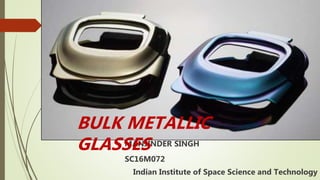
BULK METALLIC
GLASSES
CONTENT
 Introduction
 History
 Classification
 Preparation
 Bulk metallic glasses produced by detonation gun spraying.
 Melt-spinning technique for preparation of metallic glasses.
 Processing metallic glasses by selective laser melting.
 Thermal stability of BMG
 Structure of BMG
 Crystallization of BMG
 Properties of BMG
 Applications of BMG
INTRODUCTION
 Newly developed engineering materials.
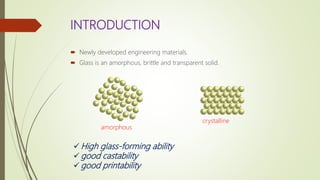
 Glass is an amorphous, brittle and transparent solid.
amorphous
crystalline
 High glass-forming ability
 good castability
 good printability
Bulk metallic glasses material is strong as steel and
moldable as plastic
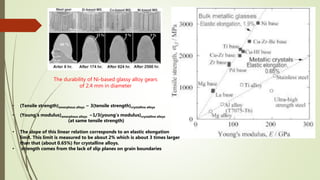
The durability of Ni-based glassy alloy gears
of 2.4 mm in diameter
• (Tensile strength)amorphous alloys ~ 3(tensile strength)crystalline alloys
• (Young’s modulus)amorphous alloys ~1/3(young’s modulus)crystalline alloys
(at same tensile strength)
• The slope of this linear relation corresponds to an elastic elongation
limit. This limit is measured to be about 2% which is about 3 times larger
than that (about 0.65%) for crystalline alloys.
• strength comes from the lack of slip planes on grain boundaries
HISTORY
 The first reported metallic glass was
an alloy (Au75Si25) produced at Caltech by W.
Klement (Jr.), Willens and Duwez in 1960.
 In 1969, an alloy of 77.5% palladium, 6%
copper, and 16.5% silicon - critical cooling
rate of 100 - 1000 K/s.
 In 1976, H. Liebermann and C. Graham
developed a new method of manufacturing
thin ribbons of amorphous metal on a super
cooled fast-spinning wheel. Metglas(alloy of
Fe, Ni, P, B).
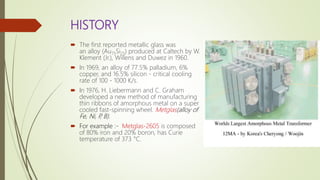
 For example :- Metglas-2605 is composed
of 80% iron and 20% boron, has Curie
temperature of 373 °C.
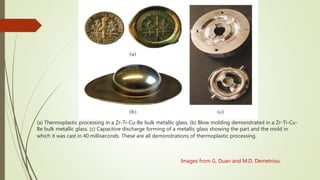
(a) Thermoplastic processing in a Zr-Ti-Cu-Be bulk metallic glass. (b) Blow molding demonstrated in a Zr-Ti-Cu-
Be bulk metallic glass. (c) Capacitive discharge forming of a metallic glass showing the part and the mold in
which it was cast in 40 milliseconds. These are all demonstrations of thermoplastic processing.
Images from G. Duan and M.D. Demetriou.
 In the 1990s new alloys were developed that form glasses at cooling rates as low as one
kelvin per second. These cooling rates can be achieved by simple casting into metallic
molds.
 The best glass-forming alloys are based on zirconium and palladium.
 In 1992, Vitreloy 1 was developed at Caltech, as a part of Department of
Energy and NASA research of new aerospace materials.
 In 2004, bulk amorphous steel (actually rather cast iron owing to high C content)-"glassy
steel“- known by "DARVA-Glass 101".
 Confusion effect :- Many amorphous alloys are formed by exploiting a phenomenon
called the "confusion" effect. Such alloys contain so many different elements that upon
cooling at sufficiently fast rates, the constituent atoms simply cannot coordinate
themselves into the equilibrium crystalline state before their mobility is stopped. In this
way, the random disordered state of the atoms is "locked in“.
 In addition to direct cooling, there are several other ways in which amorphous
metals can be produced, including:
• Physical vapor deposition
• Extremely rapid cooling
• Solid-state reaction
• Ion irradiation
• Mechanical alloying
 Amorphous metals produced by these techniques are, strictly speaking, not
glasses; however, materials scientists commonly consider amorphous alloys to be a
single class of materials, regardless of how they are prepared.
Physical vapor deposition
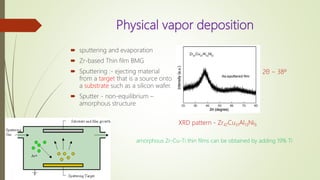
 sputtering and evaporation
 Zr-based Thin film BMG
 Sputtering :- ejecting material
from a target that is a source onto
a substrate such as a silicon wafer.
 Sputter - non-equilibrium –
amorphous structure
XRD pattern - Zr47Cu31Al13Ni9
2θ ~ 38º
amorphous Zr-Cu-Ti thin films can be obtained by adding 19% Ti
Solid-State Reaction
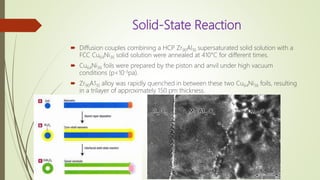
 Diffusion couples combining a HCP Zr90Al10 supersaturated solid solution with a
FCC Cu64Ni36 solid solution were annealed at 410°C for different times.
 Cu64Ni36 foils were prepared by the piston and anvil under high vacuum
conditions (p<10-3pa).
 Zr90A110 alloy was rapidly quenched in between these two Cu64Ni36 foils, resulting
in a trilayer of approximately 150 pm thickness.
Mechanical Alloying
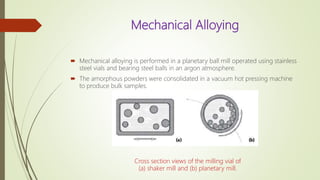
 Mechanical alloying is performed in a planetary ball mill operated using stainless
steel vials and bearing steel balls in an argon atmosphere.
 The amorphous powders were consolidated in a vacuum hot pressing machine
to produce bulk samples.
Cross section views of the milling vial of
(a) shaker mill and (b) planetary mill.
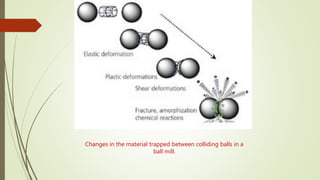
Changes in the material trapped between colliding balls in a
ball mill.
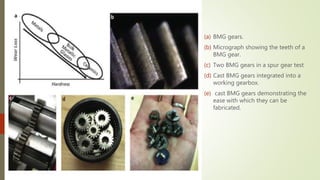
(a) BMG gears.
(b) Micrograph showing the teeth of a
BMG gear.
(c) Two BMG gears in a spur gear test
(d) Cast BMG gears integrated into a
working gearbox.
(e) cast BMG gears demonstrating the
ease with which they can be
fabricated.
CLASSIFICATION
o (Fe,Co, Ni ) and(B , Si, S, P )
o Nickel - Niobium (Ni-Nb )
o Magnesium-Zinc (Mg-Zn)
o Copper-Zirconium (Cu- Zr)
o Hafnium-Vanadium (Hf-V)
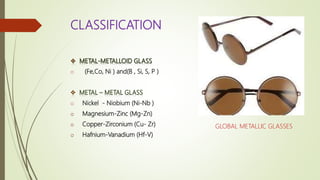
GLOBAL METALLIC GLASSES
PREPARATION
 Various rapid cooling techniques are used for the production of metallic glasses
such as :-
o spraying
o spinning
o laser deposition
BULK METALLIC GLASSES PRODUCED BY
DETONATION GUN SPRAYING
•DOI: https://doi.org/10.1557/PROC-554-113
 Detonation gun spraying of eutectic alloy containing iron, chromium, phosphorus
and carbon.
 Thickness :- 2-3 millimeters.
 Parameters studied :-
 Heat capacity
 coefficient of thermal expansion
 corrosion resistance
 Hardness
 short range order structure
 Amorphous detonation sprayed coatings - improve service properties of medical
instruments.
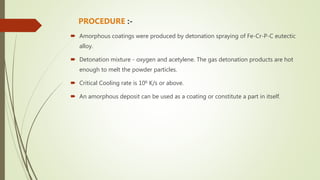
PROCEDURE :-
 Amorphous coatings were produced by detonation spraying of Fe-Cr-P-C eutectic
alloy.
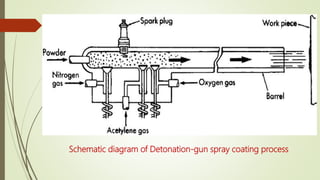
 Detonation mixture - oxygen and acetylene. The gas detonation products are hot
enough to melt the powder particles.
 Critical Cooling rate is 106 K/s or above.
 An amorphous deposit can be used as a coating or constitute a part in itself.
Schematic diagram of Detonation-gun spray coating process
Characterization :-
 XRD – Amorphous nature.
 DSC - heat capacity
 Potentiodynamic electrochemical - corrosion .
Standard cell - Ag/AgCl reference electrode with 10% HCl solution
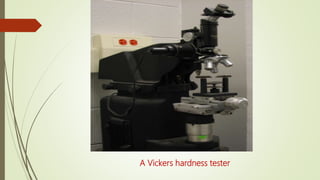
 DPH (Vickers Pyramid Number or Diamond Pyramid Hardness) - micro
hardness .
 The JWT (Jim Wold Techniques)- thermal expansion behavior.
A Vickers hardness tester
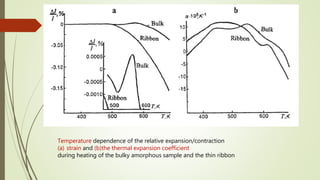
Temperature dependence of the relative expansion/contraction
(a) strain and (b)the thermal expansion coefficient
during heating of the bulky amorphous sample and the thin ribbon
MELT-SPINNING TECHNIQUE FOR
PREPARATION OF METALLIC GLASSES
DOI: 10.1007/BF02824962
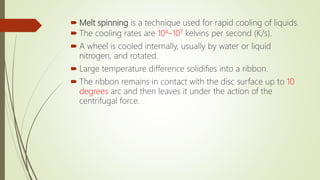
 Melt spinning is a technique used for rapid cooling of liquids.
 The cooling rates are 104–107 kelvins per second (K/s).
 A wheel is cooled internally, usually by water or liquid
nitrogen, and rotated.
 Large temperature difference solidifies into a ribbon.
 The ribbon remains in contact with the disc surface up to 10
degrees arc and then leaves it under the action of the
centrifugal force.
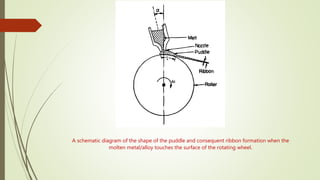
A schematic diagram of the shape of the puddle and consequent ribbon formation when the
molten metal/alloy touches the surface of the rotating wheel.
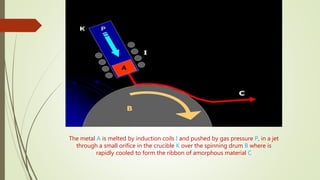
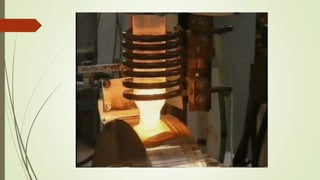
The metal A is melted by induction coils I and pushed by gas pressure P, in a jet
through a small orifice in the crucible K over the spinning drum B where is
rapidly cooled to form the ribbon of amorphous material C
PROCESSING METALLIC GLASSES BY
SELECTIVE LASER MELTING
http://doi.org/10.1016/j.mattod.2013.01.018
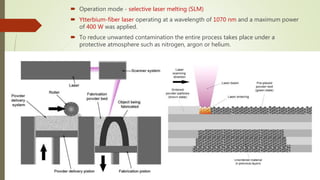
 Operation mode - selective laser melting (SLM)
 Ytterbium-fiber laser operating at a wavelength of 1070 nm and a maximum power
of 400 W was applied.
 To reduce unwanted contamination the entire process takes place under a
protective atmosphere such as nitrogen, argon or helium.
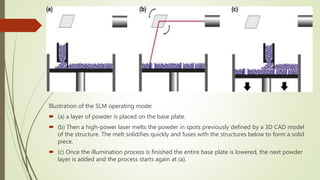
Illustration of the SLM operating mode:
 (a) a layer of powder is placed on the base plate.
 (b) Then a high-power laser melts the powder in spots previously defined by a 3D CAD model
of the structure. The melt solidifies quickly and fuses with the structures below to form a solid
piece.
 (c) Once the illumination process is finished the entire base plate is lowered, the next powder
layer is added and the process starts again at (a).
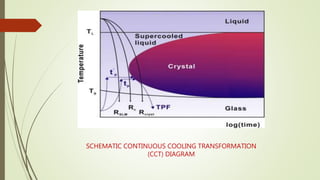
SCHEMATIC CONTINUOUS COOLING TRANSFORMATION
(CCT) DIAGRAM
Thermal stability of BMGs
 At present, the lowest critical cooling rate for BMG formation is as low as 0.10 K/s
for the Pd40 Cu30Ni10 P20 alloy.
 The maximum sample thickness reaches values as large as about 10 cm.
 The alloy with the largest supercooled liquid region of 135 K is
(Zr82.5Ti17.5)55(Ni54Cu46)18.75Be26.25
 The quinary glass-former has distinct glass transition, very high stability of
supercooled liquid state, and exhibits high thermal stability against crystallization.
Vitialloy
 Vitalloy 1(vit1) has the composition of Zr41Ti14Cu12.5Ni10Be22.5.
 The critical cooling rates for glass formation in the 1 K/s range.
 The formation of the BMGs in this family requires no fluxing or special processing
treatments and can form bulk glass by conventional metallurgical casting
 Its GFA(glass forming ability) and processability are comparable with those of
silicate glasses.
 The BMGs, which exhibit high thermal stability and superb properties, have
considerable potential as advanced engineering materials.
The picture of a cast vitalloy BMG system.
(prepared by the Institute of Physics, Chinese Academy of Sciences, China)
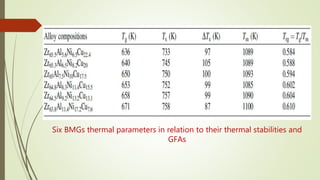
Six BMGs thermal parameters in relation to their thermal stabilities and
GFAs
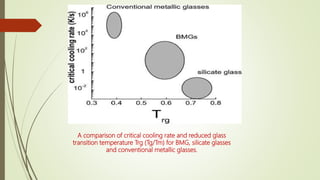
A comparison of critical cooling rate and reduced glass
transition temperature Trg (Tg/Tm) for BMG, silicate glasses
and conventional metallic glasses.
 The bulk metallic glass formers are very robust against some
heterogeneous nucleation sites at the surface or at interfaces. This leads to
the development of bulk metallic glassy matrix composites by the addition
of special crystalline materials.
 A small change of Niobium(Nb) composition results in a substantially
improved GFA and ductility of the bulky glass-forming system.
 Dissolution of minute amount of metalloid elements into the Zr–Ti–Cu–Ni–
Be metallic glass system can enlarge the thermal stability and hardness of
the BMG.
Structure of BMGs
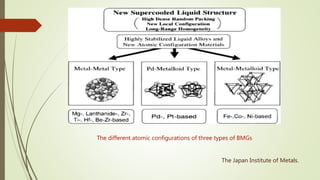
 There should be large differences in sizes leading to a complex structure which
crystallizes less easily.
 A beryllium atom, for example, is much smaller than a zirconium atom.
 Density measurements show that the density difference between BMG and fully
crystallized state is in the range 0.3–1.0%, which is much smaller than the
previously reported range of about 2% for ordinary amorphous alloys.
 Such small differences in values indicate that the BMGs have higher dense
randomly packed atomic configurations.
The different atomic configurations of three types of BMGs
The Japan Institute of Metals.
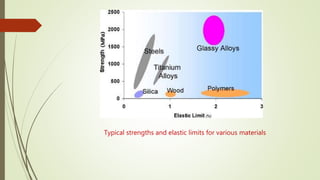
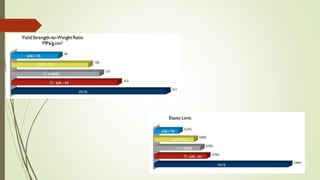
Typical strengths and elastic limits for various materials
Properties of BMGs
 The strength of metallic glasses is very high but they are lighter in weight.
 They are ductile, malleable, brittle and opaque. The hardness is very high.
 The toughness is very high i.e. the fracture resistant is very high.
 They have high elasticity i.e. the yield strength is high.
 They have high corrosion resistance.
 They do not contain any crystalline defects like point defects, dislocation, stacking
faults etc.
 They are soft magnetic materials. As a result easy magnetization and
demagnetization are possible.
 They have high electrical resistivity which leads to a low eddy current loss.
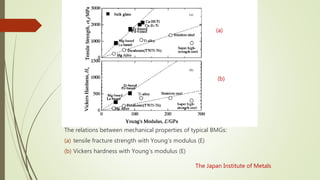
The relations between mechanical properties of typical BMGs:
(a) tensile fracture strength with Young’s modulus (E)
(b) Vickers hardness with Young’s modulus (E)
The Japan Institute of Metals
(a)
(b)
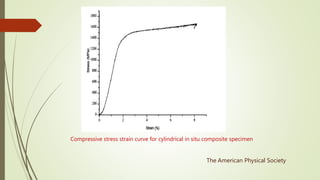
Compressive stress strain curve for cylindrical in situ composite specimen
The American Physical Society
Applications of BMGs
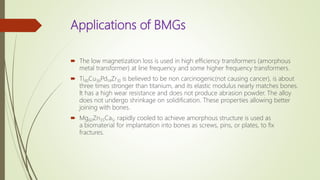
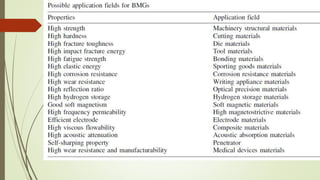
 The low magnetization loss is used in high efficiency transformers (amorphous
metal transformer) at line frequency and some higher frequency transformers.
 Ti40Cu36Pd14Zr10 is believed to be non carcinogenic(not causing cancer), is about
three times stronger than titanium, and its elastic modulus nearly matches bones.
It has a high wear resistance and does not produce abrasion powder. The alloy
does not undergo shrinkage on solidification. These properties allowing better
joining with bones.
 Mg60Zn35Ca5, rapidly cooled to achieve amorphous structure is used as
a biomaterial for implantation into bones as screws, pins, or plates, to fix
fractures.
 The high hardness is ideal for use in tooling. This property is useful in knives,
especially in scalpels.
 High elastic energy storage per unit volume and mass, and the low damping, give
metallic glasses potential as springs.
 Sporting equipment such as golf clubs and baseball bats utilize the high hardness
and elastic energy property for good energy transfer to projectiles.
 Information storage and reproduction would utilize the lack of grain structure and
high hardness.
 Features of near-atomic scale could be molded or etched into a metallic glass
surface to make masters for reproducing ultra-high density digital data.
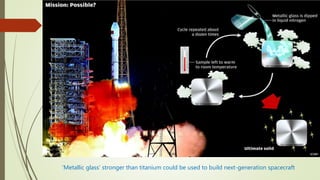
'Metallic glass' stronger than titanium could be used to build next-generation spacecraft
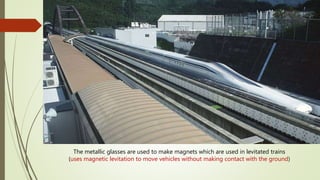
The metallic glasses are used to make magnets which are used in levitated trains
(uses magnetic levitation to move vehicles without making contact with the ground)
BULK METALLIC GLASS

BULK METALLIC GLASS

  • 1.
    MANJINDER SINGH SC16M072 Indian Instituteof Space Science and Technology BULK METALLIC GLASSES
  • 2.
    CONTENT  Introduction  History Classification  Preparation  Bulk metallic glasses produced by detonation gun spraying.  Melt-spinning technique for preparation of metallic glasses.  Processing metallic glasses by selective laser melting.  Thermal stability of BMG  Structure of BMG  Crystallization of BMG  Properties of BMG  Applications of BMG
  • 3.
    INTRODUCTION  Newly developedengineering materials.  Glass is an amorphous, brittle and transparent solid. amorphous crystalline  High glass-forming ability  good castability  good printability
  • 4.
    Bulk metallic glassesmaterial is strong as steel and moldable as plastic
  • 5.
    The durability ofNi-based glassy alloy gears of 2.4 mm in diameter • (Tensile strength)amorphous alloys ~ 3(tensile strength)crystalline alloys • (Young’s modulus)amorphous alloys ~1/3(young’s modulus)crystalline alloys (at same tensile strength) • The slope of this linear relation corresponds to an elastic elongation limit. This limit is measured to be about 2% which is about 3 times larger than that (about 0.65%) for crystalline alloys. • strength comes from the lack of slip planes on grain boundaries
  • 6.
    HISTORY  The firstreported metallic glass was an alloy (Au75Si25) produced at Caltech by W. Klement (Jr.), Willens and Duwez in 1960.  In 1969, an alloy of 77.5% palladium, 6% copper, and 16.5% silicon - critical cooling rate of 100 - 1000 K/s.  In 1976, H. Liebermann and C. Graham developed a new method of manufacturing thin ribbons of amorphous metal on a super cooled fast-spinning wheel. Metglas(alloy of Fe, Ni, P, B).  For example :- Metglas-2605 is composed of 80% iron and 20% boron, has Curie temperature of 373 °C.
  • 7.
    (a) Thermoplastic processingin a Zr-Ti-Cu-Be bulk metallic glass. (b) Blow molding demonstrated in a Zr-Ti-Cu- Be bulk metallic glass. (c) Capacitive discharge forming of a metallic glass showing the part and the mold in which it was cast in 40 milliseconds. These are all demonstrations of thermoplastic processing. Images from G. Duan and M.D. Demetriou.
  • 8.
     In the1990s new alloys were developed that form glasses at cooling rates as low as one kelvin per second. These cooling rates can be achieved by simple casting into metallic molds.  The best glass-forming alloys are based on zirconium and palladium.  In 1992, Vitreloy 1 was developed at Caltech, as a part of Department of Energy and NASA research of new aerospace materials.  In 2004, bulk amorphous steel (actually rather cast iron owing to high C content)-"glassy steel“- known by "DARVA-Glass 101".  Confusion effect :- Many amorphous alloys are formed by exploiting a phenomenon called the "confusion" effect. Such alloys contain so many different elements that upon cooling at sufficiently fast rates, the constituent atoms simply cannot coordinate themselves into the equilibrium crystalline state before their mobility is stopped. In this way, the random disordered state of the atoms is "locked in“.
  • 9.
     In additionto direct cooling, there are several other ways in which amorphous metals can be produced, including: • Physical vapor deposition • Extremely rapid cooling • Solid-state reaction • Ion irradiation • Mechanical alloying  Amorphous metals produced by these techniques are, strictly speaking, not glasses; however, materials scientists commonly consider amorphous alloys to be a single class of materials, regardless of how they are prepared.
  • 10.
    Physical vapor deposition sputtering and evaporation  Zr-based Thin film BMG  Sputtering :- ejecting material from a target that is a source onto a substrate such as a silicon wafer.  Sputter - non-equilibrium – amorphous structure XRD pattern - Zr47Cu31Al13Ni9 2θ ~ 38º amorphous Zr-Cu-Ti thin films can be obtained by adding 19% Ti
  • 11.
    Solid-State Reaction  Diffusioncouples combining a HCP Zr90Al10 supersaturated solid solution with a FCC Cu64Ni36 solid solution were annealed at 410°C for different times.  Cu64Ni36 foils were prepared by the piston and anvil under high vacuum conditions (p<10-3pa).  Zr90A110 alloy was rapidly quenched in between these two Cu64Ni36 foils, resulting in a trilayer of approximately 150 pm thickness.
  • 12.
    Mechanical Alloying  Mechanicalalloying is performed in a planetary ball mill operated using stainless steel vials and bearing steel balls in an argon atmosphere.  The amorphous powders were consolidated in a vacuum hot pressing machine to produce bulk samples. Cross section views of the milling vial of (a) shaker mill and (b) planetary mill.
  • 13.
    Changes in thematerial trapped between colliding balls in a ball mill.
  • 14.
    (a) BMG gears. (b)Micrograph showing the teeth of a BMG gear. (c) Two BMG gears in a spur gear test (d) Cast BMG gears integrated into a working gearbox. (e) cast BMG gears demonstrating the ease with which they can be fabricated.
  • 15.
    CLASSIFICATION o (Fe,Co, Ni) and(B , Si, S, P ) o Nickel - Niobium (Ni-Nb ) o Magnesium-Zinc (Mg-Zn) o Copper-Zirconium (Cu- Zr) o Hafnium-Vanadium (Hf-V) GLOBAL METALLIC GLASSES
  • 16.
    PREPARATION  Various rapidcooling techniques are used for the production of metallic glasses such as :- o spraying o spinning o laser deposition
  • 17.
    BULK METALLIC GLASSESPRODUCED BY DETONATION GUN SPRAYING •DOI: https://doi.org/10.1557/PROC-554-113
  • 18.
     Detonation gunspraying of eutectic alloy containing iron, chromium, phosphorus and carbon.  Thickness :- 2-3 millimeters.  Parameters studied :-  Heat capacity  coefficient of thermal expansion  corrosion resistance  Hardness  short range order structure  Amorphous detonation sprayed coatings - improve service properties of medical instruments.
  • 19.
    PROCEDURE :-  Amorphouscoatings were produced by detonation spraying of Fe-Cr-P-C eutectic alloy.  Detonation mixture - oxygen and acetylene. The gas detonation products are hot enough to melt the powder particles.  Critical Cooling rate is 106 K/s or above.  An amorphous deposit can be used as a coating or constitute a part in itself.
  • 20.
    Schematic diagram ofDetonation-gun spray coating process
  • 21.
    Characterization :-  XRD– Amorphous nature.  DSC - heat capacity  Potentiodynamic electrochemical - corrosion . Standard cell - Ag/AgCl reference electrode with 10% HCl solution  DPH (Vickers Pyramid Number or Diamond Pyramid Hardness) - micro hardness .  The JWT (Jim Wold Techniques)- thermal expansion behavior.
  • 22.
  • 23.
    Temperature dependence ofthe relative expansion/contraction (a) strain and (b)the thermal expansion coefficient during heating of the bulky amorphous sample and the thin ribbon
  • 24.
    MELT-SPINNING TECHNIQUE FOR PREPARATIONOF METALLIC GLASSES DOI: 10.1007/BF02824962
  • 25.
     Melt spinningis a technique used for rapid cooling of liquids.  The cooling rates are 104–107 kelvins per second (K/s).  A wheel is cooled internally, usually by water or liquid nitrogen, and rotated.  Large temperature difference solidifies into a ribbon.  The ribbon remains in contact with the disc surface up to 10 degrees arc and then leaves it under the action of the centrifugal force.
  • 26.
    A schematic diagramof the shape of the puddle and consequent ribbon formation when the molten metal/alloy touches the surface of the rotating wheel.
  • 27.
    The metal Ais melted by induction coils I and pushed by gas pressure P, in a jet through a small orifice in the crucible K over the spinning drum B where is rapidly cooled to form the ribbon of amorphous material C
  • 29.
    PROCESSING METALLIC GLASSESBY SELECTIVE LASER MELTING http://doi.org/10.1016/j.mattod.2013.01.018
  • 30.
     Operation mode- selective laser melting (SLM)  Ytterbium-fiber laser operating at a wavelength of 1070 nm and a maximum power of 400 W was applied.  To reduce unwanted contamination the entire process takes place under a protective atmosphere such as nitrogen, argon or helium.
  • 31.
    Illustration of theSLM operating mode:  (a) a layer of powder is placed on the base plate.  (b) Then a high-power laser melts the powder in spots previously defined by a 3D CAD model of the structure. The melt solidifies quickly and fuses with the structures below to form a solid piece.  (c) Once the illumination process is finished the entire base plate is lowered, the next powder layer is added and the process starts again at (a).
  • 32.
    SCHEMATIC CONTINUOUS COOLINGTRANSFORMATION (CCT) DIAGRAM
  • 33.
    Thermal stability ofBMGs  At present, the lowest critical cooling rate for BMG formation is as low as 0.10 K/s for the Pd40 Cu30Ni10 P20 alloy.  The maximum sample thickness reaches values as large as about 10 cm.  The alloy with the largest supercooled liquid region of 135 K is (Zr82.5Ti17.5)55(Ni54Cu46)18.75Be26.25  The quinary glass-former has distinct glass transition, very high stability of supercooled liquid state, and exhibits high thermal stability against crystallization.
  • 34.
    Vitialloy  Vitalloy 1(vit1)has the composition of Zr41Ti14Cu12.5Ni10Be22.5.  The critical cooling rates for glass formation in the 1 K/s range.  The formation of the BMGs in this family requires no fluxing or special processing treatments and can form bulk glass by conventional metallurgical casting  Its GFA(glass forming ability) and processability are comparable with those of silicate glasses.  The BMGs, which exhibit high thermal stability and superb properties, have considerable potential as advanced engineering materials.
  • 35.
    The picture ofa cast vitalloy BMG system. (prepared by the Institute of Physics, Chinese Academy of Sciences, China)
  • 36.
    Six BMGs thermalparameters in relation to their thermal stabilities and GFAs
  • 37.
    A comparison ofcritical cooling rate and reduced glass transition temperature Trg (Tg/Tm) for BMG, silicate glasses and conventional metallic glasses.
  • 38.
     The bulkmetallic glass formers are very robust against some heterogeneous nucleation sites at the surface or at interfaces. This leads to the development of bulk metallic glassy matrix composites by the addition of special crystalline materials.  A small change of Niobium(Nb) composition results in a substantially improved GFA and ductility of the bulky glass-forming system.  Dissolution of minute amount of metalloid elements into the Zr–Ti–Cu–Ni– Be metallic glass system can enlarge the thermal stability and hardness of the BMG.
  • 39.
    Structure of BMGs There should be large differences in sizes leading to a complex structure which crystallizes less easily.  A beryllium atom, for example, is much smaller than a zirconium atom.  Density measurements show that the density difference between BMG and fully crystallized state is in the range 0.3–1.0%, which is much smaller than the previously reported range of about 2% for ordinary amorphous alloys.  Such small differences in values indicate that the BMGs have higher dense randomly packed atomic configurations.
  • 40.
    The different atomicconfigurations of three types of BMGs The Japan Institute of Metals.
  • 41.
    Typical strengths andelastic limits for various materials
  • 42.
    Properties of BMGs The strength of metallic glasses is very high but they are lighter in weight.  They are ductile, malleable, brittle and opaque. The hardness is very high.  The toughness is very high i.e. the fracture resistant is very high.  They have high elasticity i.e. the yield strength is high.  They have high corrosion resistance.  They do not contain any crystalline defects like point defects, dislocation, stacking faults etc.  They are soft magnetic materials. As a result easy magnetization and demagnetization are possible.  They have high electrical resistivity which leads to a low eddy current loss.
  • 43.
    The relations betweenmechanical properties of typical BMGs: (a) tensile fracture strength with Young’s modulus (E) (b) Vickers hardness with Young’s modulus (E) The Japan Institute of Metals (a) (b)
  • 44.
    Compressive stress straincurve for cylindrical in situ composite specimen The American Physical Society
  • 46.
    Applications of BMGs The low magnetization loss is used in high efficiency transformers (amorphous metal transformer) at line frequency and some higher frequency transformers.  Ti40Cu36Pd14Zr10 is believed to be non carcinogenic(not causing cancer), is about three times stronger than titanium, and its elastic modulus nearly matches bones. It has a high wear resistance and does not produce abrasion powder. The alloy does not undergo shrinkage on solidification. These properties allowing better joining with bones.  Mg60Zn35Ca5, rapidly cooled to achieve amorphous structure is used as a biomaterial for implantation into bones as screws, pins, or plates, to fix fractures.
  • 48.
     The highhardness is ideal for use in tooling. This property is useful in knives, especially in scalpels.  High elastic energy storage per unit volume and mass, and the low damping, give metallic glasses potential as springs.  Sporting equipment such as golf clubs and baseball bats utilize the high hardness and elastic energy property for good energy transfer to projectiles.  Information storage and reproduction would utilize the lack of grain structure and high hardness.  Features of near-atomic scale could be molded or etched into a metallic glass surface to make masters for reproducing ultra-high density digital data.
  • 49.
    'Metallic glass' strongerthan titanium could be used to build next-generation spacecraft
  • 50.
    The metallic glassesare used to make magnets which are used in levitated trains (uses magnetic levitation to move vehicles without making contact with the ground)

Editor's Notes

  • #4 An amorphous metal (also known as metallic glass or glassy metal) is a solid metallic material, usually an alloy, with a disordered atomic-scale structure. Most metals are crystalline in their solid state, which means they have a highly ordered arrangement of atoms. Amorphous metals are non-crystalline, and have a glass-like structure.
  • #5 More recently a number of alloys with critical cooling rates low enough to allow formation of amorphous structure in thick layers (over 1 millimeter) have been produced; these are known as bulk metallic glasses (BMG).
  • #9  The product is non-magnetic at room temperature and significantly stronger than conventional steel, though a long research and development process remains before the introduction of the material into public or military use.
  • #10 Amorphous metal ribbons have been produced by sputtering molten metal onto a spinning metal disk (melt spinning). The rapid cooling, on the order of millions of degrees a second, is too fast for crystals to form and the material is "locked" in a glassy state. 
  • #49 The lack of grain structure allows a blade to be sharpened to an exceptional edge because there is no length scale above the atomic to limit it.