Learner resource 14
Long Form TV Drama
Media Language
An Introduction to Narrative
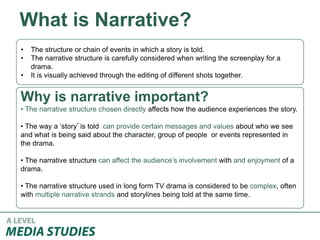
What is Narrative?
• The structure or chain of events in which a story is told.
• The narrative structure is carefully considered when writing the screenplay for a
drama.
• It is visually achieved through the editing of different shots together.
Why is narrative important?
• The narrative structure chosen directly affects how the audience experiences the story.
• The way a ‘story’is told can provide certain messages and values about who we see
and what is being said about the character, group of people or events represented in
the drama.
• The narrative structure can affect the audience’s involvement with and enjoyment of a
drama.
• The narrative structure used in long form TV drama is considered to be complex, often
with multiple narrative strands and storylines being told at the same time.
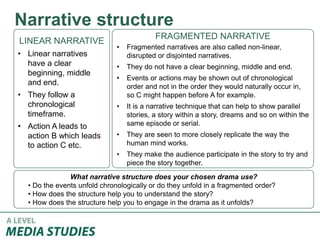
Narrative structure
What narrative structure does your chosen drama use?
• Do the events unfold chronologically or do they unfold in a fragmented order?
• How does the structure help you to understand the story?
• How does the structure help you to engage in the drama as it unfolds?
LINEAR NARRATIVE
• Linear narratives
have a clear
beginning, middle
and end.
• They follow a
chronological
timeframe.
• Action A leads to
action B which leads
to action C etc.
FRAGMENTED NARRATIVE
• Fragmented narratives are also called non-linear,
disrupted or disjointed narratives.
• They do not have a clear beginning, middle and end.
• Events or actions may be shown out of chronological
order and not in the order they would naturally occur in,
so C might happen before A for example.
• It is a narrative technique that can help to show parallel
stories, a story within a story, dreams and so on within the
same episode or serial.
• They are seen to more closely replicate the way the
human mind works.
• They make the audience participate in the story to try and
piece the story together.
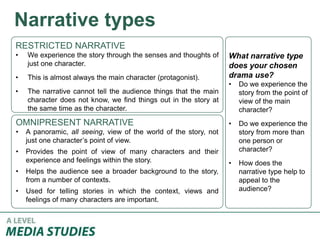
Narrative types
What narrative type
does your chosen
drama use?
• Do we experience the
story from the point of
view of the main
character?
• Do we experience the
story from more than
one person or
character?
• How does the
narrative type help to
appeal to the
audience?
RESTRICTED NARRATIVE
• We experience the story through the senses and thoughts of
just one character.
• This is almost always the main character (protagonist).
• The narrative cannot tell the audience things that the main
character does not know, we find things out in the story at
the same time as the character.
OMNIPRESENT NARRATIVE
• A panoramic, all seeing, view of the world of the story, not
just one character’s point of view.
• Provides the point of view of many characters and their
experience and feelings within the story.
• Helps the audience see a broader background to the story,
from a number of contexts.
• Used for telling stories in which the context, views and
feelings of many characters are important.
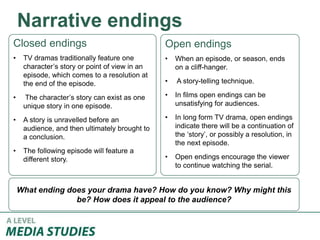
Narrative endings
What ending does your drama have? How do you know? Why might this
be? How does it appeal to the audience?
Open endings
• When an episode, or season, ends
on a cliff-hanger.
• A story-telling technique.
• In films open endings can be
unsatisfying for audiences.
• In long form TV drama, open endings
indicate there will be a continuation of
the ‘story’, or possibly a resolution, in
the next episode.
• Open endings encourage the viewer
to continue watching the serial.
Closed endings
• TV dramas traditionally feature one
character’s story or point of view in an
episode, which comes to a resolution at
the end of the episode.
• The character’s story can exist as one
unique story in one episode.
• A story is unravelled before an
audience, and then ultimately brought to
a conclusion.
• The following episode will feature a
different story.
Academic ideas about
narrative
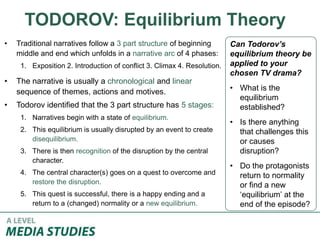
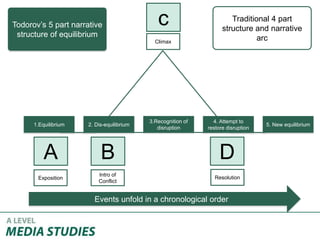
TODOROV: Equilibrium Theory
• Traditional narratives follow a 3 part structure of beginning
middle and end which unfolds in a narrative arc of 4 phases:
1. Exposition 2. Introduction of conflict 3. Climax 4. Resolution.
• The narrative is usually a chronological and linear
sequence of themes, actions and motives.
• Todorov identified that the 3 part structure has 5 stages:
1. Narratives begin with a state of equilibrium.
2. This equilibrium is usually disrupted by an event to create
disequilibrium.
3. There is then recognition of the disruption by the central
character.
4. The central character(s) goes on a quest to overcome and
restore the disruption.
5. This quest is successful, there is a happy ending and a
return to a (changed) normality or a new equilibrium.
Can Todorov’s
equilibrium theory be
applied to your
chosen TV drama?
• What is the
equilibrium
established?
• Is there anything
that challenges this
or causes
disruption?
• Do the protagonists
return to normality
or find a new
‘equilibrium’ at the
end of the episode?
A
Exposition
B
Intro of
Conflict
c
Climax
D
Resolution
1.Equilibrium 5. New equilibrium2. Dis-equilibrium
4. Attempt to
restore disruption
Events unfold in a chronological order
3.Recognition of
disruption
Todorov’s 5 part narrative
structure of equilibrium
Traditional 4 part
structure and narrative
arc
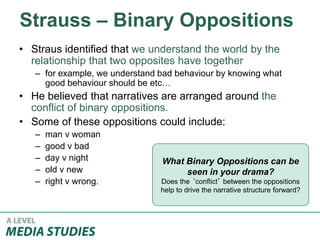
Strauss – Binary Oppositions
• Straus identified that we understand the world by the
relationship that two opposites have together
– for example, we understand bad behaviour by knowing what
good behaviour should be etc…
• He believed that narratives are arranged around the
conflict of binary oppositions.
• Some of these oppositions could include:
– man v woman
– good v bad
– day v night
– old v new
– right v wrong.
What Binary Oppositions can be
seen in your drama?
Does the ‘conflict’ between the oppositions
help to drive the narrative structure forward?
Now answer these questions….
1. What is narrative?
2. What different narrative structures are there?
3. What’s the difference between a restricted and omnipresent
narrative?
4. Which narrative ending is most likely to be used in the first episode
of a long form TV drama?
5. List 3 ideas to do with Todorov’s theory of narrative.
6. How does Strauss suggest binary oppositions work in narratives?
Give an example of one binary opposition we may see in a drama
and how it may help to develop the story?
Questions about narrative in
Episode 1:
1. Is the narrative structure linear (chronological) or
fragmented?
2. How many different storylines are introduced in the
first episode?
3. How many events are resolved, or we might have
some understanding of how they might be resolved, by
the end of the first episode?
4. How many events are unresolved by the end of the
episode?
5. Is the narrative open ended or is there full closure of
the storylines introduced in the episode?
6. What is the main event/storyline that will help to drive
the narrative across the season?
OCR Resources: the small print
OCR’s resources are provided to support the delivery of OCR qualifications, but in no way constitute an endorsed teaching method that is required by the Board, and the decision to use them lies with the individual teacher. Whilst every
effort is made to ensure the accuracy of the content, OCR cannot be held responsible for any errors or omissions within these resources.
Our documents are updated over time. Whilst every effort is made to check all documents, there may be contradictions between published support and the specification, therefore please use the information on the latest specification at all
times. Where changes are made to specifications these will be indicated within the document, there will be a new version number indicated, and a summary of the changes. If you do notice a discrepancy between the specification and a
resource please contact us at: resources.feedback@ocr.org.uk.
© OCR 2018 - This resource may be freely copied and distributed, as long as the OCR logo and this message remain intact and OCR is acknowledged as the originator of this work. OCR acknowledges the use of the following content: n/a
Please get in touch if you want to discuss the accessibility of resources we offer to support delivery of our qualifications: resources.feedback@ocr.org.uk

Narrative of D83

  • 3.
    Learner resource 14 LongForm TV Drama Media Language An Introduction to Narrative
  • 4.
    What is Narrative? •The structure or chain of events in which a story is told. • The narrative structure is carefully considered when writing the screenplay for a drama. • It is visually achieved through the editing of different shots together. Why is narrative important? • The narrative structure chosen directly affects how the audience experiences the story. • The way a ‘story’is told can provide certain messages and values about who we see and what is being said about the character, group of people or events represented in the drama. • The narrative structure can affect the audience’s involvement with and enjoyment of a drama. • The narrative structure used in long form TV drama is considered to be complex, often with multiple narrative strands and storylines being told at the same time.
  • 5.
    Narrative structure What narrativestructure does your chosen drama use? • Do the events unfold chronologically or do they unfold in a fragmented order? • How does the structure help you to understand the story? • How does the structure help you to engage in the drama as it unfolds? LINEAR NARRATIVE • Linear narratives have a clear beginning, middle and end. • They follow a chronological timeframe. • Action A leads to action B which leads to action C etc. FRAGMENTED NARRATIVE • Fragmented narratives are also called non-linear, disrupted or disjointed narratives. • They do not have a clear beginning, middle and end. • Events or actions may be shown out of chronological order and not in the order they would naturally occur in, so C might happen before A for example. • It is a narrative technique that can help to show parallel stories, a story within a story, dreams and so on within the same episode or serial. • They are seen to more closely replicate the way the human mind works. • They make the audience participate in the story to try and piece the story together.
  • 6.
    Narrative types What narrativetype does your chosen drama use? • Do we experience the story from the point of view of the main character? • Do we experience the story from more than one person or character? • How does the narrative type help to appeal to the audience? RESTRICTED NARRATIVE • We experience the story through the senses and thoughts of just one character. • This is almost always the main character (protagonist). • The narrative cannot tell the audience things that the main character does not know, we find things out in the story at the same time as the character. OMNIPRESENT NARRATIVE • A panoramic, all seeing, view of the world of the story, not just one character’s point of view. • Provides the point of view of many characters and their experience and feelings within the story. • Helps the audience see a broader background to the story, from a number of contexts. • Used for telling stories in which the context, views and feelings of many characters are important.
  • 7.
    Narrative endings What endingdoes your drama have? How do you know? Why might this be? How does it appeal to the audience? Open endings • When an episode, or season, ends on a cliff-hanger. • A story-telling technique. • In films open endings can be unsatisfying for audiences. • In long form TV drama, open endings indicate there will be a continuation of the ‘story’, or possibly a resolution, in the next episode. • Open endings encourage the viewer to continue watching the serial. Closed endings • TV dramas traditionally feature one character’s story or point of view in an episode, which comes to a resolution at the end of the episode. • The character’s story can exist as one unique story in one episode. • A story is unravelled before an audience, and then ultimately brought to a conclusion. • The following episode will feature a different story.
  • 8.
  • 9.
    TODOROV: Equilibrium Theory •Traditional narratives follow a 3 part structure of beginning middle and end which unfolds in a narrative arc of 4 phases: 1. Exposition 2. Introduction of conflict 3. Climax 4. Resolution. • The narrative is usually a chronological and linear sequence of themes, actions and motives. • Todorov identified that the 3 part structure has 5 stages: 1. Narratives begin with a state of equilibrium. 2. This equilibrium is usually disrupted by an event to create disequilibrium. 3. There is then recognition of the disruption by the central character. 4. The central character(s) goes on a quest to overcome and restore the disruption. 5. This quest is successful, there is a happy ending and a return to a (changed) normality or a new equilibrium. Can Todorov’s equilibrium theory be applied to your chosen TV drama? • What is the equilibrium established? • Is there anything that challenges this or causes disruption? • Do the protagonists return to normality or find a new ‘equilibrium’ at the end of the episode?
  • 10.
    A Exposition B Intro of Conflict c Climax D Resolution 1.Equilibrium 5.New equilibrium2. Dis-equilibrium 4. Attempt to restore disruption Events unfold in a chronological order 3.Recognition of disruption Todorov’s 5 part narrative structure of equilibrium Traditional 4 part structure and narrative arc
  • 11.
    Strauss – BinaryOppositions • Straus identified that we understand the world by the relationship that two opposites have together – for example, we understand bad behaviour by knowing what good behaviour should be etc… • He believed that narratives are arranged around the conflict of binary oppositions. • Some of these oppositions could include: – man v woman – good v bad – day v night – old v new – right v wrong. What Binary Oppositions can be seen in your drama? Does the ‘conflict’ between the oppositions help to drive the narrative structure forward?
  • 12.
    Now answer thesequestions…. 1. What is narrative? 2. What different narrative structures are there? 3. What’s the difference between a restricted and omnipresent narrative? 4. Which narrative ending is most likely to be used in the first episode of a long form TV drama? 5. List 3 ideas to do with Todorov’s theory of narrative. 6. How does Strauss suggest binary oppositions work in narratives? Give an example of one binary opposition we may see in a drama and how it may help to develop the story?
  • 13.
    Questions about narrativein Episode 1: 1. Is the narrative structure linear (chronological) or fragmented? 2. How many different storylines are introduced in the first episode? 3. How many events are resolved, or we might have some understanding of how they might be resolved, by the end of the first episode? 4. How many events are unresolved by the end of the episode? 5. Is the narrative open ended or is there full closure of the storylines introduced in the episode? 6. What is the main event/storyline that will help to drive the narrative across the season?
  • 14.
    OCR Resources: thesmall print OCR’s resources are provided to support the delivery of OCR qualifications, but in no way constitute an endorsed teaching method that is required by the Board, and the decision to use them lies with the individual teacher. Whilst every effort is made to ensure the accuracy of the content, OCR cannot be held responsible for any errors or omissions within these resources. Our documents are updated over time. Whilst every effort is made to check all documents, there may be contradictions between published support and the specification, therefore please use the information on the latest specification at all times. Where changes are made to specifications these will be indicated within the document, there will be a new version number indicated, and a summary of the changes. If you do notice a discrepancy between the specification and a resource please contact us at: resources.feedback@ocr.org.uk. © OCR 2018 - This resource may be freely copied and distributed, as long as the OCR logo and this message remain intact and OCR is acknowledged as the originator of this work. OCR acknowledges the use of the following content: n/a Please get in touch if you want to discuss the accessibility of resources we offer to support delivery of our qualifications: resources.feedback@ocr.org.uk