USING CONVENTIONS
FROM REAL MEDIA TEXTS
Preparation for Exam Question 1a: Lesson 4
Using Conventions of real media texts
You need to begin to explore how and why you have
used media conventions in your coursework. A
convention is a “rule, method or practice established by
usage”. You need to consider conventions in terms of:
 Representation
 Genre
 Technical aspects (mise-en-scene,
cinematography/photography, lighting, editing, titles,
logos and sound(diegetic & non-diegetic)
 Narrative (story (ideology), characters, setting,
costume, dialogue, use of location)
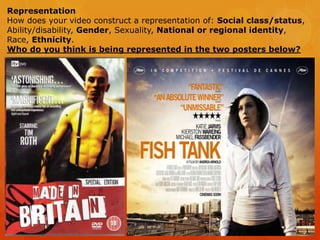
Representation
How does your video construct a representation of: Social class/status,
Ability/disability, Gender, Sexuality, National or regional identity,
Race, Ethnicity.
Who do you think is being represented in the two posters below?
Laura Mulvey’s Male Gaze theory
argues that ‘the image of women in film is one
constructed by and for a patriarchal culture, enabling
men to “live out his fantasies and obsessions…by
imposing them on the silent image of a women…” Thus
taking away a woman's importance and meaning.
David Buckingham
‘The media do not just offer us a transparent ‘window on
the world’ but a mediated version of the world. They just
don’t just present reality, they re-present it’
Stuart Hall suggests forms of ‘ideological work’ performed by
television. In an increasingly fragmented society, TV provides
images and representations of ‘the lives, meanings, practices and
values’ of social groups unfamiliar to us. TV ‘fills in’ our picture of
the world through its representations, classifies these
representations, and works to secure our consent to the ‘imaginary
unity or coherence’ it then constructs.
Some theory for you...
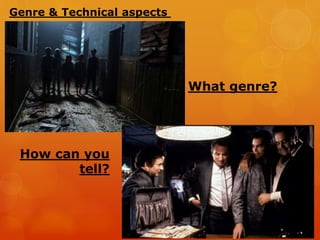
What genre?
How can you
tell?
Genre & Technical aspects
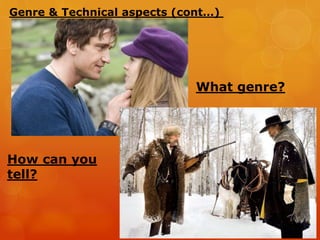
What genre?
How can you
tell?
Genre & Technical aspects (cont…)
Genre Theory
Definition: ‘Genre’ is a critical tool that helps us study texts
and audience responses to texts by dividing them into
categories based on common elements.
Daniel Chandler (2001) details that the word genre comes
from the word for kindor class. The term is widely used in
rhetoric, literary theory, media theory to refer to a
“distinctive type of ‘text’”.
All genres have sub genres (genre within a genre). This means
that they are divided up into more specific categories.
Barry Keith Grant (1995) suggests that this allows
audiences to identify them specifically by their familiar and
what become recognisable characteristics.
Certain genres are also said to have certain themes. David
Bordwell (1989) notes, any theme may appear in any genre‘.
Narrative
In media terms, narrative is the /organisation
given to a series of facts. The human mind
needs narrative to make sense of things. We
connect events and make interpretations based
on those connections. In everything we seek a
beginning, a middle and an end.
Narrative is the media term for story telling.
Narrative is the way the different elements in a
story are organised to make a meaningful
story. Some of these elements can be facts as
in a documentary, or characters and action as
in a drama.
When we look at narrative we see that stories
throughout the media share certain characteristics. This
often links them to genre. Different media tell stories in
a variety of different ways.
Narrative Structure(s)
 This is the way the story or plot unfolds.
 Is the story an open or closed structure?
 A closed structure means the story ends satisfactorily
as in most films – this is known as closure.
 An open ending means there is no final conclusion to
the story – a television soap has no final ending, it just
has minor endings.
 Some texts have an interactive structure e.g. Big
Brother.
Narrative is informed by character, action, location
Tzvetan Todorov (1977)
A Bulgarian structural linguist, interested in the way language is
ordered to infer particular meanings and has been very influential
in the field of narrative theory.
Stage 1: A point of stable equilibrium, where everything is
satisfied, calm and normal.
Stage 2: This stability is disrupted by some kind of force, which
creates a state of disequilibrium.
Stage 3: Recognition that a disruption has taken place.
Stage 4: It is only possible to re-create equilibrium through
action directed against the disruption.
Stage 5: Restoration of a new state of equilibrium. The
consequences of the reaction is to change the world of the
narrative and/or the characters so that the final state of
equilibrium in not the same as the initial state.
Vladimir Propp (1928)
Propp’s seven character types:
1. The villain — struggles against the hero.
2. The donor — prepares the hero or gives the hero some
magical object.
3. The (magical) helper — helps the hero in the quest.
4. The princess and her father — gives the task to the hero,
identifies the false hero, marries the hero, often sought for
during the narrative. Propp noted that functionally, the
princess and the father can not be clearly distinguished.
5. The dispatcher — character who makes the lack known and
sends the hero off.
6. The hero or victim/seeker hero — reacts to the donor, weds
the princess.
7. [False hero] — takes credit for the hero’s actions or tries to
marry the princess.
KEY CONCEPT POINTS:
 You need to understand how the conventions of real media texts
has developed over the course of AS and A2. (For example a
music video will have certain codes and conventions that they
should understand in order to be able to apply to their own
texts).
 To identify how you may have specific examples, like certain
music videos, that you may have developed an idea from.
 To identify how you may have learned about specific
conventions in or outside of class that they may have not
understood or knew before and have since applied it to your
own texts.
 Think about how you used other media texts to create your own
texts to either replicate what you have seen or to challenge
those conventions.
SECTION A: Theoretical Evaluation of Production
1 (a) Describe how your analysis of the conventions of real media
texts informed your own creative media practice. Refer to a range
of examples in your answer to show how these skills developed
over time. [25]
Example Exam Question
You may want to write the question down and familiarise yourself
with it.
LESSON TASKS:
Create a table as a way of structuring your notes. Two columns:
‘CONVENTIONS OF FILM OPENINGS’ & ‘CONVENTIONS OF THRILLER
FILMS’
Under each heading list the conventions of ‘FILM OPENINGS’ and
‘THRILLER FILMS‘ (AS) (10 min)
Now pick 2 - 3 of the conventions you have listed and makes notes
(below your table?) on how you have used them within your work (10
min)
Create a new table. Two columns: ‘CONVENTIONS OF MUSIC VIDEO’ and
‘CONVENTIONS OF MUSIC VIDEO’. Under each heading list the
conventions.
Now pick 2 - 3 of the conventions you have listed and makes notes
(below your table?) on how you have used them within your work (10
min)
….CONTINUED
Trailer conventions
 They highlight the best bits of the film
 Showcase stars/director of the film
 Some visual images barely stay on screen long enough for us to
recognise what we are seeing (i.e. they are often very fast paced)
 Conversations are often one-liners
 Dramatic camera angles may be chosen to show events or
characters
 Action is interspersed with credits on screen
 Voiceovers are used to tell the story and give credit information
 Music plays an important role in creating atmosphere
 Titles may not appear until the end
 Trailer builds to a climax, where it ends
 Montage
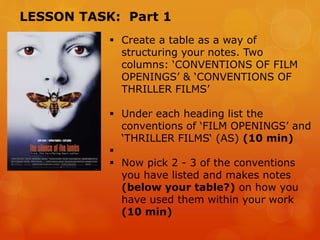
 Create a table as a way of
structuring your notes. Two
columns: ‘CONVENTIONS OF FILM
OPENINGS’ & ‘CONVENTIONS OF
THRILLER FILMS’
 Under each heading list the
conventions of ‘FILM OPENINGS’ and
‘THRILLER FILMS‘ (AS) (10 min)

 Now pick 2 - 3 of the conventions
you have listed and makes notes
(below your table?) on how you
have used them within your work
(10 min)
LESSON TASK: Part 1
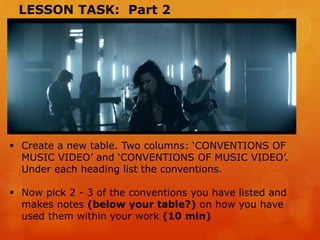
 Create a new table. Two columns: ‘CONVENTIONS OF
MUSIC VIDEO’ and ‘CONVENTIONS OF MUSIC VIDEO’.
Under each heading list the conventions.
 Now pick 2 - 3 of the conventions you have listed and
makes notes (below your table?) on how you have
used them within your work (10 min)
LESSON TASK: Part 2
IMPORTANT NOTE:
You will need to consider how useful it is to know:
• What are the different conventions (names of)
• Understand what the conventions mean
• Know why understanding them has helped to improve
you texts.
So you may have consciously made decisions based on your
understanding of conventions (example a theorist Andrew
Goodwin) or you may have used these conventions subconsciously
(research or watching these types of texts in your everyday lives)
FINAL LESSON TASK
You will need to look at how you have developed by writing a brief
summary after your notes on your development from AS to A2.
(10 min)
HOMEWORK TASK:
Using the Q1a) planning sheet, you are to start producing
detailed evaluation/planning sheets of your coursework for
each of the five elements and how they have improved from
AS to A2.
 Digital Technology
 Creativity
 Research and Planning
 Post-production
 Using conventions from real media texts
On Tues lesson after the bank holiday you will finalise
your planning sheets so by the end of the lesson you
will have a essay plan for each element. Please have
all your notes, research etc. ready for next Tues (3rd
May)
Suggestion on how to structure your answer
Paragraph 1 should be an introduction which explains which projects you did.
It can be quite short.
Paragraph 2 should pick up the skill area and perhaps suggest something
about your starting point with it- what skills did you have already and how
were these illustrated. Use an example.
Paragraph 3 should talk through your use of that skill in early projects and
what you learned and developed through these. Again there should be
examples to support all that you say.
Paragraph 4 should go on to demonstrate how the skill developed in later
projects, again backed by examples, and reflecting back on how this
represents moves forward for you from your early position and how the
development of these skills enabled you to be more creative.
Paragraph 5 short conclusion
End of Lesson 5

Lesson 5 real media texts

  • 1.
    USING CONVENTIONS FROM REALMEDIA TEXTS Preparation for Exam Question 1a: Lesson 4
  • 2.
    Using Conventions ofreal media texts You need to begin to explore how and why you have used media conventions in your coursework. A convention is a “rule, method or practice established by usage”. You need to consider conventions in terms of:  Representation  Genre  Technical aspects (mise-en-scene, cinematography/photography, lighting, editing, titles, logos and sound(diegetic & non-diegetic)  Narrative (story (ideology), characters, setting, costume, dialogue, use of location)
  • 3.
    Representation How does yourvideo construct a representation of: Social class/status, Ability/disability, Gender, Sexuality, National or regional identity, Race, Ethnicity. Who do you think is being represented in the two posters below?
  • 4.
    Laura Mulvey’s MaleGaze theory argues that ‘the image of women in film is one constructed by and for a patriarchal culture, enabling men to “live out his fantasies and obsessions…by imposing them on the silent image of a women…” Thus taking away a woman's importance and meaning. David Buckingham ‘The media do not just offer us a transparent ‘window on the world’ but a mediated version of the world. They just don’t just present reality, they re-present it’ Stuart Hall suggests forms of ‘ideological work’ performed by television. In an increasingly fragmented society, TV provides images and representations of ‘the lives, meanings, practices and values’ of social groups unfamiliar to us. TV ‘fills in’ our picture of the world through its representations, classifies these representations, and works to secure our consent to the ‘imaginary unity or coherence’ it then constructs. Some theory for you...
  • 5.
    What genre? How canyou tell? Genre & Technical aspects
  • 6.
    What genre? How canyou tell? Genre & Technical aspects (cont…)
  • 8.
    Genre Theory Definition: ‘Genre’is a critical tool that helps us study texts and audience responses to texts by dividing them into categories based on common elements. Daniel Chandler (2001) details that the word genre comes from the word for kindor class. The term is widely used in rhetoric, literary theory, media theory to refer to a “distinctive type of ‘text’”. All genres have sub genres (genre within a genre). This means that they are divided up into more specific categories. Barry Keith Grant (1995) suggests that this allows audiences to identify them specifically by their familiar and what become recognisable characteristics. Certain genres are also said to have certain themes. David Bordwell (1989) notes, any theme may appear in any genre‘.
  • 9.
    Narrative In media terms,narrative is the /organisation given to a series of facts. The human mind needs narrative to make sense of things. We connect events and make interpretations based on those connections. In everything we seek a beginning, a middle and an end. Narrative is the media term for story telling. Narrative is the way the different elements in a story are organised to make a meaningful story. Some of these elements can be facts as in a documentary, or characters and action as in a drama.
  • 10.
    When we lookat narrative we see that stories throughout the media share certain characteristics. This often links them to genre. Different media tell stories in a variety of different ways. Narrative Structure(s)  This is the way the story or plot unfolds.  Is the story an open or closed structure?  A closed structure means the story ends satisfactorily as in most films – this is known as closure.  An open ending means there is no final conclusion to the story – a television soap has no final ending, it just has minor endings.  Some texts have an interactive structure e.g. Big Brother. Narrative is informed by character, action, location
  • 11.
    Tzvetan Todorov (1977) ABulgarian structural linguist, interested in the way language is ordered to infer particular meanings and has been very influential in the field of narrative theory. Stage 1: A point of stable equilibrium, where everything is satisfied, calm and normal. Stage 2: This stability is disrupted by some kind of force, which creates a state of disequilibrium. Stage 3: Recognition that a disruption has taken place. Stage 4: It is only possible to re-create equilibrium through action directed against the disruption. Stage 5: Restoration of a new state of equilibrium. The consequences of the reaction is to change the world of the narrative and/or the characters so that the final state of equilibrium in not the same as the initial state.
  • 12.
    Vladimir Propp (1928) Propp’sseven character types: 1. The villain — struggles against the hero. 2. The donor — prepares the hero or gives the hero some magical object. 3. The (magical) helper — helps the hero in the quest. 4. The princess and her father — gives the task to the hero, identifies the false hero, marries the hero, often sought for during the narrative. Propp noted that functionally, the princess and the father can not be clearly distinguished. 5. The dispatcher — character who makes the lack known and sends the hero off. 6. The hero or victim/seeker hero — reacts to the donor, weds the princess. 7. [False hero] — takes credit for the hero’s actions or tries to marry the princess.
  • 13.
    KEY CONCEPT POINTS: You need to understand how the conventions of real media texts has developed over the course of AS and A2. (For example a music video will have certain codes and conventions that they should understand in order to be able to apply to their own texts).  To identify how you may have specific examples, like certain music videos, that you may have developed an idea from.  To identify how you may have learned about specific conventions in or outside of class that they may have not understood or knew before and have since applied it to your own texts.  Think about how you used other media texts to create your own texts to either replicate what you have seen or to challenge those conventions.
  • 14.
    SECTION A: TheoreticalEvaluation of Production 1 (a) Describe how your analysis of the conventions of real media texts informed your own creative media practice. Refer to a range of examples in your answer to show how these skills developed over time. [25] Example Exam Question You may want to write the question down and familiarise yourself with it.
  • 15.
    LESSON TASKS: Create atable as a way of structuring your notes. Two columns: ‘CONVENTIONS OF FILM OPENINGS’ & ‘CONVENTIONS OF THRILLER FILMS’ Under each heading list the conventions of ‘FILM OPENINGS’ and ‘THRILLER FILMS‘ (AS) (10 min) Now pick 2 - 3 of the conventions you have listed and makes notes (below your table?) on how you have used them within your work (10 min) Create a new table. Two columns: ‘CONVENTIONS OF MUSIC VIDEO’ and ‘CONVENTIONS OF MUSIC VIDEO’. Under each heading list the conventions. Now pick 2 - 3 of the conventions you have listed and makes notes (below your table?) on how you have used them within your work (10 min) ….CONTINUED
  • 16.
    Trailer conventions  Theyhighlight the best bits of the film  Showcase stars/director of the film  Some visual images barely stay on screen long enough for us to recognise what we are seeing (i.e. they are often very fast paced)  Conversations are often one-liners  Dramatic camera angles may be chosen to show events or characters  Action is interspersed with credits on screen  Voiceovers are used to tell the story and give credit information  Music plays an important role in creating atmosphere  Titles may not appear until the end  Trailer builds to a climax, where it ends  Montage
  • 17.
     Create atable as a way of structuring your notes. Two columns: ‘CONVENTIONS OF FILM OPENINGS’ & ‘CONVENTIONS OF THRILLER FILMS’  Under each heading list the conventions of ‘FILM OPENINGS’ and ‘THRILLER FILMS‘ (AS) (10 min)   Now pick 2 - 3 of the conventions you have listed and makes notes (below your table?) on how you have used them within your work (10 min) LESSON TASK: Part 1
  • 18.
     Create anew table. Two columns: ‘CONVENTIONS OF MUSIC VIDEO’ and ‘CONVENTIONS OF MUSIC VIDEO’. Under each heading list the conventions.  Now pick 2 - 3 of the conventions you have listed and makes notes (below your table?) on how you have used them within your work (10 min) LESSON TASK: Part 2
  • 19.
    IMPORTANT NOTE: You willneed to consider how useful it is to know: • What are the different conventions (names of) • Understand what the conventions mean • Know why understanding them has helped to improve you texts. So you may have consciously made decisions based on your understanding of conventions (example a theorist Andrew Goodwin) or you may have used these conventions subconsciously (research or watching these types of texts in your everyday lives) FINAL LESSON TASK You will need to look at how you have developed by writing a brief summary after your notes on your development from AS to A2. (10 min)
  • 20.
    HOMEWORK TASK: Using theQ1a) planning sheet, you are to start producing detailed evaluation/planning sheets of your coursework for each of the five elements and how they have improved from AS to A2.  Digital Technology  Creativity  Research and Planning  Post-production  Using conventions from real media texts On Tues lesson after the bank holiday you will finalise your planning sheets so by the end of the lesson you will have a essay plan for each element. Please have all your notes, research etc. ready for next Tues (3rd May)
  • 21.
    Suggestion on howto structure your answer Paragraph 1 should be an introduction which explains which projects you did. It can be quite short. Paragraph 2 should pick up the skill area and perhaps suggest something about your starting point with it- what skills did you have already and how were these illustrated. Use an example. Paragraph 3 should talk through your use of that skill in early projects and what you learned and developed through these. Again there should be examples to support all that you say. Paragraph 4 should go on to demonstrate how the skill developed in later projects, again backed by examples, and reflecting back on how this represents moves forward for you from your early position and how the development of these skills enabled you to be more creative. Paragraph 5 short conclusion
  • 22.