 A single camera production is simply a
  piece of media either a music video or
  film shot with a single camera.
 These are usually low budget films and
  usually involves a lot of editing during
  scenes with multiple characters having
  conversations and such.
 Single camera means you can observe
  all the work as you go
 Cheaper as you only needs to get a
  single camera.
 Don’t have to worry about another
  camera being seen by another.
 Limited to what you can do filming as
  you will only be able to take one shot.
 All the equipment has to be in one place
  so it will take time to move sets.
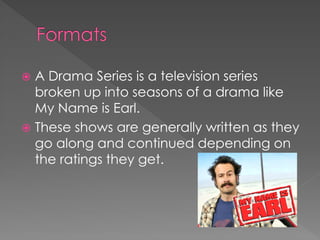
 A Drama Series is a television series
  broken up into seasons of a drama like
  My Name is Earl.
 These shows are generally written as they
  go along and continued depending on
  the ratings they get.
 A Drama Serial is a prewritten show with
  a predetermined amount of episodes
  like ‘Babylon 5’
 Shows like these are written to end and
  although they sometimes do have
  spinoffs such as Doctor Who which has
  more spin offs than any other show
  totalling to 9 although its not a exact
  serial it does have a lifespan of until the
  next two and current doctor dies.
 A single Drama is a Drama on its own not
  breaking up into episodes or seasons but
  being the single film/episode such as Still
  Life.
 A single drama is a one off drama and is
  often created to deal with a current real
  world situation or to inform or simply to
  entertain a audience with a compelling
  story. http://vimeo.com/32198276
 A linear story line is a storyline that
  progresses in the order of events like
  Game of Thrones.
 These usually just tell a straight forward
  story making the audience simply follow
  the sequence of events it displays.
 A non linear story is a story that takes
  place in different timeframes often
  flashing between different points of time
  to piece together a fragmented story.
 An example of this would be Pulp fiction
 http://vimeo.com/27433933
 A realist and anti realist narrative are
  very niche structures.
 A realist structure is one that’s realistic
  and may even be based off a true story
  like a crime drama like Bones.
 A anti-realist structure is a structure
  where basically anything can happen
  like the narrative for doctor who.
   Endings can be closed in several differ
    ways meaning they can be closed
    leaving no loose ends in the story like
    Bonnie and Clyde or open which leaves
    path ways open for a possible sequel as
    seen in the matrix films.
   Framing
   Extreme Long Shot – A distance taken from a long distance perhaps even a
    quarter mile away. Generally used to set a scene with little detail available.
   Long shot – The most difficult to categorise but is considered to be ‘Life’ sized
    allowing you to see the whole actor instead of just a part of them
   Medium shot – Usually just includes a shot of a person from the waist up and
    is typically used for dialogue scenes and typically the distance for the over
    the shoulder shot.
   Close-up – Contains very little background and usually focusses on a
    characters face or a specific detail of mise en scéne. A film maker will use
    this to make us feel more comfortable or less comfortable with a character.
   Extreme Close-up - An extreme close-up of a face would show only the
    mouth or eyes, with no background detail to create a larger dramatic effect
   Master shot- where single drama is filmed from one view throughout keeping
    all actors in view and typically works as a longshot or establishing shot as well.
Camera angles
The Bird's-Eye view – This angle looks down at the scene giving
the audience a god like view making them feel superior.
High Angle – This looks down at the audience but in a less
extreme way than a birds eye view making it feel more personal
than a birds eye view.
Eye level – This is level with the character eyes making the
audience feel more equal with the character in the focus.
Low angle – This makes the audience feel more insignificant than
the character and makes him/her seem more scary and
intimidating.
Oblique/canted angle – Sometimes the camera is tilted to show
something is unusual or off-balance and can cause discomfort
to the auidience
Movement
Pans - movement which scans a scene horizontally. The camera is placed on a tripod, which
operates as a stationary axis point as the camera is turned, often to follow a moving object
which is kept in the middle of the frame.
Tilts – Similar to a pan but only that it moves vertically instead.
Dolly Shots – This is when the camera is place on a trolley or a vehicle and follows the
characters tacking them in the lense its often used to make a smooth transition from long
distance to close up
Hand-held shots – This makes the shot have a more homemade feel and is often used in a
low budget situation they help in making the audience feel involved in an scene
Crane Shots – Basically a dolly shot from the air and is mainly used for when trying to get a
birds-eye view.
Zoom Lenses – used when trying to create action in scene where there is none not
recommended as it can distort a image and make actors and objects appear closer than
they really are.
The Aerial Shot - A more exciting variation of a crane shot is instead uses a helicopter or a
plane allowing for the camera to move faster and higher if needed.
 High Key lighting - High-key lighting is a style of lighting for film,
  television, or photography that aims to reduce the lighting ratio
  present in the scene. This was originally done partly for technological
  reasons, since early film and television did not deal well with high
  contrast ratios, but now is used to suggest an upbeat mood. It is
  often used in sitcoms and comedies. High-key lighting is usually quite
  homogeneous and free from dark shadows
 Low key lighting - This is often used to hide features using a single
  light to display only what is wanted to be seen in the shot.
 Natural lighting – This is used to create a natural feeling to the shot
  only relying on the sun or moon reflection for the scene using no
  special lighting effects.
 Ambient lighting - It is the combination of light reflections from
  various surfaces to produce a uniform illumination called the
  ambient light.
   Diegetic Sound – Is the sound that can be heard by the characters in the scene but
    may be added after.
   Non-diegetic sound – Is the sound that cannot be heard by the characters and may
    only be used to set a scene or create tension
   Sound effects – This are artificially created sound that may be used to replace or
    change a natural sound to make it sound less noticeable or more dramatic.
   Ambient sound – This is the background sound to a scene and may be used to set the
    tone for a scene either to create a feeling of safety or tension.
   Dialogue – This is the sound that comes from the actors playing their part with their
    voice.
   Voice over – A voice over is someone that may be talking over a scene often used in
    directors commentary or in a documentary.
   Synchronous sound - Is the term used for when the sound matches the actions and is
    synchronises with what is going on.
   Asynchronous sound- Is the term used for when the sound doesn’t match the scene but
    may be used to create a distortion effect within the scene.
   On screen sound – This is where sound is created in the scene in front of the audience to
    draw them to a specific point or just because its part of the scene
   Off Screen sound- This is where sound is caused off the scene, this can be done to startle
    the audience or to transfer a transition to another scene.
   Continuity editing- Where a scene is editing so that the scene transitions properly
    and doesn’t leave the audience confused and lost
   Match on Action- This will be used so that a scene changes with the action for
    instance one character will move to start opening a door and then move to the
    other side for when the character opens the door creating a smooth transition
    from one side to the other.
   Shot reverse shot - usually filmed from over the shoulder it allows the audience to
    watch which character is speaking so it does not confuse them when they watch
    the scene.
   180 degree rule – Is the rule where the audience can only see one side of the
    room and so that the audience does not get confused while watching the
    scene.
   POV shots – is the shot used for when the scene is to look like its coming from the
    characters eyes making the audience feel more personal in the scene.
   Cross-cutting – Is when one scene cut to another so it keeps relevant with the
    story.
   A montage – is when a long action is quickly passed showing highlights of the
    scene in order to pass time quickly.
   Spit screen – this is typically used in a comic style strip typically used to look more
    closely at something going on in the scene or in another to link them together.
To build a scene you need to find a
appropriate setting that’s appropriate to
the story, you also need to film in a correct
way. For instance if you were to create a
scene for a period drama you would need
a large Victorian building as a setting and
need appropriate costume to fit with the
time period if someone was to come into
the scene with a chequered shirt it would
need fit into the scene and ruin it.
   When building a story for a drama you need to
    think about what the time setting and the
    ‘universe’ its set in. For instance in the universe of
    Doctor Who being a Sci-Fi drama you need to find
    something appropriate to the subject people who
    watch the show enjoy the aliens and the parallel
    universes displayed by the show and not provide
    this to the audience would disappoint them. You
    also after think about the age of a audience to see
    if the script would be appropriate to the younger
    audience this generation of doctor who is
    presented for
   Directed by Adam Butcher
   Writer - Adam Butcher
   Producer - Ed Moline
   Animator -Jonathan Harris
   Music -Blair Mowat
   Cast
   Fortress - Duncan Wigman
   Narrator - Shaun French


   A fast-paced and experimental film told through fragments of
    internet videos, animations, blogs and news articles. A series of
    shocking events unfolds when a young man creates a public
    treasure hunt for his own amusement and a video blogger decides
    to pursue the riddles across country.
 The film is mainly pieces of footage
  edited together to from a docudrama.
 The film in many segments is in a POV
  shot as many of its just premade footage
 The film is close up on parts of the scene
  as it focused what ‘fortress’ focuses on
 Gigetic
 No sound effects other than for
  animation.
 Voice over
 Dialogue
 Synchronous sound
 On screen
   http://listverse.com/2007/10/26/top-15-movie-amazing-movie-endings/
   http://www.mediaknowall.com/camangles.html
   http://en.wikipedia.org/wiki/Master_shot
   http://en.wikipedia.org/wiki/High-key_lighting
   http://en.wikipedia.org/wiki/Low-key_lighting
   http://en.wikipedia.org/wiki/Ambient_light

Single camera production

  • 2.
     A singlecamera production is simply a piece of media either a music video or film shot with a single camera.  These are usually low budget films and usually involves a lot of editing during scenes with multiple characters having conversations and such.
  • 3.
     Single camerameans you can observe all the work as you go  Cheaper as you only needs to get a single camera.  Don’t have to worry about another camera being seen by another.
  • 4.
     Limited towhat you can do filming as you will only be able to take one shot.  All the equipment has to be in one place so it will take time to move sets.
  • 5.
     A DramaSeries is a television series broken up into seasons of a drama like My Name is Earl.  These shows are generally written as they go along and continued depending on the ratings they get.
  • 6.
     A DramaSerial is a prewritten show with a predetermined amount of episodes like ‘Babylon 5’  Shows like these are written to end and although they sometimes do have spinoffs such as Doctor Who which has more spin offs than any other show totalling to 9 although its not a exact serial it does have a lifespan of until the next two and current doctor dies.
  • 7.
     A singleDrama is a Drama on its own not breaking up into episodes or seasons but being the single film/episode such as Still Life.  A single drama is a one off drama and is often created to deal with a current real world situation or to inform or simply to entertain a audience with a compelling story. http://vimeo.com/32198276
  • 8.
     A linearstory line is a storyline that progresses in the order of events like Game of Thrones.  These usually just tell a straight forward story making the audience simply follow the sequence of events it displays.
  • 9.
     A nonlinear story is a story that takes place in different timeframes often flashing between different points of time to piece together a fragmented story.  An example of this would be Pulp fiction  http://vimeo.com/27433933
  • 10.
     A realistand anti realist narrative are very niche structures.  A realist structure is one that’s realistic and may even be based off a true story like a crime drama like Bones.  A anti-realist structure is a structure where basically anything can happen like the narrative for doctor who.
  • 11.
    Endings can be closed in several differ ways meaning they can be closed leaving no loose ends in the story like Bonnie and Clyde or open which leaves path ways open for a possible sequel as seen in the matrix films.
  • 12.
    Framing  Extreme Long Shot – A distance taken from a long distance perhaps even a quarter mile away. Generally used to set a scene with little detail available.  Long shot – The most difficult to categorise but is considered to be ‘Life’ sized allowing you to see the whole actor instead of just a part of them  Medium shot – Usually just includes a shot of a person from the waist up and is typically used for dialogue scenes and typically the distance for the over the shoulder shot.  Close-up – Contains very little background and usually focusses on a characters face or a specific detail of mise en scéne. A film maker will use this to make us feel more comfortable or less comfortable with a character.  Extreme Close-up - An extreme close-up of a face would show only the mouth or eyes, with no background detail to create a larger dramatic effect  Master shot- where single drama is filmed from one view throughout keeping all actors in view and typically works as a longshot or establishing shot as well.
  • 13.
    Camera angles The Bird's-Eyeview – This angle looks down at the scene giving the audience a god like view making them feel superior. High Angle – This looks down at the audience but in a less extreme way than a birds eye view making it feel more personal than a birds eye view. Eye level – This is level with the character eyes making the audience feel more equal with the character in the focus. Low angle – This makes the audience feel more insignificant than the character and makes him/her seem more scary and intimidating. Oblique/canted angle – Sometimes the camera is tilted to show something is unusual or off-balance and can cause discomfort to the auidience
  • 14.
    Movement Pans - movementwhich scans a scene horizontally. The camera is placed on a tripod, which operates as a stationary axis point as the camera is turned, often to follow a moving object which is kept in the middle of the frame. Tilts – Similar to a pan but only that it moves vertically instead. Dolly Shots – This is when the camera is place on a trolley or a vehicle and follows the characters tacking them in the lense its often used to make a smooth transition from long distance to close up Hand-held shots – This makes the shot have a more homemade feel and is often used in a low budget situation they help in making the audience feel involved in an scene Crane Shots – Basically a dolly shot from the air and is mainly used for when trying to get a birds-eye view. Zoom Lenses – used when trying to create action in scene where there is none not recommended as it can distort a image and make actors and objects appear closer than they really are. The Aerial Shot - A more exciting variation of a crane shot is instead uses a helicopter or a plane allowing for the camera to move faster and higher if needed.
  • 15.
     High Keylighting - High-key lighting is a style of lighting for film, television, or photography that aims to reduce the lighting ratio present in the scene. This was originally done partly for technological reasons, since early film and television did not deal well with high contrast ratios, but now is used to suggest an upbeat mood. It is often used in sitcoms and comedies. High-key lighting is usually quite homogeneous and free from dark shadows  Low key lighting - This is often used to hide features using a single light to display only what is wanted to be seen in the shot.  Natural lighting – This is used to create a natural feeling to the shot only relying on the sun or moon reflection for the scene using no special lighting effects.  Ambient lighting - It is the combination of light reflections from various surfaces to produce a uniform illumination called the ambient light.
  • 16.
    Diegetic Sound – Is the sound that can be heard by the characters in the scene but may be added after.  Non-diegetic sound – Is the sound that cannot be heard by the characters and may only be used to set a scene or create tension  Sound effects – This are artificially created sound that may be used to replace or change a natural sound to make it sound less noticeable or more dramatic.  Ambient sound – This is the background sound to a scene and may be used to set the tone for a scene either to create a feeling of safety or tension.  Dialogue – This is the sound that comes from the actors playing their part with their voice.  Voice over – A voice over is someone that may be talking over a scene often used in directors commentary or in a documentary.  Synchronous sound - Is the term used for when the sound matches the actions and is synchronises with what is going on.  Asynchronous sound- Is the term used for when the sound doesn’t match the scene but may be used to create a distortion effect within the scene.  On screen sound – This is where sound is created in the scene in front of the audience to draw them to a specific point or just because its part of the scene  Off Screen sound- This is where sound is caused off the scene, this can be done to startle the audience or to transfer a transition to another scene.
  • 17.
    Continuity editing- Where a scene is editing so that the scene transitions properly and doesn’t leave the audience confused and lost  Match on Action- This will be used so that a scene changes with the action for instance one character will move to start opening a door and then move to the other side for when the character opens the door creating a smooth transition from one side to the other.  Shot reverse shot - usually filmed from over the shoulder it allows the audience to watch which character is speaking so it does not confuse them when they watch the scene.  180 degree rule – Is the rule where the audience can only see one side of the room and so that the audience does not get confused while watching the scene.  POV shots – is the shot used for when the scene is to look like its coming from the characters eyes making the audience feel more personal in the scene.  Cross-cutting – Is when one scene cut to another so it keeps relevant with the story.  A montage – is when a long action is quickly passed showing highlights of the scene in order to pass time quickly.  Spit screen – this is typically used in a comic style strip typically used to look more closely at something going on in the scene or in another to link them together.
  • 18.
    To build ascene you need to find a appropriate setting that’s appropriate to the story, you also need to film in a correct way. For instance if you were to create a scene for a period drama you would need a large Victorian building as a setting and need appropriate costume to fit with the time period if someone was to come into the scene with a chequered shirt it would need fit into the scene and ruin it.
  • 19.
    When building a story for a drama you need to think about what the time setting and the ‘universe’ its set in. For instance in the universe of Doctor Who being a Sci-Fi drama you need to find something appropriate to the subject people who watch the show enjoy the aliens and the parallel universes displayed by the show and not provide this to the audience would disappoint them. You also after think about the age of a audience to see if the script would be appropriate to the younger audience this generation of doctor who is presented for
  • 20.
    Directed by Adam Butcher  Writer - Adam Butcher  Producer - Ed Moline  Animator -Jonathan Harris  Music -Blair Mowat  Cast  Fortress - Duncan Wigman  Narrator - Shaun French  A fast-paced and experimental film told through fragments of internet videos, animations, blogs and news articles. A series of shocking events unfolds when a young man creates a public treasure hunt for his own amusement and a video blogger decides to pursue the riddles across country.
  • 21.
     The filmis mainly pieces of footage edited together to from a docudrama.  The film in many segments is in a POV shot as many of its just premade footage  The film is close up on parts of the scene as it focused what ‘fortress’ focuses on
  • 22.
     Gigetic  Nosound effects other than for animation.  Voice over  Dialogue  Synchronous sound  On screen
  • 23.
    http://listverse.com/2007/10/26/top-15-movie-amazing-movie-endings/  http://www.mediaknowall.com/camangles.html  http://en.wikipedia.org/wiki/Master_shot  http://en.wikipedia.org/wiki/High-key_lighting  http://en.wikipedia.org/wiki/Low-key_lighting  http://en.wikipedia.org/wiki/Ambient_light