Serial Drama
Media GCSE
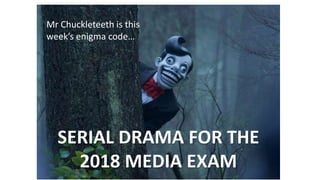
SERIAL DRAMA FOR THE
2018 MEDIA EXAM
Mr Chuckleteeth is this
week’s enigma code…
• Make sure you address your response in role
• Note it says ANY sub-genre, so while it has to be appropriate for a teen
audience, it could still be about a murder or something supernatural or
even more out there…
• I have no idea what it means about the same old stereotypical
representations of young people but they ask that your show contains
realistic and relevant representation of teenagers. When you come up with
your pitch, make your characters ethnically diverse, a mix of males and
females and don’t fall back on stereotypes. Make one of the girls a strong
figure; make her gay; make her/him Trans. A diverse cast will attract a
diverse audience – and it will attract criticism from newspapers like The
Daily Mail and once that happens, you’ll get even more publicity.
• Question 1 will more than likely ask what makes serial drama
successful, so talk about serial drama being a staple of TV schedules for
decades and note how shows like this (examples?) are now popular
online on a variety of devices THEN talk about narrative, characters
and location, just as you’ve been doing in the lessons.
• You need to talk about the importance of a strong and engaging
narrative – this is where you refer to Todorov. Look at exemplar
material I gave you: it’s not complicated but you MUST refer to
examples of shows you’ve watched and they don’t have to be teen
shows. The exam paper will probably ask for examples to at least two
shows (hey don’t have to be shows we’ve looked at in class; they can
be stuff you’ve seen at home as long as you’re really familiar with
them). You could also mention the importance of using Barthes’
Enigma Code to hook the audience in a strong opening sequence, just
like…?
• The importance of strong, varied and engaging characters. Again look at the
exemplar material – now give some examples from shows you’ve seen. What about
ethnically diverse characters – e.g. Homicide. What about using ‘binary opposites’?
Conflict drives drama. Even if the characters are on the same side, they can disagree
and/or argue. What about conflict with colleagues or bosses? Examples? Conflict in
relationships? Look at The X-Files – yes, there’s the main narrative and whatever
conflict might be present but there’s also the different between a believer in the
paranormal like Mulder and a sceptic like Scully.
• Locations – using the gritty urban mise-en-scene as pathetic fallacy to set the tone
for the show (run-down areas of Paris in Spiral, for example); or to create a tone
that runs the opposite to the murders that take place (e.g. the serenity of Oxford in
Endeavour is the backdrop to brutal murders) or as an exotic location to hook an
audience and take them away from their troubles (Death in Paradise – you’ll have to
Google where it’s set…). You can point out that, attractive or not, these locations
often attract tourists to the area the show is set e.g. tourism in Northumberland
went up 30% as a result of people watching Vera; there are Inspector
Morse/Lewis/Endeavour tours of Oxford and you can stay in the house in Sicily used
by the inspector in Montalbano.
• Question 2 will more than likely be where you have to pitch ideas for your
own drama. Try to say why it’s going to be a success. Does it have a unique
selling point (will the characters burst out into song? You can say it’s based on
a best-selling teen novel – which you’ve just made up). What’s it about and
where is it set? Is it a series of separate drama featuring the same characters?
Is it a continuing drama with storylines running throughout the series? Does it
have potential for a sequel? Give it a reasonably complex narrative to keep
people engaged. When you talk about the main narrative, think about what
you’ve just said in Q1 – you want a classic engaging narrative with an enigma
code opening to hook the audience. Talk about your key characters. You’ll
notice the exemplar material only had three, so make them the most
interesting and diverse and complicated. You could compare your show to a
successful existing show. You could also provide actors for your three key
characters. Make sure they’re not too expensive – pick people who are in or
have had successful TV shows. You could refer to a couple of adult characters
to broaden the audience. Somewhere in this section talk about the way your
show will fulfil the four needs of Uses and Gratifications.
• Question 3: The drawing question. Hard to work out from this, but the
idea of generating interest online would seem to point towards a
website – though don’t rule out some kind of social network page. This
needs to be annotated. Look at the exemplar material or look at The
Batman v Superman Dawn of Justice website and rip it off. Put some
links across the top of the page to the production company (The Serial
Box), other shows, other products, merchandise and label this synergy.
Put the (YouTube) trailer in the middle and make sure you have flash
content still playing when the trailer is finished (i.e. so you’ll still get
some moving images as if they’re played on a loop). Put social network
links at the bottom and more links down the side: more information,
interviews with cast, writer and director (could be in text form or video
or both); gallery of images; deleted scenes, a game etc etc. Don’t spend
too long on this. Annotate it for colour too, if you don’t have time to
colour it in. Maybe it will have a dominant image on the background –
or draw one on the trailer video…
• Question 4: The Marketing/Promotion Question. Note the section at the end
that highlights the importance of generating interest online and its pre-launch
digital marketing campaign. Begin your campaign 3-6 months before the show
starts. This is up to you to think what will be the most effective so you need to
stress here the need to reach a teenage audience who ae more likely to use
various media hardware to access shows like this. I suspect you’ll have to come
up with three ways you’d market the show to your audience. Don’t say anything
vague like, blog or Instagram. You’ll need to say exactly what you’ll do to reach
your audience and hook the show. You might think of providing an enigma code
– perhaps on some kind of media platform that will leak information, setting up
a Facebook or Instagram account as if it belongs to a key character (if you’re
doing a mystery type show, maybe belonging to the character who is at the
heart of the mystery or maybe one who’s gone missing or is dead). A blog with
an online comic? A blog written by one of the characters. Using social networks
by having the actors tweet or whatever about their new show, occasionally
leaking videos that hint at the story without giving it away. Maybe some kind of
online puzzle or game for people to solve to catch their interest and attract
them to watch the show…
• Remember, it’s 1 ½ hour exam and taking into account time to read the
questions and think about how you’re going to tackle them, you’ll not
have much more than 20 minutes per question. Don’t worry about
handwriting or your artistic ability, just get it down! After you’ve read
this and (hopefully) done some revision in the time you have left
between freaking out over the 102 hours a week that you spend doing
Maths, Science or English, you should be pretty well prepared and know
where you’re going with your answers even before you sit down in the
exam hall.
• The Uses and Gratifications Theory (first put forward in the USA in the
1940s) – sees the audience as able to interact with the media text, ‘using
it for various purposes. For example, audiences get a sense of Personal
identity – a sense of ourselves and peer group from media
representations; Information: the media are full of information which
we are free to pick and choose; Social Interaction – media output is
frequently the topic of conversation; Entertainment – which covers
many forms of interaction with media texts, such as pleasure in the
storyline, the characters, familiarity with characters or genre allowing for
prediction of outcome; deconstruction of the text; an interest in the
issues explored. McQuail, Blulmer and Brown’s (1972) development of
the Uses and Gratifications Model sees the spectators as active
participant in a relationship with the media to gratify their needs, such
as the need for entertainment, information or social identity.
• Todorov says that there are five stages to every narrative (story):
• Stage 1 – The Equilibrium – Life is just as usual
• Stage 2 – The Disruption – A problem happens
• Stage 3 – The Recognition and attempt to resolve the problem – Think
about how to resolve the problem – full of twists and turns, red herrings
etc
• Stage 4 – The Repair – Go ahead and resolve the problem – this is where
the action and the confrontation takes place
• Stage 5 – The Restoration– Life returns to normal – though it may be a
new equilibrium for the characters, rather than a return to the same one
as at the start of the story
• Roland Barthes’ Enigma Code!!!! – the setting up of a mystery or puzzle to
hook the audience and make it want to continue with the show to find out
what happens – think of the opening of CSI – the audience expect to see a
murder or the discovery of a dead body, so the director can play on what its
expecting each week. The X-Files does too – sets up the show by having
some paranormal event happening that will be investigated by Mulder and
Scully in the rest of the episode
•
• Levi Strauss’ Binary Opposites – conflict drives drama. Can be as simple as
man/woman or night/day. The obvious here is good/evil but within that
conflict, there may be more – conflict within the group of bad guys or
between the good guys. Police/detective shows frequently show conflict
between the detective (who wants to do things his/her way) and the
authorities. Think of The X-Files: there is the good/evil conflict; conflict
between Mulder and Scully and their boss; conflict between Mulder and
Scully because he’s a believer and she’s a rational scientist and a sceptic –
and there’s the man/woman conflict with it’s hints of romance

Serial drama

  • 1.
    Serial Drama Media GCSE SERIALDRAMA FOR THE 2018 MEDIA EXAM Mr Chuckleteeth is this week’s enigma code…
  • 2.
    • Make sureyou address your response in role • Note it says ANY sub-genre, so while it has to be appropriate for a teen audience, it could still be about a murder or something supernatural or even more out there… • I have no idea what it means about the same old stereotypical representations of young people but they ask that your show contains realistic and relevant representation of teenagers. When you come up with your pitch, make your characters ethnically diverse, a mix of males and females and don’t fall back on stereotypes. Make one of the girls a strong figure; make her gay; make her/him Trans. A diverse cast will attract a diverse audience – and it will attract criticism from newspapers like The Daily Mail and once that happens, you’ll get even more publicity.
  • 3.
    • Question 1will more than likely ask what makes serial drama successful, so talk about serial drama being a staple of TV schedules for decades and note how shows like this (examples?) are now popular online on a variety of devices THEN talk about narrative, characters and location, just as you’ve been doing in the lessons. • You need to talk about the importance of a strong and engaging narrative – this is where you refer to Todorov. Look at exemplar material I gave you: it’s not complicated but you MUST refer to examples of shows you’ve watched and they don’t have to be teen shows. The exam paper will probably ask for examples to at least two shows (hey don’t have to be shows we’ve looked at in class; they can be stuff you’ve seen at home as long as you’re really familiar with them). You could also mention the importance of using Barthes’ Enigma Code to hook the audience in a strong opening sequence, just like…?
  • 4.
    • The importanceof strong, varied and engaging characters. Again look at the exemplar material – now give some examples from shows you’ve seen. What about ethnically diverse characters – e.g. Homicide. What about using ‘binary opposites’? Conflict drives drama. Even if the characters are on the same side, they can disagree and/or argue. What about conflict with colleagues or bosses? Examples? Conflict in relationships? Look at The X-Files – yes, there’s the main narrative and whatever conflict might be present but there’s also the different between a believer in the paranormal like Mulder and a sceptic like Scully. • Locations – using the gritty urban mise-en-scene as pathetic fallacy to set the tone for the show (run-down areas of Paris in Spiral, for example); or to create a tone that runs the opposite to the murders that take place (e.g. the serenity of Oxford in Endeavour is the backdrop to brutal murders) or as an exotic location to hook an audience and take them away from their troubles (Death in Paradise – you’ll have to Google where it’s set…). You can point out that, attractive or not, these locations often attract tourists to the area the show is set e.g. tourism in Northumberland went up 30% as a result of people watching Vera; there are Inspector Morse/Lewis/Endeavour tours of Oxford and you can stay in the house in Sicily used by the inspector in Montalbano.
  • 5.
    • Question 2will more than likely be where you have to pitch ideas for your own drama. Try to say why it’s going to be a success. Does it have a unique selling point (will the characters burst out into song? You can say it’s based on a best-selling teen novel – which you’ve just made up). What’s it about and where is it set? Is it a series of separate drama featuring the same characters? Is it a continuing drama with storylines running throughout the series? Does it have potential for a sequel? Give it a reasonably complex narrative to keep people engaged. When you talk about the main narrative, think about what you’ve just said in Q1 – you want a classic engaging narrative with an enigma code opening to hook the audience. Talk about your key characters. You’ll notice the exemplar material only had three, so make them the most interesting and diverse and complicated. You could compare your show to a successful existing show. You could also provide actors for your three key characters. Make sure they’re not too expensive – pick people who are in or have had successful TV shows. You could refer to a couple of adult characters to broaden the audience. Somewhere in this section talk about the way your show will fulfil the four needs of Uses and Gratifications.
  • 6.
    • Question 3:The drawing question. Hard to work out from this, but the idea of generating interest online would seem to point towards a website – though don’t rule out some kind of social network page. This needs to be annotated. Look at the exemplar material or look at The Batman v Superman Dawn of Justice website and rip it off. Put some links across the top of the page to the production company (The Serial Box), other shows, other products, merchandise and label this synergy. Put the (YouTube) trailer in the middle and make sure you have flash content still playing when the trailer is finished (i.e. so you’ll still get some moving images as if they’re played on a loop). Put social network links at the bottom and more links down the side: more information, interviews with cast, writer and director (could be in text form or video or both); gallery of images; deleted scenes, a game etc etc. Don’t spend too long on this. Annotate it for colour too, if you don’t have time to colour it in. Maybe it will have a dominant image on the background – or draw one on the trailer video…
  • 7.
    • Question 4:The Marketing/Promotion Question. Note the section at the end that highlights the importance of generating interest online and its pre-launch digital marketing campaign. Begin your campaign 3-6 months before the show starts. This is up to you to think what will be the most effective so you need to stress here the need to reach a teenage audience who ae more likely to use various media hardware to access shows like this. I suspect you’ll have to come up with three ways you’d market the show to your audience. Don’t say anything vague like, blog or Instagram. You’ll need to say exactly what you’ll do to reach your audience and hook the show. You might think of providing an enigma code – perhaps on some kind of media platform that will leak information, setting up a Facebook or Instagram account as if it belongs to a key character (if you’re doing a mystery type show, maybe belonging to the character who is at the heart of the mystery or maybe one who’s gone missing or is dead). A blog with an online comic? A blog written by one of the characters. Using social networks by having the actors tweet or whatever about their new show, occasionally leaking videos that hint at the story without giving it away. Maybe some kind of online puzzle or game for people to solve to catch their interest and attract them to watch the show…
  • 8.
    • Remember, it’s1 ½ hour exam and taking into account time to read the questions and think about how you’re going to tackle them, you’ll not have much more than 20 minutes per question. Don’t worry about handwriting or your artistic ability, just get it down! After you’ve read this and (hopefully) done some revision in the time you have left between freaking out over the 102 hours a week that you spend doing Maths, Science or English, you should be pretty well prepared and know where you’re going with your answers even before you sit down in the exam hall.
  • 9.
    • The Usesand Gratifications Theory (first put forward in the USA in the 1940s) – sees the audience as able to interact with the media text, ‘using it for various purposes. For example, audiences get a sense of Personal identity – a sense of ourselves and peer group from media representations; Information: the media are full of information which we are free to pick and choose; Social Interaction – media output is frequently the topic of conversation; Entertainment – which covers many forms of interaction with media texts, such as pleasure in the storyline, the characters, familiarity with characters or genre allowing for prediction of outcome; deconstruction of the text; an interest in the issues explored. McQuail, Blulmer and Brown’s (1972) development of the Uses and Gratifications Model sees the spectators as active participant in a relationship with the media to gratify their needs, such as the need for entertainment, information or social identity.
  • 10.
    • Todorov saysthat there are five stages to every narrative (story): • Stage 1 – The Equilibrium – Life is just as usual • Stage 2 – The Disruption – A problem happens • Stage 3 – The Recognition and attempt to resolve the problem – Think about how to resolve the problem – full of twists and turns, red herrings etc • Stage 4 – The Repair – Go ahead and resolve the problem – this is where the action and the confrontation takes place • Stage 5 – The Restoration– Life returns to normal – though it may be a new equilibrium for the characters, rather than a return to the same one as at the start of the story
  • 11.
    • Roland Barthes’Enigma Code!!!! – the setting up of a mystery or puzzle to hook the audience and make it want to continue with the show to find out what happens – think of the opening of CSI – the audience expect to see a murder or the discovery of a dead body, so the director can play on what its expecting each week. The X-Files does too – sets up the show by having some paranormal event happening that will be investigated by Mulder and Scully in the rest of the episode • • Levi Strauss’ Binary Opposites – conflict drives drama. Can be as simple as man/woman or night/day. The obvious here is good/evil but within that conflict, there may be more – conflict within the group of bad guys or between the good guys. Police/detective shows frequently show conflict between the detective (who wants to do things his/her way) and the authorities. Think of The X-Files: there is the good/evil conflict; conflict between Mulder and Scully and their boss; conflict between Mulder and Scully because he’s a believer and she’s a rational scientist and a sceptic – and there’s the man/woman conflict with it’s hints of romance