School of Architecture, Building & Design
Bachelor of Science (Honours) in Architecture
Building Science II
(BLD61303 / ARC3413)
Project II : Integration Project
Loong Bo Lin
0321469
Mr. Edwin
0.0CONTENT
1.0 INTRODUCTION
1.1 Introduction to Klang Learning Centre
2.0OVERALL FLOOR PLANS
3.0DAYLIGHT ANALYSIS
3.1 Shadow analysis
4.0SPACE A: COOKING CLASSROOM
4.1 Daylight Calculation
4.2 Proposed Shading Device
4.3 Daylight Contour
4.4 Types of lamps to be used
4.5 Lumen Method Calculations
4.6 Reflected Ceiling Plan
4.7 PSALI Scheme
5.0SPACE B: LIBRARY
5.1 Lighting contours
5.2 Lumen Method Calculations
5.3 Reflected Ceiling Plan
5.4 PSALI Scheme
6.0REFERENCES
1.0INTRODUCTION
The objective of this project is to incorporate our understanding of artificial
lighting and daylighting strategies (PSALI) in the proposed Klang learning centre,
to solve design problems in relation to sustainability issues and to design spaces
incorporating artificial and daylighting when necessary.
1.1 INTRODUCTION TO KLANG LEARNING CENTRE
The Royal Town of Klang, one of the oldest town of Selangor, is named after the
Klang River that separates the town into two districts, North and South Klang, with
active public transportation, such as KTM commuters and bus services.
My chosen site for the Klang learning centre is an urban infill building located in
Jalan Besar, Klang. It situated at the corner of the shophouses which facing directly
to the KTM station.
The learning centre intends to provide a comfortable environment to encourage
the community to engage in reading and learning activities.
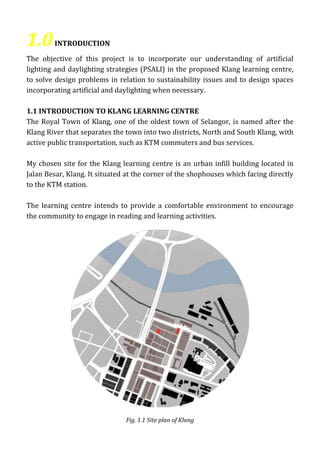
Fig. 1.1 Site plan of Klang
2.0OVERALL FLOOR PLANS
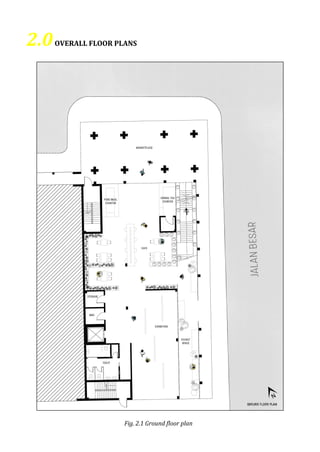
Fig. 2.1 Ground floor plan
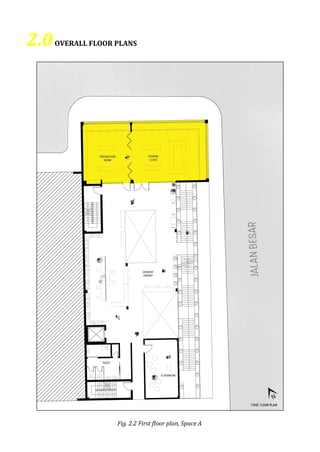
2.0OVERALL FLOOR PLANS
Fig. 2.2 First floor plan, Space A
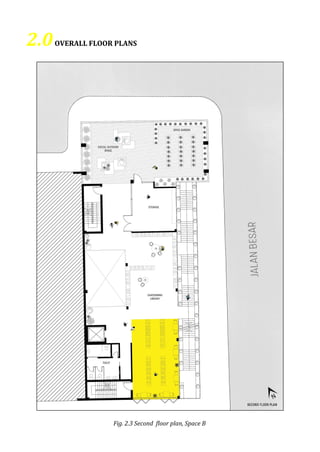
2.0OVERALL FLOOR PLANS
Fig. 2.3 Second floor plan, Space B
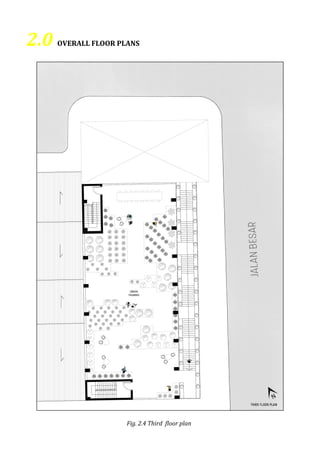
2.0 OVERALL FLOOR PLANS
Fig. 2.4 Third floor plan
3.0DAYLIGHT ANALYSIS
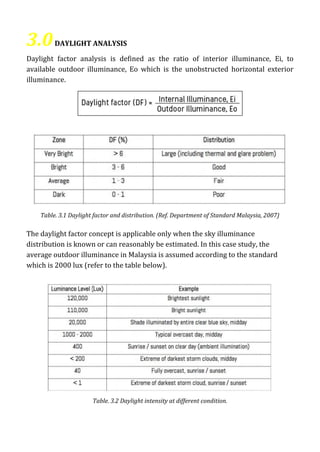
Daylight factor analysis is defined as the ratio of interior illuminance, Ei, to
available outdoor illuminance, Eo which is the unobstructed horizontal exterior
illuminance.
Table. 3.1 Daylight factor and distribution. (Ref. Department of Standard Malaysia, 2007)
The daylight factor concept is applicable only when the sky illuminance
distribution is known or can reasonably be estimated. In this case study, the
average outdoor illuminance in Malaysia is assumed according to the standard
which is 2000 lux (refer to the table below).
Table. 3.2 Daylight intensity at different condition.
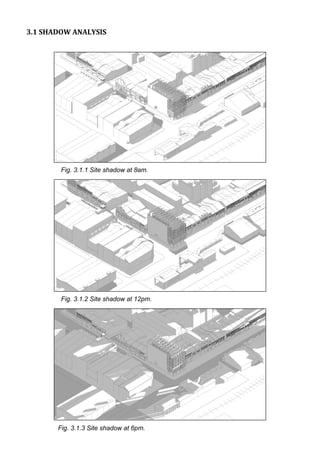
3.1 SHADOW ANALYSIS
Fig. 3.1.1 Site shadow at 8am.
Fig. 3.1.2 Site shadow at 12pm.
Fig. 3.1.3 Site shadow at 6pm.
4.0SPACE A: COOKING CLASSROOM
The cooking classroom is located on the first floor of the learning centre at the
front of the building. It has large windows which allow the space to be well lit
during the day.
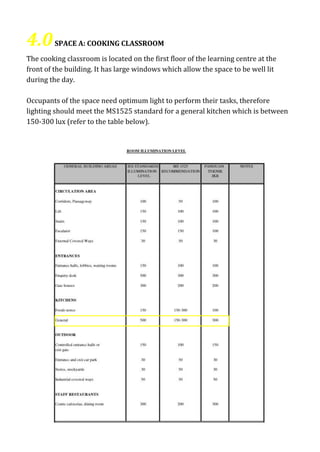
Occupants of the space need optimum light to perform their tasks, therefore
lighting should meet the MS1525 standard for a general kitchen which is between
150-300 lux (refer to the table below).
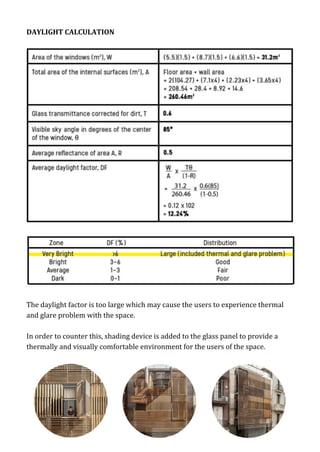
DAYLIGHT CALCULATION
The daylight factor is too large which may cause the users to experience thermal
and glare problem with the space.
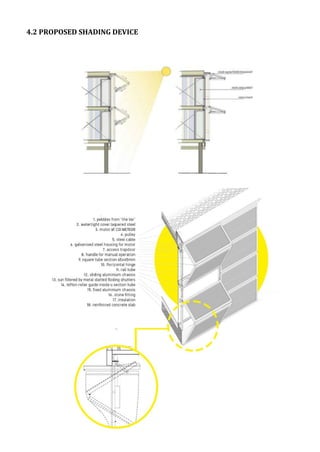
In order to counter this, shading device is added to the glass panel to provide a
thermally and visually comfortable environment for the users of the space.
4.2 PROPOSED SHADING DEVICE
4.3 DAYLIGHT CONTOUR
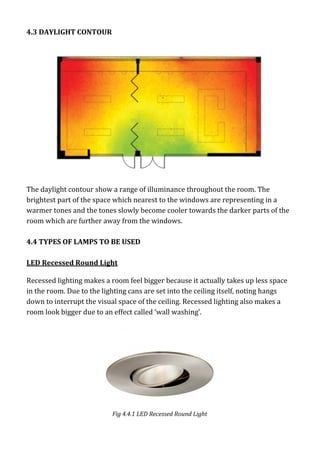
The daylight contour show a range of illuminance throughout the room. The
brightest part of the space which nearest to the windows are representing in a
warmer tones and the tones slowly become cooler towards the darker parts of the
room which are further away from the windows.
4.4 TYPES OF LAMPS TO BE USED
LED Recessed Round Light
Recessed lighting makes a room feel bigger because it actually takes up less space
in the room. Due to the lighting cans are set into the ceiling itself, noting hangs
down to interrupt the visual space of the ceiling. Recessed lighting also makes a
room look bigger due to an effect called ‘wall washing’.
Fig 4.4.1 LED Recessed Round Light
4.4 TYPES OF LAMP TO BE USED
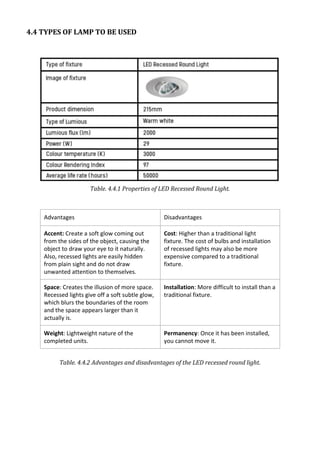
Table. 4.4.1 Properties of LED Recessed Round Light.
Table. 4.4.2 Advantages and disadvantages of the LED recessed round light.
Advantages Disadvantages
Accent: Create a soft glow coming out
from the sides of the object, causing the
object to draw your eye to it naturally.
Also, recessed lights are easily hidden
from plain sight and do not draw
unwanted attention to themselves.
Cost: Higher than a traditional light
fixture. The cost of bulbs and installation
of recessed lights may also be more
expensive compared to a traditional
fixture.
Space: Creates the illusion of more space.
Recessed lights give off a soft subtle glow,
which blurs the boundaries of the room
and the space appears larger than it
actually is.
Installation: More difficult to install than a
traditional fixture.
Weight: Lightweight nature of the
completed units.
Permanency: Once it has been installed,
you cannot move it.
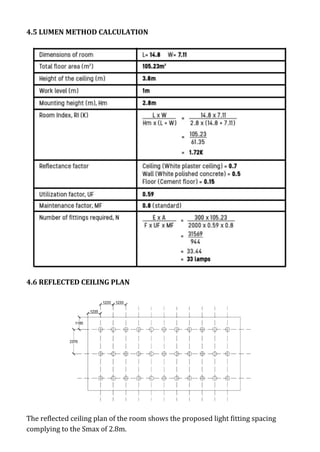
4.5 LUMEN METHOD CALCULATION
4.6 REFLECTED CEILING PLAN
The reflected ceiling plan of the room shows the proposed light fitting spacing
complying to the Smax of 2.8m.
4.7 PSALI SCHEME
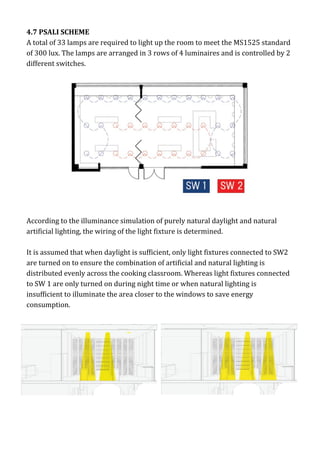
A total of 33 lamps are required to light up the room to meet the MS1525 standard
of 300 lux. The lamps are arranged in 3 rows of 4 luminaires and is controlled by 2
different switches.
According to the illuminance simulation of purely natural daylight and natural
artificial lighting, the wiring of the light fixture is determined.
It is assumed that when daylight is sufficient, only light fixtures connected to SW2
are turned on to ensure the combination of artificial and natural lighting is
distributed evenly across the cooking classroom. Whereas light fixtures connected
to SW 1 are only turned on during night time or when natural lighting is
insufficient to illuminate the area closer to the windows to save energy
consumption.
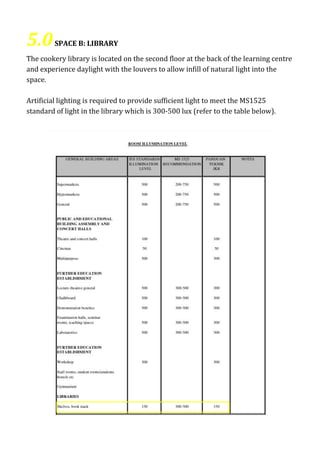
5.0SPACE B: LIBRARY
The cookery library is located on the second floor at the back of the learning centre
and experience daylight with the louvers to allow infill of natural light into the
space.
Artificial lighting is required to provide sufficient light to meet the MS1525
standard of light in the library which is 300-500 lux (refer to the table below).
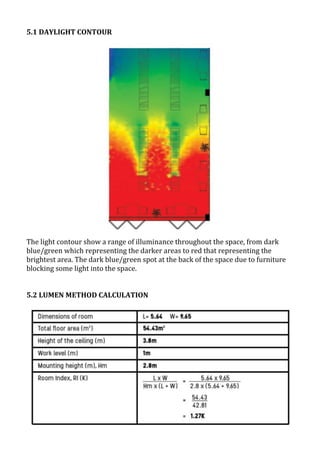
5.1 DAYLIGHT CONTOUR
The light contour show a range of illuminance throughout the space, from dark
blue/green which representing the darker areas to red that representing the
brightest area. The dark blue/green spot at the back of the space due to furniture
blocking some light into the space.
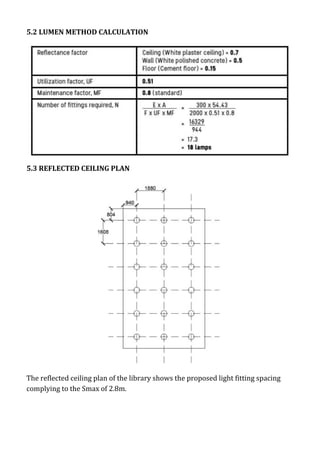
5.2 LUMEN METHOD CALCULATION
5.3 REFLECTED CEILING PLAN
The reflected ceiling plan of the library shows the proposed light fitting spacing
complying to the Smax of 2.8m.
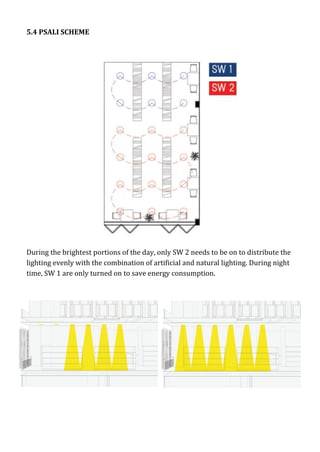
5.4 PSALI SCHEME
During the brightest portions of the day, only SW 2 needs to be on to distribute the
lighting evenly with the combination of artificial and natural lighting. During night
time, SW 1 are only turned on to save energy consumption.
6.0 REFERENCE
Daylight Factor. (n.d.). Retrieved from
https://patternguide.advancedbuildings.net/using-this-guide/analysis-methods/d
aylight-factor
Patternguide.advancedbuildings.net. (2018). Daylight Factor | Daylighting Pattern
Guide. [online] Available at:
https://patternguide.advancedbuildings.net/using-this-guide/analysis-methods/d
aylight-factor [Accessed 2 Jul. 2018].

B.science ii final

  • 1.
    School of Architecture,Building & Design Bachelor of Science (Honours) in Architecture Building Science II (BLD61303 / ARC3413) Project II : Integration Project Loong Bo Lin 0321469 Mr. Edwin
  • 2.
    0.0CONTENT 1.0 INTRODUCTION 1.1 Introductionto Klang Learning Centre 2.0OVERALL FLOOR PLANS 3.0DAYLIGHT ANALYSIS 3.1 Shadow analysis 4.0SPACE A: COOKING CLASSROOM 4.1 Daylight Calculation 4.2 Proposed Shading Device 4.3 Daylight Contour 4.4 Types of lamps to be used 4.5 Lumen Method Calculations 4.6 Reflected Ceiling Plan 4.7 PSALI Scheme 5.0SPACE B: LIBRARY 5.1 Lighting contours 5.2 Lumen Method Calculations 5.3 Reflected Ceiling Plan 5.4 PSALI Scheme 6.0REFERENCES
  • 3.
    1.0INTRODUCTION The objective ofthis project is to incorporate our understanding of artificial lighting and daylighting strategies (PSALI) in the proposed Klang learning centre, to solve design problems in relation to sustainability issues and to design spaces incorporating artificial and daylighting when necessary. 1.1 INTRODUCTION TO KLANG LEARNING CENTRE The Royal Town of Klang, one of the oldest town of Selangor, is named after the Klang River that separates the town into two districts, North and South Klang, with active public transportation, such as KTM commuters and bus services. My chosen site for the Klang learning centre is an urban infill building located in Jalan Besar, Klang. It situated at the corner of the shophouses which facing directly to the KTM station. The learning centre intends to provide a comfortable environment to encourage the community to engage in reading and learning activities. Fig. 1.1 Site plan of Klang
  • 4.
    2.0OVERALL FLOOR PLANS Fig.2.1 Ground floor plan
  • 5.
    2.0OVERALL FLOOR PLANS Fig.2.2 First floor plan, Space A
  • 6.
    2.0OVERALL FLOOR PLANS Fig.2.3 Second floor plan, Space B
  • 7.
    2.0 OVERALL FLOORPLANS Fig. 2.4 Third floor plan
  • 8.
    3.0DAYLIGHT ANALYSIS Daylight factoranalysis is defined as the ratio of interior illuminance, Ei, to available outdoor illuminance, Eo which is the unobstructed horizontal exterior illuminance. Table. 3.1 Daylight factor and distribution. (Ref. Department of Standard Malaysia, 2007) The daylight factor concept is applicable only when the sky illuminance distribution is known or can reasonably be estimated. In this case study, the average outdoor illuminance in Malaysia is assumed according to the standard which is 2000 lux (refer to the table below). Table. 3.2 Daylight intensity at different condition.
  • 9.
    3.1 SHADOW ANALYSIS Fig.3.1.1 Site shadow at 8am. Fig. 3.1.2 Site shadow at 12pm. Fig. 3.1.3 Site shadow at 6pm.
  • 10.
    4.0SPACE A: COOKINGCLASSROOM The cooking classroom is located on the first floor of the learning centre at the front of the building. It has large windows which allow the space to be well lit during the day. Occupants of the space need optimum light to perform their tasks, therefore lighting should meet the MS1525 standard for a general kitchen which is between 150-300 lux (refer to the table below).
  • 11.
    DAYLIGHT CALCULATION The daylightfactor is too large which may cause the users to experience thermal and glare problem with the space. In order to counter this, shading device is added to the glass panel to provide a thermally and visually comfortable environment for the users of the space.
  • 12.
  • 13.
    4.3 DAYLIGHT CONTOUR Thedaylight contour show a range of illuminance throughout the room. The brightest part of the space which nearest to the windows are representing in a warmer tones and the tones slowly become cooler towards the darker parts of the room which are further away from the windows. 4.4 TYPES OF LAMPS TO BE USED LED Recessed Round Light Recessed lighting makes a room feel bigger because it actually takes up less space in the room. Due to the lighting cans are set into the ceiling itself, noting hangs down to interrupt the visual space of the ceiling. Recessed lighting also makes a room look bigger due to an effect called ‘wall washing’. Fig 4.4.1 LED Recessed Round Light
  • 14.
    4.4 TYPES OFLAMP TO BE USED Table. 4.4.1 Properties of LED Recessed Round Light. Table. 4.4.2 Advantages and disadvantages of the LED recessed round light. Advantages Disadvantages Accent: Create a soft glow coming out from the sides of the object, causing the object to draw your eye to it naturally. Also, recessed lights are easily hidden from plain sight and do not draw unwanted attention to themselves. Cost: Higher than a traditional light fixture. The cost of bulbs and installation of recessed lights may also be more expensive compared to a traditional fixture. Space: Creates the illusion of more space. Recessed lights give off a soft subtle glow, which blurs the boundaries of the room and the space appears larger than it actually is. Installation: More difficult to install than a traditional fixture. Weight: Lightweight nature of the completed units. Permanency: Once it has been installed, you cannot move it.
  • 15.
    4.5 LUMEN METHODCALCULATION 4.6 REFLECTED CEILING PLAN The reflected ceiling plan of the room shows the proposed light fitting spacing complying to the Smax of 2.8m.
  • 16.
    4.7 PSALI SCHEME Atotal of 33 lamps are required to light up the room to meet the MS1525 standard of 300 lux. The lamps are arranged in 3 rows of 4 luminaires and is controlled by 2 different switches. According to the illuminance simulation of purely natural daylight and natural artificial lighting, the wiring of the light fixture is determined. It is assumed that when daylight is sufficient, only light fixtures connected to SW2 are turned on to ensure the combination of artificial and natural lighting is distributed evenly across the cooking classroom. Whereas light fixtures connected to SW 1 are only turned on during night time or when natural lighting is insufficient to illuminate the area closer to the windows to save energy consumption.
  • 17.
    5.0SPACE B: LIBRARY Thecookery library is located on the second floor at the back of the learning centre and experience daylight with the louvers to allow infill of natural light into the space. Artificial lighting is required to provide sufficient light to meet the MS1525 standard of light in the library which is 300-500 lux (refer to the table below).
  • 18.
    5.1 DAYLIGHT CONTOUR Thelight contour show a range of illuminance throughout the space, from dark blue/green which representing the darker areas to red that representing the brightest area. The dark blue/green spot at the back of the space due to furniture blocking some light into the space. 5.2 LUMEN METHOD CALCULATION
  • 19.
    5.2 LUMEN METHODCALCULATION 5.3 REFLECTED CEILING PLAN The reflected ceiling plan of the library shows the proposed light fitting spacing complying to the Smax of 2.8m.
  • 20.
    5.4 PSALI SCHEME Duringthe brightest portions of the day, only SW 2 needs to be on to distribute the lighting evenly with the combination of artificial and natural lighting. During night time, SW 1 are only turned on to save energy consumption.
  • 21.
    6.0 REFERENCE Daylight Factor.(n.d.). Retrieved from https://patternguide.advancedbuildings.net/using-this-guide/analysis-methods/d aylight-factor Patternguide.advancedbuildings.net. (2018). Daylight Factor | Daylighting Pattern Guide. [online] Available at: https://patternguide.advancedbuildings.net/using-this-guide/analysis-methods/d aylight-factor [Accessed 2 Jul. 2018].