OCCUPATIONAL SAFETY AND HEALTH (OSHA)
KAS 3501
SEMESTER II (2014/2015)
GROUP 17
LIGHT AND VISION
NAME UK NUMBER
CHEAH HUA TONG UK 29537
FATIN SAMIRA BT MOHD KHALID UK 29546
NOR FADHILAH BT MOHD ZUKI UK 29933
KHAIRUNNISA BT ABDUL KHALIL UK 30047
NUR AKLEMA BT SA’AID UK 30052
1
INTRODUCTION
 All activities of human life depends on the light
that exists in their environment .
 According to Statistics Annual Report Perkeso 2003,
7,940 number of treachery cases due to the eyes ,
ears , mouth and nose.
 Level of comfort and worker satisfaction depends
on the quality of ventilation, lighting , acoustics
and other aspects of the environment of the
workstation ( Tarcan et al . , 2004)
2
LIGHT AND VISION
 Light affects humans in at least two ways:
 It enables us to see
 It regulates our bodies' rhythms such as the sleep/wake
cycle.
 Different types and levels of light can affect a person's ability
 To see clearly,
 Identify people and objectsdrive safely. It can also
increase sleep efficiency of older adults and reduce
symptoms of seasonal affective disorder, or SAD, felt by
many people during winter months. 3
LIGHTING
 Light is the power source from sun, lamp and other
else which allows an object can be seen.
 Light have vary of wavelength in visible spectrum
which is about 380µm to 780µm.
 Normal human eye can receive wavelength of visible
spectrum light around 400µm to 700µm.
 Lighting is an essential provision for any workplace. 4
 It is preferable to provide uniform illumination
over the entire workplace by combining both
natural and artificial lighting.
 Light that illuminates the work area is caused by
the electric light.
 A comfortable lighting level is needed in jobs that
require precise vision and focus.
5
 Good lighting helps us to see and to recognize
hazards.
 It can reduce visual strain and discomfort.
 Poor lighting may affect workers performance
and health as poor visibility increases the chances
of errors being made.
6
TYPES OF LIGHTING
7
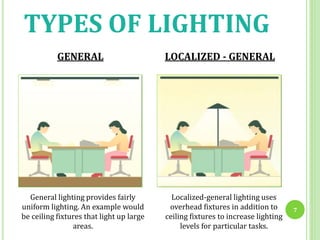
General lighting provides fairly
uniform lighting. An example would
be ceiling fixtures that light up large
areas.
Localized-general lighting uses
overhead fixtures in addition to
ceiling fixtures to increase lighting
levels for particular tasks.
GENERAL LOCALIZED - GENERAL
8
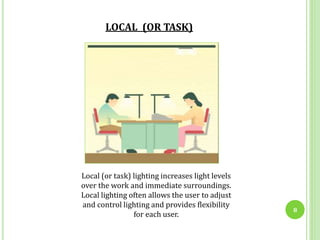
Local (or task) lighting increases light levels
over the work and immediate surroundings.
Local lighting often allows the user to adjust
and control lighting and provides flexibility
for each user.
LOCAL (OR TASK)
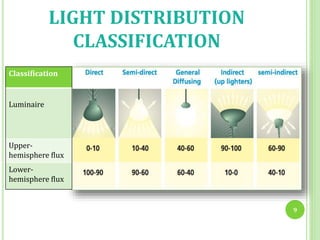
LIGHT DISTRIBUTION
CLASSIFICATION
9
Classification
Luminaire
Upper-
hemisphere flux
Lower-
hemisphere flux
TYPES OF LIGHT EXPOSURE
 Working Exposure
 The exposure that was received at work place due to
the unresponsible situation of the operation
management.
 Exposure towards radon and types of works that
related to the prevention of radionuclide material in
the small quantity is not consider as working
exposure unless been stated by the authorities.
10
 Medical Exposure
 This exposure is reserved for those that
undergoes diagnosis and medical treatment
and those who in the context of assisting
patients that undergoes diagnosis and
medical treatment.
 Parents are always advised to hold and
handle their children while doing x-ray.
11
 Public Exposure
 Else than included in the medical and working
exposure
 In light protection management, only working
protection and exposure is take into concern.
 The harm from the medical exposure must be
ensured by the medical practioner and the
patients must not receive and limits the light
exposure not more than yearly dosage. 12
FACTORS AFFECTING
LIGHTING
 Design of lighting system
 This factor affect the spread of light throughout the
space. A good design can avoid the corner or space that
is dark.
 Light distribution
 The distribution of light that is not uniform into the room
will raises the dark corner and space.
13
 Light reflection
 The reflection of light is depends on the
color and finishing.
 Space area
 The wide area is more efficient in utilize the
lighting than the small area.
14
SIGNS OF POOR LIGHTING
 Difficulty seeing document or screen (too much light or glare, or too
little light or shadows)
 Eyestrain,
 Eye irritation,
 Blurred vision,
 Dry burning eyes, and
 Headaches.
 Computer Vision Syndrome 15
LIGHTING EFFECTS ON
HEALTH
 The blue component of electromagnetic spectrum can
harm the retina but this is only caused by accidental
exposure to sunlight or to very high intensity artificial
lights so it is rare.
 Exposure to light at night while awake, such as in shift
work, or light in late evening or early morning may be
associated with an increased risk of breast cancer and
also cause sleep, gastrointestinal, mood and
cardiovascular disorders.
 Light itself has an effect on alertness, sleep, mood and
the circadian rhythms regardless of the type of lamp
used.
16
LIGHT PROTECTION SYSTEM
 Consist of two light protection. These systems
is divided based on the working condition.
The two systems are :
 Suggested practice and currently on going
practice
 Intervention
17
 This light protection system is applied on normal
working condition .
 In this working condition, light protection system
principle consider all the works should be put in this
priority :
 Application justification
 Application optimization
 Comply with individual dosage limit and risk dosage.
18
SUGGESTED AND ON GOING PRACTICE
INTERVENTION
 Is the action that is taken in exceptional circumstances
such accidents and emergency.
 Intervention must give a better results than without the
intervention.
 For the application of justification, intervention made
based on the disaster and cost of intervention.
 Shape, scale, duration of intervention should be
optimum, so the profit from dose reduction can be
maximum. 19
LIGHT PROTECTION OBJECTIVES
 Protect human and its surrounding from
unwanted light exposure and received the
benefits of light.
 Prevent side effects of no stochastic and limits
the stochastic effects from the light exposure
20
LIGHT PROTECTION PRINCIPLE
SYSTEM
 Light protection principle system emphasize on
prevention and light hazard control with :
 Get rid of or minimize mengion light risk
 Hazard control
 Employees control.
21
VISION
 Ability to interpret information from the optical
light to the eyes.
 Many parts of physiological involve in vision is
referred collectively as the visual system.
 Studies have found that majority individuals who
work at a computer experience eye-related
discomfort and /or visual problems.
22
FACTORS OF AFFECTING VISION
 Object dimension
 Small object need more concentration by eye
than the large object.
 Duration of observation
 The longer the time is taken to focus an
object, the more better the vision to focus.
 Age of worker
 Aged workers have limited visibility in
observing object.
23
 Object color
 Color brightness because of the reflection of light
 State of worker vision
 Poor computer design
 Workplace ergonomics
 Highly demanding visual task 24
GOOD VISUAL ENVIRONMENT
 Have sufficient light, coming from the right
direction and not cause obscuring shadows
 Provide good (but not excessive) contrast
between the task and the background
 Limit glare and extreme contrasts
 Provide the right type of light.
25
NON-VISUAL EFFECTS OF POOR
LIGHTING
 When people are exposed to glare or have
uncorrected vision problems, they tend to lean
forward or backward in an attempt to compensate.
 An awkward body position leads to eye strain and
accelerates postural fatigue
 In turn, it contributes to musculoskeletal injuries
(MSI).
26
 Musculoskeletal injury (MSI) is an injury or
disorder of the muscles, tendons, ligaments,
joints, nerves, blood vessels or related soft
tissue including a sprain, strain and
inflammation, that may be caused or
aggravated by work.
27
PREVENTION TO EYESIGHT
PROBLEM
 Most jobs now a days were carried out using a computer
cause the user receive light and excessive glare from the
screen monitor. As prevention:
 Make sure there are plenty of light brighten the office
without many shadows on desk
 Reduce brightness level of screen monitor
 Put the finishing on the office window as wood blinds
or vertical blinds if there be sunlight that directly into
the computer.
 Use the protection goggle when doing a job that involve of
lighting (eg. Welding)
28
ACT RELATED TO LIGHTING
 Laws of Malaysia, Factories and Machinery Act 1967
(Act 139)
 Part II (Safety, Health and Welfare), Section 22
(provisions relating to health), Subsection 1 (e)
(i).
An effective provision shall be made for securing
and maintaining sufficient and suitable lighting,
whether in natural or artificial, to every part of
factory which where the person are working or
passing;
29
 Part II (Safety, Health and Welfare), Section 22
(provisions relating to health), Subsection 1 (e) (ii).
 The minister may prescribe a standard that adequate
and suitable lighting for factory or for any class or
description of factory or its part or any process;
30
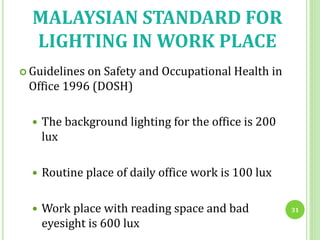
MALAYSIAN STANDARD FOR
LIGHTING IN WORK PLACE
 Guidelines on Safety and Occupational Health in
Office 1996 (DOSH)
 The background lighting for the office is 200
lux
 Routine place of daily office work is 100 lux
 Work place with reading space and bad
eyesight is 600 lux
31
CONCLUSION
Lighting is one of most significant
environmental factors that affect the
visibility of workers and quality of work
at the workplace.
Therefore, it is important for
organizations to ensure appropriate
environment with individuals who will
perform the task. 32
REFERENCES
Muhammad Muhammad Isa and Huda Zainuddin. (2014). International Journal of
Business, Humanities and Technology. Effect of Human and Technology Interaction:
Computer Vision Syndrome among Administrative Staff in a Public University, Vol.
4 (No. 3), 39-44.
Persuruhjaya Penyemak Undang-Undang Malaysia. (2006). Undang-undang Semula.
Akta Kilang dan Jentera 1967 (Akta 139).
Tuan Haji Abd. Hamid bin Osman. (2014). Info sihat bahagian kesihatan
persekitaran jabatan kerajaan tempatan: Fungsi dan Faktor Ergonomik di
Pejabat.
Baharudin Mastari. (2011). Panduan Pengurusan Persekitaran, Keselamatan dan
Kesihatan Pekerjaan (OSHE).
33

Light and vision

  • 1.
    OCCUPATIONAL SAFETY ANDHEALTH (OSHA) KAS 3501 SEMESTER II (2014/2015) GROUP 17 LIGHT AND VISION NAME UK NUMBER CHEAH HUA TONG UK 29537 FATIN SAMIRA BT MOHD KHALID UK 29546 NOR FADHILAH BT MOHD ZUKI UK 29933 KHAIRUNNISA BT ABDUL KHALIL UK 30047 NUR AKLEMA BT SA’AID UK 30052 1
  • 2.
    INTRODUCTION  All activitiesof human life depends on the light that exists in their environment .  According to Statistics Annual Report Perkeso 2003, 7,940 number of treachery cases due to the eyes , ears , mouth and nose.  Level of comfort and worker satisfaction depends on the quality of ventilation, lighting , acoustics and other aspects of the environment of the workstation ( Tarcan et al . , 2004) 2
  • 3.
    LIGHT AND VISION Light affects humans in at least two ways:  It enables us to see  It regulates our bodies' rhythms such as the sleep/wake cycle.  Different types and levels of light can affect a person's ability  To see clearly,  Identify people and objectsdrive safely. It can also increase sleep efficiency of older adults and reduce symptoms of seasonal affective disorder, or SAD, felt by many people during winter months. 3
  • 4.
    LIGHTING  Light isthe power source from sun, lamp and other else which allows an object can be seen.  Light have vary of wavelength in visible spectrum which is about 380µm to 780µm.  Normal human eye can receive wavelength of visible spectrum light around 400µm to 700µm.  Lighting is an essential provision for any workplace. 4
  • 5.
     It ispreferable to provide uniform illumination over the entire workplace by combining both natural and artificial lighting.  Light that illuminates the work area is caused by the electric light.  A comfortable lighting level is needed in jobs that require precise vision and focus. 5
  • 6.
     Good lightinghelps us to see and to recognize hazards.  It can reduce visual strain and discomfort.  Poor lighting may affect workers performance and health as poor visibility increases the chances of errors being made. 6
  • 7.
    TYPES OF LIGHTING 7 Generallighting provides fairly uniform lighting. An example would be ceiling fixtures that light up large areas. Localized-general lighting uses overhead fixtures in addition to ceiling fixtures to increase lighting levels for particular tasks. GENERAL LOCALIZED - GENERAL
  • 8.
    8 Local (or task)lighting increases light levels over the work and immediate surroundings. Local lighting often allows the user to adjust and control lighting and provides flexibility for each user. LOCAL (OR TASK)
  • 9.
  • 10.
    TYPES OF LIGHTEXPOSURE  Working Exposure  The exposure that was received at work place due to the unresponsible situation of the operation management.  Exposure towards radon and types of works that related to the prevention of radionuclide material in the small quantity is not consider as working exposure unless been stated by the authorities. 10
  • 11.
     Medical Exposure This exposure is reserved for those that undergoes diagnosis and medical treatment and those who in the context of assisting patients that undergoes diagnosis and medical treatment.  Parents are always advised to hold and handle their children while doing x-ray. 11
  • 12.
     Public Exposure Else than included in the medical and working exposure  In light protection management, only working protection and exposure is take into concern.  The harm from the medical exposure must be ensured by the medical practioner and the patients must not receive and limits the light exposure not more than yearly dosage. 12
  • 13.
    FACTORS AFFECTING LIGHTING  Designof lighting system  This factor affect the spread of light throughout the space. A good design can avoid the corner or space that is dark.  Light distribution  The distribution of light that is not uniform into the room will raises the dark corner and space. 13
  • 14.
     Light reflection The reflection of light is depends on the color and finishing.  Space area  The wide area is more efficient in utilize the lighting than the small area. 14
  • 15.
    SIGNS OF POORLIGHTING  Difficulty seeing document or screen (too much light or glare, or too little light or shadows)  Eyestrain,  Eye irritation,  Blurred vision,  Dry burning eyes, and  Headaches.  Computer Vision Syndrome 15
  • 16.
    LIGHTING EFFECTS ON HEALTH The blue component of electromagnetic spectrum can harm the retina but this is only caused by accidental exposure to sunlight or to very high intensity artificial lights so it is rare.  Exposure to light at night while awake, such as in shift work, or light in late evening or early morning may be associated with an increased risk of breast cancer and also cause sleep, gastrointestinal, mood and cardiovascular disorders.  Light itself has an effect on alertness, sleep, mood and the circadian rhythms regardless of the type of lamp used. 16
  • 17.
    LIGHT PROTECTION SYSTEM Consist of two light protection. These systems is divided based on the working condition. The two systems are :  Suggested practice and currently on going practice  Intervention 17
  • 18.
     This lightprotection system is applied on normal working condition .  In this working condition, light protection system principle consider all the works should be put in this priority :  Application justification  Application optimization  Comply with individual dosage limit and risk dosage. 18 SUGGESTED AND ON GOING PRACTICE
  • 19.
    INTERVENTION  Is theaction that is taken in exceptional circumstances such accidents and emergency.  Intervention must give a better results than without the intervention.  For the application of justification, intervention made based on the disaster and cost of intervention.  Shape, scale, duration of intervention should be optimum, so the profit from dose reduction can be maximum. 19
  • 20.
    LIGHT PROTECTION OBJECTIVES Protect human and its surrounding from unwanted light exposure and received the benefits of light.  Prevent side effects of no stochastic and limits the stochastic effects from the light exposure 20
  • 21.
    LIGHT PROTECTION PRINCIPLE SYSTEM Light protection principle system emphasize on prevention and light hazard control with :  Get rid of or minimize mengion light risk  Hazard control  Employees control. 21
  • 22.
    VISION  Ability tointerpret information from the optical light to the eyes.  Many parts of physiological involve in vision is referred collectively as the visual system.  Studies have found that majority individuals who work at a computer experience eye-related discomfort and /or visual problems. 22
  • 23.
    FACTORS OF AFFECTINGVISION  Object dimension  Small object need more concentration by eye than the large object.  Duration of observation  The longer the time is taken to focus an object, the more better the vision to focus.  Age of worker  Aged workers have limited visibility in observing object. 23
  • 24.
     Object color Color brightness because of the reflection of light  State of worker vision  Poor computer design  Workplace ergonomics  Highly demanding visual task 24
  • 25.
    GOOD VISUAL ENVIRONMENT Have sufficient light, coming from the right direction and not cause obscuring shadows  Provide good (but not excessive) contrast between the task and the background  Limit glare and extreme contrasts  Provide the right type of light. 25
  • 26.
    NON-VISUAL EFFECTS OFPOOR LIGHTING  When people are exposed to glare or have uncorrected vision problems, they tend to lean forward or backward in an attempt to compensate.  An awkward body position leads to eye strain and accelerates postural fatigue  In turn, it contributes to musculoskeletal injuries (MSI). 26
  • 27.
     Musculoskeletal injury(MSI) is an injury or disorder of the muscles, tendons, ligaments, joints, nerves, blood vessels or related soft tissue including a sprain, strain and inflammation, that may be caused or aggravated by work. 27
  • 28.
    PREVENTION TO EYESIGHT PROBLEM Most jobs now a days were carried out using a computer cause the user receive light and excessive glare from the screen monitor. As prevention:  Make sure there are plenty of light brighten the office without many shadows on desk  Reduce brightness level of screen monitor  Put the finishing on the office window as wood blinds or vertical blinds if there be sunlight that directly into the computer.  Use the protection goggle when doing a job that involve of lighting (eg. Welding) 28
  • 29.
    ACT RELATED TOLIGHTING  Laws of Malaysia, Factories and Machinery Act 1967 (Act 139)  Part II (Safety, Health and Welfare), Section 22 (provisions relating to health), Subsection 1 (e) (i). An effective provision shall be made for securing and maintaining sufficient and suitable lighting, whether in natural or artificial, to every part of factory which where the person are working or passing; 29
  • 30.
     Part II(Safety, Health and Welfare), Section 22 (provisions relating to health), Subsection 1 (e) (ii).  The minister may prescribe a standard that adequate and suitable lighting for factory or for any class or description of factory or its part or any process; 30
  • 31.
    MALAYSIAN STANDARD FOR LIGHTINGIN WORK PLACE  Guidelines on Safety and Occupational Health in Office 1996 (DOSH)  The background lighting for the office is 200 lux  Routine place of daily office work is 100 lux  Work place with reading space and bad eyesight is 600 lux 31
  • 32.
    CONCLUSION Lighting is oneof most significant environmental factors that affect the visibility of workers and quality of work at the workplace. Therefore, it is important for organizations to ensure appropriate environment with individuals who will perform the task. 32
  • 33.
    REFERENCES Muhammad Muhammad Isaand Huda Zainuddin. (2014). International Journal of Business, Humanities and Technology. Effect of Human and Technology Interaction: Computer Vision Syndrome among Administrative Staff in a Public University, Vol. 4 (No. 3), 39-44. Persuruhjaya Penyemak Undang-Undang Malaysia. (2006). Undang-undang Semula. Akta Kilang dan Jentera 1967 (Akta 139). Tuan Haji Abd. Hamid bin Osman. (2014). Info sihat bahagian kesihatan persekitaran jabatan kerajaan tempatan: Fungsi dan Faktor Ergonomik di Pejabat. Baharudin Mastari. (2011). Panduan Pengurusan Persekitaran, Keselamatan dan Kesihatan Pekerjaan (OSHE). 33