WRITTEN BY:
MUHAMMAD AKBAR
RASHID QADRI
( V I S I O N S C I E N T I S T , O P T O M E T R Y
C L U B F O U N D E R )
Burckner Test
The Brückner Test: Optimizing Child
Vision Screening Test
 Vision screening is an everyday part of the primary
care of children. Red reflex assessment,
cover/uncover tests, Allen charts, tumbling E's,
HOTV charts...all are familiar to those who care for
children. But can we do a better job? The Brückner
test takes the red reflex to the next level, and all that
is required is a direct ophthalmoscope and a child
who is willing to look at the light for just a few
seconds. What makes it better than other common
screening examinations?
What Does the Brückner Test Do?
 The Brückner test screens for the most common eye
disorders found in children, including:
 • Amblyopia;
 • Strabismus;
 • Refractive error; and
 • Media opacities.
How Do You Do the Brückner Test?
 The examination takes 3 simple steps:
 1. Dim the room lights.
 2. Have the child sit at arm's length from you,
preferably on the parent's lap, and look straight at
you.
 3. Shine the light directly at the child's eyes using the
large white spot, and focus on the iris. Use the lowest
light on the rheostat that will allow you to still see
the red reflex.
Assessing the Red Reflex
 To judge the red reflex, look for "CSM":
 • Central -- the corneal light reflex is central;
 • Steady -- no shaking of the eyes; and
 • Maintained -- each eye in turn will remain fixed on
the light.
What Does the Red Reflex Assess?
 The red reflex allows assessment for media opacities,
strabismus, refractive errors, and retinoblastoma.
 • Judge the red reflexes:
 o Quality and intensity
 o Size of the pupil
 o Position of the light reflex
 o Quality of the corneal light reflexes
 • The reflexes should be mirror images of each other.
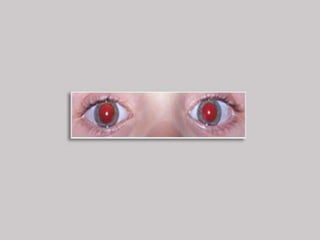
 The photograph above is of a child with a normal result
on the Brückner test. Note the gradient of red with a
lighter color at the top, which gets progressively darker
toward the bottom of the pupil.
Refractive Errors: Hyperopia
 Children with normal vision will have an even, symmetrical red reflex
that is marked by equal color and brightness of the entire reflex.
Refractive errors can be identified by lighter crescents either at the top
or bottom of the pupil. Refractive errors can be unilateral or bilateral,
so a careful comparison of the 2 eyes is essential.
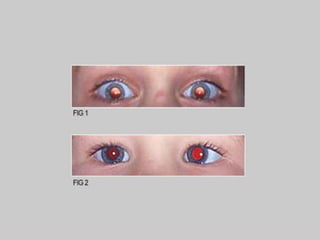
 In hyperopia (also called "farsightedness"), the lighter crescent is
visible at the top. With increasing degrees of hyperopia, the red reflex
will become dimmer. The child in the top photo has moderate
hyperopia, marked by bright, lighter red crescents at the top of the
pupil. In the child in the bottom photo, both eyes are extremely
hyperopic, but the left reflex is brighter as opposed to dull because the
eye is crossed -- a Brückner test result that indicates strabismus.
Refractive Errors: Myopia
 In myopia ("nearsightedness"), the crescents flip so
that the lighter area is at the bottom of the red reflex.
The child in the top photo has mild myopia,
identified by a lighter red crescent in the lower half
of the pupil. The child in the bottom photo, while
still exhibiting a lighter crescent on the bottom, has a
red reflex that is a duller color, indicative of more
moderate myopia.
Refractive Errors: Astigmatism
 In astigmatism, the cornea assumes a football shape
rather than the normal baseball shape. It will be seen
as a red reflex that flattens into a straight line across
the pupil rather than a crescent. The degree of visual
impairment resulting from the astigmatic refractive
error will depend on how great that refractive error
is.
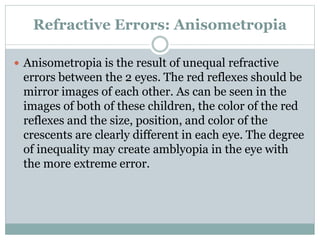
Refractive Errors: Anisometropia
 Anisometropia is the result of unequal refractive
errors between the 2 eyes. The red reflexes should be
mirror images of each other. As can be seen in the
images of both of these children, the color of the red
reflexes and the size, position, and color of the
crescents are clearly different in each eye. The degree
of inequality may create amblyopia in the eye with
the more extreme error.
Media Opacities
 Examining the red reflex also allows detection of
media opacities, including congenital cataracts.
Corneal abrasions and corneal scars will appear as
black marks on the red reflex.
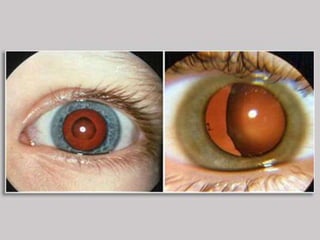
Media Opacities: Cataracts
 Both of these children have cataracts. The top image
is of a child with a congenital cataract that needs to
be removed by age 8-10 weeks. The child in the
bottom image exhibits a posterior subcapsular
cataract that is acquired. These types of cataracts can
form as a result of steroid use, trauma, or
inflammation.
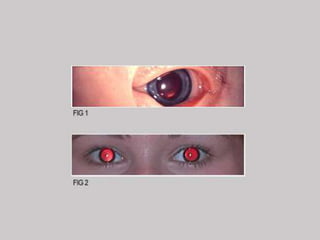
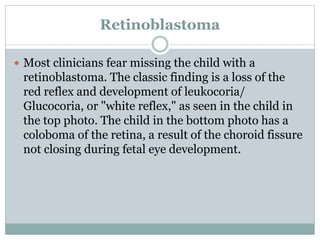
Retinoblastoma
 Most clinicians fear missing the child with a
retinoblastoma. The classic finding is a loss of the
red reflex and development of leukocoria/
Glucocoria, or "white reflex," as seen in the child in
the top photo. The child in the bottom photo has a
coloboma of the retina, a result of the choroid fissure
not closing during fetal eye development.
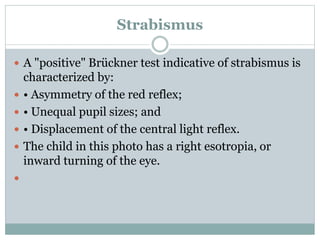
Strabismus
 A "positive" Brückner test indicative of strabismus is
characterized by:
 • Asymmetry of the red reflex;
 • Unequal pupil sizes; and
 • Displacement of the central light reflex.
 The child in this photo has a right esotropia, or
inward turning of the eye.

Esotropia
 Esotropia is the result of an inward turning of the
eye. The Hirschberg test, which is the classic test for
detection of eye misalignment, assesses the position
of the corneal light reflex -- that white dot on the
cornea that reflects the pinpoint light source.
Children with esotropia will have asymmetry of the
corneal light reflex, and the red reflex will be
brighter on the eye that goes inward. These changes
can be seen in the left eye of this child with esotropia.
Exotropia
 Exotropia is an outward turning of the eye. The red
reflex will be lighter on the eye that turns outward. If
the deviation is large enough, the white corneal
reflex will be moved inward toward the nose. The
child in the photo above has exotropia of the right
eye.

Burckner test or red reflex test

  • 1.
    WRITTEN BY: MUHAMMAD AKBAR RASHIDQADRI ( V I S I O N S C I E N T I S T , O P T O M E T R Y C L U B F O U N D E R ) Burckner Test
  • 2.
    The Brückner Test:Optimizing Child Vision Screening Test  Vision screening is an everyday part of the primary care of children. Red reflex assessment, cover/uncover tests, Allen charts, tumbling E's, HOTV charts...all are familiar to those who care for children. But can we do a better job? The Brückner test takes the red reflex to the next level, and all that is required is a direct ophthalmoscope and a child who is willing to look at the light for just a few seconds. What makes it better than other common screening examinations?
  • 3.
    What Does theBrückner Test Do?  The Brückner test screens for the most common eye disorders found in children, including:  • Amblyopia;  • Strabismus;  • Refractive error; and  • Media opacities.
  • 5.
    How Do YouDo the Brückner Test?  The examination takes 3 simple steps:  1. Dim the room lights.  2. Have the child sit at arm's length from you, preferably on the parent's lap, and look straight at you.  3. Shine the light directly at the child's eyes using the large white spot, and focus on the iris. Use the lowest light on the rheostat that will allow you to still see the red reflex.
  • 7.
    Assessing the RedReflex  To judge the red reflex, look for "CSM":  • Central -- the corneal light reflex is central;  • Steady -- no shaking of the eyes; and  • Maintained -- each eye in turn will remain fixed on the light.
  • 9.
    What Does theRed Reflex Assess?  The red reflex allows assessment for media opacities, strabismus, refractive errors, and retinoblastoma.  • Judge the red reflexes:  o Quality and intensity  o Size of the pupil  o Position of the light reflex  o Quality of the corneal light reflexes  • The reflexes should be mirror images of each other.  The photograph above is of a child with a normal result on the Brückner test. Note the gradient of red with a lighter color at the top, which gets progressively darker toward the bottom of the pupil.
  • 11.
    Refractive Errors: Hyperopia Children with normal vision will have an even, symmetrical red reflex that is marked by equal color and brightness of the entire reflex. Refractive errors can be identified by lighter crescents either at the top or bottom of the pupil. Refractive errors can be unilateral or bilateral, so a careful comparison of the 2 eyes is essential.  In hyperopia (also called "farsightedness"), the lighter crescent is visible at the top. With increasing degrees of hyperopia, the red reflex will become dimmer. The child in the top photo has moderate hyperopia, marked by bright, lighter red crescents at the top of the pupil. In the child in the bottom photo, both eyes are extremely hyperopic, but the left reflex is brighter as opposed to dull because the eye is crossed -- a Brückner test result that indicates strabismus.
  • 13.
    Refractive Errors: Myopia In myopia ("nearsightedness"), the crescents flip so that the lighter area is at the bottom of the red reflex. The child in the top photo has mild myopia, identified by a lighter red crescent in the lower half of the pupil. The child in the bottom photo, while still exhibiting a lighter crescent on the bottom, has a red reflex that is a duller color, indicative of more moderate myopia.
  • 15.
    Refractive Errors: Astigmatism In astigmatism, the cornea assumes a football shape rather than the normal baseball shape. It will be seen as a red reflex that flattens into a straight line across the pupil rather than a crescent. The degree of visual impairment resulting from the astigmatic refractive error will depend on how great that refractive error is.
  • 17.
    Refractive Errors: Anisometropia Anisometropia is the result of unequal refractive errors between the 2 eyes. The red reflexes should be mirror images of each other. As can be seen in the images of both of these children, the color of the red reflexes and the size, position, and color of the crescents are clearly different in each eye. The degree of inequality may create amblyopia in the eye with the more extreme error.
  • 19.
    Media Opacities  Examiningthe red reflex also allows detection of media opacities, including congenital cataracts. Corneal abrasions and corneal scars will appear as black marks on the red reflex.
  • 21.
    Media Opacities: Cataracts Both of these children have cataracts. The top image is of a child with a congenital cataract that needs to be removed by age 8-10 weeks. The child in the bottom image exhibits a posterior subcapsular cataract that is acquired. These types of cataracts can form as a result of steroid use, trauma, or inflammation.
  • 23.
    Retinoblastoma  Most cliniciansfear missing the child with a retinoblastoma. The classic finding is a loss of the red reflex and development of leukocoria/ Glucocoria, or "white reflex," as seen in the child in the top photo. The child in the bottom photo has a coloboma of the retina, a result of the choroid fissure not closing during fetal eye development.
  • 25.
    Strabismus  A "positive"Brückner test indicative of strabismus is characterized by:  • Asymmetry of the red reflex;  • Unequal pupil sizes; and  • Displacement of the central light reflex.  The child in this photo has a right esotropia, or inward turning of the eye. 
  • 27.
    Esotropia  Esotropia isthe result of an inward turning of the eye. The Hirschberg test, which is the classic test for detection of eye misalignment, assesses the position of the corneal light reflex -- that white dot on the cornea that reflects the pinpoint light source. Children with esotropia will have asymmetry of the corneal light reflex, and the red reflex will be brighter on the eye that goes inward. These changes can be seen in the left eye of this child with esotropia.
  • 29.
    Exotropia  Exotropia isan outward turning of the eye. The red reflex will be lighter on the eye that turns outward. If the deviation is large enough, the white corneal reflex will be moved inward toward the nose. The child in the photo above has exotropia of the right eye.