NJIT CASE STUDY
Elizabeth Limbrick, New Jersey Institute of Technology (NJIT)
Technical Assistance to Brownfield Communities (TAB)
WAYNESBORO, VIRGINIA
SETTING THE STAGE FOR
REVITALIZATION
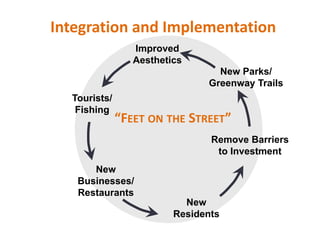
Integration and Implementation 
Remove Barriers
to Investment
New Parks/
Greenway Trails
Improved
Aesthetics
New
Businesses/
Restaurants
Tourists/
Fishing
New
Residents
“FEET ON THE STREET”
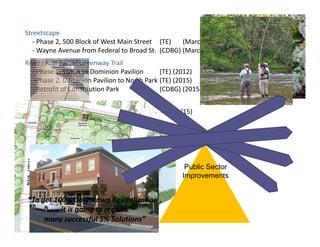
Streetscape
‐ Phase 2, 500 Block of West Main Street (TE)  (March 2014)
‐ Wayne Avenue from Federal to Broad St. (CDBG) (March 2014)
“Smaller” Efforts
‐ Branding and Wayfinding (CDBG/ Tourism) (2012/15)
‐ The Fish Deck (CSX/ Private Donations) (2013)
‐ Trophy Trout Fishing Downtown
Downtown Bridge Replacements
‐ Broad Street (2013)
‐ West Main Street/ Race Avenue (2016)
River Front Parks/ Greenway Trail
‐ Phase 1, YMCA to Dominion Pavilion  (TE) (2012)
‐Phase 2, Dominion Pavilion to North Park (TE) (2015)
‐ Retrofit of Constitution Park  (CDBG) (2015)
CDBG Façade Improvement Program
“To get 100% Downtown Revitalization ,
it is going to require 
many successful 5% Solutions”
Public Sector
Improvements
WAYNESBORO BROWNFIELDS PLAN
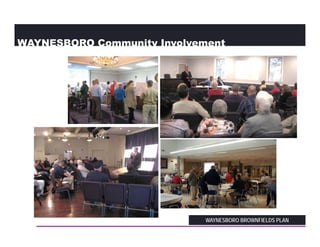
WAYNESBORO Community Involvement
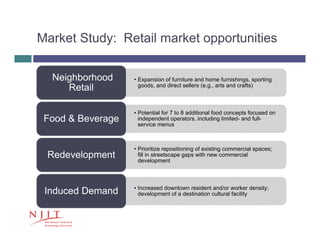
Market Study: Retail market opportunities
• Expansion of furniture and home furnishings, sporting
goods, and direct sellers (e.g., arts and crafts)
Neighborhood
Retail
• Potential for 7 to 8 additional food concepts focused on
independent operators, including limited- and full-
service menus
Food & Beverage
• Prioritize repositioning of existing commercial spaces;
fill in streetscape gaps with new commercial
development
Redevelopment
• Increased downtown resident and/or worker density;
development of a destination cultural facilityInduced Demand
WAYNESBORO BROWNFIELDS PLAN
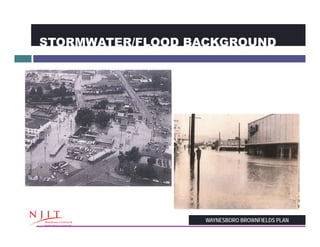
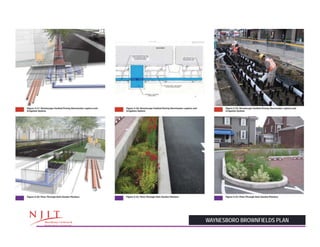
STORMWATER/FLOOD BACKGROUND
WAYNESBORO BROWNFIELDS PLAN
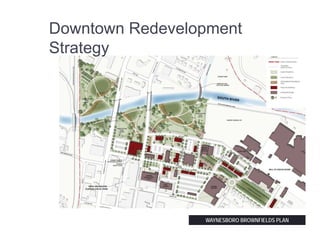
Downtown Redevelopment
Strategy
WAYNESBORO BROWNFIELDS PLAN
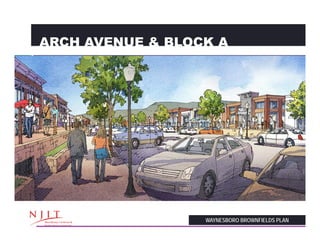
ARCH AVENUE & BLOCK A
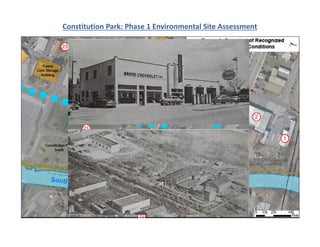
Constitution Park: Phase 1 Environmental Site Assessment
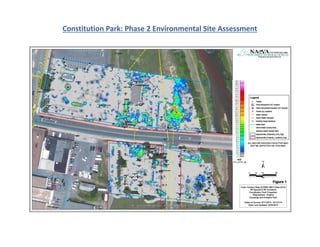
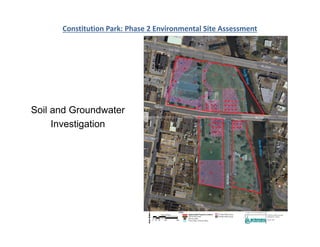
Constitution Park: Phase 2 Environmental Site Assessment
Geophysical Survey
Soil and Groundwater
Investigation
Constitution Park: Phase 2 Environmental Site Assessment
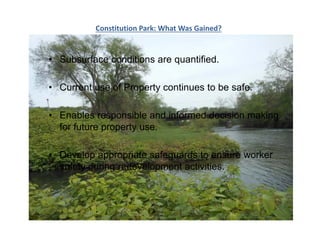
Constitution Park: What Was Gained?
• Subsurface conditions are quantified.
• Current use of Property continues to be safe.
• Enables responsible and informed decision making
for future property use.
• Develop appropriate safeguards to ensure worker
safety during redevelopment activities.
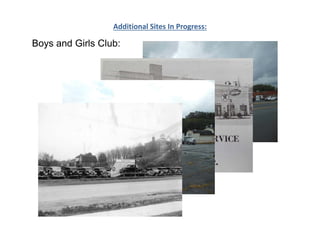
Additional Sites In Progress:
Boys and Girls Club:
WAYNESBORO BROWNFIELDS PLAN
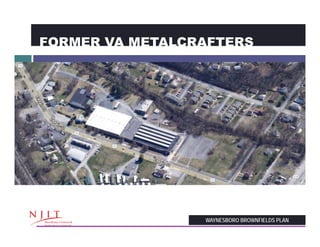
FORMER VA METALCRAFTERS
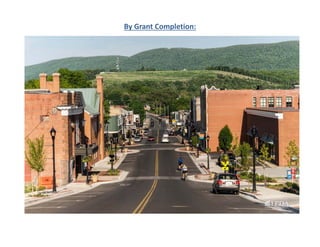
By Grant Completion:
• 16 acres in urban setting assessed
• 63 tax parcels assessed
• 15/16 acres poised for redevelopment
• Domino effect on Downtown Waynesboro …
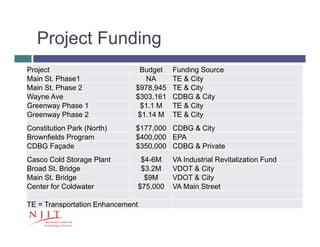
Project Funding
19
Project Budget Funding Source
Main St. Phase1 NA TE & City
Main St. Phase 2 $978,945 TE & City
Wayne Ave $303,161 CDBG & City
Greenway Phase 1 $1.1 M TE & City
Greenway Phase 2 $1.14 M TE & City
Constitution Park (North) $177,000 CDBG & City
Brownfields Program $400,000 EPA
CDBG Façade $350,000 CDBG & Private
Casco Cold Storage Plant $4-6M VA Industrial Revitalization Fund
Broad St. Bridge $3.2M VDOT & City
Main St. Bridge $9M VDOT & City
Center for Coldwater $75,000 VA Main Street
TE = Transportation Enhancement
THANK YOU
20
QUESTIONS?
Learning More
 http://www.njit.edu/tab/
THANK YOU
CONTACT INFORMATION:
Elizabeth Limbrick –973-596-5519 limbrick@njit.edu
TAB Hotline: (973-642-4165) tab@njit.edu
NADO & BROWNFIELDS
CASE STUDIES
NADO Conference
New Orleans LA | October 25th 2015
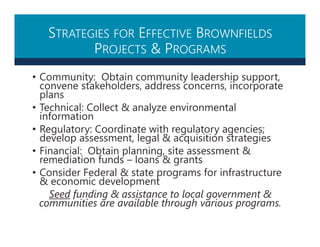
STRATEGIES FOR EFFECTIVE BROWNFIELDS
PROJECTS & PROGRAMS
• Community: Obtain community leadership support,
convene stakeholders, address concerns, incorporate
plans
• Technical: Collect & analyze environmental
information
• Regulatory: Coordinate with regulatory agencies;
develop assessment, legal & acquisition strategies
• Financial: Obtain planning, site assessment &
remediation funds – loans & grants
• Consider Federal & state programs for infrastructure
& economic development
Seed funding & assistance to local government &
communities are available through various programs.
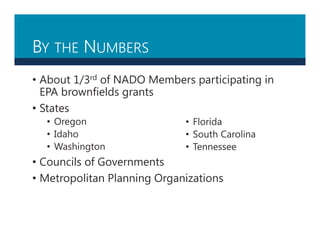
BY THE NUMBERS
• About 1/3rd of NADO Members participating in
EPA brownfields grants
• States
• Oregon
• Idaho
• Washington
• Councils of Governments
• Metropolitan Planning Organizations
• Florida
• South Carolina
• Tennessee
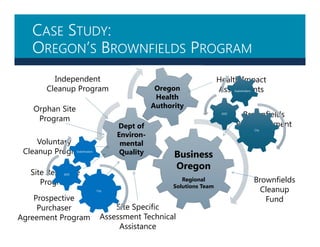
CASE STUDY:
OREGON’S BROWNFIELDS PROGRAM
Business
Oregon
Regional
Solutions Team
Dept of
Environ-
mental
Quality
Oregon
Health
Authority
Brownfields
Redevelopment
Fund
Brownfields
Cleanup
Fund
Health Impact
Assessments
Independent
Cleanup Program
Orphan Site
Program
Prospective
Purchaser
Agreement Program
Site Response
Program
Voluntary
Cleanup Program
Site Specific
Assessment Technical
Assistance
City
EDD
Stakeholders
City
EDD
Stakeholders
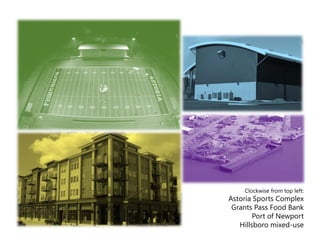
Clockwise from top left:
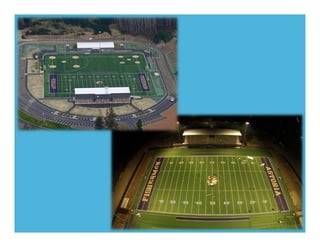
Astoria Sports Complex
Grants Pass Food Bank
Port of Newport
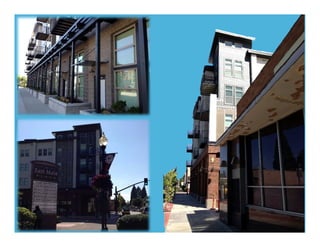
Hillsboro mixed-use
OREGON & BEYOND
• Northeast Oregon EDD
• ARC grantee
• South Central Oregon
EDD
• Coalition partner
• Southern Oregon
Regional Economic
Development, Inc &
Rogue Valley COG
• Coalition partners
(proposed)
• Land of Sky Regional
Council, NC
• Central Florida
Regional Planning
Council
• Cumberland Valley
Area Development
District, KY
• Catawba Regional
COG, SC
CITY OF ASTORIA
SPORTS COMPLEX PROJECT
Four Public/Private Partners
• City of Astoria,
• Columbia Memorial Hospital
• Astoria School District
• Recology Western Oregon
Properties Involved:
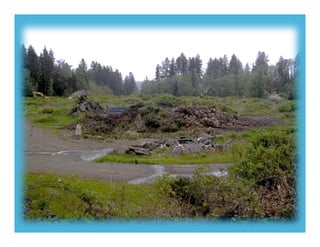
• 12-acre landfill (City)
• Not operating / not officially closed
• City lacked funding to complete DEQ closure requirements
• Football Facility and Playing Field (School District)
• Outdated & flood prone
THE NEEDS
• Columbia Memorial Hospital
• Expand to meet federal regional health care requirements
• Accommodate new cancer treatment center to serve 90
mile radius
• Landlocked - adjacent School District’s football field.
• School District Football field
• Poor location for parking and transportation
• Needed costly upgrades
• Limited alternative use possibilities
• Recology Western Oregon
• Located adjacent to the City’s landfill
• Needed upgrades/ expansion for future County disposal
needs
THE SOLUTION:
FOUR PARTY AGREEMENT
• Land swaps
• School District conveyed its former football field to
Columbia Memorial upon completion of the Sports
Complex
• City’s Urban Renewal District conveying adjacent property it
owned to Columbia Memorial
• Financing of $8M: Columbia Memorial Hospital
• For Landfill closure
• To redevelop the landfill as 17-acre athletic fields complex
for School District and the community
• Cost sharing
• Hospital, Astoria School District, Recology, and the City
• Grants and loans from Business Oregon, Oregon DEQ, and
community donations
THE RESULTS
• Proper closure of the City’s Municipal Landfill
• Reuse of the Landfill as a valuable asset
• Ability of the Hospital to expand
• cancer treatment options in partnership with Oregon
Health and Science University
• 25 to 30 new family-wage jobs
• Upgrade of a dangerous road intersection
• Sewer line upgrades for Recology
• Potential future relocation of the City’s Public
Works Shop to the Landfill property
CITY OF GRANTS PASS
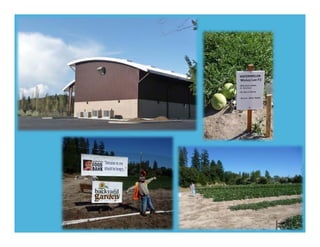
RAPTOR CREEK FARM & FOOD BANK
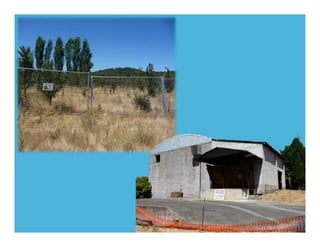
• City owned 250-acre former hop farm / orchard outside of city limits for a
regional park
• Known soil & groundwater contamination.
• Farm Use zoning
• Difficult for traditional park uses
• Community supported working farm supported by related day uses on portions of the
site
• Josephine County Food Bank
• Interest in starting a community garden
• Need to construct a new administrative and distribution facility, repack area and farm
kitchen.
• Initial lease was for 9.75 acres with expansion once environmental conditions of
property resolved
• Two ESA and Cleanup Planning for 50’ by 50’ trellis dip tank area
impacted by soil and groundwater contamination - State Brownfields
Redevelopment Fund and City match.
FUNDING
• Business Oregon provided Cleanup Funding
through its Brownfields Cleanup Fund
• The Food Bank, with assistance from local Rotary
clubs, raised funds for construction of a new
administrative and distribution facility
• City obtained rural CDBG
• Construction of new distribution, repackaging, and
administrative facility completed in April 2015 at a
total cost of $1.9 million. Lease extended to 19
acres.
COMMUNITY BENEFITS
• Food Bank grows ~50,000 pounds of produce
annually its 2.4 acre garden
• Distribution to 12,000 community members monthly
• Food Bank & partners (YMCA, Boys & Girls Club)
provide youth summer education programs about
the health benefits of fresh foods
• The Food Bank provides complementary raised
garden space, tools, and irrigation for low- to
moderate- income or disabled senior citizens to grow
their own fresh fruits, vegetables, and flowers
• Future plans include an expanded farm, additional
public gardens, and a certified farm kitchen
CITY OF HILLSBORO:
4TH MAIN PROJECT
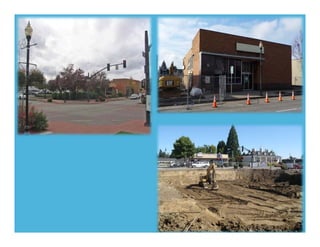
• Setting the Stage:
• METRO designates City’s downtown as a
“Regional Center.”
• City in its Downtown Framework Plan and
METRO in its 2040 Growth Concept Plan
identified property located adjacent to City’s
downtown Transit Center as ideal for transit-
orientated development
• City lacked mixed use high density, transit-
orientated vertical housing within core
downtown.
PUTTING THE PIECES IN PLACE
• 2010: City adopts Urban Renewal Plan Area
(URA); 1,108 acres
• 2010: METRO/City issue RFQ for
redeveloping 4th Main property as a mixed-
use TOD
• 2011: City adopts Vertical Housing
Development Zone for downtown area
READY TO PROCEED – WELL SORT OF!
• 2011: City/Metro execute a Disposition &
Development Agreement
• Land value write down to $150,000.
• URA financing $872,000 of site development costs to
City over 10 years
• METRO purchased TOD easement (for commercial
reuse of former bank building) for $465,000
• Transfer of property to developer with commitment
from the City to undertake and incur environmental
cleanup costs estimated at $300,000.
OTHER DETAILS
• 2012: DEQ provided Prospective Purchaser Agreement
for liability relief
• 2012: City enters into Voluntary Cleanup Program
• June 2012: City obtained $300,000 (3.25%/10 year;
interest only through 12/31/2012, full payments
thereafter) Oregon Brownfields Redevelopment Fund
loan through Business Oregon to complete cleanup of
property. Paid from tax increment.
• METRO/City/Developer each contributed $76,625 for
pre-development costs
• Vertical Housing Tax credits: 20% for each floor up to
80% for four stories of residential
END RESULTS
• 2014: 71 market-rate apartments above 3,800
square feet of ground floor commercial retail
space. Total construction cost $14.5 million.
• All apartments are leased; one business
(McNally’s Tap Room) has opened; additional
commercial space is available for lease
• DEQ issued Certificate of Completion under terms
of Consent Order (PPA) April 2014
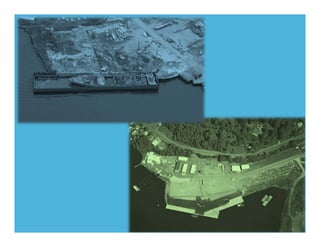
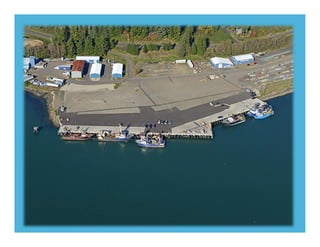
PORT OF NEWPORT: THE PROBLEM
• Port facility was originally constructed in the late
1940s by sinking and filling two, 400-foot WWII
concrete cargo ships with dredge material that
formed bulkheads for shipping
• Need to remediate, render the ships inert, remove
one ship and partially remove other ship, and
refilling the ships with clean material
• Contamination from fuel oil, asbestos and others
• Six thousand tons of contaminated material was
THE SOLUTION
• 2006, port district voters approved a $15.4M GO
bonds to renovate the Port
• BizOregon cleanup loan
• Removed and 19.4 million gallons of water was
treated in the cleaning of the ships’ cargo holds
• Salvage value $900k; 90% recycling
Regional Planning Commission’s
Brownfield Redevelopment Program
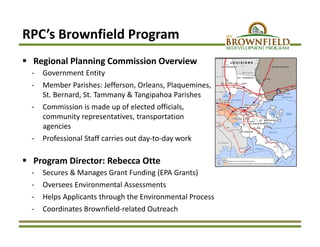
RPC’s Brownfield Program
 Regional Planning Commission Overview
‐ Government Entity 
‐ Member Parishes: Jefferson, Orleans, Plaquemines, 
St. Bernard, St. Tammany & Tangipahoa Parishes 
‐ Commission is made up of elected officials, 
community representatives, transportation 
agencies
‐ Professional Staff carries out day‐to‐day work
 Program Director: Rebecca Otte
‐ Secures & Manages Grant Funding (EPA Grants)
‐ Oversees Environmental Assessments
‐ Helps Applicants through the Environmental Process
‐ Coordinates Brownfield‐related Outreach
 U.S. Environmental Protection Agency (EPA)
‐ Provides funding through competitive grants
‐ Oversees compliance with EPA grant 
requirements 
 Louisiana Dept. of Environmental Quality (LDEQ)
‐ State Environmental Regulatory Agency
‐ Overseas technical aspects of environmental 
assessments & cleanups
‐ Responsible for approving all environmental 
cleanup activities
‐ Also has a Brownfields Program
 Louisiana Brownfield Association
RPC’s Brownfield Partners
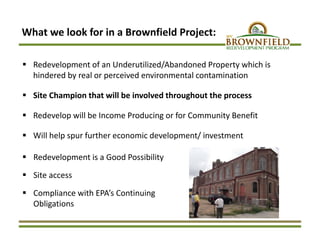
What we look for in a Brownfield Project:
 Redevelopment of an Underutilized/Abandoned Property which is 
hindered by real or perceived environmental contamination
 Site Champion that will be involved throughout the process 
 Redevelop will be Income Producing or for Community Benefit
 Will help spur further economic development/ investment
 Redevelopment is a Good Possibility 
 Site access
 Compliance with EPA’s Continuing 
Obligations
RPC’s Brownfield Program
What IS NOT included under Brownfields Funding:
 Payment for environmental assessments already conducted
 Funding for Site Purchase
 Funding for Site Redevelopment, unless related to the Cleanup
 Payments to other consultants or to property owners for 
environmental activities 
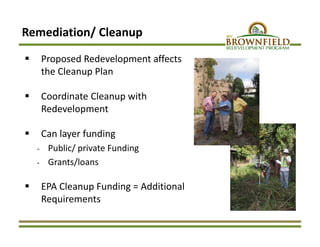
Remediation/ Cleanup
 Reducing the risk of exposure
‐ Treating contamination on‐site or in situ (in the ground)
‐ Removing the contamination
‐ Institutional Controls (e.g., conveyance notice to not allow 
groundwater to be used for drinking water)
‐ Engineering Controls (e.g., capping contamination with a parking lot)
Goal: Reduce the risk of exposure to 
unsafe levels of contamination to protect 
Human Health & the Environment
Remediation/ Cleanup
 Proposed Redevelopment affects 
the Cleanup Plan
 Coordinate Cleanup with 
Redevelopment
 Can layer funding 
‐ Public/ private Funding 
‐ Grants/loans
 EPA Cleanup Funding = Additional 
Requirements
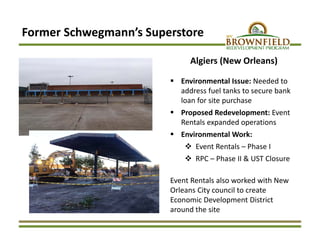
Former Schwegmann’s Superstore 
Algiers (New Orleans)
 Environmental Issue: Needed to 
address fuel tanks to secure bank 
loan for site purchase 
 Proposed Redevelopment: Event 
Rentals expanded operations
 Environmental Work:
 Event Rentals – Phase I
 RPC – Phase II & UST Closure 
Event Rentals also worked with New 
Orleans City council to create 
Economic Development District 
around the site
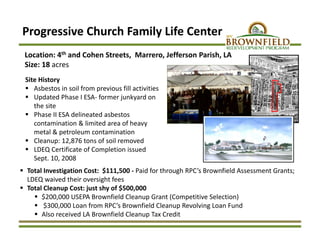
Progressive Church Family Life Center
Site History
 Asbestos in soil from previous fill activities
 Updated Phase I ESA‐ former junkyard on 
the site
 Phase II ESA delineated asbestos 
contamination & limited area of heavy 
metal & petroleum contamination
 Cleanup: 12,876 tons of soil removed 
 LDEQ Certificate of Completion issued  
Sept. 10, 2008
Location: 4th and Cohen Streets,  Marrero, Jefferson Parish, LA
Size: 18 acres
 Total Investigation Cost:  $111,500 ‐ Paid for through RPC’s Brownfield Assessment Grants; 
LDEQ waived their oversight fees
 Total Cleanup Cost: just shy of $500,000 
 $200,000 USEPA Brownfield Cleanup Grant (Competitive Selection)
 $300,000 Loan from RPC’s Brownfield Cleanup Revolving Loan Fund
 Also received LA Brownfield Cleanup Tax Credit
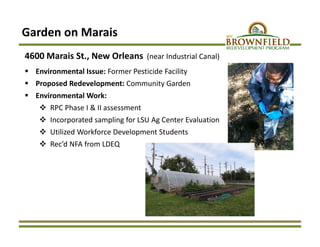
Garden on Marais
4600 Marais St., New Orleans (near Industrial Canal)
 Environmental Issue: Former Pesticide Facility
 Proposed Redevelopment: Community Garden
 Environmental Work:
 RPC Phase I & II assessment
 Incorporated sampling for LSU Ag Center Evaluation
 Utilized Workforce Development Students
 Rec’d NFA from LDEQ
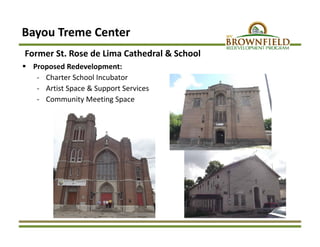
Former St. Rose de Lima Cathedral & School
 Proposed Redevelopment: 
‐ Charter School Incubator
‐ Artist Space & Support Services
‐ Community Meeting Space
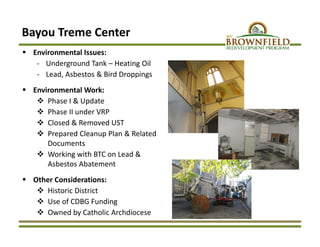
Bayou Treme Center 
 Environmental Issues: 
‐ Underground Tank – Heating Oil
‐ Lead, Asbestos & Bird Droppings
 Environmental Work:
 Phase I & Update
 Phase II under VRP
 Closed & Removed UST
 Prepared Cleanup Plan & Related 
Documents
 Working with BTC on Lead & 
Asbestos Abatement
 Other Considerations:
 Historic District
 Use of CDBG Funding
 Owned by Catholic Archdiocese
Bayou Treme Center 
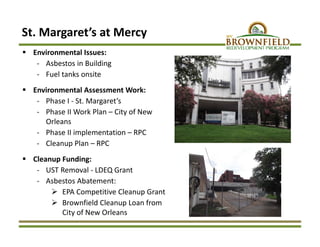
St. Margaret’s at Mercy
 Environmental Issues: 
‐ Asbestos in Building
‐ Fuel tanks onsite
 Environmental Assessment Work:
‐ Phase I ‐ St. Margaret’s
‐ Phase II Work Plan – City of New 
Orleans
‐ Phase II implementation – RPC
‐ Cleanup Plan – RPC
 Cleanup Funding:
‐ UST Removal ‐ LDEQ Grant
‐ Asbestos Abatement:
 EPA Competitive Cleanup Grant
 Brownfield Cleanup Loan from 
City of New Orleans
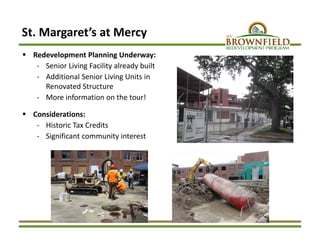
St. Margaret’s at Mercy
 Redevelopment Planning Underway:
‐ Senior Living Facility already built
‐ Additional Senior Living Units in 
Renovated Structure
‐ More information on the tour!
 Considerations:
‐ Historic Tax Credits
‐ Significant community interest
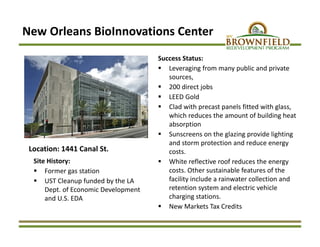
Falstaff Brewery
Location: 2600 Gravier Street, New Orleans, LA
Size:  8 acres
Site History:
 Brewery Closed in 1978; Site left vacant
 Phase I ESA conducted in Aug. 2005 in 
preparation for site purchase; Paid for by 
RPC Brownfield Assessment Grant
 Extensive Asbestos Containing Materials, 
Lead‐Based Paint, and Solid Waste 
throughout 7‐Story Structure
 Falstaff Properties I LLC purchased property 
and cleaned up contamination
Success Status:
 Opened in 2008
 Currently at 95% Occupancy
 Mixed‐Use Residential & Commercial Property 
 Tax credits ‐ Includes Affordable Housing Units
Before:
After:
New Orleans BioInnovations Center
Location: 1441 Canal St.
Site History:
 Former gas station
 UST Cleanup funded by the LA 
Dept. of Economic Development 
and U.S. EDA
Success Status:
 Leveraging from many public and private 
sources,
 200 direct jobs
 LEED Gold
 Clad with precast panels fitted with glass, 
which reduces the amount of building heat 
absorption 
 Sunscreens on the glazing provide lighting 
and storm protection and reduce energy 
costs. 
 White reflective roof reduces the energy 
costs. Other sustainable features of the 
facility include a rainwater collection and 
retention system and electric vehicle 
charging stations. 
 New Markets Tax Credits
Considerations for Brownfield Funding
 EPA Funding Comes with Strings Attached
 EPA & LDEQ approvals
 EPA reporting
 Quality Assurance Project Plan
 RPC helps with “string management” 
 RPC helps facilitate the LDEQ review process by:
‐ Flagging sites as redevelopment projects
‐ Reviewing documents prior to submission
‐ Working with the LDEQ Team Leaders on timing
 Brownfields does not move quickly
 Takes about 30 days to enroll a site
‐ Timing depends on how long it takes to receive paperwork & access 
agreement from applicant
 Phase I: 60‐90 days (normally 30 days with private funding)
 Phase II: 6‐ 12 months
 VRP Phase II: 12 – 18 months
 Cleanup: At least 12 months
Brownfields Timing
Contact Information
Rebecca Otte 
Brownfield Redevelopment Program Director
Regional Planning Commission
brownfields@norpc.org
(504) 483‐8513 
Questions?
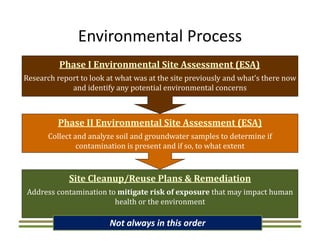
Environmental Process
Site	Cleanup/Reuse	Plans &	Remediation
Address	contamination	to	mitigate	risk	of	exposure	that	may	impact	human	
health	or	the	environment
Not always in this order
Phase	I	Environmental	Site	Assessment	(ESA)
Research	report	to	look	at	what	was	at	the	site	previously	and	what’s	there	now	
and	identify	any	potential	environmental	concerns
Phase	II	Environmental	Site	Assessment	(ESA)
Collect	and	analyze	soil	and	groundwater	samples	to determine	if	
contamination	is	present	and	if	so,	to	what	extent
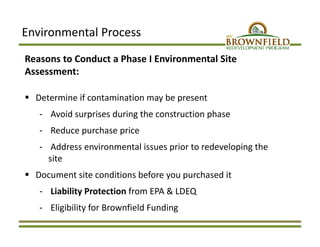
Environmental Process
Reasons to Conduct a Phase I Environmental Site 
Assessment:
 Determine if contamination may be present 
‐ Avoid surprises during the construction phase
‐ Reduce purchase price
‐ Address environmental issues prior to redeveloping the 
site
 Document site conditions before you purchased it
‐ Liability Protection from EPA & LDEQ
‐ Eligibility for Brownfield Funding
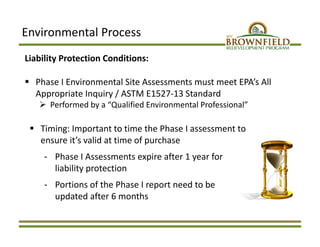
Environmental Process
Liability Protection Conditions:
 Phase I Environmental Site Assessments must meet EPA’s All 
Appropriate Inquiry / ASTM E1527‐13 Standard
 Performed by a “Qualified Environmental Professional”
 Timing: Important to time the Phase I assessment to 
ensure it’s valid at time of purchase
‐ Phase I Assessments expire after 1 year for 
liability protection
‐ Portions of the Phase I report need to be 
updated after 6 months
Environmental Process
Regulatory Oversight Options for 
Phase II Assessments and Cleanups/ Remediation:
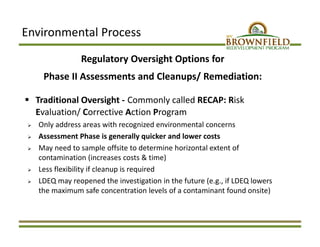
 Traditional Oversight ‐ Commonly called RECAP: Risk 
Evaluation/ Corrective Action Program 
 Only address areas with recognized environmental concerns
 Assessment Phase is generally quicker and lower costs 
 May need to sample offsite to determine horizontal extent of 
contamination (increases costs & time)
 Less flexibility if cleanup is required 
 LDEQ may reopened the investigation in the future (e.g., if LDEQ lowers 
the maximum safe concentration levels of a contaminant found onsite)
Environmental Process
Regulatory Oversight Options for 
Phase II Assessments and Cleanups/ Remediation:
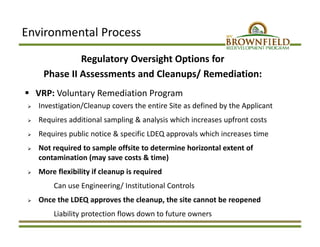
 VRP: Voluntary Remediation Program
 Investigation/Cleanup covers the entire Site as defined by the Applicant
 Requires additional sampling & analysis which increases upfront costs
 Requires public notice & specific LDEQ approvals which increases time
 Not required to sample offsite to determine horizontal extent of 
contamination (may save costs & time)
 More flexibility if cleanup is required 
Can use Engineering/ Institutional Controls
 Once the LDEQ approves the cleanup, the site cannot be reopened
Liability protection flows down to future owners
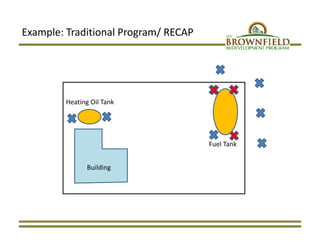
Example: Traditional Program/ RECAP
Building
Heating Oil Tank
Fuel Tank
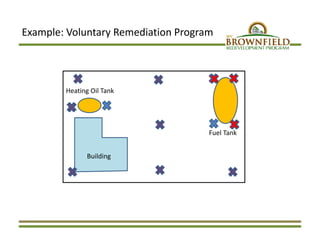
Example: Voluntary Remediation Program
Building
Heating Oil Tank
Fuel Tank
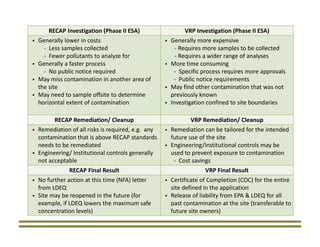
RECAP Investigation (Phase II ESA) VRP Investigation (Phase II ESA)
 Generally lower in costs 
‐ Less samples collected
‐ Fewer pollutants to analyze for
 Generally a faster process
‐ No public notice required
 May miss contamination in another area of 
the site
 May need to sample offsite to determine 
horizontal extent of contamination
 Generally more expensive
‐ Requires more samples to be collected
‐ Requires a wider range of analyses
 More time consuming
‐ Specific process requires more approvals
‐ Public notice requirements
 May find other contamination that was not 
previously known
 Investigation confined to site boundaries
RECAP Remediation/ Cleanup VRP Remediation/ Cleanup
 Remediation of all risks is required, e.g.  any 
contamination that is above RECAP standards 
needs to be remediated
 Engineering/ Institutional controls generally 
not acceptable
 Remediation can be tailored for the intended 
future use of the site
 Engineering/Institutional controls may be 
used to prevent exposure to contamination
‐ Cost savings
RECAP Final Result VRP Final Result
 No further action at this time (NFA) letter 
from LDEQ
 Site may be reopened in the future (for 
example, if LDEQ lowers the maximum safe 
concentration levels)
 Certificate of Completion (COC) for the entire 
site defined in the application
 Release of liability from EPA & LDEQ for all 
past contamination at the site (transferable to 
future site owners)
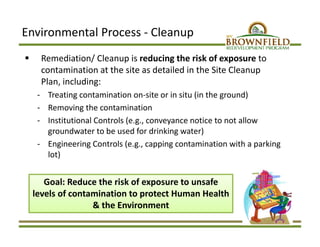
Environmental Process ‐ Cleanup
 Remediation/ Cleanup is reducing the risk of exposure to 
contamination at the site as detailed in the Site Cleanup 
Plan, including:
‐ Treating contamination on‐site or in situ (in the ground)
‐ Removing the contamination
‐ Institutional Controls (e.g., conveyance notice to not allow 
groundwater to be used for drinking water)
‐ Engineering Controls (e.g., capping contamination with a parking 
lot)
Goal: Reduce the risk of exposure to unsafe 
levels of contamination to protect Human Health 
& the Environment
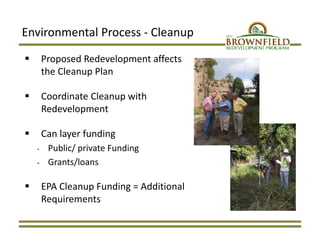
Environmental Process ‐ Cleanup
 Proposed Redevelopment affects 
the Cleanup Plan
 Coordinate Cleanup with 
Redevelopment
 Can layer funding 
‐ Public/ private Funding 
‐ Grants/loans
 EPA Cleanup Funding = Additional 
Requirements
Web Resources
 US Environmental Protection Agency’s (EPA’s) Brownfields Website:  
www.epa.gov/brownfields/
 US Department of Housing and Urban Development (HUD): 
http://portal.hud.gov/hudportal/HUD?src=/program_offices/comm_plann
ing/economicdevelopment/programs
 EPA’s RE‐Powering America’s Land Initiative:  www2.epa.gov/re‐powering
 The Brownfield and Land Revitalization Technology Support Center (EPA, 
USACE, ANL): www.brownfieldstsc.org

Brownfields Redevelopment Case Studies