SUBMITTED BY-
MOKSHIKA BALANA
B.ARCH 10THSEM.
ROLLNO. 2011-ARA- 237
DEPARTMENT OF
ARCHITECTURE,
GURU NANAK DEV UNIVERSITY,
CENTRAL BUISNESS DISTRICT
THESIS REPORT - 2016
2
CONTENTS
CHAPTER – 1 INTRODUCTION
1. Introduction
2. Validity
3. Aims and Objectives
4. Scope of project
5. Methodology
CHAPTER – 2 LIBRARY STUDY
CHAPTER – 3 CASE STUDIESAND LITERATURE STUDY
1. NEHRU PLACE , NEW DELHI
2. SAKET DISTRICT CENTER, NEW DELHI
3. Literature study
BHIKHAJI CAMA
CHAPTER-4 PROJECT BRIEF
PG NO.
2-7
8-19
20-38
39-56
57-63
64-744.1 Site Analysis
4.2 Design Criteria
4.3 Area Requirements
|| CENTRAL BUISNESS DISTRICT
3
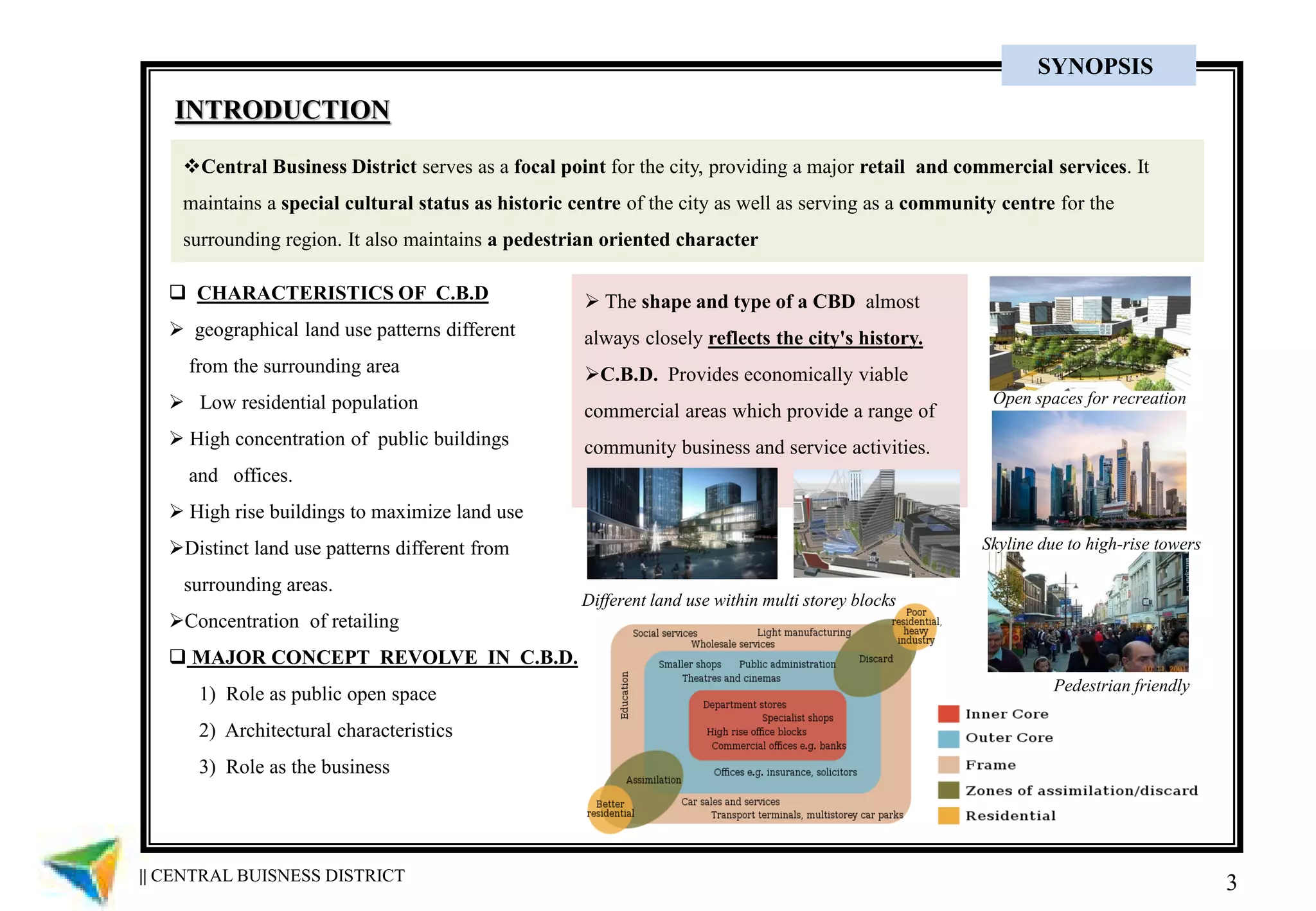
Central Business District serves as a focal point for the city, providing a major retail and commercial services. It
maintains a special cultural status as historic centre of the city as well as serving as a community centre for the
surrounding region. It also maintains a pedestrian oriented character
 The shape and type of a CBD almost
always closely reflects the city's history.
C.B.D. Provides economically viable
commercial areas which provide a range of
community business and service activities.
 CHARACTERISTICS OF C.B.D
 geographical land use patterns different
from the surrounding area
 Low residential population
 High concentration of public buildings
and offices.
 High rise buildings to maximize land use
Distinct land use patterns different from
surrounding areas.
Concentration of retailing
 MAJOR CONCEPT REVOLVE IN C.B.D.
1) Role as public open space
2) Architectural characteristics
3) Role as the business
INTRODUCTION
Open spaces for recreation
Skyline due to high-rise towers
Pedestrian friendly
Different land use within multi storey blocks
|| CENTRAL BUISNESS DISTRICT
SYNOPSIS
4
VALIDITY
ACCORDING TO MASTER PLAN OF AMRITSAR
 The markets of the walled city are highly congested and have high density.
 Due to absence of adequate parking and organized commercial area the movement in these areas has been
hampered.
 The narrow streets and road encroachments have further degraded the aesthetic and potential of the area.
 This has affected the trade of the markets and thus their existence.
 No market is dedicated to selling of traditional industrial products of the city, like shawls, to achieve good
marketing of traditional products of the city.
 No commercial complex for banking, insurance and share market exists in the city
KEY ISSUES FOR NEED
Considering the nature and context of trade and its relationship with city and its activities , its proposed to shift wholesale food
grain trade presently being carried out at bhagatanwala outside
the city.
 SHIFTING GRAIN MARKET :-
 will help in minimizing the traffic congestion caused by influx of large number of vehicles.
 Considering the close proximity of bhagatanwala gate to walled city, it is proposed to develop the land as city market with
office spaces , retail markets ,eating joints and serve as market for tourist recreation .
|| CENTRAL BUISNESS DISTRICT
SYNOPSIS
5
The project CENTRAL BUISNESS DISTRICT in AMRITSAR, PUNJAB that
would provide access to major commercial and retail services for the city. It would
form the node for holding and experiencing commercial, cultural and social
activities .
GENERAL FUNCTIONS
The main components of district centre are
• Commercial components
•Cultural components
• Recreational components
 SITE BRIEF
The proposed site for district center is located
at GRAIN MARKET,BHAGTANWALA GATE .
 SITE CONNECTIVITY
The proposed site for district center is
approached by 6m wide road . It lies close
to the major commercial center of the city i.e.
walled city. Site is 2.5 km from the GOLDEN TEMPLE , major tourist attraction in
the city and 5.5 km from the BUS STAND and 4km from the RAILWAY STATION
|| CENTRAL BUISNESS DISTRICT
SYNOPSIS
PROJECT BRIEF
6
• To create an interactive relationship between visual avenue , moments and activity pattern .
• To create a barrier free environment
• To understand the overall space concept with respect to human scale and built environment.
• To create a space which can form the node for holding and experiencing commercial, cultural and social
activities .
AIMS OF THE PROJECT
1) to provide open living spaces achieving the comfort ambience.
2) to blend architecture planning and structure and architecture
3) to ensure an all time engaging and vibrant environment for all the users by:
• mixed use zoning
• integration of movement and activity
• juxtaposition of formal and informal sector
OBJECTIVES ARE AS FOLLOWS
ARCHITECTURAL CHALLENGES OF THE PROJECT:
1) To explore the symbiotic character of COMMERCE and CULTURE.
2) Explore the inter-relationships of the spaces and the challenges of disparities cause by design which restrict
spaces to particular segment of public .
3) To evolve a contemporary model of conventional Indian market.
4) The project would try to explore the possible integration of the functions which usually exist at larger distances
|| CENTRAL BUISNESS DISTRICT
SYNOPSIS
7
SCOPE
 The major role is to design the CENTRAL BUISNESS DISTRICT in a series of integrated spaces and variety and
mix use giving unique identity to business streets and serve as hub of commercial activities. This includes :
Detailed layout scheme of project.
(parking , circulation , landscape , Pedestrian movement shall be dealt in detail)
Detailed design of office building, shops cum offices, piazzas and other buildings like library
Landscape plan for the proposed site .
Detailed structural grid drawings for office building, shop cum offices.
LIMITATION
 No detailed structural drawings and calculations.
Detailing of limited building modules out of all requirements.
THRUST
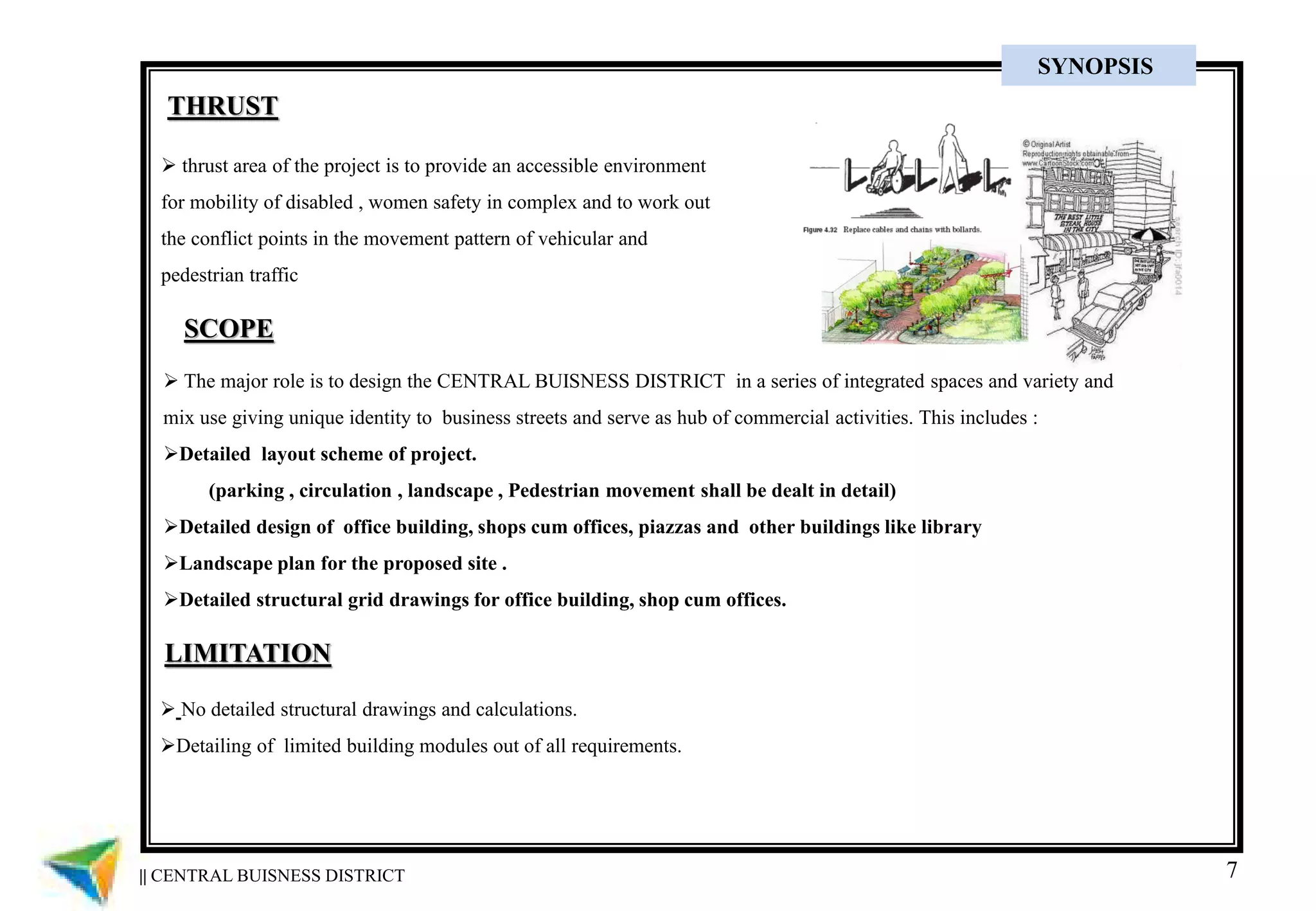
 thrust area of the project is to provide an accessible environment
for mobility of disabled , women safety in complex and to work out
the conflict points in the movement pattern of vehicular and
pedestrian traffic
|| CENTRAL BUISNESS DISTRICT
SYNOPSIS
8
• A review of various aspects of C.B.D
• How does such a COMPLEX will be able to produce real values pertaining to COMMERCIAL and SOCIAL
intentions
• Analytical study of activities and relative studies
• The realization of built form in relation with open spaces with the idea of producing enlivenment out of a holistic
approach and fulfilling, the aspirations of the users
• Analysis of site and response of proposed buildings to:
• Surroundings
• Establishment of functional criteria
• Culture and climate
• Relevant literature studies – context, case-studies, standards and anthropometric data.
• Analysis of literature and case studies and driving the inference and conclusions from each study, comparisons of
studies.
• Formulation of Spaces and the areas.
• Formulation of Development Controls.
• Design concept
• Ultimate design proposal.
METHODOLOGY
|| CENTRAL BUISNESS DISTRICT
SYNOPSIS
9
•GENERAL OBJECTIVES
•Accessibility -District centre should be planned in a
way so that every activity falls within the accessible
distance.
•Safety -By providing road side infrastructure
encouraging pedestrian’s movement and less vehicular
traffic which help enhance safety.
•Comfort-Providing more sitting spaces in the parks,
facilities like public conveniences.
•Compatibility-Any two activities provided in
consecutively would be compatible with each other or
buffer zone would be provided for the same.
INTRODUCTION
The CBD or Central Business District is the focal point of a
city. It is the commercial, office, retail, and cultural center of the
city and usually is the center point for transportation networks. .
It maintains a special cultural status as historic centre of the
city as well as serving as a community centre for the surrounding
region. It also maintains a pedestrian oriented character.
The CBD developed as the market square in ancient cities. On
market days, farmers, merchants and consumers would gather in
the center of the city to exchange, buy, and sell goods. This
ancient market is the forerunner to the CBD. As cities grew and
developed, CBDs became fixed location where retail and
commerce took place. The CBD is often near a major
transportation route that provided the site for the city's location,
such as a river, railroad, or highway.
HISTORIC BACKGROUND
|| CENTRAL BUISNESS DISTRICT
LIBRARY STUDY
10
OBJECTIVES
• The entire complex shall be designed with proper orientation and maximum wind
movement. Building may be oriented along NW – SE orientation.
• Development of open spaces, nodes and transition spaces between main building
and approach areas.
• Ensuring proper connection between public areas, semi public areas and services.
• While formal and informal areas shall be well connected, a sense of segregation
should be ensured as well.
• To create streets which are safe and attractive to pedestrians.
• To provide activity and interest along the street.
SITE PLANNING
The allocation of spaces for these and possibly others users should be guided by certain
planning principles in order to attain the highest feasible productivity of the land over an
extended period of time
1. Safeguard surrounding areas against the blind
2. Expose retail facilities to maximum foot traffic
3. Separate various mechanized traffic type from one another
4. Create a maximum of comfort for the shoppers and merchants
5. Achieve order, unity and beauty.
N
The shop units and the plazas
should be north facing to avoid the
glare
Pedestrian friendly complex
Barrier free environment
|| CENTRAL BUISNESS DISTRICT
LIBRARY STUDY
11|| CENTRAL BUISNESS DISTRICT
LIBRARY STUDY
COMPONENTS OF C.B.D
12
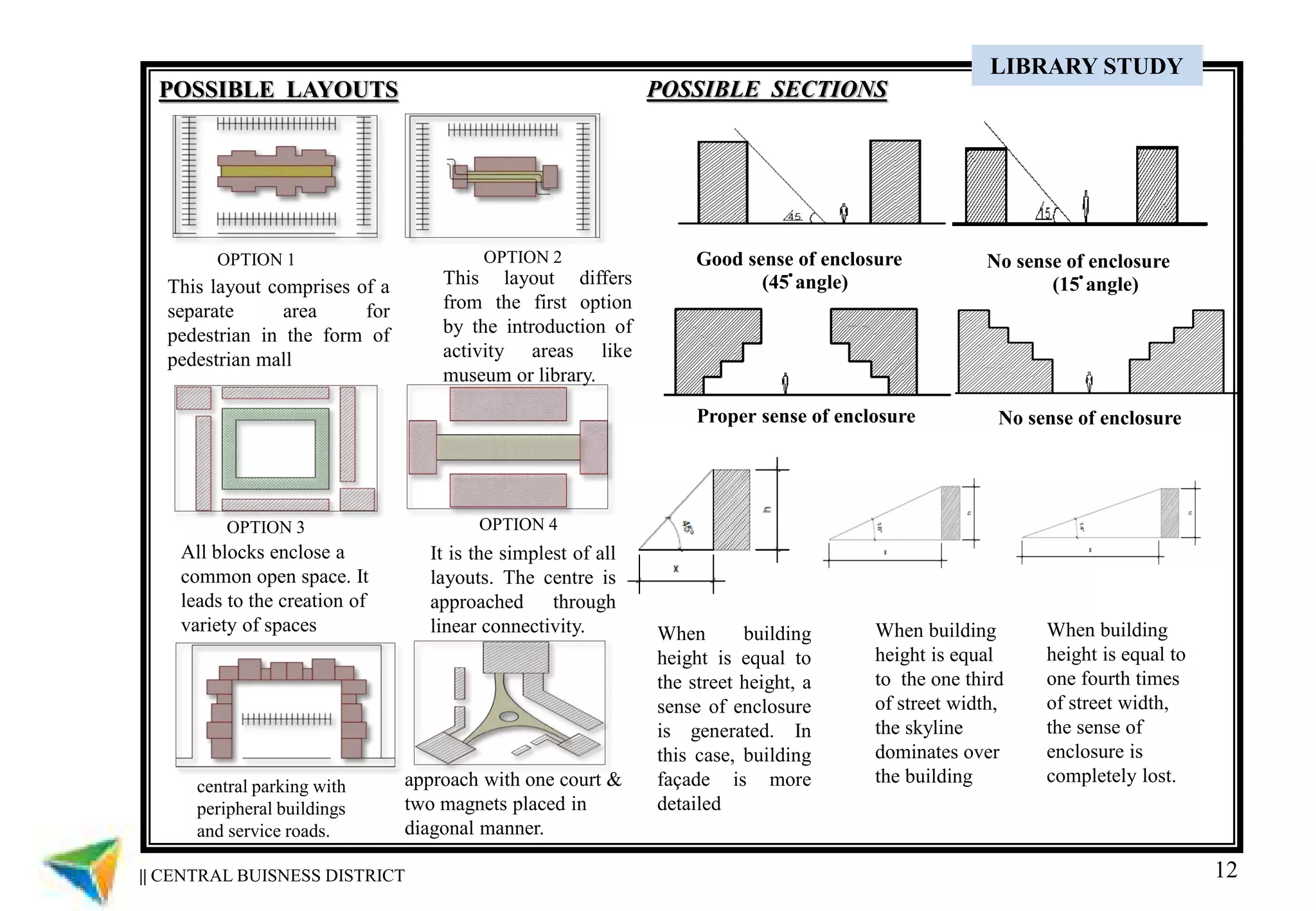
POSSIBLE SECTIONS
No sense of enclosure
Good sense of enclosure
(45angle)
Proper sense of enclosure
No sense of enclosure
(15angle)
|| CENTRAL BUISNESS DISTRICT
LIBRARY STUDY
When building
height is equal to
the street height, a
sense of enclosure
is generated. In
this case, building
façade is more
detailed
When building
height is equal
to the one third
of street width,
the skyline
dominates over
the building
When building
height is equal to
one fourth times
of street width,
the sense of
enclosure is
completely lost.
POSSIBLE LAYOUTS
This layout comprises of a
separate area for
pedestrian in the form of
pedestrian mall
This layout differs
from the first option
by the introduction of
activity areas like
museum or library.
OPTION 1 OPTION 2
OPTION 3
central parking with
peripheral buildings
and service roads.
All blocks enclose a
common open space. It
leads to the creation of
variety of spaces
approach with one court &
two magnets placed in
diagonal manner.
It is the simplest of all
layouts. The centre is
approached through
linear connectivity.
OPTION 4
13
Parking requirement/E.C.S
1)0° - parallel to road. Entry and exit to
parking bay difficult. Suitable for
narrow roads.
2) 30°- angle to access road. Easy entry to
parking bay and exit. Uses a large area.
3) 45°- angle to access road. Good entry to
parking bay and exit. Relatively small
parking space.
4) 60°- angle to access road. Relatively good
entry and exit to parking bay; small
parking space. Arrangement often used.
5) Right angles to road (parking spaces 2.50
m wide). Sharp turn needed for entry and
exit.
6) Right angles to road (parking spaces 2.30
m wide). Small area needed for parking
space. Ideal for compact parking layouts,
used frequently.
PARKING
|| CENTRAL BUISNESS DISTRICT
LIBRARY STUDY
• 2 wheeler parking: 1.2 x 2.1 m
• Car - Parking: 2.5 x 5 m -
Turning Radius 5m
• Bus - Parking: 3.5 x 12 m -
Turning Radius 12.2m
Parking type sqm
Open 23
Ground floor covered 28
Basement 32
Multilevel with ramps 30
Automated multilevel with
lifts
16
14
PEDESTRIAN
GENERAL SITE DESIGN FOR PEDESTRIANS
 No shortage of sources for site furnishings
today.
 Range of well-designed & durable materials
in many styles from which the designer may
choose.
 All of these furnishings comply with the
accepted standards of human dimensions &
behavior is necessary.
A fundamental element of design for the
pedestrian is the pathway or side-walk.
The sidewalk width must be designed to
provide the level of service suited to the user.
The parameters of sidewalk width are
determined according to the :
-anticipated volume of foot traffic,
-the speed at which the pedestrians will be
walking ,and the desired density of traffic.
WALKWAYS
Rigid mortared paving detail
Standing & Walking dimension
Pathway design
for wheelchair
W=v(m/s)
I.E.
o W = the width of the
pathway or sidewalk,ft.
oV = the traffic volume,
persons /minute
oM = the space module
allowed/person,ft².
oS = the walking speed
o,ft/min
|| CENTRAL BUISNESS DISTRICT
LIBRARY STUDY
15
STREET FURNITURE
.
LITTER BINS:-These are of
three types
• Open types
• semi open type
• Hinged- door opening
BARRIERS:- The purpose of
these barriers are
• Privacy
• Safety
 CHAIN AND BARRIERS:-
It should be 790mm in height
When lower than 790 mm it is
Difficult to detect by pedestrian ,
cyclist, motorcyclist
STREET FURNITURE :- Elements
placed in a landscape or streetscape for
comfort, convenience, information,
circulation control, protection, and user
enjoyment are collectively referred to as
site furniture (figure 510-1) .Benches,
bollards, signage, lighting, tree grates,
and utility boxes
SIGN DESIGN.
Consider both pedestrian and vehicular
traffic in selecting and designing
signage.
.SIGNAGE AND THE BUILDING
Signage should be low-key in order to
avoid competition with the architecture of
the structure.
Materials and design should be
compatible with the building’s materials
and style
SITTING CHAIR:-
Signage Chains and barriers
Litter bins
|| CENTRAL BUISNESS DISTRICT
LIBRARY STUDY
16
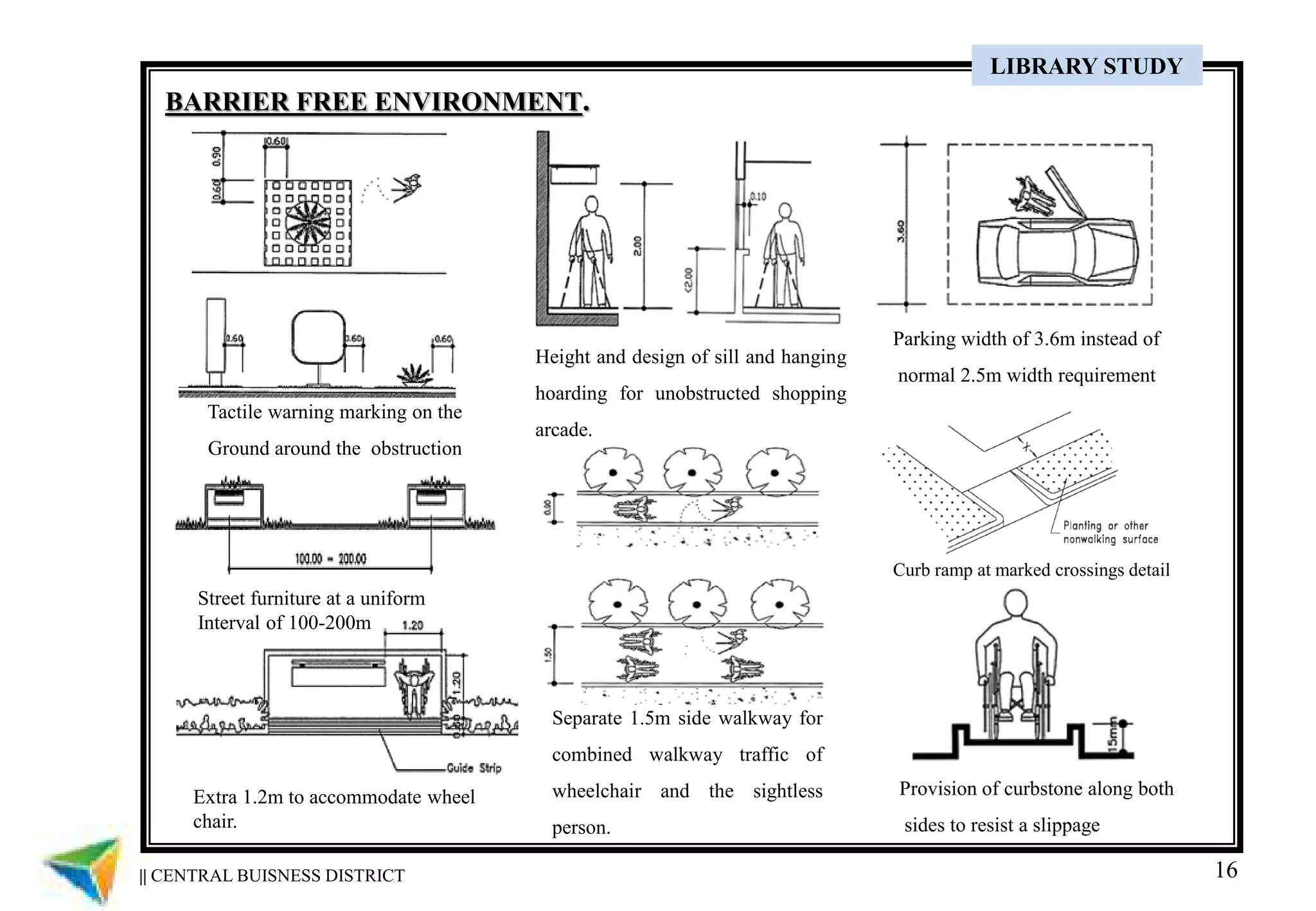
Tactile warning marking on the
Ground around the obstruction
Extra 1.2m to accommodate wheel
chair.
Street furniture at a uniform
Interval of 100-200m
Parking width of 3.6m instead of
normal 2.5m width requirement
Provision of curbstone along both
sides to resist a slippage
Separate 1.5m side walkway for
combined walkway traffic of
wheelchair and the sightless
person.
Height and design of sill and hanging
hoarding for unobstructed shopping
arcade.
BARRIER FREE ENVIRONMENT.
|| CENTRAL BUISNESS DISTRICT
LIBRARY STUDY
Curb ramp at marked crossings detail
17
Mature street trees shall be maintained for clear head clearance.
LANDSCAPING
•Trees shall be provided along major pedestrian
corridors.
•Trees shall not be placed closer than 30 feet
from intersections. They shall remain out of the
clear vision triangle.
•Branch height of mature trees on traffic side
shall be no less than 13’-6” above the street.
•Branch height on pedestrian side shall be no
less than 8’above the sidewalk.
•Proper irrigation systems shall be installed to
establish and maintain healthy growth.
•Tree species shall be selected that can
withstand the harsh conditions of the urban
environment. When an area is to be unified,
plant only one species.
•Mature tree height and canopy fullness shall
not obscure important building features or
business identification.
• Shady trees – sitting can be provided under shady trees
Neem – azadirachta indica
Peepal – ficus relegiosa
Golden fig – ficus benjaminia
• Flowering trees – for aesthetics
Amaltas – cassia fistula
Gulmohar – delonixx fistula
Kachnar – bauhinia frandosa
• Ornamental trees – for aesthetics
Royal palm – oreodoxa regia
Palmyra – borassus flabellifer
• Avenue trees –
Silver oak – gravilla robusta
Ashoka – polyalthia longifolia
|| CENTRAL BUISNESS DISTRICT
LIBRARY STUDY
Use of vegetation in redirecting air flows
High branched
trees provide shade
for the breeze
'Cooling path'
provided for breeze
before it enters the
building.
18
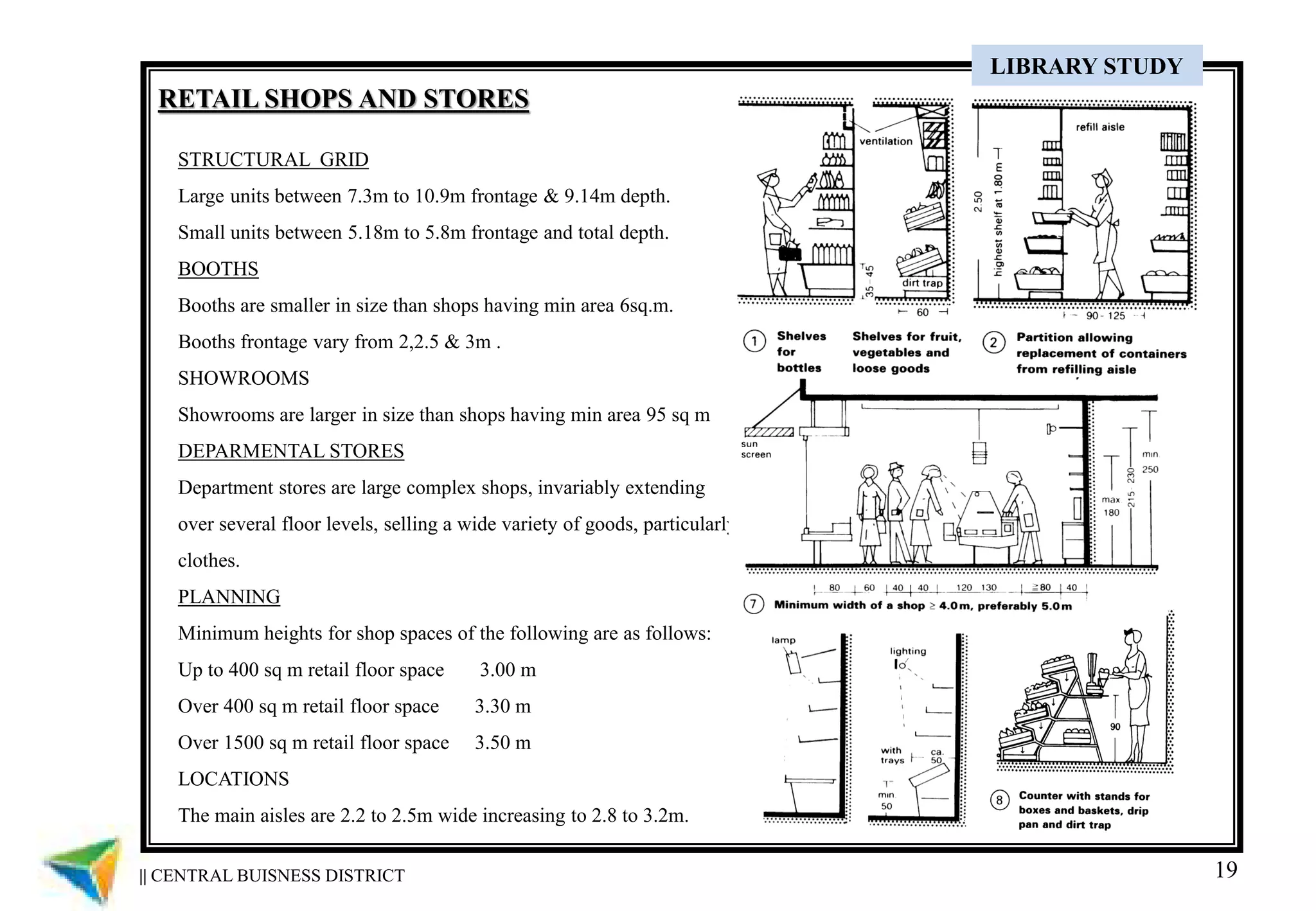
Retail outlets can be broadly divided into
• Small Shops – 20 sq m
• Medium Shops – 50 sq m
• Large shops – 150 sq m
• Departmental Stores Or
• Supermarkets – 350 sq m
PLANNING GUIDELINES
• Occupation in stores - 1 person per 5 to 6 sq m; 1 person per 1.8 sq m in peak hours
• Shelf Units - Shelf units should not be higher than 1.8m and not lesser than 0.3m.
SHOP WIDTH
• This is the most important dimension as it involves column spacing and frontage of stores.
• The most common used shop widths are 6 , 7.6, 9.14 m the last being the most flexible one.
SHOP DEPTH – It can vary according to the frontage
Covered verandahs
• Covered verandahs must be provided for shade and protection against sun and rain.
• Width can vary from 1.85m to 3.04 m depending upon the type of shop.
RETAIL SHOPS AND STORES
Fig.3- Narrow
frontage Max.
Window Perimeter
Fig.2- Not
recommended
should be avoided.
Fig. 1 - wide frontage columns
cause no interruption to display
in arcade.
Fig.4- Narrow frontage
Flat front
|| CENTRAL BUISNESS DISTRICT
LIBRARY STUDY
19
STRUCTURAL GRID
Large units between 7.3m to 10.9m frontage & 9.14m depth.
Small units between 5.18m to 5.8m frontage and total depth.
BOOTHS
Booths are smaller in size than shops having min area 6sq.m.
Booths frontage vary from 2,2.5 & 3m .
SHOWROOMS
Showrooms are larger in size than shops having min area 95 sq m
DEPARMENTAL STORES
Department stores are large complex shops, invariably extending
over several floor levels, selling a wide variety of goods, particularly
clothes.
PLANNING
Minimum heights for shop spaces of the following are as follows:
Up to 400 sq m retail floor space 3.00 m
Over 400 sq m retail floor space 3.30 m
Over 1500 sq m retail floor space 3.50 m
LOCATIONS
The main aisles are 2.2 to 2.5m wide increasing to 2.8 to 3.2m.
|| CENTRAL BUISNESS DISTRICT
LIBRARY STUDY
RETAIL SHOPS AND STORES
20
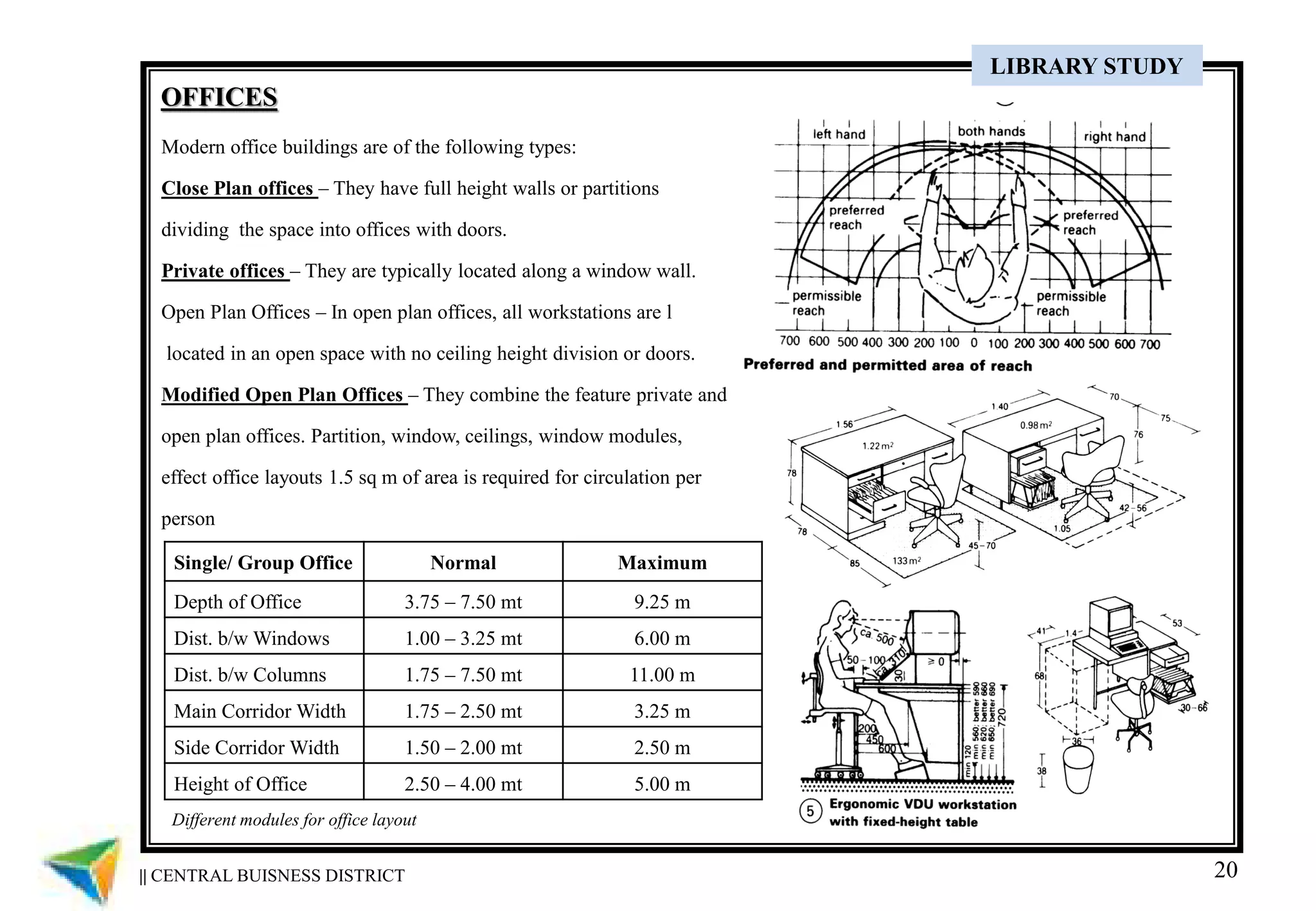
OFFICES
Modern office buildings are of the following types:
Close Plan offices – They have full height walls or partitions
dividing the space into offices with doors.
Private offices – They are typically located along a window wall.
Open Plan Offices – In open plan offices, all workstations are l
located in an open space with no ceiling height division or doors.
Modified Open Plan Offices – They combine the feature private and
open plan offices. Partition, window, ceilings, window modules,
effect office layouts 1.5 sq m of area is required for circulation per
person
|| CENTRAL BUISNESS DISTRICT
LIBRARY STUDY
Single/ Group Office Normal Maximum
Depth of Office 3.75 – 7.50 mt 9.25 m
Dist. b/w Windows 1.00 – 3.25 mt 6.00 m
Dist. b/w Columns 1.75 – 7.50 mt 11.00 m
Main Corridor Width 1.75 – 2.50 mt 3.25 m
Side Corridor Width 1.50 – 2.00 mt 2.50 m
Height of Office 2.50 – 4.00 mt 5.00 m
Different modules for office layout
21
CASE STUDY 1:-NEHRU PLACE . NEW DELHI
PROJECT BRIEF
PROJECT NAME NEHRU PLACE,
DELHI
TYPE OF
PROJECT
COMMERCIAL
DEVELOPERS D.D.A
CLIENT D.D.A
YEAR OF START 1969
YEAR OF
COMPLETION
1980
INCLUDES SHOPS, OFFICE
BUILDING,
RECREATIONAL
AREAS
NO. OF STOREYS
FOR OFFICE AND
COMMERCIAL
BUILDING G+8
TOWERS G+17
TOTAL SITE
AREA
49 ACRES
NEHRU PLACE,NEW DELHI
|| CENTRAL BUISNESS DISTRICT
CASE STUDY
22
 It is located in South Delhi.
 Nehru Place lies next to the Outer
Ring Road.
 On one edge of the site, there lies the
road towards Iskon temple
NEW DELHI
APPROACH AND ACCESS
CHIRAG
ENCLAVE
METRO ST.
ISCON
TEMPLE
SOUTH DELHI
NEHRU PLACE
Main access-
Lala Lajpath
Rai road which
is 100 ft wide.
Delhi-metro station
on violet line.
Outer ring road
Own bus terminal-
Nehru place bus
terminal.
LOCATION
|| CENTRAL BUISNESS DISTRICT
CASE STUDY
•Easy approach since located on prime location and proper transportation connection
23
SITE CHARACTER AND ORIENTATION
SITE AREA :- 49 ACRES
TOPOGRAPHY :- Site was built atop the
Aravalli mountain
range. the hills were
blown and removed.
SHAPE :- Site is quadrilateral
ORIENTATION :- Site is east- west
oriented
The site is divided in to three zones.
Commercial and office zone.
 Re-creational Zone
Public Building zone
Office towers at outer periphery to reduce
chaos
Recreational areas in front of shops in
form of piazza to cater informal activities.
Piazzas created on levels to create interest
N N
SS
EW
commercial buildings oriented in east west direction allows more open spaces
to receive indirect sunlight and lesser heat gain
SITE ZONING
LEGENDS
Commercial
and office
Re-
creational
Zone
Public zone
|| CENTRAL BUISNESS DISTRICT
CASE STUDY
24
SITE LAYOUT
The central business district
comprises of following :-
Nehru place Metro station
Satyam multiplex
Commercial building
Official building
Multi level parking
Bus terminal
Eros cooperation tower
Modi towers
Informal shops
G+17 G+1
G+3
G+5
G+17
G+15
G+17
G+17
G+5
G+3 G+5
G+5
G+3
G+7
G+7
G+6
G+5
G18
G18
G+18
G+9
G+5
G+1
Eros Tower
Multilevel parking
Shops
Paras cinema
Metro station
Inadequate circulation
space, congestion at
the entry & exits
points.
Pathways open to
large piazzas which
are on levels to create
interest
-
+
|| CENTRAL BUISNESS DISTRICT
CASE STUDY
SITE LAYOUT :NEHRU PLACE
25
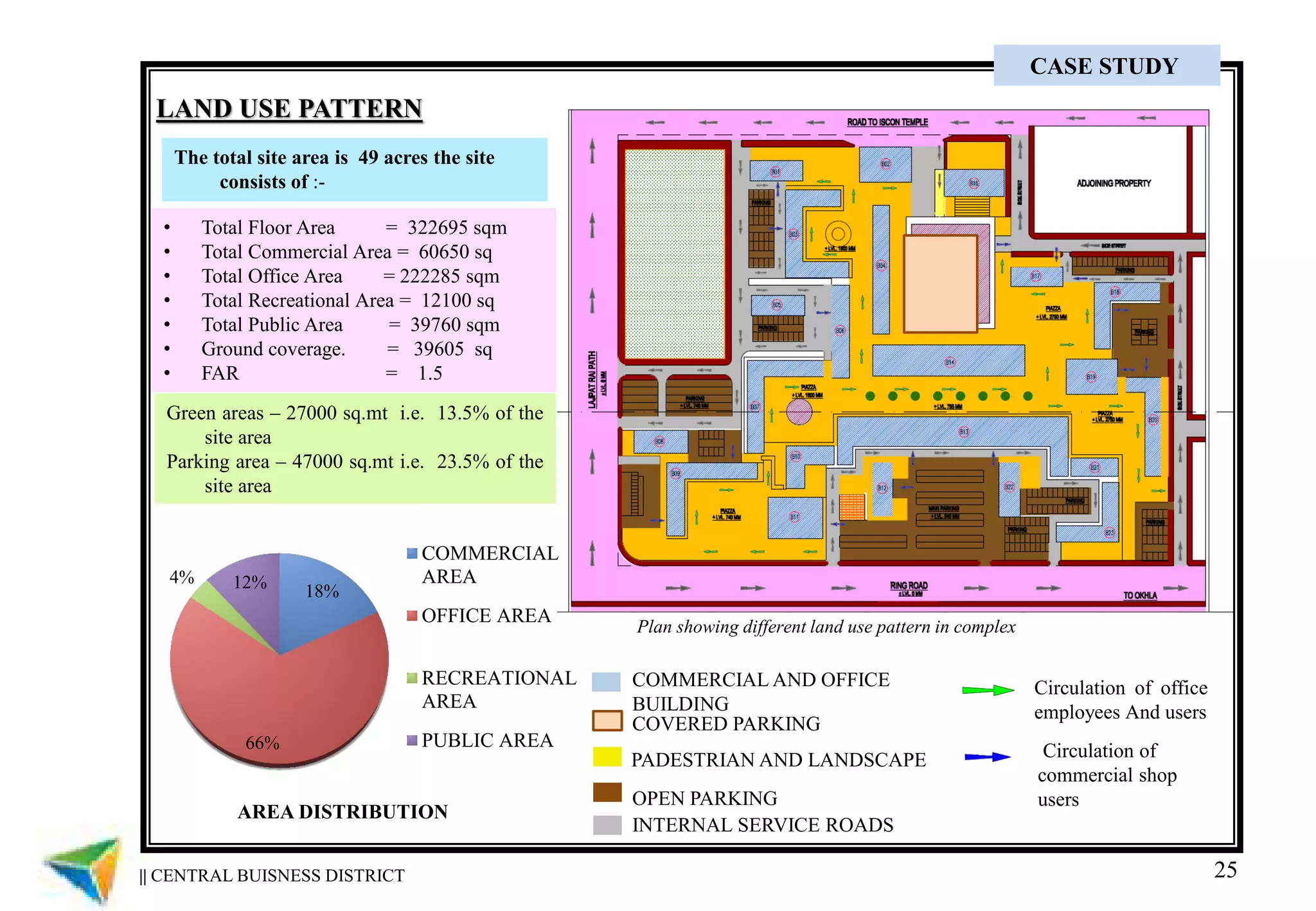
LAND USE PATTERN
COVERED PARKING
PADESTRIAN AND LANDSCAPE
OPEN PARKING
INTERNAL SERVICE ROADS
Circulation of
commercial shop
users
Circulation of office
employees And users
18%
66%
4% 12%
AREA DISTRIBUTION
COMMERCIAL
AREA
OFFICE AREA
RECREATIONAL
AREA
PUBLIC AREA
The total site area is 49 acres the site
consists of :-
• Total Floor Area = 322695 sqm
• Total Commercial Area = 60650 sq
• Total Office Area = 222285 sqm
• Total Recreational Area = 12100 sq
• Total Public Area = 39760 sqm
• Ground coverage. = 39605 sq
• FAR = 1.5
COMMERCIAL AND OFFICE
BUILDING
Green areas – 27000 sq.mt i.e. 13.5% of the
site area
Parking area – 47000 sq.mt i.e. 23.5% of the
site area
|| CENTRAL BUISNESS DISTRICT
CASE STUDY
Plan showing different land use pattern in complex
26
Entrance to Nehru
place from metro
station
Continuous covered
corridors for pedestrian
movement in front of
shops
(Lala
Lajpathrai
marg)
Entrance from
outer ring road
leading to shops
No vehicular access
to piazza for safety
of pedestrians
Large open piazzas provided
at the intersecting nodes of
the central pathways
15M wide
peripheral
vehicular roads
Central pathway
with shops on
both sides,
Parking area –
48000 sq.mt i.e.
23.5%
Vehicular movement
– 2100SQMT i.e.
11%
Pedestrian movement
area – 6400 i.e.
32%
Surface parking
on peripheral
roads
Vehicular
Movement
Pedestrian
Movement
Parking
Spaces
Main roads
CIRCULATION
Width of pathways
Acc to NBC
1.5m ≥30m
Existing condition
pathways
Leading from metro
station = 15m
Leading from bus
terminal =18m
Central pathway
= 29m
|| CENTRAL BUISNESS DISTRICT
CASE STUDY
Plan showing different circulation pattern in complex
27
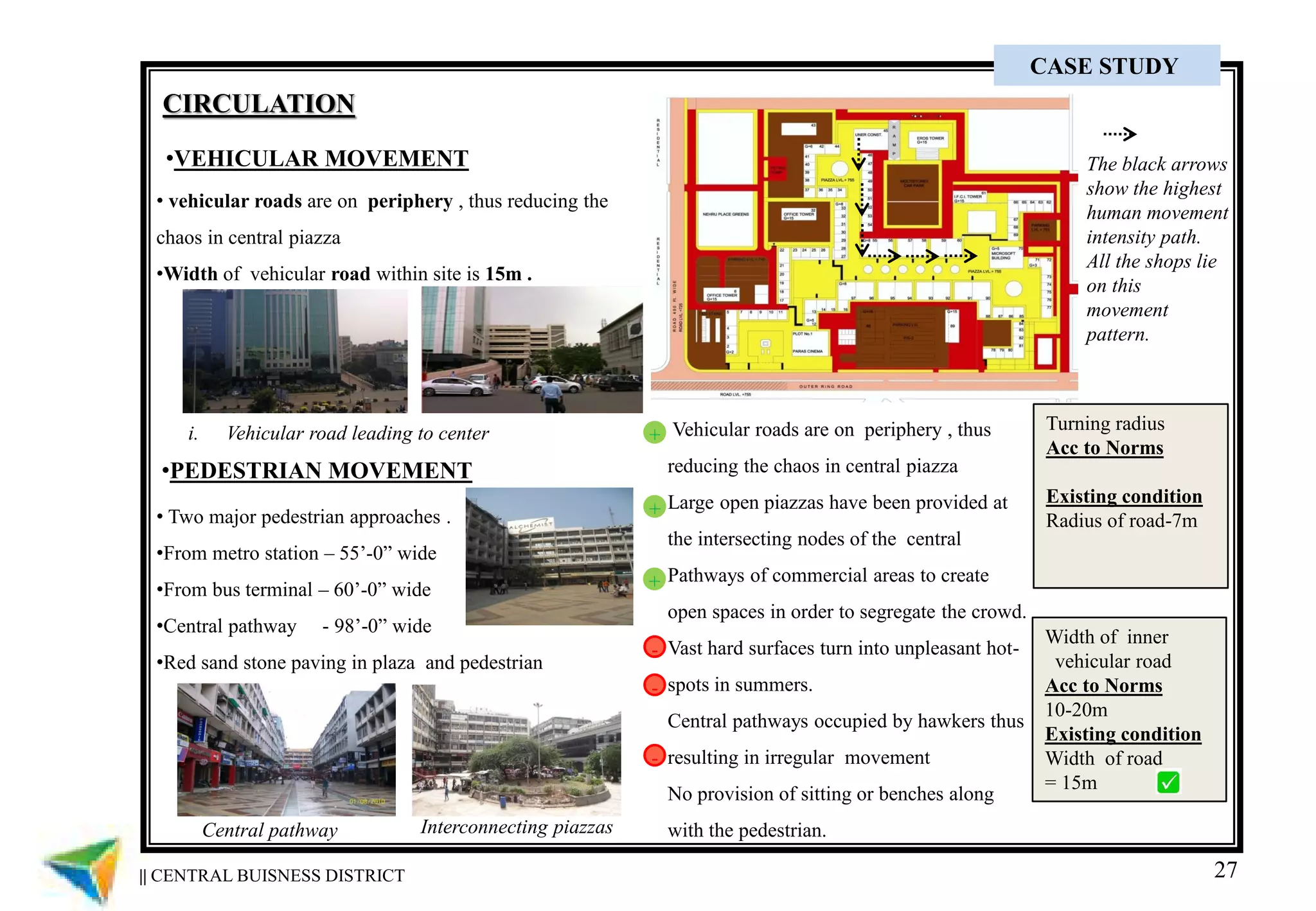
CIRCULATION
•VEHICULAR MOVEMENT
•PEDESTRIAN MOVEMENT
Vehicular roads are on periphery , thus
reducing the chaos in central piazza
Large open piazzas have been provided at
the intersecting nodes of the central
Pathways of commercial areas to create
open spaces in order to segregate the crowd.
Vast hard surfaces turn into unpleasant hot-
spots in summers.
Central pathways occupied by hawkers thus
resulting in irregular movement
No provision of sitting or benches along
with the pedestrian.
+
+
-
-
-
i. Vehicular road leading to center
Central pathway Interconnecting piazzas
• vehicular roads are on periphery , thus reducing the
chaos in central piazza
•Width of vehicular road within site is 15m .
• Two major pedestrian approaches .
•From metro station – 55’-0” wide
•From bus terminal – 60’-0” wide
•Central pathway - 98’-0” wide
•Red sand stone paving in plaza and pedestrian
+
Width of inner
vehicular road
Acc to Norms
10-20m
Existing condition
Width of road
= 15m
Turning radius
Acc to Norms
Existing condition
Radius of road-7m
The black arrows
show the highest
human movement
intensity path.
All the shops lie
on this
movement
pattern.
|| CENTRAL BUISNESS DISTRICT
CASE STUDY
28
Type of parking provided in the centre:
 Open parking.
 Multi-level parking
 Basement parking.
 OPEN PARKING provided along the
periphery of the complex to reduce chaos
{Open – 1400 }
 BASEMENT PARKING has also
been provided. But it is not used much
since it is dark and dingy . {Basement –
400}
MULTILEVEL CAR PARKING
Owned by private company has solved
the parking problem in complex a lot
{Multi level – 1000}
PARKING
SURFACE PARKINGBASEMENT PARKING MULTILEVEL PARING
+
-
Total surface parking = 48,000sq.m.
Total basement parking =2,600sq.m.
Total multi-level parking =24,000sq.m.
Total parking area= 74,6000sq.m
Nehru place
•presently – 2800
• planned for 5500 ecs {but not achieved}
•current demand: 6621 ecs
•projected demand in 2020: 9530 ecs
•Esc = estimated car space
Peripheral parking so
less chaos in complex
Complex is unable to
meet the parking
requirements
|| CENTRAL BUISNESS DISTRICT
CASE STUDY
Plan showing different type of parking in complex
29
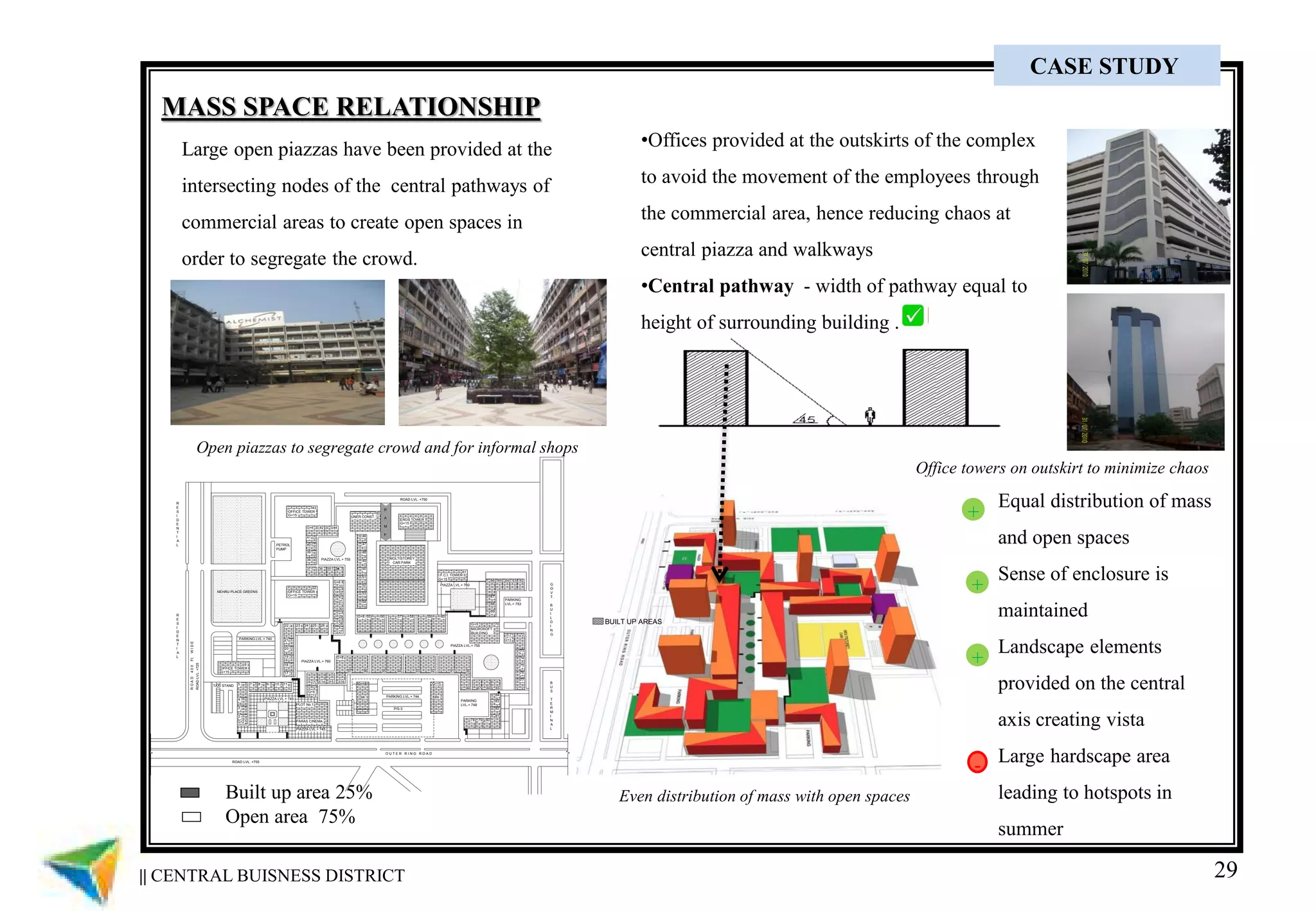
Large open piazzas have been provided at the
intersecting nodes of the central pathways of
commercial areas to create open spaces in
order to segregate the crowd.
•Offices provided at the outskirts of the complex
to avoid the movement of the employees through
the commercial area, hence reducing chaos at
central piazza and walkways
•Central pathway - width of pathway equal to
height of surrounding building .
MASS SPACE RELATIONSHIP
Open piazzas to segregate crowd and for informal shops
Office towers on outskirt to minimize chaos
Even distribution of mass with open spaces
+
Equal distribution of mass
and open spaces
Sense of enclosure is
maintained
Landscape elements
provided on the central
axis creating vista
Large hardscape area
leading to hotspots in
summer
-
+
+
|| CENTRAL BUISNESS DISTRICT
CASE STUDY
OFFICE TOWER
G+15
G+6 42 44
43
41
40
39
38
37 36 35 34
G+8
33
32
31
30
29
28
27
26
34
25242322
21
20
19
18
17
1514
13
12
G+5
PARAS CINEMA
PLOT No.1
PIAZZA LVL.+ 745
PIAZZA LVL.+ 745
OFFICE TOWER
G+15
32
OFFICE TOWER
G+15
6
2
3
4
5 7 8 9 10 11
G+2
TAXI STAND
NEHRU PLACE GREENS
PIAZZA LVL.+ 760
PARKING LVL.+ 744
P/S-3
G+15 G+15
97 96 95 94 93 92 91 90
88 87 86 85
16
98 89
84
83
82
81
807978
77
76
75
74
73
7271
70G+5
MICROSOFT
BUILDING
PIAZZA LVL.+ 755
G+3
PARKING
LVL.+ 753
69
68
67
65 64 63 6266
PETROL
PUMP
PIAZZA LVL.+ 755
PIAZZA LVL.+ 760
I.F.C.I. TOWER
G+15
61
605958575655G+8
G+8
46
47
48
49
50
51
52
53
54
45
UNER CONST.
R
A
M
P
EROS TOWER
G+15
MOLTISTOREY
CAR PARK
B
U
S
T
E
R
M
I
N
A
L
G
O
V
T.
B
U
I
L
D
I
N
G
ROAD LVL. +750
ROAD400Ft.WIDE
ROADLVL.+725
R
E
S
I
D
E
N
T
I
A
L
R
E
S
I
D
E
N
T
I
A
L
ROAD LVL. +755
O U T E R R I N G R O A D
PARKING
LVL.+ 748
PARKING LVL.+ 740
BUILT UP AREAS
Built up area 25%
Open area 75%
30
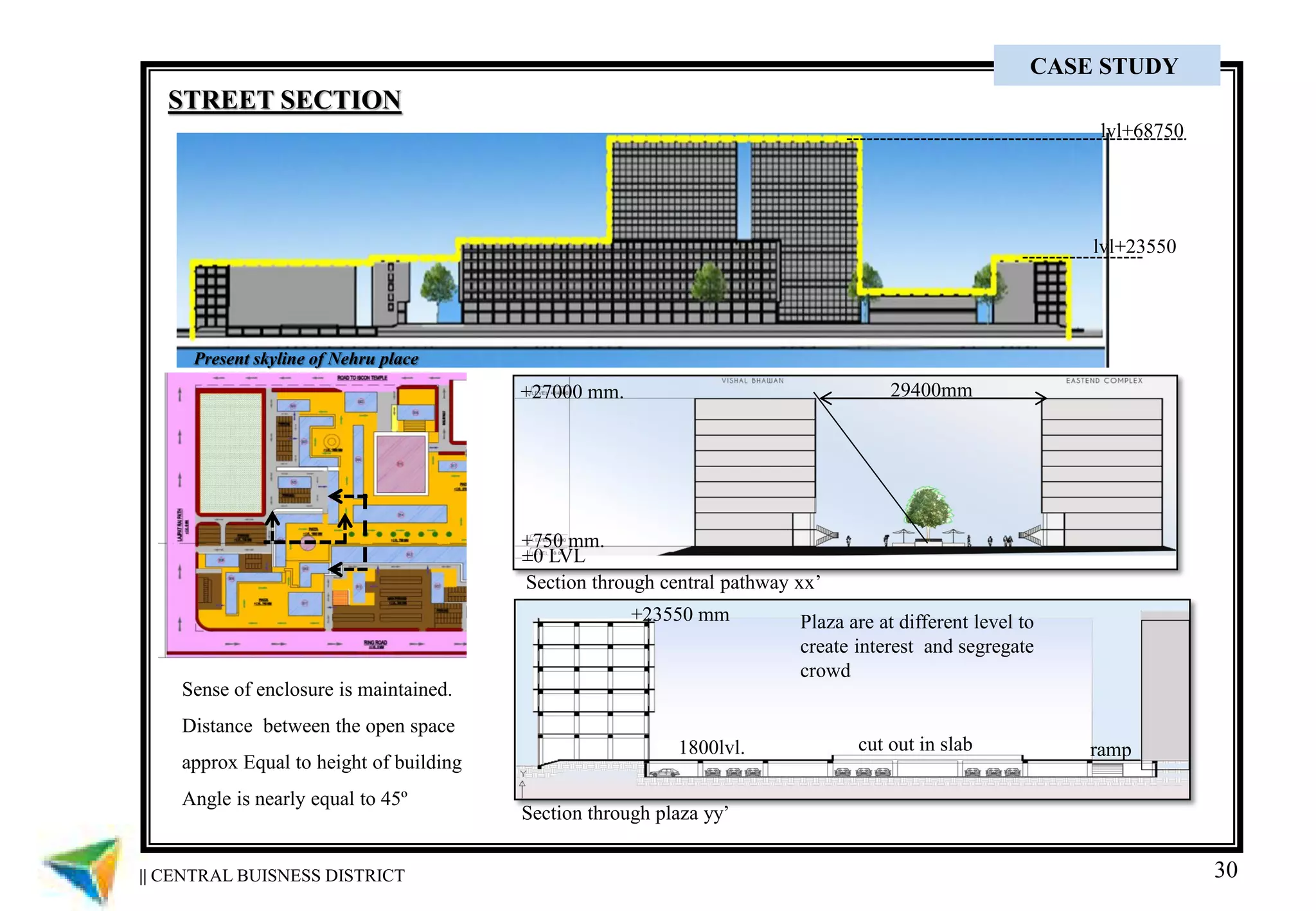
STREET SECTION
lvl+68750
lvl+23550
Present skyline of Nehru place
Sense of enclosure is maintained.
Distance between the open space
approx Equal to height of building
Angle is nearly equal to 45º
+750 mm.
+27000 mm.
±0 LVL
29400mm
1800lvl. cut out in slab ramp
+23550 mm
Section through plaza yy’
Section through central pathway xx’
Plaza are at different level to
create interest and segregate
crowd
|| CENTRAL BUISNESS DISTRICT
CASE STUDY
31
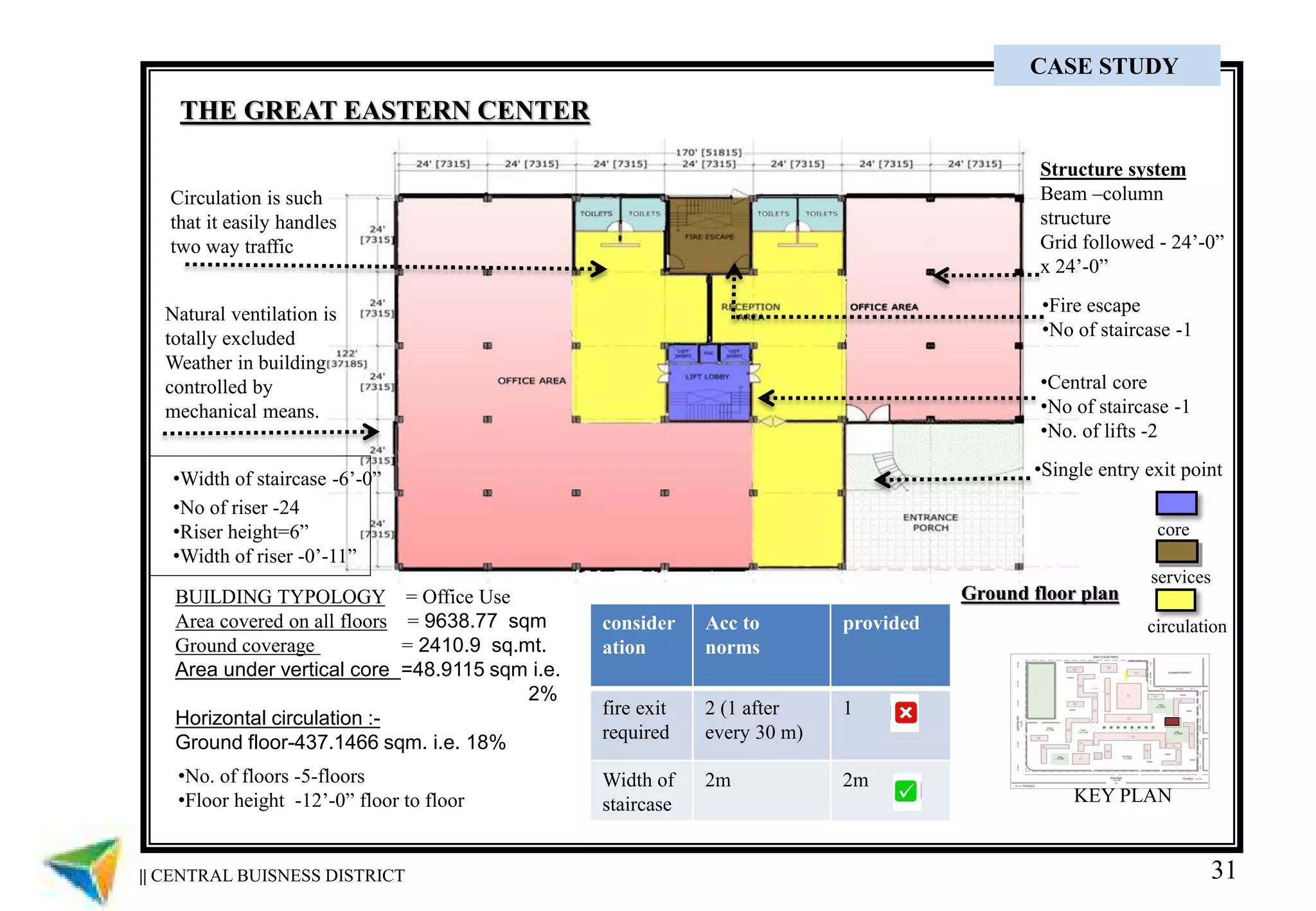
BUILDING TYPOLOGY = Office Use
Area covered on all floors = 9638.77 sqm
Ground coverage = 2410.9 sq.mt.
Area under vertical core =48.9115 sqm i.e.
2%
Horizontal circulation :-
Ground floor-437.1466 sqm. i.e. 18%
THE GREAT EASTERN CENTER
circulation
core
services
Ground floor plan
KEY PLAN
•Central core
•No of staircase -1
•No. of lifts -2
•Fire escape
•No of staircase -1
Structure system
Beam –column
structure
Grid followed - 24’-0”
x 24’-0”
•Width of staircase -6’-0”
•No of riser -24
•Riser height=6”
•Width of riser -0’-11”
•Single entry exit point
•No. of floors -5-floors
•Floor height -12’-0” floor to floor
Natural ventilation is
totally excluded
Weather in building
controlled by
mechanical means.
Circulation is such
that it easily handles
two way traffic
consider
ation
Acc to
norms
provided
fire exit
required
2 (1 after
every 30 m)
1
Width of
staircase
2m 2m
|| CENTRAL BUISNESS DISTRICT
CASE STUDY
32
 Street pattern is followed
 Plots for offices/shops in a continuous row along
the pedestrian plazas, which are 4,6 and 9 storey
high.
 Shops cover 2 floors of the building block.
 Large distance between opposite shops sufficient
to cater crowd but hawkers in between the
pathway cases hindrance
 Staircase is provided after every 8 shop
Key plan
RETAIL SHOPS
Plan showing areas of formal activities
TOTAL FORMAL RETAILAREA : 12877.81 SQM
Retail shopsRetail shops
ASPECT
(SHOPS)
ACC TO
NORMS
(MIN)
Provided
LARGE 20’X66’ 25’X40’
MEDIUM 15’X 30’ 10’X 24’
SMALL
SHOPS
15’X10’ -
|| CENTRAL BUISNESS DISTRICT
CASE STUDY
33
SHAKUNTALA TOWERS
BUILDING TYPOLOGY = Office Use
Area covered on all floors = 21678.696 SQ.MT.
Ground coverage = 2408.744 sq.mt.
KEY PLAN
•VERTICAL CIRCULATION
•Area under vertical core =19.60 sqm
•No. of elevator – 6
•Size of elevators -80”x 54”
•No. of floors -9-floors
•Floor height -12’-0” floor to floor
HORIZONTAL CIRCULATION :-
Ground floor-791.379 SQ.MT.-
Typical floor-183.8493 SQ.MT
SERVICE AREA: - 116.694 SQ.MT
|| CENTRAL BUISNESS DISTRICT
CASE STUDY
Off centered
vertical core
Provision
of 2 fire
escape
Mechanical
means to
maintain the
temp. within
34
High density in office complex
Sparse consumers
Office goers visit plaza for lunch
Consumers increases
Office goers leave
Plaza heavily crowded
Afternoon 2 pm Evening 6 pmMorning 10 am
DEMOGRAPHICS
Age groups
(years)
0-12 13-18 19-24 25-35 35-50 50
ONWARDS
No. Of people 0 0 68 206 64 0
COMPLEX USED BY DIFFERENT GROUPS
|| CENTRAL BUISNESS DISTRICT
CASE STUDY
35
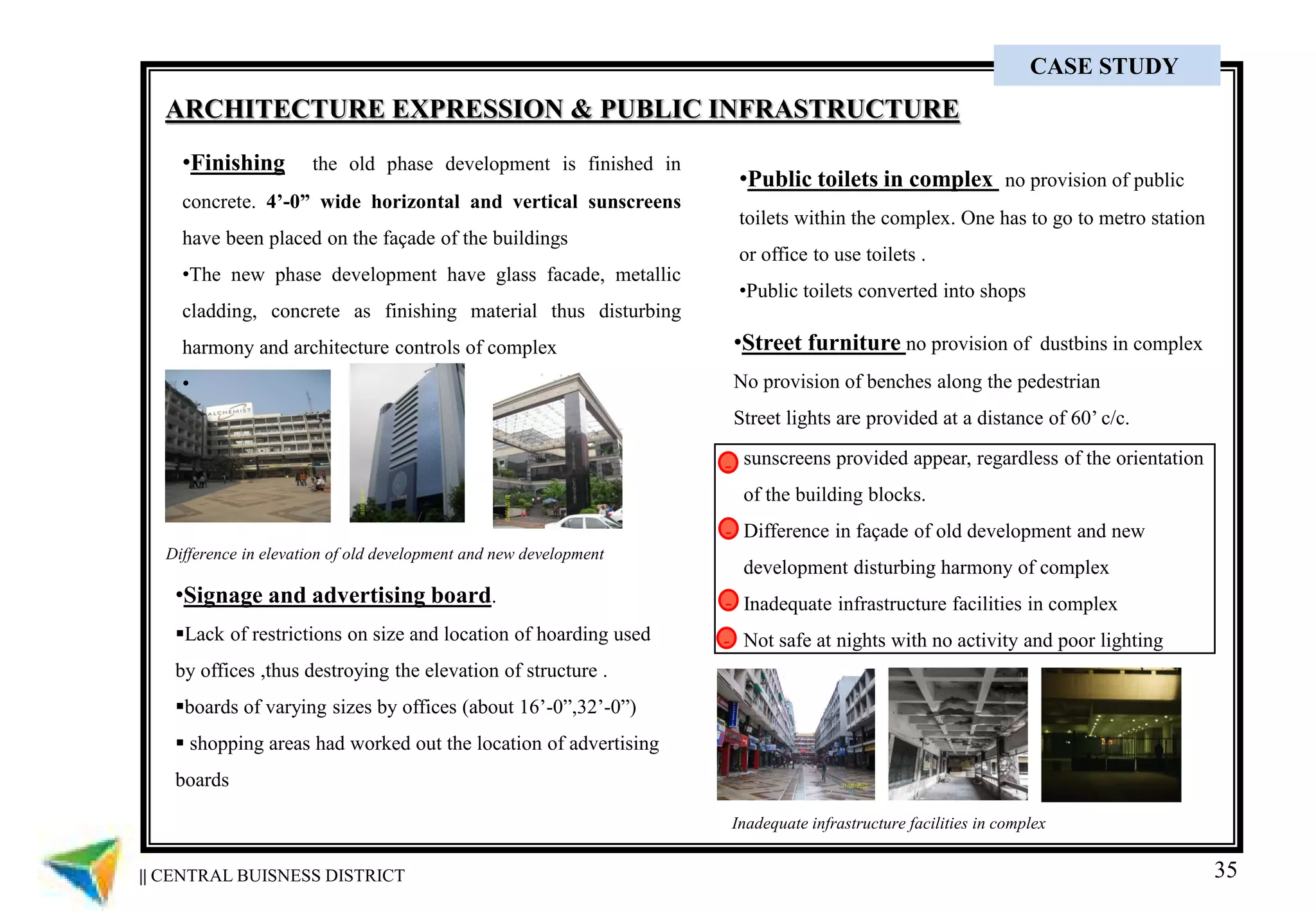
ARCHITECTURE EXPRESSION & PUBLIC INFRASTRUCTURE
•Finishing the old phase development is finished in
concrete. 4’-0” wide horizontal and vertical sunscreens
have been placed on the façade of the buildings
•The new phase development have glass facade, metallic
cladding, concrete as finishing material thus disturbing
harmony and architecture controls of complex
•
•Signage and advertising board.
Lack of restrictions on size and location of hoarding used
by offices ,thus destroying the elevation of structure .
boards of varying sizes by offices (about 16’-0”,32’-0”)
 shopping areas had worked out the location of advertising
boards
•Public toilets in complex no provision of public
toilets within the complex. One has to go to metro station
or office to use toilets .
•Public toilets converted into shops
•Street furniture no provision of dustbins in complex
No provision of benches along the pedestrian
Street lights are provided at a distance of 60’ c/c.
sunscreens provided appear, regardless of the orientation
of the building blocks.
Difference in façade of old development and new
development disturbing harmony of complex
Inadequate infrastructure facilities in complex
Not safe at nights with no activity and poor lighting
-
-
-
-
Inadequate infrastructure facilities in complex
Difference in elevation of old development and new development
|| CENTRAL BUISNESS DISTRICT
CASE STUDY
36
 Nehru place is having varying skyline. More variation could be seen because of the new buildings that have come up
with the passage of time.
 Commercial cum office block surrounding the central plaza have linear skyline
High rise corporate towers are placed on the outer periphery of the complex
SKYLINE
lvl+68750
lvl+23550
lvl+30750
lvl+23550
lvl+66150
lvl+66150
lvl+23550
Present skyline of Nehru place
skyline of Nehru place when designed
skyline of Nehru place when designed Different skyline of Nehru place
lvl+15000
|| CENTRAL BUISNESS DISTRICT
CASE STUDY
37
Green area provided in the north-
west corner of Nehru place, now
used as a recreational park, creating
macro climate vast
street light are provided Distance
b/w poles: 60’-0” c/c.
Vast hard landscaped area has been
provided in most of the complex
red sandstone paving in the plazas
and pedestrian pathways has been
done which change s into
unpleasant hot-spots in summers.
There is no system in place to
manage waste. Complex lacks
infrastructure to manage the waste
it produces
No provision of benches along
pedestrian.
ROW OF TREES
PROVIDED IN CENTRE
OFPATHWAY
GREEN AREA
PROVIDED IN THE
NORTH-WEST CORNER
LANDSCAPING
+
+
-
-
-
Green areas – 27000 sq.mt i.e. 13.5% of the site area
Trees in
parking
Satpatti,
Peepal
Trees along
pedestrian
Jamun , a,
Satpatti
soka
Trees in
plazas
Australian
wattle, Silver
oak
Acc to norms:-
All new or expanding development shall designate
a min, of 15% of total site area for green space
Acc. to site :-
13.5% of area is allocated to green which is less
acc to norms
|| CENTRAL BUISNESS DISTRICT
CASE STUDY
38
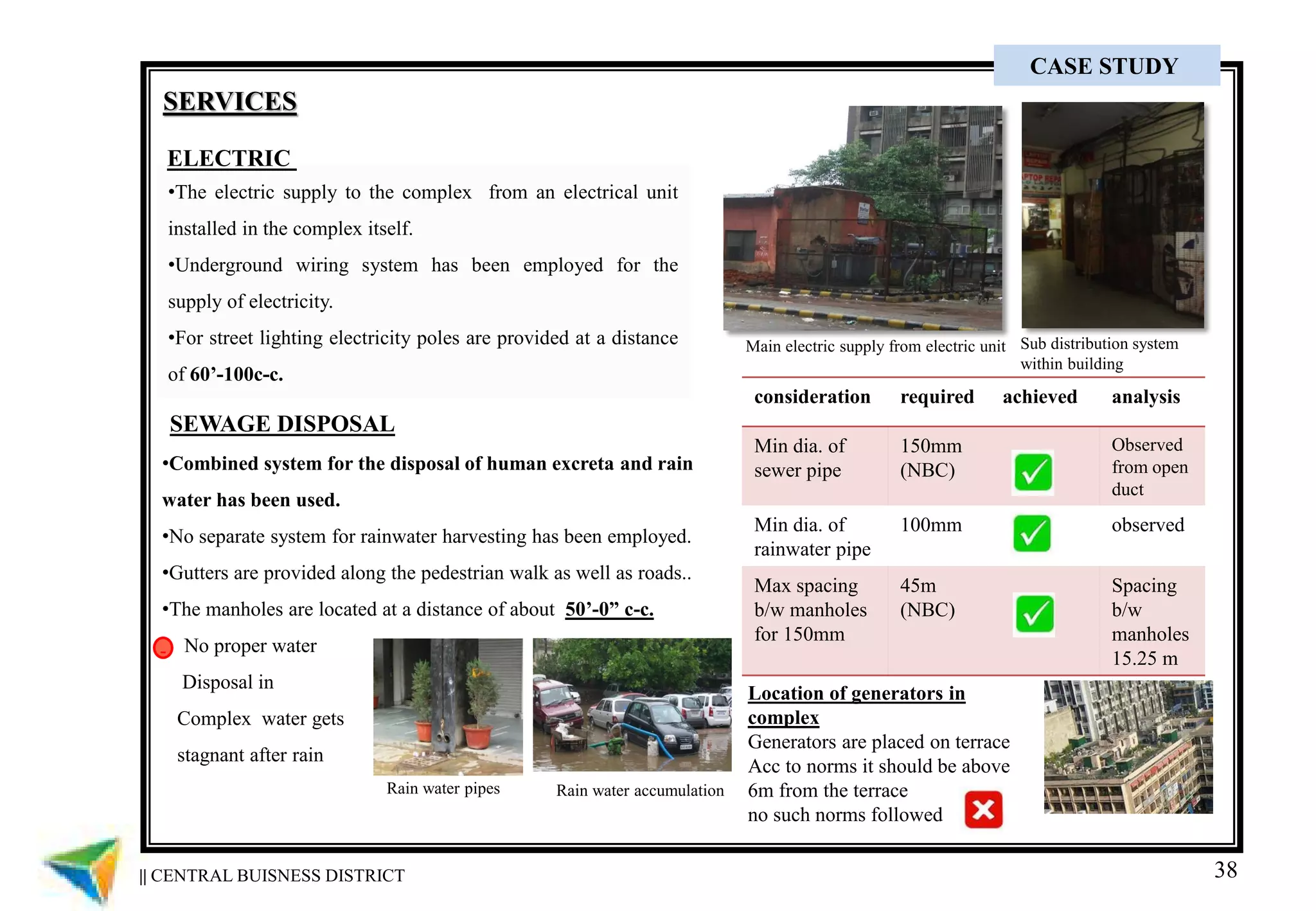
•Combined system for the disposal of human excreta and rain
water has been used.
•No separate system for rainwater harvesting has been employed.
•Gutters are provided along the pedestrian walk as well as roads..
•The manholes are located at a distance of about 50’-0” c-c.
• No proper water
Disposal in
Complex water gets
stagnant after rain
•The electric supply to the complex from an electrical unit
installed in the complex itself.
•Underground wiring system has been employed for the
supply of electricity.
•For street lighting electricity poles are provided at a distance
of 60’-100c-c.
SEWAGE DISPOSAL
SERVICES
ELECTRIC
Main electric supply from electric unit Sub distribution system
within building
Rain water pipes Rain water accumulation
consideration required achieved analysis
Min dia. of
sewer pipe
150mm
(NBC)
Observed
from open
duct
Min dia. of
rainwater pipe
100mm observed
Max spacing
b/w manholes
for 150mm
45m
(NBC)
Spacing
b/w
manholes
15.25 m
Location of generators in
complex
Generators are placed on terrace
Acc to norms it should be above
6m from the terrace
no such norms followed
-
|| CENTRAL BUISNESS DISTRICT
CASE STUDY
39
SERVICES
FIRE FIGHTING
•All the buildings
are planned as per
the fire safety
norms.
•Fire escapes are
provided as per the
rules and
regulations laid by
dda, ndmc and
other governing
authorities.
•Hose reels are provided
in all the buildings.
•Fire escape
staircases are
provided in almost all
the buildings.
Nearest fire station which supply
services t o complex is on behron
mandir bus terminal
No Provision of onsite under ground
water tank for fire fighting services
capacity
No provision of fire hydrants on site
•Fire station
which serve
the complex
|| CENTRAL BUISNESS DISTRICT
CASE STUDY
40
STRENGTH
• Nehru place is located on the Outer Ring Road so it
can be easily accessible by the other parts of the Delhi.
• Being an IT Hub, the market caters more to the people
of age group 25-35 years because of there shops or job
or shopping, etc.
• Nehru Place is designed in such a way that large open
spaces are there between the towers, in form of
courtyards and parking. Due to long courtyard
connectivity fresh air enter these corridors with a thrust.
• Parking are designed near to the Towers which makes it
easy for the crowd and the employees and also to the
transporters.
• Office blocks are on the second floor which are totally
segregated from the loud and the crowd.
WEAKNESS
Since it was not planned to accommodate these
numbers, the result is congestion, lack of
sanitation, and a degenerating infrastructure in
and around the areas surrounding Nehru Place.
The market is not so User Friendly, i.e. can’t be
easily accessed by handicaps and senior citizens
find it difficult to climb the stairs
Lack of cultural and recreational spaces
Make highly extensive shopping plaza.
Heavy and rigid concrete boxes and linear
Planning.
The centre has not been able to attract local
shoppers, since it is not located on an existing
commercial spine
The centre stays dead in the night, save some
homeless laborers who find the shelter of the
corridors adequate to pitch in at night.
INFERENCES
|| CENTRAL BUISNESS DISTRICT
CASE STUDY
41
CASE STUDY 2: SAKET DISTICT CENTER
PROJECT BRIEF
Project Name District Center Saket
Location Saket, South Delhi
Type of project commercial
Type of development Mixed use
development
Developers D.D.A
Year Of Completion 2007
Comprises of Retail podium,
cinemas, office
building, service
apartments
Surrounding mostly residential,
some of commercial
No. Of Storey's
Office Building G+8
Retail G+2
Total Site Area 54 Acres
SAKET DISTRICT CENTER,SITE PROFILE
|| CENTRAL BUISNESS DISTRICT
CASE STUDY
|| CENTRAL BUISNESS DISTRICT
CASE STUDY
42
LOCATION
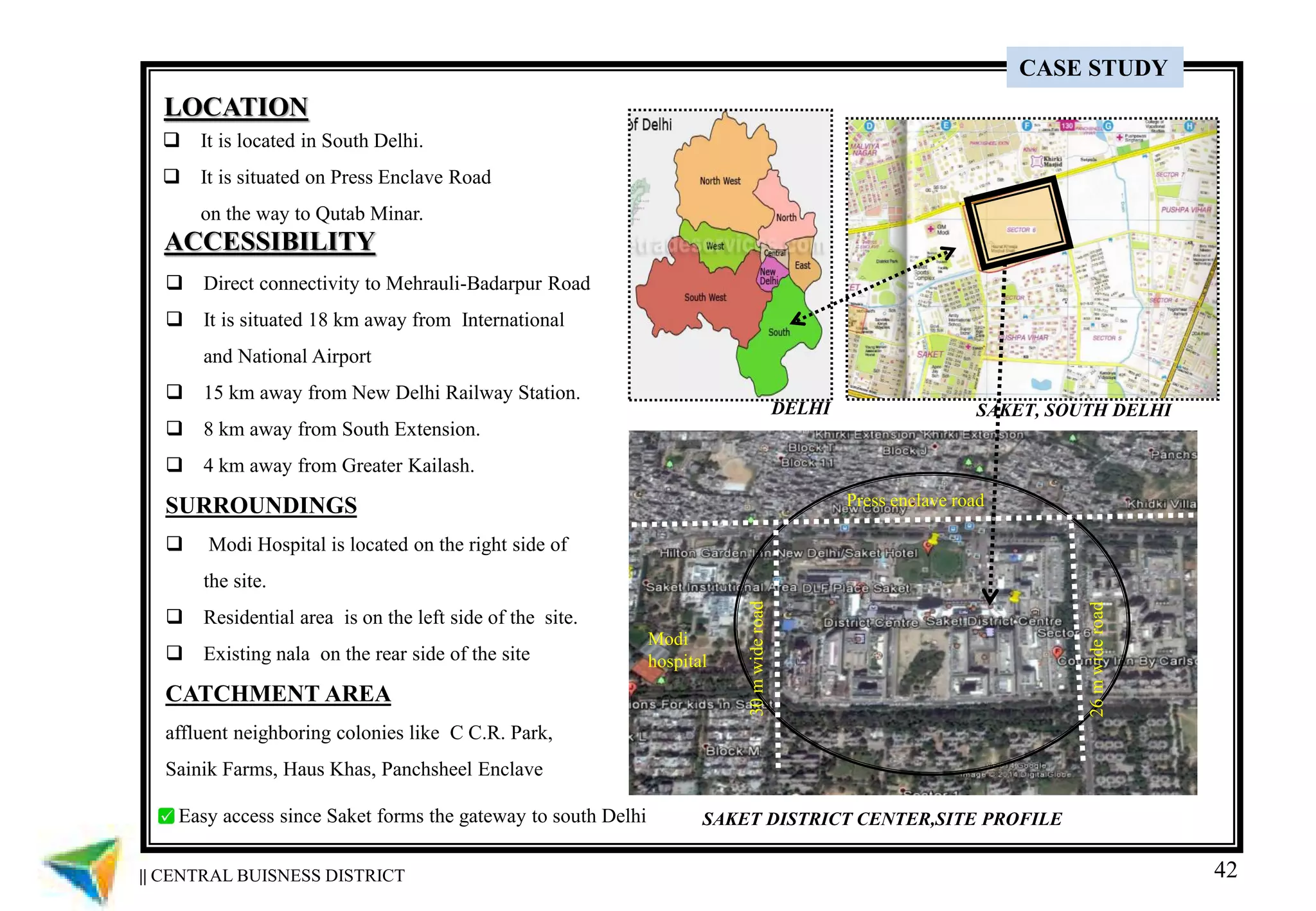
 It is located in South Delhi.
 It is situated on Press Enclave Road
on the way to Qutab Minar.
ACCESSIBILITY
 Direct connectivity to Mehrauli-Badarpur Road
 It is situated 18 km away from International
and National Airport
 15 km away from New Delhi Railway Station.
 8 km away from South Extension.
 4 km away from Greater Kailash.
SURROUNDINGS
 Modi Hospital is located on the right side of
the site.
 Residential area is on the left side of the site.
 Existing nala on the rear side of the site
CATCHMENT AREA
affluent neighboring colonies like C C.R. Park,
Sainik Farms, Haus Khas, Panchsheel Enclave
SAKET DISTRICT CENTER,SITE PROFILE
SAKET, SOUTH DELHIDELHI
Modi
hospital
Press enclave road
26mwideroad
30mwideroad
|| CENTRAL BUISNESS DISTRICT
CASE STUDY
Easy access since Saket forms the gateway to south Delhi
43
ACCESSIBILITY & ENTRANCES,EXIT
• It is easily accessible through PUBLIC TRANSPORT i.e. DTC buses, Metro rail, Auto
rickshaws, And through private vehicles.
• There is problem in crossing of road as no Pedestrian facility like FOB, Subway is provided
near by to it. So, number of modal conflicts are more.
Entry/Exit
Traffic
Conflict Area
Traffic
Movement
LEGEND
MGF Mall
DLF Mall
Select City
Mall
Southern Park
Mall
|| CENTRAL BUISNESS DISTRICT
CASE STUDY
SITE AREA :-
54 ACRES
TOPOGRAPHY :-
site has flat terrain
SHAPE :-
Site is quadrilateral
ORIENTATION :-
Site is north- south
oriented
N
G+1
G+2G+8
G+8 G+8 G+8 G+8
G+3
G+2
G+2
44
AREA PROGRAMME
SITE ZONING
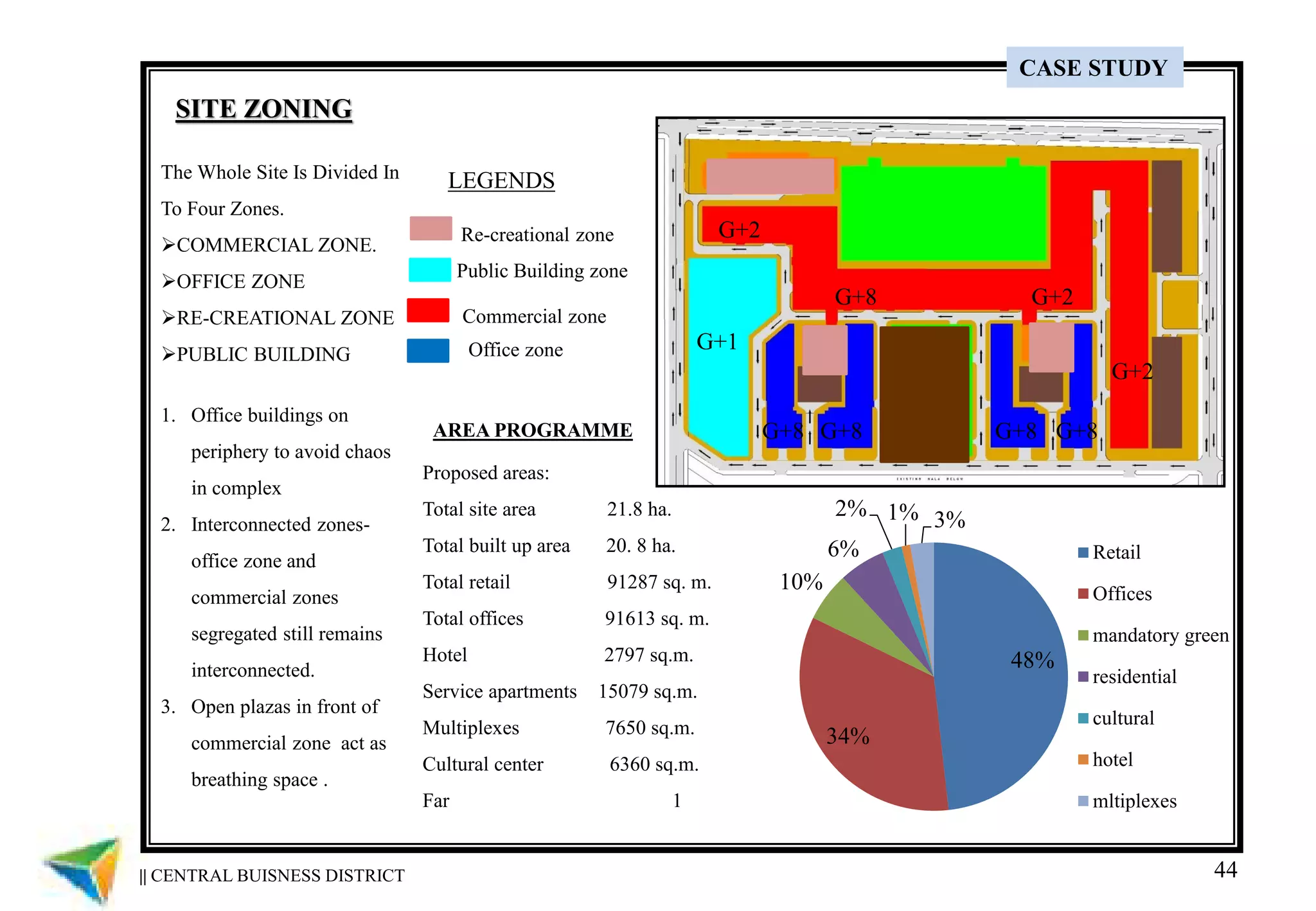
The Whole Site Is Divided In
To Four Zones.
COMMERCIAL ZONE.
OFFICE ZONE
RE-CREATIONAL ZONE
PUBLIC BUILDING
1. Office buildings on
periphery to avoid chaos
in complex
2. Interconnected zones-
office zone and
commercial zones
segregated still remains
interconnected.
3. Open plazas in front of
commercial zone act as
breathing space .
LEGENDS
Public Building zone
Commercial zone
Office zone
Re-creational zone
Proposed areas:
Total site area 21.8 ha.
Total built up area 20. 8 ha.
Total retail 91287 sq. m.
Total offices 91613 sq. m.
Hotel 2797 sq.m.
Service apartments 15079 sq.m.
Multiplexes 7650 sq.m.
Cultural center 6360 sq.m.
Far 1
48%
34%
10%
6%
2% 1% 3%
Retail
Offices
mandatory green
residential
cultural
hotel
mltiplexes
|| CENTRAL BUISNESS DISTRICT
CASE STUDY
45
CIRCULATION
Vehicular
Circulation
Service Lane
Circulation
Vehicular movement
Pedestrian movement
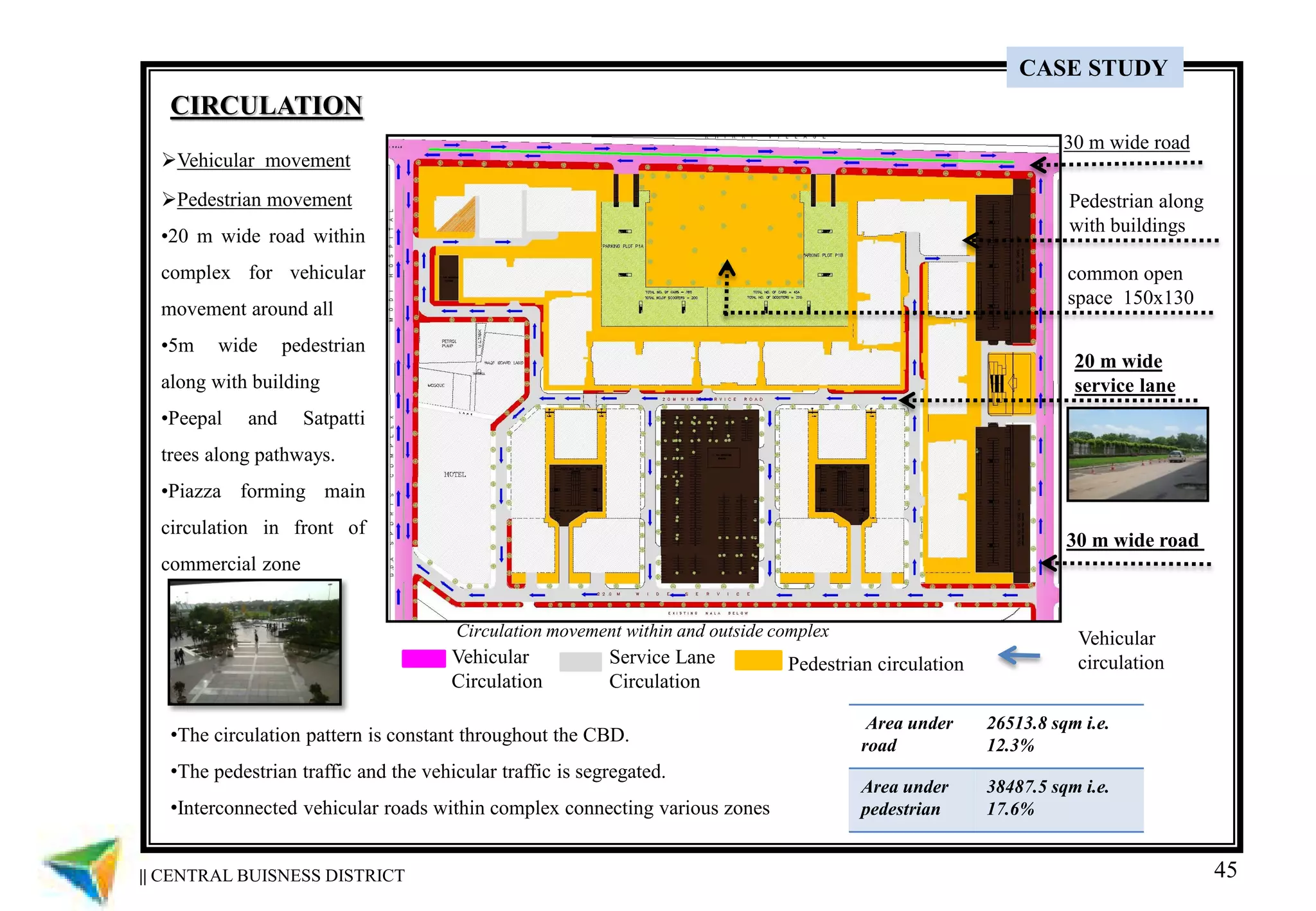
•20 m wide road within
complex for vehicular
movement around all
•5m wide pedestrian
along with building
•Peepal and Satpatti
trees along pathways.
•Piazza forming main
circulation in front of
commercial zone
Pedestrian circulation
Vehicular
circulation
Area under
road
26513.8 sqm i.e.
12.3%
Area under
pedestrian
38487.5 sqm i.e.
17.6%
30 m wide road
30 m wide road
20 m wide
service lane
Pedestrian along
with buildings
common open
space 150x130
•The circulation pattern is constant throughout the CBD.
•The pedestrian traffic and the vehicular traffic is segregated.
•Interconnected vehicular roads within complex connecting various zones
Circulation movement within and outside complex
|| CENTRAL BUISNESS DISTRICT
CASE STUDY
46
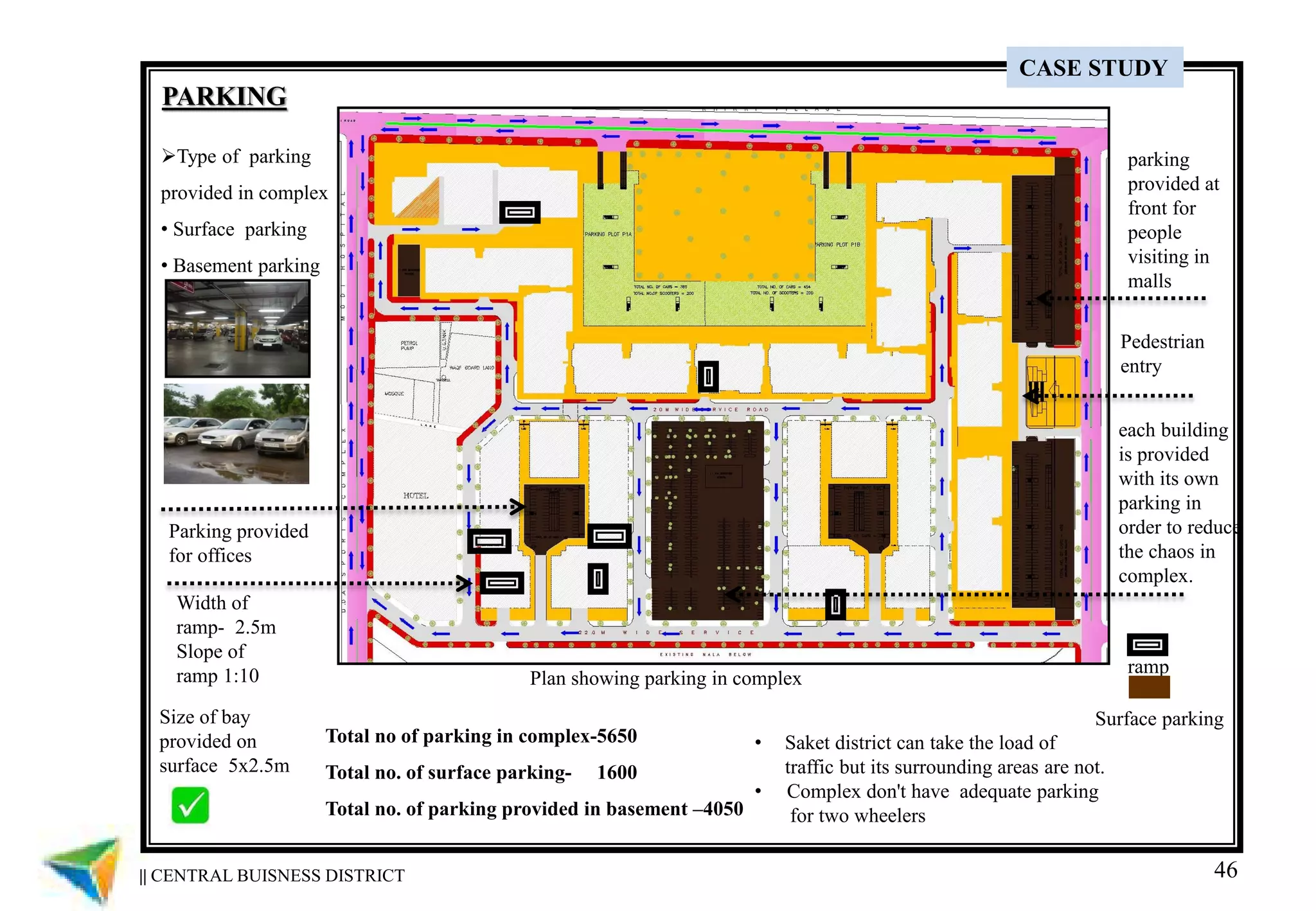
PARKING
|| CENTRAL BUISNESS DISTRICT
CASE STUDY
Type of parking
provided in complex
• Surface parking
• Basement parking
ramp
each building
is provided
with its own
parking in
order to reduce
the chaos in
complex.
Width of
ramp- 2.5m
Slope of
ramp 1:10
parking
provided at
front for
people
visiting in
malls
Parking provided
for offices
Pedestrian
entry
Total no of parking in complex-5650
Total no. of surface parking- 1600
Total no. of parking provided in basement –4050
• Saket district can take the load of
traffic but its surrounding areas are not.
• Complex don't have adequate parking
for two wheelers
Plan showing parking in complex
Surface parkingSize of bay
provided on
surface 5x2.5m
47
MASS SPACE RELATIONSHIP
 Piazza's provided at the
front facade to create a
interesting visual experience.
The spaces enclosed by
office buildings pose the
maximum sense of enclosure.
Offices provided at the
outskirts of the complex to
avoid the movement of the
employees through the
commercial area
 The Heights in the entire site have been
restricted according to the use. Hence the
open space-built form relationship has been
maintained in a controlled manner.
 G+8 for office tower
G+1/G+2 for shopping /commercial
building
 Overall ,the varied enclosure gives the
visitor a rich, interesting experience, as the
spaces open out into each other according
to the usage of the respective block. There
is dynamism and clarity in the layout.
Scio graphic studies of the
entire area show that the degree
of enclosure increases around the
office buildings whereas there is
practically no sense of enclosure
in the case of the piazza that
forms the frontage to the
shopping and commercial areas.
The piazza acts as a common
open space for the shopping and
commercial areas. The visitor
experiences a full panoramic view
of the entire district centre.
|| CENTRAL BUISNESS DISTRICT
CASE STUDY
48
LAND USE
 SELECT CITYWALK
• Select city walk - shopping mall.
• Developed by - select group
• Area -1,300,000 sq ft
• Retail, a multiplex, serviced
Apartments, offices, and public space
 THE SOUTH COURT
• The south court- shopping mall under
construction.
• Developed by -DLF group
• Total area - 400,000 sq ft
(37,000 m2).
• Will have a lifestyle and a landmark
anchor store, retail arcade with many
major Indian brands of clothes and
apparel, a food court, gourmet outlets,
office complex and a hotel
 DLF PLACE
• The DLF place - shopping mall
• Developed by- DLF group
• Total area - 400,000 sq ft
• six-screen DT cinemas multiplex
& diner, A food court, hard rock
cafe, gourmet outlets, office
complex and Hilton hotel.  METROPOLITAN MALL
•Metropolitan Mall -shopping mall
•Developed by - MGF Group
•total area - 11000 sq. metres.
Saket district center basically comprise 5 major mall namely
1. DLF place
2. Select city walk
3. The south court
4. Metropolitan mall
5. Southern park
 SOUTHERN PARK
• Southern park - mall cum
commercial complex .
• Developed by -TDI group
• Area - (9,000 m2)
• Spread over five floors +
• two tiers of basement
parking
|| CENTRAL BUISNESS DISTRICT
CASE STUDY
49
Shopping area
Horizontal circulation
Vertical circulation
 Linear atriums at all places in the
mall referred to as courtyards.
 Open spaces at the junctions
breaking the linearity.
 The shops are aligned to the atrium
and are rectangular in shape with
length to width ratio of 3.5:1.
 For vertical transportation mall has
16 staircases(most of them acting
as fire escapes also), 15 elevators
which go to the basements and 8
escalators which are provided at
the end of atriums
Bridge connecting
upper levels
Kiosk and
Exhibition space
DLF MALL
Project profile: Dlf Place Mall
Developers: DLF infrastructure
Year of completion : 2007
No of storey's: for retail G +2
Architect: mohit gujral
Area of mall 37000 sqm
Grid 8x8 m
Entrance
DLF
MAL
L
|| CENTRAL BUISNESS DISTRICT
LIBRARY STUDY
GROUND FLOOR PLAN
50
Shopping Area
Horizontal Circulation
Vertical Circulation
Re-creational Area
 First floor level of mall are visible
through atriums.
 The opposite ends are connected
through bridges in court 1 and court
three, moreover a circular atrium is
provided between court1 and court 2 at
the corner of the mall.
Smaller size of shops because of the
corridor
DLF MALL
The High street gives an experience of
European shopping streets as these are being
used as terraces for coffee shop, shops open
on to these streets and there are structures on
the piazza side of the street which acts as
kiosks on certain days
A view of High Street
Retail Store at
first floor level
Circular Atrium
FIRST FLOOR PLAN
|| CENTRAL BUISNESS DISTRICT
CASE STUDY
51
Food Courts
Horizontal
Circulation
Vertical Circulation
Re-creational Area
 When we come to the second floor
level there is a major change in the
layout of the mall. The shops and service
cores on the piazza side of the mall are
discontinued and a terrace takes their
place.
 Second floor mainly consists of food
court and restaurants
 The large terraces that are being formed at
this level give a magnificent look of the plaza
area, also they provide a beautiful setting for
the food court users in the evenings whereby
they can eat in the open in the evenings.
DLF MALL
Food courts
SECOND FLOOR PLAN
|| CENTRAL BUISNESS DISTRICT
CASE STUDY
52
 3 level basement for parking
and services
 Parking space collectively
1000-1200 cars
 The clear height of these
basements are:
 3950 mm for
basement 1
 4050 mm for
basement 2
 3050 mm for
basement 3
 Mall lifts continued till the
basement
 16 staircases
Ramp to basement
from service road
Ticketing at entry
Stairs coming out of
basement
Lift lobby entrance
BASEMENT FLOORS
|| CENTRAL BUISNESS DISTRICT
CASE STUDY
53
Finishing. The entire complex is finished with
combination of granite, composite metallic
cladding, acrylic paint and structural glazing.
 The lower levels of the building have been
given a more transparent look with large
glazed part being offered to foyer/food
court/retail. This has been done also keeping
in mind the commercial aspect for shops to
have maximum frontage and making the
shops more visible and lively for the crowd
visiting the building.
The lower levels glazing
is treated with granite
bands making a striking
bold impression on the
lower shopping level and
also relates itself with the
mall elevation
At the upper level on the front
facade, space provided for
advertisements, forthcoming
attractions and cinema posters, ideally
visible from a distance governing the
external elevation.
To conceal the
services, 1.5m projection
has been extended at the
roof level beneath the
service floor on the
terrace.
ARCHITECTURAL EXPRESSION
|| CENTRAL BUISNESS DISTRICT
CASE STUDY
54
 It covers the large area of green cover(upto 4 acres)
 Open plaza, having an open air theatre
 Saanskriti, for art festivals, fairs, exhibitions, performances, and al
fresco dining.
 The plaza is landscaped extensively in timber, water, stone and
steel and has an
 Open–air amphitheater, along with trees and water features
 Street furniture is provided at various places.
 Dustbins are not provided for security reasons.
 The open areas is also seen with water bodies including
fountains.
 It is designed with beautiful inviting landscapes.
SECTION THROUGH LANDSCAPED AREA
LANDSCAPE FEATURE IN PLAZA
TOTAL GREEN AREA
2.18 Hectares
10% of the site area
PLAZA
Shady Tree Along Road
Peepal Ficus religiosa
Satparni Alstoniascholaris
Parking Trees
Pilkan Ficus infectorija
Satparni Alstoniascholaris
Parks/Gardens
Asoka
Bottle brush
Saraca indica
Callistemon viminalis
LANDSCAPING
•Landscaped area •Pedestrian path
•corridor
|| CENTRAL BUISNESS DISTRICT
CASE STUDY
55
SERVICES
The main air conditioning plant room is
situated in the basement and cooling towers are
on the terrace. Each shop has been provided
with their own A.H.U.’s so that they can
maintain temperature individually. For the
purpose of air conditioning of atriums ducts are
provided along the atrium with water nozzles.
To impart a natural flow of air large exhausts
are installed at terrace along the atrium
HVAC System:
Fire sprinklers at
regular grid
Dist. Between 2
fire hydrants.
Cooling plant at
terrace
Exhaust
along atrium
At 45 m.
Sluice valve
at each level to
control water
flow
Fire hydrants
placed along the
periphery of the
building
Service core comprises of:
•Water supply pipes
•Drainage
•Telecommunication wires
•Fire safety pipes
•Electrical supply pipes
•Fire fighting system is
installed for each building.
Underground Electrical
room
Service corridor running at
the rear side of the building
Service pipes concealed in
the projected canopy at
the top
|| CENTRAL BUISNESS DISTRICT
CASE STUDY
56
5 ac plant rooms
Water pump room
Electric panels
•Services at different floors:
•There are well placed lift cores, providing or
more than adequate elevators, for both passengers
and freight.
•Individual AHU and FCU have been
provided for individual shops.
•AHU rooms provided for common area.
•BASEMENT1:
•5 nos DG SETS
•3nos 2000kva+2nos 1000kva
•Garbage dumping rooms provided at basement.
•BASEMENT2:
•4 water supply tanks- fire water tank
•Domestic, raw water , fire water , soft water tanks.
•The help desk is also provided in second basement.
•Staff dinning and changing rooms also provided at second basement.
•Fire alarms are provided at regular intervals in the basement.
•Control room provided in basement.
• Big exhaust fans provided
SERVICES
|| CENTRAL BUISNESS DISTRICT
LIBRARY STUDY
57
 South Delhi: Prime location
 The Saket district centre provides large public and landscaped open spaces. The public realm has being given a
thought!
 Instead of having shopping malls stand as isolated entities – disjoint from one another – the development at Saket is
planned in a manner where the multiple buildings are tied together with a common colonnade and uninterrupted access
and transition, making it vibrant, dynamic and friendly.
 Saket Place is projected to employ close to 30,000 people, and attract about 1,00,000 cars in the vicinity every hour
 A district centre goes dead after work-hours – Saket district center devoid of this scenario.
INFERENCES
 Too much of rigidity imparted on the developer in terms of the design of buildings and
elevation kills the creativity of the architect involved.
 Saket District centre may be ready to take the huge volume of traffic, but the surrounding
transportation arteries are still not!
|| CENTRAL BUISNESS DISTRICT
CASE STUDY
58|| CENTRAL BUISNESS DISTRICT
CASE STUDY
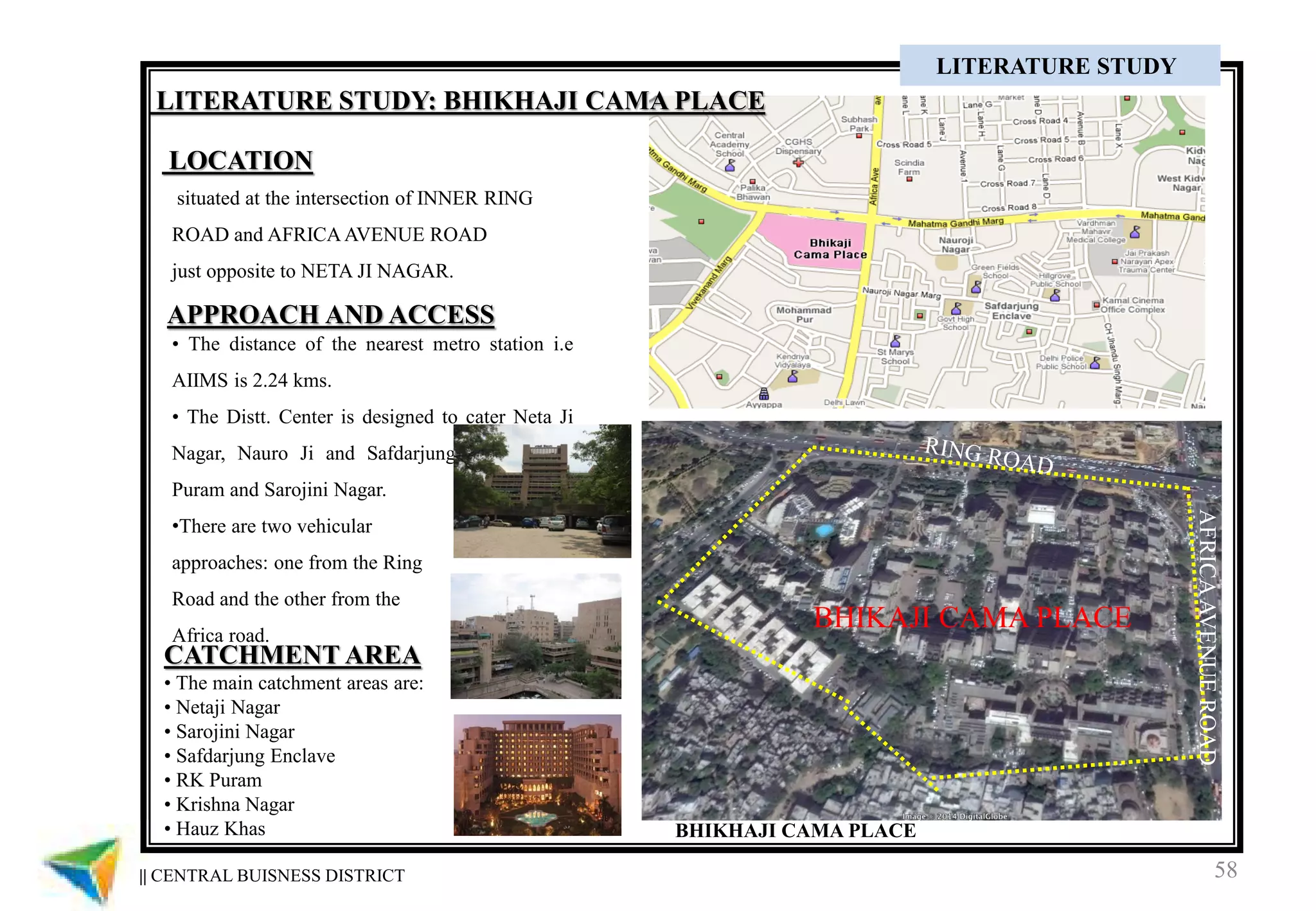
BHIKAJI CAMA PLACE
AFRICAAVENUEROAD
situated at the intersection of INNER RING
ROAD and AFRICA AVENUE ROAD
just opposite to NETA JI NAGAR.
• The distance of the nearest metro station i.e
AIIMS is 2.24 kms.
• The Distt. Center is designed to cater Neta Ji
Nagar, Nauro Ji and Safdarjung Enclave RK
Puram and Sarojini Nagar.
•There are two vehicular
approaches: one from the Ring
Road and the other from the
Africa road.
APPROACH AND ACCESS
LOCATION
LITERATURE STUDY
CATCHMENT AREA
• The main catchment areas are:
• Netaji Nagar
• Sarojini Nagar
• Safdarjung Enclave
• RK Puram
• Krishna Nagar
• Hauz Khas BHIKHAJI CAMA PLACE
LITERATURE STUDY: BHIKHAJI CAMA PLACE
59
1.
14.
13.
12.
15.
16.
17.
9.
8.
7.
18.
19.
5.
4.
3.
2.
N
VIVEKANANDMARG
R I N G R O A D
10.
11.
SERVICE
COURTSERVICE
COURT
CAR PARK
CAR PARK SERVICE
COURT
SERVICE
COURT
DISTRIBUTARY ROAD
CHAIN ROAD
AFRICAAVENUEROAD
|| CENTRAL BUISNESS DISTRICT
LITERATURE STUDY
LEGEND:
1. HYATT REGENY
2. E.I. HOUSE.
3. E.I. ANNEXE.
4. ANSAL CHAMBER1
5. MOHTA CHAMBER.
6. SOMDATT CHAMBER1
7. ANSAL CHAMBER2
8. TELEPHNE EXCHANGE.
9. SOMDATT CHAMBER2
10. P.N.B.
11. SANRAKSHAN BHAWAN
13 JINDAL HOUSE
14 GAIL
15 CIVICSTRUCTURE
16 NBCC TOWER
17 HUDCO BHAWAN
18 PETRO PUMP
19 HUDCO BAZAAR
SITE LAYOUT
60
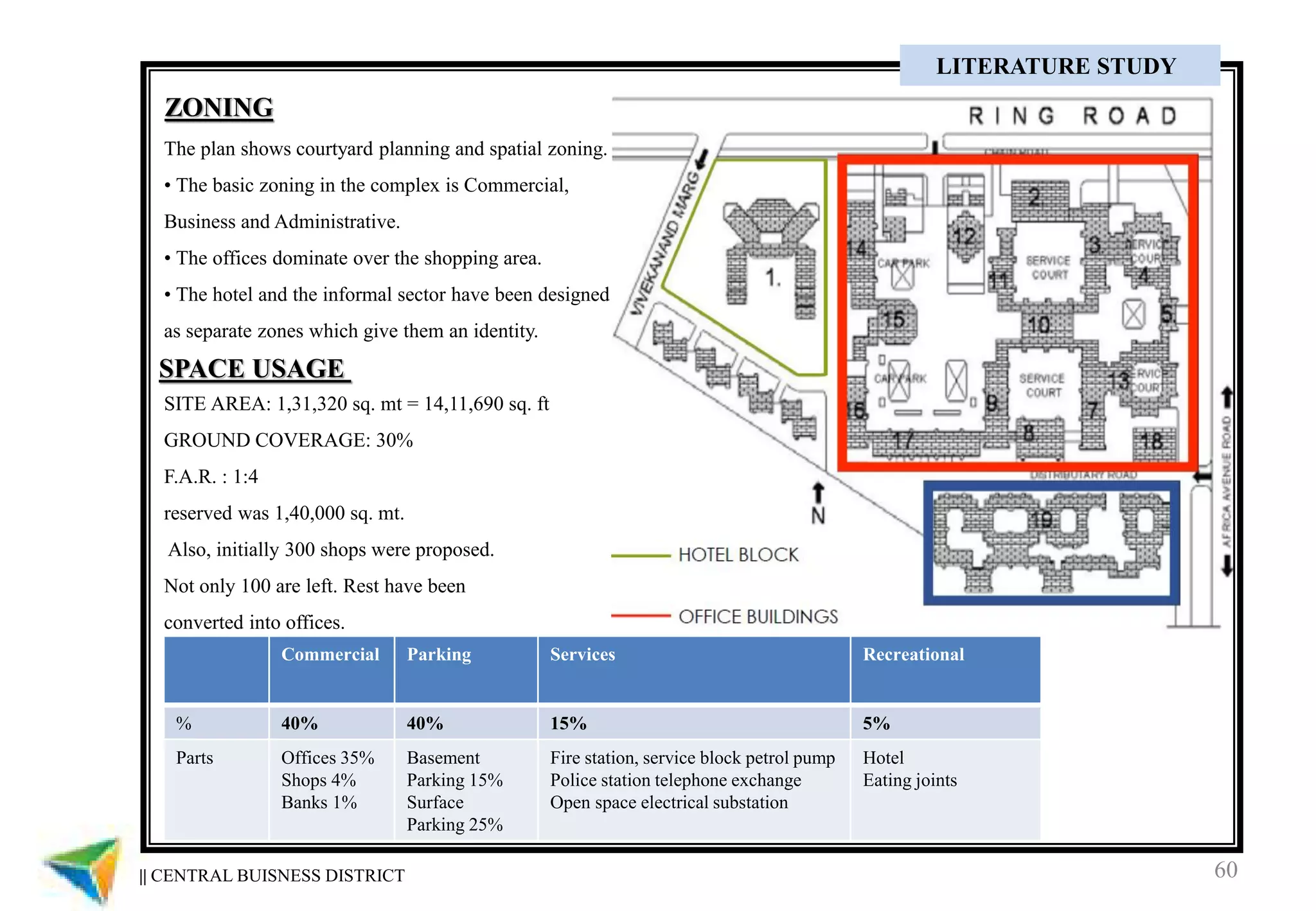
The plan shows courtyard planning and spatial zoning.
• The basic zoning in the complex is Commercial,
Business and Administrative.
• The offices dominate over the shopping area.
• The hotel and the informal sector have been designed
as separate zones which give them an identity.
SITE AREA: 1,31,320 sq. mt = 14,11,690 sq. ft
GROUND COVERAGE: 30%
F.A.R. : 1:4
reserved was 1,40,000 sq. mt.
Also, initially 300 shops were proposed.
Not only 100 are left. Rest have been
converted into offices.
|| CENTRAL BUISNESS DISTRICT
LITERATURE STUDY
ZONING
SPACE USAGE
Commercial Parking Services Recreational
% 40% 40% 15% 5%
Parts Offices 35%
Shops 4%
Banks 1%
Basement
Parking 15%
Surface
Parking 25%
Fire station, service block petrol pump
Police station telephone exchange
Open space electrical substation
Hotel
Eating joints
61|| CENTRAL BUISNESS DISTRICT
CASE STUDY
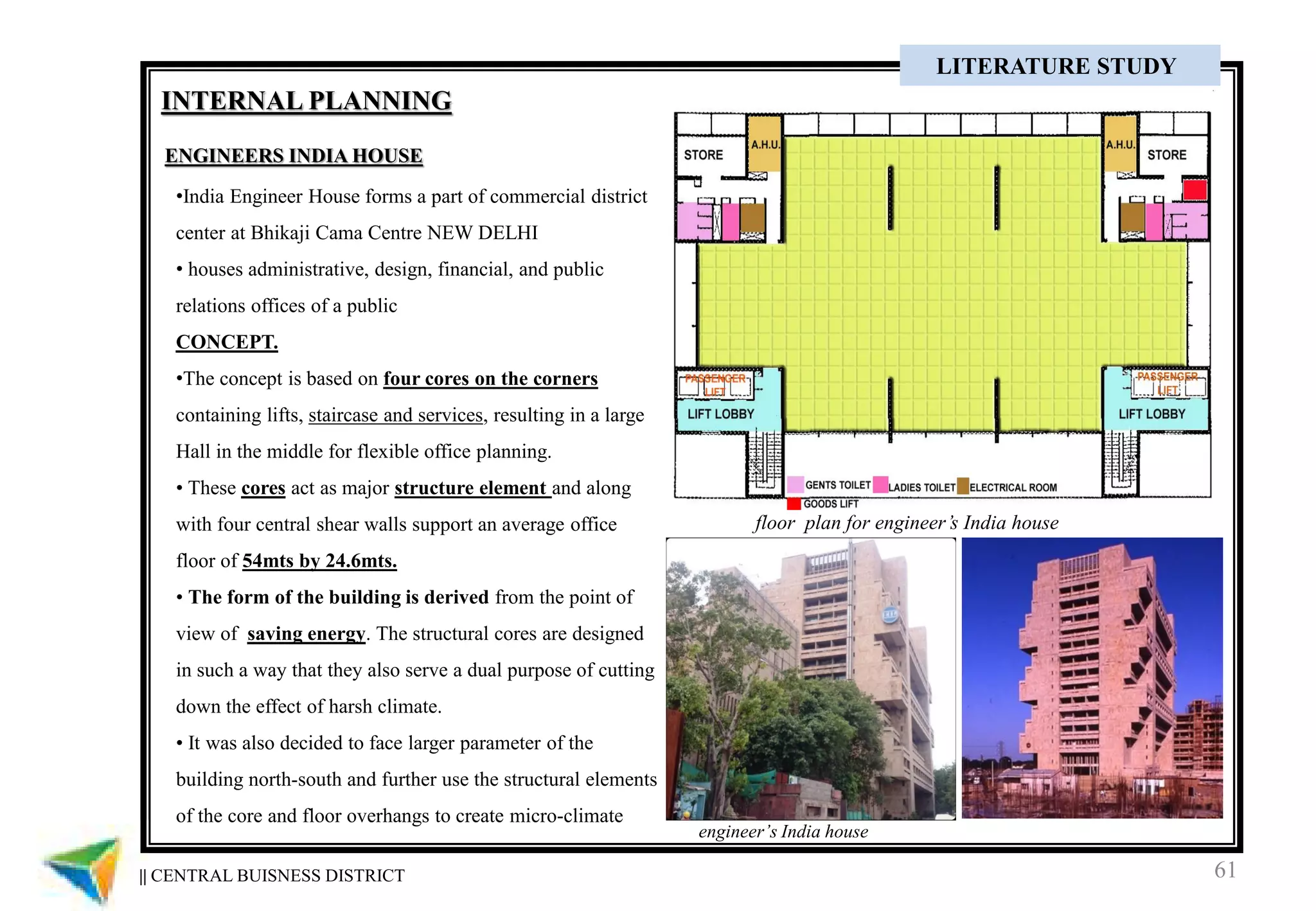
ENGINEERS INDIA HOUSE
•India Engineer House forms a part of commercial district
center at Bhikaji Cama Centre NEW DELHI
• houses administrative, design, financial, and public
relations offices of a public
CONCEPT.
•The concept is based on four cores on the corners
containing lifts, staircase and services, resulting in a large
Hall in the middle for flexible office planning.
• These cores act as major structure element and along
with four central shear walls support an average office
floor of 54mts by 24.6mts.
• The form of the building is derived from the point of
view of saving energy. The structural cores are designed
in such a way that they also serve a dual purpose of cutting
down the effect of harsh climate.
• It was also decided to face larger parameter of the
building north-south and further use the structural elements
of the core and floor overhangs to create micro-climate
floor plan for engineer’s India house
engineer’s India house
INTERNAL PLANNING
LITERATURE STUDY
62|| CENTRAL BUISNESS DISTRICT
CASE STUDY
The EIL house is entered on the ground floor directly
from the road by car and has two level of parking
• Pedestrian enter the upper ground floor by mean of
external steps or directly from central plaza.
• The central part of the entrance has the height of
10 mts and give access to the mezzanine at 3 levels
providing changing views of information and
exhibition spaces.
• The shear walls and structural cores are clad,
externally and internally with 2.5cm thick beige
sandstone.
• The internal stone cladding is polished to harmonies
with flooring and teak wood paneling.
• The partition with in the hall are demountable and
vary according to the functional requirement of
typical floors.
• The lower two floors are used as public relation offices
and contain exhibition space and small conference
rooms
ENGINEERS INDIA HOUSE
LITERATURE STUDY
63
" One side of complex facing the bhikaji cama place contains large shops and offices in 3 stories stepped building.
" The building developed has one basement and 4 floors above it.
• The front elevation has the concept of offsetting, which is the basic architectural character of the complex
The central courtyard is very well landscaped, unlike the rest of the open spaces.
|| CENTRAL BUISNESS DISTRICT
CASE STUDY
HUDCO BAZAAR
C"("CHANDER"SHAKER"AZAD) WINGA"(ABDUL"KALAM")"WING B"("BHAGAT"SINGH")"WING"
LITERATURE STUDY
64
Delhi’s climate is in fact characterized by extremes.
The sky is overcast during monsoons. Maximum
temperature touches 45 degree every year and
minimum may touch 4 degree.
•Taking in consideration the climate of Delhi, the
main
feature in the center is the “offsetting” which allows
maximum sunlight to enter from the North Side and
avoids the South sunlight.
• Screening is provided in the North-West direction to
protect against the cold winter winds by use of
evergreen trees.
• The buildings have protection from the over head
summer sun but on the other hand, in winters, the
sunlight is captured.
• There is a provision of roof overhangs on the south
side of the buildings.
|| CENTRAL BUISNESS DISTRICT
CASE STUDY
CLIMATIC CONCERN
P.N.B. Building
Bikaji Cama Bhawan
Sunken court amidst the building blocks
HUDCO Bazaar
Canopy in front of the Trikoot-1
Offsetting in the Hyatt Regency
LITERATURE STUDY
65
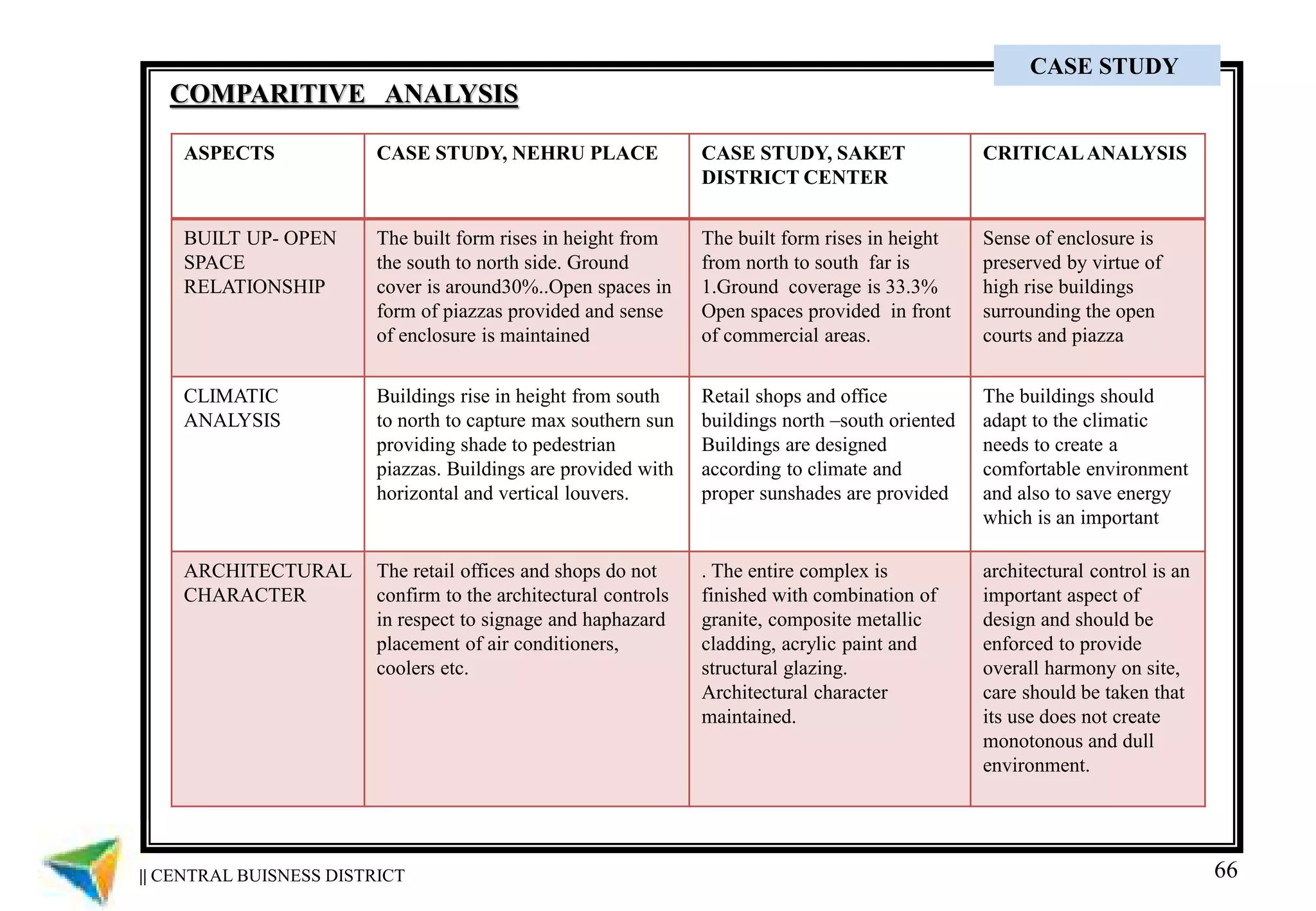
COMPARITIVE ANALYSIS
ASPECTS CASE STUDY, NEHRU PLACE CASE STUDY, SAKET
DISTRICT CENTER
CRITICALANALYSIS
LOCATION located on the Outer Ring Road so it
can be easily accessible by the other
parts of the Delhi.
Located on press enclave road,
forms the main gate to south
Delhi on prime location.
easily accessible by the
other parts of the Delhi.
SITE Area =49 acres heights =for office
and commercial building g+8 towers
g+17
Area =54 acres office building
=g+8 retail g+2
CIRCULATION Mainly peripheral traffic. Parking on
ground and basement( not properly
utilized), also multi storied parking
has been built. Free flowing traffic as
street width is adequate.
Interconnected roads within site
for circulation . Ground and
basement parking. Surface
parking along with the buildings.
Proper flow of traffic.
Segregation of vehicular
and pedestrian traffic is
important aspect for
separating silent and noisy
zones.
PEDESTRIAN Large piazzas have been created on
multiple levels to segregate vehicular
and pedestrian traffic.
Entire site is pedestrianized .
Pedestrian and vehicular
movement is segregated. Piazza
created to accommodate crowd.
Demarcation between
pedestrian and vehicular
movement, using level
difference is a good
solution
LAND USE The basic land use is the commercial
having shops, offices, and lacks
recreational areas
Basic landuse is retail shops,
offices, mall, multiplex, spaces
for recreational areas provided
recreational areas like open
courts for informal
shopping should be
provided
|| CENTRAL BUISNESS DISTRICT
CASE STUDY
66
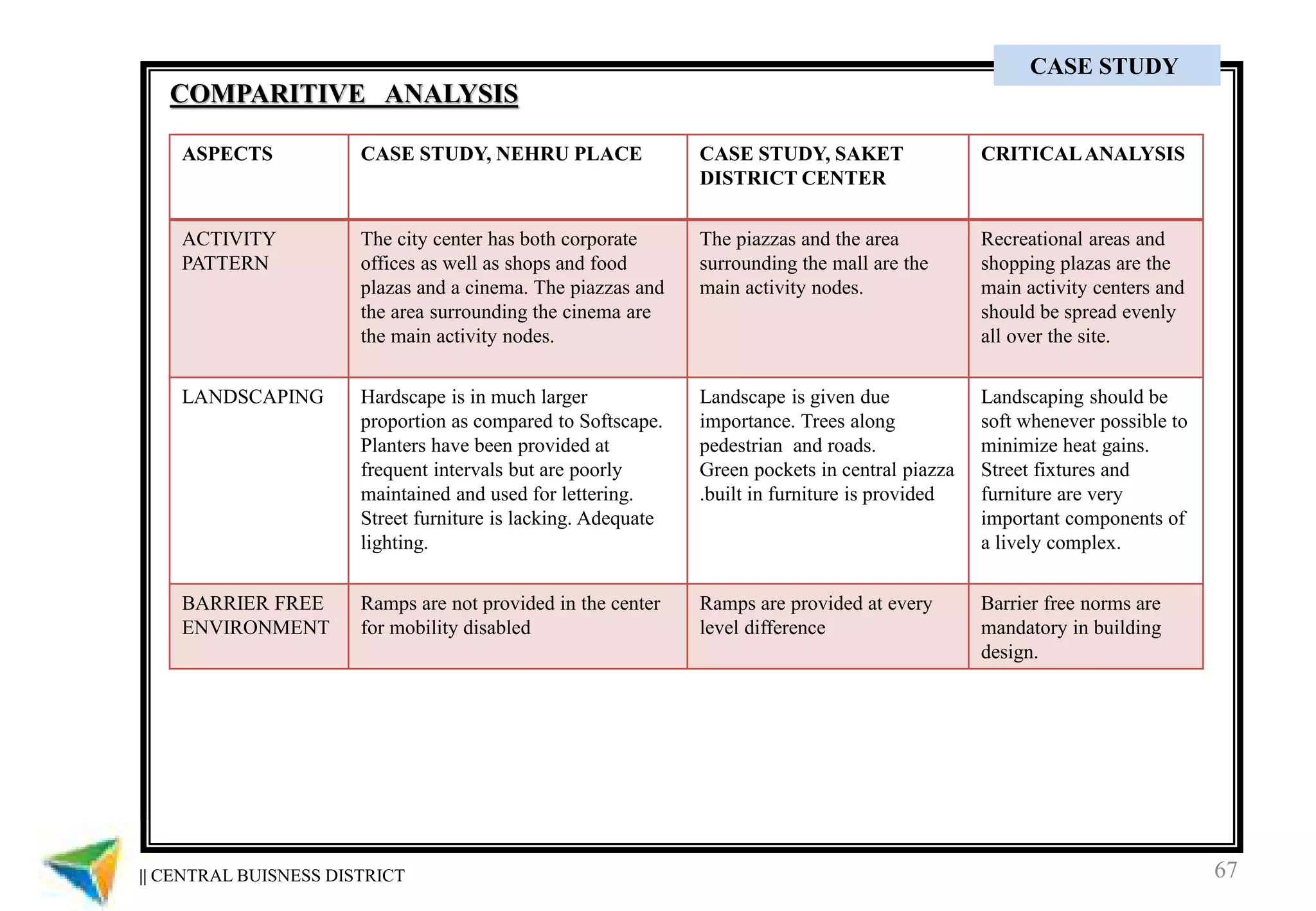
ASPECTS CASE STUDY, NEHRU PLACE CASE STUDY, SAKET
DISTRICT CENTER
CRITICALANALYSIS
BUILT UP- OPEN
SPACE
RELATIONSHIP
The built form rises in height from
the south to north side. Ground
cover is around30%..Open spaces in
form of piazzas provided and sense
of enclosure is maintained
The built form rises in height
from north to south far is
1.Ground coverage is 33.3%
Open spaces provided in front
of commercial areas.
Sense of enclosure is
preserved by virtue of
high rise buildings
surrounding the open
courts and piazza
CLIMATIC
ANALYSIS
Buildings rise in height from south
to north to capture max southern sun
providing shade to pedestrian
piazzas. Buildings are provided with
horizontal and vertical louvers.
Retail shops and office
buildings north –south oriented
Buildings are designed
according to climate and
proper sunshades are provided
The buildings should
adapt to the climatic
needs to create a
comfortable environment
and also to save energy
which is an important
ARCHITECTURAL
CHARACTER
The retail offices and shops do not
confirm to the architectural controls
in respect to signage and haphazard
placement of air conditioners,
coolers etc.
. The entire complex is
finished with combination of
granite, composite metallic
cladding, acrylic paint and
structural glazing.
Architectural character
maintained.
architectural control is an
important aspect of
design and should be
enforced to provide
overall harmony on site,
care should be taken that
its use does not create
monotonous and dull
environment.
COMPARITIVE ANALYSIS
|| CENTRAL BUISNESS DISTRICT
CASE STUDY
67
ASPECTS CASE STUDY, NEHRU PLACE CASE STUDY, SAKET
DISTRICT CENTER
CRITICALANALYSIS
ACTIVITY
PATTERN
The city center has both corporate
offices as well as shops and food
plazas and a cinema. The piazzas and
the area surrounding the cinema are
the main activity nodes.
The piazzas and the area
surrounding the mall are the
main activity nodes.
Recreational areas and
shopping plazas are the
main activity centers and
should be spread evenly
all over the site.
LANDSCAPING Hardscape is in much larger
proportion as compared to Softscape.
Planters have been provided at
frequent intervals but are poorly
maintained and used for lettering.
Street furniture is lacking. Adequate
lighting.
Landscape is given due
importance. Trees along
pedestrian and roads.
Green pockets in central piazza
.built in furniture is provided
Landscaping should be
soft whenever possible to
minimize heat gains.
Street fixtures and
furniture are very
important components of
a lively complex.
BARRIER FREE
ENVIRONMENT
Ramps are not provided in the center
for mobility disabled
Ramps are provided at every
level difference
Barrier free norms are
mandatory in building
design.
COMPARITIVE ANALYSIS
|| CENTRAL BUISNESS DISTRICT
CASE STUDY
68
To Mullechak
village
SITE BRIEF
• The main approach road to the site crosses Bhagatanwala railway line.
• Approach road is 5.5m wide with on one side of mandi shops and on other side commercial shops cum private
• The road ahead goes to MULLE CHAK VILLAGE AREA .
AMRITSARPUNJAB
GRAIN MARKET
WALLED CITYGRAIN MARKET
|| CENTRAL BUISNESS DISTRICT
SYNOPSIS
69
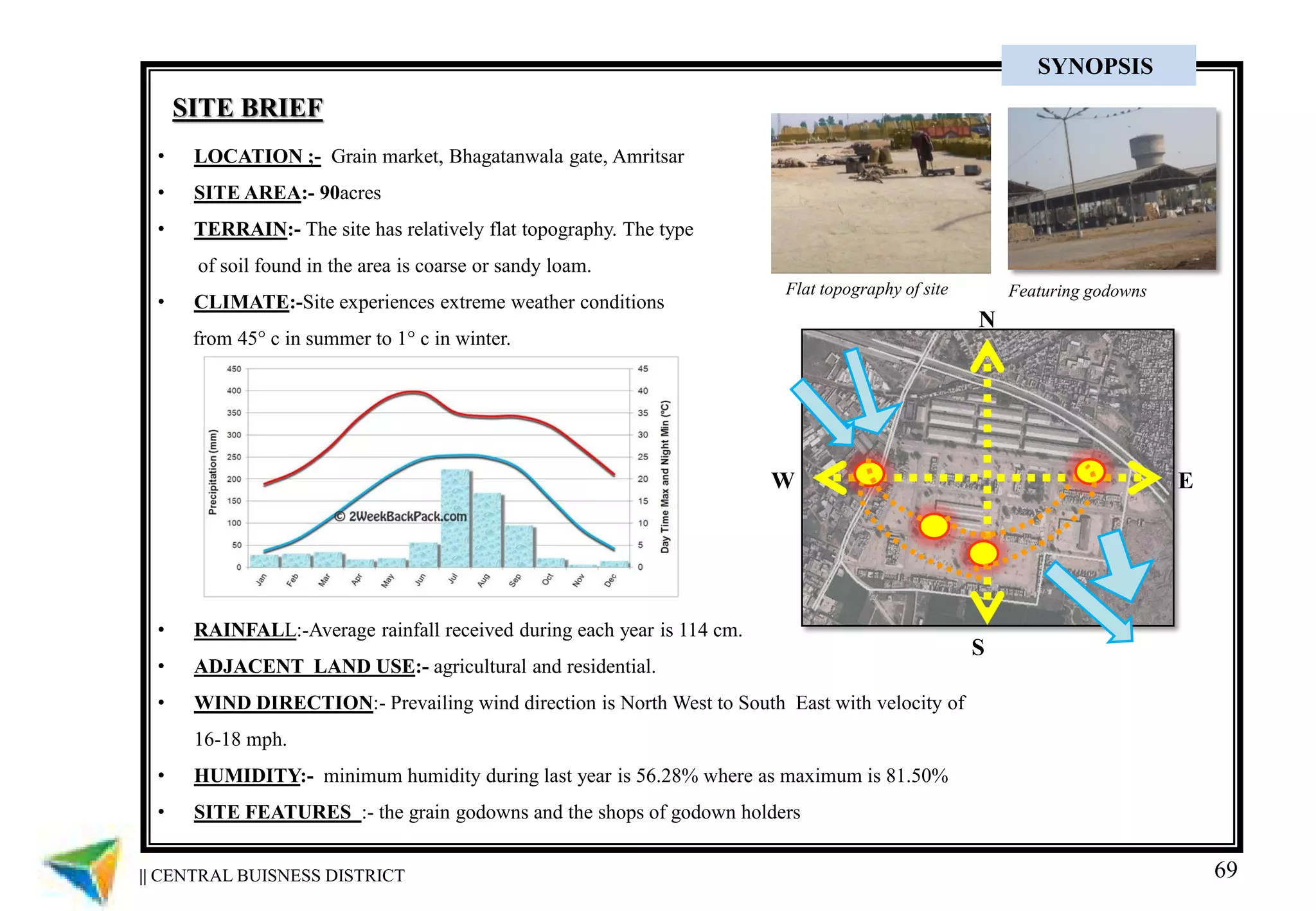
SITE BRIEF
• LOCATION ;- Grain market, Bhagatanwala gate, Amritsar
• SITE AREA:- 90acres
• TERRAIN:- The site has relatively flat topography. The type
of soil found in the area is coarse or sandy loam.
• CLIMATE:-Site experiences extreme weather conditions
from 45° c in summer to 1° c in winter.
• RAINFALL:-Average rainfall received during each year is 114 cm.
• ADJACENT LAND USE:- agricultural and residential.
• WIND DIRECTION:- Prevailing wind direction is North West to South East with velocity of
16-18 mph.
• HUMIDITY:- minimum humidity during last year is 56.28% where as maximum is 81.50%
• SITE FEATURES :- the grain godowns and the shops of godown holders
S
E
N
W
Flat topography of site Featuring godowns
|| CENTRAL BUISNESS DISTRICT
SYNOPSIS
70
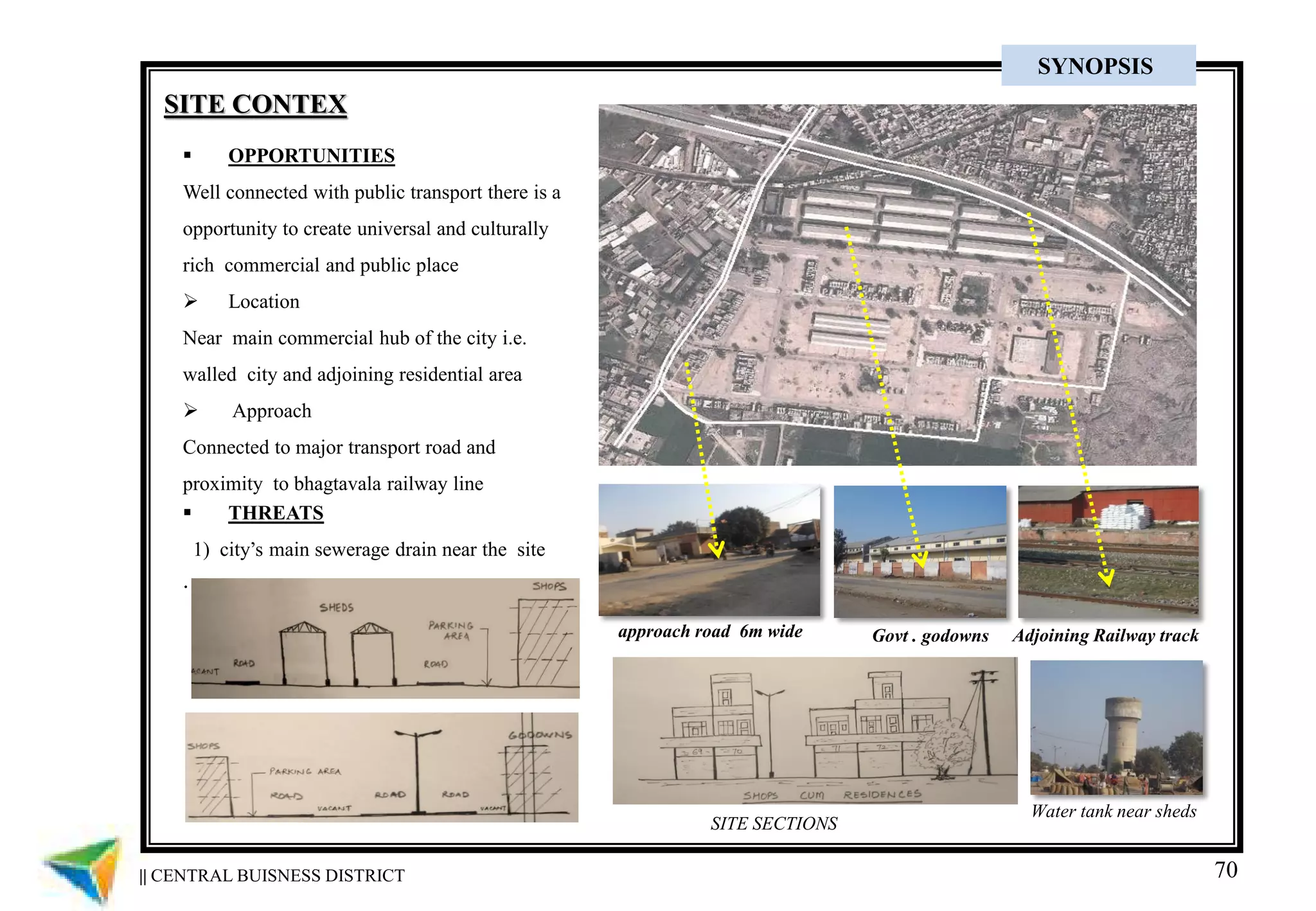
approach road 6m wide Adjoining Railway track
Water tank near sheds
Govt . godowns
 OPPORTUNITIES
Well connected with public transport there is a
opportunity to create universal and culturally
rich commercial and public place
 Location
Near main commercial hub of the city i.e.
walled city and adjoining residential area
 Approach
Connected to major transport road and
proximity to bhagtavala railway line
 THREATS
1) city’s main sewerage drain near the site
.
SITE SECTIONS
SITE CONTEX
|| CENTRAL BUISNESS DISTRICT
SYNOPSIS
71
AREA OF THE SITE = 90 ACRE
AREA FOR DEVELOPMENT = 90 ACRE =364217.4SQ M
Acc. To MC BYE LAWS
FAR allowed – 1.75 Ground coverage -40% ECS =2 PER 100 SQM
DETAILED REQUIREMENTS FOR COMMERCIALAREA
COMPONENTS PUDA
(Area in acres)
DERIVED
(area in acres)
NO. OF
UNITS
TOTALAREA
(INACRE)
Hotel 2.2 1.5 1 1.5
Restaurant 0.8 0.8 4 3.2
Banks .50 0.50 3 1.5
Malls and multiplex 1-1.25 1.25 3 3.75
Shops
Large/ S.C.O - 100 3.0
Medium shops - 250 2.5
Small shops - 150 0.5
Booths - 50 0.1
Local govt. Offices/ administrative 3-4 4 - 4
Weekly market/ exhibition hall 5-10 3 + 2 - 5
Total 24.65 acres
|| CENTRAL BUISNESS DISTRICT
AREA STATEMENT
AREA STATEMENT
72
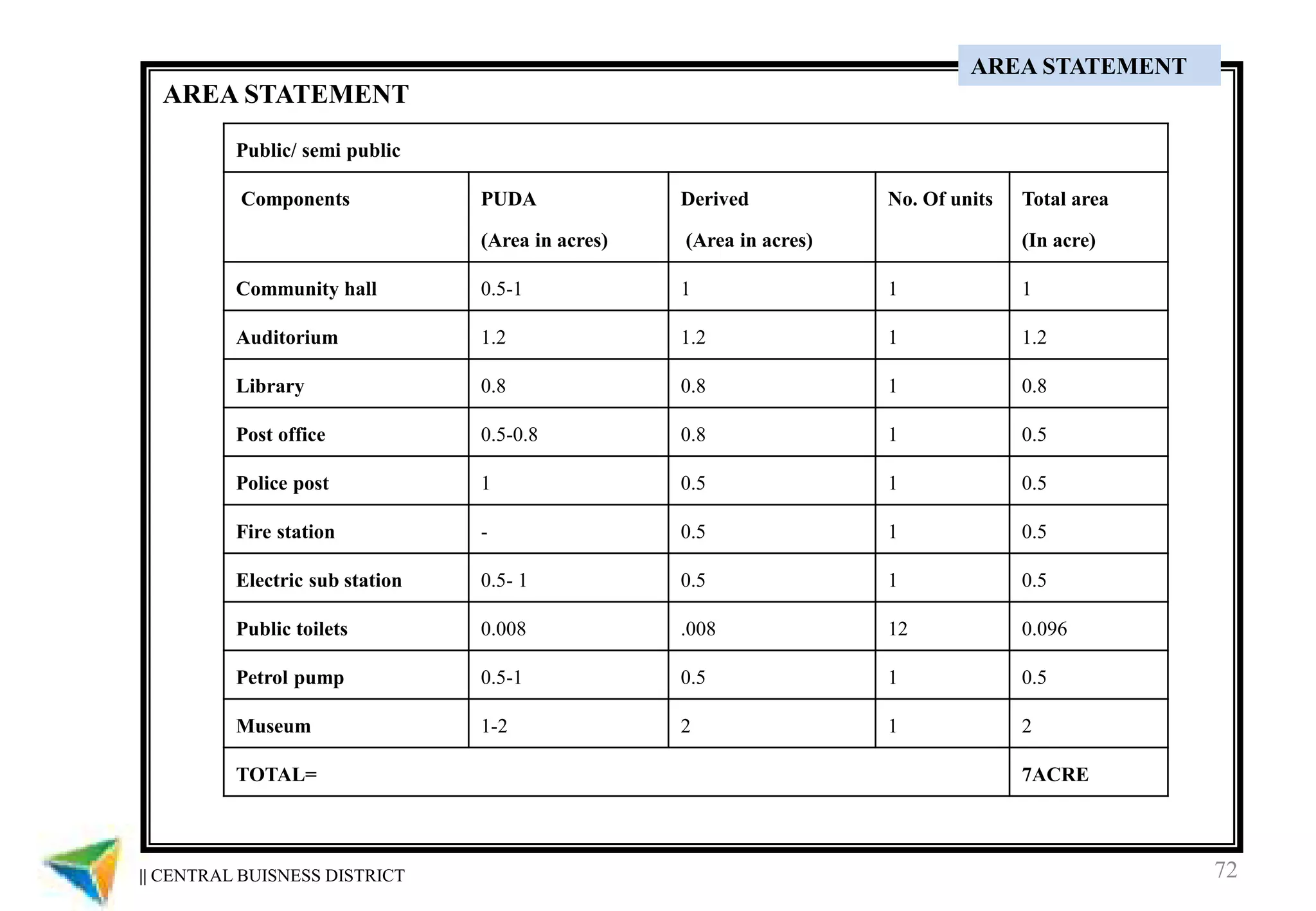
Public/ semi public
Components PUDA
(Area in acres)
Derived
(Area in acres)
No. Of units Total area
(In acre)
Community hall 0.5-1 1 1 1
Auditorium 1.2 1.2 1 1.2
Library 0.8 0.8 1 0.8
Post office 0.5-0.8 0.8 1 0.5
Police post 1 0.5 1 0.5
Fire station - 0.5 1 0.5
Electric sub station 0.5- 1 0.5 1 0.5
Public toilets 0.008 .008 12 0.096
Petrol pump 0.5-1 0.5 1 0.5
Museum 1-2 2 1 2
TOTAL= 7ACRE
|| CENTRAL BUISNESS DISTRICT
AREA STATEMENT
AREA STATEMENT
73
LAND USE % AREA ( ACRE )
Commercial 27 24.65
Public/semi public 8 7
Circulation 25 22.5
Parks / open spaces 15 13.5
Parking 25 22.5
Total 100 90
OPEN SPACES
Components PUDA
(Area in acres)
Derived
(Area in acres)
No. Of
units
Total area
(In acre)
District park 5-10 10 1 10
Other parks 0.5-1 0.5 6 3
|| CENTRAL BUISNESS DISTRICT
AREA STATEMENT
AREA STATEMENT
74|| CENTRAL BUISNESS DISTRICT
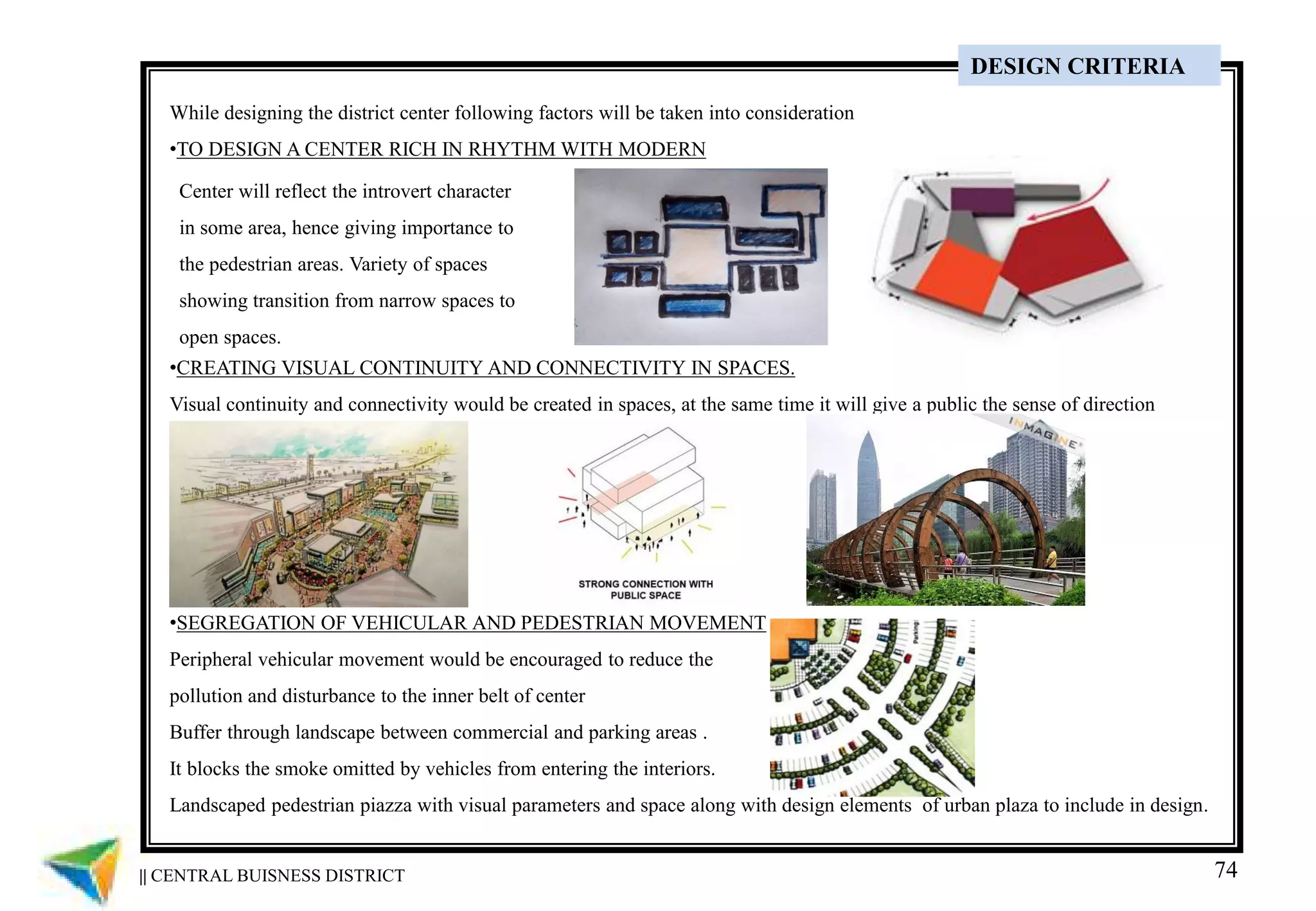
DESIGN CRITERIA
While designing the district center following factors will be taken into consideration
•TO DESIGN A CENTER RICH IN RHYTHM WITH MODERN
•CREATING VISUAL CONTINUITY AND CONNECTIVITY IN SPACES.
Visual continuity and connectivity would be created in spaces, at the same time it will give a public the sense of direction
•SEGREGATION OF VEHICULAR AND PEDESTRIAN MOVEMENT
Peripheral vehicular movement would be encouraged to reduce the
pollution and disturbance to the inner belt of center
Buffer through landscape between commercial and parking areas .
It blocks the smoke omitted by vehicles from entering the interiors.
Landscaped pedestrian piazza with visual parameters and space along with design elements of urban plaza to include in design.
Center will reflect the introvert character
in some area, hence giving importance to
the pedestrian areas. Variety of spaces
showing transition from narrow spaces to
open spaces.
75|| CENTRAL BUISNESS DISTRICT
DESIGN CRITERIA
WOMEN SAFETY
Easy movement within the location. General visibility of the entire space, , free from hiding places where a person could
wait unseen
Includes mixed uses – many places to hangout, walk, play, eat, exercise, etc. for diverse user groups at different times of day
Concept of pink parking- parking provided for females to increase safety
ZONING
While designing the complex zoning will be taken into account so as to segregate the contrasting combination of two
activities. design separately both silent and noisy zones.
ORIENTATION
It is most important point to be kept in mind while designing district center. the orientation will be worked while designing the
building with respect to their use

THESIS REPORT ON CENTRAL BUSINESS DISRTICT

  • 1.
    SUBMITTED BY- MOKSHIKA BALANA B.ARCH10THSEM. ROLLNO. 2011-ARA- 237 DEPARTMENT OF ARCHITECTURE, GURU NANAK DEV UNIVERSITY, CENTRAL BUISNESS DISTRICT CENTRAL BUISNESS DISTRICT THESIS REPORT - 2016
  • 2.
    2 CONTENTS CHAPTER – 1INTRODUCTION 1. Introduction 2. Validity 3. Aims and Objectives 4. Scope of project 5. Methodology CHAPTER – 2 LIBRARY STUDY CHAPTER – 3 CASE STUDIESAND LITERATURE STUDY 1. NEHRU PLACE , NEW DELHI 2. SAKET DISTRICT CENTER, NEW DELHI 3. Literature study BHIKHAJI CAMA CHAPTER-4 PROJECT BRIEF PG NO. 2-7 8-19 20-38 39-56 57-63 64-744.1 Site Analysis 4.2 Design Criteria 4.3 Area Requirements || CENTRAL BUISNESS DISTRICT
  • 3.
    3 Central Business Districtserves as a focal point for the city, providing a major retail and commercial services. It maintains a special cultural status as historic centre of the city as well as serving as a community centre for the surrounding region. It also maintains a pedestrian oriented character  The shape and type of a CBD almost always closely reflects the city's history. C.B.D. Provides economically viable commercial areas which provide a range of community business and service activities.  CHARACTERISTICS OF C.B.D  geographical land use patterns different from the surrounding area  Low residential population  High concentration of public buildings and offices.  High rise buildings to maximize land use Distinct land use patterns different from surrounding areas. Concentration of retailing  MAJOR CONCEPT REVOLVE IN C.B.D. 1) Role as public open space 2) Architectural characteristics 3) Role as the business INTRODUCTION Open spaces for recreation Skyline due to high-rise towers Pedestrian friendly Different land use within multi storey blocks || CENTRAL BUISNESS DISTRICT SYNOPSIS
  • 4.
    4 VALIDITY ACCORDING TO MASTERPLAN OF AMRITSAR  The markets of the walled city are highly congested and have high density.  Due to absence of adequate parking and organized commercial area the movement in these areas has been hampered.  The narrow streets and road encroachments have further degraded the aesthetic and potential of the area.  This has affected the trade of the markets and thus their existence.  No market is dedicated to selling of traditional industrial products of the city, like shawls, to achieve good marketing of traditional products of the city.  No commercial complex for banking, insurance and share market exists in the city KEY ISSUES FOR NEED Considering the nature and context of trade and its relationship with city and its activities , its proposed to shift wholesale food grain trade presently being carried out at bhagatanwala outside the city.  SHIFTING GRAIN MARKET :-  will help in minimizing the traffic congestion caused by influx of large number of vehicles.  Considering the close proximity of bhagatanwala gate to walled city, it is proposed to develop the land as city market with office spaces , retail markets ,eating joints and serve as market for tourist recreation . || CENTRAL BUISNESS DISTRICT SYNOPSIS
  • 5.
    5 The project CENTRALBUISNESS DISTRICT in AMRITSAR, PUNJAB that would provide access to major commercial and retail services for the city. It would form the node for holding and experiencing commercial, cultural and social activities . GENERAL FUNCTIONS The main components of district centre are • Commercial components •Cultural components • Recreational components  SITE BRIEF The proposed site for district center is located at GRAIN MARKET,BHAGTANWALA GATE .  SITE CONNECTIVITY The proposed site for district center is approached by 6m wide road . It lies close to the major commercial center of the city i.e. walled city. Site is 2.5 km from the GOLDEN TEMPLE , major tourist attraction in the city and 5.5 km from the BUS STAND and 4km from the RAILWAY STATION || CENTRAL BUISNESS DISTRICT SYNOPSIS PROJECT BRIEF
  • 6.
    6 • To createan interactive relationship between visual avenue , moments and activity pattern . • To create a barrier free environment • To understand the overall space concept with respect to human scale and built environment. • To create a space which can form the node for holding and experiencing commercial, cultural and social activities . AIMS OF THE PROJECT 1) to provide open living spaces achieving the comfort ambience. 2) to blend architecture planning and structure and architecture 3) to ensure an all time engaging and vibrant environment for all the users by: • mixed use zoning • integration of movement and activity • juxtaposition of formal and informal sector OBJECTIVES ARE AS FOLLOWS ARCHITECTURAL CHALLENGES OF THE PROJECT: 1) To explore the symbiotic character of COMMERCE and CULTURE. 2) Explore the inter-relationships of the spaces and the challenges of disparities cause by design which restrict spaces to particular segment of public . 3) To evolve a contemporary model of conventional Indian market. 4) The project would try to explore the possible integration of the functions which usually exist at larger distances || CENTRAL BUISNESS DISTRICT SYNOPSIS
  • 7.
    7 SCOPE  The majorrole is to design the CENTRAL BUISNESS DISTRICT in a series of integrated spaces and variety and mix use giving unique identity to business streets and serve as hub of commercial activities. This includes : Detailed layout scheme of project. (parking , circulation , landscape , Pedestrian movement shall be dealt in detail) Detailed design of office building, shops cum offices, piazzas and other buildings like library Landscape plan for the proposed site . Detailed structural grid drawings for office building, shop cum offices. LIMITATION  No detailed structural drawings and calculations. Detailing of limited building modules out of all requirements. THRUST  thrust area of the project is to provide an accessible environment for mobility of disabled , women safety in complex and to work out the conflict points in the movement pattern of vehicular and pedestrian traffic || CENTRAL BUISNESS DISTRICT SYNOPSIS
  • 8.
    8 • A reviewof various aspects of C.B.D • How does such a COMPLEX will be able to produce real values pertaining to COMMERCIAL and SOCIAL intentions • Analytical study of activities and relative studies • The realization of built form in relation with open spaces with the idea of producing enlivenment out of a holistic approach and fulfilling, the aspirations of the users • Analysis of site and response of proposed buildings to: • Surroundings • Establishment of functional criteria • Culture and climate • Relevant literature studies – context, case-studies, standards and anthropometric data. • Analysis of literature and case studies and driving the inference and conclusions from each study, comparisons of studies. • Formulation of Spaces and the areas. • Formulation of Development Controls. • Design concept • Ultimate design proposal. METHODOLOGY || CENTRAL BUISNESS DISTRICT SYNOPSIS
  • 9.
    9 •GENERAL OBJECTIVES •Accessibility -Districtcentre should be planned in a way so that every activity falls within the accessible distance. •Safety -By providing road side infrastructure encouraging pedestrian’s movement and less vehicular traffic which help enhance safety. •Comfort-Providing more sitting spaces in the parks, facilities like public conveniences. •Compatibility-Any two activities provided in consecutively would be compatible with each other or buffer zone would be provided for the same. INTRODUCTION The CBD or Central Business District is the focal point of a city. It is the commercial, office, retail, and cultural center of the city and usually is the center point for transportation networks. . It maintains a special cultural status as historic centre of the city as well as serving as a community centre for the surrounding region. It also maintains a pedestrian oriented character. The CBD developed as the market square in ancient cities. On market days, farmers, merchants and consumers would gather in the center of the city to exchange, buy, and sell goods. This ancient market is the forerunner to the CBD. As cities grew and developed, CBDs became fixed location where retail and commerce took place. The CBD is often near a major transportation route that provided the site for the city's location, such as a river, railroad, or highway. HISTORIC BACKGROUND || CENTRAL BUISNESS DISTRICT LIBRARY STUDY
  • 10.
    10 OBJECTIVES • The entirecomplex shall be designed with proper orientation and maximum wind movement. Building may be oriented along NW – SE orientation. • Development of open spaces, nodes and transition spaces between main building and approach areas. • Ensuring proper connection between public areas, semi public areas and services. • While formal and informal areas shall be well connected, a sense of segregation should be ensured as well. • To create streets which are safe and attractive to pedestrians. • To provide activity and interest along the street. SITE PLANNING The allocation of spaces for these and possibly others users should be guided by certain planning principles in order to attain the highest feasible productivity of the land over an extended period of time 1. Safeguard surrounding areas against the blind 2. Expose retail facilities to maximum foot traffic 3. Separate various mechanized traffic type from one another 4. Create a maximum of comfort for the shoppers and merchants 5. Achieve order, unity and beauty. N The shop units and the plazas should be north facing to avoid the glare Pedestrian friendly complex Barrier free environment || CENTRAL BUISNESS DISTRICT LIBRARY STUDY
  • 11.
    11|| CENTRAL BUISNESSDISTRICT LIBRARY STUDY COMPONENTS OF C.B.D
  • 12.
    12 POSSIBLE SECTIONS No senseof enclosure Good sense of enclosure (45angle) Proper sense of enclosure No sense of enclosure (15angle) || CENTRAL BUISNESS DISTRICT LIBRARY STUDY When building height is equal to the street height, a sense of enclosure is generated. In this case, building façade is more detailed When building height is equal to the one third of street width, the skyline dominates over the building When building height is equal to one fourth times of street width, the sense of enclosure is completely lost. POSSIBLE LAYOUTS This layout comprises of a separate area for pedestrian in the form of pedestrian mall This layout differs from the first option by the introduction of activity areas like museum or library. OPTION 1 OPTION 2 OPTION 3 central parking with peripheral buildings and service roads. All blocks enclose a common open space. It leads to the creation of variety of spaces approach with one court & two magnets placed in diagonal manner. It is the simplest of all layouts. The centre is approached through linear connectivity. OPTION 4
  • 13.
    13 Parking requirement/E.C.S 1)0° -parallel to road. Entry and exit to parking bay difficult. Suitable for narrow roads. 2) 30°- angle to access road. Easy entry to parking bay and exit. Uses a large area. 3) 45°- angle to access road. Good entry to parking bay and exit. Relatively small parking space. 4) 60°- angle to access road. Relatively good entry and exit to parking bay; small parking space. Arrangement often used. 5) Right angles to road (parking spaces 2.50 m wide). Sharp turn needed for entry and exit. 6) Right angles to road (parking spaces 2.30 m wide). Small area needed for parking space. Ideal for compact parking layouts, used frequently. PARKING || CENTRAL BUISNESS DISTRICT LIBRARY STUDY • 2 wheeler parking: 1.2 x 2.1 m • Car - Parking: 2.5 x 5 m - Turning Radius 5m • Bus - Parking: 3.5 x 12 m - Turning Radius 12.2m Parking type sqm Open 23 Ground floor covered 28 Basement 32 Multilevel with ramps 30 Automated multilevel with lifts 16
  • 14.
    14 PEDESTRIAN GENERAL SITE DESIGNFOR PEDESTRIANS  No shortage of sources for site furnishings today.  Range of well-designed & durable materials in many styles from which the designer may choose.  All of these furnishings comply with the accepted standards of human dimensions & behavior is necessary. A fundamental element of design for the pedestrian is the pathway or side-walk. The sidewalk width must be designed to provide the level of service suited to the user. The parameters of sidewalk width are determined according to the : -anticipated volume of foot traffic, -the speed at which the pedestrians will be walking ,and the desired density of traffic. WALKWAYS Rigid mortared paving detail Standing & Walking dimension Pathway design for wheelchair W=v(m/s) I.E. o W = the width of the pathway or sidewalk,ft. oV = the traffic volume, persons /minute oM = the space module allowed/person,ft². oS = the walking speed o,ft/min || CENTRAL BUISNESS DISTRICT LIBRARY STUDY
  • 15.
    15 STREET FURNITURE . LITTER BINS:-Theseare of three types • Open types • semi open type • Hinged- door opening BARRIERS:- The purpose of these barriers are • Privacy • Safety  CHAIN AND BARRIERS:- It should be 790mm in height When lower than 790 mm it is Difficult to detect by pedestrian , cyclist, motorcyclist STREET FURNITURE :- Elements placed in a landscape or streetscape for comfort, convenience, information, circulation control, protection, and user enjoyment are collectively referred to as site furniture (figure 510-1) .Benches, bollards, signage, lighting, tree grates, and utility boxes SIGN DESIGN. Consider both pedestrian and vehicular traffic in selecting and designing signage. .SIGNAGE AND THE BUILDING Signage should be low-key in order to avoid competition with the architecture of the structure. Materials and design should be compatible with the building’s materials and style SITTING CHAIR:- Signage Chains and barriers Litter bins || CENTRAL BUISNESS DISTRICT LIBRARY STUDY
  • 16.
    16 Tactile warning markingon the Ground around the obstruction Extra 1.2m to accommodate wheel chair. Street furniture at a uniform Interval of 100-200m Parking width of 3.6m instead of normal 2.5m width requirement Provision of curbstone along both sides to resist a slippage Separate 1.5m side walkway for combined walkway traffic of wheelchair and the sightless person. Height and design of sill and hanging hoarding for unobstructed shopping arcade. BARRIER FREE ENVIRONMENT. || CENTRAL BUISNESS DISTRICT LIBRARY STUDY Curb ramp at marked crossings detail
  • 17.
    17 Mature street treesshall be maintained for clear head clearance. LANDSCAPING •Trees shall be provided along major pedestrian corridors. •Trees shall not be placed closer than 30 feet from intersections. They shall remain out of the clear vision triangle. •Branch height of mature trees on traffic side shall be no less than 13’-6” above the street. •Branch height on pedestrian side shall be no less than 8’above the sidewalk. •Proper irrigation systems shall be installed to establish and maintain healthy growth. •Tree species shall be selected that can withstand the harsh conditions of the urban environment. When an area is to be unified, plant only one species. •Mature tree height and canopy fullness shall not obscure important building features or business identification. • Shady trees – sitting can be provided under shady trees Neem – azadirachta indica Peepal – ficus relegiosa Golden fig – ficus benjaminia • Flowering trees – for aesthetics Amaltas – cassia fistula Gulmohar – delonixx fistula Kachnar – bauhinia frandosa • Ornamental trees – for aesthetics Royal palm – oreodoxa regia Palmyra – borassus flabellifer • Avenue trees – Silver oak – gravilla robusta Ashoka – polyalthia longifolia || CENTRAL BUISNESS DISTRICT LIBRARY STUDY Use of vegetation in redirecting air flows High branched trees provide shade for the breeze 'Cooling path' provided for breeze before it enters the building.
  • 18.
    18 Retail outlets canbe broadly divided into • Small Shops – 20 sq m • Medium Shops – 50 sq m • Large shops – 150 sq m • Departmental Stores Or • Supermarkets – 350 sq m PLANNING GUIDELINES • Occupation in stores - 1 person per 5 to 6 sq m; 1 person per 1.8 sq m in peak hours • Shelf Units - Shelf units should not be higher than 1.8m and not lesser than 0.3m. SHOP WIDTH • This is the most important dimension as it involves column spacing and frontage of stores. • The most common used shop widths are 6 , 7.6, 9.14 m the last being the most flexible one. SHOP DEPTH – It can vary according to the frontage Covered verandahs • Covered verandahs must be provided for shade and protection against sun and rain. • Width can vary from 1.85m to 3.04 m depending upon the type of shop. RETAIL SHOPS AND STORES Fig.3- Narrow frontage Max. Window Perimeter Fig.2- Not recommended should be avoided. Fig. 1 - wide frontage columns cause no interruption to display in arcade. Fig.4- Narrow frontage Flat front || CENTRAL BUISNESS DISTRICT LIBRARY STUDY
  • 19.
    19 STRUCTURAL GRID Large unitsbetween 7.3m to 10.9m frontage & 9.14m depth. Small units between 5.18m to 5.8m frontage and total depth. BOOTHS Booths are smaller in size than shops having min area 6sq.m. Booths frontage vary from 2,2.5 & 3m . SHOWROOMS Showrooms are larger in size than shops having min area 95 sq m DEPARMENTAL STORES Department stores are large complex shops, invariably extending over several floor levels, selling a wide variety of goods, particularly clothes. PLANNING Minimum heights for shop spaces of the following are as follows: Up to 400 sq m retail floor space 3.00 m Over 400 sq m retail floor space 3.30 m Over 1500 sq m retail floor space 3.50 m LOCATIONS The main aisles are 2.2 to 2.5m wide increasing to 2.8 to 3.2m. || CENTRAL BUISNESS DISTRICT LIBRARY STUDY RETAIL SHOPS AND STORES
  • 20.
    20 OFFICES Modern office buildingsare of the following types: Close Plan offices – They have full height walls or partitions dividing the space into offices with doors. Private offices – They are typically located along a window wall. Open Plan Offices – In open plan offices, all workstations are l located in an open space with no ceiling height division or doors. Modified Open Plan Offices – They combine the feature private and open plan offices. Partition, window, ceilings, window modules, effect office layouts 1.5 sq m of area is required for circulation per person || CENTRAL BUISNESS DISTRICT LIBRARY STUDY Single/ Group Office Normal Maximum Depth of Office 3.75 – 7.50 mt 9.25 m Dist. b/w Windows 1.00 – 3.25 mt 6.00 m Dist. b/w Columns 1.75 – 7.50 mt 11.00 m Main Corridor Width 1.75 – 2.50 mt 3.25 m Side Corridor Width 1.50 – 2.00 mt 2.50 m Height of Office 2.50 – 4.00 mt 5.00 m Different modules for office layout
  • 21.
    21 CASE STUDY 1:-NEHRUPLACE . NEW DELHI PROJECT BRIEF PROJECT NAME NEHRU PLACE, DELHI TYPE OF PROJECT COMMERCIAL DEVELOPERS D.D.A CLIENT D.D.A YEAR OF START 1969 YEAR OF COMPLETION 1980 INCLUDES SHOPS, OFFICE BUILDING, RECREATIONAL AREAS NO. OF STOREYS FOR OFFICE AND COMMERCIAL BUILDING G+8 TOWERS G+17 TOTAL SITE AREA 49 ACRES NEHRU PLACE,NEW DELHI || CENTRAL BUISNESS DISTRICT CASE STUDY
  • 22.
    22  It islocated in South Delhi.  Nehru Place lies next to the Outer Ring Road.  On one edge of the site, there lies the road towards Iskon temple NEW DELHI APPROACH AND ACCESS CHIRAG ENCLAVE METRO ST. ISCON TEMPLE SOUTH DELHI NEHRU PLACE Main access- Lala Lajpath Rai road which is 100 ft wide. Delhi-metro station on violet line. Outer ring road Own bus terminal- Nehru place bus terminal. LOCATION || CENTRAL BUISNESS DISTRICT CASE STUDY •Easy approach since located on prime location and proper transportation connection
  • 23.
    23 SITE CHARACTER ANDORIENTATION SITE AREA :- 49 ACRES TOPOGRAPHY :- Site was built atop the Aravalli mountain range. the hills were blown and removed. SHAPE :- Site is quadrilateral ORIENTATION :- Site is east- west oriented The site is divided in to three zones. Commercial and office zone.  Re-creational Zone Public Building zone Office towers at outer periphery to reduce chaos Recreational areas in front of shops in form of piazza to cater informal activities. Piazzas created on levels to create interest N N SS EW commercial buildings oriented in east west direction allows more open spaces to receive indirect sunlight and lesser heat gain SITE ZONING LEGENDS Commercial and office Re- creational Zone Public zone || CENTRAL BUISNESS DISTRICT CASE STUDY
  • 24.
    24 SITE LAYOUT The centralbusiness district comprises of following :- Nehru place Metro station Satyam multiplex Commercial building Official building Multi level parking Bus terminal Eros cooperation tower Modi towers Informal shops G+17 G+1 G+3 G+5 G+17 G+15 G+17 G+17 G+5 G+3 G+5 G+5 G+3 G+7 G+7 G+6 G+5 G18 G18 G+18 G+9 G+5 G+1 Eros Tower Multilevel parking Shops Paras cinema Metro station Inadequate circulation space, congestion at the entry & exits points. Pathways open to large piazzas which are on levels to create interest - + || CENTRAL BUISNESS DISTRICT CASE STUDY SITE LAYOUT :NEHRU PLACE
  • 25.
    25 LAND USE PATTERN COVEREDPARKING PADESTRIAN AND LANDSCAPE OPEN PARKING INTERNAL SERVICE ROADS Circulation of commercial shop users Circulation of office employees And users 18% 66% 4% 12% AREA DISTRIBUTION COMMERCIAL AREA OFFICE AREA RECREATIONAL AREA PUBLIC AREA The total site area is 49 acres the site consists of :- • Total Floor Area = 322695 sqm • Total Commercial Area = 60650 sq • Total Office Area = 222285 sqm • Total Recreational Area = 12100 sq • Total Public Area = 39760 sqm • Ground coverage. = 39605 sq • FAR = 1.5 COMMERCIAL AND OFFICE BUILDING Green areas – 27000 sq.mt i.e. 13.5% of the site area Parking area – 47000 sq.mt i.e. 23.5% of the site area || CENTRAL BUISNESS DISTRICT CASE STUDY Plan showing different land use pattern in complex
  • 26.
    26 Entrance to Nehru placefrom metro station Continuous covered corridors for pedestrian movement in front of shops (Lala Lajpathrai marg) Entrance from outer ring road leading to shops No vehicular access to piazza for safety of pedestrians Large open piazzas provided at the intersecting nodes of the central pathways 15M wide peripheral vehicular roads Central pathway with shops on both sides, Parking area – 48000 sq.mt i.e. 23.5% Vehicular movement – 2100SQMT i.e. 11% Pedestrian movement area – 6400 i.e. 32% Surface parking on peripheral roads Vehicular Movement Pedestrian Movement Parking Spaces Main roads CIRCULATION Width of pathways Acc to NBC 1.5m ≥30m Existing condition pathways Leading from metro station = 15m Leading from bus terminal =18m Central pathway = 29m || CENTRAL BUISNESS DISTRICT CASE STUDY Plan showing different circulation pattern in complex
  • 27.
    27 CIRCULATION •VEHICULAR MOVEMENT •PEDESTRIAN MOVEMENT Vehicularroads are on periphery , thus reducing the chaos in central piazza Large open piazzas have been provided at the intersecting nodes of the central Pathways of commercial areas to create open spaces in order to segregate the crowd. Vast hard surfaces turn into unpleasant hot- spots in summers. Central pathways occupied by hawkers thus resulting in irregular movement No provision of sitting or benches along with the pedestrian. + + - - - i. Vehicular road leading to center Central pathway Interconnecting piazzas • vehicular roads are on periphery , thus reducing the chaos in central piazza •Width of vehicular road within site is 15m . • Two major pedestrian approaches . •From metro station – 55’-0” wide •From bus terminal – 60’-0” wide •Central pathway - 98’-0” wide •Red sand stone paving in plaza and pedestrian + Width of inner vehicular road Acc to Norms 10-20m Existing condition Width of road = 15m Turning radius Acc to Norms Existing condition Radius of road-7m The black arrows show the highest human movement intensity path. All the shops lie on this movement pattern. || CENTRAL BUISNESS DISTRICT CASE STUDY
  • 28.
    28 Type of parkingprovided in the centre:  Open parking.  Multi-level parking  Basement parking.  OPEN PARKING provided along the periphery of the complex to reduce chaos {Open – 1400 }  BASEMENT PARKING has also been provided. But it is not used much since it is dark and dingy . {Basement – 400} MULTILEVEL CAR PARKING Owned by private company has solved the parking problem in complex a lot {Multi level – 1000} PARKING SURFACE PARKINGBASEMENT PARKING MULTILEVEL PARING + - Total surface parking = 48,000sq.m. Total basement parking =2,600sq.m. Total multi-level parking =24,000sq.m. Total parking area= 74,6000sq.m Nehru place •presently – 2800 • planned for 5500 ecs {but not achieved} •current demand: 6621 ecs •projected demand in 2020: 9530 ecs •Esc = estimated car space Peripheral parking so less chaos in complex Complex is unable to meet the parking requirements || CENTRAL BUISNESS DISTRICT CASE STUDY Plan showing different type of parking in complex
  • 29.
    29 Large open piazzashave been provided at the intersecting nodes of the central pathways of commercial areas to create open spaces in order to segregate the crowd. •Offices provided at the outskirts of the complex to avoid the movement of the employees through the commercial area, hence reducing chaos at central piazza and walkways •Central pathway - width of pathway equal to height of surrounding building . MASS SPACE RELATIONSHIP Open piazzas to segregate crowd and for informal shops Office towers on outskirt to minimize chaos Even distribution of mass with open spaces + Equal distribution of mass and open spaces Sense of enclosure is maintained Landscape elements provided on the central axis creating vista Large hardscape area leading to hotspots in summer - + + || CENTRAL BUISNESS DISTRICT CASE STUDY OFFICE TOWER G+15 G+6 42 44 43 41 40 39 38 37 36 35 34 G+8 33 32 31 30 29 28 27 26 34 25242322 21 20 19 18 17 1514 13 12 G+5 PARAS CINEMA PLOT No.1 PIAZZA LVL.+ 745 PIAZZA LVL.+ 745 OFFICE TOWER G+15 32 OFFICE TOWER G+15 6 2 3 4 5 7 8 9 10 11 G+2 TAXI STAND NEHRU PLACE GREENS PIAZZA LVL.+ 760 PARKING LVL.+ 744 P/S-3 G+15 G+15 97 96 95 94 93 92 91 90 88 87 86 85 16 98 89 84 83 82 81 807978 77 76 75 74 73 7271 70G+5 MICROSOFT BUILDING PIAZZA LVL.+ 755 G+3 PARKING LVL.+ 753 69 68 67 65 64 63 6266 PETROL PUMP PIAZZA LVL.+ 755 PIAZZA LVL.+ 760 I.F.C.I. TOWER G+15 61 605958575655G+8 G+8 46 47 48 49 50 51 52 53 54 45 UNER CONST. R A M P EROS TOWER G+15 MOLTISTOREY CAR PARK B U S T E R M I N A L G O V T. B U I L D I N G ROAD LVL. +750 ROAD400Ft.WIDE ROADLVL.+725 R E S I D E N T I A L R E S I D E N T I A L ROAD LVL. +755 O U T E R R I N G R O A D PARKING LVL.+ 748 PARKING LVL.+ 740 BUILT UP AREAS Built up area 25% Open area 75%
  • 30.
    30 STREET SECTION lvl+68750 lvl+23550 Present skylineof Nehru place Sense of enclosure is maintained. Distance between the open space approx Equal to height of building Angle is nearly equal to 45º +750 mm. +27000 mm. ±0 LVL 29400mm 1800lvl. cut out in slab ramp +23550 mm Section through plaza yy’ Section through central pathway xx’ Plaza are at different level to create interest and segregate crowd || CENTRAL BUISNESS DISTRICT CASE STUDY
  • 31.
    31 BUILDING TYPOLOGY =Office Use Area covered on all floors = 9638.77 sqm Ground coverage = 2410.9 sq.mt. Area under vertical core =48.9115 sqm i.e. 2% Horizontal circulation :- Ground floor-437.1466 sqm. i.e. 18% THE GREAT EASTERN CENTER circulation core services Ground floor plan KEY PLAN •Central core •No of staircase -1 •No. of lifts -2 •Fire escape •No of staircase -1 Structure system Beam –column structure Grid followed - 24’-0” x 24’-0” •Width of staircase -6’-0” •No of riser -24 •Riser height=6” •Width of riser -0’-11” •Single entry exit point •No. of floors -5-floors •Floor height -12’-0” floor to floor Natural ventilation is totally excluded Weather in building controlled by mechanical means. Circulation is such that it easily handles two way traffic consider ation Acc to norms provided fire exit required 2 (1 after every 30 m) 1 Width of staircase 2m 2m || CENTRAL BUISNESS DISTRICT CASE STUDY
  • 32.
    32  Street patternis followed  Plots for offices/shops in a continuous row along the pedestrian plazas, which are 4,6 and 9 storey high.  Shops cover 2 floors of the building block.  Large distance between opposite shops sufficient to cater crowd but hawkers in between the pathway cases hindrance  Staircase is provided after every 8 shop Key plan RETAIL SHOPS Plan showing areas of formal activities TOTAL FORMAL RETAILAREA : 12877.81 SQM Retail shopsRetail shops ASPECT (SHOPS) ACC TO NORMS (MIN) Provided LARGE 20’X66’ 25’X40’ MEDIUM 15’X 30’ 10’X 24’ SMALL SHOPS 15’X10’ - || CENTRAL BUISNESS DISTRICT CASE STUDY
  • 33.
    33 SHAKUNTALA TOWERS BUILDING TYPOLOGY= Office Use Area covered on all floors = 21678.696 SQ.MT. Ground coverage = 2408.744 sq.mt. KEY PLAN •VERTICAL CIRCULATION •Area under vertical core =19.60 sqm •No. of elevator – 6 •Size of elevators -80”x 54” •No. of floors -9-floors •Floor height -12’-0” floor to floor HORIZONTAL CIRCULATION :- Ground floor-791.379 SQ.MT.- Typical floor-183.8493 SQ.MT SERVICE AREA: - 116.694 SQ.MT || CENTRAL BUISNESS DISTRICT CASE STUDY Off centered vertical core Provision of 2 fire escape Mechanical means to maintain the temp. within
  • 34.
    34 High density inoffice complex Sparse consumers Office goers visit plaza for lunch Consumers increases Office goers leave Plaza heavily crowded Afternoon 2 pm Evening 6 pmMorning 10 am DEMOGRAPHICS Age groups (years) 0-12 13-18 19-24 25-35 35-50 50 ONWARDS No. Of people 0 0 68 206 64 0 COMPLEX USED BY DIFFERENT GROUPS || CENTRAL BUISNESS DISTRICT CASE STUDY
  • 35.
    35 ARCHITECTURE EXPRESSION &PUBLIC INFRASTRUCTURE •Finishing the old phase development is finished in concrete. 4’-0” wide horizontal and vertical sunscreens have been placed on the façade of the buildings •The new phase development have glass facade, metallic cladding, concrete as finishing material thus disturbing harmony and architecture controls of complex • •Signage and advertising board. Lack of restrictions on size and location of hoarding used by offices ,thus destroying the elevation of structure . boards of varying sizes by offices (about 16’-0”,32’-0”)  shopping areas had worked out the location of advertising boards •Public toilets in complex no provision of public toilets within the complex. One has to go to metro station or office to use toilets . •Public toilets converted into shops •Street furniture no provision of dustbins in complex No provision of benches along the pedestrian Street lights are provided at a distance of 60’ c/c. sunscreens provided appear, regardless of the orientation of the building blocks. Difference in façade of old development and new development disturbing harmony of complex Inadequate infrastructure facilities in complex Not safe at nights with no activity and poor lighting - - - - Inadequate infrastructure facilities in complex Difference in elevation of old development and new development || CENTRAL BUISNESS DISTRICT CASE STUDY
  • 36.
    36  Nehru placeis having varying skyline. More variation could be seen because of the new buildings that have come up with the passage of time.  Commercial cum office block surrounding the central plaza have linear skyline High rise corporate towers are placed on the outer periphery of the complex SKYLINE lvl+68750 lvl+23550 lvl+30750 lvl+23550 lvl+66150 lvl+66150 lvl+23550 Present skyline of Nehru place skyline of Nehru place when designed skyline of Nehru place when designed Different skyline of Nehru place lvl+15000 || CENTRAL BUISNESS DISTRICT CASE STUDY
  • 37.
    37 Green area providedin the north- west corner of Nehru place, now used as a recreational park, creating macro climate vast street light are provided Distance b/w poles: 60’-0” c/c. Vast hard landscaped area has been provided in most of the complex red sandstone paving in the plazas and pedestrian pathways has been done which change s into unpleasant hot-spots in summers. There is no system in place to manage waste. Complex lacks infrastructure to manage the waste it produces No provision of benches along pedestrian. ROW OF TREES PROVIDED IN CENTRE OFPATHWAY GREEN AREA PROVIDED IN THE NORTH-WEST CORNER LANDSCAPING + + - - - Green areas – 27000 sq.mt i.e. 13.5% of the site area Trees in parking Satpatti, Peepal Trees along pedestrian Jamun , a, Satpatti soka Trees in plazas Australian wattle, Silver oak Acc to norms:- All new or expanding development shall designate a min, of 15% of total site area for green space Acc. to site :- 13.5% of area is allocated to green which is less acc to norms || CENTRAL BUISNESS DISTRICT CASE STUDY
  • 38.
    38 •Combined system forthe disposal of human excreta and rain water has been used. •No separate system for rainwater harvesting has been employed. •Gutters are provided along the pedestrian walk as well as roads.. •The manholes are located at a distance of about 50’-0” c-c. • No proper water Disposal in Complex water gets stagnant after rain •The electric supply to the complex from an electrical unit installed in the complex itself. •Underground wiring system has been employed for the supply of electricity. •For street lighting electricity poles are provided at a distance of 60’-100c-c. SEWAGE DISPOSAL SERVICES ELECTRIC Main electric supply from electric unit Sub distribution system within building Rain water pipes Rain water accumulation consideration required achieved analysis Min dia. of sewer pipe 150mm (NBC) Observed from open duct Min dia. of rainwater pipe 100mm observed Max spacing b/w manholes for 150mm 45m (NBC) Spacing b/w manholes 15.25 m Location of generators in complex Generators are placed on terrace Acc to norms it should be above 6m from the terrace no such norms followed - || CENTRAL BUISNESS DISTRICT CASE STUDY
  • 39.
    39 SERVICES FIRE FIGHTING •All thebuildings are planned as per the fire safety norms. •Fire escapes are provided as per the rules and regulations laid by dda, ndmc and other governing authorities. •Hose reels are provided in all the buildings. •Fire escape staircases are provided in almost all the buildings. Nearest fire station which supply services t o complex is on behron mandir bus terminal No Provision of onsite under ground water tank for fire fighting services capacity No provision of fire hydrants on site •Fire station which serve the complex || CENTRAL BUISNESS DISTRICT CASE STUDY
  • 40.
    40 STRENGTH • Nehru placeis located on the Outer Ring Road so it can be easily accessible by the other parts of the Delhi. • Being an IT Hub, the market caters more to the people of age group 25-35 years because of there shops or job or shopping, etc. • Nehru Place is designed in such a way that large open spaces are there between the towers, in form of courtyards and parking. Due to long courtyard connectivity fresh air enter these corridors with a thrust. • Parking are designed near to the Towers which makes it easy for the crowd and the employees and also to the transporters. • Office blocks are on the second floor which are totally segregated from the loud and the crowd. WEAKNESS Since it was not planned to accommodate these numbers, the result is congestion, lack of sanitation, and a degenerating infrastructure in and around the areas surrounding Nehru Place. The market is not so User Friendly, i.e. can’t be easily accessed by handicaps and senior citizens find it difficult to climb the stairs Lack of cultural and recreational spaces Make highly extensive shopping plaza. Heavy and rigid concrete boxes and linear Planning. The centre has not been able to attract local shoppers, since it is not located on an existing commercial spine The centre stays dead in the night, save some homeless laborers who find the shelter of the corridors adequate to pitch in at night. INFERENCES || CENTRAL BUISNESS DISTRICT CASE STUDY
  • 41.
    41 CASE STUDY 2:SAKET DISTICT CENTER PROJECT BRIEF Project Name District Center Saket Location Saket, South Delhi Type of project commercial Type of development Mixed use development Developers D.D.A Year Of Completion 2007 Comprises of Retail podium, cinemas, office building, service apartments Surrounding mostly residential, some of commercial No. Of Storey's Office Building G+8 Retail G+2 Total Site Area 54 Acres SAKET DISTRICT CENTER,SITE PROFILE || CENTRAL BUISNESS DISTRICT CASE STUDY || CENTRAL BUISNESS DISTRICT CASE STUDY
  • 42.
    42 LOCATION  It islocated in South Delhi.  It is situated on Press Enclave Road on the way to Qutab Minar. ACCESSIBILITY  Direct connectivity to Mehrauli-Badarpur Road  It is situated 18 km away from International and National Airport  15 km away from New Delhi Railway Station.  8 km away from South Extension.  4 km away from Greater Kailash. SURROUNDINGS  Modi Hospital is located on the right side of the site.  Residential area is on the left side of the site.  Existing nala on the rear side of the site CATCHMENT AREA affluent neighboring colonies like C C.R. Park, Sainik Farms, Haus Khas, Panchsheel Enclave SAKET DISTRICT CENTER,SITE PROFILE SAKET, SOUTH DELHIDELHI Modi hospital Press enclave road 26mwideroad 30mwideroad || CENTRAL BUISNESS DISTRICT CASE STUDY Easy access since Saket forms the gateway to south Delhi
  • 43.
    43 ACCESSIBILITY & ENTRANCES,EXIT •It is easily accessible through PUBLIC TRANSPORT i.e. DTC buses, Metro rail, Auto rickshaws, And through private vehicles. • There is problem in crossing of road as no Pedestrian facility like FOB, Subway is provided near by to it. So, number of modal conflicts are more. Entry/Exit Traffic Conflict Area Traffic Movement LEGEND MGF Mall DLF Mall Select City Mall Southern Park Mall || CENTRAL BUISNESS DISTRICT CASE STUDY SITE AREA :- 54 ACRES TOPOGRAPHY :- site has flat terrain SHAPE :- Site is quadrilateral ORIENTATION :- Site is north- south oriented N
  • 44.
    G+1 G+2G+8 G+8 G+8 G+8G+8 G+3 G+2 G+2 44 AREA PROGRAMME SITE ZONING The Whole Site Is Divided In To Four Zones. COMMERCIAL ZONE. OFFICE ZONE RE-CREATIONAL ZONE PUBLIC BUILDING 1. Office buildings on periphery to avoid chaos in complex 2. Interconnected zones- office zone and commercial zones segregated still remains interconnected. 3. Open plazas in front of commercial zone act as breathing space . LEGENDS Public Building zone Commercial zone Office zone Re-creational zone Proposed areas: Total site area 21.8 ha. Total built up area 20. 8 ha. Total retail 91287 sq. m. Total offices 91613 sq. m. Hotel 2797 sq.m. Service apartments 15079 sq.m. Multiplexes 7650 sq.m. Cultural center 6360 sq.m. Far 1 48% 34% 10% 6% 2% 1% 3% Retail Offices mandatory green residential cultural hotel mltiplexes || CENTRAL BUISNESS DISTRICT CASE STUDY
  • 45.
    45 CIRCULATION Vehicular Circulation Service Lane Circulation Vehicular movement Pedestrianmovement •20 m wide road within complex for vehicular movement around all •5m wide pedestrian along with building •Peepal and Satpatti trees along pathways. •Piazza forming main circulation in front of commercial zone Pedestrian circulation Vehicular circulation Area under road 26513.8 sqm i.e. 12.3% Area under pedestrian 38487.5 sqm i.e. 17.6% 30 m wide road 30 m wide road 20 m wide service lane Pedestrian along with buildings common open space 150x130 •The circulation pattern is constant throughout the CBD. •The pedestrian traffic and the vehicular traffic is segregated. •Interconnected vehicular roads within complex connecting various zones Circulation movement within and outside complex || CENTRAL BUISNESS DISTRICT CASE STUDY
  • 46.
    46 PARKING || CENTRAL BUISNESSDISTRICT CASE STUDY Type of parking provided in complex • Surface parking • Basement parking ramp each building is provided with its own parking in order to reduce the chaos in complex. Width of ramp- 2.5m Slope of ramp 1:10 parking provided at front for people visiting in malls Parking provided for offices Pedestrian entry Total no of parking in complex-5650 Total no. of surface parking- 1600 Total no. of parking provided in basement –4050 • Saket district can take the load of traffic but its surrounding areas are not. • Complex don't have adequate parking for two wheelers Plan showing parking in complex Surface parkingSize of bay provided on surface 5x2.5m
  • 47.
    47 MASS SPACE RELATIONSHIP Piazza's provided at the front facade to create a interesting visual experience. The spaces enclosed by office buildings pose the maximum sense of enclosure. Offices provided at the outskirts of the complex to avoid the movement of the employees through the commercial area  The Heights in the entire site have been restricted according to the use. Hence the open space-built form relationship has been maintained in a controlled manner.  G+8 for office tower G+1/G+2 for shopping /commercial building  Overall ,the varied enclosure gives the visitor a rich, interesting experience, as the spaces open out into each other according to the usage of the respective block. There is dynamism and clarity in the layout. Scio graphic studies of the entire area show that the degree of enclosure increases around the office buildings whereas there is practically no sense of enclosure in the case of the piazza that forms the frontage to the shopping and commercial areas. The piazza acts as a common open space for the shopping and commercial areas. The visitor experiences a full panoramic view of the entire district centre. || CENTRAL BUISNESS DISTRICT CASE STUDY
  • 48.
    48 LAND USE  SELECTCITYWALK • Select city walk - shopping mall. • Developed by - select group • Area -1,300,000 sq ft • Retail, a multiplex, serviced Apartments, offices, and public space  THE SOUTH COURT • The south court- shopping mall under construction. • Developed by -DLF group • Total area - 400,000 sq ft (37,000 m2). • Will have a lifestyle and a landmark anchor store, retail arcade with many major Indian brands of clothes and apparel, a food court, gourmet outlets, office complex and a hotel  DLF PLACE • The DLF place - shopping mall • Developed by- DLF group • Total area - 400,000 sq ft • six-screen DT cinemas multiplex & diner, A food court, hard rock cafe, gourmet outlets, office complex and Hilton hotel.  METROPOLITAN MALL •Metropolitan Mall -shopping mall •Developed by - MGF Group •total area - 11000 sq. metres. Saket district center basically comprise 5 major mall namely 1. DLF place 2. Select city walk 3. The south court 4. Metropolitan mall 5. Southern park  SOUTHERN PARK • Southern park - mall cum commercial complex . • Developed by -TDI group • Area - (9,000 m2) • Spread over five floors + • two tiers of basement parking || CENTRAL BUISNESS DISTRICT CASE STUDY
  • 49.
    49 Shopping area Horizontal circulation Verticalcirculation  Linear atriums at all places in the mall referred to as courtyards.  Open spaces at the junctions breaking the linearity.  The shops are aligned to the atrium and are rectangular in shape with length to width ratio of 3.5:1.  For vertical transportation mall has 16 staircases(most of them acting as fire escapes also), 15 elevators which go to the basements and 8 escalators which are provided at the end of atriums Bridge connecting upper levels Kiosk and Exhibition space DLF MALL Project profile: Dlf Place Mall Developers: DLF infrastructure Year of completion : 2007 No of storey's: for retail G +2 Architect: mohit gujral Area of mall 37000 sqm Grid 8x8 m Entrance DLF MAL L || CENTRAL BUISNESS DISTRICT LIBRARY STUDY GROUND FLOOR PLAN
  • 50.
    50 Shopping Area Horizontal Circulation VerticalCirculation Re-creational Area  First floor level of mall are visible through atriums.  The opposite ends are connected through bridges in court 1 and court three, moreover a circular atrium is provided between court1 and court 2 at the corner of the mall. Smaller size of shops because of the corridor DLF MALL The High street gives an experience of European shopping streets as these are being used as terraces for coffee shop, shops open on to these streets and there are structures on the piazza side of the street which acts as kiosks on certain days A view of High Street Retail Store at first floor level Circular Atrium FIRST FLOOR PLAN || CENTRAL BUISNESS DISTRICT CASE STUDY
  • 51.
    51 Food Courts Horizontal Circulation Vertical Circulation Re-creationalArea  When we come to the second floor level there is a major change in the layout of the mall. The shops and service cores on the piazza side of the mall are discontinued and a terrace takes their place.  Second floor mainly consists of food court and restaurants  The large terraces that are being formed at this level give a magnificent look of the plaza area, also they provide a beautiful setting for the food court users in the evenings whereby they can eat in the open in the evenings. DLF MALL Food courts SECOND FLOOR PLAN || CENTRAL BUISNESS DISTRICT CASE STUDY
  • 52.
    52  3 levelbasement for parking and services  Parking space collectively 1000-1200 cars  The clear height of these basements are:  3950 mm for basement 1  4050 mm for basement 2  3050 mm for basement 3  Mall lifts continued till the basement  16 staircases Ramp to basement from service road Ticketing at entry Stairs coming out of basement Lift lobby entrance BASEMENT FLOORS || CENTRAL BUISNESS DISTRICT CASE STUDY
  • 53.
    53 Finishing. The entirecomplex is finished with combination of granite, composite metallic cladding, acrylic paint and structural glazing.  The lower levels of the building have been given a more transparent look with large glazed part being offered to foyer/food court/retail. This has been done also keeping in mind the commercial aspect for shops to have maximum frontage and making the shops more visible and lively for the crowd visiting the building. The lower levels glazing is treated with granite bands making a striking bold impression on the lower shopping level and also relates itself with the mall elevation At the upper level on the front facade, space provided for advertisements, forthcoming attractions and cinema posters, ideally visible from a distance governing the external elevation. To conceal the services, 1.5m projection has been extended at the roof level beneath the service floor on the terrace. ARCHITECTURAL EXPRESSION || CENTRAL BUISNESS DISTRICT CASE STUDY
  • 54.
    54  It coversthe large area of green cover(upto 4 acres)  Open plaza, having an open air theatre  Saanskriti, for art festivals, fairs, exhibitions, performances, and al fresco dining.  The plaza is landscaped extensively in timber, water, stone and steel and has an  Open–air amphitheater, along with trees and water features  Street furniture is provided at various places.  Dustbins are not provided for security reasons.  The open areas is also seen with water bodies including fountains.  It is designed with beautiful inviting landscapes. SECTION THROUGH LANDSCAPED AREA LANDSCAPE FEATURE IN PLAZA TOTAL GREEN AREA 2.18 Hectares 10% of the site area PLAZA Shady Tree Along Road Peepal Ficus religiosa Satparni Alstoniascholaris Parking Trees Pilkan Ficus infectorija Satparni Alstoniascholaris Parks/Gardens Asoka Bottle brush Saraca indica Callistemon viminalis LANDSCAPING •Landscaped area •Pedestrian path •corridor || CENTRAL BUISNESS DISTRICT CASE STUDY
  • 55.
    55 SERVICES The main airconditioning plant room is situated in the basement and cooling towers are on the terrace. Each shop has been provided with their own A.H.U.’s so that they can maintain temperature individually. For the purpose of air conditioning of atriums ducts are provided along the atrium with water nozzles. To impart a natural flow of air large exhausts are installed at terrace along the atrium HVAC System: Fire sprinklers at regular grid Dist. Between 2 fire hydrants. Cooling plant at terrace Exhaust along atrium At 45 m. Sluice valve at each level to control water flow Fire hydrants placed along the periphery of the building Service core comprises of: •Water supply pipes •Drainage •Telecommunication wires •Fire safety pipes •Electrical supply pipes •Fire fighting system is installed for each building. Underground Electrical room Service corridor running at the rear side of the building Service pipes concealed in the projected canopy at the top || CENTRAL BUISNESS DISTRICT CASE STUDY
  • 56.
    56 5 ac plantrooms Water pump room Electric panels •Services at different floors: •There are well placed lift cores, providing or more than adequate elevators, for both passengers and freight. •Individual AHU and FCU have been provided for individual shops. •AHU rooms provided for common area. •BASEMENT1: •5 nos DG SETS •3nos 2000kva+2nos 1000kva •Garbage dumping rooms provided at basement. •BASEMENT2: •4 water supply tanks- fire water tank •Domestic, raw water , fire water , soft water tanks. •The help desk is also provided in second basement. •Staff dinning and changing rooms also provided at second basement. •Fire alarms are provided at regular intervals in the basement. •Control room provided in basement. • Big exhaust fans provided SERVICES || CENTRAL BUISNESS DISTRICT LIBRARY STUDY
  • 57.
    57  South Delhi:Prime location  The Saket district centre provides large public and landscaped open spaces. The public realm has being given a thought!  Instead of having shopping malls stand as isolated entities – disjoint from one another – the development at Saket is planned in a manner where the multiple buildings are tied together with a common colonnade and uninterrupted access and transition, making it vibrant, dynamic and friendly.  Saket Place is projected to employ close to 30,000 people, and attract about 1,00,000 cars in the vicinity every hour  A district centre goes dead after work-hours – Saket district center devoid of this scenario. INFERENCES  Too much of rigidity imparted on the developer in terms of the design of buildings and elevation kills the creativity of the architect involved.  Saket District centre may be ready to take the huge volume of traffic, but the surrounding transportation arteries are still not! || CENTRAL BUISNESS DISTRICT CASE STUDY
  • 58.
    58|| CENTRAL BUISNESSDISTRICT CASE STUDY BHIKAJI CAMA PLACE AFRICAAVENUEROAD situated at the intersection of INNER RING ROAD and AFRICA AVENUE ROAD just opposite to NETA JI NAGAR. • The distance of the nearest metro station i.e AIIMS is 2.24 kms. • The Distt. Center is designed to cater Neta Ji Nagar, Nauro Ji and Safdarjung Enclave RK Puram and Sarojini Nagar. •There are two vehicular approaches: one from the Ring Road and the other from the Africa road. APPROACH AND ACCESS LOCATION LITERATURE STUDY CATCHMENT AREA • The main catchment areas are: • Netaji Nagar • Sarojini Nagar • Safdarjung Enclave • RK Puram • Krishna Nagar • Hauz Khas BHIKHAJI CAMA PLACE LITERATURE STUDY: BHIKHAJI CAMA PLACE
  • 59.
    59 1. 14. 13. 12. 15. 16. 17. 9. 8. 7. 18. 19. 5. 4. 3. 2. N VIVEKANANDMARG R I NG R O A D 10. 11. SERVICE COURTSERVICE COURT CAR PARK CAR PARK SERVICE COURT SERVICE COURT DISTRIBUTARY ROAD CHAIN ROAD AFRICAAVENUEROAD || CENTRAL BUISNESS DISTRICT LITERATURE STUDY LEGEND: 1. HYATT REGENY 2. E.I. HOUSE. 3. E.I. ANNEXE. 4. ANSAL CHAMBER1 5. MOHTA CHAMBER. 6. SOMDATT CHAMBER1 7. ANSAL CHAMBER2 8. TELEPHNE EXCHANGE. 9. SOMDATT CHAMBER2 10. P.N.B. 11. SANRAKSHAN BHAWAN 13 JINDAL HOUSE 14 GAIL 15 CIVICSTRUCTURE 16 NBCC TOWER 17 HUDCO BHAWAN 18 PETRO PUMP 19 HUDCO BAZAAR SITE LAYOUT
  • 60.
    60 The plan showscourtyard planning and spatial zoning. • The basic zoning in the complex is Commercial, Business and Administrative. • The offices dominate over the shopping area. • The hotel and the informal sector have been designed as separate zones which give them an identity. SITE AREA: 1,31,320 sq. mt = 14,11,690 sq. ft GROUND COVERAGE: 30% F.A.R. : 1:4 reserved was 1,40,000 sq. mt. Also, initially 300 shops were proposed. Not only 100 are left. Rest have been converted into offices. || CENTRAL BUISNESS DISTRICT LITERATURE STUDY ZONING SPACE USAGE Commercial Parking Services Recreational % 40% 40% 15% 5% Parts Offices 35% Shops 4% Banks 1% Basement Parking 15% Surface Parking 25% Fire station, service block petrol pump Police station telephone exchange Open space electrical substation Hotel Eating joints
  • 61.
    61|| CENTRAL BUISNESSDISTRICT CASE STUDY ENGINEERS INDIA HOUSE •India Engineer House forms a part of commercial district center at Bhikaji Cama Centre NEW DELHI • houses administrative, design, financial, and public relations offices of a public CONCEPT. •The concept is based on four cores on the corners containing lifts, staircase and services, resulting in a large Hall in the middle for flexible office planning. • These cores act as major structure element and along with four central shear walls support an average office floor of 54mts by 24.6mts. • The form of the building is derived from the point of view of saving energy. The structural cores are designed in such a way that they also serve a dual purpose of cutting down the effect of harsh climate. • It was also decided to face larger parameter of the building north-south and further use the structural elements of the core and floor overhangs to create micro-climate floor plan for engineer’s India house engineer’s India house INTERNAL PLANNING LITERATURE STUDY
  • 62.
    62|| CENTRAL BUISNESSDISTRICT CASE STUDY The EIL house is entered on the ground floor directly from the road by car and has two level of parking • Pedestrian enter the upper ground floor by mean of external steps or directly from central plaza. • The central part of the entrance has the height of 10 mts and give access to the mezzanine at 3 levels providing changing views of information and exhibition spaces. • The shear walls and structural cores are clad, externally and internally with 2.5cm thick beige sandstone. • The internal stone cladding is polished to harmonies with flooring and teak wood paneling. • The partition with in the hall are demountable and vary according to the functional requirement of typical floors. • The lower two floors are used as public relation offices and contain exhibition space and small conference rooms ENGINEERS INDIA HOUSE LITERATURE STUDY
  • 63.
    63 " One sideof complex facing the bhikaji cama place contains large shops and offices in 3 stories stepped building. " The building developed has one basement and 4 floors above it. • The front elevation has the concept of offsetting, which is the basic architectural character of the complex The central courtyard is very well landscaped, unlike the rest of the open spaces. || CENTRAL BUISNESS DISTRICT CASE STUDY HUDCO BAZAAR C"("CHANDER"SHAKER"AZAD) WINGA"(ABDUL"KALAM")"WING B"("BHAGAT"SINGH")"WING" LITERATURE STUDY
  • 64.
    64 Delhi’s climate isin fact characterized by extremes. The sky is overcast during monsoons. Maximum temperature touches 45 degree every year and minimum may touch 4 degree. •Taking in consideration the climate of Delhi, the main feature in the center is the “offsetting” which allows maximum sunlight to enter from the North Side and avoids the South sunlight. • Screening is provided in the North-West direction to protect against the cold winter winds by use of evergreen trees. • The buildings have protection from the over head summer sun but on the other hand, in winters, the sunlight is captured. • There is a provision of roof overhangs on the south side of the buildings. || CENTRAL BUISNESS DISTRICT CASE STUDY CLIMATIC CONCERN P.N.B. Building Bikaji Cama Bhawan Sunken court amidst the building blocks HUDCO Bazaar Canopy in front of the Trikoot-1 Offsetting in the Hyatt Regency LITERATURE STUDY
  • 65.
    65 COMPARITIVE ANALYSIS ASPECTS CASESTUDY, NEHRU PLACE CASE STUDY, SAKET DISTRICT CENTER CRITICALANALYSIS LOCATION located on the Outer Ring Road so it can be easily accessible by the other parts of the Delhi. Located on press enclave road, forms the main gate to south Delhi on prime location. easily accessible by the other parts of the Delhi. SITE Area =49 acres heights =for office and commercial building g+8 towers g+17 Area =54 acres office building =g+8 retail g+2 CIRCULATION Mainly peripheral traffic. Parking on ground and basement( not properly utilized), also multi storied parking has been built. Free flowing traffic as street width is adequate. Interconnected roads within site for circulation . Ground and basement parking. Surface parking along with the buildings. Proper flow of traffic. Segregation of vehicular and pedestrian traffic is important aspect for separating silent and noisy zones. PEDESTRIAN Large piazzas have been created on multiple levels to segregate vehicular and pedestrian traffic. Entire site is pedestrianized . Pedestrian and vehicular movement is segregated. Piazza created to accommodate crowd. Demarcation between pedestrian and vehicular movement, using level difference is a good solution LAND USE The basic land use is the commercial having shops, offices, and lacks recreational areas Basic landuse is retail shops, offices, mall, multiplex, spaces for recreational areas provided recreational areas like open courts for informal shopping should be provided || CENTRAL BUISNESS DISTRICT CASE STUDY
  • 66.
    66 ASPECTS CASE STUDY,NEHRU PLACE CASE STUDY, SAKET DISTRICT CENTER CRITICALANALYSIS BUILT UP- OPEN SPACE RELATIONSHIP The built form rises in height from the south to north side. Ground cover is around30%..Open spaces in form of piazzas provided and sense of enclosure is maintained The built form rises in height from north to south far is 1.Ground coverage is 33.3% Open spaces provided in front of commercial areas. Sense of enclosure is preserved by virtue of high rise buildings surrounding the open courts and piazza CLIMATIC ANALYSIS Buildings rise in height from south to north to capture max southern sun providing shade to pedestrian piazzas. Buildings are provided with horizontal and vertical louvers. Retail shops and office buildings north –south oriented Buildings are designed according to climate and proper sunshades are provided The buildings should adapt to the climatic needs to create a comfortable environment and also to save energy which is an important ARCHITECTURAL CHARACTER The retail offices and shops do not confirm to the architectural controls in respect to signage and haphazard placement of air conditioners, coolers etc. . The entire complex is finished with combination of granite, composite metallic cladding, acrylic paint and structural glazing. Architectural character maintained. architectural control is an important aspect of design and should be enforced to provide overall harmony on site, care should be taken that its use does not create monotonous and dull environment. COMPARITIVE ANALYSIS || CENTRAL BUISNESS DISTRICT CASE STUDY
  • 67.
    67 ASPECTS CASE STUDY,NEHRU PLACE CASE STUDY, SAKET DISTRICT CENTER CRITICALANALYSIS ACTIVITY PATTERN The city center has both corporate offices as well as shops and food plazas and a cinema. The piazzas and the area surrounding the cinema are the main activity nodes. The piazzas and the area surrounding the mall are the main activity nodes. Recreational areas and shopping plazas are the main activity centers and should be spread evenly all over the site. LANDSCAPING Hardscape is in much larger proportion as compared to Softscape. Planters have been provided at frequent intervals but are poorly maintained and used for lettering. Street furniture is lacking. Adequate lighting. Landscape is given due importance. Trees along pedestrian and roads. Green pockets in central piazza .built in furniture is provided Landscaping should be soft whenever possible to minimize heat gains. Street fixtures and furniture are very important components of a lively complex. BARRIER FREE ENVIRONMENT Ramps are not provided in the center for mobility disabled Ramps are provided at every level difference Barrier free norms are mandatory in building design. COMPARITIVE ANALYSIS || CENTRAL BUISNESS DISTRICT CASE STUDY
  • 68.
    68 To Mullechak village SITE BRIEF •The main approach road to the site crosses Bhagatanwala railway line. • Approach road is 5.5m wide with on one side of mandi shops and on other side commercial shops cum private • The road ahead goes to MULLE CHAK VILLAGE AREA . AMRITSARPUNJAB GRAIN MARKET WALLED CITYGRAIN MARKET || CENTRAL BUISNESS DISTRICT SYNOPSIS
  • 69.
    69 SITE BRIEF • LOCATION;- Grain market, Bhagatanwala gate, Amritsar • SITE AREA:- 90acres • TERRAIN:- The site has relatively flat topography. The type of soil found in the area is coarse or sandy loam. • CLIMATE:-Site experiences extreme weather conditions from 45° c in summer to 1° c in winter. • RAINFALL:-Average rainfall received during each year is 114 cm. • ADJACENT LAND USE:- agricultural and residential. • WIND DIRECTION:- Prevailing wind direction is North West to South East with velocity of 16-18 mph. • HUMIDITY:- minimum humidity during last year is 56.28% where as maximum is 81.50% • SITE FEATURES :- the grain godowns and the shops of godown holders S E N W Flat topography of site Featuring godowns || CENTRAL BUISNESS DISTRICT SYNOPSIS
  • 70.
    70 approach road 6mwide Adjoining Railway track Water tank near sheds Govt . godowns  OPPORTUNITIES Well connected with public transport there is a opportunity to create universal and culturally rich commercial and public place  Location Near main commercial hub of the city i.e. walled city and adjoining residential area  Approach Connected to major transport road and proximity to bhagtavala railway line  THREATS 1) city’s main sewerage drain near the site . SITE SECTIONS SITE CONTEX || CENTRAL BUISNESS DISTRICT SYNOPSIS
  • 71.
    71 AREA OF THESITE = 90 ACRE AREA FOR DEVELOPMENT = 90 ACRE =364217.4SQ M Acc. To MC BYE LAWS FAR allowed – 1.75 Ground coverage -40% ECS =2 PER 100 SQM DETAILED REQUIREMENTS FOR COMMERCIALAREA COMPONENTS PUDA (Area in acres) DERIVED (area in acres) NO. OF UNITS TOTALAREA (INACRE) Hotel 2.2 1.5 1 1.5 Restaurant 0.8 0.8 4 3.2 Banks .50 0.50 3 1.5 Malls and multiplex 1-1.25 1.25 3 3.75 Shops Large/ S.C.O - 100 3.0 Medium shops - 250 2.5 Small shops - 150 0.5 Booths - 50 0.1 Local govt. Offices/ administrative 3-4 4 - 4 Weekly market/ exhibition hall 5-10 3 + 2 - 5 Total 24.65 acres || CENTRAL BUISNESS DISTRICT AREA STATEMENT AREA STATEMENT
  • 72.
    72 Public/ semi public ComponentsPUDA (Area in acres) Derived (Area in acres) No. Of units Total area (In acre) Community hall 0.5-1 1 1 1 Auditorium 1.2 1.2 1 1.2 Library 0.8 0.8 1 0.8 Post office 0.5-0.8 0.8 1 0.5 Police post 1 0.5 1 0.5 Fire station - 0.5 1 0.5 Electric sub station 0.5- 1 0.5 1 0.5 Public toilets 0.008 .008 12 0.096 Petrol pump 0.5-1 0.5 1 0.5 Museum 1-2 2 1 2 TOTAL= 7ACRE || CENTRAL BUISNESS DISTRICT AREA STATEMENT AREA STATEMENT
  • 73.
    73 LAND USE %AREA ( ACRE ) Commercial 27 24.65 Public/semi public 8 7 Circulation 25 22.5 Parks / open spaces 15 13.5 Parking 25 22.5 Total 100 90 OPEN SPACES Components PUDA (Area in acres) Derived (Area in acres) No. Of units Total area (In acre) District park 5-10 10 1 10 Other parks 0.5-1 0.5 6 3 || CENTRAL BUISNESS DISTRICT AREA STATEMENT AREA STATEMENT
  • 74.
    74|| CENTRAL BUISNESSDISTRICT DESIGN CRITERIA While designing the district center following factors will be taken into consideration •TO DESIGN A CENTER RICH IN RHYTHM WITH MODERN •CREATING VISUAL CONTINUITY AND CONNECTIVITY IN SPACES. Visual continuity and connectivity would be created in spaces, at the same time it will give a public the sense of direction •SEGREGATION OF VEHICULAR AND PEDESTRIAN MOVEMENT Peripheral vehicular movement would be encouraged to reduce the pollution and disturbance to the inner belt of center Buffer through landscape between commercial and parking areas . It blocks the smoke omitted by vehicles from entering the interiors. Landscaped pedestrian piazza with visual parameters and space along with design elements of urban plaza to include in design. Center will reflect the introvert character in some area, hence giving importance to the pedestrian areas. Variety of spaces showing transition from narrow spaces to open spaces.
  • 75.
    75|| CENTRAL BUISNESSDISTRICT DESIGN CRITERIA WOMEN SAFETY Easy movement within the location. General visibility of the entire space, , free from hiding places where a person could wait unseen Includes mixed uses – many places to hangout, walk, play, eat, exercise, etc. for diverse user groups at different times of day Concept of pink parking- parking provided for females to increase safety ZONING While designing the complex zoning will be taken into account so as to segregate the contrasting combination of two activities. design separately both silent and noisy zones. ORIENTATION It is most important point to be kept in mind while designing district center. the orientation will be worked while designing the building with respect to their use