NEIGHBOURHOOD PLANNING
AND ITS CASE STUDIES
PLANNING STUDIO-2
SUBMITTED TO
 PARNA SARKHEL
 GAYATRI PATI
 SWAPNA SWETA SWAIN
 SRABANI UPADHYAYA
1
SUBMITTED BY
GROUP -1
2nd SEMESTER
B.PLAN
ODISHA UNIVERSITY OF TECHNOLOGY AND RESEARCH, BHUBANESWAR
CONTENTS
2
TOPIC PAGE NO.
1. INTRODUCTION 3
2. PRINCIPLES 4
3. MERITS OF NEIGHBOURHOOD PLANNING 5
4. DEMERITS OF NEIGHBOURHOOD PLANNING 6
5. EXAMPLES WITH MODELS 7-8
6. CASE STUDY OF NATIONAL NEIGHBOURHOOD PLANNING 9-11
7. CASE STUDY OF INTERNATIONAL NEIGHBOURHOOD PLANNNG 12-14
8. MAGARPATTA VS HARLESDEN NEIGHBOURHOOD PLANNING 15-16
9. CONCLUSION 17
10. INFERENCES 18
INTRODUCTION
 History :
 Robert E. Park and E.W Burges introduced the concept of neighbourhood while Clarence Arthur Perry
developed the idea of neighbourhood planning in the early 1900’s.
 What is neighbourhood planning?
 The concept of neighbourhood planning is based on the principle that one is planning for society and not for
an aggregate of houses.
 The neighbourhood planning is an attempt to form various physical
units of residential areas belonging to a particular rank of life.
 Purpose of Neighboruhood planning:
 To make people socialize with each other.
 To provide safety and efficiency to road users and pedestrians.
 To support a safe and healthy environment within the neighborhood.
 To enable the inhabitants to share the public and recreational facilities.
3
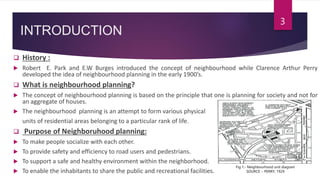
Fig 1:- Neighbourhood unit diagram
SOURCE :- PERRY, 1929
PRINCIPLES OF NEIGHBOURHOOD
PLANNING
 Principles and important features of Neighbourhood planning:
 (a) Size: The town is divided into self-contained units or sectors of 10,000
population. This is further divided into smaller units called neighbourhood
unit with 2,000 to 5,000 . The size of the unit is therefore limited to
about 1 to 1. 5 sq km .
 (b) Boundaries: The unit should be bounded on all its sides by main
road, wide enough for traffic.
 (c) Protective Strips: These are necessary to protect the neighbourhood from annoyance of traffic and, to provide
suitable facilities for developing parks, playgrounds, and road widening scheme in future. These are also called Minor Green
Belts.
 (d) Internal Streets: The internal streets are designed to ensure safety to the people and the school going children in
particular .
4
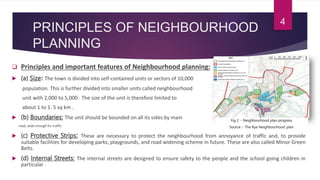
Fig 2 :- Neighbourhood plan progress
Source :- The Rye Neighbourhood plan
MERITS OF NEIGHBOURHOOD
PLANNING
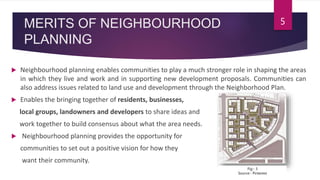
 Neighbourhood planning enables communities to play a much stronger role in shaping the areas
in which they live and work and in supporting new development proposals. Communities can
also address issues related to land use and development through the Neighborhood Plan.
 Enables the bringing together of residents, businesses,
local groups, landowners and developers to share ideas and
work together to build consensus about what the area needs.
 Neighbourhood planning provides the opportunity for
communities to set out a positive vision for how they
want their community.
5
Fig:- 3
Source:- Pinterest
DEMERITS OF NEIGHBOURHOOD
PLANNING
 TOO COSTLY
Sometimes, a major concern for the neighbourhood planning scheme is that it costs too much. The cost of
maintenance and improvement work undertaken annually can be a huge financial burden for less affluent
urban societies.
 TIME TAKEN
Since neighbourhood planning requires the participation of all the residents, it takes a lot of time to plan
and implement. The approval of all the members are required and the positive feedback collected over a
certain period, can prove to be too time consuming.
 FAIR REPRESENTATION OF CITIZENS IS NOT ALWAYS POSSIBLE
It is not always possible to get each and every citizen involved in the neighbourhood planning. This is
especially true in the Indian urban setting where there is lack of awareness in such contexts.
 COMPLEX AND BURDENSOME PROCESS
Certain researchers argue that neighbourhood planning is a complex and burdensome process. It can affect
the lives of the citizens who are involved in this process. It can be troublesome in the less affluent settings.
6
EXAMPLES WITH MODELS OF NEIGHBOURHOOD
PLAN
7
 CRINGLEFORD NHP
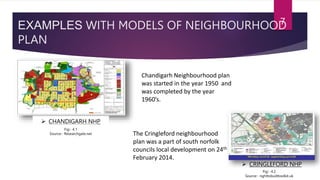
 CHANDIGARH NHP
Chandigarh Neighbourhood plan
was started in the year 1950 and
was completed by the year
1960’s.
Fig:- 4.1
Source:- Researchgate.net The Cringleford neighbourhood
plan was a part of south norfolk
councils local development on 24th
February 2014.
Fig:- 4.2
Source:- righttobuilttoolkit.uk
EXAMPLES WITH MODELS OF
NEIGHBOURHOOD PLAN
8
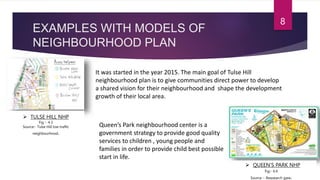
 TULSE HILL NHP
 QUEEN’S PARK NHP
Fig :- 4.3
Source:- Tulse Hill low traffic
neighbourhood.
It was started in the year 2015. The main goal of Tulse Hill
neighbourhood plan is to give communities direct power to develop
a shared vision for their neighbourhood and shape the development
growth of their local area.
Fig:- 4.4
Source :- Reasearch gate.
Queen’s Park neighbourhood center is a
government strategy to provide good quality
services to children , young people and
families in order to provide child best possible
start in life.
CASE STUDY OF NATIONAL
NEIGHBOURHOOD PLAN
9
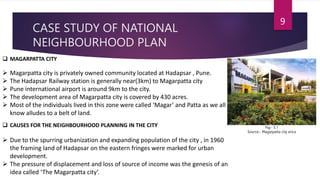
 MAGARPATTA CITY
 Magarpatta city is privately owned community located at Hadapsar , Pune.
 The Hadapsar Railway station is generally near(3km) to Magarpatta city
 Pune international airport is around 9km to the city.
 The development area of Magarpatta city is covered by 430 acres.
 Most of the individuals lived in this zone were called ‘Magar’ and Patta as we all
know alludes to a belt of land.
 CAUSES FOR THE NEIGHBOURHOOD PLANNING IN THE CITY
 Due to the spurring urbanization and expanding population of the city , in 1960
the framing land of Hadapsar on the eastern fringes were marked for urban
development.
 The pressure of displacement and loss of source of income was the genesis of an
idea called ‘The Magarpatta city’.
Fig:- 5.1
Source:- Magarpatta city erica
CASE STUDY OF NATIONAL
NEIGHBOURHOOD PLANNING
 WHO PLANNED THE CITY
 Magarpatta city Planning is conceptualized by Mr.Satish Magar
which entails the idea of Integrated Township.
 The Planning and engineering improvement of the city was
attempted by Associated Space Designers Pvt . Ltd, Pune , under
the stewardship of Ar.Prakash Deshmukh.
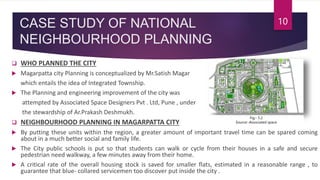
 NEIGHBOURHOOD PLANNING IN MAGARPATTA CITY
 By putting these units within the region, a greater amount of important travel time can be spared coming
about in a much better social and family life.
 The City public schools is put so that students can walk or cycle from their houses in a safe and secure
pedestrian need walkway, a few minutes away from their home.
 A critical rate of the overall housing stock is saved for smaller flats, estimated in a reasonable range , to
guarantee that blue- collared servicemen too discover put inside the city .
10
Fig:- 5.2
Source:-Associated space
CASE STUDY OF NATIONAL
NEIGHBOURHOOD PLANNING
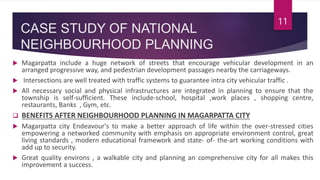
 Magarpatta include a huge network of streets that encourage vehicular development in an
arranged progressive way, and pedestrian development passages nearby the carriageways.
 Intersections are well treated with traffic systems to guarantee intra city vehicular traffic .
 All necessary social and physical infrastructures are integrated in planning to ensure that the
township is self-sufficient. These include-school, hospital ,work places , shopping centre,
restaurants, Banks , Gym, etc.
 BENEFITS AFTER NEIGHBOURHOOD PLANNING IN MAGARPATTA CITY
 Magarpatta city Endeavour's to make a better approach of life within the over-stressed cities
empowering a networked community with emphasis on appropriate environment control, great
living standards , modern educational framework and state- of- the-art working conditions with
add up to security.
 Great quality environs , a walkable city and planning an comprehensive city for all makes this
improvement a success.
11
CASE STUDY OF INTERNATIONAL
NEIGHBOURHOOD PLANNING
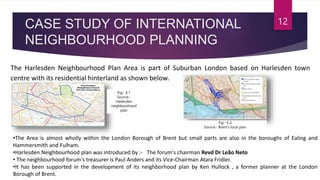
The Harlesden Neighbourhood Plan Area is part of Suburban London based on Harlesden town
centre with its residential hinterland as shown below.
•The Area is almost wholly within the London Borough of Brent but small parts are also in the boroughs of Ealing and
Hammersmith and Fulham.
•Harlesden Neighbourhood plan was introduced by :- The forum's chairman Revd Dr Leão Neto
• The neighbourhood forum's treasurer is Paul Anders and its Vice-Chairman Atara Fridler.
•It has been supported in the development of its neighborhood plan by Ken Hullock , a former planner at the London
Borough of Brent.
12
Fig:- 6.2
Source:- Brent’s local plan
Fig:- 6.1
Source:-
Harlesden
neighbourhood
plan
CASE STUDY OF INTERNATIONAL
NEIGHBOURHOOD PLANNING
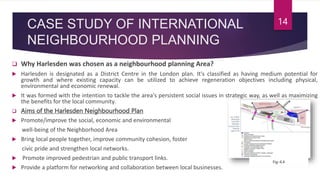
 Approval of Harlesden Neighbourhood Plan
 The designation of Harlesden Neighbourhood Forum and Neighbourhood
Plan Area was approved by Brent Council in August 2015 and by the OPDC
in November 2019.
 The final version of the Plan was produced accordingly and was taken to a
local referendum within 2019. This plan sets out the development of
Harlesden over next 15 years.
13
Fig:- 6.3
Source:- Harlesden neighbourhood
plan
CASE STUDY OF INTERNATIONAL
NEIGHBOURHOOD PLANNING
 Why Harlesden was chosen as a neighbourhood planning Area?
 Harlesden is designated as a District Centre in the London plan. It's classified as having medium potential for
growth and where existing capacity can be utilized to achieve regeneration objectives including physical,
environmental and economic renewal.
 It was formed with the intention to tackle the area's persistent social issues in strategic way, as well as maximizing
the benefits for the local community.
 Aims of the Harlesden Neighbourhood Plan
 Promote/improve the social, economic and environmental
well-being of the Neighborhood Area
 Bring local people together, improve community cohesion, foster
civic pride and strengthen local networks.
 Promote improved pedestrian and public transport links.
 Provide a platform for networking and collaboration between local businesses.
14
Fig:-6.4
MAGARPATTA vs HARLESDEN
NEIGHBOURHOOD PLANNING
Magarpatta neighboruhood planning (Hadapsar, Pune)
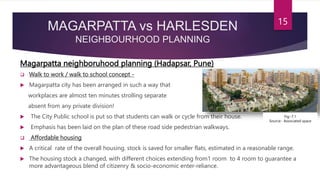
 Walk to work / walk to school concept -
 Magarpatta city has been arranged in such a way that
workplaces are almost ten minutes strolling separate
absent from any private division!
 The City Public school is put so that students can walk or cycle from their house.
 Emphasis has been laid on the plan of these road side pedestrian walkways.
 Affordable housing
 A critical rate of the overall housing. stock is saved for smaller flats, estimated in a reasonable range.
 The housing stock a changed, with different choices extending from1 room to 4 room to guarantee a
more advantageous blend of citizenry & socio-economic enter-reliance.
15
Fig:-7.1
Source:- Associated space
MAGARPATTA vs HARLESDEN
NEIGHBOURHOOD PLANNING
 Access to economical facilities –
 Comfortable live ability feature based on the tried and tested live - Work – Play- learn convention
 Magarpatta City is created around 6 million sq. ft of commercial workplaces .
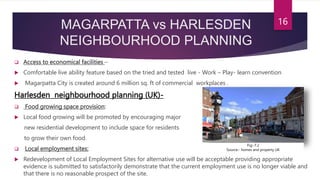
Harlesden neighbourhood planning (UK)-
 Food growing space provision:
 Local food growing will be promoted by encouraging major
new residential development to include space for residents
to grow their own food.
 Local employment sites:
 Redevelopment of Local Employment Sites for alternative use will be acceptable providing appropriate
evidence is submitted to satisfactorily demonstrate that the current employment use is no longer viable and
that there is no reasonable prospect of the site.
16
Fig:-7.2
Source:- homes and property UK
CONCLUSIONS
 Neighbourhood planning provides opportunities to people to communicate.
 Transportation problems have been reduced by providing amenities nearby.
 Communities can also solve problems related to land use and development through neighbourhood
plans.
REFERENCES
 https://www.london.gov.uk/
 https://www.brent.gov.uk/
 Westminster city council
 Patricios Nicholas, "200261_21-32.Pdf," Urban Morphology, Volume 6
 www.irjet.net
 Neighbourhoodplanning@westminster.gov.uk
17
18
THANK YOU

NEIGHBORHOOD PLANNING.2nd Sem.pptx

  • 1.
    NEIGHBOURHOOD PLANNING AND ITSCASE STUDIES PLANNING STUDIO-2 SUBMITTED TO  PARNA SARKHEL  GAYATRI PATI  SWAPNA SWETA SWAIN  SRABANI UPADHYAYA 1 SUBMITTED BY GROUP -1 2nd SEMESTER B.PLAN ODISHA UNIVERSITY OF TECHNOLOGY AND RESEARCH, BHUBANESWAR
  • 2.
    CONTENTS 2 TOPIC PAGE NO. 1.INTRODUCTION 3 2. PRINCIPLES 4 3. MERITS OF NEIGHBOURHOOD PLANNING 5 4. DEMERITS OF NEIGHBOURHOOD PLANNING 6 5. EXAMPLES WITH MODELS 7-8 6. CASE STUDY OF NATIONAL NEIGHBOURHOOD PLANNING 9-11 7. CASE STUDY OF INTERNATIONAL NEIGHBOURHOOD PLANNNG 12-14 8. MAGARPATTA VS HARLESDEN NEIGHBOURHOOD PLANNING 15-16 9. CONCLUSION 17 10. INFERENCES 18
  • 3.
    INTRODUCTION  History : Robert E. Park and E.W Burges introduced the concept of neighbourhood while Clarence Arthur Perry developed the idea of neighbourhood planning in the early 1900’s.  What is neighbourhood planning?  The concept of neighbourhood planning is based on the principle that one is planning for society and not for an aggregate of houses.  The neighbourhood planning is an attempt to form various physical units of residential areas belonging to a particular rank of life.  Purpose of Neighboruhood planning:  To make people socialize with each other.  To provide safety and efficiency to road users and pedestrians.  To support a safe and healthy environment within the neighborhood.  To enable the inhabitants to share the public and recreational facilities. 3 Fig 1:- Neighbourhood unit diagram SOURCE :- PERRY, 1929
  • 4.
    PRINCIPLES OF NEIGHBOURHOOD PLANNING Principles and important features of Neighbourhood planning:  (a) Size: The town is divided into self-contained units or sectors of 10,000 population. This is further divided into smaller units called neighbourhood unit with 2,000 to 5,000 . The size of the unit is therefore limited to about 1 to 1. 5 sq km .  (b) Boundaries: The unit should be bounded on all its sides by main road, wide enough for traffic.  (c) Protective Strips: These are necessary to protect the neighbourhood from annoyance of traffic and, to provide suitable facilities for developing parks, playgrounds, and road widening scheme in future. These are also called Minor Green Belts.  (d) Internal Streets: The internal streets are designed to ensure safety to the people and the school going children in particular . 4 Fig 2 :- Neighbourhood plan progress Source :- The Rye Neighbourhood plan
  • 5.
    MERITS OF NEIGHBOURHOOD PLANNING Neighbourhood planning enables communities to play a much stronger role in shaping the areas in which they live and work and in supporting new development proposals. Communities can also address issues related to land use and development through the Neighborhood Plan.  Enables the bringing together of residents, businesses, local groups, landowners and developers to share ideas and work together to build consensus about what the area needs.  Neighbourhood planning provides the opportunity for communities to set out a positive vision for how they want their community. 5 Fig:- 3 Source:- Pinterest
  • 6.
    DEMERITS OF NEIGHBOURHOOD PLANNING TOO COSTLY Sometimes, a major concern for the neighbourhood planning scheme is that it costs too much. The cost of maintenance and improvement work undertaken annually can be a huge financial burden for less affluent urban societies.  TIME TAKEN Since neighbourhood planning requires the participation of all the residents, it takes a lot of time to plan and implement. The approval of all the members are required and the positive feedback collected over a certain period, can prove to be too time consuming.  FAIR REPRESENTATION OF CITIZENS IS NOT ALWAYS POSSIBLE It is not always possible to get each and every citizen involved in the neighbourhood planning. This is especially true in the Indian urban setting where there is lack of awareness in such contexts.  COMPLEX AND BURDENSOME PROCESS Certain researchers argue that neighbourhood planning is a complex and burdensome process. It can affect the lives of the citizens who are involved in this process. It can be troublesome in the less affluent settings. 6
  • 7.
    EXAMPLES WITH MODELSOF NEIGHBOURHOOD PLAN 7  CRINGLEFORD NHP  CHANDIGARH NHP Chandigarh Neighbourhood plan was started in the year 1950 and was completed by the year 1960’s. Fig:- 4.1 Source:- Researchgate.net The Cringleford neighbourhood plan was a part of south norfolk councils local development on 24th February 2014. Fig:- 4.2 Source:- righttobuilttoolkit.uk
  • 8.
    EXAMPLES WITH MODELSOF NEIGHBOURHOOD PLAN 8  TULSE HILL NHP  QUEEN’S PARK NHP Fig :- 4.3 Source:- Tulse Hill low traffic neighbourhood. It was started in the year 2015. The main goal of Tulse Hill neighbourhood plan is to give communities direct power to develop a shared vision for their neighbourhood and shape the development growth of their local area. Fig:- 4.4 Source :- Reasearch gate. Queen’s Park neighbourhood center is a government strategy to provide good quality services to children , young people and families in order to provide child best possible start in life.
  • 9.
    CASE STUDY OFNATIONAL NEIGHBOURHOOD PLAN 9  MAGARPATTA CITY  Magarpatta city is privately owned community located at Hadapsar , Pune.  The Hadapsar Railway station is generally near(3km) to Magarpatta city  Pune international airport is around 9km to the city.  The development area of Magarpatta city is covered by 430 acres.  Most of the individuals lived in this zone were called ‘Magar’ and Patta as we all know alludes to a belt of land.  CAUSES FOR THE NEIGHBOURHOOD PLANNING IN THE CITY  Due to the spurring urbanization and expanding population of the city , in 1960 the framing land of Hadapsar on the eastern fringes were marked for urban development.  The pressure of displacement and loss of source of income was the genesis of an idea called ‘The Magarpatta city’. Fig:- 5.1 Source:- Magarpatta city erica
  • 10.
    CASE STUDY OFNATIONAL NEIGHBOURHOOD PLANNING  WHO PLANNED THE CITY  Magarpatta city Planning is conceptualized by Mr.Satish Magar which entails the idea of Integrated Township.  The Planning and engineering improvement of the city was attempted by Associated Space Designers Pvt . Ltd, Pune , under the stewardship of Ar.Prakash Deshmukh.  NEIGHBOURHOOD PLANNING IN MAGARPATTA CITY  By putting these units within the region, a greater amount of important travel time can be spared coming about in a much better social and family life.  The City public schools is put so that students can walk or cycle from their houses in a safe and secure pedestrian need walkway, a few minutes away from their home.  A critical rate of the overall housing stock is saved for smaller flats, estimated in a reasonable range , to guarantee that blue- collared servicemen too discover put inside the city . 10 Fig:- 5.2 Source:-Associated space
  • 11.
    CASE STUDY OFNATIONAL NEIGHBOURHOOD PLANNING  Magarpatta include a huge network of streets that encourage vehicular development in an arranged progressive way, and pedestrian development passages nearby the carriageways.  Intersections are well treated with traffic systems to guarantee intra city vehicular traffic .  All necessary social and physical infrastructures are integrated in planning to ensure that the township is self-sufficient. These include-school, hospital ,work places , shopping centre, restaurants, Banks , Gym, etc.  BENEFITS AFTER NEIGHBOURHOOD PLANNING IN MAGARPATTA CITY  Magarpatta city Endeavour's to make a better approach of life within the over-stressed cities empowering a networked community with emphasis on appropriate environment control, great living standards , modern educational framework and state- of- the-art working conditions with add up to security.  Great quality environs , a walkable city and planning an comprehensive city for all makes this improvement a success. 11
  • 12.
    CASE STUDY OFINTERNATIONAL NEIGHBOURHOOD PLANNING The Harlesden Neighbourhood Plan Area is part of Suburban London based on Harlesden town centre with its residential hinterland as shown below. •The Area is almost wholly within the London Borough of Brent but small parts are also in the boroughs of Ealing and Hammersmith and Fulham. •Harlesden Neighbourhood plan was introduced by :- The forum's chairman Revd Dr Leão Neto • The neighbourhood forum's treasurer is Paul Anders and its Vice-Chairman Atara Fridler. •It has been supported in the development of its neighborhood plan by Ken Hullock , a former planner at the London Borough of Brent. 12 Fig:- 6.2 Source:- Brent’s local plan Fig:- 6.1 Source:- Harlesden neighbourhood plan
  • 13.
    CASE STUDY OFINTERNATIONAL NEIGHBOURHOOD PLANNING  Approval of Harlesden Neighbourhood Plan  The designation of Harlesden Neighbourhood Forum and Neighbourhood Plan Area was approved by Brent Council in August 2015 and by the OPDC in November 2019.  The final version of the Plan was produced accordingly and was taken to a local referendum within 2019. This plan sets out the development of Harlesden over next 15 years. 13 Fig:- 6.3 Source:- Harlesden neighbourhood plan
  • 14.
    CASE STUDY OFINTERNATIONAL NEIGHBOURHOOD PLANNING  Why Harlesden was chosen as a neighbourhood planning Area?  Harlesden is designated as a District Centre in the London plan. It's classified as having medium potential for growth and where existing capacity can be utilized to achieve regeneration objectives including physical, environmental and economic renewal.  It was formed with the intention to tackle the area's persistent social issues in strategic way, as well as maximizing the benefits for the local community.  Aims of the Harlesden Neighbourhood Plan  Promote/improve the social, economic and environmental well-being of the Neighborhood Area  Bring local people together, improve community cohesion, foster civic pride and strengthen local networks.  Promote improved pedestrian and public transport links.  Provide a platform for networking and collaboration between local businesses. 14 Fig:-6.4
  • 15.
    MAGARPATTA vs HARLESDEN NEIGHBOURHOODPLANNING Magarpatta neighboruhood planning (Hadapsar, Pune)  Walk to work / walk to school concept -  Magarpatta city has been arranged in such a way that workplaces are almost ten minutes strolling separate absent from any private division!  The City Public school is put so that students can walk or cycle from their house.  Emphasis has been laid on the plan of these road side pedestrian walkways.  Affordable housing  A critical rate of the overall housing. stock is saved for smaller flats, estimated in a reasonable range.  The housing stock a changed, with different choices extending from1 room to 4 room to guarantee a more advantageous blend of citizenry & socio-economic enter-reliance. 15 Fig:-7.1 Source:- Associated space
  • 16.
    MAGARPATTA vs HARLESDEN NEIGHBOURHOODPLANNING  Access to economical facilities –  Comfortable live ability feature based on the tried and tested live - Work – Play- learn convention  Magarpatta City is created around 6 million sq. ft of commercial workplaces . Harlesden neighbourhood planning (UK)-  Food growing space provision:  Local food growing will be promoted by encouraging major new residential development to include space for residents to grow their own food.  Local employment sites:  Redevelopment of Local Employment Sites for alternative use will be acceptable providing appropriate evidence is submitted to satisfactorily demonstrate that the current employment use is no longer viable and that there is no reasonable prospect of the site. 16 Fig:-7.2 Source:- homes and property UK
  • 17.
    CONCLUSIONS  Neighbourhood planningprovides opportunities to people to communicate.  Transportation problems have been reduced by providing amenities nearby.  Communities can also solve problems related to land use and development through neighbourhood plans. REFERENCES  https://www.london.gov.uk/  https://www.brent.gov.uk/  Westminster city council  Patricios Nicholas, "200261_21-32.Pdf," Urban Morphology, Volume 6  www.irjet.net  Neighbourhoodplanning@westminster.gov.uk 17
  • 18.