ASTHMA
BY
DR Olubayode Akinbi
• Definition
• Asthma triggers
• Signs and Symptoms
• Pathogenesis
• Types
• Diagnose
• Management
Definition
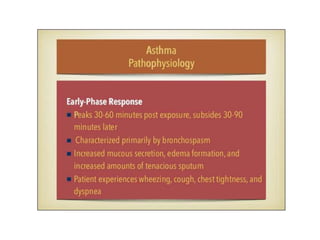
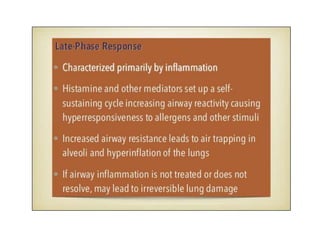
A reversible chronic inflammatory airway
disease that is characterized by bronchial hyper-
responsiveness of the airways to various stimuli
leading to wide spread bronchoconstriction,
airflow limitation and inflammation of the
bronchi causing symptoms of cough, wheeze,
chest tightness and dyspnea.
EPIDEMIOLOGY
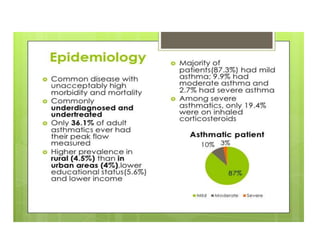
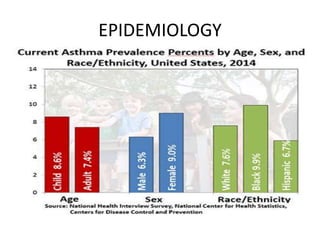
• Asthma affects 5-10% of the population or an
estimated 23.4 million persons, including 7 million
children.
• Annually, WHO has estimated that 15 million
disability-adjusted life-years are lost and 250,000
asthma deaths are reported worldwide
• Asthma predominantly occurs in boys in childhood,
with a male-to-female ratio of 2:1 until puberty, when
the male-to-female ratio becomes 1:1.
• Asthma prevalence is greater in females after puberty,
and the majority of adult-onset cases diagnosed in
persons older than 40 years occur in females.
EPIDEMIOLOGY
Activators/Triggers
• Allergens such as pollen, dust mites,
cockroaches, and cat dander.
• Infection and cold air
• Emotional stress or Exercise and occupation
• Catamenial ( related to menstrual cycle)
• Aspirin,NSAIDS, beta blockers, histamine, any
nebulized medication, tobacco smoke
• Gastroesophageal reflux disease (GERD)
Early warning signs
• Cough
• Mood Changes
• Change in facial
appearance
• Breathing changes
• Verbal complaints
• Itchy chin or neck
• Itchy, watery, or
glassy eyes
• Runny nose
• Head stopped up
• Sneezing
• Dark Circles under
eyes
• Getting out of
breath
• Chest hurts
Symptoms of Asthma Flare-up
• Cough
• Wheeze
• Shortness of breath
• Chest tightness
• Retractions
• Symptoms worse at night
• Eczema or atopic dermatitis on physical
examination
• Increased length of expiratory phase of
respiration
• Increased use of accessory respiratory muscles
(e.g intercostals)
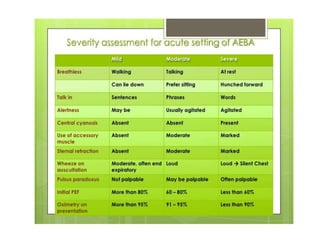
Asthma Classification
The National Asthma Education and Prevention
Program has classified asthma as:
• Intermittent.
• Mild persistent.
• Moderate persistent.
• Severe persistent.
These classifications are based on severity, which is
determined by symptoms and lung function tests
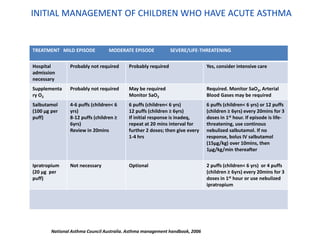
INITIAL MANAGEMENT OF CHILDREN WHO HAVE ACUTE ASTHMA
TREATMENT MILD EPISODE MODERATE EPISODE SEVERE/LIFE-THREATENING
Hospital
admission
necessary
Probably not required Probably required Yes, consider intensive care
Supplementa
ry O2
Probably not required May be required
Monitor SaO2
Required. Monitor SaO2, Arterial
Blood Gases may be required
Salbutamol
(100 µg per
puff)
4-6 puffs (children< 6
yrs)
8-12 puffs (children ≥
6yrs)
Review in 20mins
6 puffs (children< 6 yrs)
12 puffs (children ≥ 6yrs)
If initial response is inadeq,
repeat at 20 mins interval for
further 2 doses; then give every
1-4 hrs
6 puffs (children< 6 yrs) or 12 puffs
(children ≥ 6yrs) every 20mins for 3
doses in 1st hour. If episode is life-
threatening, use continous
nebulized salbutamol. If no
response, bolus IV salbutamol
(15µg/kg) over 10mins, then
1µg/kg/min thereafter
Ipratropium
(20 µg per
puff)
Not necessary Optional 2 puffs (children< 6 yrs) or 4 puffs
(children ≥ 6yrs) every 20mins for 3
doses in 1st hour or use nebulized
ipratropium
National Asthma Council Australia. Asthma management handbook, 2006
INITIAL MANAGEMENT OF CHILDREN WHO HAVE
ACUTE ASTHMA Contd
TREATMENT MILD EPISODE MODERATE EPISODE SEVERE/ LIFE-
THREATENING
Systemic
corticosteroids
Yes (consider) Oral prednisolone (1mg/kg daily
for up to 3 days)
Oral prednisolone (1mg/kg/dose)
daily for up to 5 days
Methylprednisolone IV (1mg/kg)
every 6hrs on day 1, every 12hrs on
day 2, then daily
Magnesium No No MgSO4 50% 0.1mL/kg (50mg/kg) IV
over 20mins, then 0.06 mL/kg/h
(30mg/kg/h); target serum 1.5-2.5
mmol/L
Aminophylline No No Only in ICU; loading dose 10mg/kg;
maintanance 1.1mg/kg/h if < 9 yrs
or 0.7mg/kg/h if ≥ 9yrs
Chest radiograph Not necessary unless
focal signs present
Not necessary unless focal signs
present
Necessary if no response to initial
therapy or pnuemothorax is
suspected
Observations Observe for 20mins
after dose
Observe for 1 hour after last dose Arrange for admission to hospital
National Asthma Council Australia. Asthma management handbook, 2006
THANK YOU

Asthma

  • 1.
  • 2.
    • Definition • Asthmatriggers • Signs and Symptoms • Pathogenesis • Types • Diagnose • Management
  • 3.
    Definition A reversible chronicinflammatory airway disease that is characterized by bronchial hyper- responsiveness of the airways to various stimuli leading to wide spread bronchoconstriction, airflow limitation and inflammation of the bronchi causing symptoms of cough, wheeze, chest tightness and dyspnea.
  • 6.
    EPIDEMIOLOGY • Asthma affects5-10% of the population or an estimated 23.4 million persons, including 7 million children. • Annually, WHO has estimated that 15 million disability-adjusted life-years are lost and 250,000 asthma deaths are reported worldwide • Asthma predominantly occurs in boys in childhood, with a male-to-female ratio of 2:1 until puberty, when the male-to-female ratio becomes 1:1. • Asthma prevalence is greater in females after puberty, and the majority of adult-onset cases diagnosed in persons older than 40 years occur in females.
  • 7.
  • 9.
    Activators/Triggers • Allergens suchas pollen, dust mites, cockroaches, and cat dander. • Infection and cold air • Emotional stress or Exercise and occupation • Catamenial ( related to menstrual cycle) • Aspirin,NSAIDS, beta blockers, histamine, any nebulized medication, tobacco smoke • Gastroesophageal reflux disease (GERD)
  • 10.
    Early warning signs •Cough • Mood Changes • Change in facial appearance • Breathing changes • Verbal complaints • Itchy chin or neck • Itchy, watery, or glassy eyes • Runny nose • Head stopped up • Sneezing • Dark Circles under eyes • Getting out of breath • Chest hurts
  • 11.
    Symptoms of AsthmaFlare-up • Cough • Wheeze • Shortness of breath • Chest tightness • Retractions
  • 12.
    • Symptoms worseat night • Eczema or atopic dermatitis on physical examination • Increased length of expiratory phase of respiration • Increased use of accessory respiratory muscles (e.g intercostals)
  • 17.
    Asthma Classification The NationalAsthma Education and Prevention Program has classified asthma as: • Intermittent. • Mild persistent. • Moderate persistent. • Severe persistent. These classifications are based on severity, which is determined by symptoms and lung function tests
  • 32.
    INITIAL MANAGEMENT OFCHILDREN WHO HAVE ACUTE ASTHMA TREATMENT MILD EPISODE MODERATE EPISODE SEVERE/LIFE-THREATENING Hospital admission necessary Probably not required Probably required Yes, consider intensive care Supplementa ry O2 Probably not required May be required Monitor SaO2 Required. Monitor SaO2, Arterial Blood Gases may be required Salbutamol (100 µg per puff) 4-6 puffs (children< 6 yrs) 8-12 puffs (children ≥ 6yrs) Review in 20mins 6 puffs (children< 6 yrs) 12 puffs (children ≥ 6yrs) If initial response is inadeq, repeat at 20 mins interval for further 2 doses; then give every 1-4 hrs 6 puffs (children< 6 yrs) or 12 puffs (children ≥ 6yrs) every 20mins for 3 doses in 1st hour. If episode is life- threatening, use continous nebulized salbutamol. If no response, bolus IV salbutamol (15µg/kg) over 10mins, then 1µg/kg/min thereafter Ipratropium (20 µg per puff) Not necessary Optional 2 puffs (children< 6 yrs) or 4 puffs (children ≥ 6yrs) every 20mins for 3 doses in 1st hour or use nebulized ipratropium National Asthma Council Australia. Asthma management handbook, 2006
  • 33.
    INITIAL MANAGEMENT OFCHILDREN WHO HAVE ACUTE ASTHMA Contd TREATMENT MILD EPISODE MODERATE EPISODE SEVERE/ LIFE- THREATENING Systemic corticosteroids Yes (consider) Oral prednisolone (1mg/kg daily for up to 3 days) Oral prednisolone (1mg/kg/dose) daily for up to 5 days Methylprednisolone IV (1mg/kg) every 6hrs on day 1, every 12hrs on day 2, then daily Magnesium No No MgSO4 50% 0.1mL/kg (50mg/kg) IV over 20mins, then 0.06 mL/kg/h (30mg/kg/h); target serum 1.5-2.5 mmol/L Aminophylline No No Only in ICU; loading dose 10mg/kg; maintanance 1.1mg/kg/h if < 9 yrs or 0.7mg/kg/h if ≥ 9yrs Chest radiograph Not necessary unless focal signs present Not necessary unless focal signs present Necessary if no response to initial therapy or pnuemothorax is suspected Observations Observe for 20mins after dose Observe for 1 hour after last dose Arrange for admission to hospital National Asthma Council Australia. Asthma management handbook, 2006
  • 37.