The Wisconsin 
Public Service Commission 
Introduces: 
Broadband Expansion Grant 
Workshop
Presenters: 
Jill Hietpas, UWEX Broadband Educator 
Jill.hietpas@ces.uwex.edu 
Frank Livermore, Livermore Technologies 
frank.livermore@livermoretechnologies.com 
Maria Alvarez-Stroud, Director 
UWEX Broadband & Ecommerce Education Center 
maria.alvarez-stroud@uwex.uwc.edu
Today’s Objectives 
• Review the Grant Requirements 
• Address Possible Technology Solutions and Opportunities 
for Your Unserved Areas 
• Look at the “Ingredients for Success” for round one grants 
and guidelines for round 2 success 
• Engage Providers as Partners and Ways to Build on the 
Public/Private requirement 
• Utilize the Broadband & E-Commerce Education Center as 
a Resource
Set by statute: expectation that 
you’ll demonstrate a clear and 
achievable plan (Wis. Stat. 196.504)
Overview of Grant Requirements 
Overall Goal: increase subscribership by 
providing construction of broadband facilities. 
Minimum expectation of 3 mbps download & 
768 kbps for upload 
Demonstrate “underserved” areas 
By Census Block Map or 
By other means: data, demand, etc.
If you are a public entity: 
You need a Private Partner
Project Description 
Include the following: 
A map and description of the area of the state 
affected 
 Explanation how the project will increase 
broadband access 
 Last mile, middle mile or backbone? 
 Service described including speeds & technology 
 A Schedule
PSC Resources/Data Collection 
Tools 
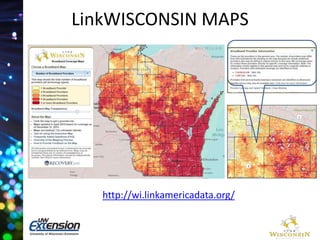
• LinkWISCONSIN Maps 
• Bandwidth Assessment Tool for Data 
Collection 
• Demand Survey Data 
• LinkWISCONSIN Website 
– http://linkwisconsin.org/lwi/default.aspx?page 
=8
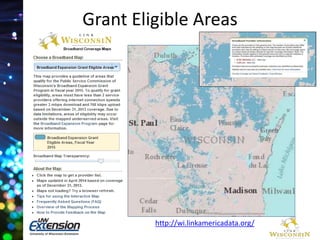
Grant Eligible Areas 
http://wi.linkamericadata.org/
LinkWISCONSIN MAPS 
http://wi.linkamericadata.org/
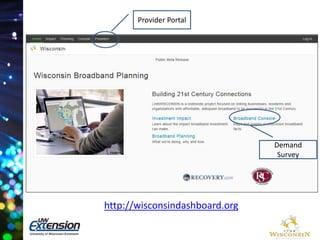
Provider Portal 
http://wisconsindashboard.org 
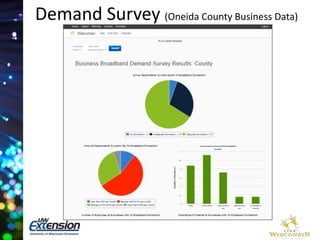
Demand 
Survey
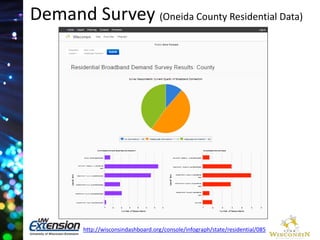
Demand Survey (Oneida County Residential Data) 
http://wisconsindashboard.org/console/infograph/state/residential/085
Demand Survey (Oneida County Business Data)
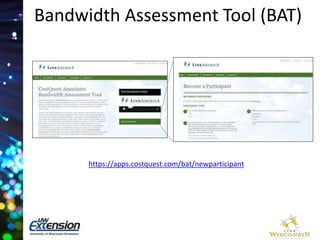
Bandwidth Assessment Tool (BAT) 
https://apps.costquest.com/bat/newparticipant
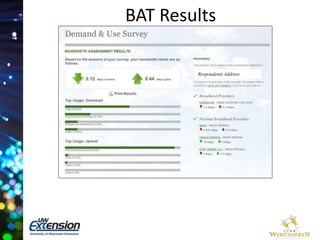
BAT Results 
Respondents Address
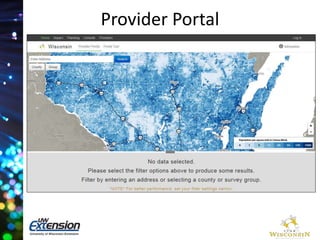
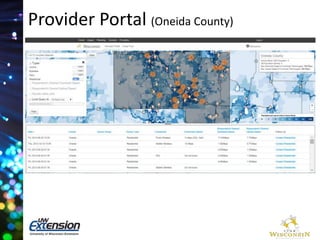
Provider Portal
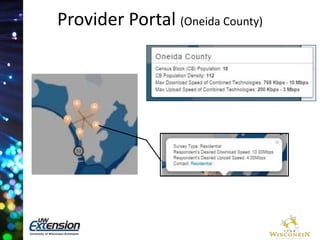
Provider Portal (Oneida County)
Include a Budget 
• AN ITEMIZED STATEMENT of the investment & 
construction costs proposed. 
– Equipment purchases, Labor, Salary info., Training expenses 
– Owned, rented or leased? 
• Requirements: This is not a subsidy and funds can 
only be used for construction in your proposed area. 
– Note the allowable list of items (page 7)
Priority Factors & Evaluation Criteria 
• 1. Matching Funds - Cash, salary or in-kind? 
• 2. Apparent Public-private partnerships 
• 3. Existing broadband service for your proposed area 
 Includes overlapping providers of footprint: address the overlap 
• 4. Project Impact 
 Geographic area, population, including likely users: 
business and residential
Possible Added Scoring Criteria 
• Number of persons served compared to others 
• Download and upload speeds 
• Secondary benefits of the project
Proposal Submission 
• October 13, 2014 Applications due by 4pm 
• http://psc.wi.gov/apps35/ERF_upload/conten 
t/mymenu.aspx 
Select “Existing Docket” (public or confidential) 
Docket Number -5-GT-100 
ERF description is “Broadband Expansion Grant 
Program” 
Must be electronically submitted!
The Process 
A Screening Panel 
• Recommendations to 
the Commission 
• Recommendations by 
grant priority factors 
• Proposals are ranked 
• Non-binding 
The PSC Commission 
• Screen Panel’s 
recommendations are a 
starting point 
• Review proposals as 
well 
• Also rank proposals and 
make final 
determination
Broadband Expansion Grant 
Awards of FY 2014
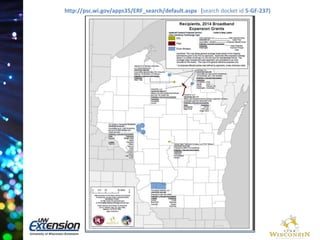
http://psc.wi.gov/apps35/ERF_search/default.aspx (search docket id 5-GF-237)
Some Observations: 
• Technology agnostic: from DSL to Wireless to Fiber 
• Funding range between $14,000 to $140,000 
• Unserved areas (or those without broadband ) were 
found to be rated higher in importance than 
underserved areas 
• Matching funds or other investments showing 
financial commitment were important 
• Supporting documents to consider
Public Partners Included: 
• Municipalities 
• County Economic Development Corporations 
• Townships 
• Regional Economic Development Corporations 
• Community Area Network with hospitals
Possible Solutions 
The Technology
Solutions Start With Questions 
• How rural is your community? 
• What is your last-mile broadband speed goal? 
• What is your anticipated market penetration? 
• What is your topology and geology for your area? 
• What is your budget and/or cost sharing 
opportunities? 
• Can you obtain access to existing duct and/or 
towers in favorable locations? 
• Do you have existing fiber or tower sites now?
Popular Broadband Technologies 
• Fiber-optic cable 
• Performance: High 
• Reliability: High 
• Cost: High 
• Maintenance: Low 
• Digital Subscriber Line 
• Performance: Moderate 
• Reliability: Moderate/High 
• Cost: Low (Compared to Fiber) 
• Maintenance: Moderate 
• Cable 
• Performance: High 
• Reliability: Moderate 
• Cost: Varies (Whether new or existing HFC) 
• Maintenance: Moderate
Other Broadband Technologies 
• Broadband Over Power Line (BPL) 
• Performance: Moderate/High 
• Reliability: Moderate 
• Cost: Moderate/High 
• Maintenance: Low/Moderate 
• Satellite 
• Performance: Low/Moderate, Latency Issues 
• Reliability: Moderate, Environmental Issues 
• Cost: Moderate to High 
• Maintenance: Low 
• T1, T3 
• Performance: Low and Moderate Respectively 
• Reliability: Moderate/High 
• Cost: High (Compared To Other Technologies) 
• Maintenance: Low
Wireless Broadband 
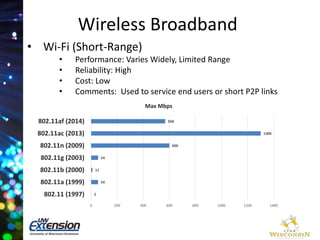
• Wi-Fi (Short-Range) 
• Performance: Varies Widely, Limited Range 
• Reliability: High 
• Cost: Low 
• Comments: Used to service end users or short P2P links 
2 
54 
11 
54 
600 
1300 
568 
0 200 400 600 800 1000 1200 1400 
802.11af (2014) 
802.11ac (2013) 
802.11n (2009) 
802.11g (2003) 
802.11b (2000) 
802.11a (1999) 
802.11 (1997) 
Max Mbps
Wireless Broadband 
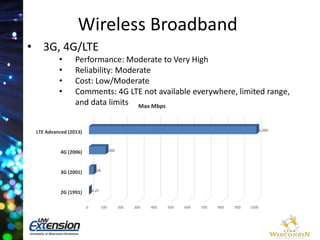
• 3G, 4G/LTE 
• Performance: Moderate to Very High 
• Reliability: Moderate 
• Cost: Low/Moderate 
• Comments: 4G LTE not available everywhere, limited range, 
and data limits 
28 
0 100 200 300 400 500 600 700 800 900 1000 
LTE Advanced (2013) 
4G (2006) 
3G (2001) 
2G (1991) 
0.25 
100 
1,000 
Max Mbps
Wireless Broadband 
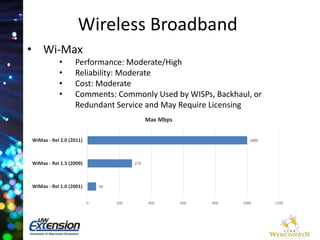
• Wi-Max 
• Performance: Moderate/High 
• Reliability: Moderate 
• Cost: Moderate 
• Comments: Commonly Used by WISPs, Backhaul, or 
Redundant Service and May Require Licensing 
54 
279 
1000 
0 200 400 600 800 1000 1200 
WiMax - Rel 2.0 (2011) 
WiMax - Rel 1.5 (2009) 
WiMax - Rel 1.0 (2001) 
Max Mbps
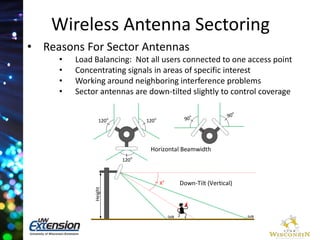
Wireless Antenna Sectoring 
• Reasons For Sector Antennas 
• Load Balancing: Not all users connected to one access point 
• Concentrating signals in areas of specific interest 
• Working around neighboring interference problems 
• Sector antennas are down-tilted slightly to control coverage 
120o 
120o 
120o 
_ 
Horizontal Beamwidth 
Xo 
Height 
Down-Tilt (Vertical) 
-3dB -3dB
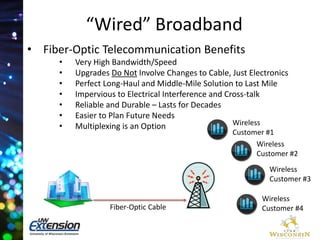
“Wired” Broadband 
• Fiber-Optic Telecommunication Benefits 
• Very High Bandwidth/Speed 
• Upgrades Do Not Involve Changes to Cable, Just Electronics 
• Perfect Long-Haul and Middle-Mile Solution to Last Mile 
• Impervious to Electrical Interference and Cross-talk 
• Reliable and Durable – Lasts for Decades 
• Easier to Plan Future Needs 
• Multiplexing is an Option Wireless 
Customer #1 
Wireless 
Customer #2 
Wireless 
Customer #3 
Wireless 
Fiber-Optic Cable Customer #4
“Wired” Broadband 
• Digital Subscriber Line Benefits 
• Good Speed, Higher Speeds Possible (Up To 100Mbps Short- 
Distance) 
• Can Use Existing Lines (Assuming They are in Good Shape) 
• Up to 18,000’ Last Mile Service From CO 
• Not a Shared Medium Like Cable 
• Is Often Times Bundled With Landline Telephone (Can be Naked) 
• Cost to Consumer 
• Cable Modem Benefits 
• Very Good Speed, Offerings Exceeding 100Mbps 
• Can Use Existing Cable, Hardware Upgrades Needed 
• Cable Infrastructure Located in Higher Population Areas 
• “Always On” Service, Turn On and Use 
• Triple-Play Packages Very Common
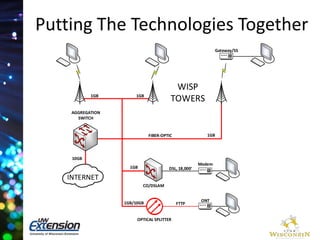
Putting The Technologies Together 
WISP 
TOWERS 
FIBER-OPTIC 
1GB 1GB 
CO/DSLAM 
DSL, 18,000' 
AGGREGATION 
SWITCH 
INTERNET 
1GB 
1GB 
10GB 
1GB/10GB FTTP 
OPTICAL SPLITTER 
Modem 
ONT 
Gateway/SS
Public – Private Partnerships 
Open Discussion
Reminders 
• Deadline for Questions Concerning the Grant 
Application: September 25th 
– Email: PSCstatebroadbandoffice@wisconsin.gov 
– Subject Line: Broadband Expansion Grant Application 
Question 
• Grant Deadline of October 13, 2014 at 4:00pm Central 
Time 
• Posting of Q&A’s and all packet materials on 
http://WIBroadband.org 
• Here to assist – steer you in the right direction

Broadband Grant Workshop - PSC (Oneida County)

  • 1.
    The Wisconsin PublicService Commission Introduces: Broadband Expansion Grant Workshop
  • 2.
    Presenters: Jill Hietpas,UWEX Broadband Educator Jill.hietpas@ces.uwex.edu Frank Livermore, Livermore Technologies frank.livermore@livermoretechnologies.com Maria Alvarez-Stroud, Director UWEX Broadband & Ecommerce Education Center maria.alvarez-stroud@uwex.uwc.edu
  • 3.
    Today’s Objectives •Review the Grant Requirements • Address Possible Technology Solutions and Opportunities for Your Unserved Areas • Look at the “Ingredients for Success” for round one grants and guidelines for round 2 success • Engage Providers as Partners and Ways to Build on the Public/Private requirement • Utilize the Broadband & E-Commerce Education Center as a Resource
  • 4.
    Set by statute:expectation that you’ll demonstrate a clear and achievable plan (Wis. Stat. 196.504)
  • 5.
    Overview of GrantRequirements Overall Goal: increase subscribership by providing construction of broadband facilities. Minimum expectation of 3 mbps download & 768 kbps for upload Demonstrate “underserved” areas By Census Block Map or By other means: data, demand, etc.
  • 6.
    If you area public entity: You need a Private Partner
  • 7.
    Project Description Includethe following: A map and description of the area of the state affected  Explanation how the project will increase broadband access  Last mile, middle mile or backbone?  Service described including speeds & technology  A Schedule
  • 8.
    PSC Resources/Data Collection Tools • LinkWISCONSIN Maps • Bandwidth Assessment Tool for Data Collection • Demand Survey Data • LinkWISCONSIN Website – http://linkwisconsin.org/lwi/default.aspx?page =8
  • 9.
    Grant Eligible Areas http://wi.linkamericadata.org/
  • 10.
  • 11.
  • 12.
    Demand Survey (OneidaCounty Residential Data) http://wisconsindashboard.org/console/infograph/state/residential/085
  • 13.
    Demand Survey (OneidaCounty Business Data)
  • 14.
    Bandwidth Assessment Tool(BAT) https://apps.costquest.com/bat/newparticipant
  • 15.
  • 16.
  • 17.
  • 18.
  • 20.
    Include a Budget • AN ITEMIZED STATEMENT of the investment & construction costs proposed. – Equipment purchases, Labor, Salary info., Training expenses – Owned, rented or leased? • Requirements: This is not a subsidy and funds can only be used for construction in your proposed area. – Note the allowable list of items (page 7)
  • 21.
    Priority Factors &Evaluation Criteria • 1. Matching Funds - Cash, salary or in-kind? • 2. Apparent Public-private partnerships • 3. Existing broadband service for your proposed area  Includes overlapping providers of footprint: address the overlap • 4. Project Impact  Geographic area, population, including likely users: business and residential
  • 22.
    Possible Added ScoringCriteria • Number of persons served compared to others • Download and upload speeds • Secondary benefits of the project
  • 23.
    Proposal Submission •October 13, 2014 Applications due by 4pm • http://psc.wi.gov/apps35/ERF_upload/conten t/mymenu.aspx Select “Existing Docket” (public or confidential) Docket Number -5-GT-100 ERF description is “Broadband Expansion Grant Program” Must be electronically submitted!
  • 24.
    The Process AScreening Panel • Recommendations to the Commission • Recommendations by grant priority factors • Proposals are ranked • Non-binding The PSC Commission • Screen Panel’s recommendations are a starting point • Review proposals as well • Also rank proposals and make final determination
  • 25.
    Broadband Expansion Grant Awards of FY 2014
  • 26.
  • 27.
    Some Observations: •Technology agnostic: from DSL to Wireless to Fiber • Funding range between $14,000 to $140,000 • Unserved areas (or those without broadband ) were found to be rated higher in importance than underserved areas • Matching funds or other investments showing financial commitment were important • Supporting documents to consider
  • 28.
    Public Partners Included: • Municipalities • County Economic Development Corporations • Townships • Regional Economic Development Corporations • Community Area Network with hospitals
  • 29.
  • 30.
    Solutions Start WithQuestions • How rural is your community? • What is your last-mile broadband speed goal? • What is your anticipated market penetration? • What is your topology and geology for your area? • What is your budget and/or cost sharing opportunities? • Can you obtain access to existing duct and/or towers in favorable locations? • Do you have existing fiber or tower sites now?
  • 31.
    Popular Broadband Technologies • Fiber-optic cable • Performance: High • Reliability: High • Cost: High • Maintenance: Low • Digital Subscriber Line • Performance: Moderate • Reliability: Moderate/High • Cost: Low (Compared to Fiber) • Maintenance: Moderate • Cable • Performance: High • Reliability: Moderate • Cost: Varies (Whether new or existing HFC) • Maintenance: Moderate
  • 32.
    Other Broadband Technologies • Broadband Over Power Line (BPL) • Performance: Moderate/High • Reliability: Moderate • Cost: Moderate/High • Maintenance: Low/Moderate • Satellite • Performance: Low/Moderate, Latency Issues • Reliability: Moderate, Environmental Issues • Cost: Moderate to High • Maintenance: Low • T1, T3 • Performance: Low and Moderate Respectively • Reliability: Moderate/High • Cost: High (Compared To Other Technologies) • Maintenance: Low
  • 33.
    Wireless Broadband •Wi-Fi (Short-Range) • Performance: Varies Widely, Limited Range • Reliability: High • Cost: Low • Comments: Used to service end users or short P2P links 2 54 11 54 600 1300 568 0 200 400 600 800 1000 1200 1400 802.11af (2014) 802.11ac (2013) 802.11n (2009) 802.11g (2003) 802.11b (2000) 802.11a (1999) 802.11 (1997) Max Mbps
  • 34.
    Wireless Broadband •3G, 4G/LTE • Performance: Moderate to Very High • Reliability: Moderate • Cost: Low/Moderate • Comments: 4G LTE not available everywhere, limited range, and data limits 28 0 100 200 300 400 500 600 700 800 900 1000 LTE Advanced (2013) 4G (2006) 3G (2001) 2G (1991) 0.25 100 1,000 Max Mbps
  • 35.
    Wireless Broadband •Wi-Max • Performance: Moderate/High • Reliability: Moderate • Cost: Moderate • Comments: Commonly Used by WISPs, Backhaul, or Redundant Service and May Require Licensing 54 279 1000 0 200 400 600 800 1000 1200 WiMax - Rel 2.0 (2011) WiMax - Rel 1.5 (2009) WiMax - Rel 1.0 (2001) Max Mbps
  • 36.
    Wireless Antenna Sectoring • Reasons For Sector Antennas • Load Balancing: Not all users connected to one access point • Concentrating signals in areas of specific interest • Working around neighboring interference problems • Sector antennas are down-tilted slightly to control coverage 120o 120o 120o _ Horizontal Beamwidth Xo Height Down-Tilt (Vertical) -3dB -3dB
  • 37.
    “Wired” Broadband •Fiber-Optic Telecommunication Benefits • Very High Bandwidth/Speed • Upgrades Do Not Involve Changes to Cable, Just Electronics • Perfect Long-Haul and Middle-Mile Solution to Last Mile • Impervious to Electrical Interference and Cross-talk • Reliable and Durable – Lasts for Decades • Easier to Plan Future Needs • Multiplexing is an Option Wireless Customer #1 Wireless Customer #2 Wireless Customer #3 Wireless Fiber-Optic Cable Customer #4
  • 38.
    “Wired” Broadband •Digital Subscriber Line Benefits • Good Speed, Higher Speeds Possible (Up To 100Mbps Short- Distance) • Can Use Existing Lines (Assuming They are in Good Shape) • Up to 18,000’ Last Mile Service From CO • Not a Shared Medium Like Cable • Is Often Times Bundled With Landline Telephone (Can be Naked) • Cost to Consumer • Cable Modem Benefits • Very Good Speed, Offerings Exceeding 100Mbps • Can Use Existing Cable, Hardware Upgrades Needed • Cable Infrastructure Located in Higher Population Areas • “Always On” Service, Turn On and Use • Triple-Play Packages Very Common
  • 39.
    Putting The TechnologiesTogether WISP TOWERS FIBER-OPTIC 1GB 1GB CO/DSLAM DSL, 18,000' AGGREGATION SWITCH INTERNET 1GB 1GB 10GB 1GB/10GB FTTP OPTICAL SPLITTER Modem ONT Gateway/SS
  • 40.
    Public – PrivatePartnerships Open Discussion
  • 41.
    Reminders • Deadlinefor Questions Concerning the Grant Application: September 25th – Email: PSCstatebroadbandoffice@wisconsin.gov – Subject Line: Broadband Expansion Grant Application Question • Grant Deadline of October 13, 2014 at 4:00pm Central Time • Posting of Q&A’s and all packet materials on http://WIBroadband.org • Here to assist – steer you in the right direction

Editor's Notes

  • #3  Doing four of these workshops, today it is Frank and myself. We are here on behalf of the PSC and as many of you know, we have had a long partnership with them, assisting them in the areas of education and outreach.
  • #4 This is pretty straight forward and throughout we will remind you that you have a packet of information that includes resources we are talking about and at times ask that you retrieve a particular item. Throughout, if you have a question, please ask it at any time (well, within reason…smile)
  • #5 Just a reminder that this grant program is determined through statue and as such, we are authorized by the PSC to be providing this workshop – without this authorization we wouldn’t be able to assist you.
  • #6 The goal is very clear – having more people in Wisconsin subscribe to broadband. The first step the construction of broadband facilities in unserved and underserved areas of the state. Keeping with one of the prominent definitions of broadband, they want to see these numbers as minimums And the target of these grants is “underserved”, although clearly proposals can address unserved if this can be backed up.
  • #7  The reverse is not the case but in if you look at the application you will see that much detail is required about what you propose to do – to provide that detail, you need the partnership.
  • #8 LinkWisconsin and it resources can be very helpful for you in seeing areas within your county that may be deem underserved. The map is the starting point and then specific information about what you propose to do: is it laying so many mile of fiber, adding on to a wireless network by using existing buildings like silos or water towers, WHAT IS IT THAT YOU PROPOSE TO DO. The maps will give the picture of where it is and how it fits into the larger picture. Is it last mile, middle mile or backbone? What is the current situation as far as speed and how will it improve? Why did you choose it? How will it improve the picture of broadband? Again, having someone with the expertise in the field of broadband will be important – something we’ll cover in more detail when we talk about the possible solutions.
  • #9 Note: Much of the reporting information to the PSC is public;
  • #10 When you look at this map, first of all the underserved areas are designated as such through data report through census blocks. As was demonstrated in the FY 14 grant round, if you can demonstrated that there are in fact pockets where there is very little service, i.e.. only one provider and households or businesses are unable to get the service they need, then this can be an area proposed to be served in your proposal. How might you do this: Through additional maps, through demand survey information, through letters from parties in the area you propose to address.
  • #11 Vilas, Price, Oneida
  • #12 PSC Data Collection: Provider Portal to access the Bandwidth Assessment Tool and includes data prior to March 2014 Demand Survey Data: Access results from PSC Residential and Business Demand Surveys BAT Survey (Via Providers Link)
  • #13 If your county/community filled out the Broadband Demand Survey, data from that survey is depicting on the infograph in the broadband console; there are other features on the console worthy of exploring as well (dual map—change over time, etc.) These are getting data as new information becomes available via the BAT.
  • #15 Fill out the survey to become a participant Can create/add to a Group Resident, Business, Farm, anchor institution
  • #16 An Example of the data the participant receives based on their answers. It also gives a list of providers and the speeds they provide at that location.
  • #17 Note: Preliminary Data and Maps—Colter will provide some release date/time information so this look/options may change. Can view data by county or Groups— Information in these maps is refreshed daily, so you can use them as a data collection tool for grant purposes—showing demand
  • #18 Notice the 21 in the orange circle reflects the number of respondents—zoom in on this number/location to gather more data.
  • #19 Provider portal allows you to look at more recent BAT data filled out by residents, businesses and anchor institutions. This could be used as a tool to better identify demand for a given unserved or underserved area. A table depicting the data and time stamp is also available.
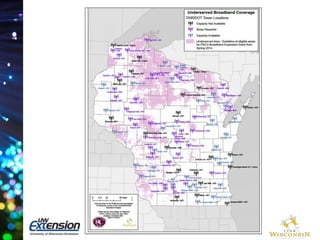
  • #20 Potential Partnerships with state agencies—DOT/DNR towers. What is required for a study? Who to contact for more information? All towers are registered with the Antenna Structure Registration (ARS) FCC. You can obtain some information here: Note underserved areas/locations and the opportunity that could exist with state tower structures
  • #21 Not going to go in detail here, clearly detail is required and as you can see, there is an ability to build in any cost associated with the project, including salary and labor. A reminder that this cannot be a subsidy and any kind, in other words costs can only be included that are for this specific project only.
  • #22  If you have read through the application guidelines you’ll see that the priority factors listed are the exact same as the listed evaluation critiera – so pretty important to make sure each is addressed more than adequately. Matching funds – one of the successful applicants from Round 1 had a 50% match. Obviously not a requirement but it probably jumped out as something quite unique and sustainable! Just be clear about what the matching funds are in your description; where are they coming from, as they can be from different sources if they are partners. I called it the bigger picture of broadband for the area that you are proposing. If there is overlap note it and explain how it fits into your goals. And Project Impact: how is this going to impact the area, think business and residential, as well as Community Anchor Institutions that will benefit. If it is agricultural businesses that will benefit, point it out and why it is important.
  • #23 In FY 14 , ____ number of proposals were submitted totally $__________. For this grant the numbers are anticipated to be even higher, so when you look at this supplemental list, you might see it as make or break for some proposals.
  • #25 Basically this is a two step process that the PSC hopes to accomplish by mid-November. Certainly obtainable depending upon the number of applications
  • #26 Let’s take a quick look at the folks who were awarded grants in Fy14
  • #27 7 funded proposals, as you can see four of which were awarded in the northern part of the state – this is the part of the state that they also received the most applications from. These proposals are online and can be found at: http://psc.wi.gov/apps35/ERF_search/default.aspx search docket id 5-GF-237
  • #28 Supporting documents examples: letters of support from folks who will be impacted Additional data about demand/need, even if these are stories collected over a period of years A diagram about how you see it working (for example how the towers will all interconnect by using existing facilities Existing Tower Agreements Partnership Agreement
  • #29 Really, what ever makes sense for your community, area, county