Enjoy the Uptime.
SDN offers Internet, connectivity, IP phone systems, networking equipment, and managed services over its 30,000
miles of fiber optics. The network touches 300+ South Dakota communities, plus connects to other regional and
national networks.
Carrie Johnson
Manager of Government and External Relations
SDN Communications
E-Rate Reform:
What the Recent E-Rate Changes
Mean for Your District
What role does SDN play?
• Major vendor to the Digital Dakota Network
• Internet
• Network services (physical Ethernet
connections – WAN connectivity)
• Network surveillance (NSC) and reporting
• Demos, consultation, and wireless surveys
• Additional services for school districts:
• Wireless access
• Network audits
• Servers and data storage
• Phone systems
• Provide Internet directly for private schools
E-Rate Reform
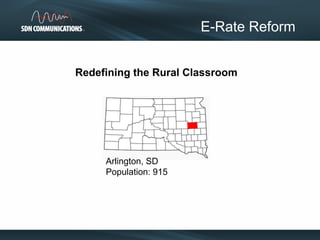
Redefining the Rural Classroom
E-Rate Reform
Arlington, SD
Population: 915
E-Rate Reform
Video:
https://www.youtube.com/watch?v=
N4drkZVd9ig
E-Rate Reform
• Bandwidth Demands in Schools
• Assessments
• e-Textbooks
• One-to-One Programs
• Customized Learning
• Bandwidth Demands in Libraries
• Job Search & Job Applications
• Access to Information –
government, health care, informed
purchasing decisions
• Education, Research, & Distance
Learning
E-Rate Reform
E-Rate Reform: Why Now?
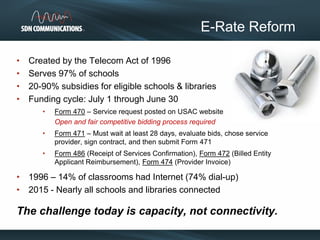
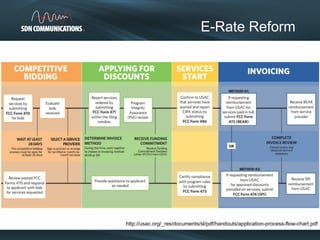
• Created by the Telecom Act of 1996
• Serves 97% of schools
• 20-90% subsidies for eligible schools & libraries
• Funding cycle: July 1 through June 30
• Form 470 – Service request posted on USAC website
Open and fair competitive bidding process required
• Form 471 – Must wait at least 28 days, evaluate bids, chose service
provider, sign contract, and then submit Form 471
• Form 486 (Receipt of Services Confirmation), Form 472 (Billed Entity
Applicant Reimbursement), Form 474 (Provider Invoice)
• 1996 – 14% of classrooms had Internet (74% dial-up)
• 2015 - Nearly all schools and libraries connected
The challenge today is capacity, not connectivity.
E-Rate Reform
E-Rate Reform
http://usac.org/_res/documents/sl/pdf/handouts/application-process-flow-chart.pdf
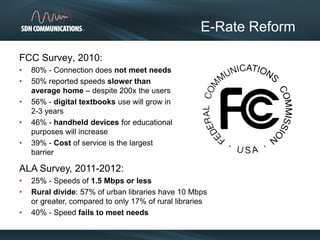
FCC Survey, 2010:
• 80% - Connection does not meet needs
• 50% reported speeds slower than
average home – despite 200x the users
• 56% - digital textbooks use will grow in
2-3 years
• 46% - handheld devices for educational
purposes will increase
• 39% - Cost of service is the largest
barrier
E-Rate Reform
ALA Survey, 2011-2012:
• 25% - Speeds of 1.5 Mbps or less
• Rural divide: 57% of urban libraries have 10 Mbps
or greater, compared to only 17% of rural libraries
• 40% - Speed fails to meet needs
From Blackboards to Smartboards
E-Rate Reform
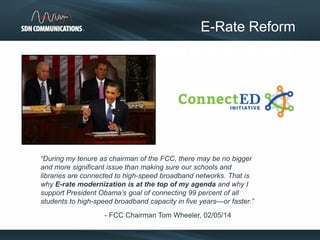
“During my tenure as chairman of the FCC, there may be no bigger
and more significant issue than making sure our schools and
libraries are connected to high-speed broadband networks. That is
why E-rate modernization is at the top of my agenda and why I
support President Obama’s goal of connecting 99 percent of all
students to high-speed broadband capacity in five years—or faster.”
- FCC Chairman Tom Wheeler, 02/05/14
E-Rate Reform
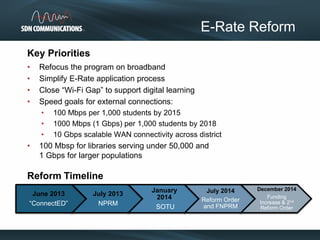
June 2013
“ConnectED”
July 2013
NPRM
January
2014
SOTU
July 2014
Reform Order
and FNPRM
December 2014
Funding
Increase & 2nd
Reform Order
Reform Timeline
Key Priorities
• Refocus the program on broadband
• Simplify E-Rate application process
• Close “Wi-Fi Gap” to support digital learning
• Speed goals for external connections:
• 100 Mbps per 1,000 students by 2015
• 1000 Mbps (1 Gbps) per 1,000 students by 2018
• 10 Gbps scalable WAN connectivity across district
• 100 Mbsp for libraries serving under 50,000 and
1 Gbps for larger populations
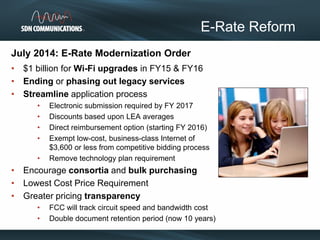
July 2014: E-Rate Modernization Order
• $1 billion for Wi-Fi upgrades in FY15 & FY16
• Ending or phasing out legacy services
• Streamline application process
• Electronic submission required by FY 2017
• Discounts based upon LEA averages
• Direct reimbursement option (starting FY 2016)
• Exempt low-cost, business-class Internet of
$3,600 or less from competitive bidding process
• Remove technology plan requirement
• Encourage consortia and bulk purchasing
• Lowest Cost Price Requirement
• Greater pricing transparency
• FCC will track circuit speed and bandwidth cost
• Double document retention period (now 10 years)
E-Rate Reform
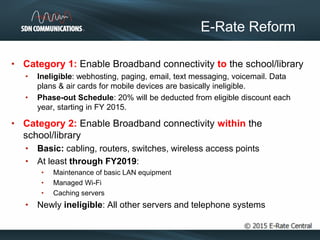
• Category 1: Enable Broadband connectivity to the school/library
• Ineligible: webhosting, paging, email, text messaging, voicemail. Data
plans & air cards for mobile devices are basically ineligible.
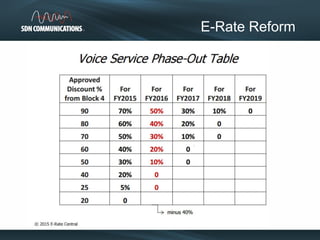
• Phase-out Schedule: 20% will be deducted from eligible discount each
year, starting in FY 2015.
• Category 2: Enable Broadband connectivity within the
school/library
• Basic: cabling, routers, switches, wireless access points
• At least through FY2019:
• Maintenance of basic LAN equipment
• Managed Wi-Fi
• Caching servers
• Newly ineligible: All other servers and telephone systems
E-Rate Reform
E-Rate Reform
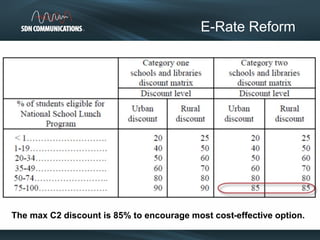
The max C2 discount is 85% to encourage most cost-effective option.
E-Rate Reform
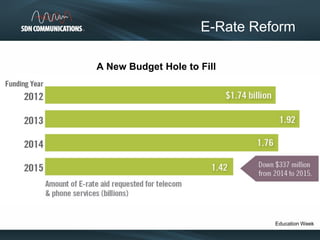
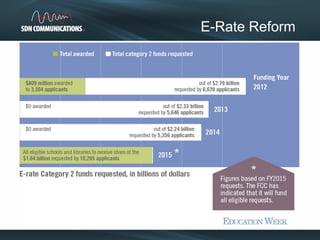
A New Budget Hole to Fill
E-Rate Reform
Education Week
E-Rate Reform
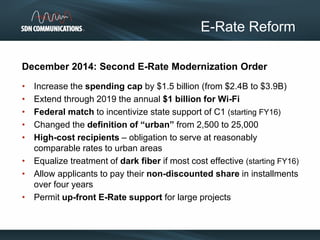
December 2014: Second E-Rate Modernization Order
• Increase the spending cap by $1.5 billion (from $2.4B to $3.9B)
• Extend through 2019 the annual $1 billion for Wi-Fi
• Federal match to incentivize state support of C1 (starting FY16)
• Changed the definition of “urban” from 2,500 to 25,000
• High-cost recipients – obligation to serve at reasonably
comparable rates to urban areas
• Equalize treatment of dark fiber if most cost effective (starting FY16)
• Allow applicants to pay their non-discounted share in installments
over four years
• Permit up-front E-Rate support for large projects
E-Rate Reform
educationsuperhighway.org
E-Rate Reform
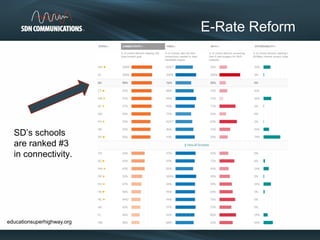
SD’s schools
are ranked #3
in connectivity.
educationsuperhighway.org
E-Rate Reform
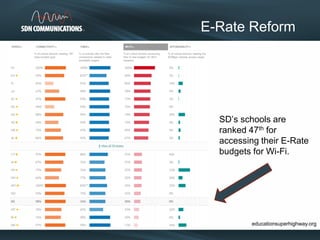
SD’s schools are
ranked 47th for
accessing their E-Rate
budgets for Wi-Fi.
educationsuperhighway.org
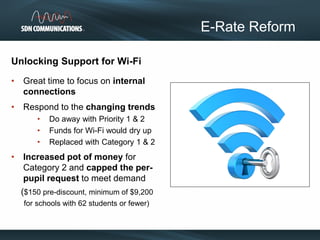
Unlocking Support for Wi-Fi
• Great time to focus on internal
connections
• Respond to the changing trends
• Do away with Priority 1 & 2
• Funds for Wi-Fi would dry up
• Replaced with Category 1 & 2
• Increased pot of money for
Category 2 and capped the per-
pupil request to meet demand
($150 pre-discount, minimum of $9,200
for schools with 62 students or fewer)
E-Rate Reform
E-Rate Reform
Questions?
Connect with SDN
Carrie.Johnson@sdncommuncations.com
www.sdncommunications.com

What the Recent E-Rate Changes Mean for Your District

  • 1.
    Enjoy the Uptime. SDNoffers Internet, connectivity, IP phone systems, networking equipment, and managed services over its 30,000 miles of fiber optics. The network touches 300+ South Dakota communities, plus connects to other regional and national networks.
  • 2.
    Carrie Johnson Manager ofGovernment and External Relations SDN Communications E-Rate Reform: What the Recent E-Rate Changes Mean for Your District
  • 5.
    What role doesSDN play? • Major vendor to the Digital Dakota Network • Internet • Network services (physical Ethernet connections – WAN connectivity) • Network surveillance (NSC) and reporting • Demos, consultation, and wireless surveys • Additional services for school districts: • Wireless access • Network audits • Servers and data storage • Phone systems • Provide Internet directly for private schools E-Rate Reform
  • 6.
    Redefining the RuralClassroom E-Rate Reform Arlington, SD Population: 915
  • 7.
  • 8.
  • 9.
    • Bandwidth Demandsin Schools • Assessments • e-Textbooks • One-to-One Programs • Customized Learning • Bandwidth Demands in Libraries • Job Search & Job Applications • Access to Information – government, health care, informed purchasing decisions • Education, Research, & Distance Learning E-Rate Reform E-Rate Reform: Why Now?
  • 10.
    • Created bythe Telecom Act of 1996 • Serves 97% of schools • 20-90% subsidies for eligible schools & libraries • Funding cycle: July 1 through June 30 • Form 470 – Service request posted on USAC website Open and fair competitive bidding process required • Form 471 – Must wait at least 28 days, evaluate bids, chose service provider, sign contract, and then submit Form 471 • Form 486 (Receipt of Services Confirmation), Form 472 (Billed Entity Applicant Reimbursement), Form 474 (Provider Invoice) • 1996 – 14% of classrooms had Internet (74% dial-up) • 2015 - Nearly all schools and libraries connected The challenge today is capacity, not connectivity. E-Rate Reform
  • 11.
  • 12.
    FCC Survey, 2010: •80% - Connection does not meet needs • 50% reported speeds slower than average home – despite 200x the users • 56% - digital textbooks use will grow in 2-3 years • 46% - handheld devices for educational purposes will increase • 39% - Cost of service is the largest barrier E-Rate Reform ALA Survey, 2011-2012: • 25% - Speeds of 1.5 Mbps or less • Rural divide: 57% of urban libraries have 10 Mbps or greater, compared to only 17% of rural libraries • 40% - Speed fails to meet needs
  • 13.
    From Blackboards toSmartboards E-Rate Reform “During my tenure as chairman of the FCC, there may be no bigger and more significant issue than making sure our schools and libraries are connected to high-speed broadband networks. That is why E-rate modernization is at the top of my agenda and why I support President Obama’s goal of connecting 99 percent of all students to high-speed broadband capacity in five years—or faster.” - FCC Chairman Tom Wheeler, 02/05/14
  • 14.
    E-Rate Reform June 2013 “ConnectED” July2013 NPRM January 2014 SOTU July 2014 Reform Order and FNPRM December 2014 Funding Increase & 2nd Reform Order Reform Timeline Key Priorities • Refocus the program on broadband • Simplify E-Rate application process • Close “Wi-Fi Gap” to support digital learning • Speed goals for external connections: • 100 Mbps per 1,000 students by 2015 • 1000 Mbps (1 Gbps) per 1,000 students by 2018 • 10 Gbps scalable WAN connectivity across district • 100 Mbsp for libraries serving under 50,000 and 1 Gbps for larger populations
  • 15.
    July 2014: E-RateModernization Order • $1 billion for Wi-Fi upgrades in FY15 & FY16 • Ending or phasing out legacy services • Streamline application process • Electronic submission required by FY 2017 • Discounts based upon LEA averages • Direct reimbursement option (starting FY 2016) • Exempt low-cost, business-class Internet of $3,600 or less from competitive bidding process • Remove technology plan requirement • Encourage consortia and bulk purchasing • Lowest Cost Price Requirement • Greater pricing transparency • FCC will track circuit speed and bandwidth cost • Double document retention period (now 10 years) E-Rate Reform
  • 16.
    • Category 1:Enable Broadband connectivity to the school/library • Ineligible: webhosting, paging, email, text messaging, voicemail. Data plans & air cards for mobile devices are basically ineligible. • Phase-out Schedule: 20% will be deducted from eligible discount each year, starting in FY 2015. • Category 2: Enable Broadband connectivity within the school/library • Basic: cabling, routers, switches, wireless access points • At least through FY2019: • Maintenance of basic LAN equipment • Managed Wi-Fi • Caching servers • Newly ineligible: All other servers and telephone systems E-Rate Reform
  • 17.
    E-Rate Reform The maxC2 discount is 85% to encourage most cost-effective option.
  • 18.
  • 19.
    A New BudgetHole to Fill E-Rate Reform Education Week
  • 20.
    E-Rate Reform December 2014:Second E-Rate Modernization Order • Increase the spending cap by $1.5 billion (from $2.4B to $3.9B) • Extend through 2019 the annual $1 billion for Wi-Fi • Federal match to incentivize state support of C1 (starting FY16) • Changed the definition of “urban” from 2,500 to 25,000 • High-cost recipients – obligation to serve at reasonably comparable rates to urban areas • Equalize treatment of dark fiber if most cost effective (starting FY16) • Allow applicants to pay their non-discounted share in installments over four years • Permit up-front E-Rate support for large projects
  • 21.
  • 22.
    E-Rate Reform SD’s schools areranked #3 in connectivity. educationsuperhighway.org
  • 23.
    E-Rate Reform SD’s schoolsare ranked 47th for accessing their E-Rate budgets for Wi-Fi. educationsuperhighway.org
  • 24.
    Unlocking Support forWi-Fi • Great time to focus on internal connections • Respond to the changing trends • Do away with Priority 1 & 2 • Funds for Wi-Fi would dry up • Replaced with Category 1 & 2 • Increased pot of money for Category 2 and capped the per- pupil request to meet demand ($150 pre-discount, minimum of $9,200 for schools with 62 students or fewer) E-Rate Reform
  • 25.
  • 26.
  • 27.