Broadband in Ireland

     By Tony Smyth
      N00082777
  New Media Technology
        DL242.4
What is Broadband

Broadband is a term which refers to the broad bandwidth (at least 256
Kbps) components of a transmission medium and its capability of
transporting multiple signals and traffic types at the same time.
Broadband generally refers to high-speed internet access that is always
on and faster than the more dated dial-up access.

Broadband v’s Dial-up:
• In the majority of connections, broadband provides a higher-speed of data
   transmission and also caters for a greater amount of content to be carried
   through the transmission.
• As the internet advances the newly-developing services require the
   transfer of sizeable amounts of data that may not be technically viable
   with the dial-up service.
• As broadband is always on, there isn’t a need to reconnect to the network
   after logging off and it doesn’t block any phone lines.
• Less delay in transmission of content when using broadband.
Types of Broadband
There are several different types of high-speed transmission
technologies in which broadband can be obtained:


•   Digital Subscriber Line (DSL)
•   Cable Modem
•   Fibre Optic Technology
•   Wireless
•   Satellite
•   Broadband over Power lines (BPL)
Digital Subscriber Line (DSL)
DSL is a wire line transmission technology that channels data quicker over traditional copper telephone lines
    already installed in businesses and homes. Through DSL, phone lines and broadband work
    simultaneously. DSL-based broadband produce transmission speeds fluctuating from several hundred
    Kbps to Mbps. The accessibility and speed of a DSL service will depend on the location of a chosen home
    or business in relation to the closest telephone company provider, i.e. the closer the location → the
    fasted the connection.

There are two types of DSL transmission technologies. They are as follows:
• Asymmetrical Digital Subscriber Line (ADSL) – is a technology that is primarily used by residential
    customers for transmitting digital information at a high bandwidth on pre-existing landlines. ADSL uses
    most of the channel to transmit downstream to the user and a small part for upstream use. This
    unbalanced method of streaming optimizes the customers usage, as the majority of residential users
    would download rather than upload. ADSL accommodates for a faster downstream traffic over the same
    line used for a telephone, whilst not disrupting regular calls on that line.
• Symmetrical Digital Subscriber Line (SDSL) – is a technology that caters for more of a business use.
    Unalike ADSL, SDSL cannot operate simultaneously with voice calls over the same wires. Further more
    from this, SDSL supports the same data rates for upstream and downstream traffic.

Quicker methods of DSL available to businesses;
• High data rate Digital Subscriber Line (HDSL)
• Very High data rate Digital Subscriber Line (VDSL)
Cable Modem
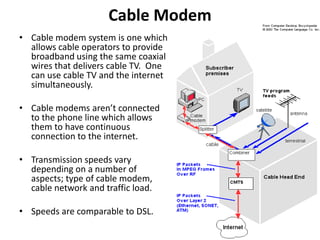
• Cable modem system is one which
  allows cable operators to provide
  broadband using the same coaxial
  wires that delivers cable TV. One
  can use cable TV and the internet
  simultaneously.

• Cable modems aren’t connected
  to the phone line which allows
  them to have continuous
  connection to the internet.

• Transmission speeds vary
  depending on a number of
  aspects; type of cable modem,
  cable network and traffic load.

• Speeds are comparable to DSL.
Fibre Optic Technology
•   Fibre Optic broadband uses fibre optic cables to
    convert electrical signals transporting data to light
    and sends the light through glass fibres about the
    diameter of a human hair.

•   Fibre optic cables transports data at a
    substantially faster rate than that of current DSL
    or cable modem speeds, typically by tens or even
    hundreds of Mbps.

•   The broadband speed depends on a number of
    factors; how close the broadband provider brings
    the fibre to one computer, how the broadband
    provider configures the service and the amount
    of bandwidth available in the package.

•   The service provider may run the fibre into the
    home/ business, to the curb outside, or to a
    neutral location between their facilities and the
    customer.

•   The fibre cable that delivers the broadband can
    also provide voice and video services, i.e. landline
    and cable TV, simultaneously.

•   Fibre optic’s are often used in rural areas where
    broadband servers are scarce.
Wireless
•    Wireless broadband uses high-speed technology that eliminates
     the need for modem cables or routers.                                  USB
•    It connects to the internet using a radio link between the            modem
     customer’s location and the broadband provider’s facility.
•    Wireless broadband can be either fixed or mobile.
Fixed Wireless:
•    Fixed wireless broadband allows consumers to access the
     internet from a fixed point while stationary and often needs a
     direct line-of-sight between the wireless transmitter and receiver.
•    These services have been offered using both licensed spectrum
     and unlicensed devices.
•    Subscribers can be added or moved without modifying the
     infrastructure.
•    Customers in a remote location can be connected to the internet
     wirelessly without the need for the installation of new cables or     receiver
     optical fibres across the countryside.
Mobile Wireless:
•    Mobile wireless broadband refers to a high-speed internet access
     from mobile providers for portable devices.
•    Most cellular providers offer wireless broadband for smart
     phones.
•    Cellular providers also offer internet access on your laptop using
     built-in mobile broadband network cards or other portable
     network devices, such as; USB modems or portable wi-fi mobile
     hotspots.
•    Generally wireless mobile broadband is slower than fixed
     wireless.
Satellite
    •  Satellite broadband works in the same way as satellites that provide links for telephone and
       television.
    • Satellite broadband is another form of wireless broadband.
    • It is the most expensive means of accessing the internet but in sparsely populated areas
       offers a faster connection alternative than the dated dial-up connection.
    • The strength of the connection is determined by the following factors; provider and service
       package purchased, the consumer’s line of sight to the orbiting satellite and the weather.
    Two types of satellite broadband:
    • One way satellite internet access: in this situation a phone line with an Internet Service
       Provider (ISP) is necessary. A request is sent through the ISP to the satellite operator using
       the landline.
    • Two way satellite internet access: no landline is required. A request is sent using a satellite
       dish to the satellite.
One way                                              Two way
satellite                                            satellite
internet                                             internet
access                                               access
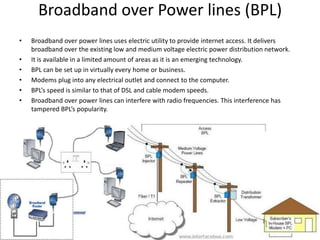
Broadband over Power lines (BPL)
•   Broadband over power lines uses electric utility to provide internet access. It delivers
    broadband over the existing low and medium voltage electric power distribution network.
•   It is available in a limited amount of areas as it is an emerging technology.
•   BPL can be set up in virtually every home or business.
•   Modems plug into any electrical outlet and connect to the computer.
•   BPL’s speed is similar to that of DSL and cable modem speeds.
•   Broadband over power lines can interfere with radio frequencies. This interference has
    tampered BPL’s popularity.
Broadband available in my area:
Categories of Broadband Networks
    Available in the Cabinteely Area:
   DSL       Cable        Fibre      Wireless       Satellite   BPL
Vodafone   UPC        UPC          Imagine WiMax   Digiweb       -
Eircom           -    Eircom       Vodafone             -        -
Digiweb          -            -          -              -        -


                     Mobile Broadband Providers
                     Meteor
                     O2
                     Vodafone
                     Three
Plans and Prices:
Connection/ Provider      Maximum Speed   Plan/ Cost
DSL/ Vodafone             24mbps          8mb/ 45 euro
                                          24mb/ 55 euro
Fibre/ UPC                150mbps         50mb/ 39 euro
                                          100mb/ 49 euro
                                          150mb/ 59 euro
Wireless/ Imagine WiMax   10mbps          3mb/ 25 euro
                                          7mb/ 27.50 euro
                                          10mb/ 32.50 euro
Broadband choice for a small
                   business:
•   I feel that UPC offer a better service than the other providers. UPC’s speed is a lot
    faster than that of its competitors. The pricing in relation to the data usage is far
    more attractive than the other providers. Initially I would obtain UPC’s 49 euro
    package, as 100mb seems plenty but I can always avail of their 150mb package if
    necessary.

•   For a mobile business scenario I would obtain Vodafones Mobile WiFi device as it
    is quite cheap; 29.99 euro, and vodafone has a very good reputation in Ireland for
    having good mobile signal. Further more, it can take five devices simultaneously
    which would be of great benefit to the business as multiple workers can use the
    same WiFi.
References:
•   http://www.oecd.org/internet/broadbandandtelecom/oecdbroadbandportal.htm
•   http://www.getbroadband.ie/business_broadband_deals.php?at=2
•   http://www.broadband.gov/broadband_types.html
•   http://www.slideshare.net/EgerardB/broadband-in-the-dun-laoghaire-area
•   http://www.scholarpedia.org/article/Digital_subscriber_line_%28DSL%29
•   http://www.techterms.com/definition/cablemodem
•   http://searchnetworking.techtarget.com/definition/ADSL
•   http://www.webopedia.com/TERM/S/SDSL.html
•   http://www.uchoose.ie/We-explain-the-different-types-of-Broadband-available-in-Ireland-1/read/
•   http://www.pcmag.com/encyclopedia_term/0,1237,t=cable+modem&i=39166,00.asp
•   http://www.broadband-finder.co.uk/blog/2008/09/09/next-generation-broadband-could-cost-up-
    to-288bn/
•   http://www.broadbandchoices.co.uk/broadband/fibre-optic-broadband.html
•   http://www.moneysupermarket.com/broadband/fibre-optic-broadband-guide/
•   http://www.pcmag.com/encyclopedia_term/0,1237,t=wireless+broadband&i=54763,00.asp
•   http://searchmobilecomputing.techtarget.com/definition/fixed-wireless
•   http://mobileoffice.about.com/od/glossary/g/mobile-broadband.htm
•   http://mobileoffice.about.com/od/connectingtotheoffice/g/satelliteaccess.htm
•   http://www.internet-via-satellite.info/index.php/t/15/n/335/internet-satellite-does-work.html
•   http://compnetworking.about.com/od/broadband/g/bldef_bpl.htm
•   http://www.vodafone.ie/internet-broadband/?ts=1350607415815
•   http://digiweb.ie/business/
•   http://www.imagine.ie/offer/
•   http://www.upc.ie/deals/
•   http://www.strencom.net/
•   http://business.eircom.net/broadband/?EGPage=BusBB

Broadband presentation

  • 1.
    Broadband in Ireland By Tony Smyth N00082777 New Media Technology DL242.4
  • 2.
    What is Broadband Broadbandis a term which refers to the broad bandwidth (at least 256 Kbps) components of a transmission medium and its capability of transporting multiple signals and traffic types at the same time. Broadband generally refers to high-speed internet access that is always on and faster than the more dated dial-up access. Broadband v’s Dial-up: • In the majority of connections, broadband provides a higher-speed of data transmission and also caters for a greater amount of content to be carried through the transmission. • As the internet advances the newly-developing services require the transfer of sizeable amounts of data that may not be technically viable with the dial-up service. • As broadband is always on, there isn’t a need to reconnect to the network after logging off and it doesn’t block any phone lines. • Less delay in transmission of content when using broadband.
  • 3.
    Types of Broadband Thereare several different types of high-speed transmission technologies in which broadband can be obtained: • Digital Subscriber Line (DSL) • Cable Modem • Fibre Optic Technology • Wireless • Satellite • Broadband over Power lines (BPL)
  • 4.
    Digital Subscriber Line(DSL) DSL is a wire line transmission technology that channels data quicker over traditional copper telephone lines already installed in businesses and homes. Through DSL, phone lines and broadband work simultaneously. DSL-based broadband produce transmission speeds fluctuating from several hundred Kbps to Mbps. The accessibility and speed of a DSL service will depend on the location of a chosen home or business in relation to the closest telephone company provider, i.e. the closer the location → the fasted the connection. There are two types of DSL transmission technologies. They are as follows: • Asymmetrical Digital Subscriber Line (ADSL) – is a technology that is primarily used by residential customers for transmitting digital information at a high bandwidth on pre-existing landlines. ADSL uses most of the channel to transmit downstream to the user and a small part for upstream use. This unbalanced method of streaming optimizes the customers usage, as the majority of residential users would download rather than upload. ADSL accommodates for a faster downstream traffic over the same line used for a telephone, whilst not disrupting regular calls on that line. • Symmetrical Digital Subscriber Line (SDSL) – is a technology that caters for more of a business use. Unalike ADSL, SDSL cannot operate simultaneously with voice calls over the same wires. Further more from this, SDSL supports the same data rates for upstream and downstream traffic. Quicker methods of DSL available to businesses; • High data rate Digital Subscriber Line (HDSL) • Very High data rate Digital Subscriber Line (VDSL)
  • 5.
    Cable Modem • Cablemodem system is one which allows cable operators to provide broadband using the same coaxial wires that delivers cable TV. One can use cable TV and the internet simultaneously. • Cable modems aren’t connected to the phone line which allows them to have continuous connection to the internet. • Transmission speeds vary depending on a number of aspects; type of cable modem, cable network and traffic load. • Speeds are comparable to DSL.
  • 6.
    Fibre Optic Technology • Fibre Optic broadband uses fibre optic cables to convert electrical signals transporting data to light and sends the light through glass fibres about the diameter of a human hair. • Fibre optic cables transports data at a substantially faster rate than that of current DSL or cable modem speeds, typically by tens or even hundreds of Mbps. • The broadband speed depends on a number of factors; how close the broadband provider brings the fibre to one computer, how the broadband provider configures the service and the amount of bandwidth available in the package. • The service provider may run the fibre into the home/ business, to the curb outside, or to a neutral location between their facilities and the customer. • The fibre cable that delivers the broadband can also provide voice and video services, i.e. landline and cable TV, simultaneously. • Fibre optic’s are often used in rural areas where broadband servers are scarce.
  • 7.
    Wireless • Wireless broadband uses high-speed technology that eliminates the need for modem cables or routers. USB • It connects to the internet using a radio link between the modem customer’s location and the broadband provider’s facility. • Wireless broadband can be either fixed or mobile. Fixed Wireless: • Fixed wireless broadband allows consumers to access the internet from a fixed point while stationary and often needs a direct line-of-sight between the wireless transmitter and receiver. • These services have been offered using both licensed spectrum and unlicensed devices. • Subscribers can be added or moved without modifying the infrastructure. • Customers in a remote location can be connected to the internet wirelessly without the need for the installation of new cables or receiver optical fibres across the countryside. Mobile Wireless: • Mobile wireless broadband refers to a high-speed internet access from mobile providers for portable devices. • Most cellular providers offer wireless broadband for smart phones. • Cellular providers also offer internet access on your laptop using built-in mobile broadband network cards or other portable network devices, such as; USB modems or portable wi-fi mobile hotspots. • Generally wireless mobile broadband is slower than fixed wireless.
  • 8.
    Satellite • Satellite broadband works in the same way as satellites that provide links for telephone and television. • Satellite broadband is another form of wireless broadband. • It is the most expensive means of accessing the internet but in sparsely populated areas offers a faster connection alternative than the dated dial-up connection. • The strength of the connection is determined by the following factors; provider and service package purchased, the consumer’s line of sight to the orbiting satellite and the weather. Two types of satellite broadband: • One way satellite internet access: in this situation a phone line with an Internet Service Provider (ISP) is necessary. A request is sent through the ISP to the satellite operator using the landline. • Two way satellite internet access: no landline is required. A request is sent using a satellite dish to the satellite. One way Two way satellite satellite internet internet access access
  • 9.
    Broadband over Powerlines (BPL) • Broadband over power lines uses electric utility to provide internet access. It delivers broadband over the existing low and medium voltage electric power distribution network. • It is available in a limited amount of areas as it is an emerging technology. • BPL can be set up in virtually every home or business. • Modems plug into any electrical outlet and connect to the computer. • BPL’s speed is similar to that of DSL and cable modem speeds. • Broadband over power lines can interfere with radio frequencies. This interference has tampered BPL’s popularity.
  • 10.
  • 11.
    Categories of BroadbandNetworks Available in the Cabinteely Area: DSL Cable Fibre Wireless Satellite BPL Vodafone UPC UPC Imagine WiMax Digiweb - Eircom - Eircom Vodafone - - Digiweb - - - - - Mobile Broadband Providers Meteor O2 Vodafone Three
  • 12.
    Plans and Prices: Connection/Provider Maximum Speed Plan/ Cost DSL/ Vodafone 24mbps 8mb/ 45 euro 24mb/ 55 euro Fibre/ UPC 150mbps 50mb/ 39 euro 100mb/ 49 euro 150mb/ 59 euro Wireless/ Imagine WiMax 10mbps 3mb/ 25 euro 7mb/ 27.50 euro 10mb/ 32.50 euro
  • 13.
    Broadband choice fora small business: • I feel that UPC offer a better service than the other providers. UPC’s speed is a lot faster than that of its competitors. The pricing in relation to the data usage is far more attractive than the other providers. Initially I would obtain UPC’s 49 euro package, as 100mb seems plenty but I can always avail of their 150mb package if necessary. • For a mobile business scenario I would obtain Vodafones Mobile WiFi device as it is quite cheap; 29.99 euro, and vodafone has a very good reputation in Ireland for having good mobile signal. Further more, it can take five devices simultaneously which would be of great benefit to the business as multiple workers can use the same WiFi.
  • 14.
    References: • http://www.oecd.org/internet/broadbandandtelecom/oecdbroadbandportal.htm • http://www.getbroadband.ie/business_broadband_deals.php?at=2 • http://www.broadband.gov/broadband_types.html • http://www.slideshare.net/EgerardB/broadband-in-the-dun-laoghaire-area • http://www.scholarpedia.org/article/Digital_subscriber_line_%28DSL%29 • http://www.techterms.com/definition/cablemodem • http://searchnetworking.techtarget.com/definition/ADSL • http://www.webopedia.com/TERM/S/SDSL.html • http://www.uchoose.ie/We-explain-the-different-types-of-Broadband-available-in-Ireland-1/read/ • http://www.pcmag.com/encyclopedia_term/0,1237,t=cable+modem&i=39166,00.asp • http://www.broadband-finder.co.uk/blog/2008/09/09/next-generation-broadband-could-cost-up- to-288bn/ • http://www.broadbandchoices.co.uk/broadband/fibre-optic-broadband.html • http://www.moneysupermarket.com/broadband/fibre-optic-broadband-guide/ • http://www.pcmag.com/encyclopedia_term/0,1237,t=wireless+broadband&i=54763,00.asp • http://searchmobilecomputing.techtarget.com/definition/fixed-wireless • http://mobileoffice.about.com/od/glossary/g/mobile-broadband.htm • http://mobileoffice.about.com/od/connectingtotheoffice/g/satelliteaccess.htm • http://www.internet-via-satellite.info/index.php/t/15/n/335/internet-satellite-does-work.html • http://compnetworking.about.com/od/broadband/g/bldef_bpl.htm • http://www.vodafone.ie/internet-broadband/?ts=1350607415815 • http://digiweb.ie/business/ • http://www.imagine.ie/offer/ • http://www.upc.ie/deals/ • http://www.strencom.net/ • http://business.eircom.net/broadband/?EGPage=BusBB