Broadband!
Session #4; June 13, 2013 9AM-3PM
Merrill Community Forum Series
Introductions
Who are you? Who Do you represent?
How important do you think broadband expansion is
in Lincoln County?
Nice?
Important?
Imperative?
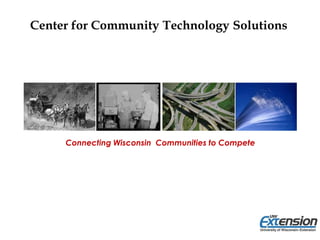
Center for Community Technology Solutions
Connecting Wisconsin Communities to Compete
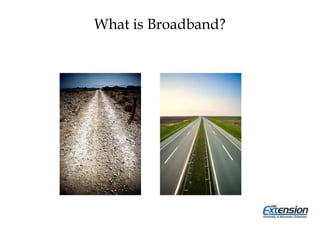
What is Broadband?
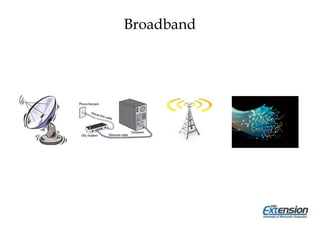
Broadband
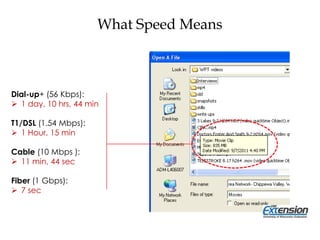
What Speed Means
Dial-up+ (56 Kbps):
 1 day, 10 hrs, 44 min
T1/DSL (1.54 Mbps):
 1 Hour, 15 min
Cable (10 Mbps ):
 11 min, 44 sec
Fiber (1 Gbps):
 7 sec
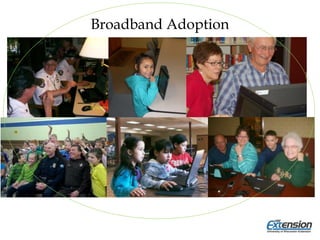
Broadband Adoption
7
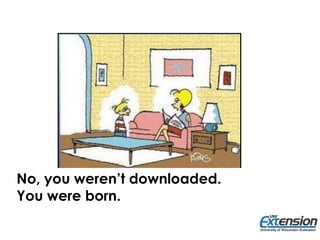
No, you weren’t downloaded.
You were born.
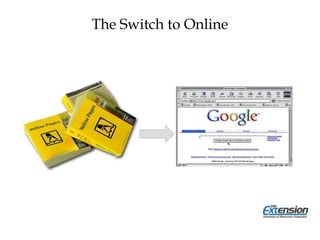
The Switch to Online
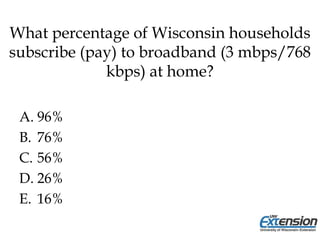
What percentage of Wisconsin households
subscribe (pay) to broadband (3 mbps/768
kbps) at home?
A. 96%
B. 76%
C. 56%
D. 26%
E. 16%
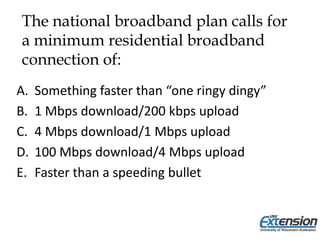
The national broadband plan calls for
a minimum residential broadband
connection of:
A. Something faster than “one ringy dingy”
B. 1 Mbps download/200 kbps upload
C. 4 Mbps download/1 Mbps upload
D. 100 Mbps download/4 Mbps upload
E. Faster than a speeding bullet
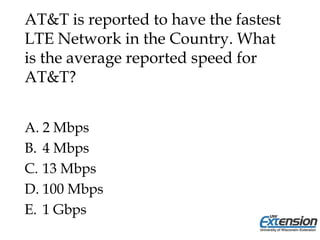
AT&T is reported to have the fastest
LTE Network in the Country. What
is the average reported speed for
AT&T?
A. 2 Mbps
B. 4 Mbps
C. 13 Mbps
D. 100 Mbps
E. 1 Gbps
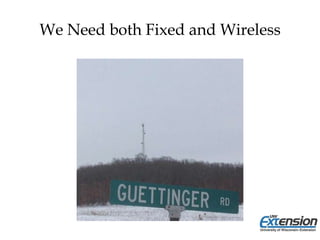
We Need both Fixed and Wireless
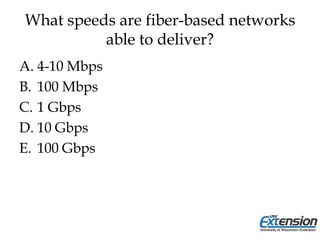
What speeds are fiber-based networks
able to deliver?
A. 4-10 Mbps
B. 100 Mbps
C. 1 Gbps
D. 10 Gbps
E. 100 Gbps
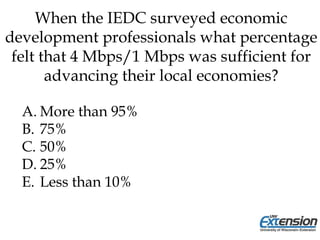
When the IEDC surveyed economic
development professionals what percentage
felt that 4 Mbps/1 Mbps was sufficient for
advancing their local economies?
A. More than 95%
B. 75%
C. 50%
D. 25%
E. Less than 10%
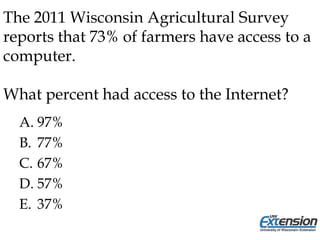
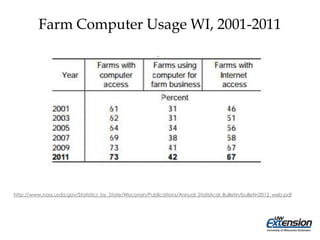
The 2011 Wisconsin Agricultural Survey
reports that 73% of farmers have access to a
computer.
What percent had access to the Internet?
A. 97%
B. 77%
C. 67%
D. 57%
E. 37%
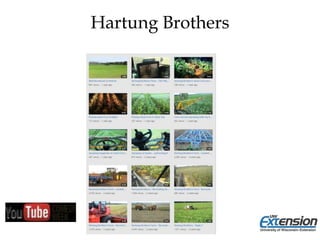
Hartung Brothers
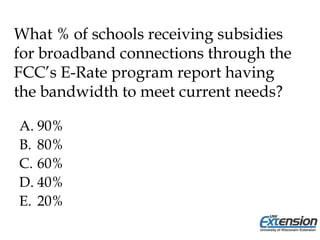
What % of schools receiving subsidies
for broadband connections through the
FCC’s E-Rate program report having
the bandwidth to meet current needs?
A. 90%
B. 80%
C. 60%
D. 40%
E. 20%
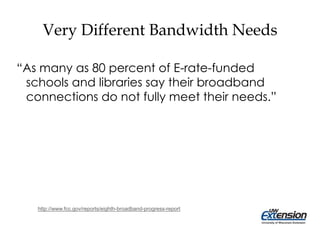
Very Different Bandwidth Needs
“As many as 80 percent of E-rate-funded
schools and libraries say their broadband
connections do not fully meet their needs.”
Eighth Broadband Progress Report, Aug 21, 2012, FCC
http://www.fcc.gov/reports/eighth-broadband-progress-report
Where Do We Stand?
 In the State
 In the Country
 In the World
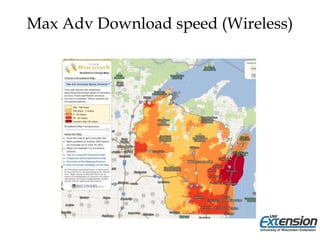
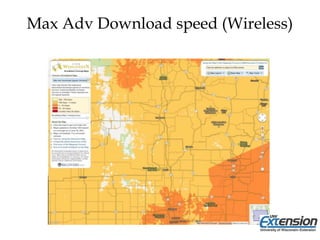
Max Adv Download speed (Wireless)
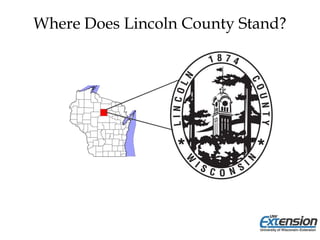
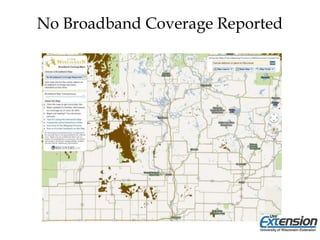
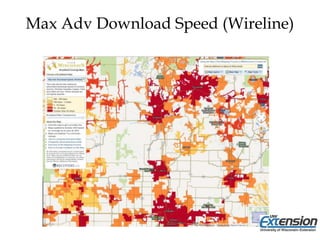
Where Does Lincoln County Stand?
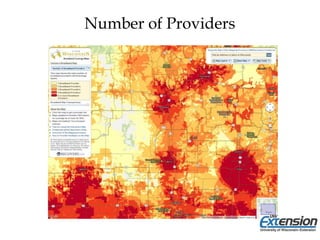
Number of Providers
No Broadband Coverage Reported
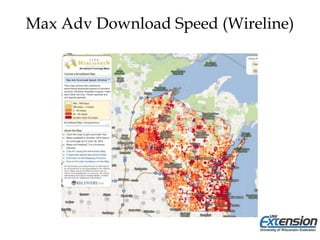
Max Adv Download Speed (Wireline)
Max Adv Download speed (Wireless)
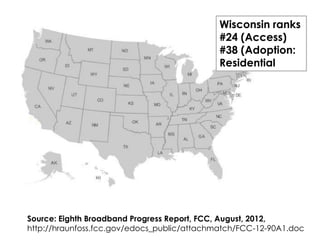
Wisconsin ranks
#24 (Access)
#38 (Adoption:
Residential
Source: Eighth Broadband Progress Report, FCC, August, 2012,
http://hraunfoss.fcc.gov/edocs_public/attachmatch/FCC-12-90A1.doc
Our Place in the World…
45.1806° N, 89.6833° W
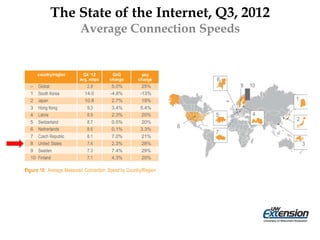
country/region Q4 ‘12
avg. mbps
QoQ
change
yoy
change
– Global 2.9 5.0% 25%
1 South Korea 14.0 -4.8% -13%
2 Japan 10.8 2.7% 19%
3 Hong Kong 9.3 3.4% 5.4%
4 Latvia 8.9 2.3% 20%
5 Switzerland 8.7 0.5% 20%
6 Netherlands 8.6 0.1% 3.3%
7 Czech Republic 8.1 7.0% 21%
8 United States 7.4 2.3% 28%
9 Sweden 7.3 7.4% 29%
10 Finland 7.1 4.3% 20%
6
9 10
1
5 4
2
8
7
3
figure 10: Average Measured Connection Speed by Country/Region
The State of the Internet, Q3, 2012
Average Connection Speeds
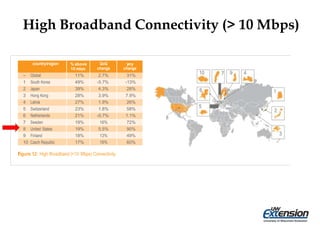
country/region % above
10 mbps
QoQ
change
yoy
change
– Global 11% 2.7% 31%
1 South Korea 49% -5.7% -13%
2 Japan 39% 4.3% 28%
3 Hong Kong 28% 3.9% 7.9%
4 Latvia 27% 1.9% 26%
5 Switzerland 23% 1.8% 58%
6 Netherlands 21% -0.7% 1.1%
7 Sweden 19% 16% 72%
8 United States 19% 5.5% 90%
9 Finland 18% 13% 49%
10 Czech Republic 17% 16% 60%
10 7 9 4
6 1
5
2
8
3
figure 12: High Broadband (>10 Mbps) Connectivity
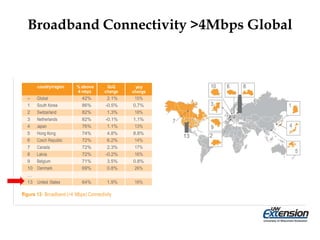
High Broadband Connectivity (> 10 Mbps)
country/region % above
4 mbps
QoQ
change
yoy
change
– Global 42% 2.1% 15%
1 South Korea 86% -0.5% 0.7%
2 Switzerland 82% 1.3% 18%
3 Netherlands 82% -0.1% 1.1%
4 Japan 76% 1.1% 13%
5 Hong Kong 74% 4.8% 8.8%
6 Czech Republic 72% 6.2% 14%
7 Canada 72% 2.3% 17%
8 Latvia 72% -0.2% 16%
9 Belgium 71% 3.5% 0.8%
10 Denmark 69% 0.8% 26%
…
13 United States 64% 1.9% 16%
10 6 8
3 1
7
9 4
13 2
5
figure 13: Broadband (>4 Mbps) Connectivity
Broadband Connectivity >4Mbps Global
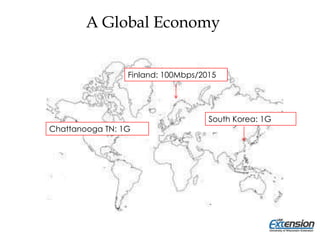
South Korea: 1G
Finland: 100Mbps/2015
Chattanooga TN: 1G
A Global Economy
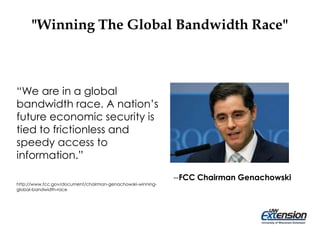
"Winning The Global Bandwidth Race"
“We are in a global
bandwidth race. A nation’s
future economic security is
tied to frictionless and
speedy access to
information.”
http://www.fcc.gov/document/chairman-genachowski-winning-
global-bandwidth-race
--FCC Chairman Genachowski
IEDC Survey 2012
Fewer than 10%
believe 4 Mbps
is sufficient for
advancing their
local economies
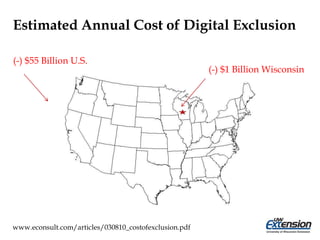
Estimated Annual Cost of Digital Exclusion
(-) $55 Billion U.S.
(-) $1 Billion Wisconsin
www.econsult.com/articles/030810_costofexclusion.pdf
Retail sales increased at an average annual
growth rate of 2.6% from 2002-2010
Sources:
U.S. Census E-stats, May 10,2012: http://www.census.gov/econ/estats/2010/2010reportfinal.pdf
Quarterly Retail E-Commerce Sales, Q3, 2012:
http://www.census.gov/retail/mrts/www/data/pdf/ec_current.pdf
In 2010, U.S. manufacturing shipments
totaled $4.9 trillion.
What percentage of the $4.9 trillion in
manufacturing shipments was attributable to e-
commerce in 2010?
a) 13%
b) 25%
c) 46%
d) 88%
Source:
U.S. Census E-stats, May 10, 2012, http://www.census.gov/econ/estats/2010/2010reportfinal.pdf
E-commerce generated $4.1 trillion in sales in 2010
What percentage of total internet sales was between
businesses (B2B)?
a) 27 percent
b) 38 percent
c) 62 percent
d) 89 percent
Impact On Business…
 Minnesota business establishments that use
broadband report median annual revenues that are
approximately $200,000 higher than businesses that
do not use broadband.
 Nearly 60% of small businesses report that
broadband availability is an essential factor in
making a decision on their location.
Sources:
www.sngroup.com
www.connectmn.org/sites/default/files/learn-sidebar-docs/mn_biz_2012.pdf
Economic Development Impact
Businesses that get it: B2C
Businesses that get it: B2B
Farm Computer Usage WI, 2001-2011
http://www.nass.usda.gov/Statistics_by_State/Wisconsin/Publications/Annual_Statistical_Bulletin/bulletin2012_web.pdf
Break (10:30-10:45)
Wisconsin Communities
Addressing Broadband
Door County Broadband Efforts
Step 1: 2001
Door County Technology Council forms & develops mission:
“The Door County Technology Council is made up of private and
public sector organizations working to provide for the
telecommunications infrastructure needs of Door County to improve
the competitiveness of its businesses and the quality of life of its
residents.”
http://www.doorcountybusiness.com/community-development/technology-council/
Door County: Next Steps
Informal analysis of Tech Council members
identifies two main issues:
 Lack of redundancy
 High cost for limited broadband services
 2002 - Infrastructure Assessment
 2003 - Technology Needs & Market Study
 2008 - Economic Development Corp. strategy:
 Move to a New Economy model that includes and supports…
technology infrastructure….
Door County: Continued Action
Action Steps
 Continue to educate citizens and business owners
 Seek local, state and federal support for building
telecommunications infrastructure in a rural county.
 Develop promising and feasible approaches to providing
broadband service to Door County.
 Develop a marketing plan that leverages the improvement
in telecommunications to retain and attract businesses.
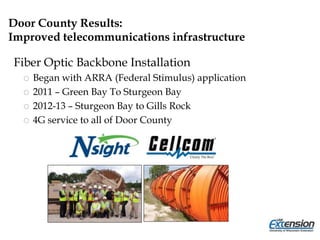
Fiber Optic Backbone Installation
 Began with ARRA (Federal Stimulus) application
 2011 – Green Bay To Sturgeon Bay
 2012-13 – Sturgeon Bay to Gills Rock
 4G service to all of Door County
Door County Results:
Improved telecommunications infrastructure
Chippewa Valley
Inter-
Networking
Consortium
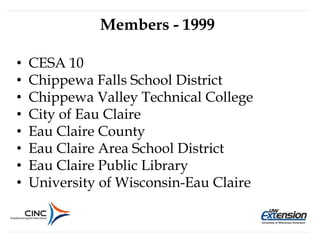
Members - 1999
• CESA 10
• Chippewa Falls School District
• Chippewa Valley Technical College
• City of Eau Claire
• Eau Claire County
• Eau Claire Area School District
• Eau Claire Public Library
• University of Wisconsin-Eau Claire
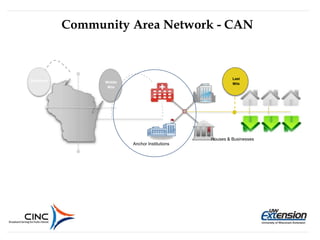
Community Area Network - CAN
Backbone Middle
Mile
Last
Mile
Houses & Businesses
Anchor Institutions
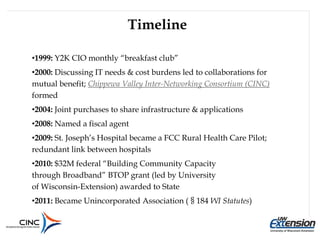
Timeline
•1999: Y2K CIO monthly “breakfast club”
•2000: Discussing IT needs & cost burdens led to collaborations for
mutual benefit; Chippewa Valley Inter-Networking Consortium (CINC)
formed
•2004: Joint purchases to share infrastructure & applications
•2008: Named a fiscal agent
•2009: St. Joseph’s Hospital became a FCC Rural Health Care Pilot;
redundant link between hospitals
•2010: $32M federal “Building Community Capacity
through Broadband” BTOP grant (led by University
of Wisconsin-Extension) awarded to State
•2011: Became Unincorporated Association (§184 WI Statutes)
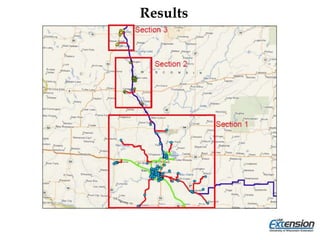
Results
CINC
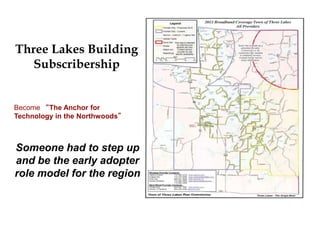
Become “The Anchor for
Technology in the Northwoods”
Someone had to step up
and be the early adopter
role model for the region
Three Lakes Building
Subscribership
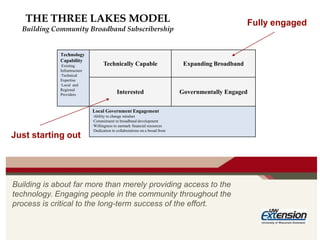
Building is about far more than merely providing access to the
technology. Engaging people in the community throughout the
process is critical to the long-term success of the effort.
THE THREE LAKES MODEL
Building Community Broadband Subscribership
Technology
Capability
·Existing
Infrastructure
·Technical
Expertise
·Local and
Regional
Providers
Technically Capable Expanding Broadband
Interested Governmentally Engaged
Local Government Engagement
·Ability to change mindset
·Commitment to broadband development
·Willingness to earmark financial resources
·Dedication to collaborations on a broad front
Just starting out
Fully engaged
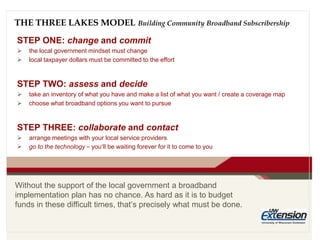
THE THREE LAKES MODEL Building Community Broadband Subscribership
STEP ONE: change and commit
 the local government mindset must change
 local taxpayer dollars must be committed to the effort
STEP TWO: assess and decide
 take an inventory of what you have and make a list of what you want / create a coverage map
 choose what broadband options you want to pursue
STEP THREE: collaborate and contact
 arrange meetings with your local service providers
 go to the technology – you’ll be waiting forever for it to come to you
Without the support of the local government a broadband
implementation plan has no chance. As hard as it is to budget
funds in these difficult times, that’s precisely what must be done.
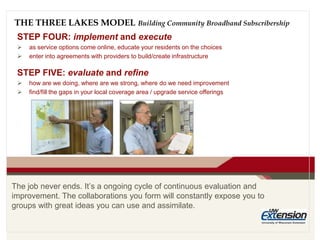
THE THREE LAKES MODEL Building Community Broadband Subscribership
STEP FOUR: implement and execute
 as service options come online, educate your residents on the choices
 enter into agreements with providers to build/create infrastructure
STEP FIVE: evaluate and refine
 how are we doing, where are we strong, where do we need improvement
 find/fill the gaps in your local coverage area / upgrade service offerings
The job never ends. It’s a ongoing cycle of continuous evaluation and
improvement. The collaborations you form will constantly expose you to
groups with great ideas you can use and assimilate.
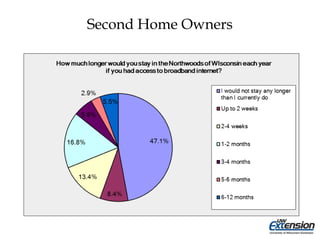
Second Home Owners
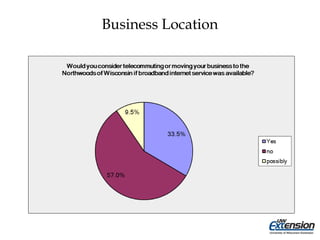
Business Location
Broadband Improvement: Town of Minocqua
The Past
 2010: Minocqua invests $50,000 in three towers to
improve options to residents.
 Entered agreement with SonicNet to provide
Internet Service to areas now served by the new
towers.
 2012, Town Chairman, created the Minocqua
Broadband & Business Development Committee
 Committee executed survey on broadband, sent
out with 2012 tax bills.
Minocqua Broadband Survey
1. Is this your Primary Residence YES NO
2. Do you currently have Internet Service at this address YES NO
3. Who is your Internet Provider: Charter - Frontier - Verizon -AT&T –
Hughes – Wild Blue - Other _________________
4. Are you satisfied with your current service YES NO What is your
monthly cost $________
5. Do you know how fast your current internet service speed is?
___I don’t know [go to www.speedtest.net to find the speed]
___< 1 Megabits ___1-3 Megabits ___3-5 Megabits ___5-10 Megabits
___ > 10 Megabits
Please print your current Minocqua Home Street Address:
___________________________________________________________
Minocqua Survey Results
 Received 1,670 responses from over 5,000 tax
bills sent
 Approximately half were seasonal residents
 Approximately half had internet service
 Only one third were satisfied with the service
 Only 33% were satisfied!
The Present
 Analyzing data from recent survey and 2011 Survey of Grow
North Region
 Planning July 9, 2013 Broadband Fair at LUHS
 Internet Service Providers
 Educational Opportunities
 Food
 Revising Agreement with SonicNet.
 Considering involvement in Partnership with the Lac du
Flambeau Tribe & Vilas County to create a regional Internet
Service Provider for underserved and un-served areas.
Broadband Improvement: Town of Minocqua
Lunch Time!
What do you think?
How well is broadband understood in your
community?
What do you think are the roadblocks or
obstacles for expanding broadband usage?
 If we could help you with one thing regarding
broadband, what would it be?
 Imagine your area as a broadband connected
community five years from now; what does it
look like?
Break (2:00 – 2:15pm)
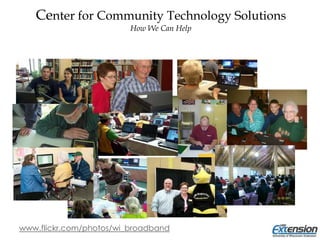
Center for Community Technology Solutions
How We Can Help
www.flickr.com/photos/wi_broadband
Our Goals for the Next Year
Work with Economic Development Specialists to
increase broadband availability across the state
Partner with the Public Service Commission on their
planning and mapping effort
Increase the number of rural communities actively
engaged to find solutions
Tech/Broadband Training & Coaching
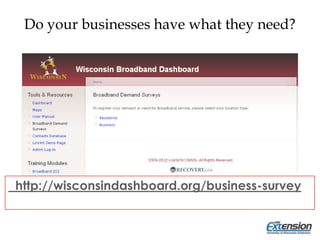
Do your businesses have what they need?
http://wisconsindashboard.org/business-survey
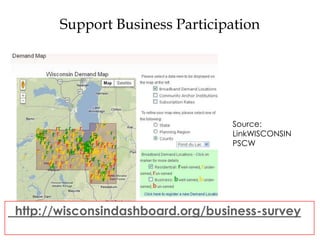
Support Business Participation
Source:
LinkWISCONSIN
PSCW
http://wisconsindashboard.org/business-survey
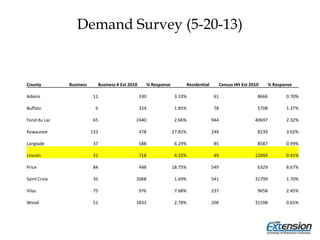
County Business Business # Est 2010 % Response Residential Census HH Est 2010 % Response
Adams 11 330 3.33% 61 8666 0.70%
Buffalo 6 324 1.85% 78 5708 1.37%
Fond du Lac 65 2440 2.66% 944 40697 2.32%
Kewaunee 133 478 27.82% 249 8239 3.02%
Langlade 37 588 6.29% 85 8587 0.99%
Lincoln 31 718 4.32% 49 12094 0.41%
Price 84 448 18.75% 549 6329 8.67%
Saint Croix 35 2068 1.69% 541 31799 1.70%
Vilas 75 976 7.68% 237 9658 2.45%
Wood 51 1833 2.78% 206 31598 0.65%
Demand Survey (5-20-13)
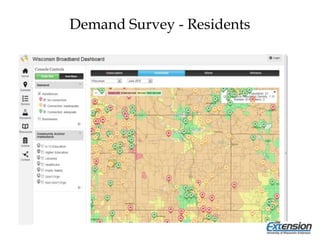
Demand Survey - Residents
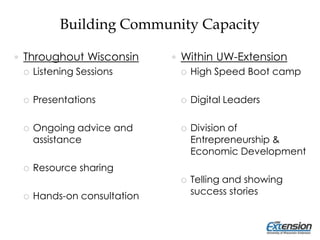
Building Community Capacity
 Throughout Wisconsin
 Listening Sessions
 Presentations
 Ongoing advice and
assistance
 Resource sharing
 Hands-on consultation
 Within UW-Extension
 High Speed Boot camp
 Digital Leaders
 Division of
Entrepreneurship &
Economic Development
 Telling and showing
success stories
Exercises to help you figure it out
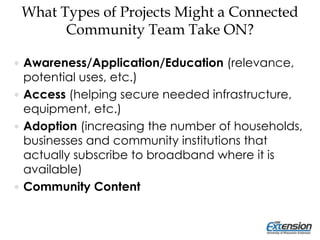
What Types of Projects Might a Connected
Community Team Take ON?
 Awareness/Application/Education (relevance,
potential uses, etc.)
 Access (helping secure needed infrastructure,
equipment, etc.)
 Adoption (increasing the number of households,
businesses and community institutions that
actually subscribe to broadband where it is
available)
 Community Content
Who Needs to Be On the Team?
Leadership Team Identification Worksheet
http://srdc.msstate.edu/ecommerce/curricula/co
nnectingcommunities/files/1-
2_leadership_team_id.pdf
Designing Solutions
 Community Projects Checklist
 50 Ideas to Connect Communities
Contact Information:
Prof. Andy Lewis
Community Economic Development Specialist
Center for Community Technology Solutions
University Wisconsin-Extension
(608) 890-4254 or andy.lewis@uwex.edu
Maria Alvarez Stroud
Director
Center for Community Technology Solutions
University of Wisconsin-extension
(608) 263-9295 or maria.alvarez-stroud@uwex.edu

Lincoln county

  • 1.
    Broadband! Session #4; June13, 2013 9AM-3PM Merrill Community Forum Series
  • 2.
    Introductions Who are you?Who Do you represent? How important do you think broadband expansion is in Lincoln County? Nice? Important? Imperative?
  • 3.
    Center for CommunityTechnology Solutions Connecting Wisconsin Communities to Compete
  • 4.
  • 5.
  • 6.
    What Speed Means Dial-up+(56 Kbps):  1 day, 10 hrs, 44 min T1/DSL (1.54 Mbps):  1 Hour, 15 min Cable (10 Mbps ):  11 min, 44 sec Fiber (1 Gbps):  7 sec
  • 7.
  • 8.
    No, you weren’tdownloaded. You were born.
  • 9.
  • 10.
    What percentage ofWisconsin households subscribe (pay) to broadband (3 mbps/768 kbps) at home? A. 96% B. 76% C. 56% D. 26% E. 16%
  • 11.
    The national broadbandplan calls for a minimum residential broadband connection of: A. Something faster than “one ringy dingy” B. 1 Mbps download/200 kbps upload C. 4 Mbps download/1 Mbps upload D. 100 Mbps download/4 Mbps upload E. Faster than a speeding bullet
  • 12.
    AT&T is reportedto have the fastest LTE Network in the Country. What is the average reported speed for AT&T? A. 2 Mbps B. 4 Mbps C. 13 Mbps D. 100 Mbps E. 1 Gbps
  • 13.
    We Need bothFixed and Wireless
  • 14.
    What speeds arefiber-based networks able to deliver? A. 4-10 Mbps B. 100 Mbps C. 1 Gbps D. 10 Gbps E. 100 Gbps
  • 15.
    When the IEDCsurveyed economic development professionals what percentage felt that 4 Mbps/1 Mbps was sufficient for advancing their local economies? A. More than 95% B. 75% C. 50% D. 25% E. Less than 10%
  • 16.
    The 2011 WisconsinAgricultural Survey reports that 73% of farmers have access to a computer. What percent had access to the Internet? A. 97% B. 77% C. 67% D. 57% E. 37%
  • 17.
  • 18.
    What % ofschools receiving subsidies for broadband connections through the FCC’s E-Rate program report having the bandwidth to meet current needs? A. 90% B. 80% C. 60% D. 40% E. 20%
  • 20.
    Very Different BandwidthNeeds “As many as 80 percent of E-rate-funded schools and libraries say their broadband connections do not fully meet their needs.” Eighth Broadband Progress Report, Aug 21, 2012, FCC http://www.fcc.gov/reports/eighth-broadband-progress-report
  • 21.
    Where Do WeStand?  In the State  In the Country  In the World
  • 22.
    Max Adv Downloadspeed (Wireless)
  • 23.
    Where Does LincolnCounty Stand?
  • 24.
  • 25.
  • 26.
    Max Adv DownloadSpeed (Wireline)
  • 27.
    Max Adv DownloadSpeed (Wireline)
  • 28.
    Max Adv Downloadspeed (Wireless)
  • 29.
    Wisconsin ranks #24 (Access) #38(Adoption: Residential Source: Eighth Broadband Progress Report, FCC, August, 2012, http://hraunfoss.fcc.gov/edocs_public/attachmatch/FCC-12-90A1.doc
  • 30.
    Our Place inthe World… 45.1806° N, 89.6833° W
  • 31.
    country/region Q4 ‘12 avg.mbps QoQ change yoy change – Global 2.9 5.0% 25% 1 South Korea 14.0 -4.8% -13% 2 Japan 10.8 2.7% 19% 3 Hong Kong 9.3 3.4% 5.4% 4 Latvia 8.9 2.3% 20% 5 Switzerland 8.7 0.5% 20% 6 Netherlands 8.6 0.1% 3.3% 7 Czech Republic 8.1 7.0% 21% 8 United States 7.4 2.3% 28% 9 Sweden 7.3 7.4% 29% 10 Finland 7.1 4.3% 20% 6 9 10 1 5 4 2 8 7 3 figure 10: Average Measured Connection Speed by Country/Region The State of the Internet, Q3, 2012 Average Connection Speeds
  • 32.
    country/region % above 10mbps QoQ change yoy change – Global 11% 2.7% 31% 1 South Korea 49% -5.7% -13% 2 Japan 39% 4.3% 28% 3 Hong Kong 28% 3.9% 7.9% 4 Latvia 27% 1.9% 26% 5 Switzerland 23% 1.8% 58% 6 Netherlands 21% -0.7% 1.1% 7 Sweden 19% 16% 72% 8 United States 19% 5.5% 90% 9 Finland 18% 13% 49% 10 Czech Republic 17% 16% 60% 10 7 9 4 6 1 5 2 8 3 figure 12: High Broadband (>10 Mbps) Connectivity High Broadband Connectivity (> 10 Mbps)
  • 33.
    country/region % above 4mbps QoQ change yoy change – Global 42% 2.1% 15% 1 South Korea 86% -0.5% 0.7% 2 Switzerland 82% 1.3% 18% 3 Netherlands 82% -0.1% 1.1% 4 Japan 76% 1.1% 13% 5 Hong Kong 74% 4.8% 8.8% 6 Czech Republic 72% 6.2% 14% 7 Canada 72% 2.3% 17% 8 Latvia 72% -0.2% 16% 9 Belgium 71% 3.5% 0.8% 10 Denmark 69% 0.8% 26% … 13 United States 64% 1.9% 16% 10 6 8 3 1 7 9 4 13 2 5 figure 13: Broadband (>4 Mbps) Connectivity Broadband Connectivity >4Mbps Global
  • 34.
    South Korea: 1G Finland:100Mbps/2015 Chattanooga TN: 1G A Global Economy
  • 35.
    "Winning The GlobalBandwidth Race" “We are in a global bandwidth race. A nation’s future economic security is tied to frictionless and speedy access to information.” http://www.fcc.gov/document/chairman-genachowski-winning- global-bandwidth-race --FCC Chairman Genachowski
  • 36.
    IEDC Survey 2012 Fewerthan 10% believe 4 Mbps is sufficient for advancing their local economies
  • 37.
    Estimated Annual Costof Digital Exclusion (-) $55 Billion U.S. (-) $1 Billion Wisconsin www.econsult.com/articles/030810_costofexclusion.pdf
  • 38.
    Retail sales increasedat an average annual growth rate of 2.6% from 2002-2010 Sources: U.S. Census E-stats, May 10,2012: http://www.census.gov/econ/estats/2010/2010reportfinal.pdf Quarterly Retail E-Commerce Sales, Q3, 2012: http://www.census.gov/retail/mrts/www/data/pdf/ec_current.pdf
  • 39.
    In 2010, U.S.manufacturing shipments totaled $4.9 trillion. What percentage of the $4.9 trillion in manufacturing shipments was attributable to e- commerce in 2010? a) 13% b) 25% c) 46% d) 88% Source: U.S. Census E-stats, May 10, 2012, http://www.census.gov/econ/estats/2010/2010reportfinal.pdf
  • 40.
    E-commerce generated $4.1trillion in sales in 2010 What percentage of total internet sales was between businesses (B2B)? a) 27 percent b) 38 percent c) 62 percent d) 89 percent
  • 41.
    Impact On Business… Minnesota business establishments that use broadband report median annual revenues that are approximately $200,000 higher than businesses that do not use broadband.  Nearly 60% of small businesses report that broadband availability is an essential factor in making a decision on their location. Sources: www.sngroup.com www.connectmn.org/sites/default/files/learn-sidebar-docs/mn_biz_2012.pdf
  • 42.
  • 43.
  • 44.
  • 45.
    Farm Computer UsageWI, 2001-2011 http://www.nass.usda.gov/Statistics_by_State/Wisconsin/Publications/Annual_Statistical_Bulletin/bulletin2012_web.pdf
  • 46.
  • 47.
  • 48.
    Door County BroadbandEfforts Step 1: 2001 Door County Technology Council forms & develops mission: “The Door County Technology Council is made up of private and public sector organizations working to provide for the telecommunications infrastructure needs of Door County to improve the competitiveness of its businesses and the quality of life of its residents.” http://www.doorcountybusiness.com/community-development/technology-council/
  • 49.
    Door County: NextSteps Informal analysis of Tech Council members identifies two main issues:  Lack of redundancy  High cost for limited broadband services  2002 - Infrastructure Assessment  2003 - Technology Needs & Market Study  2008 - Economic Development Corp. strategy:  Move to a New Economy model that includes and supports… technology infrastructure….
  • 50.
    Door County: ContinuedAction Action Steps  Continue to educate citizens and business owners  Seek local, state and federal support for building telecommunications infrastructure in a rural county.  Develop promising and feasible approaches to providing broadband service to Door County.  Develop a marketing plan that leverages the improvement in telecommunications to retain and attract businesses.
  • 51.
    Fiber Optic BackboneInstallation  Began with ARRA (Federal Stimulus) application  2011 – Green Bay To Sturgeon Bay  2012-13 – Sturgeon Bay to Gills Rock  4G service to all of Door County Door County Results: Improved telecommunications infrastructure
  • 52.
  • 53.
    Members - 1999 •CESA 10 • Chippewa Falls School District • Chippewa Valley Technical College • City of Eau Claire • Eau Claire County • Eau Claire Area School District • Eau Claire Public Library • University of Wisconsin-Eau Claire
  • 54.
    Community Area Network- CAN Backbone Middle Mile Last Mile Houses & Businesses Anchor Institutions
  • 55.
    Timeline •1999: Y2K CIOmonthly “breakfast club” •2000: Discussing IT needs & cost burdens led to collaborations for mutual benefit; Chippewa Valley Inter-Networking Consortium (CINC) formed •2004: Joint purchases to share infrastructure & applications •2008: Named a fiscal agent •2009: St. Joseph’s Hospital became a FCC Rural Health Care Pilot; redundant link between hospitals •2010: $32M federal “Building Community Capacity through Broadband” BTOP grant (led by University of Wisconsin-Extension) awarded to State •2011: Became Unincorporated Association (§184 WI Statutes)
  • 56.
  • 57.
    Become “The Anchorfor Technology in the Northwoods” Someone had to step up and be the early adopter role model for the region Three Lakes Building Subscribership
  • 58.
    Building is aboutfar more than merely providing access to the technology. Engaging people in the community throughout the process is critical to the long-term success of the effort. THE THREE LAKES MODEL Building Community Broadband Subscribership Technology Capability ·Existing Infrastructure ·Technical Expertise ·Local and Regional Providers Technically Capable Expanding Broadband Interested Governmentally Engaged Local Government Engagement ·Ability to change mindset ·Commitment to broadband development ·Willingness to earmark financial resources ·Dedication to collaborations on a broad front Just starting out Fully engaged
  • 59.
    THE THREE LAKESMODEL Building Community Broadband Subscribership STEP ONE: change and commit  the local government mindset must change  local taxpayer dollars must be committed to the effort STEP TWO: assess and decide  take an inventory of what you have and make a list of what you want / create a coverage map  choose what broadband options you want to pursue STEP THREE: collaborate and contact  arrange meetings with your local service providers  go to the technology – you’ll be waiting forever for it to come to you Without the support of the local government a broadband implementation plan has no chance. As hard as it is to budget funds in these difficult times, that’s precisely what must be done.
  • 60.
    THE THREE LAKESMODEL Building Community Broadband Subscribership STEP FOUR: implement and execute  as service options come online, educate your residents on the choices  enter into agreements with providers to build/create infrastructure STEP FIVE: evaluate and refine  how are we doing, where are we strong, where do we need improvement  find/fill the gaps in your local coverage area / upgrade service offerings The job never ends. It’s a ongoing cycle of continuous evaluation and improvement. The collaborations you form will constantly expose you to groups with great ideas you can use and assimilate.
  • 61.
  • 62.
  • 63.
    Broadband Improvement: Townof Minocqua The Past  2010: Minocqua invests $50,000 in three towers to improve options to residents.  Entered agreement with SonicNet to provide Internet Service to areas now served by the new towers.  2012, Town Chairman, created the Minocqua Broadband & Business Development Committee  Committee executed survey on broadband, sent out with 2012 tax bills.
  • 64.
    Minocqua Broadband Survey 1.Is this your Primary Residence YES NO 2. Do you currently have Internet Service at this address YES NO 3. Who is your Internet Provider: Charter - Frontier - Verizon -AT&T – Hughes – Wild Blue - Other _________________ 4. Are you satisfied with your current service YES NO What is your monthly cost $________ 5. Do you know how fast your current internet service speed is? ___I don’t know [go to www.speedtest.net to find the speed] ___< 1 Megabits ___1-3 Megabits ___3-5 Megabits ___5-10 Megabits ___ > 10 Megabits Please print your current Minocqua Home Street Address: ___________________________________________________________
  • 65.
    Minocqua Survey Results Received 1,670 responses from over 5,000 tax bills sent  Approximately half were seasonal residents  Approximately half had internet service  Only one third were satisfied with the service  Only 33% were satisfied!
  • 66.
    The Present  Analyzingdata from recent survey and 2011 Survey of Grow North Region  Planning July 9, 2013 Broadband Fair at LUHS  Internet Service Providers  Educational Opportunities  Food  Revising Agreement with SonicNet.  Considering involvement in Partnership with the Lac du Flambeau Tribe & Vilas County to create a regional Internet Service Provider for underserved and un-served areas. Broadband Improvement: Town of Minocqua
  • 67.
  • 68.
    What do youthink? How well is broadband understood in your community? What do you think are the roadblocks or obstacles for expanding broadband usage?
  • 69.
     If wecould help you with one thing regarding broadband, what would it be?  Imagine your area as a broadband connected community five years from now; what does it look like?
  • 70.
  • 71.
    Center for CommunityTechnology Solutions How We Can Help www.flickr.com/photos/wi_broadband
  • 72.
    Our Goals forthe Next Year Work with Economic Development Specialists to increase broadband availability across the state Partner with the Public Service Commission on their planning and mapping effort Increase the number of rural communities actively engaged to find solutions Tech/Broadband Training & Coaching
  • 73.
    Do your businesseshave what they need? http://wisconsindashboard.org/business-survey
  • 74.
  • 75.
    County Business Business# Est 2010 % Response Residential Census HH Est 2010 % Response Adams 11 330 3.33% 61 8666 0.70% Buffalo 6 324 1.85% 78 5708 1.37% Fond du Lac 65 2440 2.66% 944 40697 2.32% Kewaunee 133 478 27.82% 249 8239 3.02% Langlade 37 588 6.29% 85 8587 0.99% Lincoln 31 718 4.32% 49 12094 0.41% Price 84 448 18.75% 549 6329 8.67% Saint Croix 35 2068 1.69% 541 31799 1.70% Vilas 75 976 7.68% 237 9658 2.45% Wood 51 1833 2.78% 206 31598 0.65% Demand Survey (5-20-13)
  • 76.
    Demand Survey -Residents
  • 77.
    Building Community Capacity Throughout Wisconsin  Listening Sessions  Presentations  Ongoing advice and assistance  Resource sharing  Hands-on consultation  Within UW-Extension  High Speed Boot camp  Digital Leaders  Division of Entrepreneurship & Economic Development  Telling and showing success stories
  • 78.
    Exercises to helpyou figure it out
  • 79.
    What Types ofProjects Might a Connected Community Team Take ON?  Awareness/Application/Education (relevance, potential uses, etc.)  Access (helping secure needed infrastructure, equipment, etc.)  Adoption (increasing the number of households, businesses and community institutions that actually subscribe to broadband where it is available)  Community Content
  • 80.
    Who Needs toBe On the Team? Leadership Team Identification Worksheet http://srdc.msstate.edu/ecommerce/curricula/co nnectingcommunities/files/1- 2_leadership_team_id.pdf
  • 81.
    Designing Solutions  CommunityProjects Checklist  50 Ideas to Connect Communities
  • 82.
    Contact Information: Prof. AndyLewis Community Economic Development Specialist Center for Community Technology Solutions University Wisconsin-Extension (608) 890-4254 or andy.lewis@uwex.edu Maria Alvarez Stroud Director Center for Community Technology Solutions University of Wisconsin-extension (608) 263-9295 or maria.alvarez-stroud@uwex.edu

Editor's Notes

  • #2 Andy and Maria both give short intros
  • #3 Round Robin of intro’s, we’ll record on flip chart responsesExplain we are going to go back and forth between Maria and Andy
  • #4 Maria: slides 3 - 10Historically communities developed along important waterways, then stage coach roads , railroads and highways (and other infrastructure like mills and electricity).  Why?  Access to markets.  Where is your nearest on-ramp to the world-market via the Internet ? How many lanes does it have and what is the speed limit?  Successful communities and their businesses in the next years will be those that tap into this huge potential.  Successful communities will be those that bring this essential infrastructure to their community. 
  • #5 Maria:In simple terms, broadband essentially means high speed Internet. It allows you to download large files quickly (books, movies, music, medical records, bank statements, etc.).Think of a dirt road versus a super highway—or, dial up versus broadband.
  • #6 Maria:You get it in different ways; what people, businesses included want is reliable service that they can count on.
  • #7 We have created a number of broadband video case studies. This particular clip is 835 Megabytes (a byte is a different measurement then bit). Same data, 1.5 days to 7 seconds download range.
  • #8 Maria:When you talk about broadband, you also have to think about the people using it and why, for what and who sees the value and who doesn’t
  • #9 Maria:The Digital Divide of today: Digitalnatives have a different perspective.Transition: Let’s start by looking at what we digital immigrants need to know about technology.
  • #10 Maria:The Economics behind broadband – the changing landscapePlumbers Convention story
  • #11 Maria:So, first question for you:http://hraunfoss.fcc.gov/edocs_public/attachmatch/FCC-12-90A1.docPage 16462% have 768/200 kbps4.9% have 6/1.5 mbps
  • #12 Andy: slides 11 to 20
  • #13 Andy:http://www.fiercewireless.com/story/att-clocks-average-real-world-lte-speeds-13-mbps-opensignal-survey-finds/2013-02-14
  • #14 Andy
  • #15 Andy
  • #16 Andy
  • #17 Andy
  • #18 Andy
  • #19 Andyhttp://www.slate.com/articles/technology/future_tense/2013/04/moocs_and_other_education_technologies_require_better_broadband_infrastructure.2.html
  • #20 Andy
  • #21 Andy: While a high percentage of households may have access to broadband that meets their needs (at least in urban areas), that is not the case with CAI’s.COMMUNITY ANCHOR INSTITUTIONSBob Bocher had data indicating that more than half of the library customers getting Badgernet services at the beginning of this year were receiving less than the standard for residential (4 Mbps/1Mbps)
  • #22 Maria 21 - 34
  • #30 AndyNote: There are different Data Sources that can be used to measure these two things, different ways of measuring broadband, and the data is constantly being updated (Form 477 data)Access: The percentage of households that have access to broadband of at least 3 Mbps download/.7 Mbps uploadSource: “Eighth Broadband Progress Report” released by the FCC, August, 2012, http://hraunfoss.fcc.gov/edocs_public/attachmatch/FCC-12-90A1.doc (Adoption: Appendix H, Page 163, Access, Appendix G, Page 161) The data from broadband providers indicate that 93.1% of Wisconsin Households have access to this level of service.BUT….The difference between #1 and #35 is less than 7% . 93.1% vs. 100% in D.C. We have been as low as #45 in recent years. Subscribership/AdoptionBased on data provided by wireline providers, only 26% of households subscribe to a wired broadband connection providing speeds of at least 3Mbps download, .7Mbps upload. We are tied for 38’th based on this data. Twelve states have adoption rates that are double the rate in Wisconsin and the national average was 40.4% (compared to WI 25%). Massachussetts had an adoption rate of 69.7%If we look at slightly faster service, less than 5% of the Wisconsin population (4.9%) is subscribing to a service providing 6 Mbps/1.5 Mbps service. That compares to 27.6% for the nation.So while the availability of broadband meeting the benchmark speeds adopted by the FCC for the residential customers might be average, our adoption rates lag significantly behind the nation. Source: “Eighth Broadband Progress Report” released by the FCC, August, 2012, http://hraunfoss.fcc.gov/edocs_public/attachmatch/FCC-12-90A1.doc (Page 161-164) On the issue of Access/Deployment, how we compare against other states, or the national average is a little irrelevant given the low bar we have established in the U.S. The top states like Massachussetts, New Jerseyand Connecticut can simply declare themselves the winner of the shortest midget contest. There are some exceptions. We have areas like Chattanooga Tennessee and Kansas City installing networks that provide ~ 100 times the connectivity offered by the benchmark speeds of 3Mbps/.7Mbps THAT IS THE COMPETITION
  • #31 MariaWe are living in a global economy. It matters less about how we compete against Alabama or West Virginia, because frankly our nationals standard sets the bar pretty low. More importantly how do we compete against countries with higher population densities? Where the United Nations has declared broadband a “basic human right”? Where some countries have made broadband a legal right? Where some U.S. communities and many nations have set the bar at 1 Gbps?
  • #32 Andy***PLEASE NOTE, NEW REPORT OUT, THESE CHARTS ARE FROM THAT REPORT. “Akamai Intelligence Platform”Akamai doesn’t rely on “peak advertised broadband speeds” or data reported by the service providers. Instead it does analysis based on the approximately two trillion requests for Web content that it services on a daily basis from 665 million IP addresses in 242 Countries/regions. The Platform is made up of over one hundred thousand servers, deployed in over 75 countries and spanning the most important networks within the Internet, a single network hop away from 90% of Internet users. These servers are all controlled by Akamai software that is constantly monitoring Internet conditions.
  • #35 Maria:Broadband Recognition as a citizens right by the United NationCountries Goals to connect every household; South Korea’s pledge of 1 Gbps by 2012Finland&apos;s Goals of 100 Mbps by 2015Chattanooga is offering connectivity that is 200 times what most residents in this country are gettingWhat else might be pointed out here?????
  • #36 Andy slides 34 - 45
  • #37 Andy:International Economic Development Council (IEDC)74% of economic development professionals thought that fiber-based broadband would have a direct or indirect impact on their ability to attract businesses 18% of respondents have insufficient speeds to produce economic outcomes and have given up hope for a solution 13% do not have enough speed to get the job done but are actively trying to find a solution
  • #38 Andy: What we learned from the project:Build it and they’ll come doesn’t workOutreach and education is key—both for general public and for leadershipThere is a continuum of community-recognized needAccess to high speed internet (aka broadband) is critical for economic development. *Estimated that the impact of not having broadband is costing U.S. over $55 Billion a year *Costing Wisconsin over $1 Billion/yearThese themes drive the creation and work of the Center for Community Technology Solutions
  • #39 Andy: Retail sales increased at an average annual growth rate of 2.6% from 2002-2010The real question f course is what has the annual average growth rate for retail e-sales been during this same period? 17.9%!Word of caution….E-commerce sales still only make up a little less than 5%of total sales…but it is the trend that is important.
  • #40 Andy:Most people thinking about e-commerce as being things like ordering plane tickets or something on Amazon or E-bay. What about manufacturing??46% is the answer
  • #41 Again, while people think of e-commerce as a consumer activitiy (consumers buying from on-line businesses), much of the e-commerce activity is between businesses.You should be getting good at this by now. C is the right answer right? Nope…(89 percent ($3.7 trillion) of the total $4.1 trillion in e-commerce sales in 2010 was B2B.
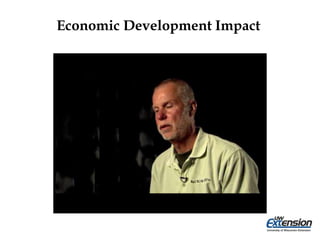
  • #43 This is not an uncommon theme. Site study done by Three Lakes…..Joe Hegge, Grow North
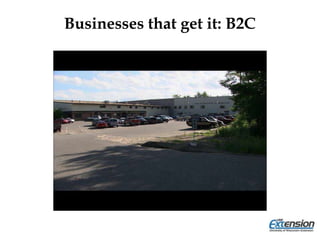
  • #44 We also know there are companies in Wisconsin who get it and are doing wellDr’s Foster and Smith (Rhinelander)
  • #45 Andy:My tires
  • #46 Andy:U.S.62% with Internet Access37% using computer for farm business65% have computer access2011 WI USPurchase Agricultural 17% 14%InputsOver InternetConduct Agricultural 17% 12%Marketing ActivitiesOver InternetAccess Other Federal 16% 14%Government Web sitesOver InternetConduct Business With Any 43% 35%Non-Agricultural Web sitePrimary Method of Internet Access By State and United States, 2011Dial Up 12% 12%DSL 51% 38%Cable 8% 11%http://www.nass.usda.gov/Statistics_by_State/Wisconsin/Publications/Annual_Statistical_Bulletin/bulletin2012_web.pdf
  • #57 Chippewa Valley / Eau Claire / aka CINC (pronounced “sink”): Chippewa InterNetworking ConsortiumCINC is a pioneer in CANs in the state of Wisconsin and the nation. They’ve been doing this for 10 years with great success (note all the green lines—existing fiber). CINC has been the model for much of what we’re doing with CANs.The BCCB grant project here will dramatically increase the reach across two counties and approximately 10 communities, redefining the “Community” in CAN.There’s also another twist to the Chippewa Valley plan: wireless.
  • #62 PSC Region 2: (Forest, Langlade, Lincoln, Oneida, Vilas).
  • #63 Broadband Internet AccessibilityWould you consider telecommuting or moving your business to the Northwoods of Wisconsin if broadband internet service was available?Answer OptionsResponse PercentResponse Count Yes 33.5% 53 no 57.0% 90 possibly 9.5% 15 answered question158skipped question85
  • #69 Let’s switch gears and have you do the talking: Art to ask the questions?????
  • #70 Andy 0r Maria; one records, Art to ask questions?
  • #72 The technology is important, but it is the people who will make the difference. We are focused on bothOur Flickr site tells a million stories….20,000+ to be exact.
  • #73 2012 Goals:Economic Development Goal: Increase broadband availability and effective use of broadband to advance the state’s economy PSC University Partnershipfor Evaluation and MonitoringGoal: Effectively monitor and evaluate the Public Service Commission’s effort to improve broadband in the state of Wisconsin. PSC University Partnershipfor Technology Training Goal: Increase and expand skill sets of Regional Team Leadership in order to impact broadband understanding locally throughout the state.  Community Piloting Goal: Increase the number of rural communities who are actively working to improve broadband availability, adoption and application. Outreach &amp; Engagement Goal: Develop relationships with relevant organizations demonstrating the benefits of broadband in effort to increase broadband adoption. Tech/Broadband Training &amp; Coaching Goal: Expand the capacity of UWEX/Colleges faculty/staff to assist communities with strategies aimed at increasing their level of broadband connectivity.
  • #75 http://www.wisconsindashboard.org/node/460Now….we can bicker about what we should be measuring, or we could focus on what people say they actually need. This is the Demand Survey created by the LinkWISCONSIN project and illustrates the residential responses in the urban county of Fond du lac County. There are an overwelming number of yellow colored r’s that indicate under-served households. The red colored r’s indicate the number of households that say they are un-served.Instead of the government or the providers telling us what people need, shouldn’t the consumers and businesses be deciding that? And what is being requested is readily avaialbe in other global markets.
  • #77 http://wisconsindashboard.org/console
  • #81 You may have all you need to get started represented here today. But think about who else could make contributions to your effort and invited to the table.
  • #82 I would recommend using the “Community Projects Checklist” after the leadership identification worksheet.Directions: To use the checklist in a community meeting, divide the group into 3 groups and give each group a different set of statements. Instruct each group to circle each numbered statement they agree with and check off any projects they would like to consider undertaking. After 30 minutes, get back together as a large group. Have each group present their statements and suggested projects. Discuss the feasibility of the number and types of projects. Prioritize them and ask for volunteers for each project.