|| Jai Sri Gurudev||
Sri Adichunchanagiri Shikshana Trust (R)
SJB INSTITUTE OF TECHNOLOGY
(Affiliated to Visvesvaraya Technological University, Belagavi& Approved by AICTE, New Delhi.)
No. 67, BGS Health & Education City, Dr. Vishnuvardhan Road Kengeri, Bengaluru – 560 060
NOSQL DATABASE (21CS745)
By
Vijayalaxmi Joshi
VII Semester
Department of Computer Science & Engineering
Aca. Year: ODD SEM /2024-25
Module 3
Chapter 7: Map-Reduce
7.1 Basic Map-Reduce
7.2 Partitioning and Combining
7.3 Composing Map-Reduce Calculations
7.3.1ATwo Stage Map-Reduce Example
7.3.2 Incremental Map-Reduce
7.4 Further Reading
7.5 Key Points
Chapter 8: Key-Value Databases
8.1What Is a Key-Value Store
8.2 Key-Value Store Features
8.2.1 Consistency
8.2.2Transactions
8.2.3 Query Features
8.2.4 Structure of Data
8.2.5 Scaling
8.3 Suitable Use Cases
8.3.1 Storing Session Information3
8.3.2 User Profiles, Preferences
8.3.3 Shopping Cart Data
8.4When Not to Use
8.4.1 Relationships among Data
8.4.2 MultioperationTransactions
8.4.3 Query by Data
8.4.4 Operations by Sets
Chapter 7. Map-Reduce
 Running on a cluster means you must make your tradeoffs in data
storage differently than when running on a single machine.
 Clusters don’t just change the rules for data storage—they also
change the rules for computation.
 If you store lots of data on a cluster, processing that data
efficiently means you have to think differently about how you
organize your processing.
Map-Reduce pattern
 The map-reduce pattern (a form of Scatter-Gather [Hohpe andWoolf]) is
a way to organize processing in such a way as to take advantage of
multiple machines on a cluster while keeping as much processing and
the data it needs together on the same machine.
 It first gained prominence with Google’s MapReduce framework [Dean
and Ghemawat]
 A widely used open-source implementation is part of the Hadoop
project, although several databases include their own implementations.
 As with most patterns, there are differences in detail between these
implementations, so we’ll concentrate on the general concept.
 The name “map-reduce” reveals its inspiration from the map and
reduce operations on collections in functional programming languages.
7.1. Basic Map-Reduce
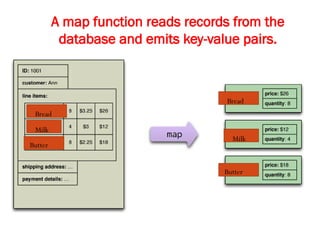
 The first stage in a map-reduce job is the map.
 A map is a function whose input is a single aggregate and whose
output is a bunch of key value pairs.
 Example, the input would be an order.The output would be key-
value pairs corresponding to the line items.
 Each one would have the product ID as the key and an embedded
map with the quantity and price as the values.
A map function reads records from the
database and emits key-value pairs.
Bread
Bread
Milk
Milk
Butter
Butter
 Each application of the map function is independent of all the
others.This allows them to be safely parallelizable, so that a map-
reduce framework can create efficient map tasks on each node
and freely allocate each order to a map task.
 This yields a great deal of parallelism and locality of data access.
 For this example, we are just selecting a value out of the record,
but there’s no reason why we can’t carry out some arbitrarily
complex function as part of the map—providing it only depends
on one aggregate’s worth of data.
Reduce function
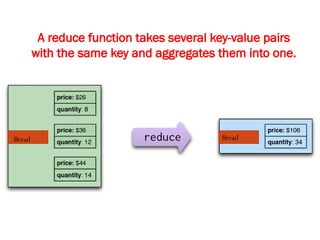
 A map operation only operates on a single record; the reduce
function takes multiple map outputs with the same key and
combines their values.
 So, a map function might yield 1000-line items from orders for
“Database Refactoring”; the reduce function would reduce down
to one, with the totals for the quantity and revenue.
 While the map function is limited to working only on data from a
single aggregate, the reduce function can use all values emitted
for a single key
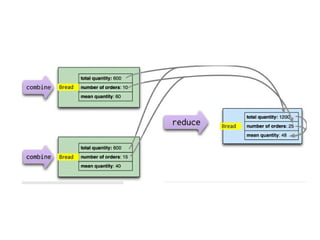
A reduce function takes several key-value pairs
with the same key and aggregates them into one.
Bread Bread
 The map-reduce framework arranges for map tasks to be run on
the correct nodes to process all the documents and for data to be
moved to the reduce function.
 To make it easier to write the reduce function, the framework
collects all the values for a single pair and calls the reduce function
once with the key and the collection of all the values for that key.
 So to run a map-reduce job, you just need to write these two
functions.
Partitioning and Combining
 In the simplest form, we think of a map-reduce job as having a
single reduce function.
 The outputs from all the map tasks running on the various
nodes are concatenated together and sent into the reduce.
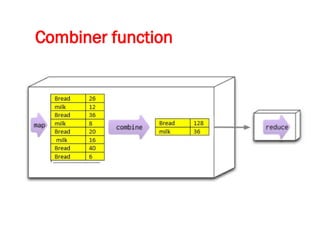
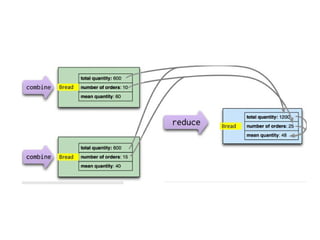
 While this will work, there are things we can do to increase the
parallelism and to reduce the data transfer
References
1.Dan Sullivan, "NoSQL For Mere Mortals", 1st Edition, Pearson
Education India, 2015. (ISBN13: 978-9332557338)
2. Dan McCreary and Ann Kelly, "Making Sense of NoSQL:A guide for
Managers and the Rest of us", 1st Edition, Manning
Publication/Dreamtech Press, 2013. (ISBN-13: 978-9351192022)
3. Kristina Chodorow, "Mongodb:The Definitive Guide- Powerful and
Scalable Data Storage", 2nd Edition, O'Reilly Publications, 2013.
(ISBN-13: 978-9351102694)
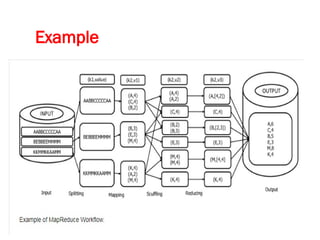
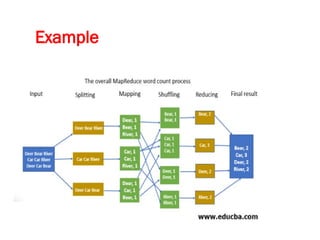
Example
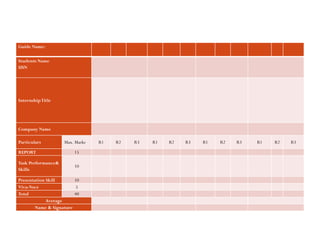
Guide Name:
Students Name
USN
InternshipTitle
Company Name
Particulars Max. Marks R1 R2 R3 R1 R2 R3 R1 R2 R3 R1 R2 R3
REPORT 15
Task Performance&
Skills
10
Presentation Skill 10
Viva-Voce 5
Total 40
Average
Name & Signature
Example
Combiner function
Composing Map-Reduce Calculations
 The map-reduce approach is a way of thinking about concurrent
processing that trades off flexibility in how you structure your
computation for a relatively straightforward model for
parallelizing the computation over a cluster.
 Since it’s a tradeoff, there are constraints on what you can do in
your calculations. Within a map task, you can only operate on a
single aggregate.
 Within a reduce task, you can only operate on a single key.
 This means you have to think differently about structuring your
programs so they work well within these constraints.
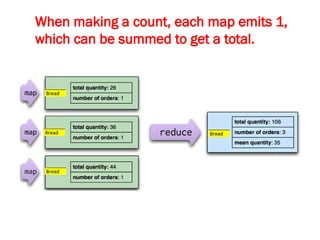
When making a count, each map emits 1,
which can be summed to get a total.
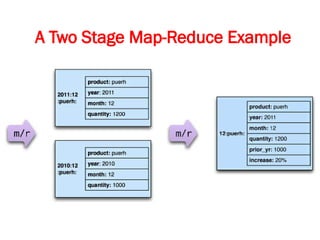
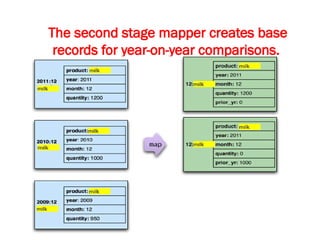
A Two Stage Map-Reduce Example
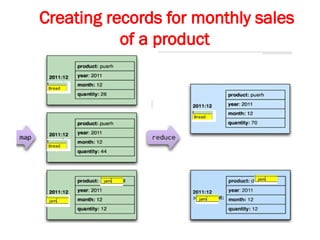
Creating records for monthly sales
of a product
The second stage mapper creates base
records for year-on-year comparisons.
Incremental Map-Reduce
 The map stages of a map-reduce are easy to handle incrementally—
only if the input data changes does the mapper need to be rerun.
 Since maps are isolated from each other, incremental updates are
straightforward. The more complex case is the reduce step, since it
pulls together the outputs from many maps and any change in the map
outputs could trigger a new reduction.
 This re computation can be lessened depending on how parallel the
reduce step is.
 If we are partitioning the data for reduction, then any partition that’s
unchanged does not need to be re-reduced. Similarly, if there’s a
combiner step, it doesn’t need to be rerun if its source data hasn’t
changed
Key Points
 Map-reduce is a pattern to allow computations to be parallelized over a cluster.
 The map task reads data from an aggregate and boils it down to relevant key-value
pairs. Maps only read a single record at a time and can thus be parallelized and run on
the node that stores the record.
 Reduce tasks take many values for a single key output from map tasks and summarize
them into a single output. Each reducer operates on the result of a single key, so it can
be parallelized by key.
 Reducers that have the same form for input and output can be combined into
pipelines.This improves parallelism and reduces the amount of data to be transferred.
 Map-reduce operations can be composed into pipelines where the output of one
reduce is the input to another operation’s map.
 If the result of a map-reduce computation is widely used, it can be stored as a
materialized view.
 Materialized views can be updated through incremental map-reduce operations that
only compute changes to the view instead of recomputing everything from scratch.
Chapter 8. Key-Value Databases
Chapter 8: Key-Value Databases
8.1What Is a Key-Value Store
8.2 Key-Value Store Features
8.2.1 Consistency
8.2.2Transactions
8.2.3 Query Features
8.2.4 Structure of Data
8.2.5 Scaling
8.3 Suitable Use Cases
8.3.1 Storing Session Information3
8.3.2 User Profiles, Preferences
8.3.3 Shopping Cart Data
8.4When Not to Use
8.4.1 Relationships among Data
8.4.2 MultioperationTransactions
8.4.3 Query by Data
8.4.4 Operations by Sets
Key-Value Databases
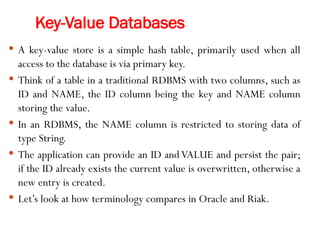
 A key-value store is a simple hash table, primarily used when all
access to the database is via primary key.
 Think of a table in a traditional RDBMS with two columns, such as
ID and NAME, the ID column being the key and NAME column
storing the value.
 In an RDBMS, the NAME column is restricted to storing data of
type String.
 The application can provide an ID and VALUE and persist the pair;
if the ID already exists the current value is overwritten, otherwise a
new entry is created.
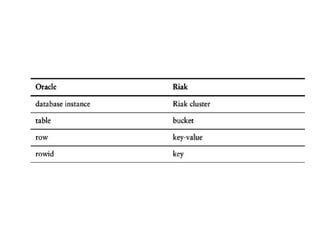
 Let’s look at how terminology compares in Oracle and Riak.
Popular key-value databases
 Riak [Riak]
 Redis (often referred to as Data Structure server) [Redis]
 Memcached DB and its flavors [Memcached]
 Berkeley DB [Berkeley DB]
 HamsterDB (especially suited for embedded use) [HamsterDB]
 Amazon DynamoDB [Amazon’s Dynamo] (not open-source)
 ProjectVoldemort [ProjectVoldemort] (an open-source
implementation ofAmazon DynamoDB).
Redis
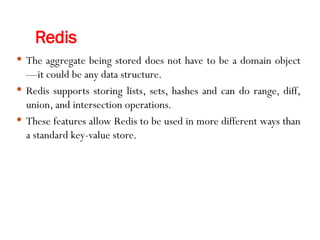
 The aggregate being stored does not have to be a domain object
—it could be any data structure.
 Redis supports storing lists, sets, hashes and can do range, diff,
union, and intersection operations.
 These features allow Redis to be used in more different ways than
a standard key-value store.
Riak
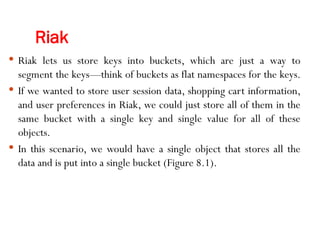
 Riak lets us store keys into buckets, which are just a way to
segment the keys—think of buckets as flat namespaces for the keys.
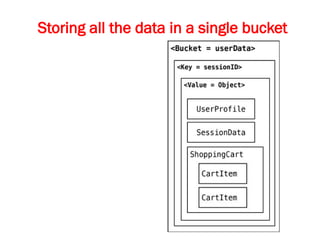
 If we wanted to store user session data, shopping cart information,
and user preferences in Riak, we could just store all of them in the
same bucket with a single key and single value for all of these
objects.
 In this scenario, we would have a single object that stores all the
data and is put into a single bucket (Figure 8.1).
Storing all the data in a single bucket
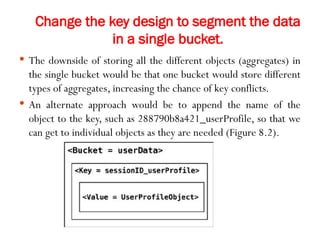
Change the key design to segment the data
in a single bucket.
 The downside of storing all the different objects (aggregates) in
the single bucket would be that one bucket would store different
types of aggregates, increasing the chance of key conflicts.
 An alternate approach would be to append the name of the
object to the key, such as 288790b8a421_userProfile, so that we
can get to individual objects as they are needed (Figure 8.2).
8.2. Key-Value Store Features
8.2.1. Consistency
8.2.2.Transactions
8.2.3. Query Features
8.2.4. Structure of Data
8.2.5. Scaling
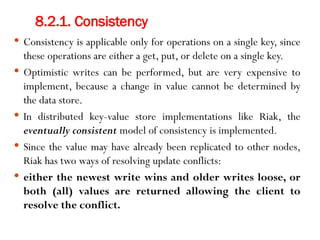
8.2.1. Consistency
 Consistency is applicable only for operations on a single key, since
these operations are either a get, put, or delete on a single key.
 Optimistic writes can be performed, but are very expensive to
implement, because a change in value cannot be determined by
the data store.
 In distributed key-value store implementations like Riak, the
eventually consistent model of consistency is implemented.
 Since the value may have already been replicated to other nodes,
Riak has two ways of resolving update conflicts:
 either the newest write wins and older writes loose, or
both (all) values are returned allowing the client to
resolve the conflict.
Riak
 In Riak, these options can be set up during the bucket creation.
 Buckets are just a way to namespace keys so that key collisions
can be reduced—for example, all customer keys may reside in
the customer bucket.
 When creating a bucket, default values for consistency can be
provided, for example that a write is considered good only when
the data is consistent across all the nodes where the data is
stored.
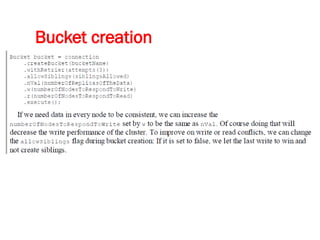
Bucket creation
8.2.2. Transactions
 Different products of the key-value store kind have different
specifications of transactions.
 Generally speaking, there are no guarantees on the writes. Many data
stores do implement transactions in different ways.
 Riak uses the concept of quorum implemented by using theW value —
replication factor—during the write API call.
 Assume we have a Riak cluster with a replication factor of 5 and we
supply the W value of 3. When writing, the write is reported as
successful only when it is written and reported as a success on at least
three of the nodes.
 This allows Riak to have write tolerance; in our example, with N equal
to 5 and with aW value of 3, the cluster can tolerate N -W = 2 nodes
being down for write operations, though we would still have lost some
data on those nodes for read.
8.2.4. Structure of Data
 Key-value databases don’t care what is stored in the value part of
the key-value pair.
 The value can be a blob, text, JSON, XML, and so on.
 In Riak, we can use the Content-Type in the POST request to
specify the data type.
8.2.5. Scaling
 Many key-value stores scale by using sharding.With sharding, the
value of the key determines on which node the key is stored.
 Let’s assume we are sharding by the first character of the key; if
the key is f4b19d79587d, which starts with an f, it will be sent to
different node than the key ad9c7a396542.
 This kind of sharding setup can increase performance as more
nodes are added to the cluster.
 Sharding also introduces some problems. If the node used to store
f goes down, the data stored on that node becomes unavailable,
nor can new data be written with keys that start with f.
Data stores such as Riak
 Data stores such as Riak allow you to control the aspects of the CAP
Theorem ,N (number of nodes to store the key-value replicas), R (number of
nodes that have to have the data being fetched before the read is considered
successful), andW (the number of nodes the write has to be written to before it
is considered successful).
 Let’s assume we have a 5-node Riak cluster. Setting N to 3 means that all data is
replicated to at least three nodes, setting R to 2 means any two nodes must reply
to a GET request for it to be considered successful, and setting W to 2 ensures
that the PUT request is written to two nodes before the write is considered
successful.
 These settings allow us to fine-tune node failures for read or write operations.
 Based on our need, we can change these values for better read availability or
write availability.
 Generally speaking choose a W value to match your consistency needs; these
values can be set as defaults during bucket creation.R
8.3. Suitable Use Cases
 8.3.1. Storing Session Information
 Generally, every web session is unique and is assigned a unique
sessionid value.
 Applications that store the sessionid on disk or in an RDBMS will
greatly benefit from moving to a key-value store, since everything
about the session can be stored by a single PUT request or retrieved
using GET.
 This single-request operation makes it very fast, as everything about
the session is stored in a single object.
 Solutions such as Memcached are used by many web applications,
and Riak can be used when availability is important.
8.3.2. User Profiles, Preferences
 Almost every user has a unique userId, username, or some other
attribute, as well as preferences such as language, color, timezone,
which products the user has access to, and so on.
 This can all be put into an object, so getting preferences of a user
takes a single GET operation. Similarly, product profiles can be
stored.
8.3.3. Shopping Cart Data
 E-commerce websites have shopping carts tied to the user.
 As we want the shopping carts to be available all the time, across
browsers, machines, and sessions, all the shopping information
can be put into the value where the key is the userid.
 A Riak cluster would be best suited for these kinds of
applications.
8.4. When Not to Use
 There are problem spaces where key-value stores are not the best
solution.
8.4.1. Relationships among Data
 If you need to have relationships between different sets of data, or
correlate the data between different sets of keys, key-value stores
are not the best solution to use, even though some key-value stores
provide link-walking features.
8.4.2. MultioperationTransactions
 If you’re saving multiple keys and there is a failure to save any
one of them, and you want to revert or roll back the rest of
the operations, key-value stores are not the best solution to be
used.
8.4.3. Query by Data
 If you need to search the keys based on something found in the
value part of the key-value pairs, then key-value stores are not
going to perform well for you.
 There is no way to inspect the value on the database side, with
the exception of some products like Riak Search or indexing
engines like Lucene [Lucene] or Solr [Solr].
8.4.4. Operations by Sets
 Since operations are limited to one key at a time, there is no
way to operate upon multiple keys at the same time.
 If you need to operate upon multiple keys, you have to handle
this from the client side.

Module3 for enginerring students ppt.pptx

  • 1.
    || Jai SriGurudev|| Sri Adichunchanagiri Shikshana Trust (R) SJB INSTITUTE OF TECHNOLOGY (Affiliated to Visvesvaraya Technological University, Belagavi& Approved by AICTE, New Delhi.) No. 67, BGS Health & Education City, Dr. Vishnuvardhan Road Kengeri, Bengaluru – 560 060 NOSQL DATABASE (21CS745) By Vijayalaxmi Joshi VII Semester Department of Computer Science & Engineering Aca. Year: ODD SEM /2024-25
  • 2.
    Module 3 Chapter 7:Map-Reduce 7.1 Basic Map-Reduce 7.2 Partitioning and Combining 7.3 Composing Map-Reduce Calculations 7.3.1ATwo Stage Map-Reduce Example 7.3.2 Incremental Map-Reduce 7.4 Further Reading 7.5 Key Points Chapter 8: Key-Value Databases 8.1What Is a Key-Value Store 8.2 Key-Value Store Features 8.2.1 Consistency 8.2.2Transactions 8.2.3 Query Features 8.2.4 Structure of Data 8.2.5 Scaling 8.3 Suitable Use Cases 8.3.1 Storing Session Information3 8.3.2 User Profiles, Preferences 8.3.3 Shopping Cart Data 8.4When Not to Use 8.4.1 Relationships among Data 8.4.2 MultioperationTransactions 8.4.3 Query by Data 8.4.4 Operations by Sets
  • 3.
    Chapter 7. Map-Reduce Running on a cluster means you must make your tradeoffs in data storage differently than when running on a single machine.  Clusters don’t just change the rules for data storage—they also change the rules for computation.  If you store lots of data on a cluster, processing that data efficiently means you have to think differently about how you organize your processing.
  • 4.
    Map-Reduce pattern  Themap-reduce pattern (a form of Scatter-Gather [Hohpe andWoolf]) is a way to organize processing in such a way as to take advantage of multiple machines on a cluster while keeping as much processing and the data it needs together on the same machine.  It first gained prominence with Google’s MapReduce framework [Dean and Ghemawat]  A widely used open-source implementation is part of the Hadoop project, although several databases include their own implementations.  As with most patterns, there are differences in detail between these implementations, so we’ll concentrate on the general concept.  The name “map-reduce” reveals its inspiration from the map and reduce operations on collections in functional programming languages.
  • 5.
    7.1. Basic Map-Reduce The first stage in a map-reduce job is the map.  A map is a function whose input is a single aggregate and whose output is a bunch of key value pairs.  Example, the input would be an order.The output would be key- value pairs corresponding to the line items.  Each one would have the product ID as the key and an embedded map with the quantity and price as the values.
  • 6.
    A map functionreads records from the database and emits key-value pairs. Bread Bread Milk Milk Butter Butter
  • 7.
     Each applicationof the map function is independent of all the others.This allows them to be safely parallelizable, so that a map- reduce framework can create efficient map tasks on each node and freely allocate each order to a map task.  This yields a great deal of parallelism and locality of data access.  For this example, we are just selecting a value out of the record, but there’s no reason why we can’t carry out some arbitrarily complex function as part of the map—providing it only depends on one aggregate’s worth of data.
  • 8.
    Reduce function  Amap operation only operates on a single record; the reduce function takes multiple map outputs with the same key and combines their values.  So, a map function might yield 1000-line items from orders for “Database Refactoring”; the reduce function would reduce down to one, with the totals for the quantity and revenue.  While the map function is limited to working only on data from a single aggregate, the reduce function can use all values emitted for a single key
  • 9.
    A reduce functiontakes several key-value pairs with the same key and aggregates them into one. Bread Bread
  • 10.
     The map-reduceframework arranges for map tasks to be run on the correct nodes to process all the documents and for data to be moved to the reduce function.  To make it easier to write the reduce function, the framework collects all the values for a single pair and calls the reduce function once with the key and the collection of all the values for that key.  So to run a map-reduce job, you just need to write these two functions.
  • 11.
    Partitioning and Combining In the simplest form, we think of a map-reduce job as having a single reduce function.  The outputs from all the map tasks running on the various nodes are concatenated together and sent into the reduce.  While this will work, there are things we can do to increase the parallelism and to reduce the data transfer
  • 12.
    References 1.Dan Sullivan, "NoSQLFor Mere Mortals", 1st Edition, Pearson Education India, 2015. (ISBN13: 978-9332557338) 2. Dan McCreary and Ann Kelly, "Making Sense of NoSQL:A guide for Managers and the Rest of us", 1st Edition, Manning Publication/Dreamtech Press, 2013. (ISBN-13: 978-9351192022) 3. Kristina Chodorow, "Mongodb:The Definitive Guide- Powerful and Scalable Data Storage", 2nd Edition, O'Reilly Publications, 2013. (ISBN-13: 978-9351102694)
  • 13.
  • 14.
    Guide Name: Students Name USN InternshipTitle CompanyName Particulars Max. Marks R1 R2 R3 R1 R2 R3 R1 R2 R3 R1 R2 R3 REPORT 15 Task Performance& Skills 10 Presentation Skill 10 Viva-Voce 5 Total 40 Average Name & Signature
  • 15.
  • 16.
  • 17.
    Composing Map-Reduce Calculations The map-reduce approach is a way of thinking about concurrent processing that trades off flexibility in how you structure your computation for a relatively straightforward model for parallelizing the computation over a cluster.  Since it’s a tradeoff, there are constraints on what you can do in your calculations. Within a map task, you can only operate on a single aggregate.  Within a reduce task, you can only operate on a single key.  This means you have to think differently about structuring your programs so they work well within these constraints.
  • 20.
    When making acount, each map emits 1, which can be summed to get a total.
  • 21.
    A Two StageMap-Reduce Example
  • 22.
    Creating records formonthly sales of a product
  • 23.
    The second stagemapper creates base records for year-on-year comparisons.
  • 24.
    Incremental Map-Reduce  Themap stages of a map-reduce are easy to handle incrementally— only if the input data changes does the mapper need to be rerun.  Since maps are isolated from each other, incremental updates are straightforward. The more complex case is the reduce step, since it pulls together the outputs from many maps and any change in the map outputs could trigger a new reduction.  This re computation can be lessened depending on how parallel the reduce step is.  If we are partitioning the data for reduction, then any partition that’s unchanged does not need to be re-reduced. Similarly, if there’s a combiner step, it doesn’t need to be rerun if its source data hasn’t changed
  • 25.
    Key Points  Map-reduceis a pattern to allow computations to be parallelized over a cluster.  The map task reads data from an aggregate and boils it down to relevant key-value pairs. Maps only read a single record at a time and can thus be parallelized and run on the node that stores the record.  Reduce tasks take many values for a single key output from map tasks and summarize them into a single output. Each reducer operates on the result of a single key, so it can be parallelized by key.  Reducers that have the same form for input and output can be combined into pipelines.This improves parallelism and reduces the amount of data to be transferred.  Map-reduce operations can be composed into pipelines where the output of one reduce is the input to another operation’s map.  If the result of a map-reduce computation is widely used, it can be stored as a materialized view.  Materialized views can be updated through incremental map-reduce operations that only compute changes to the view instead of recomputing everything from scratch.
  • 26.
    Chapter 8. Key-ValueDatabases Chapter 8: Key-Value Databases 8.1What Is a Key-Value Store 8.2 Key-Value Store Features 8.2.1 Consistency 8.2.2Transactions 8.2.3 Query Features 8.2.4 Structure of Data 8.2.5 Scaling 8.3 Suitable Use Cases 8.3.1 Storing Session Information3 8.3.2 User Profiles, Preferences 8.3.3 Shopping Cart Data 8.4When Not to Use 8.4.1 Relationships among Data 8.4.2 MultioperationTransactions 8.4.3 Query by Data 8.4.4 Operations by Sets
  • 27.
    Key-Value Databases  Akey-value store is a simple hash table, primarily used when all access to the database is via primary key.  Think of a table in a traditional RDBMS with two columns, such as ID and NAME, the ID column being the key and NAME column storing the value.  In an RDBMS, the NAME column is restricted to storing data of type String.  The application can provide an ID and VALUE and persist the pair; if the ID already exists the current value is overwritten, otherwise a new entry is created.  Let’s look at how terminology compares in Oracle and Riak.
  • 29.
    Popular key-value databases Riak [Riak]  Redis (often referred to as Data Structure server) [Redis]  Memcached DB and its flavors [Memcached]  Berkeley DB [Berkeley DB]  HamsterDB (especially suited for embedded use) [HamsterDB]  Amazon DynamoDB [Amazon’s Dynamo] (not open-source)  ProjectVoldemort [ProjectVoldemort] (an open-source implementation ofAmazon DynamoDB).
  • 30.
    Redis  The aggregatebeing stored does not have to be a domain object —it could be any data structure.  Redis supports storing lists, sets, hashes and can do range, diff, union, and intersection operations.  These features allow Redis to be used in more different ways than a standard key-value store.
  • 31.
    Riak  Riak letsus store keys into buckets, which are just a way to segment the keys—think of buckets as flat namespaces for the keys.  If we wanted to store user session data, shopping cart information, and user preferences in Riak, we could just store all of them in the same bucket with a single key and single value for all of these objects.  In this scenario, we would have a single object that stores all the data and is put into a single bucket (Figure 8.1).
  • 32.
    Storing all thedata in a single bucket
  • 33.
    Change the keydesign to segment the data in a single bucket.  The downside of storing all the different objects (aggregates) in the single bucket would be that one bucket would store different types of aggregates, increasing the chance of key conflicts.  An alternate approach would be to append the name of the object to the key, such as 288790b8a421_userProfile, so that we can get to individual objects as they are needed (Figure 8.2).
  • 34.
    8.2. Key-Value StoreFeatures 8.2.1. Consistency 8.2.2.Transactions 8.2.3. Query Features 8.2.4. Structure of Data 8.2.5. Scaling
  • 35.
    8.2.1. Consistency  Consistencyis applicable only for operations on a single key, since these operations are either a get, put, or delete on a single key.  Optimistic writes can be performed, but are very expensive to implement, because a change in value cannot be determined by the data store.  In distributed key-value store implementations like Riak, the eventually consistent model of consistency is implemented.  Since the value may have already been replicated to other nodes, Riak has two ways of resolving update conflicts:  either the newest write wins and older writes loose, or both (all) values are returned allowing the client to resolve the conflict.
  • 36.
    Riak  In Riak,these options can be set up during the bucket creation.  Buckets are just a way to namespace keys so that key collisions can be reduced—for example, all customer keys may reside in the customer bucket.  When creating a bucket, default values for consistency can be provided, for example that a write is considered good only when the data is consistent across all the nodes where the data is stored.
  • 37.
  • 38.
    8.2.2. Transactions  Differentproducts of the key-value store kind have different specifications of transactions.  Generally speaking, there are no guarantees on the writes. Many data stores do implement transactions in different ways.  Riak uses the concept of quorum implemented by using theW value — replication factor—during the write API call.  Assume we have a Riak cluster with a replication factor of 5 and we supply the W value of 3. When writing, the write is reported as successful only when it is written and reported as a success on at least three of the nodes.  This allows Riak to have write tolerance; in our example, with N equal to 5 and with aW value of 3, the cluster can tolerate N -W = 2 nodes being down for write operations, though we would still have lost some data on those nodes for read.
  • 39.
    8.2.4. Structure ofData  Key-value databases don’t care what is stored in the value part of the key-value pair.  The value can be a blob, text, JSON, XML, and so on.  In Riak, we can use the Content-Type in the POST request to specify the data type.
  • 40.
    8.2.5. Scaling  Manykey-value stores scale by using sharding.With sharding, the value of the key determines on which node the key is stored.  Let’s assume we are sharding by the first character of the key; if the key is f4b19d79587d, which starts with an f, it will be sent to different node than the key ad9c7a396542.  This kind of sharding setup can increase performance as more nodes are added to the cluster.  Sharding also introduces some problems. If the node used to store f goes down, the data stored on that node becomes unavailable, nor can new data be written with keys that start with f.
  • 41.
    Data stores suchas Riak  Data stores such as Riak allow you to control the aspects of the CAP Theorem ,N (number of nodes to store the key-value replicas), R (number of nodes that have to have the data being fetched before the read is considered successful), andW (the number of nodes the write has to be written to before it is considered successful).  Let’s assume we have a 5-node Riak cluster. Setting N to 3 means that all data is replicated to at least three nodes, setting R to 2 means any two nodes must reply to a GET request for it to be considered successful, and setting W to 2 ensures that the PUT request is written to two nodes before the write is considered successful.  These settings allow us to fine-tune node failures for read or write operations.  Based on our need, we can change these values for better read availability or write availability.  Generally speaking choose a W value to match your consistency needs; these values can be set as defaults during bucket creation.R
  • 42.
    8.3. Suitable UseCases  8.3.1. Storing Session Information  Generally, every web session is unique and is assigned a unique sessionid value.  Applications that store the sessionid on disk or in an RDBMS will greatly benefit from moving to a key-value store, since everything about the session can be stored by a single PUT request or retrieved using GET.  This single-request operation makes it very fast, as everything about the session is stored in a single object.  Solutions such as Memcached are used by many web applications, and Riak can be used when availability is important.
  • 43.
    8.3.2. User Profiles,Preferences  Almost every user has a unique userId, username, or some other attribute, as well as preferences such as language, color, timezone, which products the user has access to, and so on.  This can all be put into an object, so getting preferences of a user takes a single GET operation. Similarly, product profiles can be stored.
  • 44.
    8.3.3. Shopping CartData  E-commerce websites have shopping carts tied to the user.  As we want the shopping carts to be available all the time, across browsers, machines, and sessions, all the shopping information can be put into the value where the key is the userid.  A Riak cluster would be best suited for these kinds of applications.
  • 45.
    8.4. When Notto Use  There are problem spaces where key-value stores are not the best solution. 8.4.1. Relationships among Data  If you need to have relationships between different sets of data, or correlate the data between different sets of keys, key-value stores are not the best solution to use, even though some key-value stores provide link-walking features.
  • 46.
    8.4.2. MultioperationTransactions  Ifyou’re saving multiple keys and there is a failure to save any one of them, and you want to revert or roll back the rest of the operations, key-value stores are not the best solution to be used. 8.4.3. Query by Data  If you need to search the keys based on something found in the value part of the key-value pairs, then key-value stores are not going to perform well for you.  There is no way to inspect the value on the database side, with the exception of some products like Riak Search or indexing engines like Lucene [Lucene] or Solr [Solr].
  • 47.
    8.4.4. Operations bySets  Since operations are limited to one key at a time, there is no way to operate upon multiple keys at the same time.  If you need to operate upon multiple keys, you have to handle this from the client side.