TCloud Computing, Inc.
Hadoop Product Family
and Ecosystem
Agenda
• What is Big Data?
• Big Data Opportunities
• Hadoop
– Introduction to Hadoop
– Hadoop 2.0
– What’s next for Hadoop?
• Hadoop ecosystem
• Conclusion
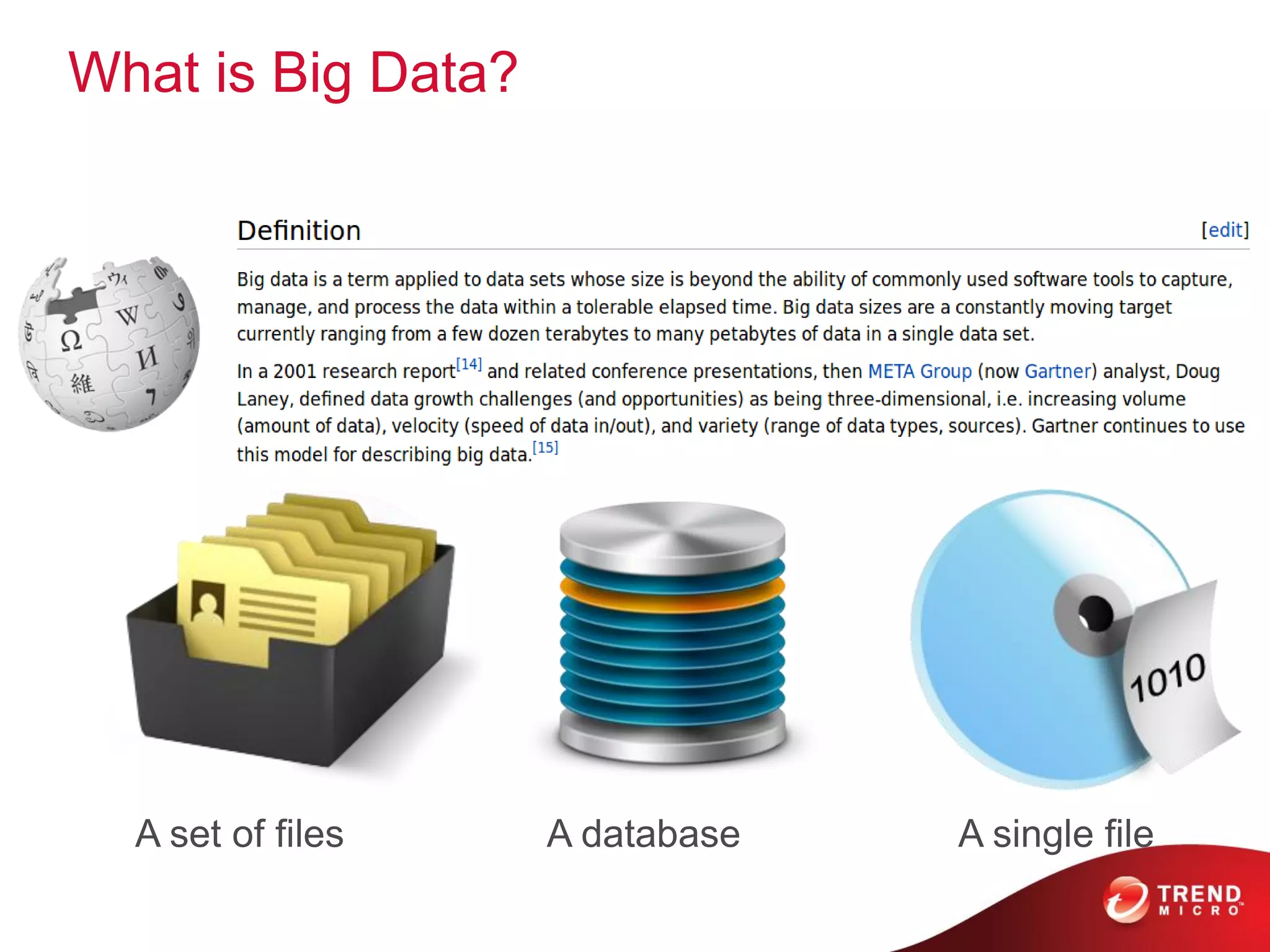
What is Big Data?
A set of files A database A single file
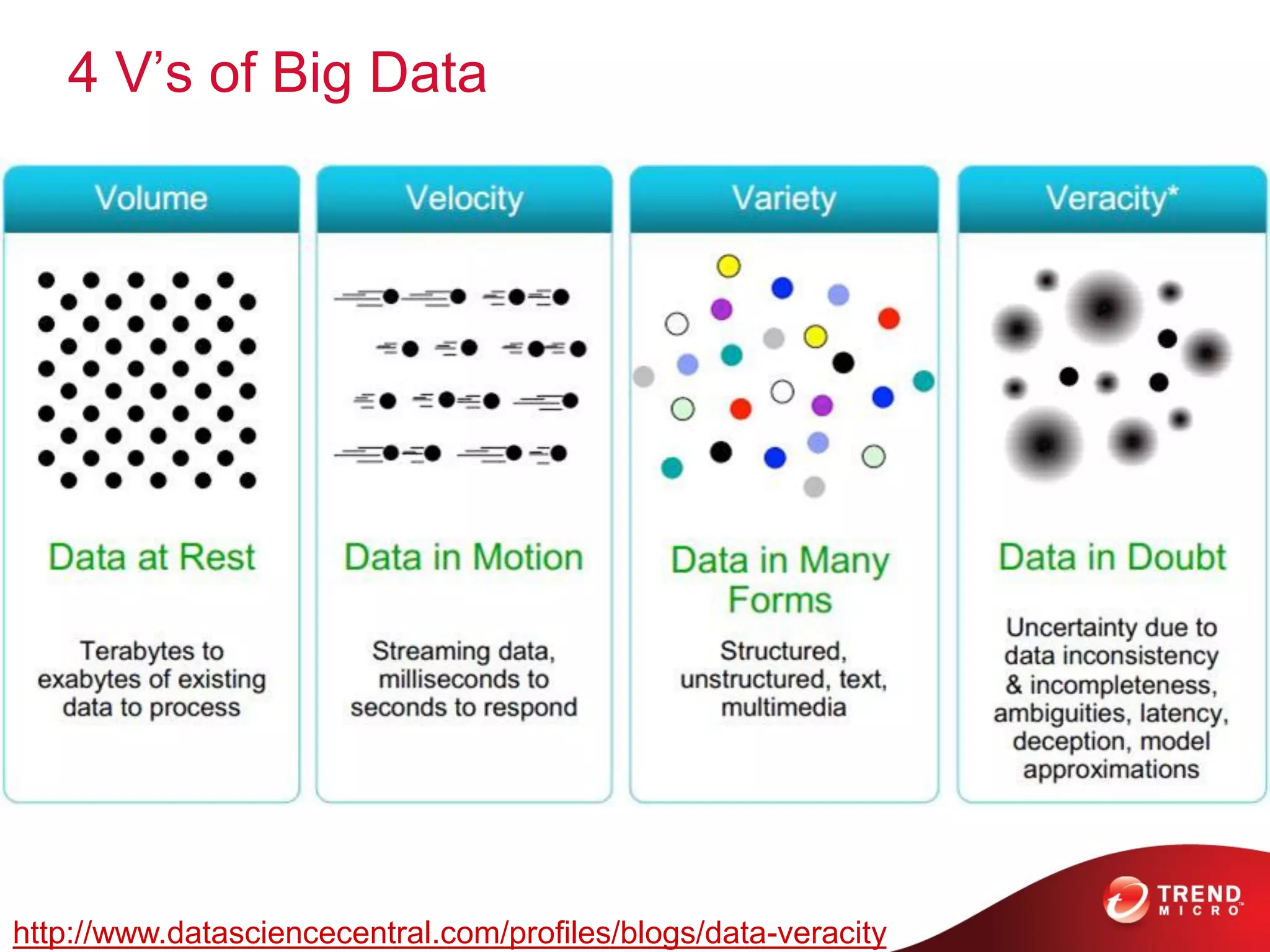
4 V’s of Big Data
http://www.datasciencecentral.com/profiles/blogs/data-veracity
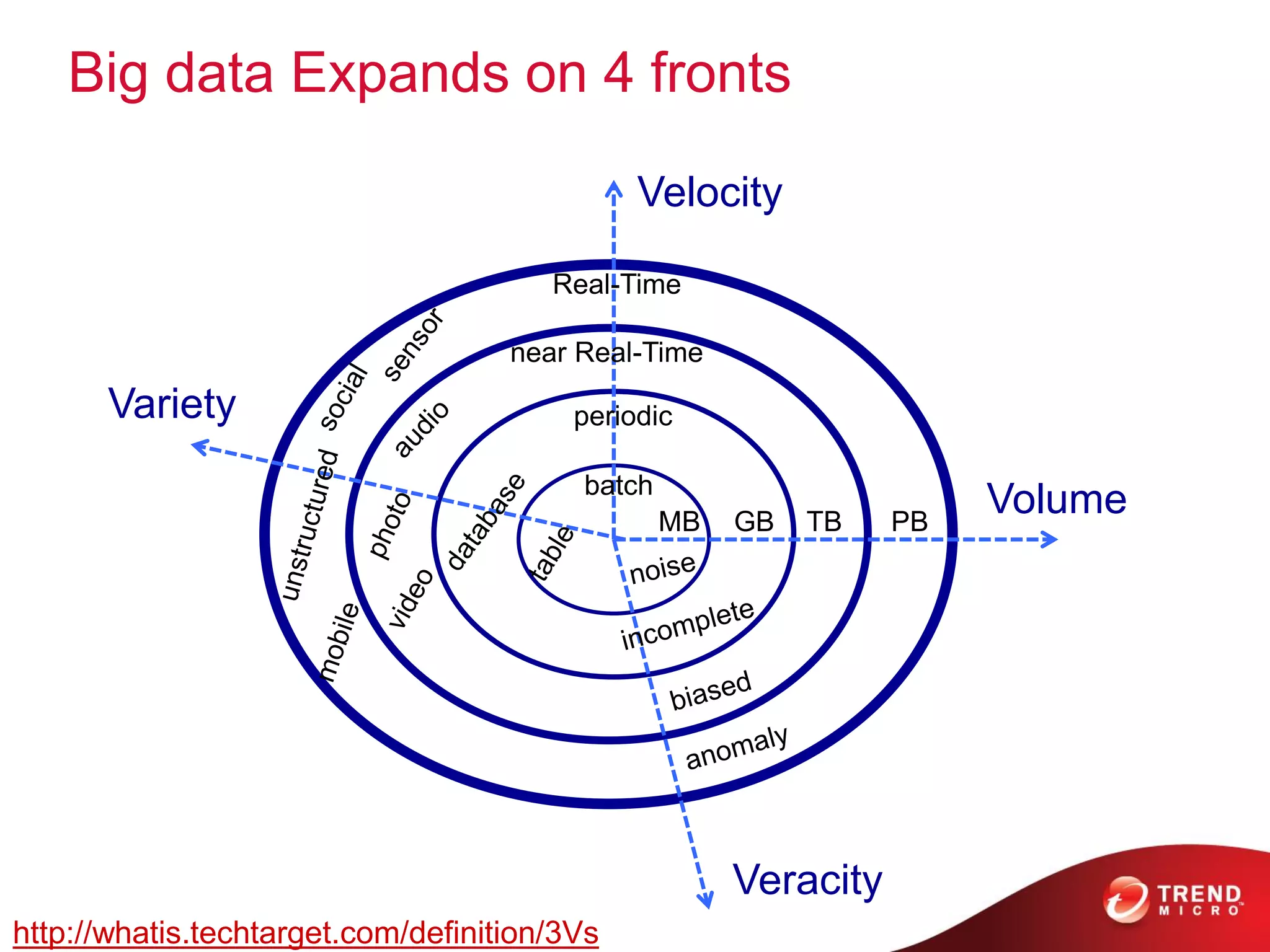
Big data Expands on 4 fronts
Velocity
Volume
Variety
Veracity
MB GB TB PB
batch
periodic
near Real-Time
Real-Time
http://whatis.techtarget.com/definition/3Vs
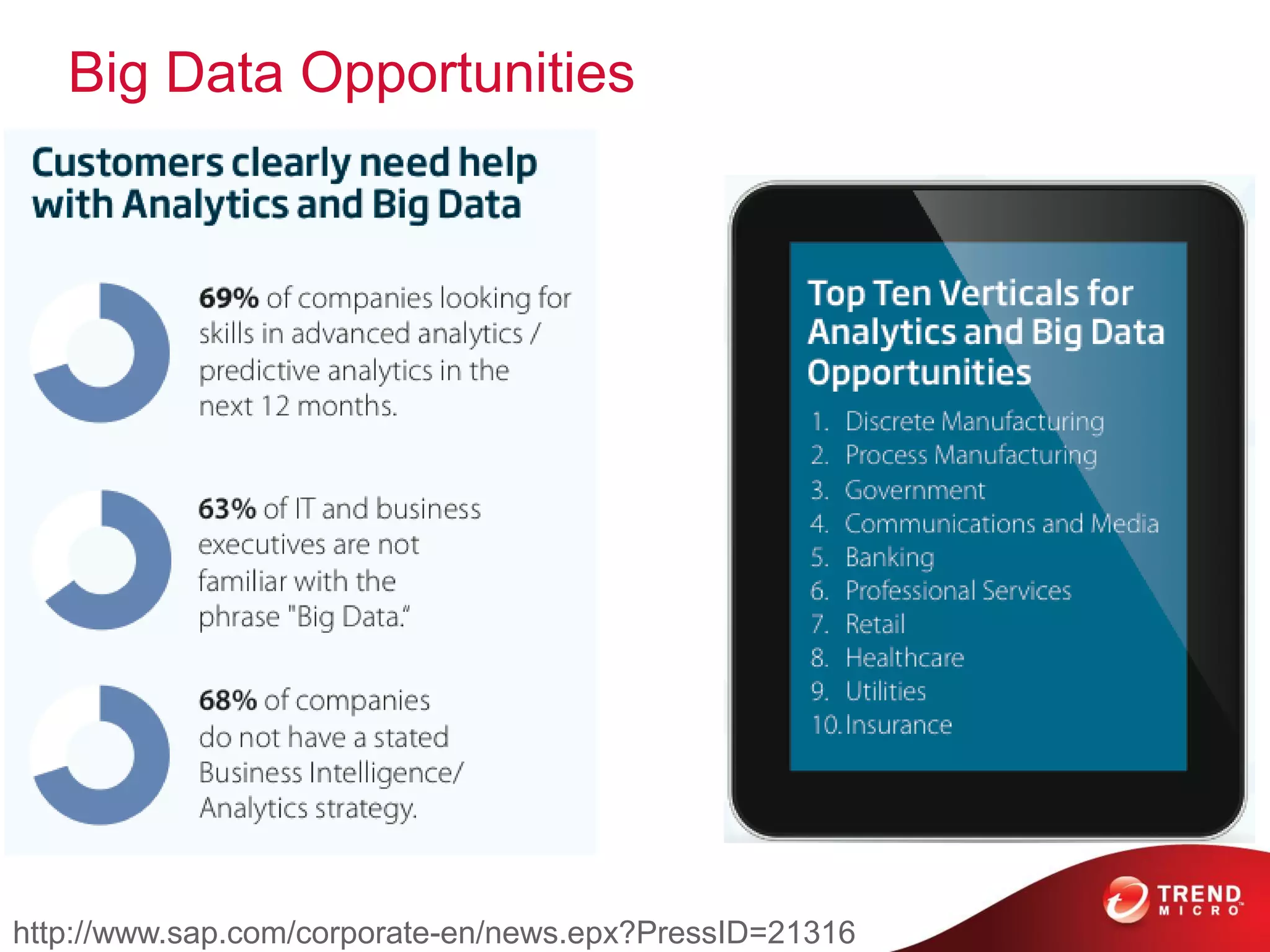
Big Data Opportunities
http://www.sap.com/corporate-en/news.epx?PressID=21316
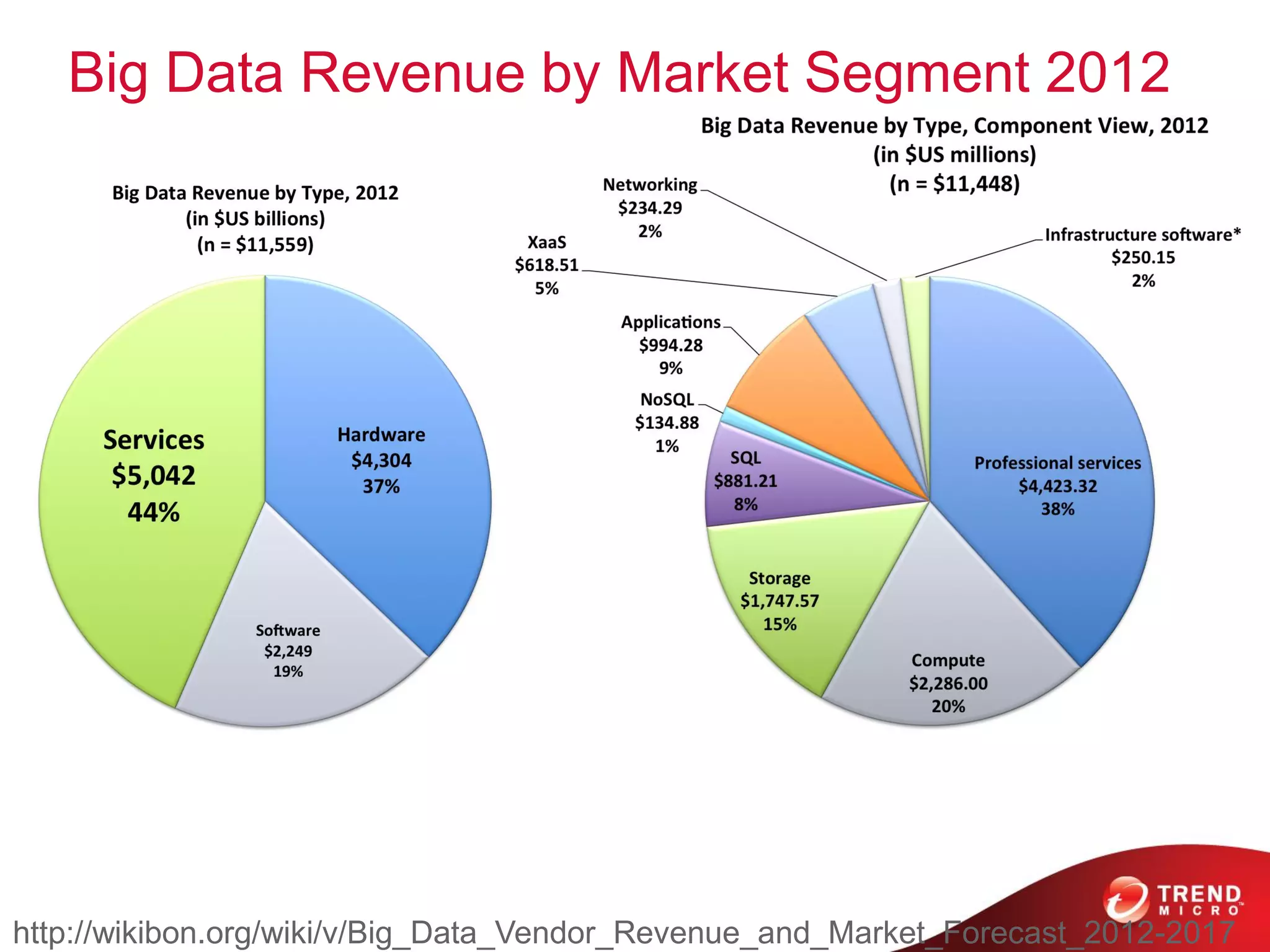
Big Data Revenue by Market Segment 2012
• 1
http://wikibon.org/wiki/v/Big_Data_Vendor_Revenue_and_Market_Forecast_2012-2017
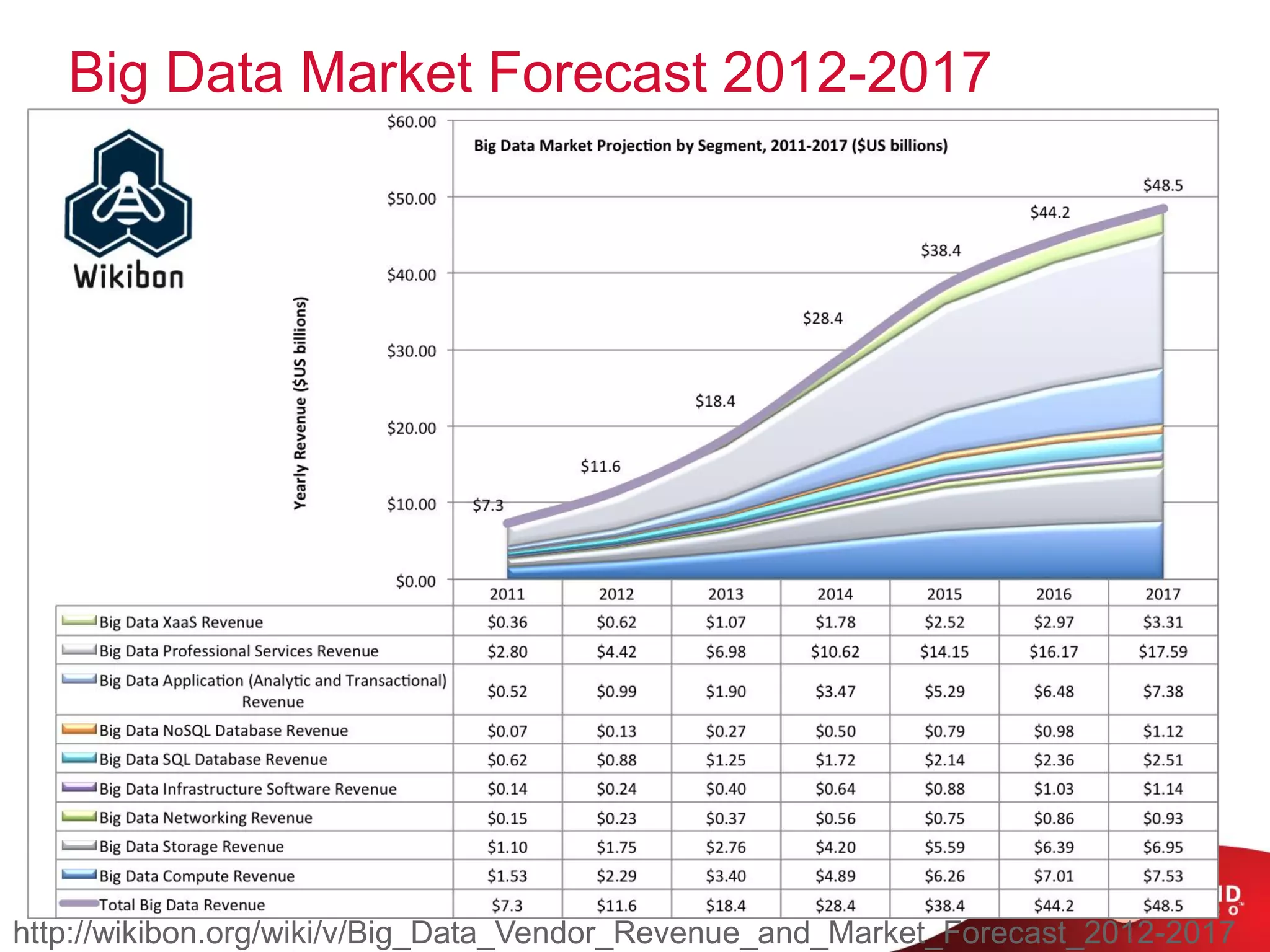
Big Data Market Forecast 2012-2017
• 1
http://wikibon.org/wiki/v/Big_Data_Vendor_Revenue_and_Market_Forecast_2012-2017
Hadoop Solutions
The most common problems Hadoop can solve
Threat Analysis/Trade Surveillance
• Challenge:
– Detecting threats in the form of fraudulent activity or attacks
• Large data volumes involved
• Like looking for a needle in a haystack
• Solution with Hadoop:
– Parallel processing over huge datasets
– Pattern recognition to identify anomalies
• – i.e., threats
• Typical Industry:
– Security, Financial Services
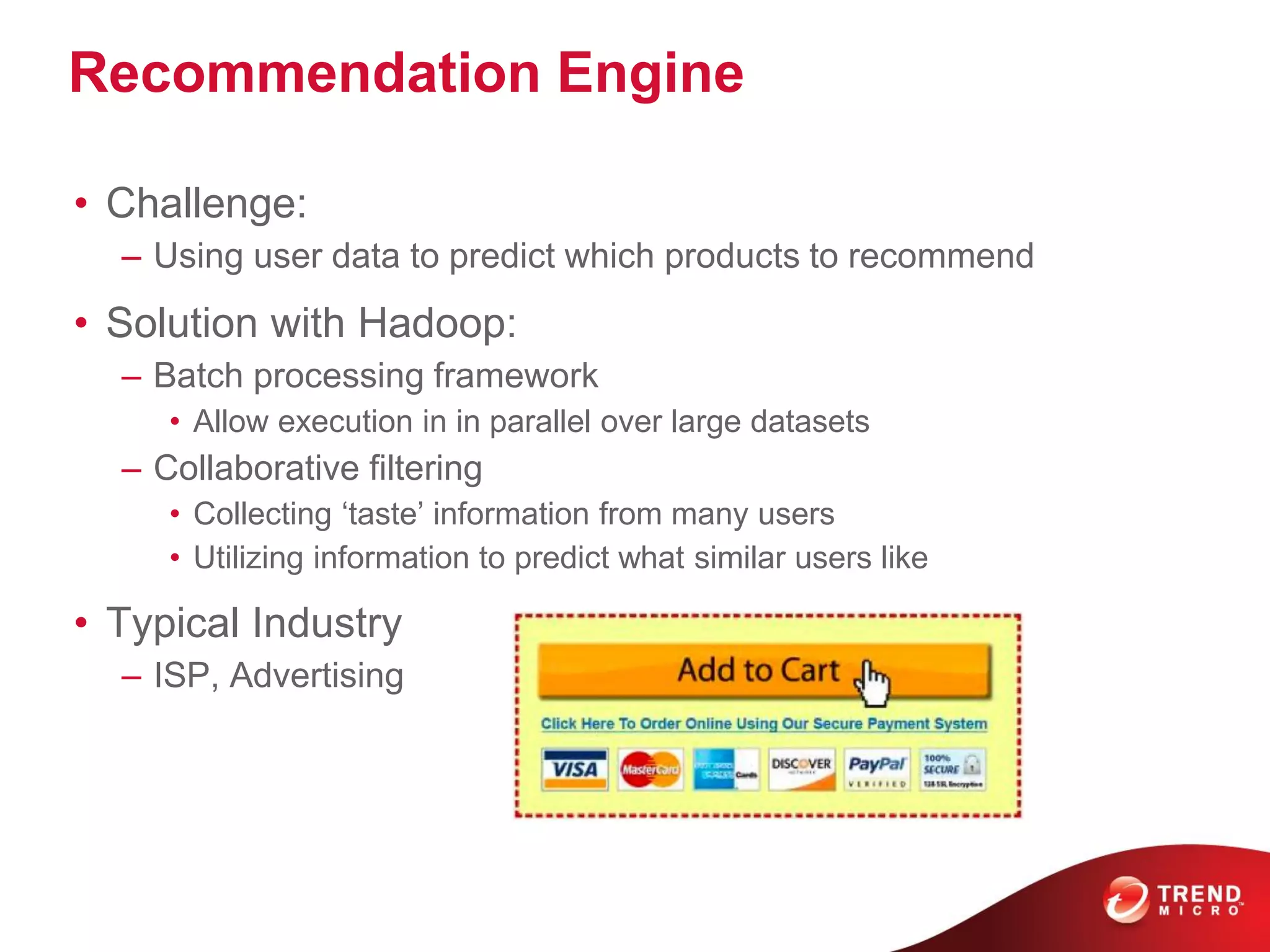
Recommendation Engine
• Challenge:
– Using user data to predict which products to recommend
• Solution with Hadoop:
– Batch processing framework
• Allow execution in in parallel over large datasets
– Collaborative filtering
• Collecting ‘taste’ information from many users
• Utilizing information to predict what similar users like
• Typical Industry
– ISP, Advertising
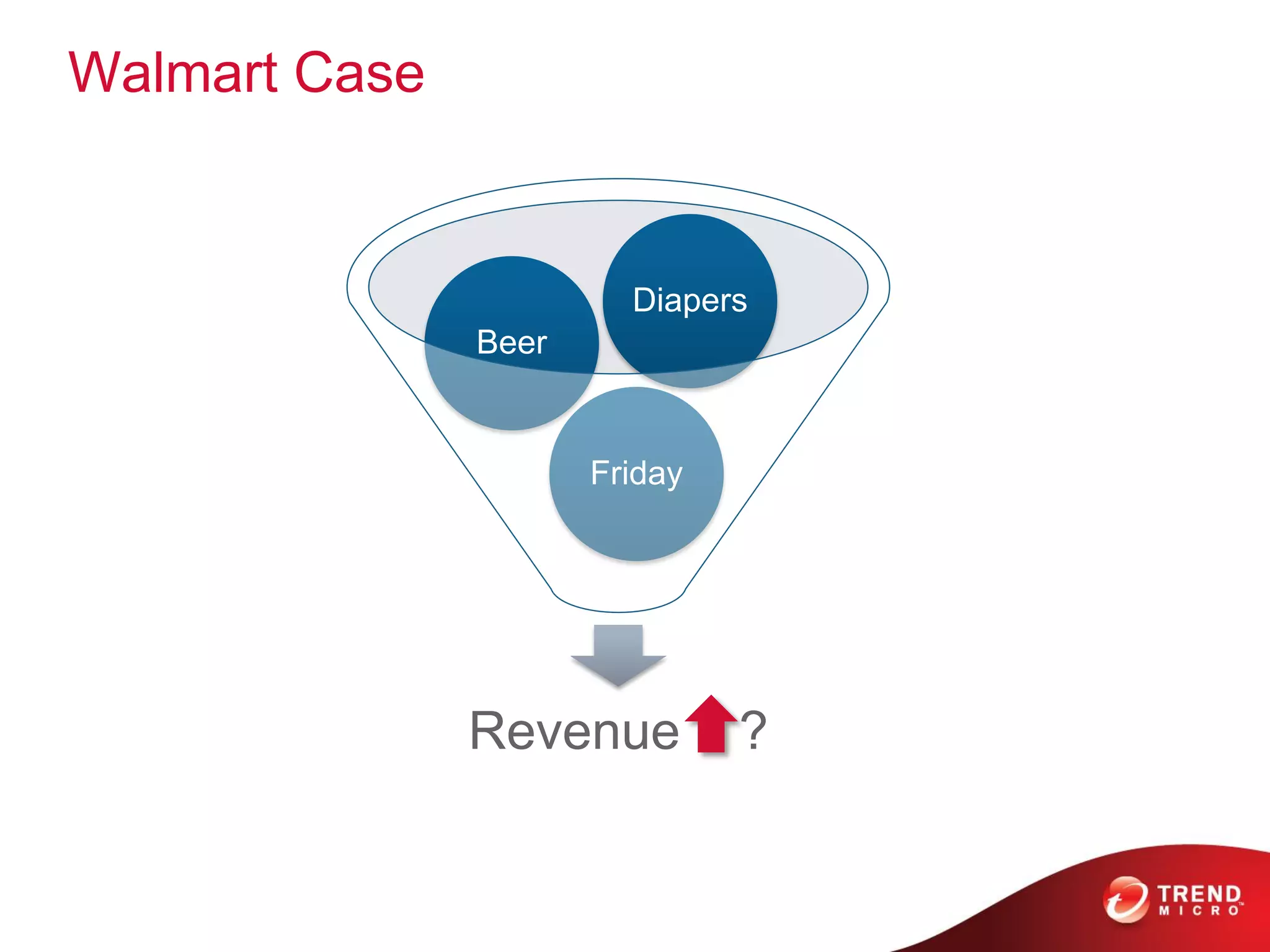
Walmart Case
Revenue ?
Friday
Beer
Diapers
• 1
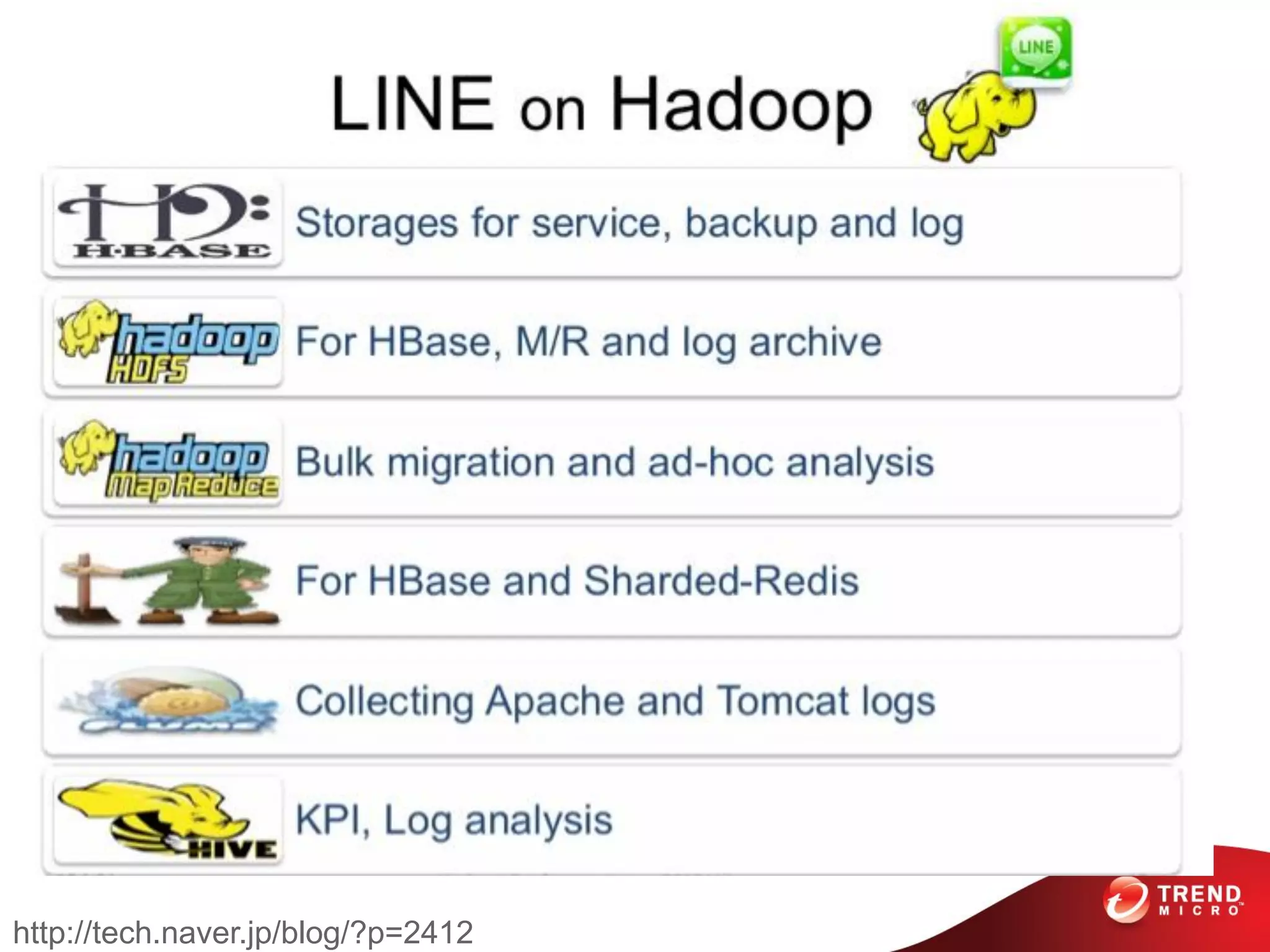
http://tech.naver.jp/blog/?p=2412
Hadoop!
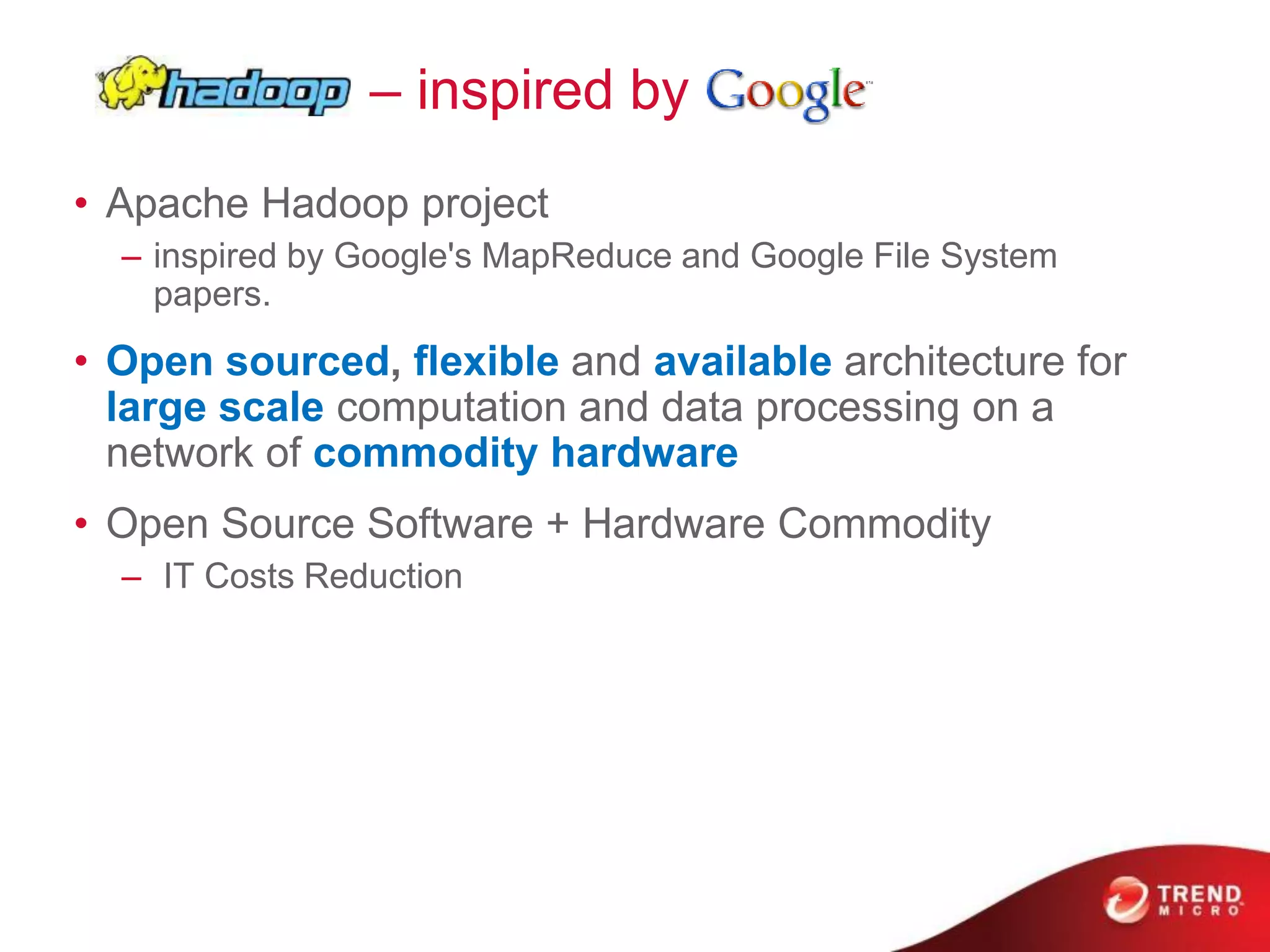
• Apache Hadoop project
– inspired by Google's MapReduce and Google File System
papers.
• Open sourced, flexible and available architecture for
large scale computation and data processing on a
network of commodity hardware
• Open Source Software + Hardware Commodity
– IT Costs Reduction
– inspired by
Hadoop Concepts
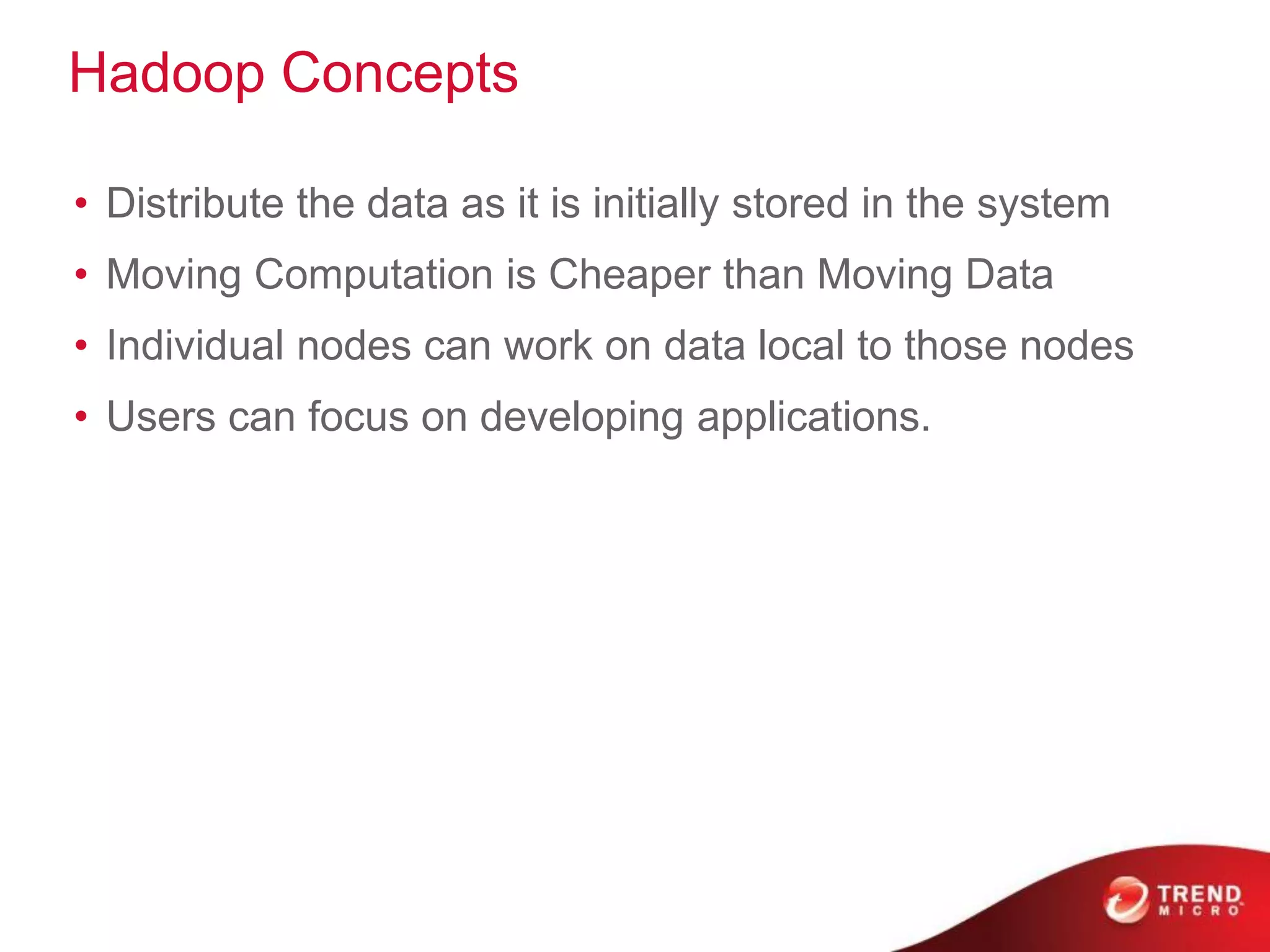
• Distribute the data as it is initially stored in the system
• Moving Computation is Cheaper than Moving Data
• Individual nodes can work on data local to those nodes
• Users can focus on developing applications.
Hadoop 2.0
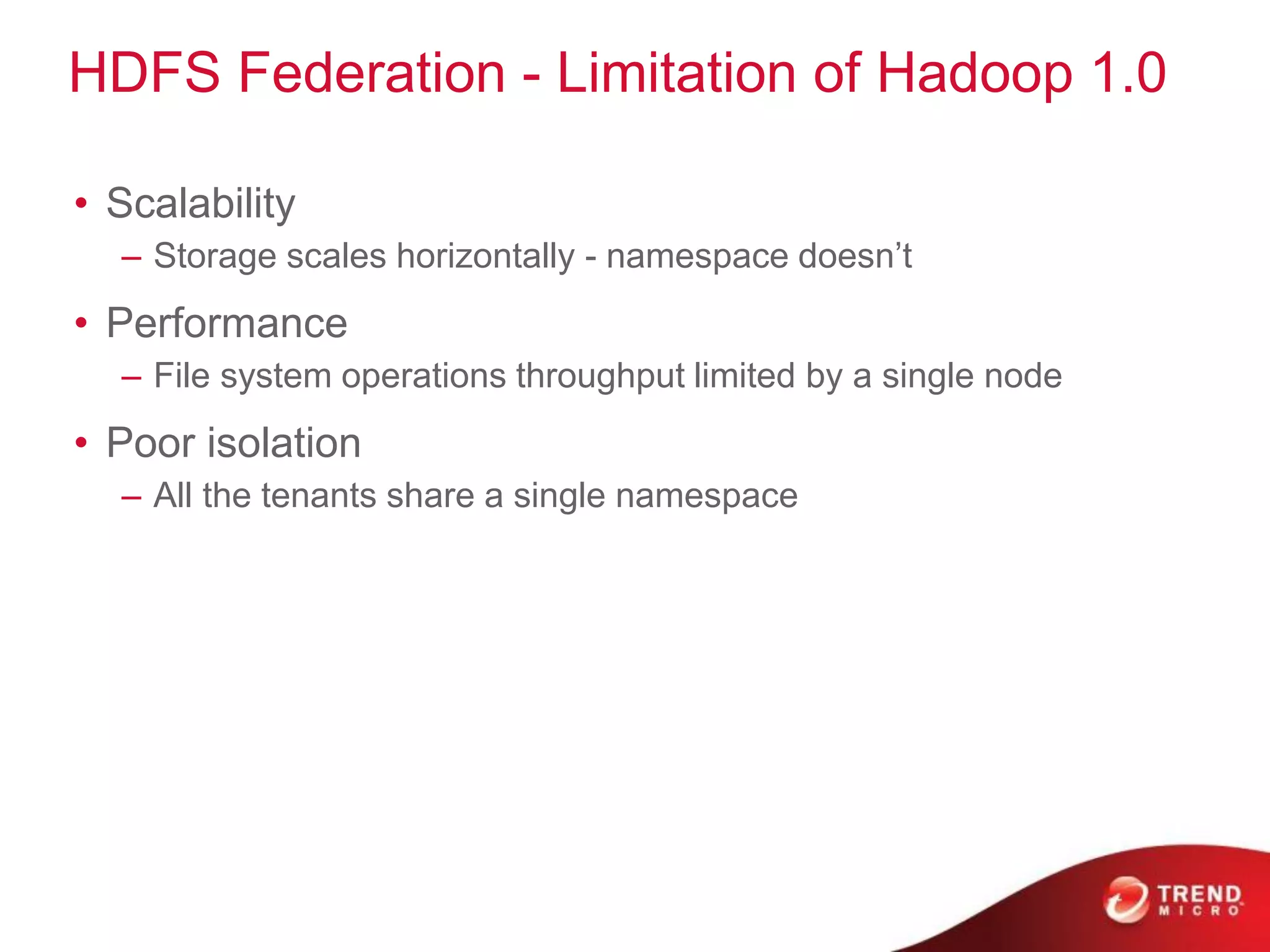
• Hadoop 2.2.0 is expected to GA in Fall 2013
• HDFS Federation
• HDFS High Availability (HA)
• Hadoop YARN (MapReduce 2.0)
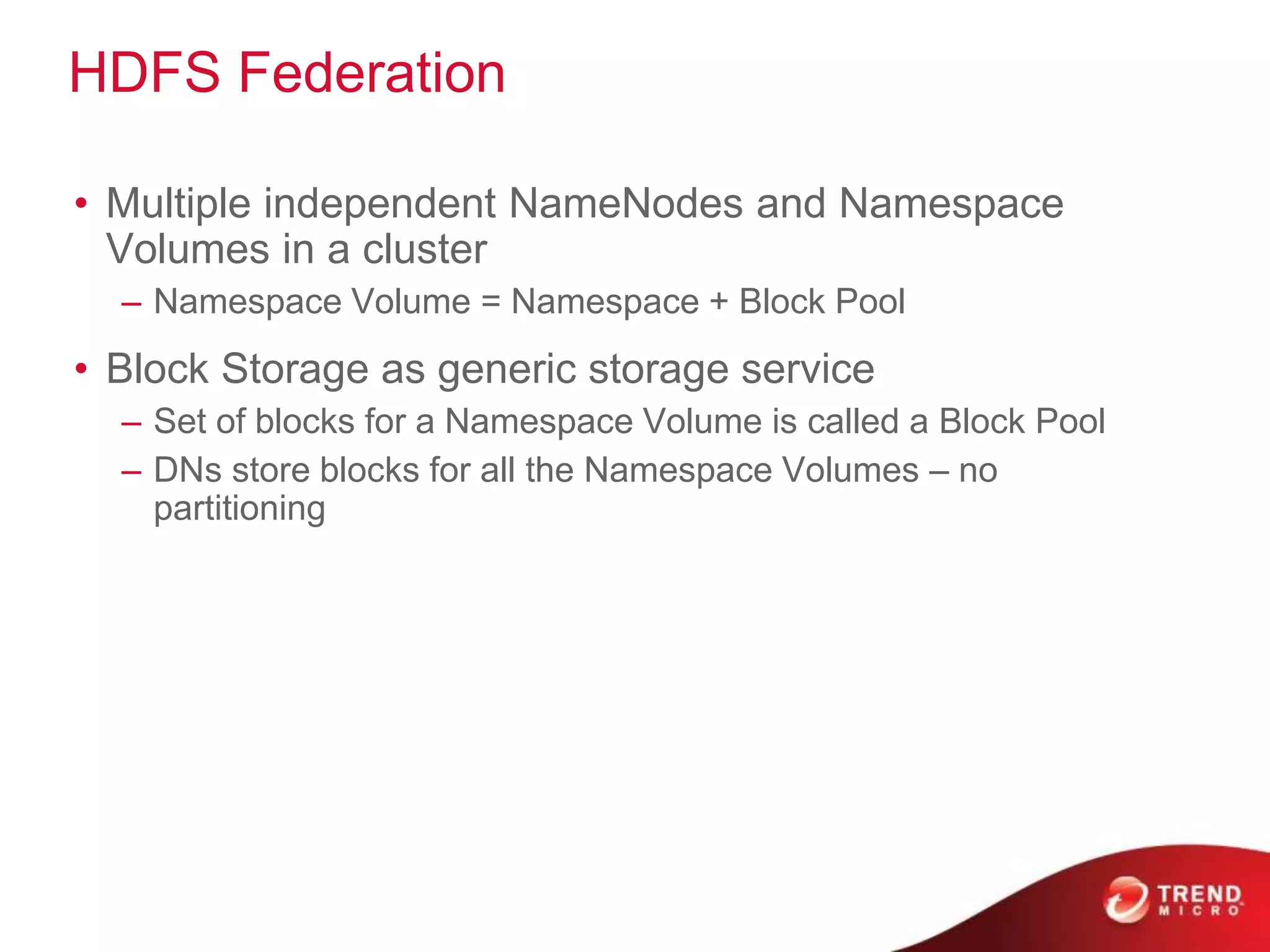
HDFS Federation - Limitation of Hadoop 1.0
• Scalability
– Storage scales horizontally - namespace doesn’t
• Performance
– File system operations throughput limited by a single node
• Poor isolation
– All the tenants share a single namespace
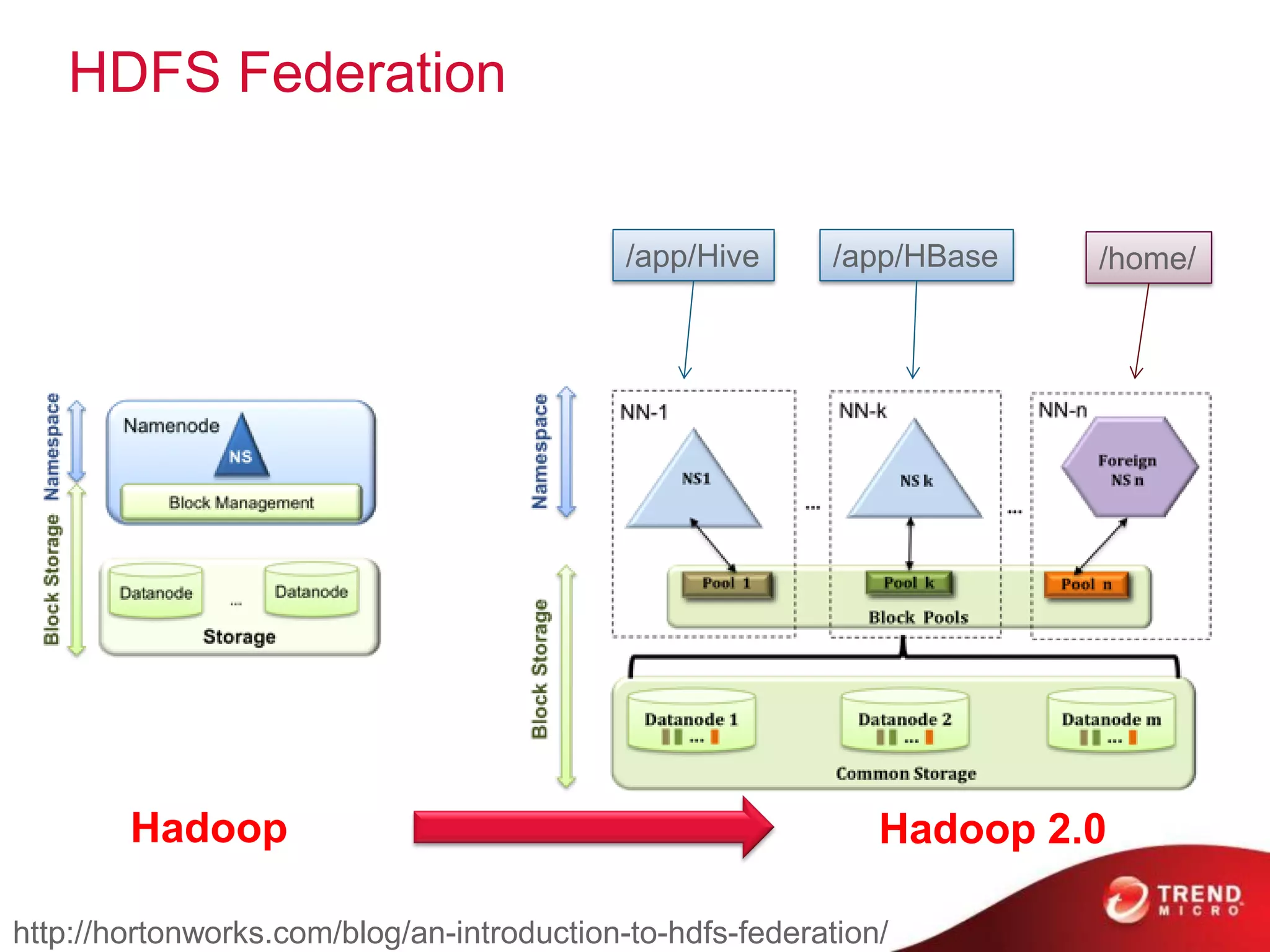
HDFS Federation
• Multiple independent NameNodes and Namespace
Volumes in a cluster
– Namespace Volume = Namespace + Block Pool
• Block Storage as generic storage service
– Set of blocks for a Namespace Volume is called a Block Pool
– DNs store blocks for all the Namespace Volumes – no
partitioning
HDFS Federation
Hadoop Hadoop 2.0
http://hortonworks.com/blog/an-introduction-to-hdfs-federation/
/home//app/Hive /app/HBase
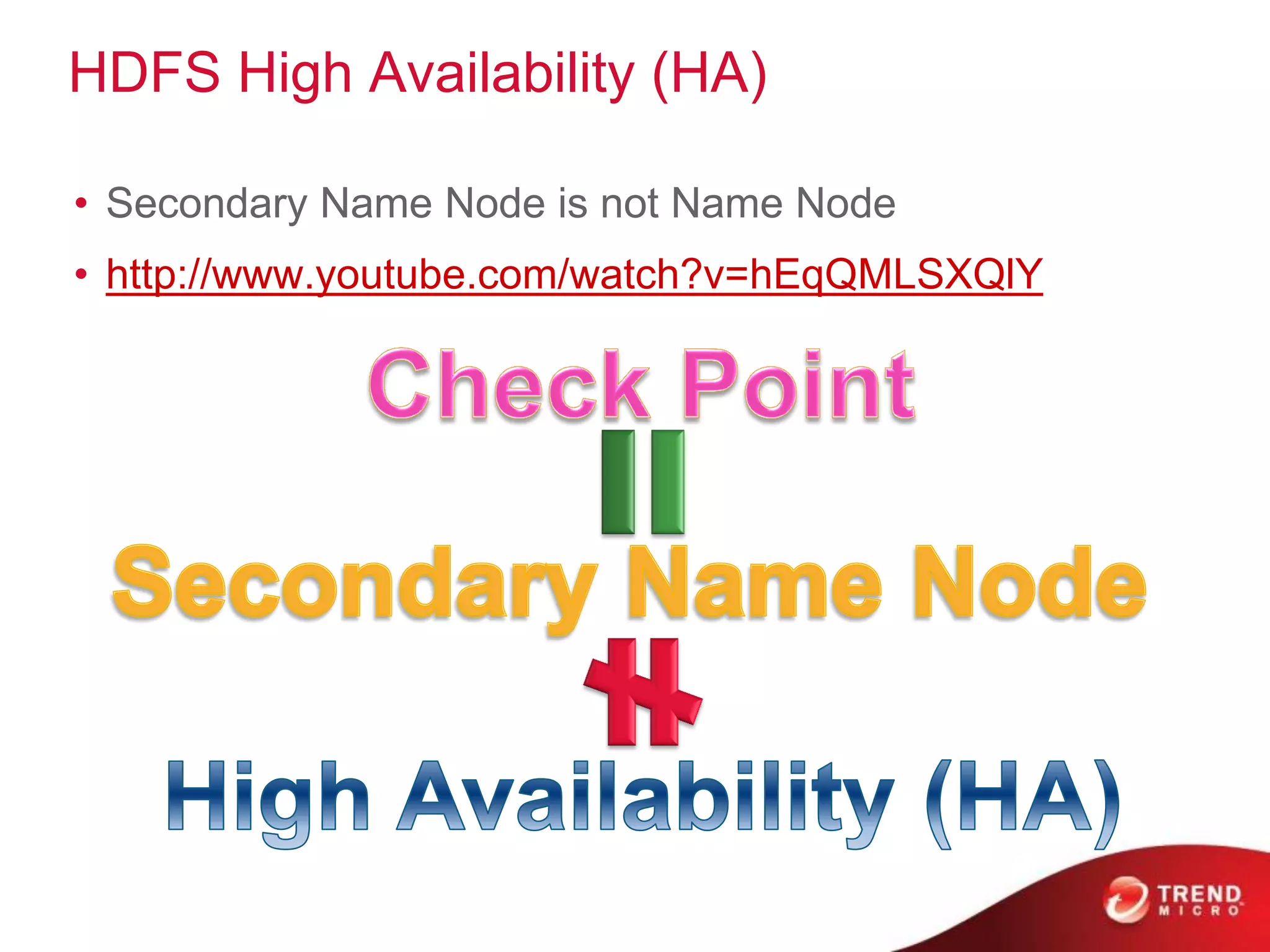
HDFS High Availability (HA)
• Secondary Name Node is not Name Node
• http://www.youtube.com/watch?v=hEqQMLSXQlY
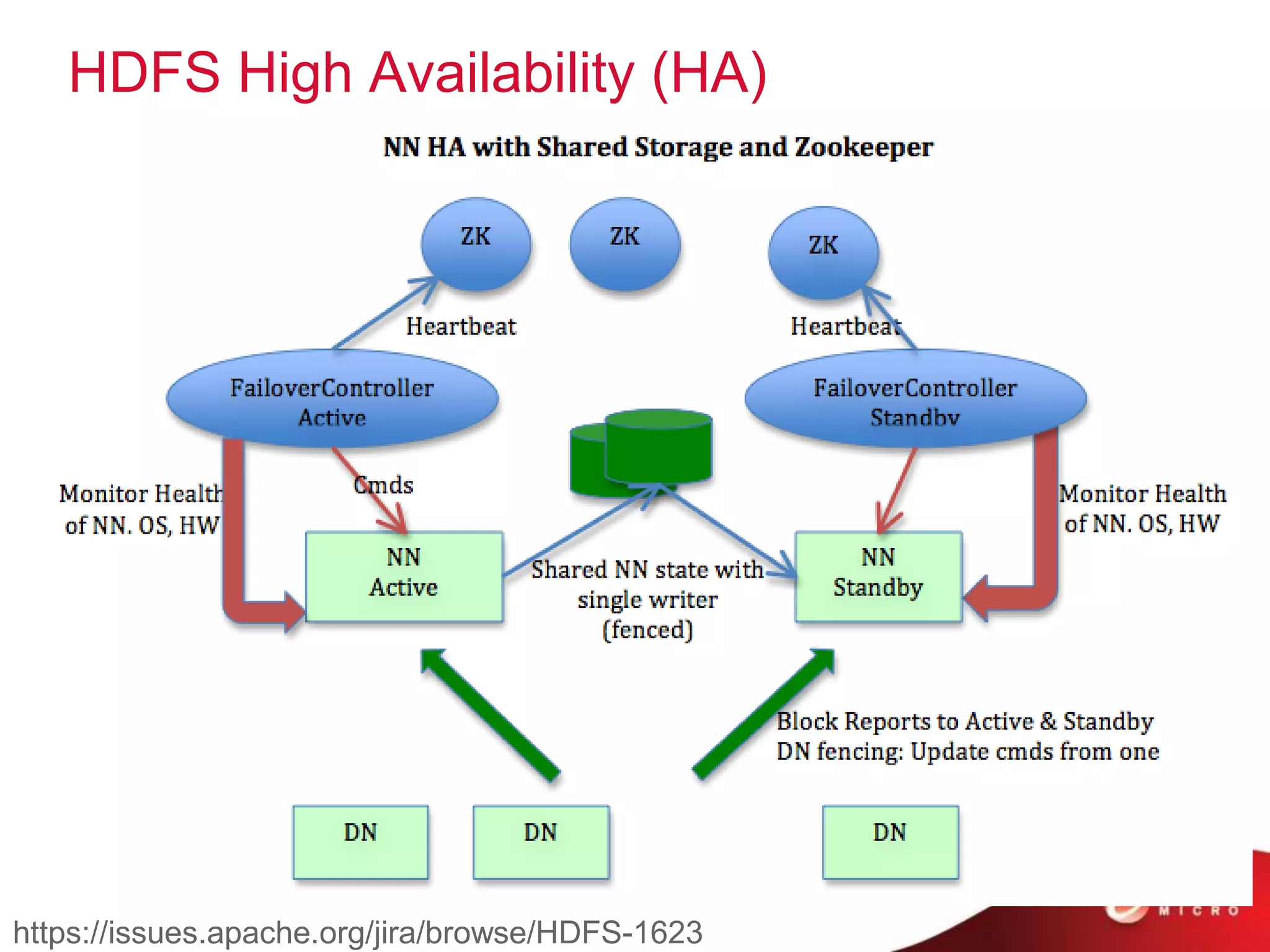
HDFS High Availability (HA)
https://issues.apache.org/jira/browse/HDFS-1623
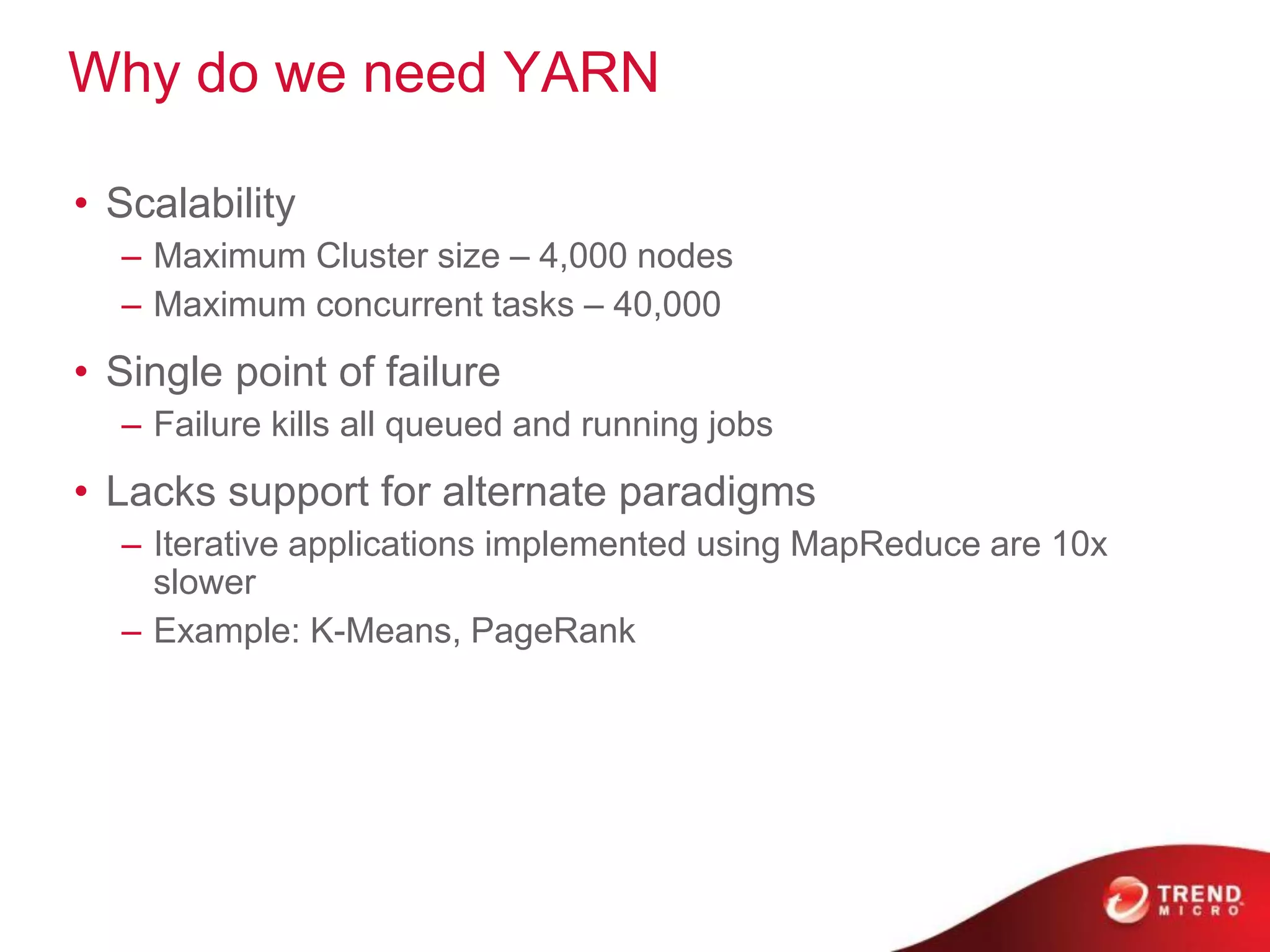
Why do we need YARN
• Scalability
– Maximum Cluster size – 4,000 nodes
– Maximum concurrent tasks – 40,000
• Single point of failure
– Failure kills all queued and running jobs
• Lacks support for alternate paradigms
– Iterative applications implemented using MapReduce are 10x
slower
– Example: K-Means, PageRank
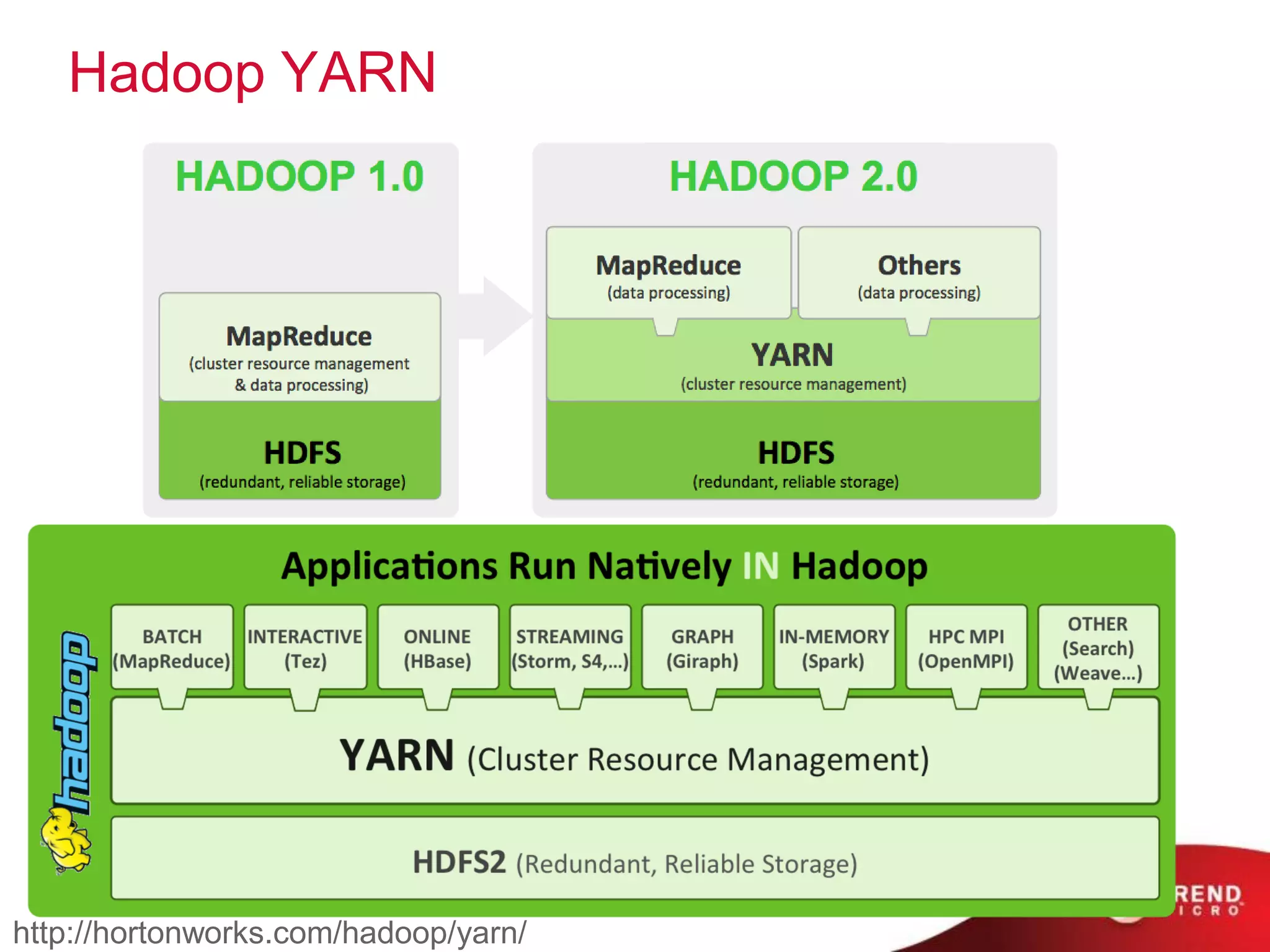
Hadoop YARN
http://hortonworks.com/hadoop/yarn/
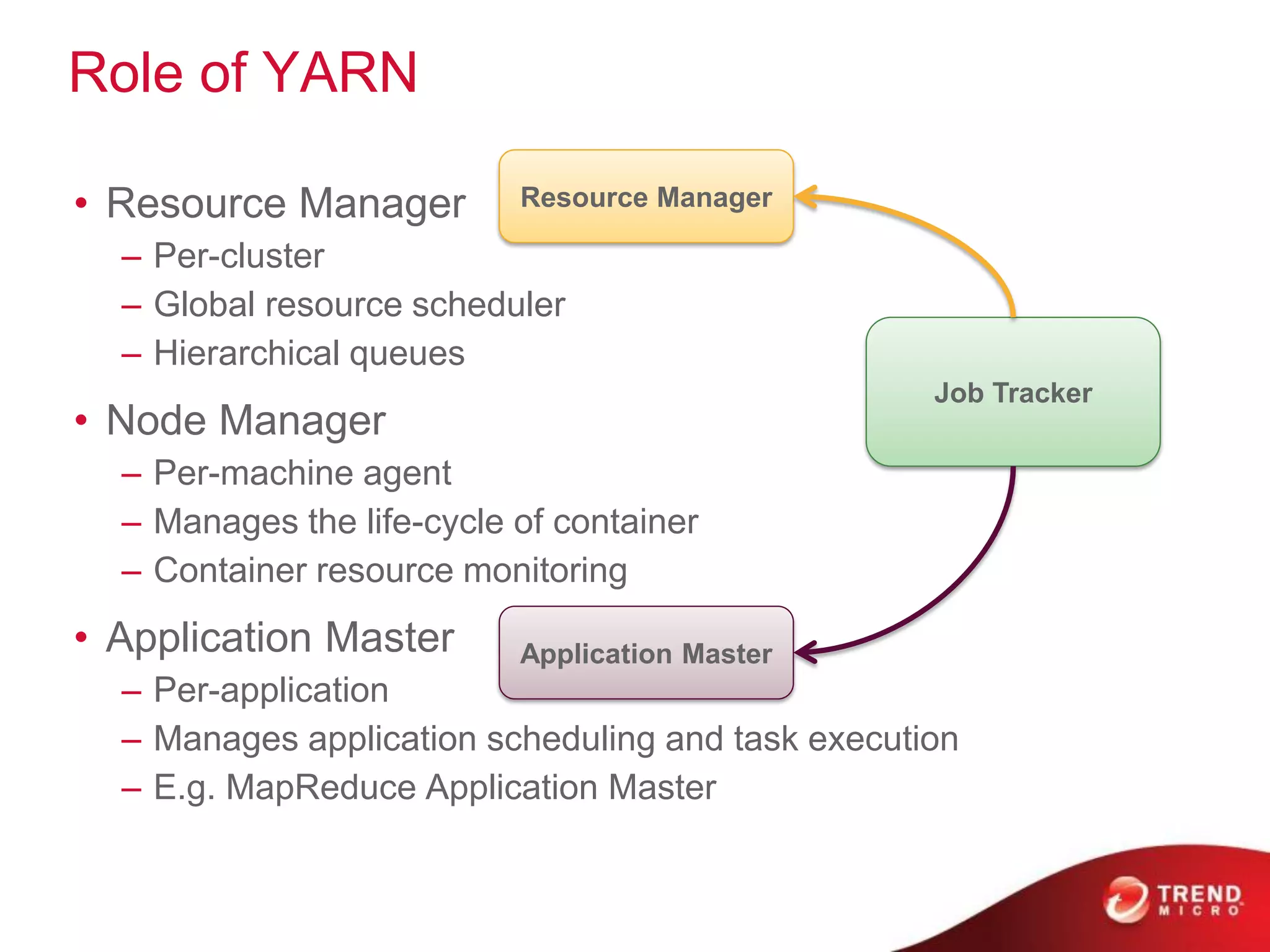
Role of YARN
• Resource Manager
– Per-cluster
– Global resource scheduler
– Hierarchical queues
• Node Manager
– Per-machine agent
– Manages the life-cycle of container
– Container resource monitoring
• Application Master
– Per-application
– Manages application scheduling and task execution
– E.g. MapReduce Application Master
Job Tracker
Resource Manager
Application Master
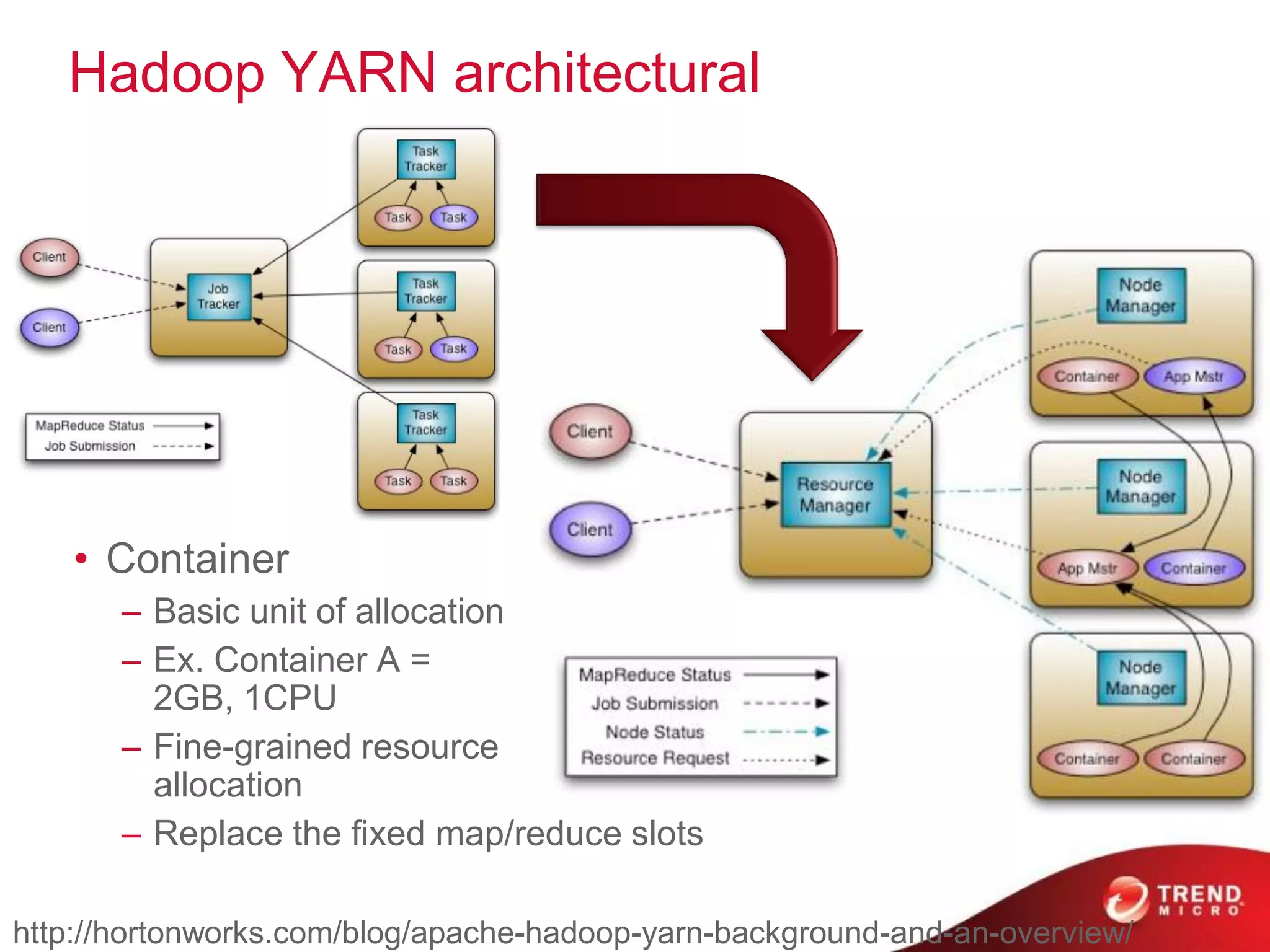
Hadoop YARN architectural
http://hortonworks.com/blog/apache-hadoop-yarn-background-and-an-overview/
• Container
– Basic unit of allocation
– Ex. Container A =
2GB, 1CPU
– Fine-grained resource
allocation
– Replace the fixed map/reduce slots
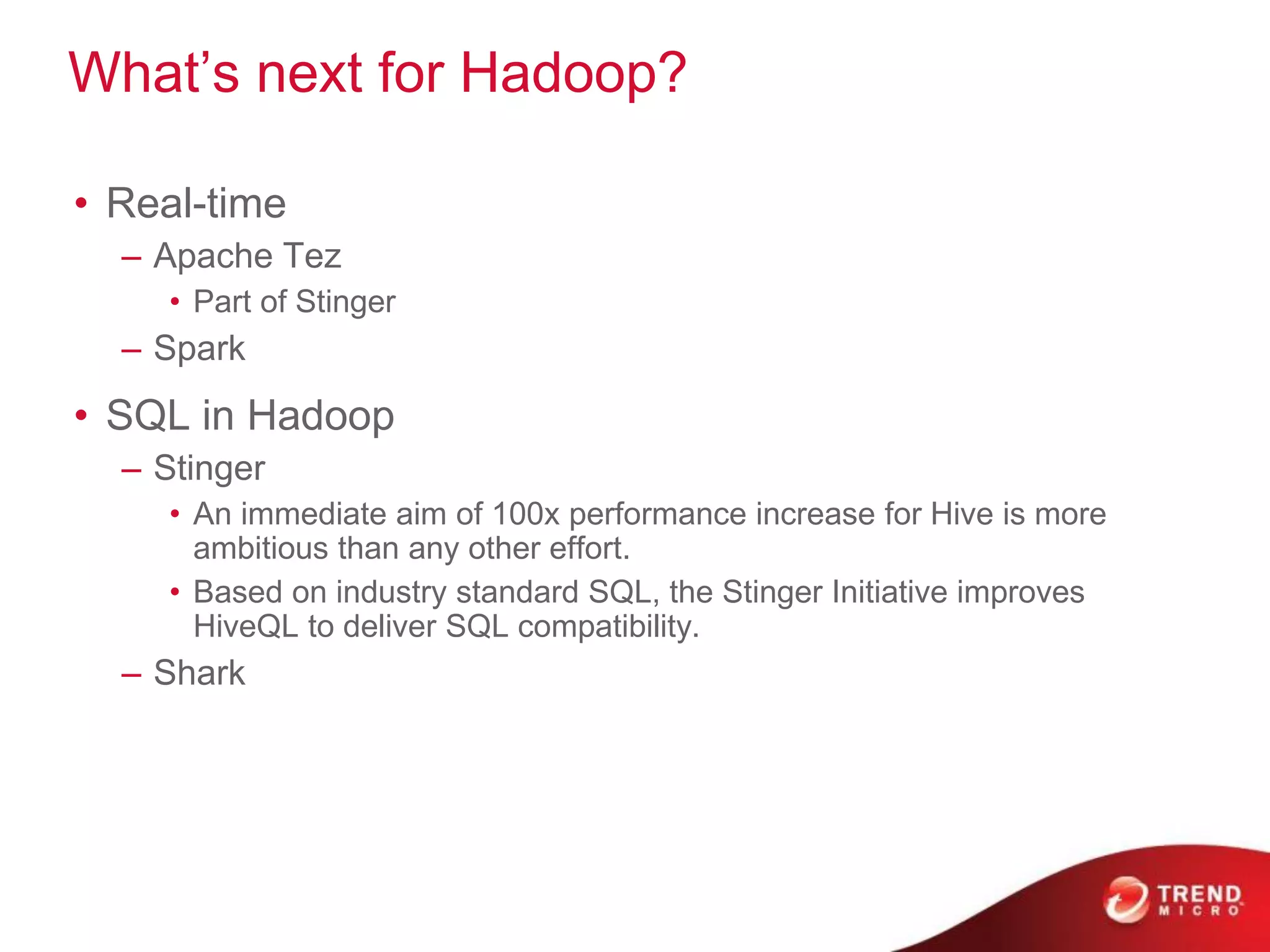
What’s next for Hadoop?
• Real-time
– Apache Tez
• Part of Stinger
– Spark
• SQL in Hadoop
– Stinger
• An immediate aim of 100x performance increase for Hive is more
ambitious than any other effort.
• Based on industry standard SQL, the Stinger Initiative improves
HiveQL to deliver SQL compatibility.
– Shark
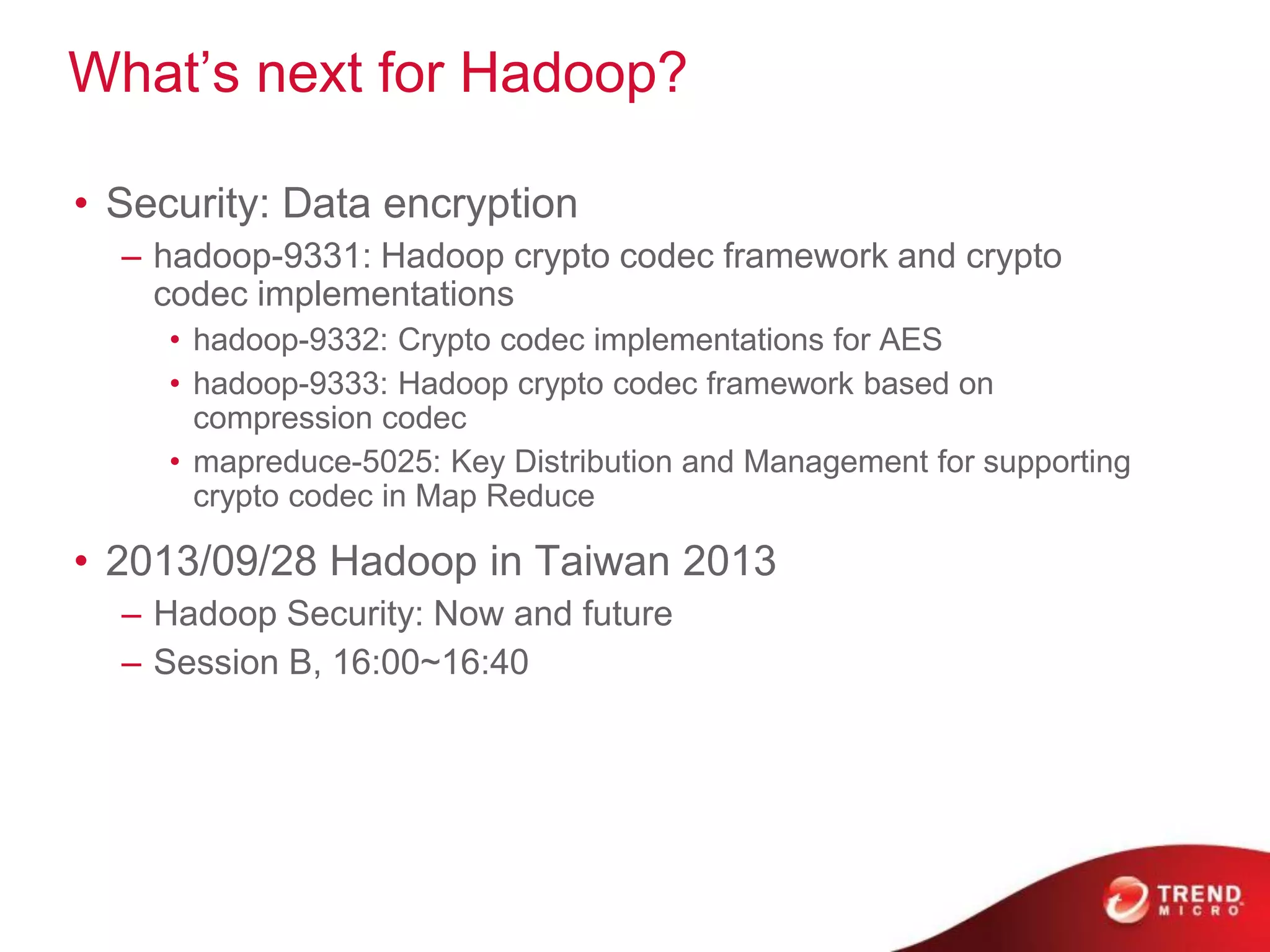
What’s next for Hadoop?
• Security: Data encryption
– hadoop-9331: Hadoop crypto codec framework and crypto
codec implementations
• hadoop-9332: Crypto codec implementations for AES
• hadoop-9333: Hadoop crypto codec framework based on
compression codec
• mapreduce-5025: Key Distribution and Management for supporting
crypto codec in Map Reduce
• 2013/09/28 Hadoop in Taiwan 2013
– Hadoop Security: Now and future
– Session B, 16:00~16:40
The Hadoop Ecosystems
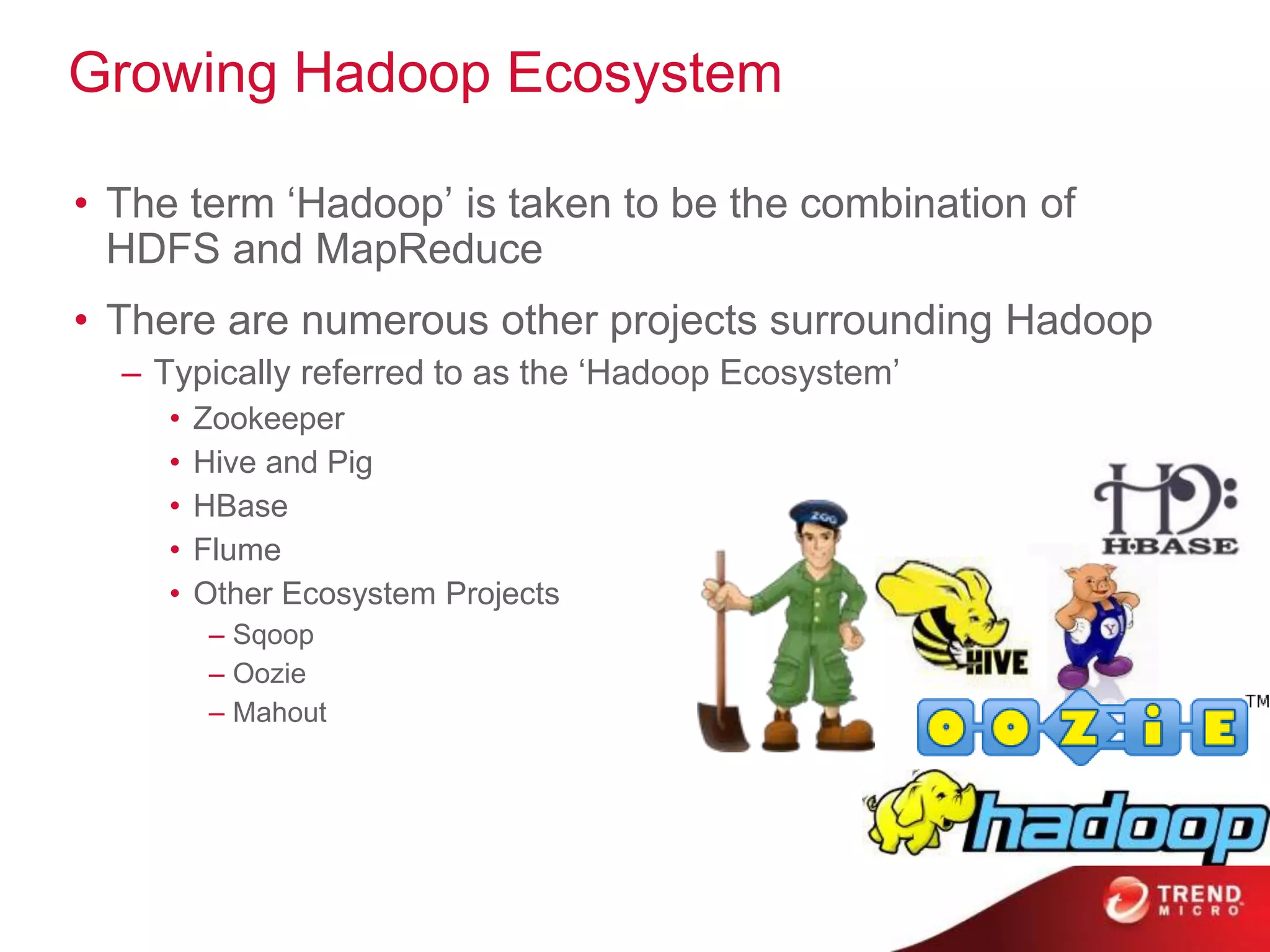
Growing Hadoop Ecosystem
• The term ‘Hadoop’ is taken to be the combination of
HDFS and MapReduce
• There are numerous other projects surrounding Hadoop
– Typically referred to as the ‘Hadoop Ecosystem’
• Zookeeper
• Hive and Pig
• HBase
• Flume
• Other Ecosystem Projects
– Sqoop
– Oozie
– Mahout
The Ecosystem is the System
• Hadoop has become the kernel of the distributed
operating system for Big Data
• No one uses the kernel alone
• A collection of projects at Apache
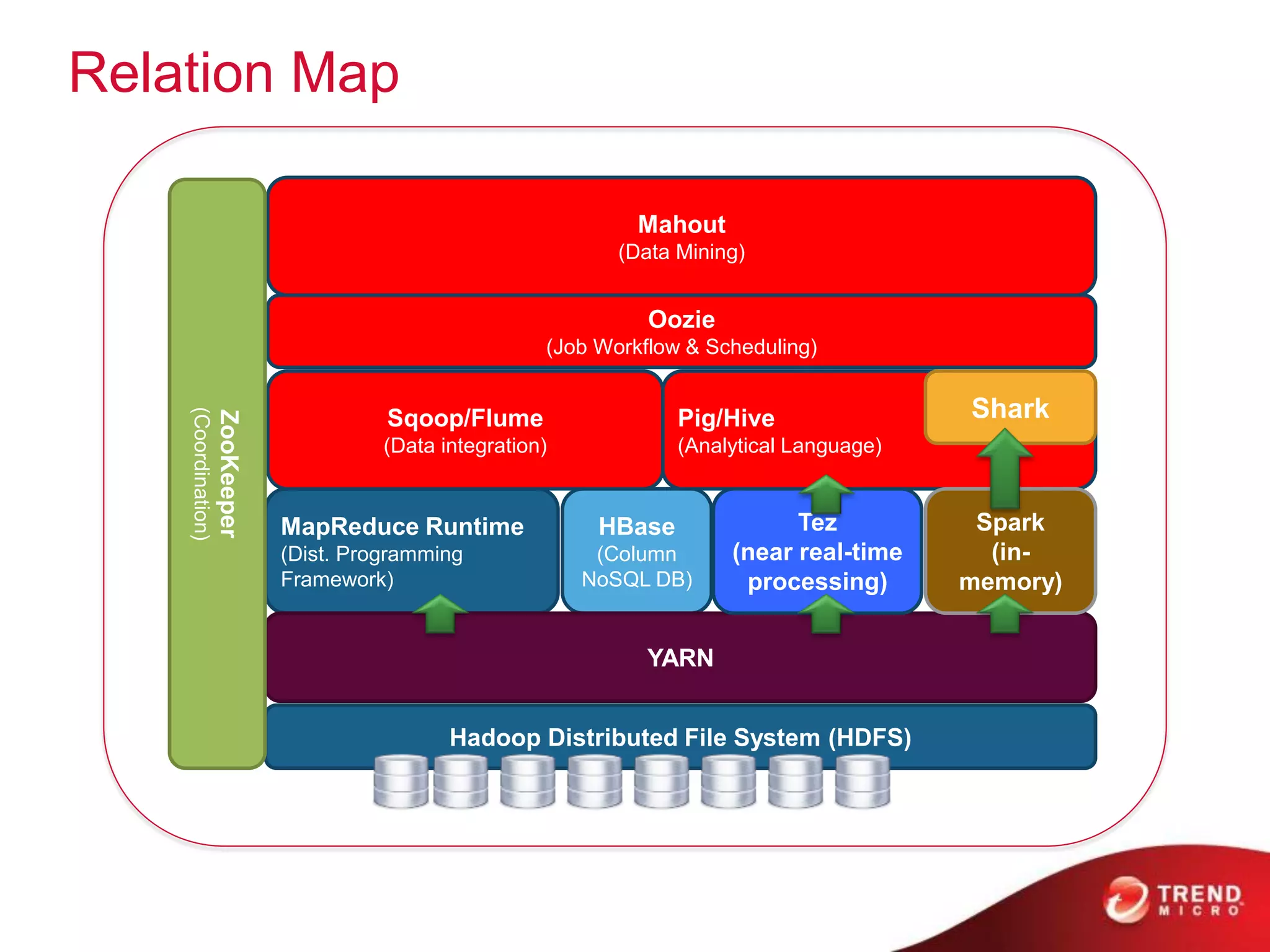
Relation Map
MapReduce Runtime
(Dist. Programming
Framework)
Hadoop Distributed File System (HDFS)
HBase
(Column
NoSQL DB)
Sqoop/Flume
(Data integration)
Oozie
(Job Workflow & Scheduling)
Pig/Hive
(Analytical Language)
Mahout
(Data Mining)
YARN
ZooKeeper
(Coordination)
Tez
(near real-time
processing)
Spark
(in-
memory)
Shark
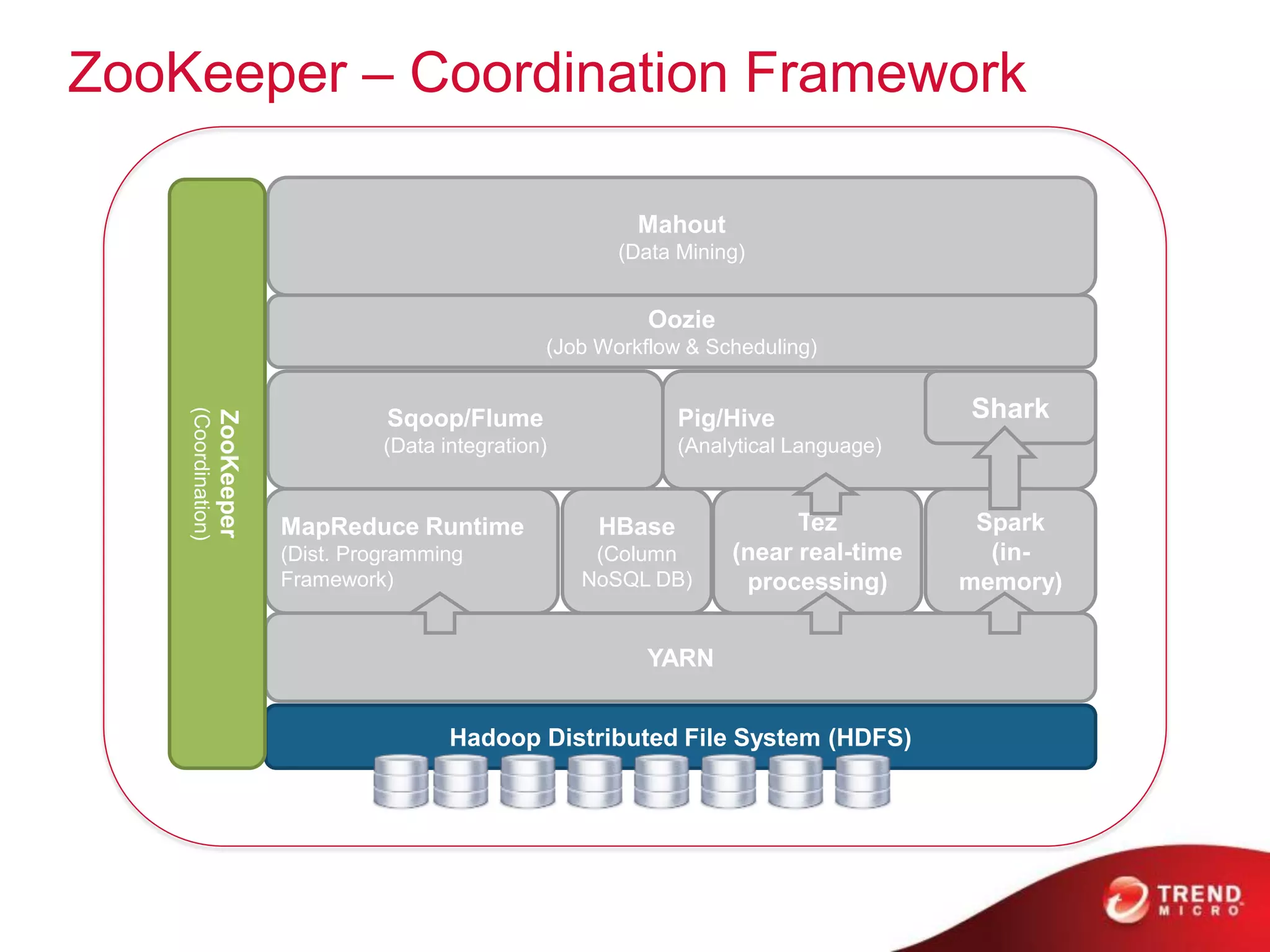
ZooKeeper – Coordination Framework
MapReduce Runtime
(Dist. Programming
Framework)
Hadoop Distributed File System (HDFS)
HBase
(Column
NoSQL DB)
Sqoop/Flume
(Data integration)
Oozie
(Job Workflow & Scheduling)
Pig/Hive
(Analytical Language)
Mahout
(Data Mining)
YARN
ZooKeeper
(Coordination)
Tez
(near real-time
processing)
Spark
(in-
memory)
Shark
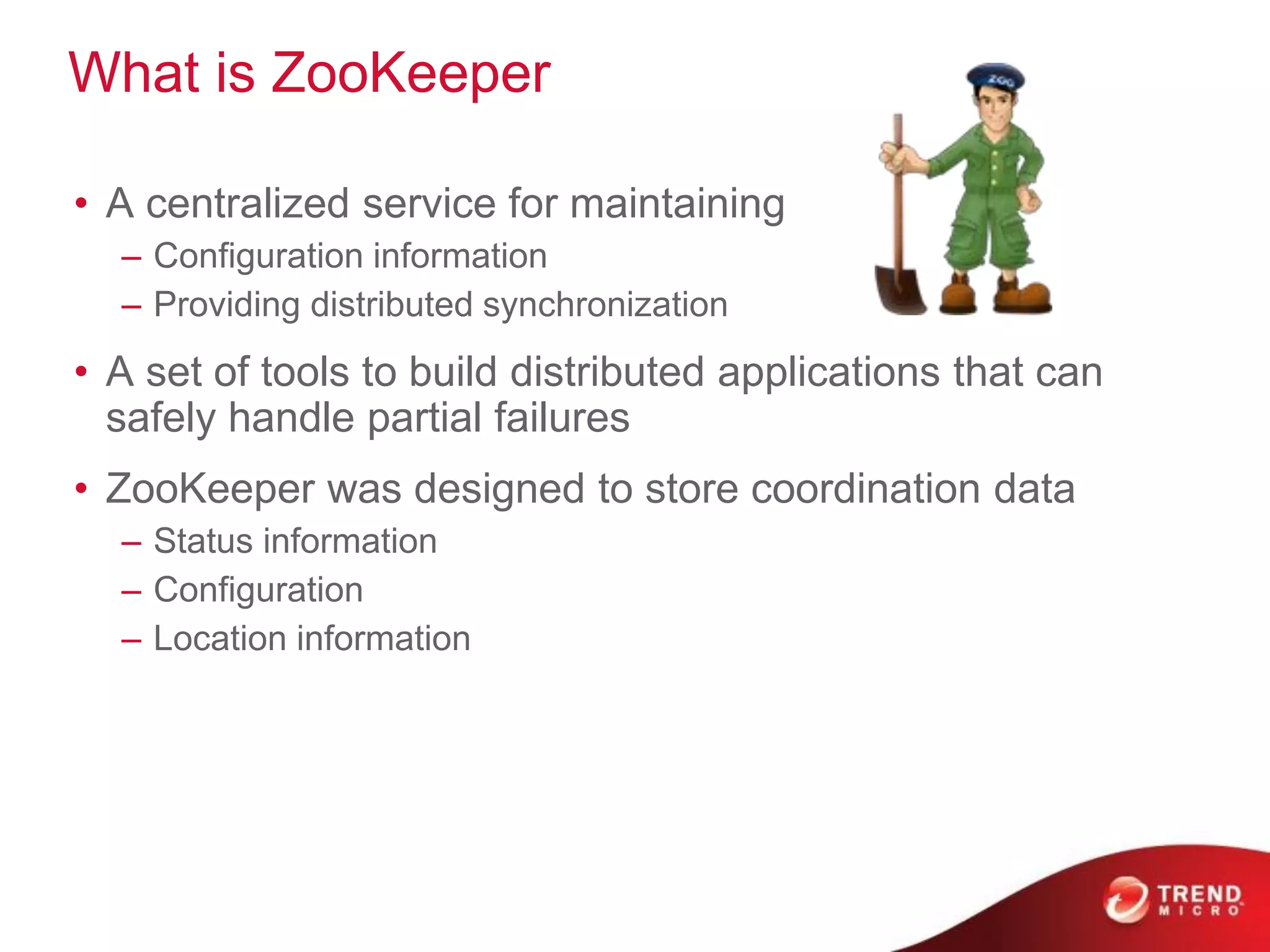
What is ZooKeeper
• A centralized service for maintaining
– Configuration information
– Providing distributed synchronization
• A set of tools to build distributed applications that can
safely handle partial failures
• ZooKeeper was designed to store coordination data
– Status information
– Configuration
– Location information
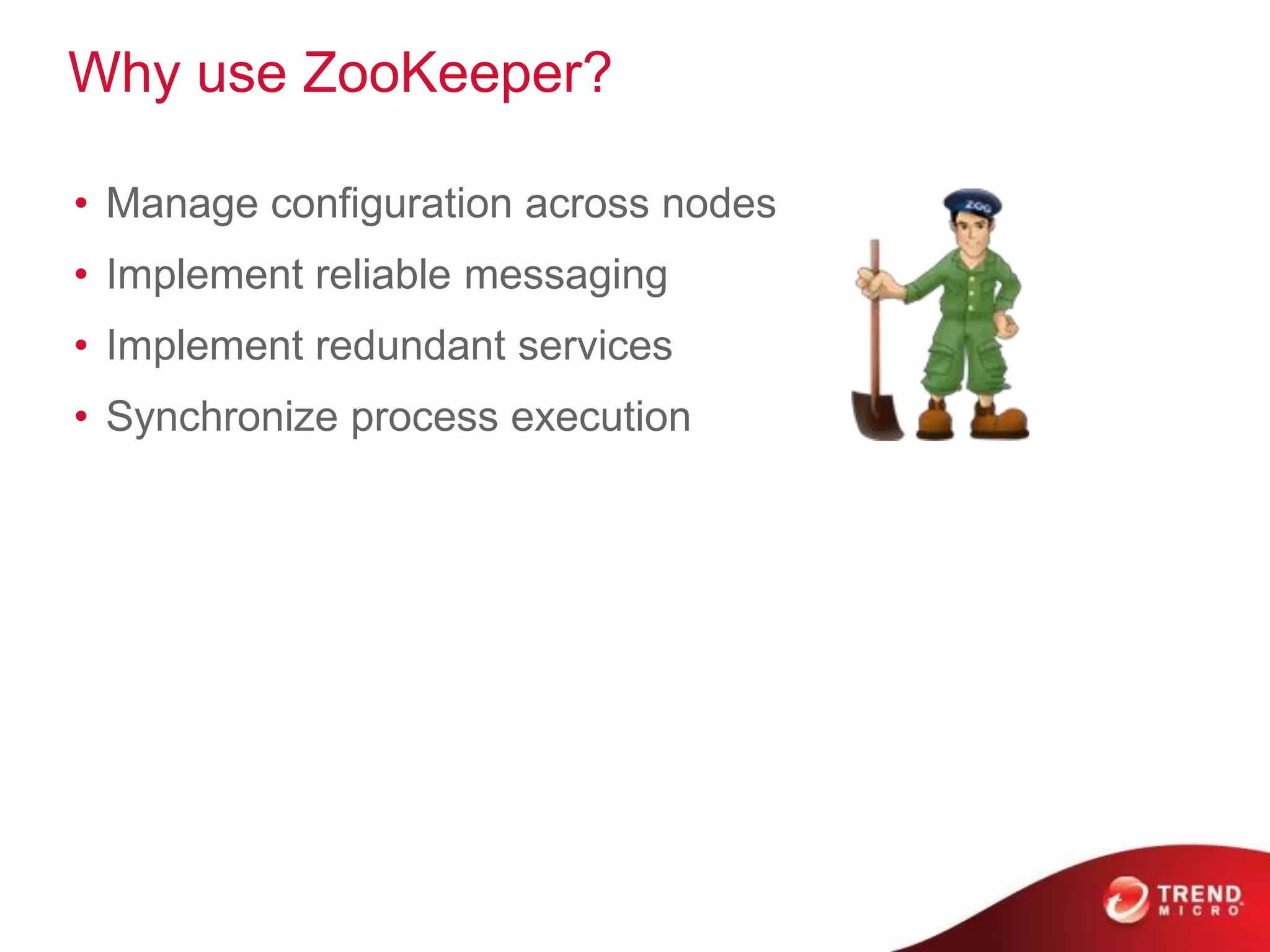
Why use ZooKeeper?
• Manage configuration across nodes
• Implement reliable messaging
• Implement redundant services
• Synchronize process execution
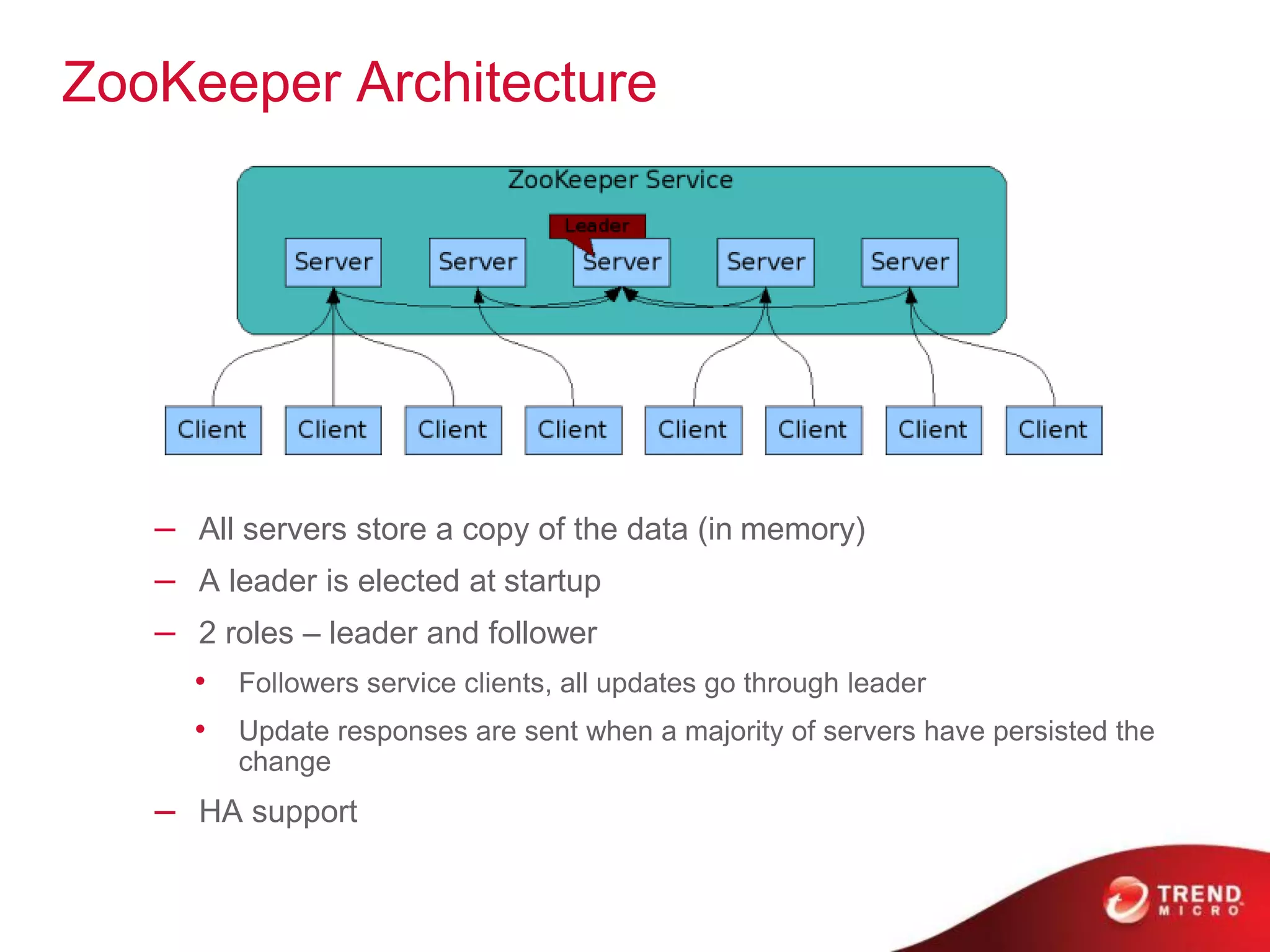
ZooKeeper Architecture
– All servers store a copy of the data (in memory)
– A leader is elected at startup
– 2 roles – leader and follower
• Followers service clients, all updates go through leader
• Update responses are sent when a majority of servers have persisted the
change
– HA support
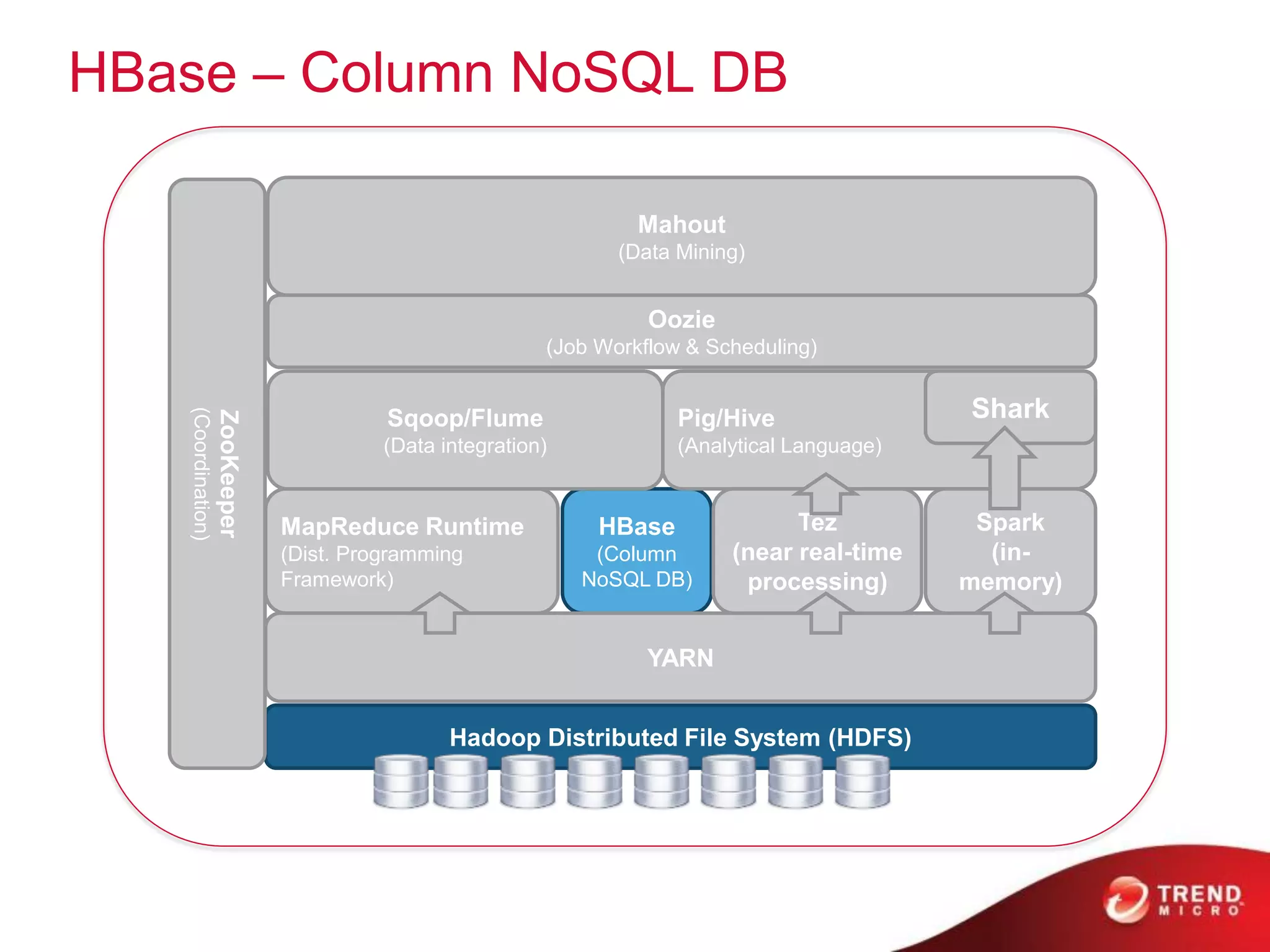
HBase – Column NoSQL DB
MapReduce Runtime
(Dist. Programming
Framework)
Hadoop Distributed File System (HDFS)
HBase
(Column
NoSQL DB)
Sqoop/Flume
(Data integration)
Oozie
(Job Workflow & Scheduling)
Pig/Hive
(Analytical Language)
Mahout
(Data Mining)
YARN
ZooKeeper
(Coordination)
Tez
(near real-time
processing)
Spark
(in-
memory)
Shark
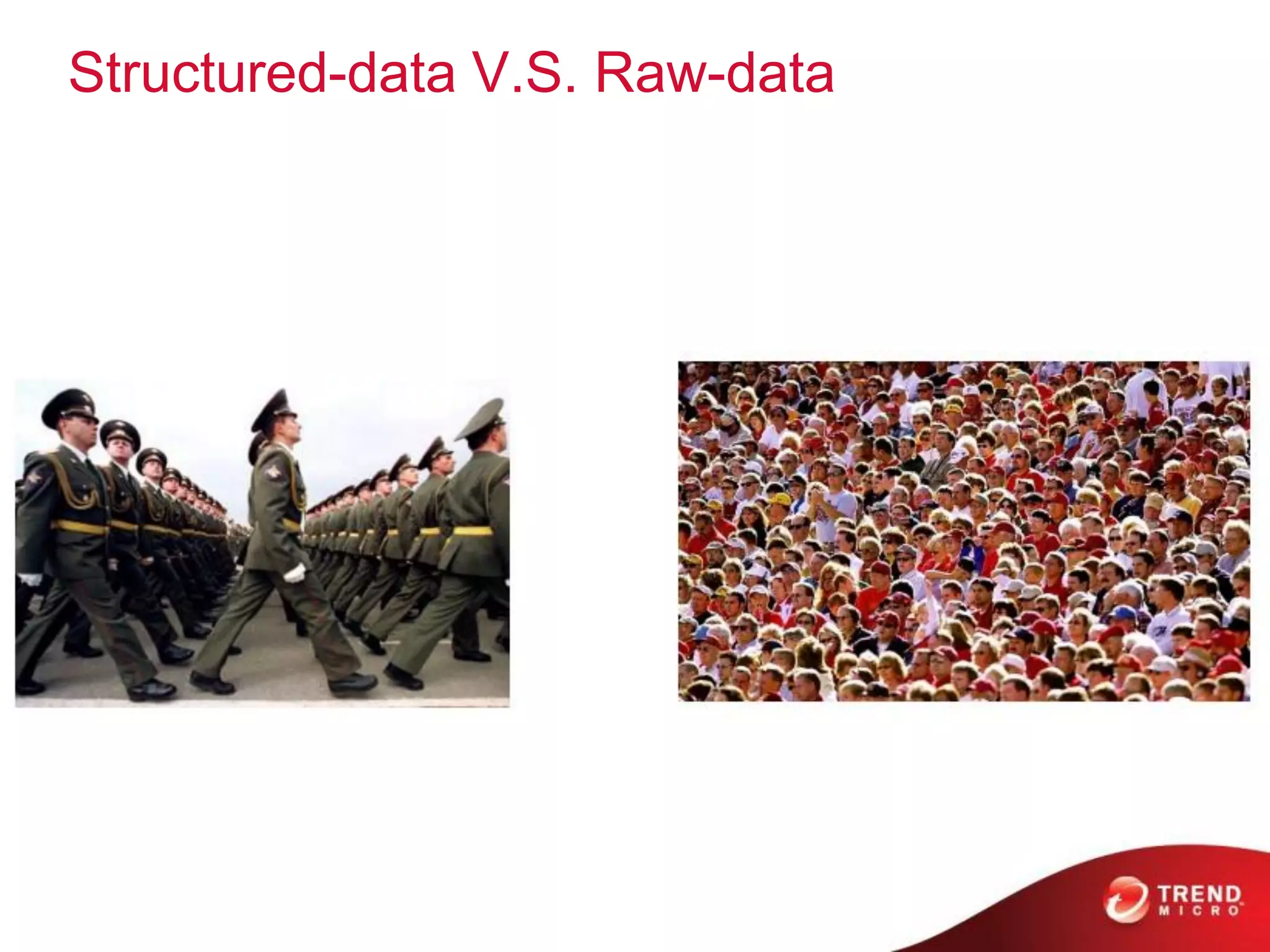
Structured-data V.S. Raw-data
I – Inspired by
• Apache open source project
• Inspired from Google Big Table
• Non-relational, distributed database written in Java
• Coordinated by Zookeeper
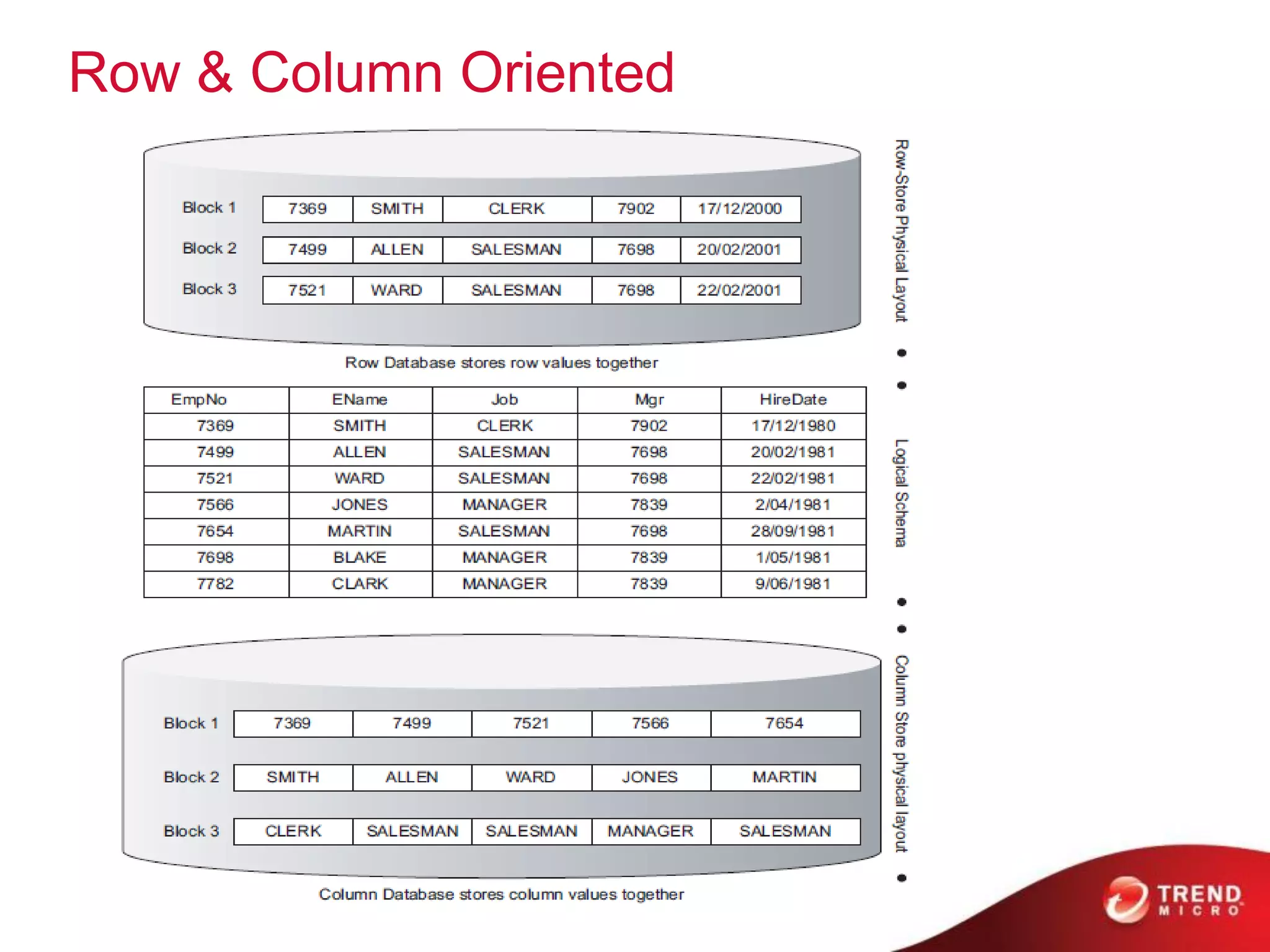
Row & Column Oriented
HBase – Data Model
• Cells are “versioned”
• Table rows are sorted by row key
• Region – a row range [start-key:end-key]
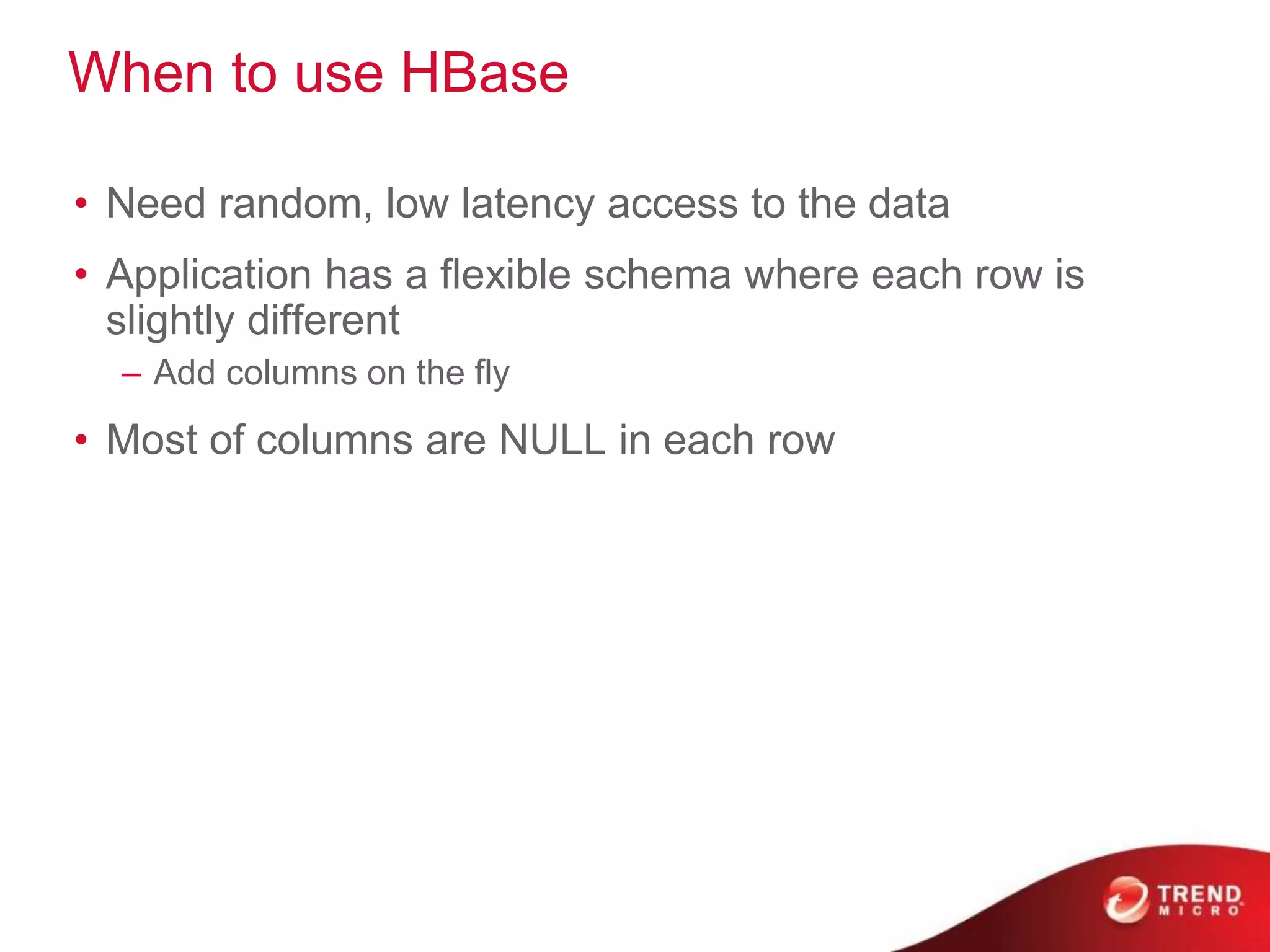
When to use HBase
• Need random, low latency access to the data
• Application has a flexible schema where each row is
slightly different
– Add columns on the fly
• Most of columns are NULL in each row
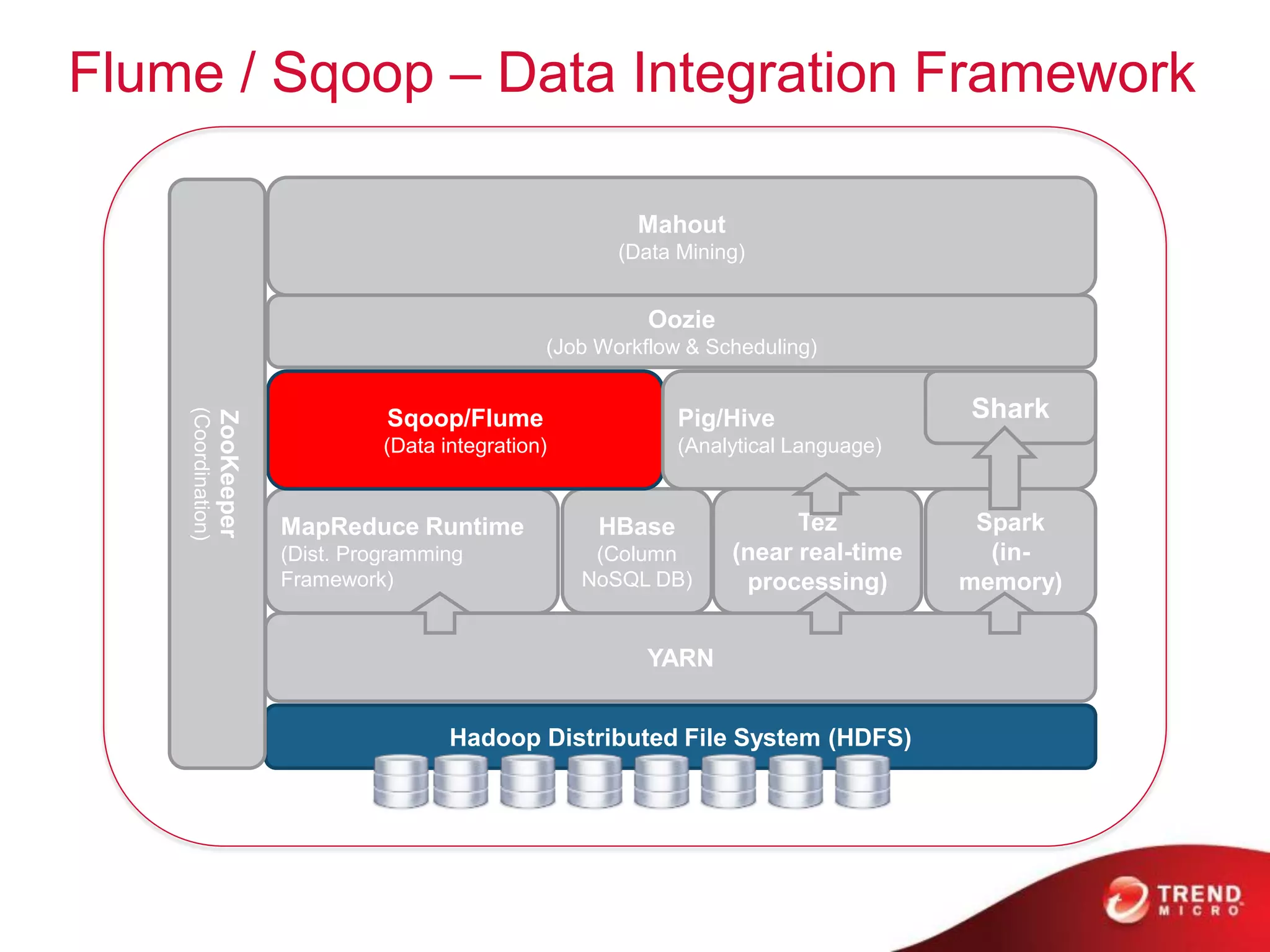
Flume / Sqoop – Data Integration Framework
MapReduce Runtime
(Dist. Programming
Framework)
Hadoop Distributed File System (HDFS)
HBase
(Column
NoSQL DB)
Sqoop/Flume
(Data integration)
Oozie
(Job Workflow & Scheduling)
Pig/Hive
(Analytical Language)
Mahout
(Data Mining)
YARN
ZooKeeper
(Coordination)
Tez
(near real-time
processing)
Spark
(in-
memory)
Shark
What’s the problem for data collection
• Data collection is currently a priori and ad hoc
• A priori – decide what you want to collect ahead of time
• Ad hoc – each kind of data source goes through its own
collection path
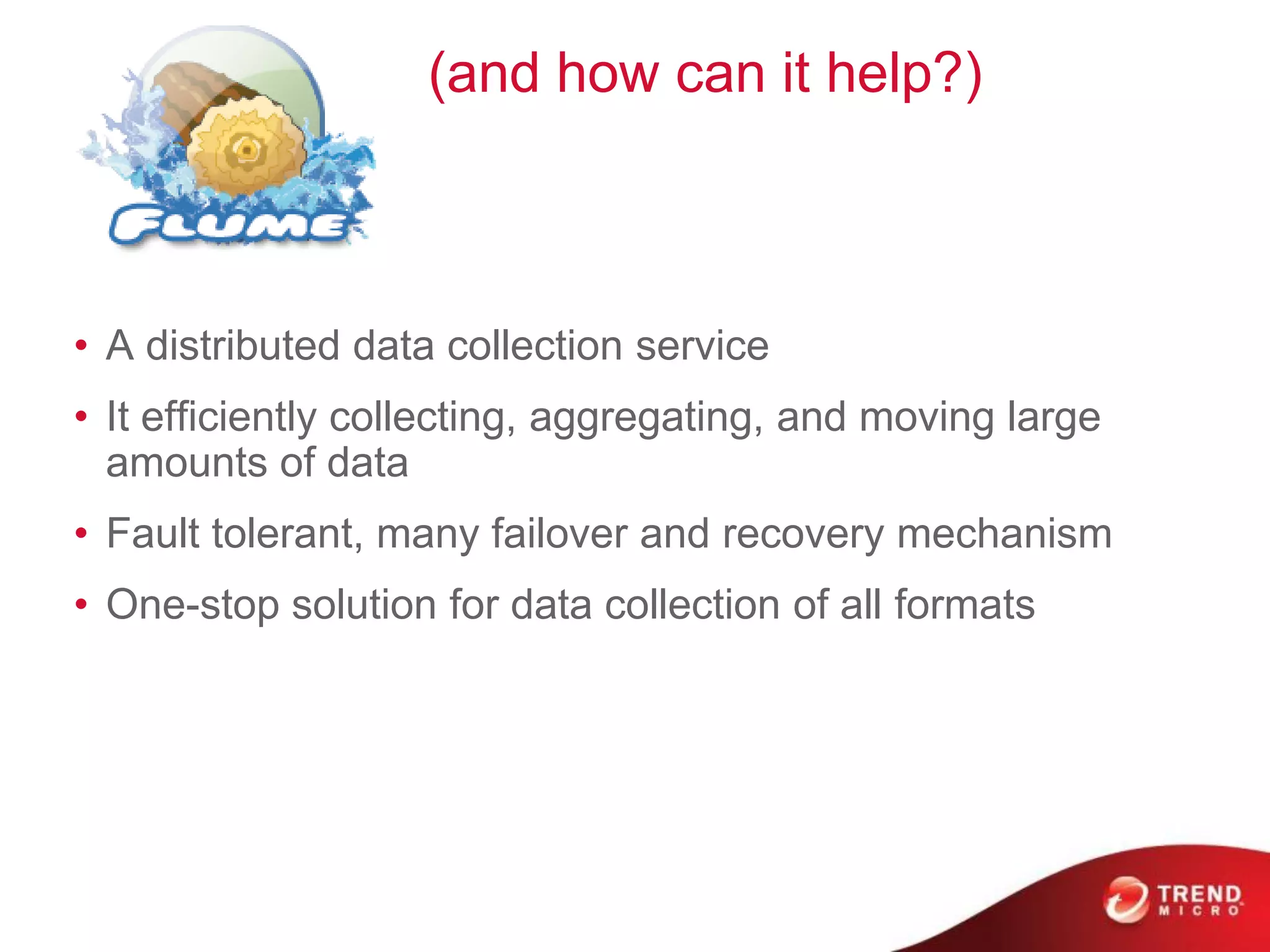
(and how can it help?)
• A distributed data collection service
• It efficiently collecting, aggregating, and moving large
amounts of data
• Fault tolerant, many failover and recovery mechanism
• One-stop solution for data collection of all formats
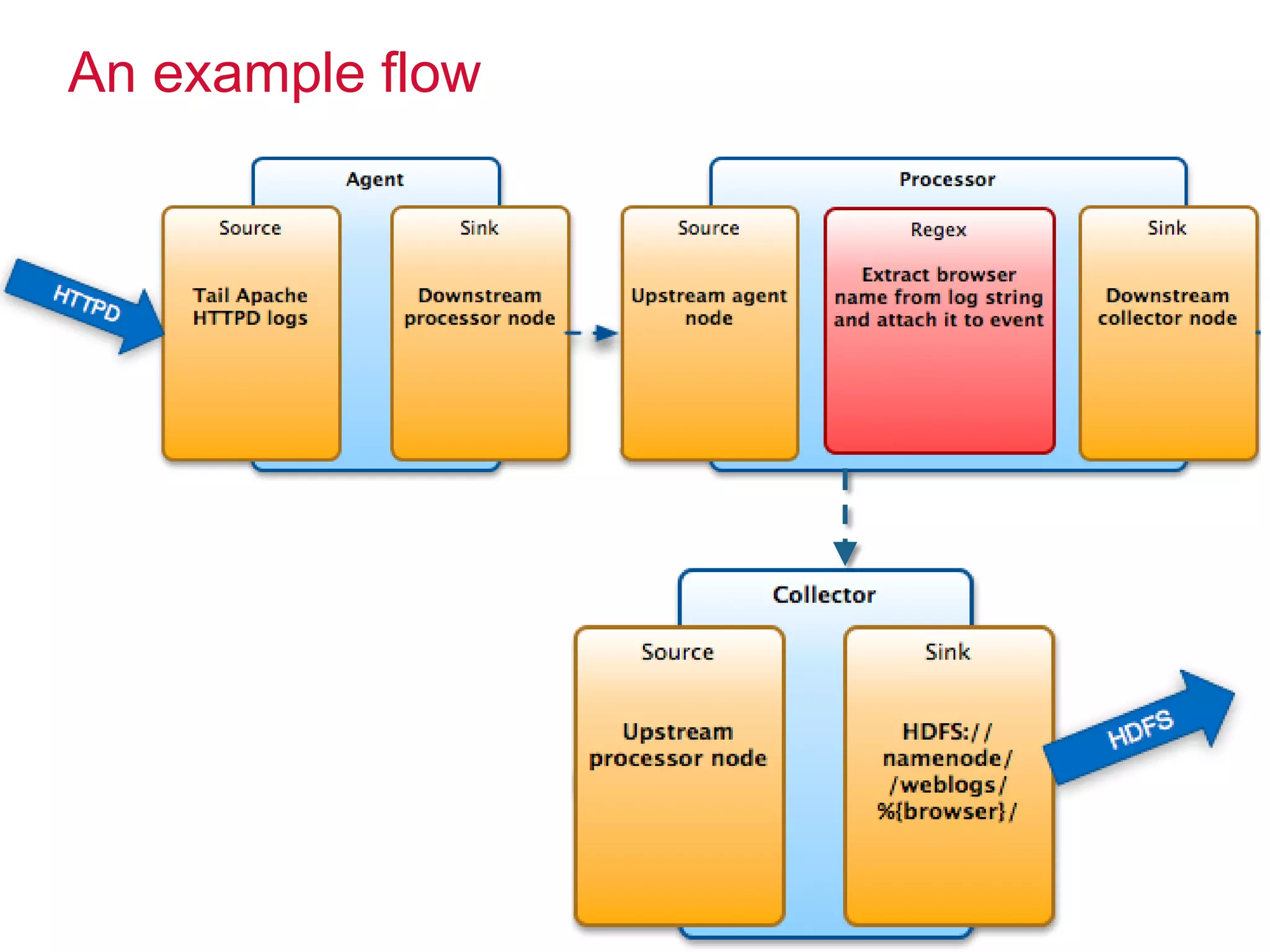
An example flow
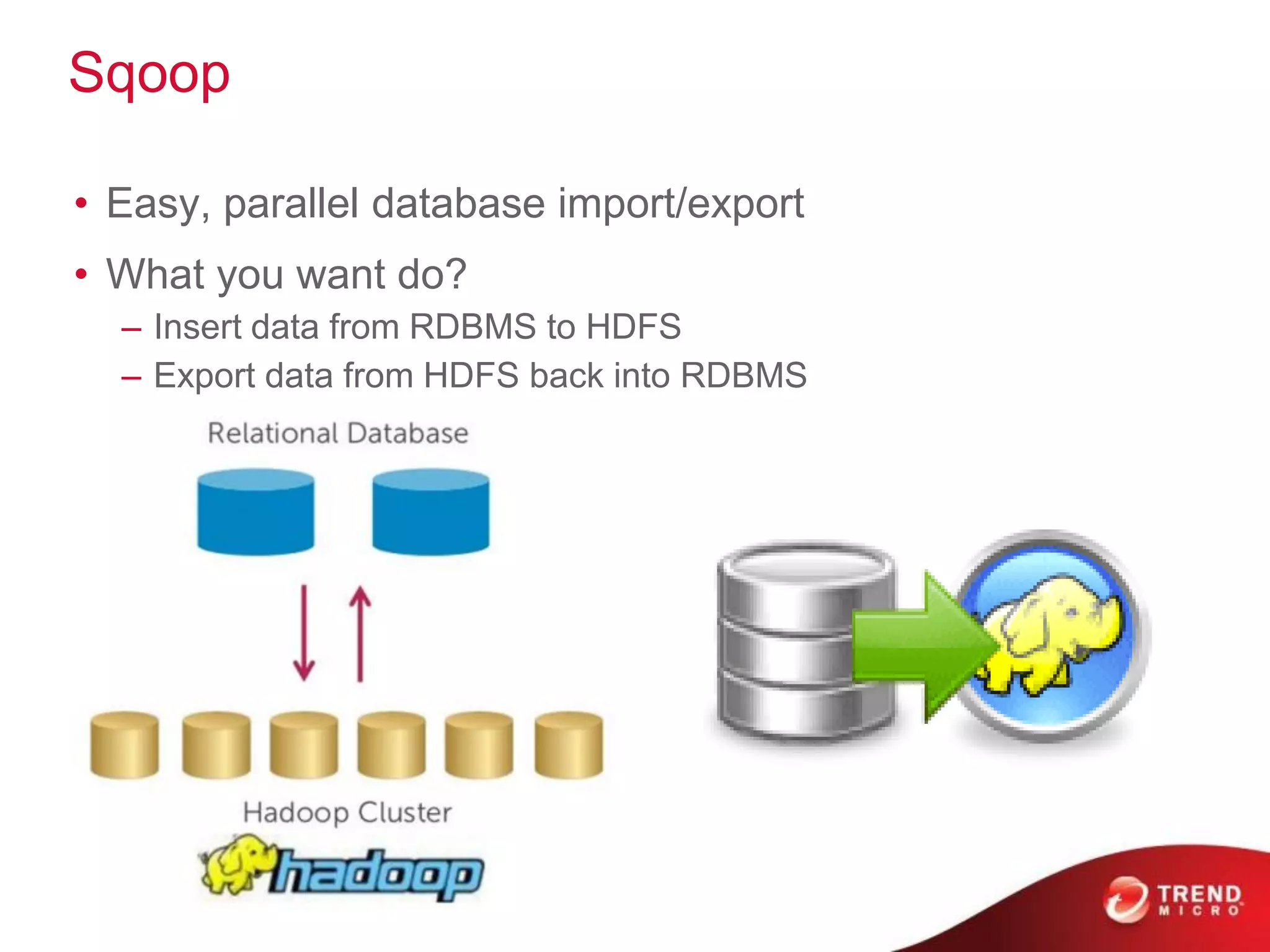
Sqoop
• Easy, parallel database import/export
• What you want do?
– Insert data from RDBMS to HDFS
– Export data from HDFS back into RDBMS
What is Sqoop
• A suite of tools that connect Hadoop and database
systems
• Import tables from databases into HDFS for deep
analysis
• Export MapReduce results back to a database for
presentation to end-users
• Provides the ability to import from SQL databases
straight into your Hive data warehouse
How Sqoop helps
• The Problem
– Structured data in traditional databases cannot be easily
combined with complex data stored in HDFS
• Sqoop (SQL-to-Hadoop)
– Easy import of data from many databases to HDFS
– Generate code for use in MapReduce applications
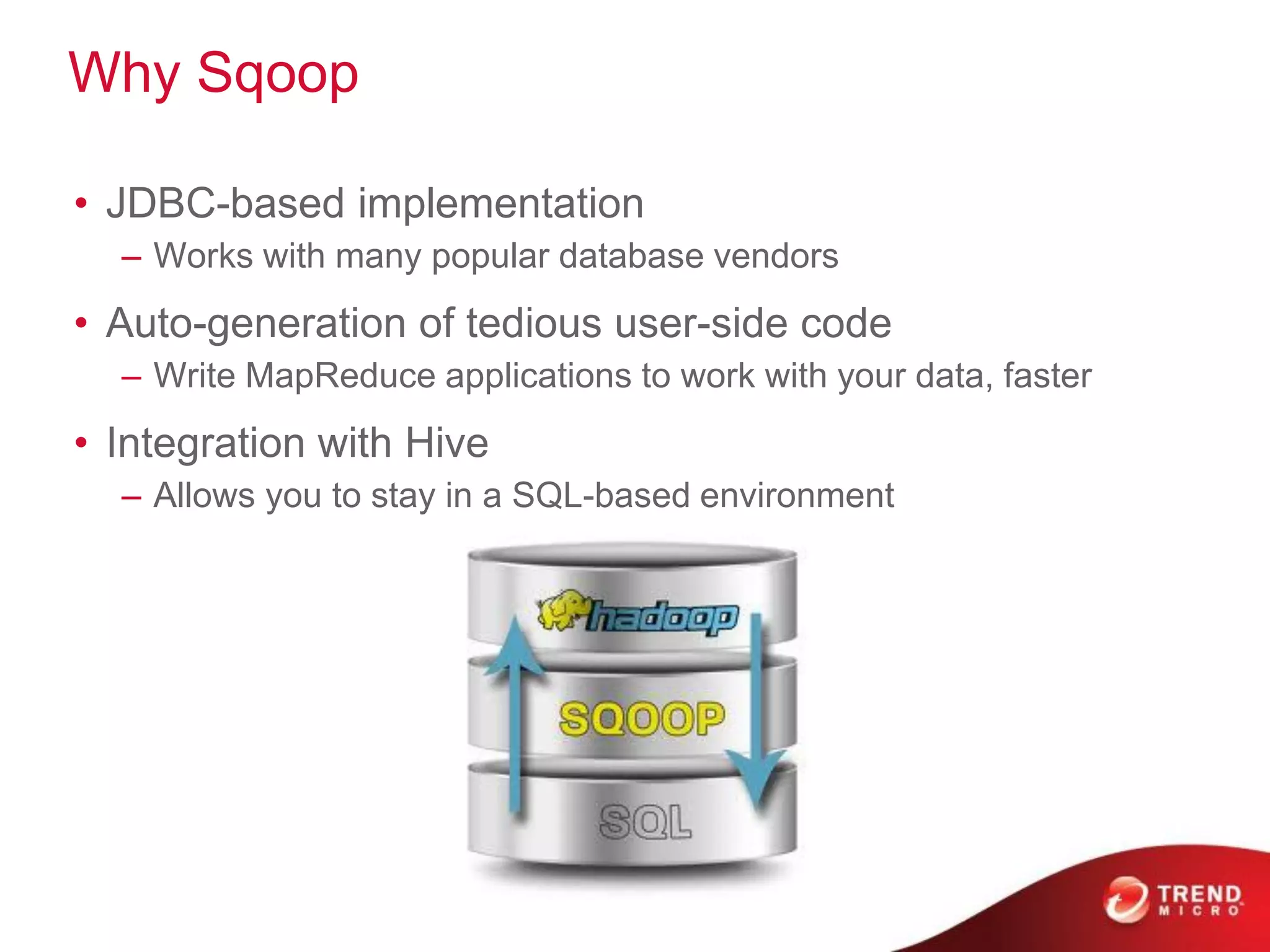
Why Sqoop
• JDBC-based implementation
– Works with many popular database vendors
• Auto-generation of tedious user-side code
– Write MapReduce applications to work with your data, faster
• Integration with Hive
– Allows you to stay in a SQL-based environment
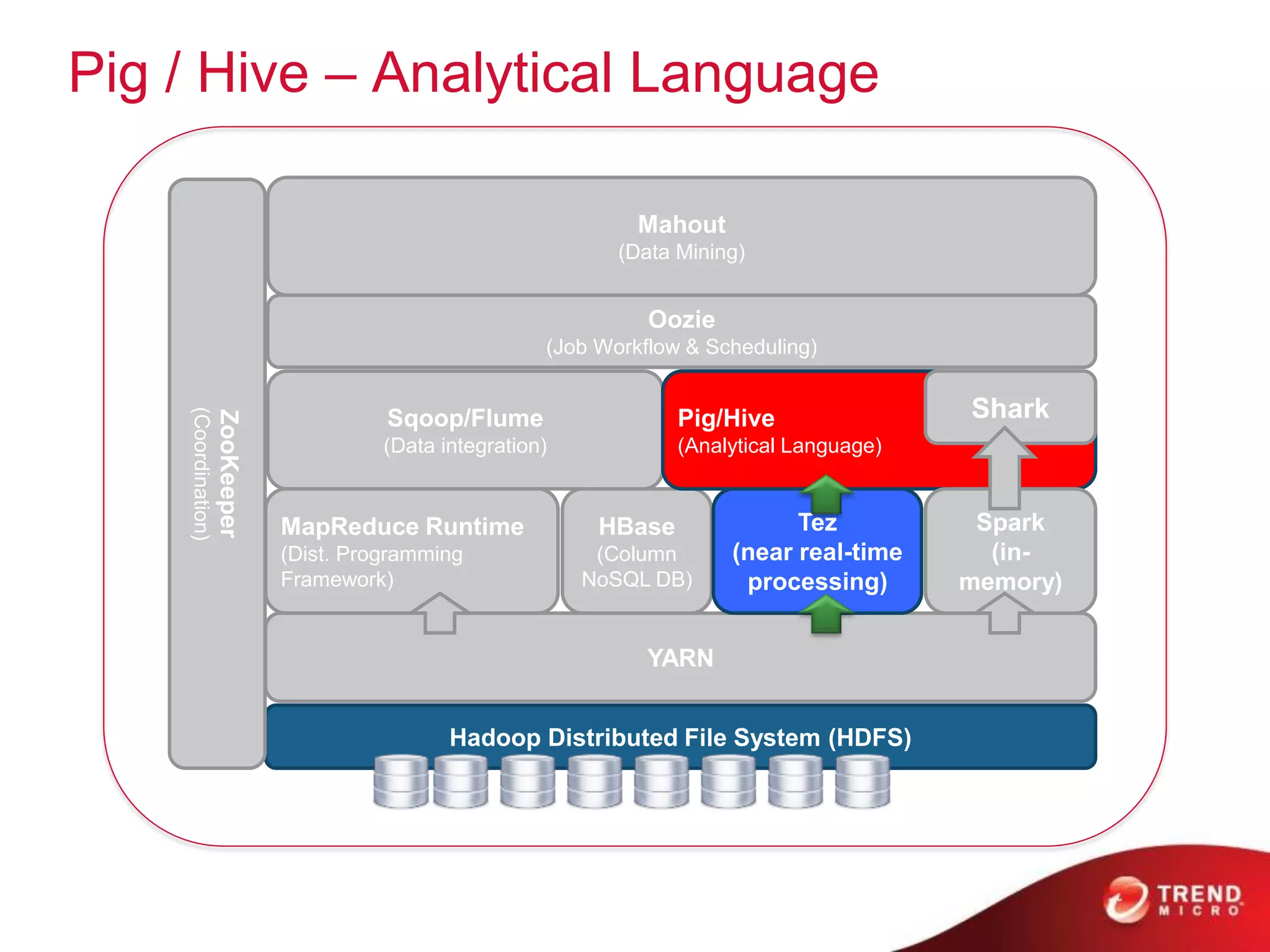
Pig / Hive – Analytical Language
MapReduce Runtime
(Dist. Programming
Framework)
Hadoop Distributed File System (HDFS)
HBase
(Column
NoSQL DB)
Sqoop/Flume
(Data integration)
Oozie
(Job Workflow & Scheduling)
Pig/Hive
(Analytical Language)
Mahout
(Data Mining)
YARN
ZooKeeper
(Coordination)
Tez
(near real-time
processing)
Spark
(in-
memory)
Shark
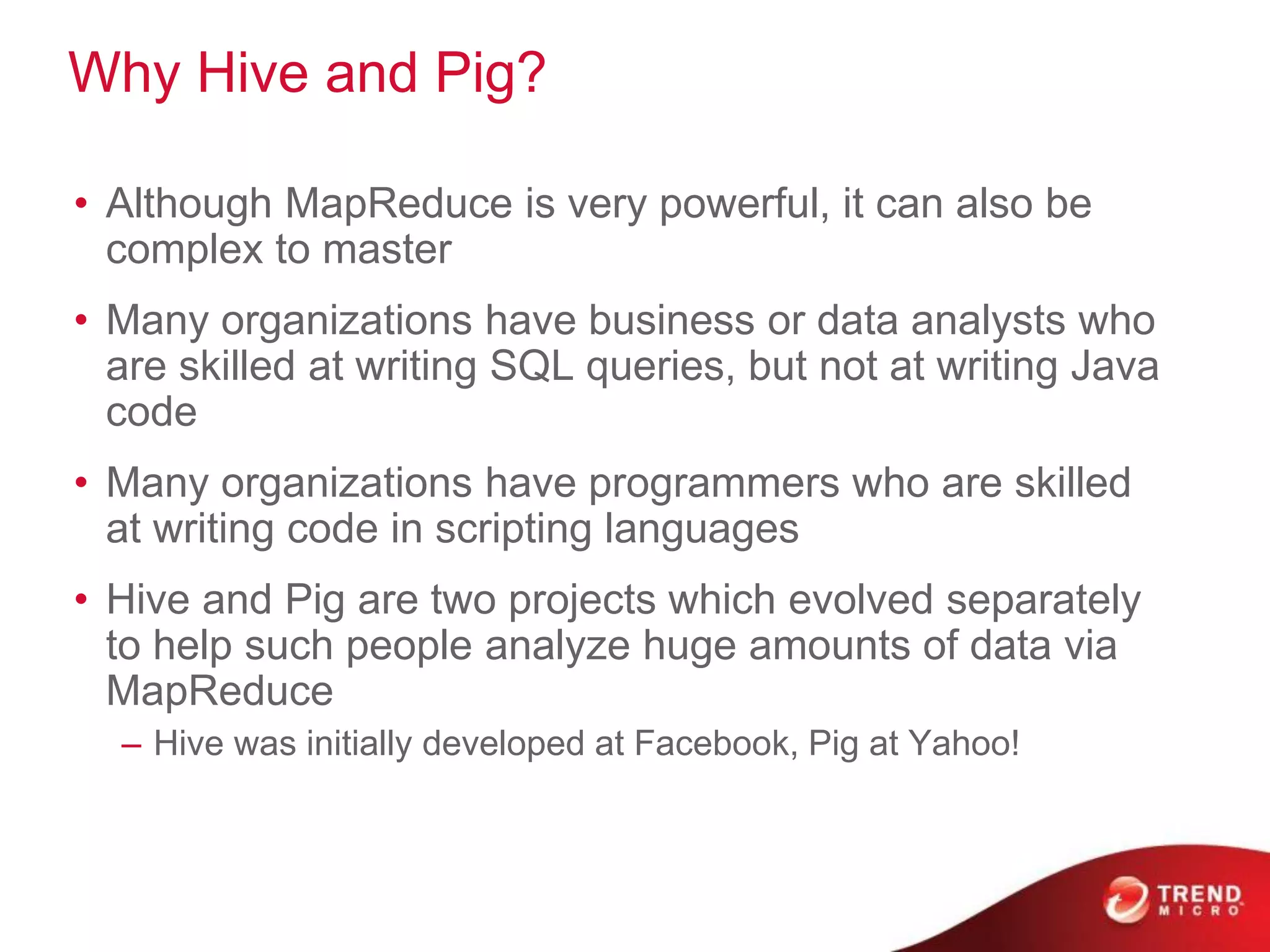
Why Hive and Pig?
• Although MapReduce is very powerful, it can also be
complex to master
• Many organizations have business or data analysts who
are skilled at writing SQL queries, but not at writing Java
code
• Many organizations have programmers who are skilled
at writing code in scripting languages
• Hive and Pig are two projects which evolved separately
to help such people analyze huge amounts of data via
MapReduce
– Hive was initially developed at Facebook, Pig at Yahoo!
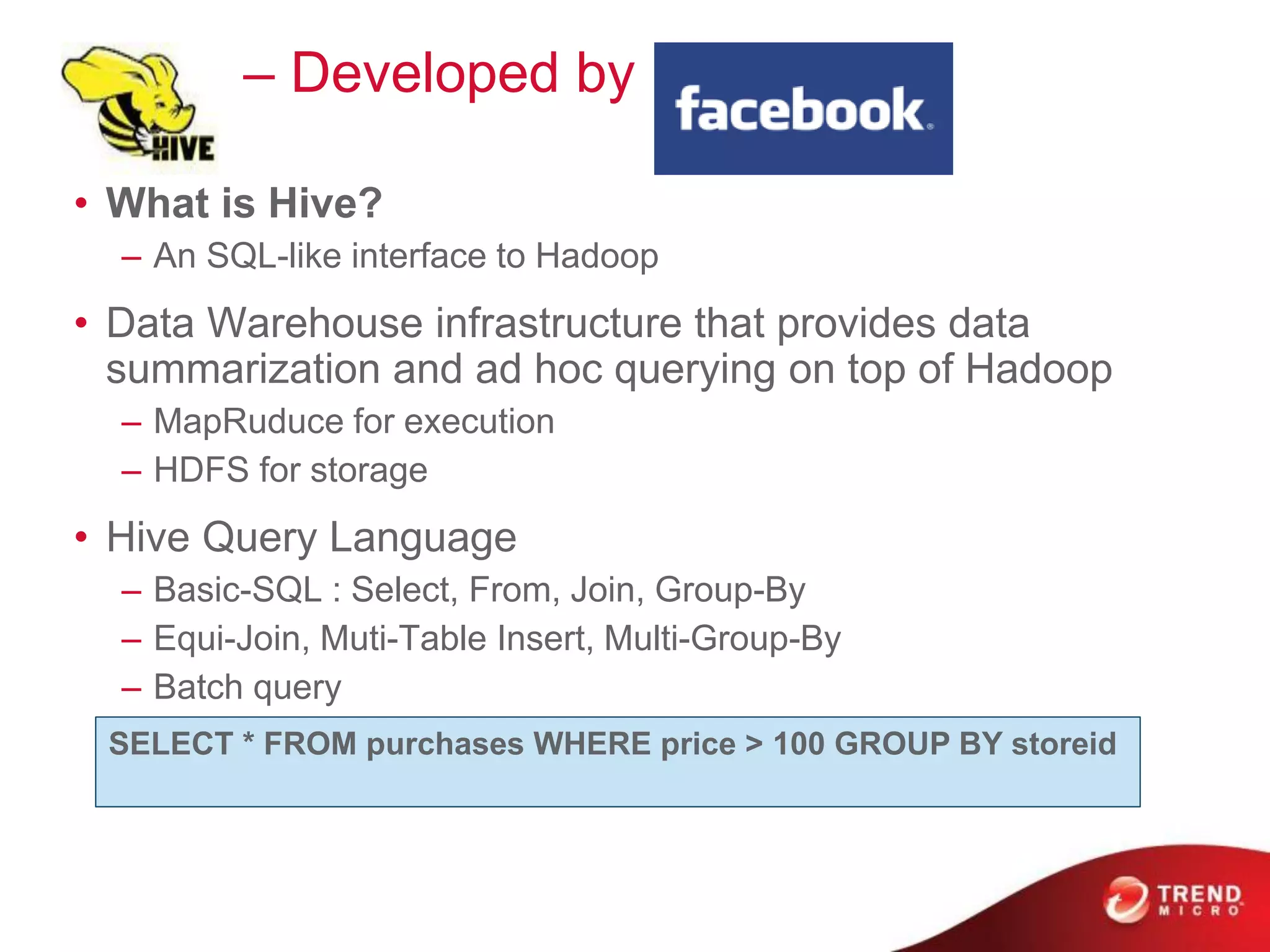
Hive – Developed by
• What is Hive?
– An SQL-like interface to Hadoop
• Data Warehouse infrastructure that provides data
summarization and ad hoc querying on top of Hadoop
– MapRuduce for execution
– HDFS for storage
• Hive Query Language
– Basic-SQL : Select, From, Join, Group-By
– Equi-Join, Muti-Table Insert, Multi-Group-By
– Batch query
SELECT * FROM purchases WHERE price > 100 GROUP BY storeid
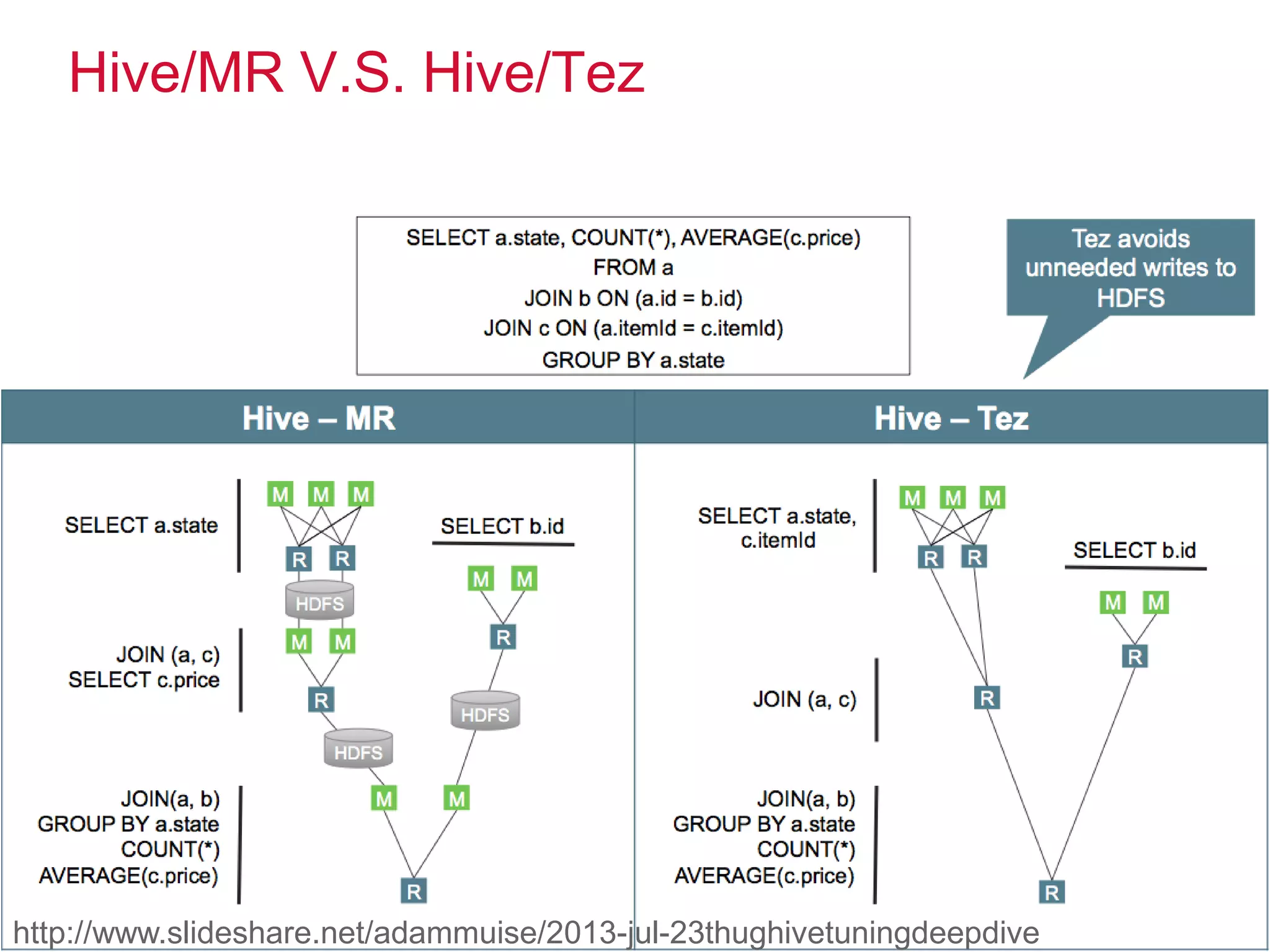
Hive/MR V.S. Hive/Tez
http://www.slideshare.net/adammuise/2013-jul-23thughivetuningdeepdive
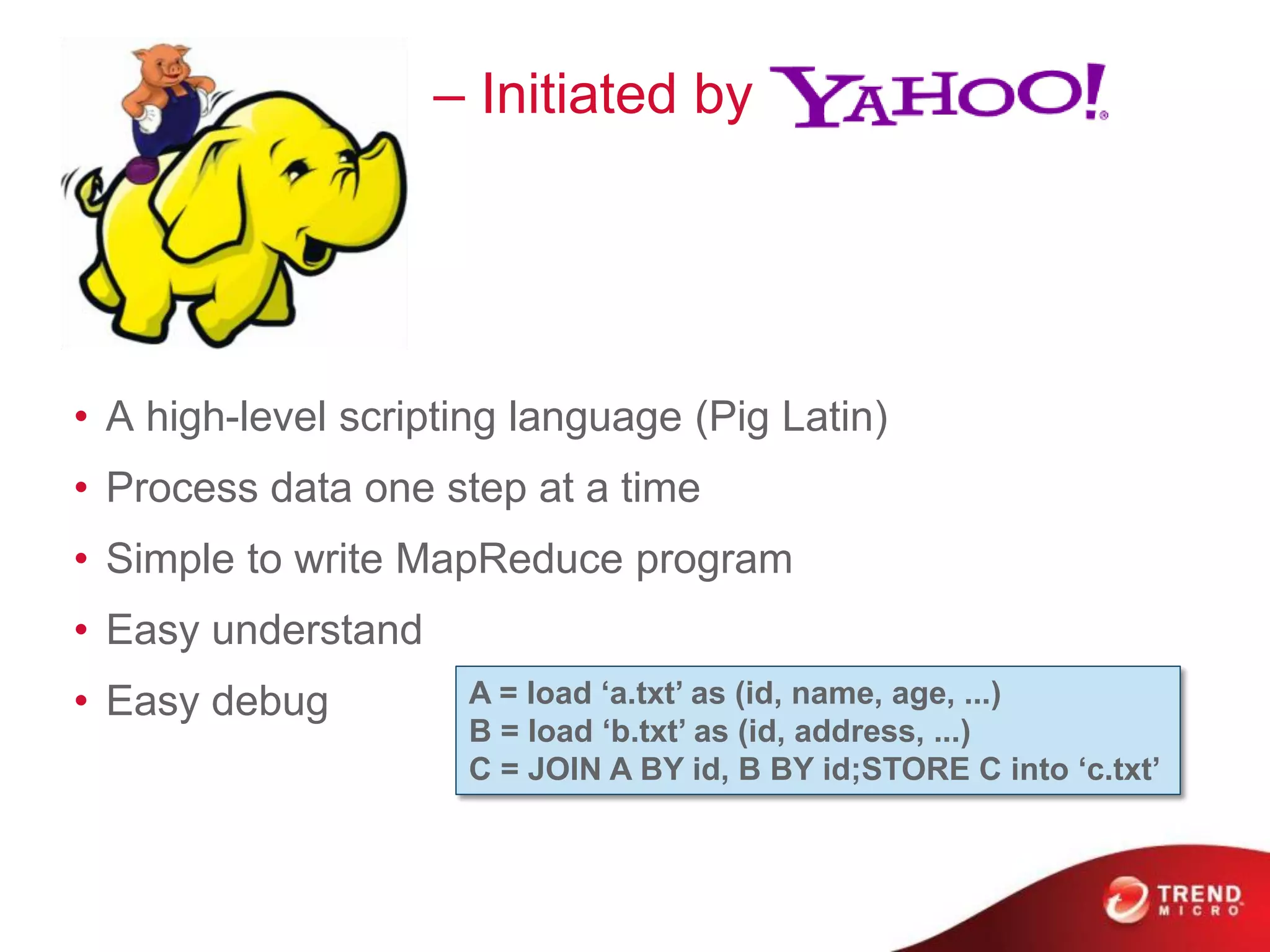
Pig
• A high-level scripting language (Pig Latin)
• Process data one step at a time
• Simple to write MapReduce program
• Easy understand
• Easy debug A = load ‘a.txt’ as (id, name, age, ...)
B = load ‘b.txt’ as (id, address, ...)
C = JOIN A BY id, B BY id;STORE C into ‘c.txt’
– Initiated by
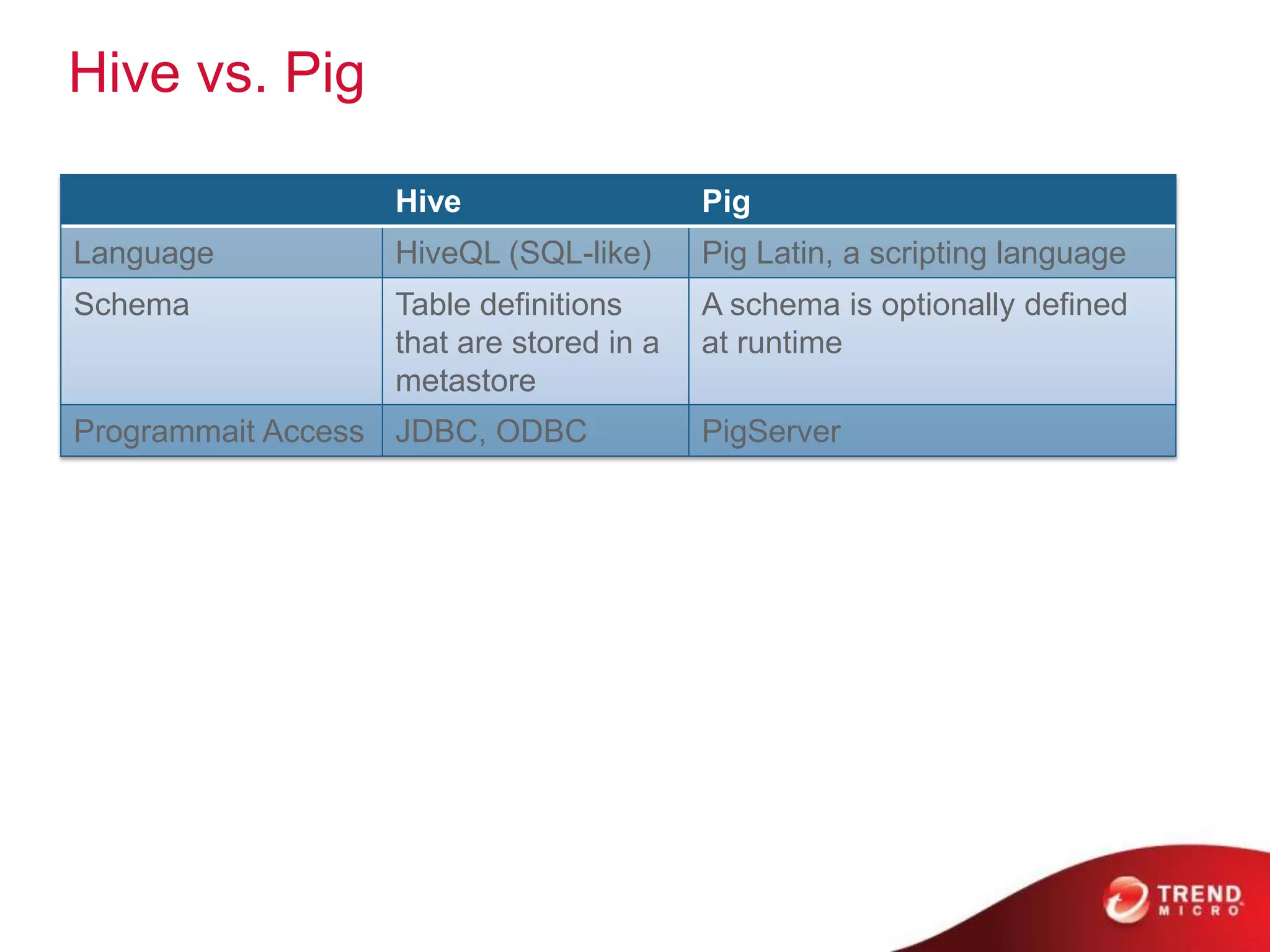
Hive vs. Pig
Hive Pig
Language HiveQL (SQL-like) Pig Latin, a scripting language
Schema Table definitions
that are stored in a
metastore
A schema is optionally defined
at runtime
Programmait Access JDBC, ODBC PigServer
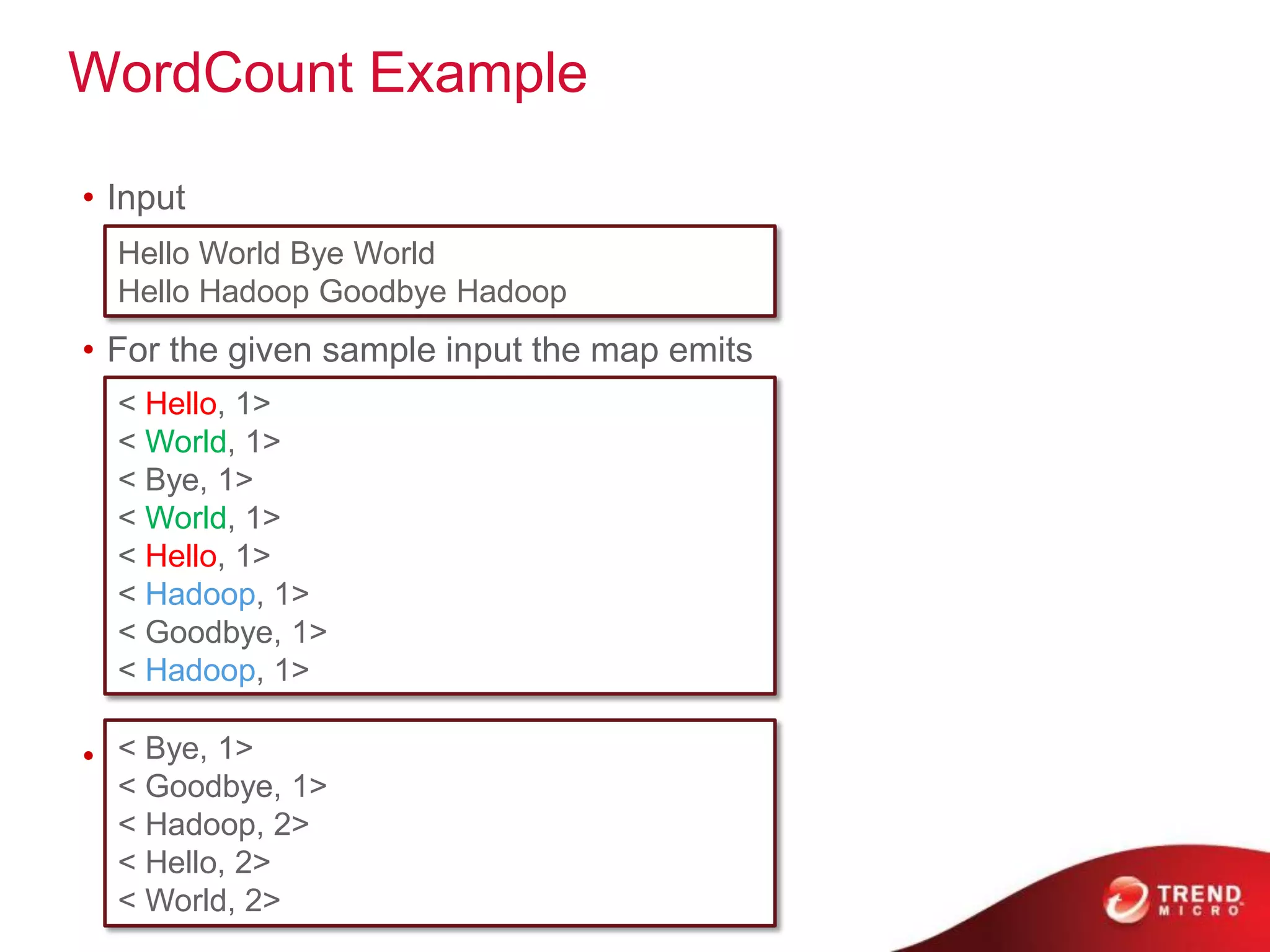
• Input
• For the given sample input the map emits
• the reduce just sums up the values
Hello World Bye World
Hello Hadoop Goodbye Hadoop
< Hello, 1>
< World, 1>
< Bye, 1>
< World, 1>
< Hello, 1>
< Hadoop, 1>
< Goodbye, 1>
< Hadoop, 1>
< Bye, 1>
< Goodbye, 1>
< Hadoop, 2>
< Hello, 2>
< World, 2>
WordCount Example
WordCount Example In MapReduce
public class WordCount {
public static class Map extends Mapper<LongWritable, Text, Text, IntWritable> {
private final static IntWritable one = new IntWritable(1);
private Text word = new Text();
public void map(LongWritable key, Text value, Context context) throws IOException, InterruptedException {
String line = value.toString();
StringTokenizer tokenizer = new StringTokenizer(line);
while (tokenizer.hasMoreTokens()) {
word.set(tokenizer.nextToken());
context.write(word, one);
}
}
}
public static class Reduce extends Reducer<Text, IntWritable, Text, IntWritable> {
public void reduce(Text key, Iterable<IntWritable> values, Context context)
throws IOException, InterruptedException {
int sum = 0;
for (IntWritable val : values) {
sum += val.get();
}
context.write(key, new IntWritable(sum));
}
}
public static void main(String[] args) throws Exception {
Configuration conf = new Configuration();
Job job = new Job(conf, "wordcount");
job.setOutputKeyClass(Text.class);
job.setOutputValueClass(IntWritable.class);
job.setMapperClass(Map.class);
job.setReducerClass(Reduce.class);
job.setInputFormatClass(TextInputFormat.class);
job.setOutputFormatClass(TextOutputFormat.class);
FileInputFormat.addInputPath(job, new Path(args[0]));
FileOutputFormat.setOutputPath(job, new Path(args[1]));
job.waitForCompletion(true);
}
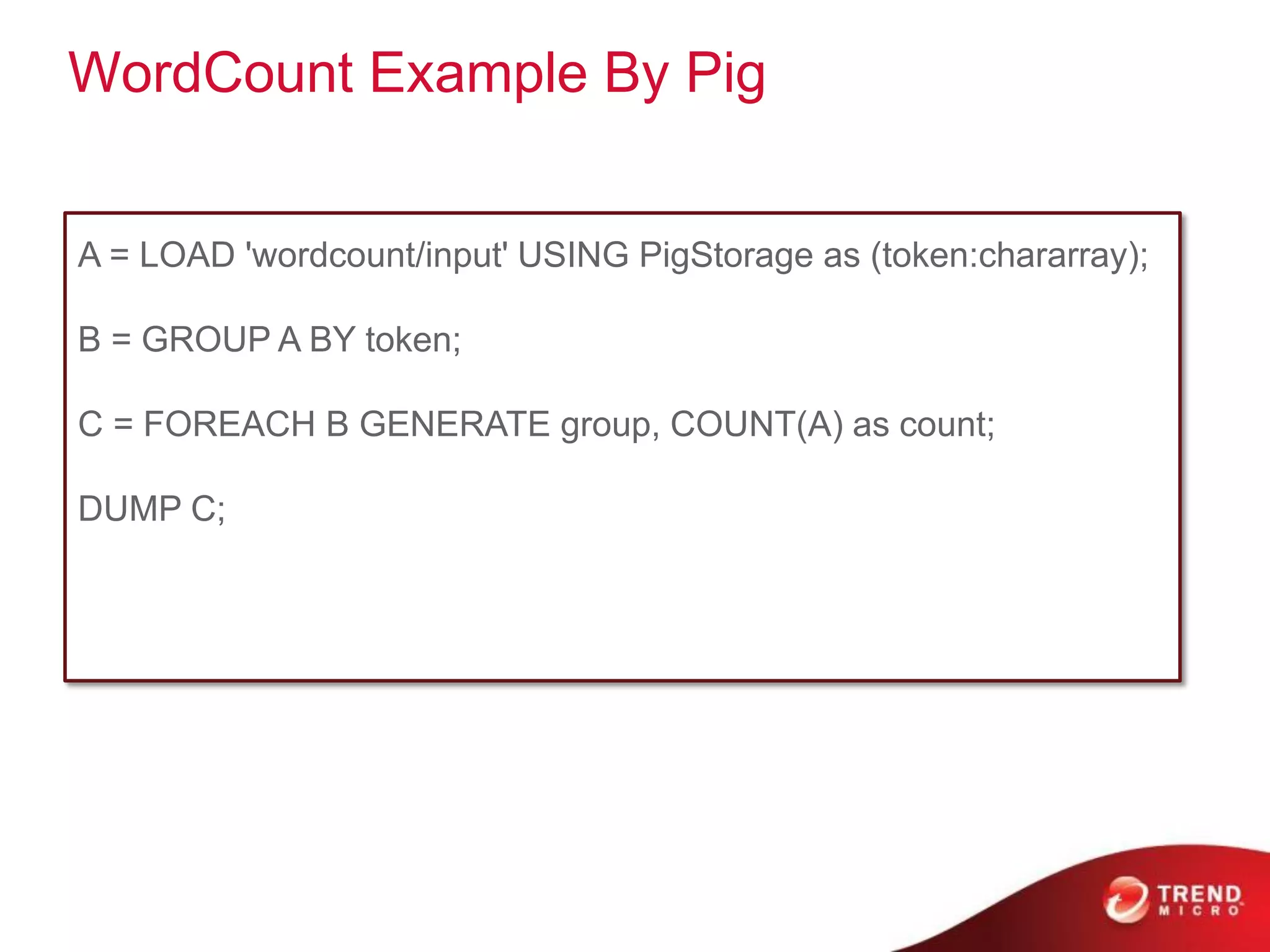
WordCount Example By Pig
A = LOAD 'wordcount/input' USING PigStorage as (token:chararray);
B = GROUP A BY token;
C = FOREACH B GENERATE group, COUNT(A) as count;
DUMP C;
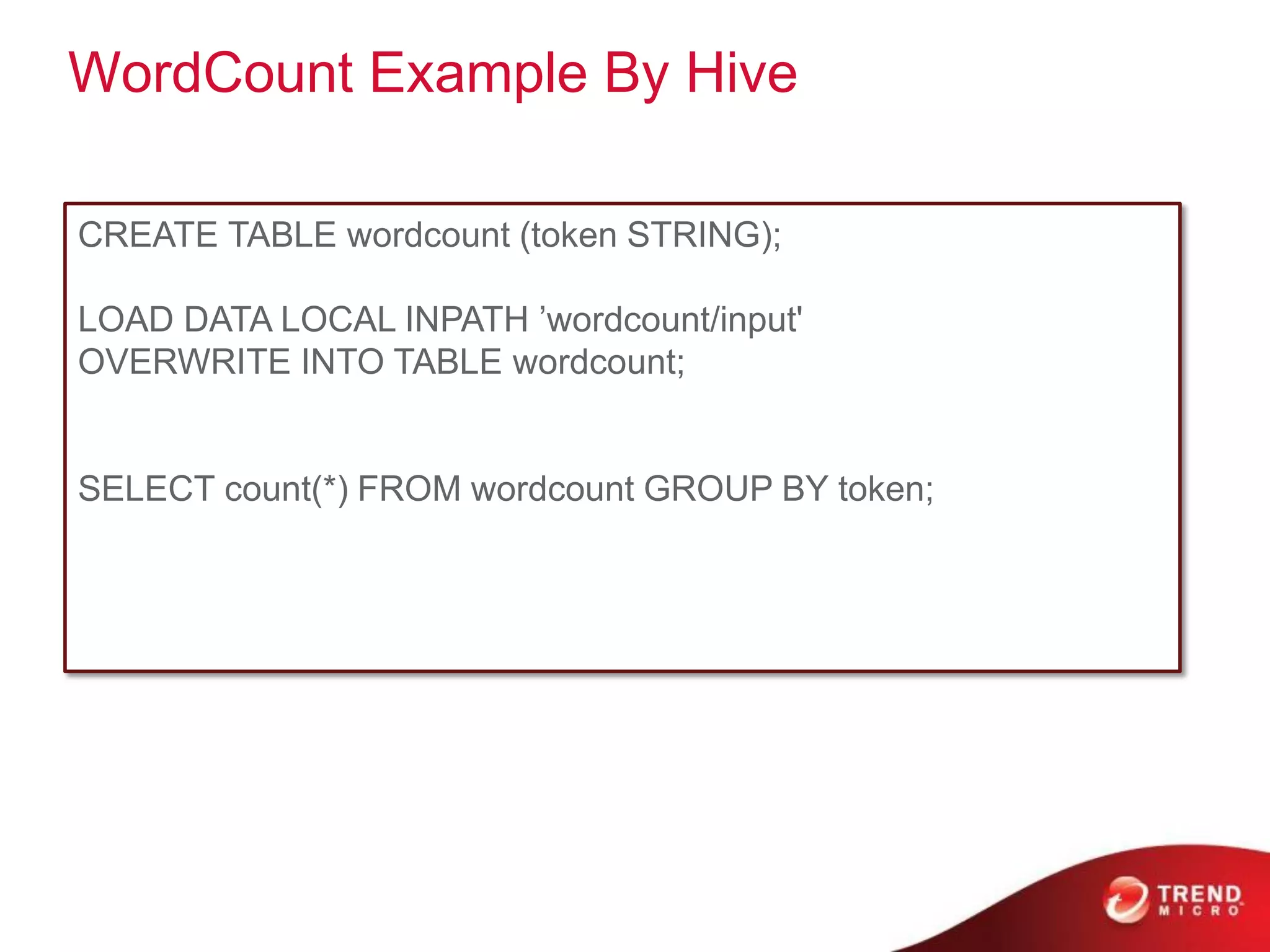
WordCount Example By Hive
CREATE TABLE wordcount (token STRING);
LOAD DATA LOCAL INPATH ’wordcount/input'
OVERWRITE INTO TABLE wordcount;
SELECT count(*) FROM wordcount GROUP BY token;
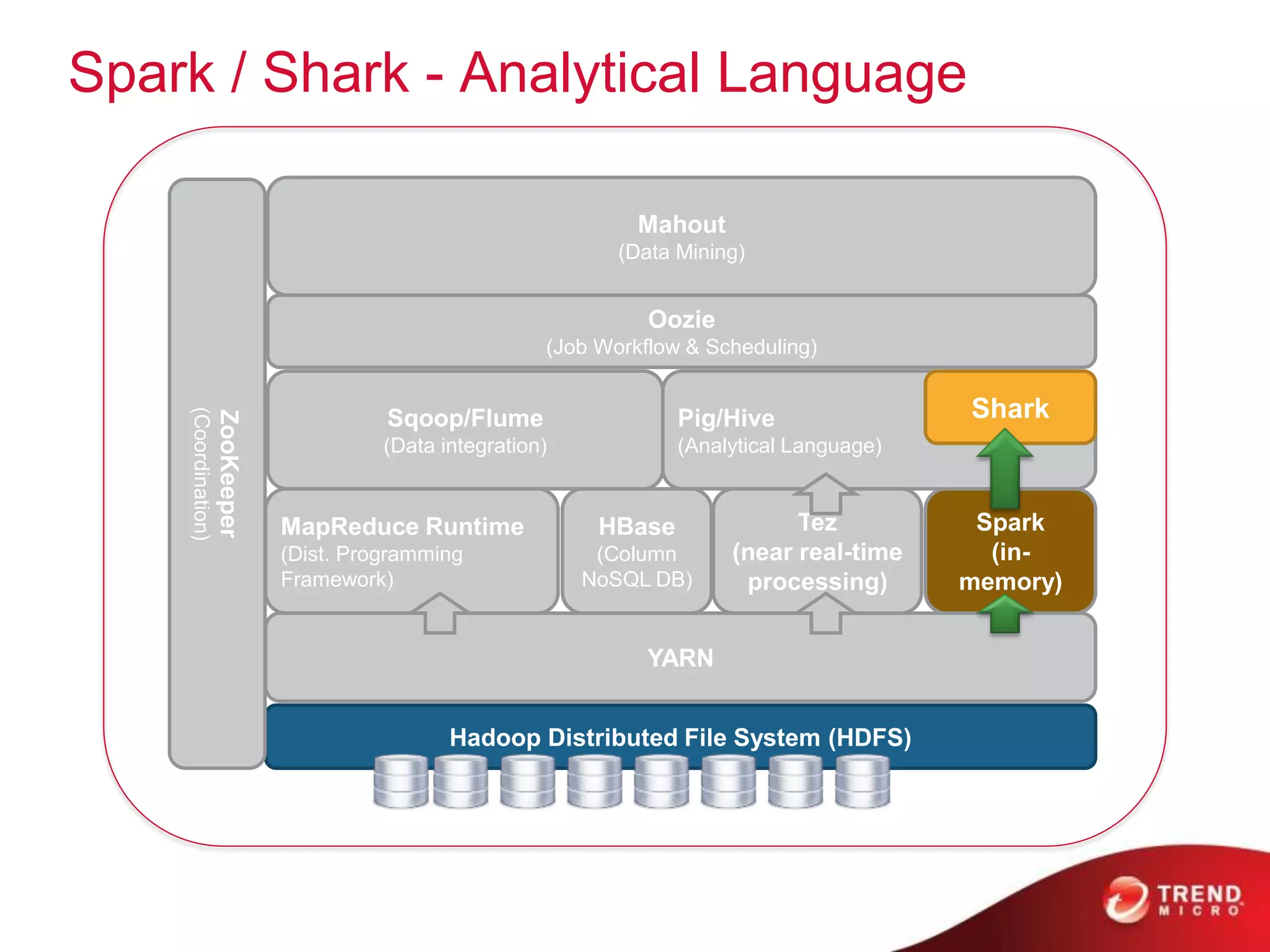
Spark / Shark - Analytical Language
MapReduce Runtime
(Dist. Programming
Framework)
Hadoop Distributed File System (HDFS)
HBase
(Column
NoSQL DB)
Sqoop/Flume
(Data integration)
Oozie
(Job Workflow & Scheduling)
Pig/Hive
(Analytical Language)
Mahout
(Data Mining)
YARN
ZooKeeper
(Coordination)
Tez
(near real-time
processing)
Spark
(in-
memory)
Shark
Why
• MapReduce is too slow
• Aims to make data analytics fast — both fast to run and
fast to write.
• When you have the request: iterative algorithms
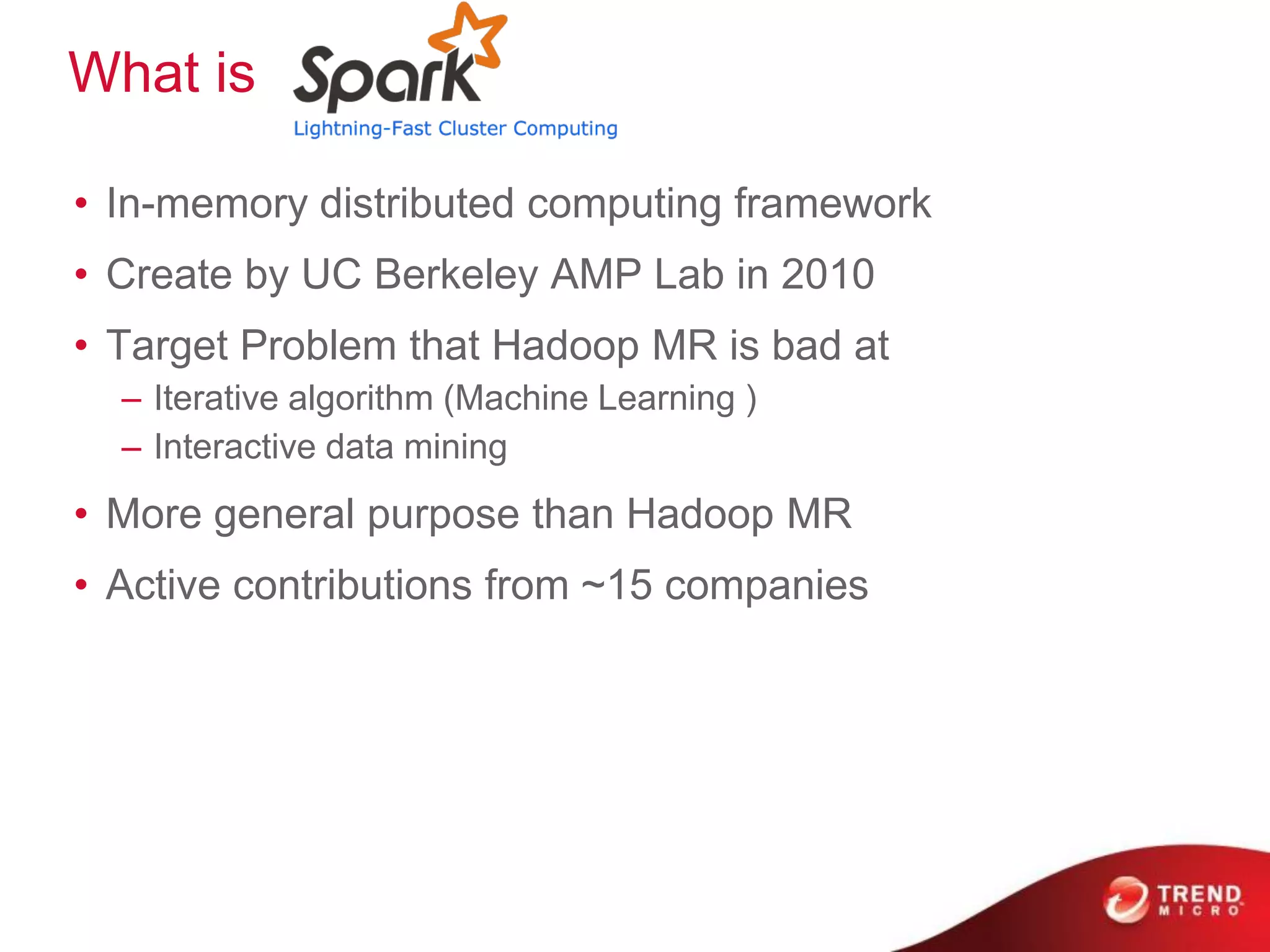
What is
• In-memory distributed computing framework
• Create by UC Berkeley AMP Lab in 2010
• Target Problem that Hadoop MR is bad at
– Iterative algorithm (Machine Learning )
– Interactive data mining
• More general purpose than Hadoop MR
• Active contributions from ~15 companies
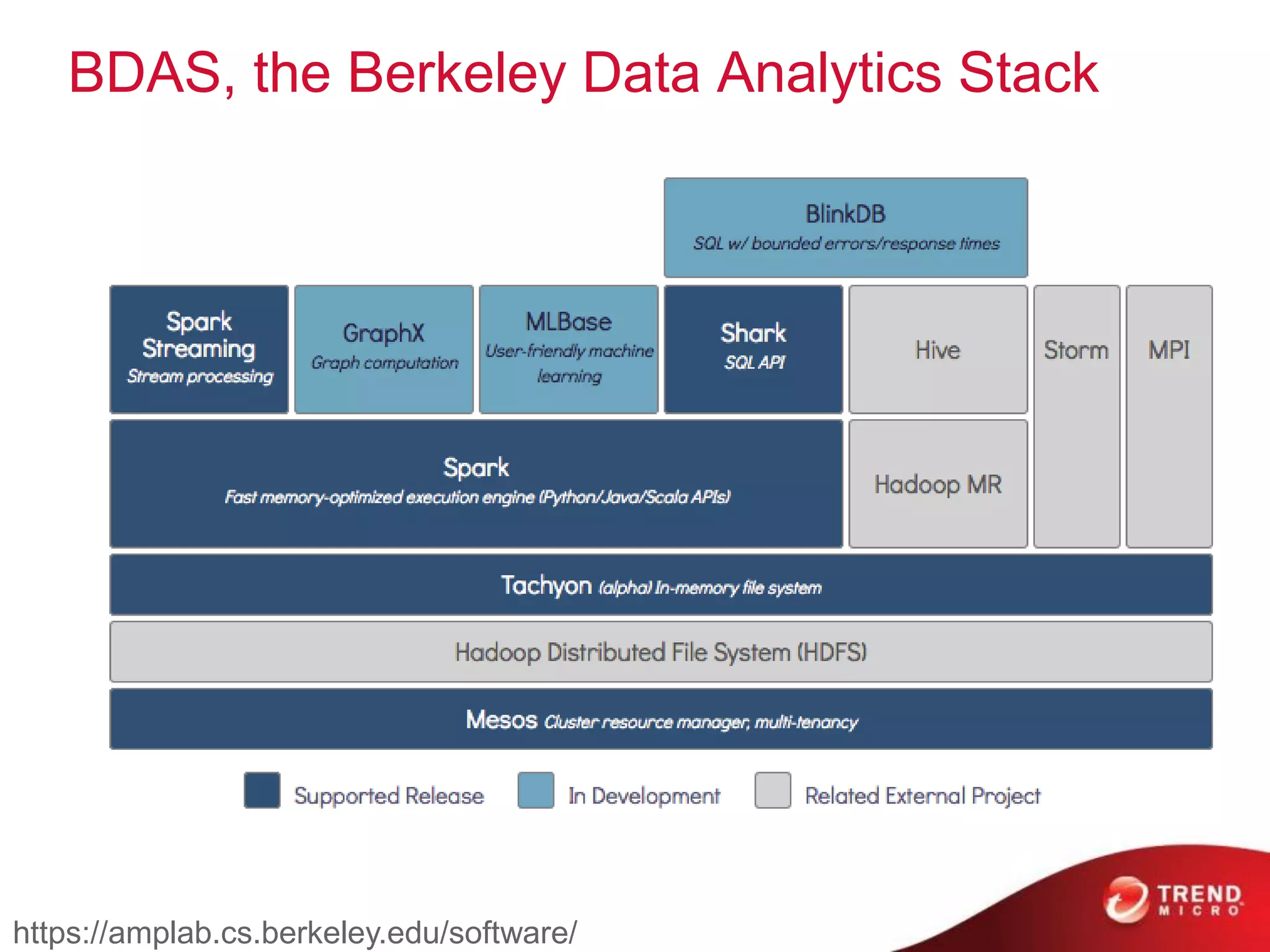
BDAS, the Berkeley Data Analytics Stack
https://amplab.cs.berkeley.edu/software/
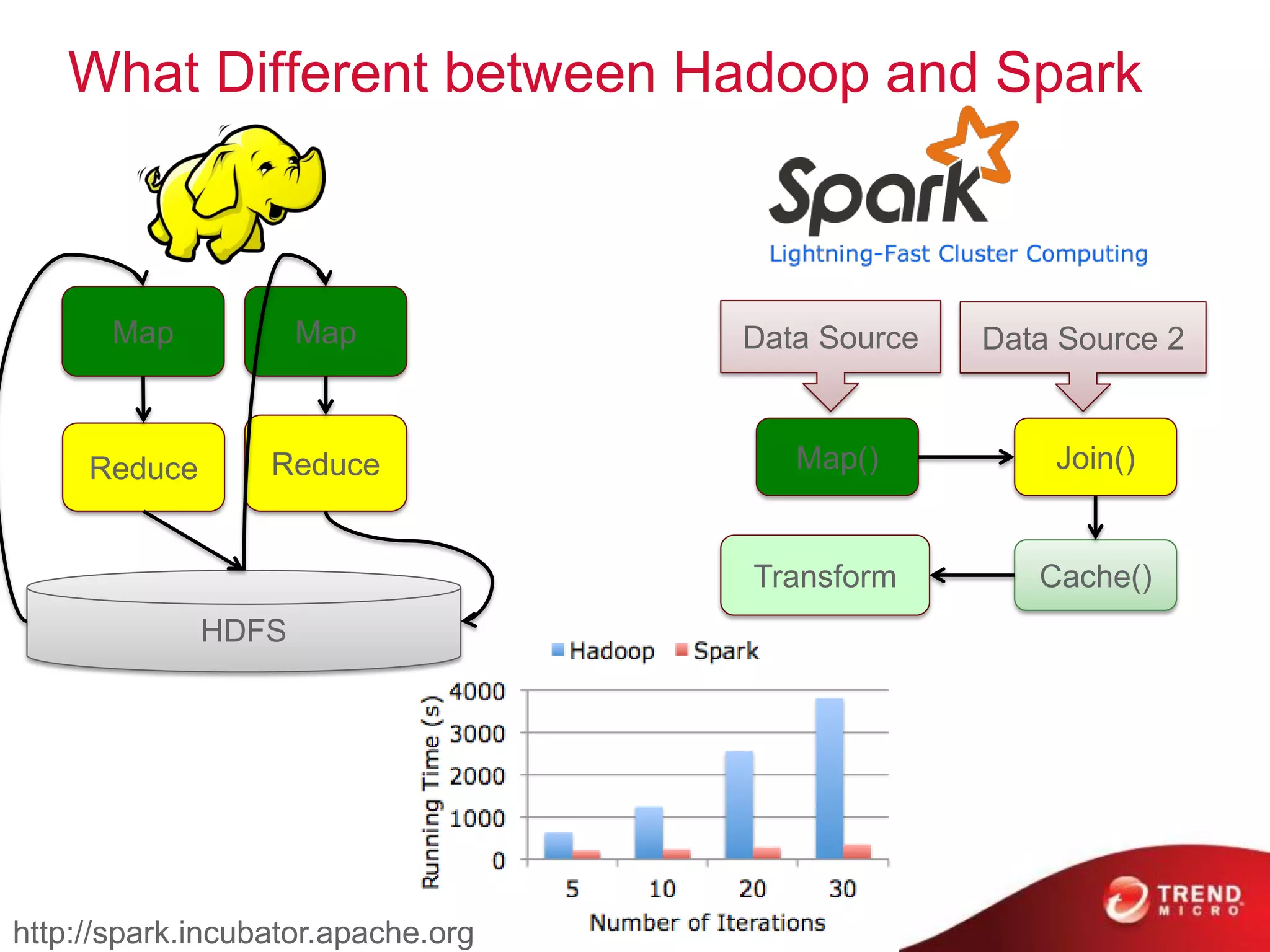
What Different between Hadoop and Spark
Data Source
Map()
Data Source 2
Join()
Cache()Transform
http://spark.incubator.apache.org
HDFS
Map
Reduce
Map
Reduce
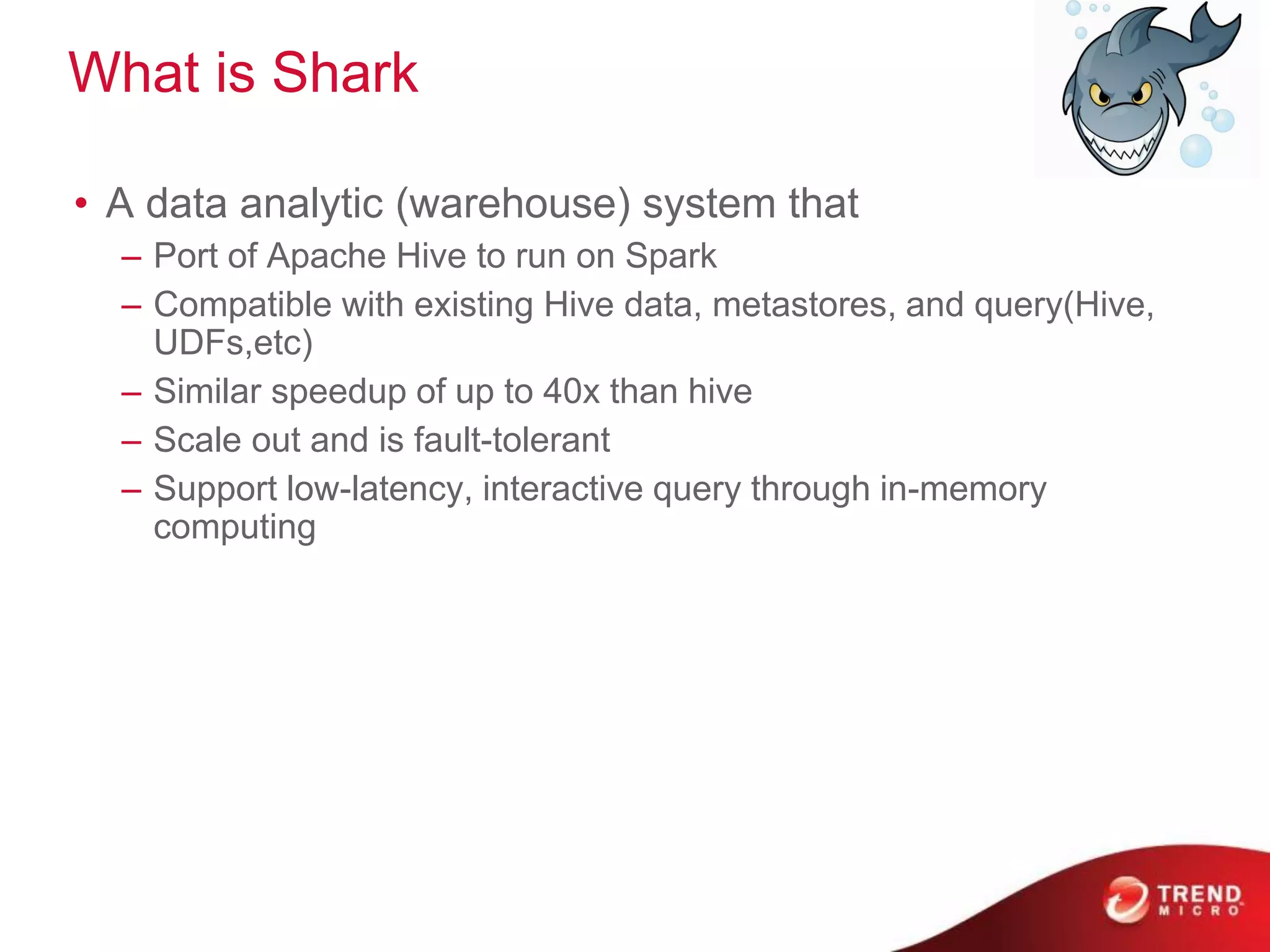
What is Shark
• A data analytic (warehouse) system that
– Port of Apache Hive to run on Spark
– Compatible with existing Hive data, metastores, and query(Hive,
UDFs,etc)
– Similar speedup of up to 40x than hive
– Scale out and is fault-tolerant
– Support low-latency, interactive query through in-memory
computing
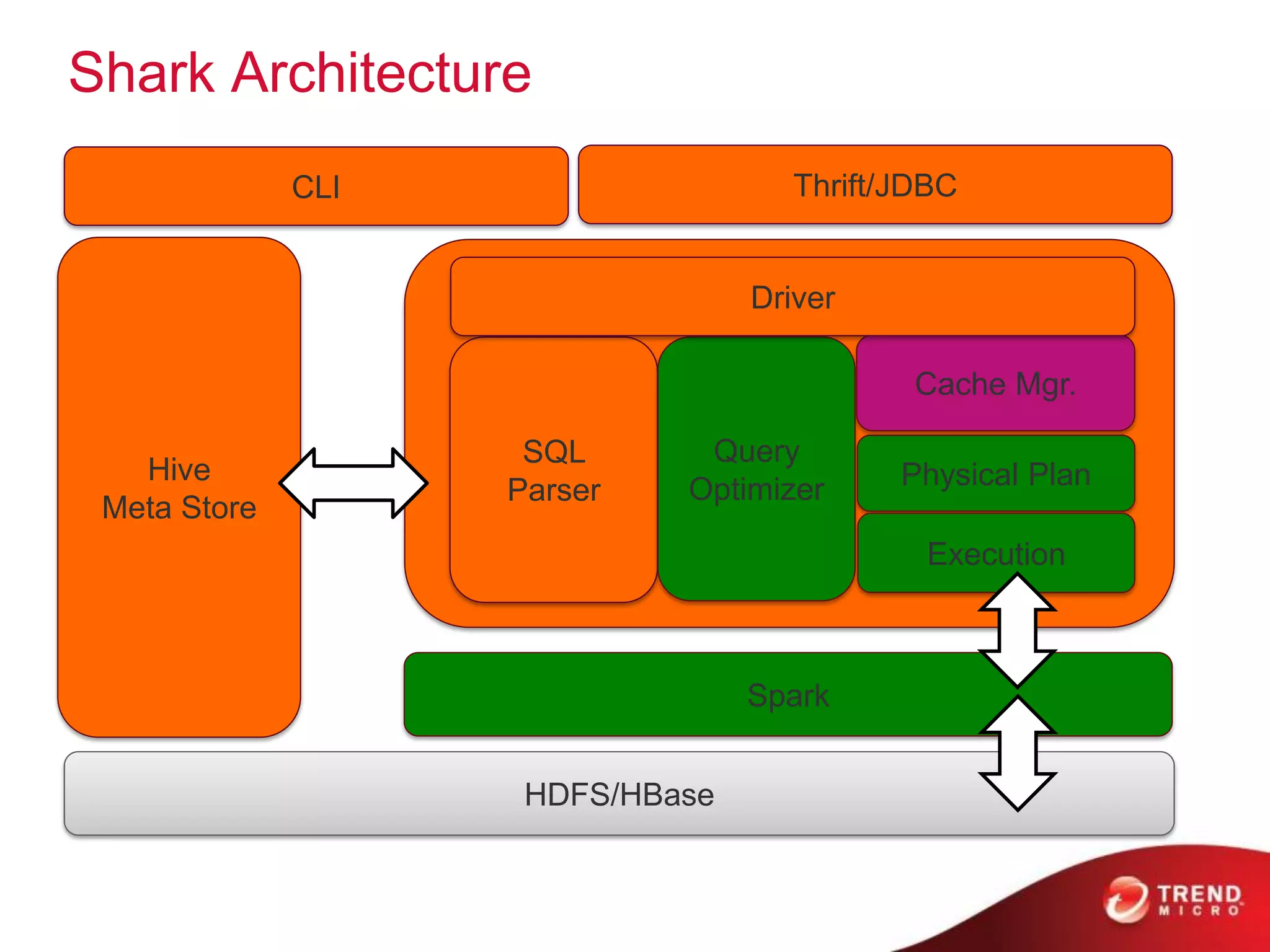
Shark Architecture
Hive
Meta Store
HDFS/HBase
Spark
SQL
Parser
Query
Optimizer Physical Plan
Execution
Cache Mgr.
CLI Thrift/JDBC
Driver
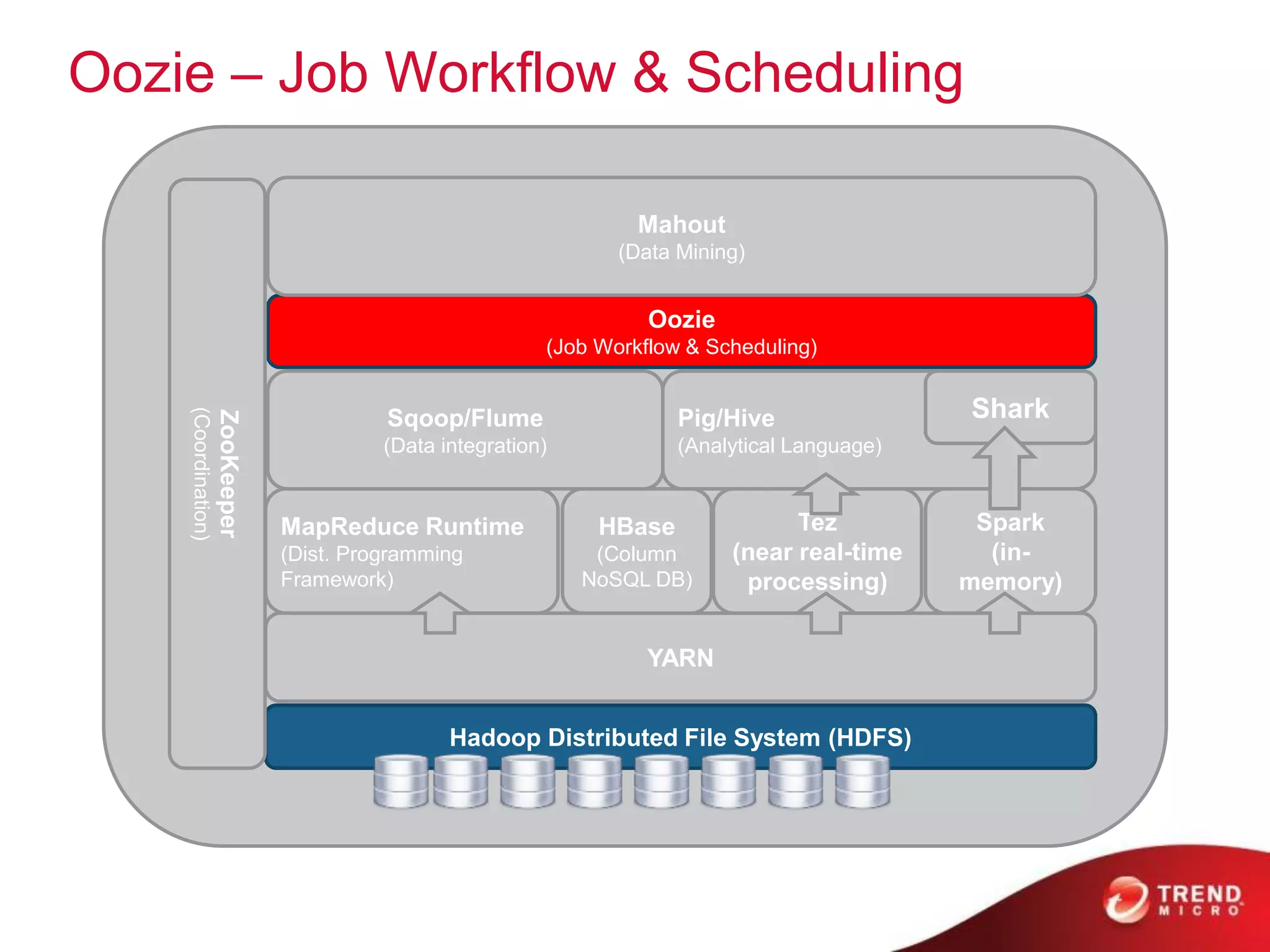
Oozie – Job Workflow & Scheduling
MapReduce Runtime
(Dist. Programming
Framework)
Hadoop Distributed File System (HDFS)
HBase
(Column
NoSQL DB)
Sqoop/Flume
(Data integration)
Oozie
(Job Workflow & Scheduling)
Pig/Hive
(Analytical Language)
Mahout
(Data Mining)
YARN
ZooKeeper
(Coordination)
Tez
(near real-time
processing)
Spark
(in-
memory)
Shark
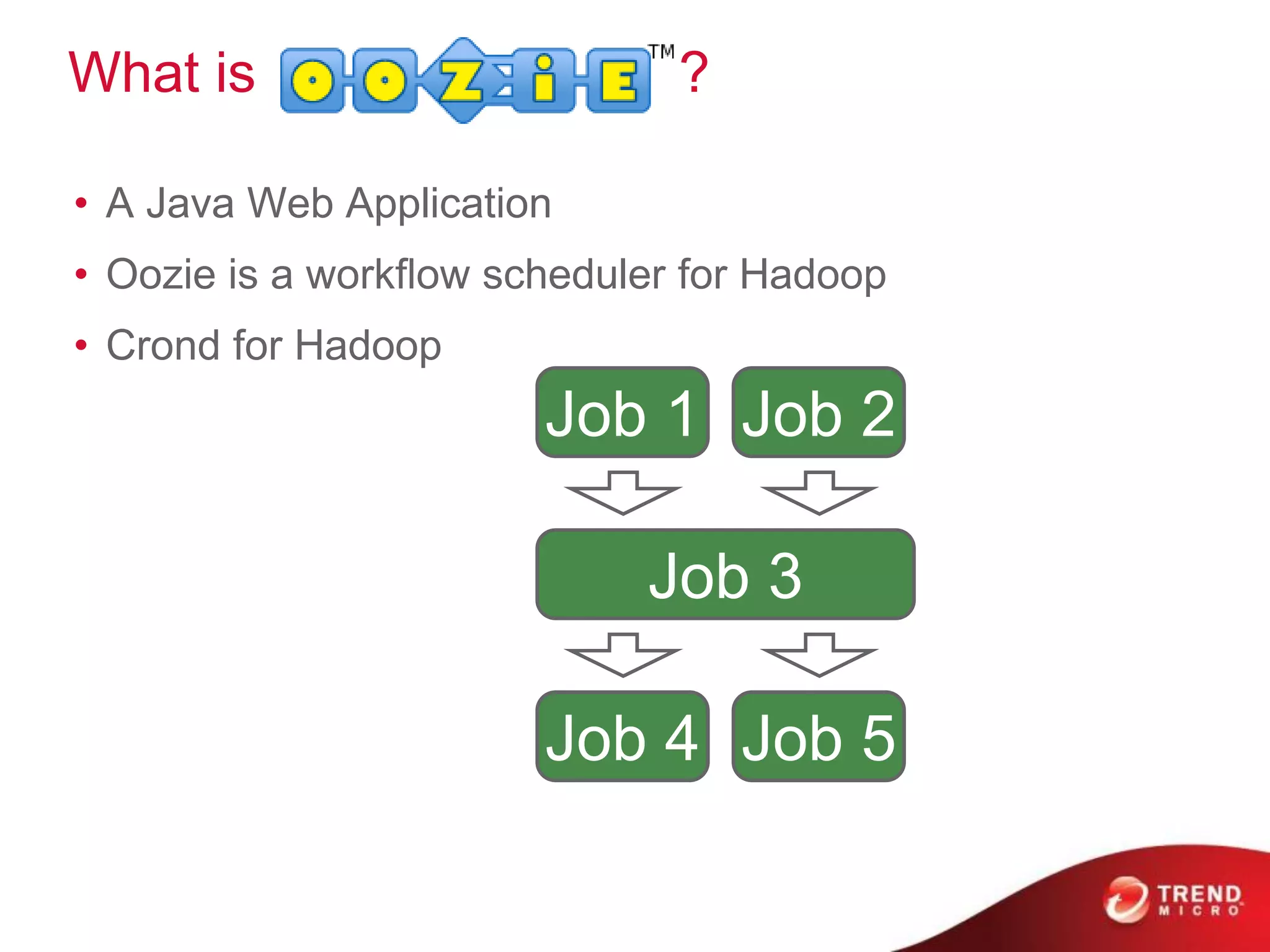
What is ?
• A Java Web Application
• Oozie is a workflow scheduler for Hadoop
• Crond for Hadoop
Job 1
Job 3
Job 2
Job 4 Job 5
Why
• Why use Oozie instead of just cascading a jobs one
after another
• Major flexibility
– Start, Stop, Suspend, and re-run jobs
• Oozie allows you to restart from a failure
– You can tell Oozie to restart a job from a specific node in the
graph or to skip specific failed nodes
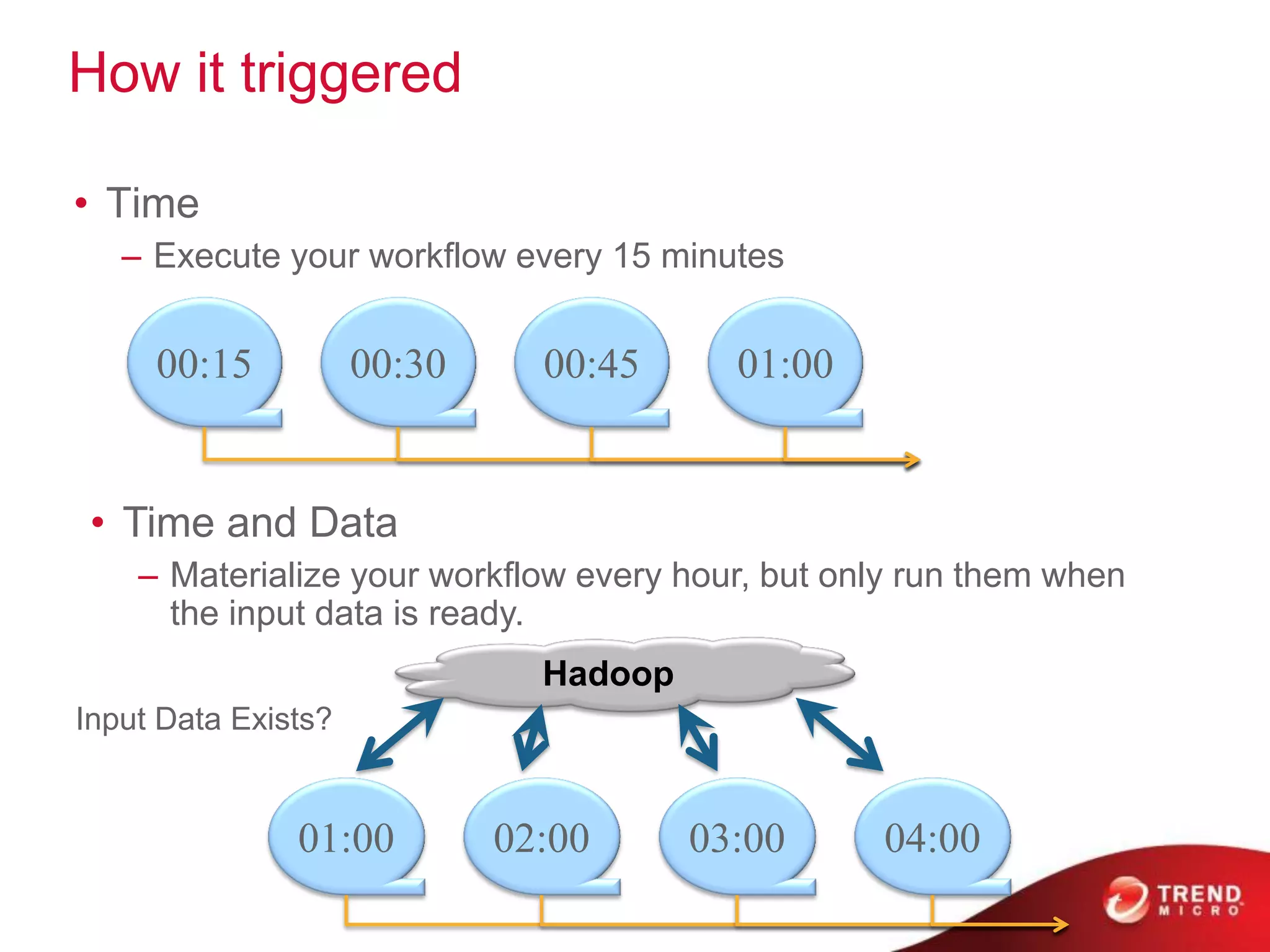
How it triggered
• Time
– Execute your workflow every 15 minutes
• Time and Data
– Materialize your workflow every hour, but only run them when
the input data is ready.
00:15 00:30 00:45 01:00
01:00 02:00 03:00 04:00
Hadoop
Input Data Exists?
Oozie use criteria
• Need Launch, control, and monitor jobs from your Java
Apps
– Java Client API/Command Line Interface
• Need control jobs from anywhere
– Web Service API
• Have jobs that you need to run every hour, day, week
• Need receive notification when a job done
– Email when a job is complete
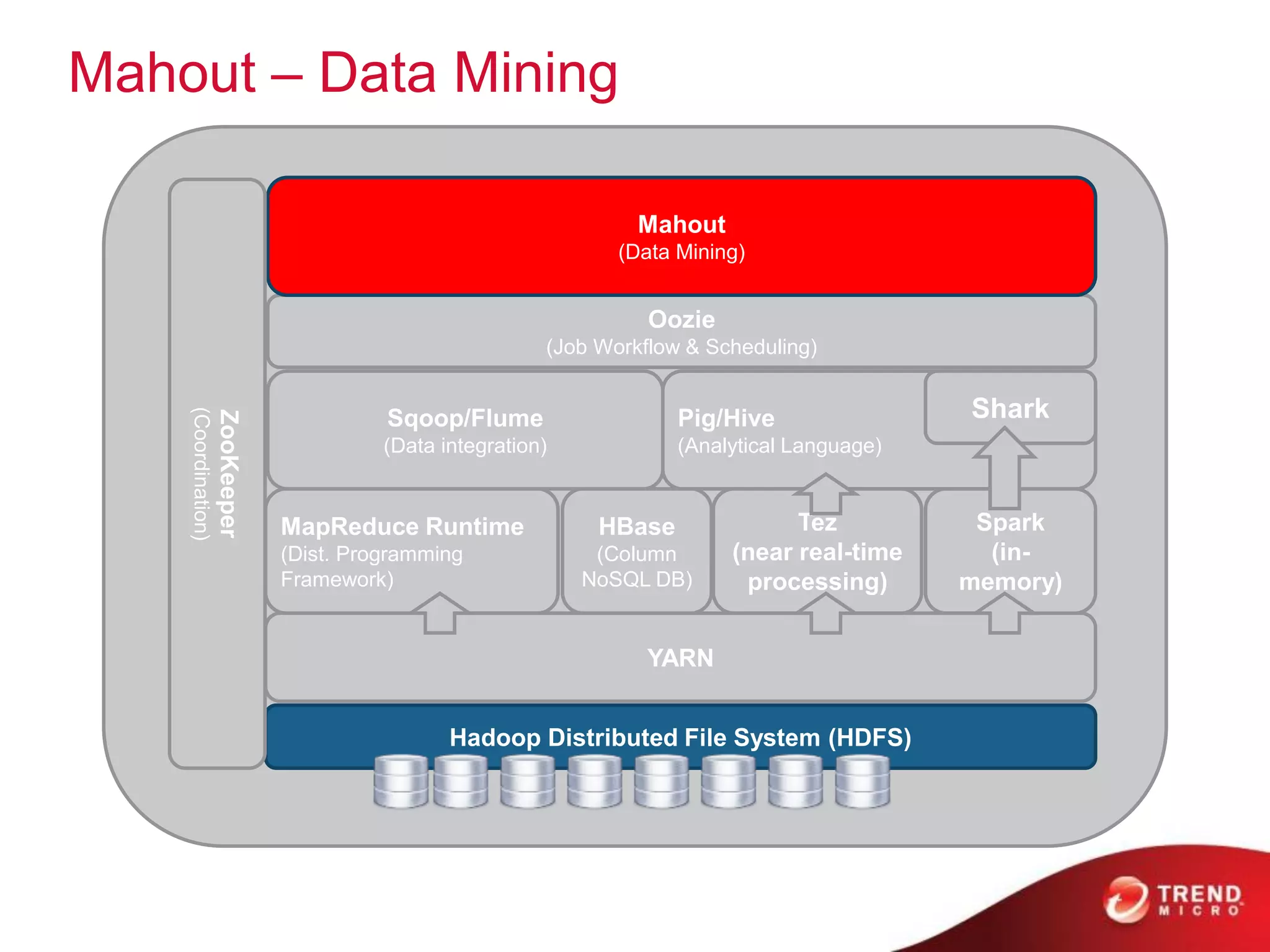
Mahout – Data Mining
MapReduce Runtime
(Dist. Programming
Framework)
Hadoop Distributed File System (HDFS)
HBase
(Column
NoSQL DB)
Sqoop/Flume
(Data integration)
Oozie
(Job Workflow & Scheduling)
Pig/Hive
(Analytical Language)
Mahout
(Data Mining)
YARN
ZooKeeper
(Coordination)
Tez
(near real-time
processing)
Spark
(in-
memory)
Shark
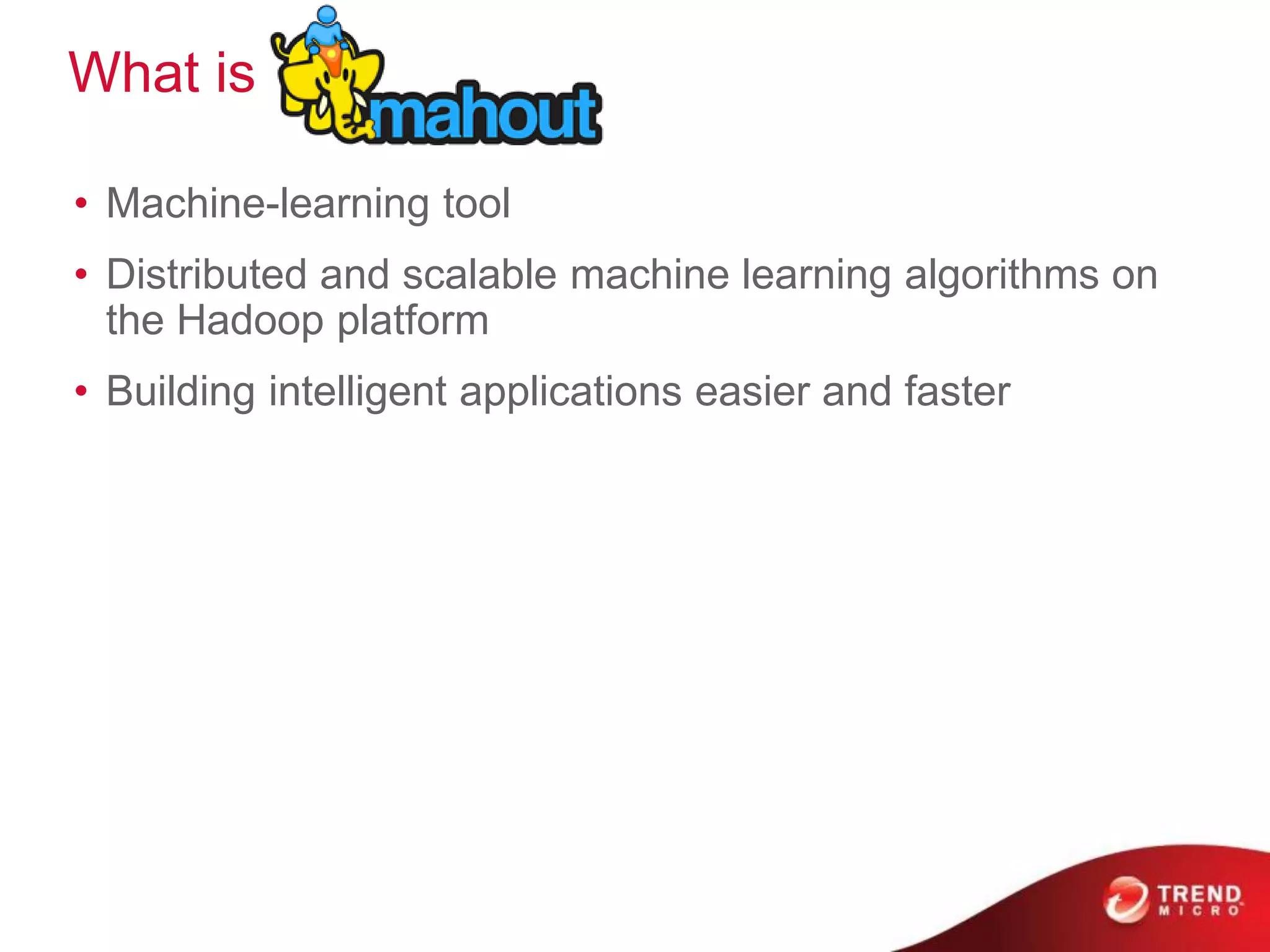
What is
• Machine-learning tool
• Distributed and scalable machine learning algorithms on
the Hadoop platform
• Building intelligent applications easier and faster
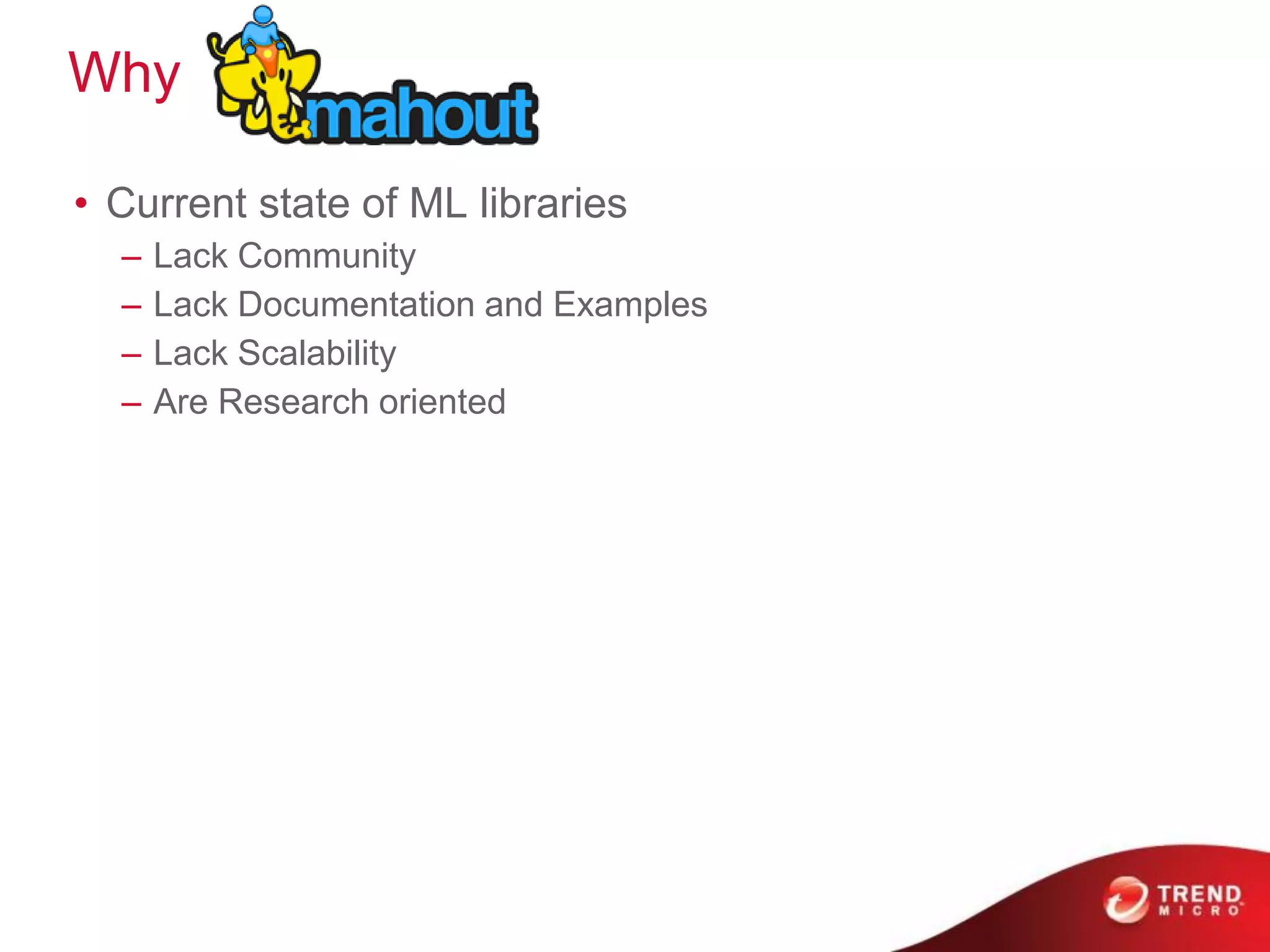
Why
• Current state of ML libraries
– Lack Community
– Lack Documentation and Examples
– Lack Scalability
– Are Research oriented
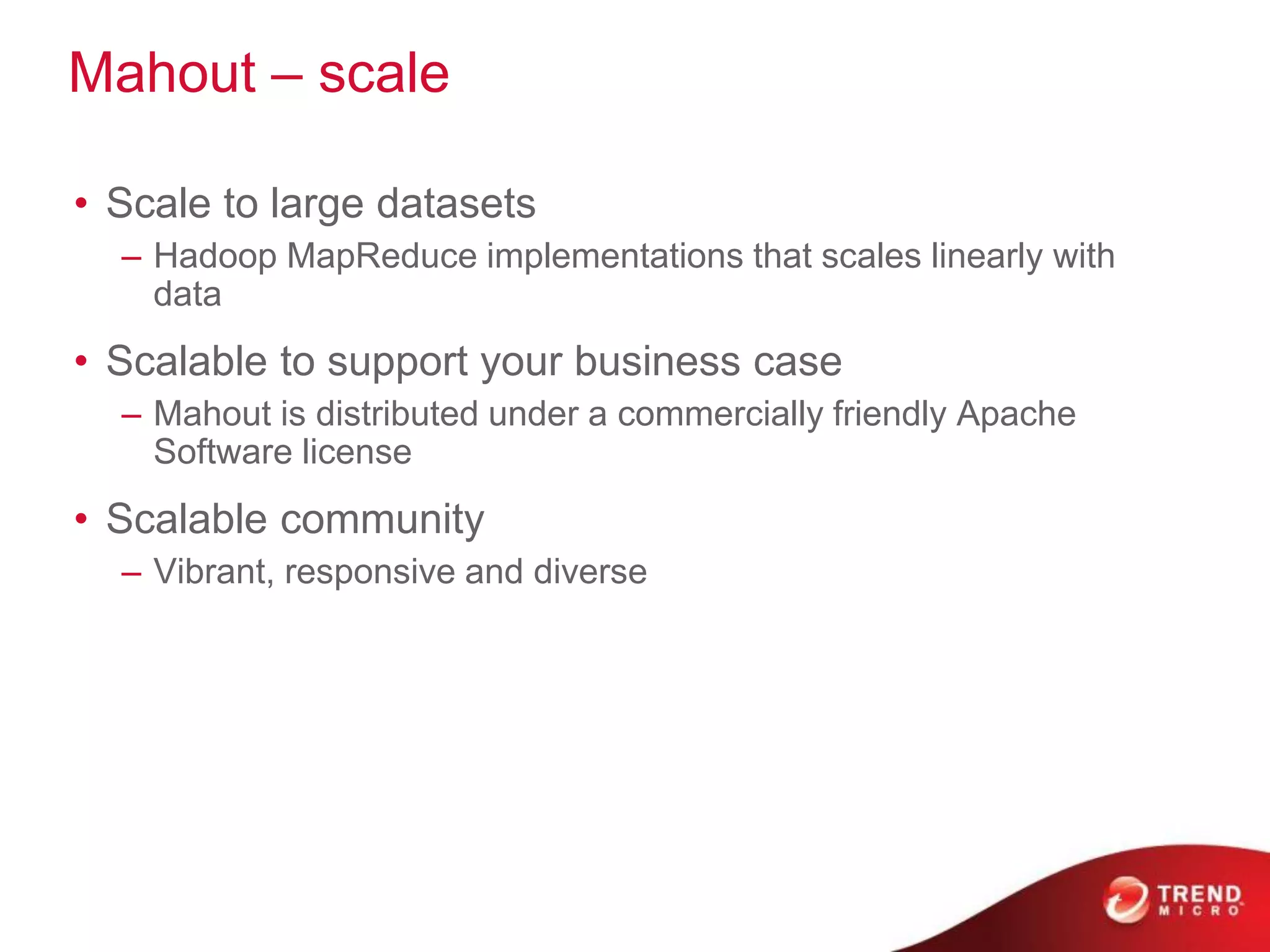
Mahout – scale
• Scale to large datasets
– Hadoop MapReduce implementations that scales linearly with
data
• Scalable to support your business case
– Mahout is distributed under a commercially friendly Apache
Software license
• Scalable community
– Vibrant, responsive and diverse
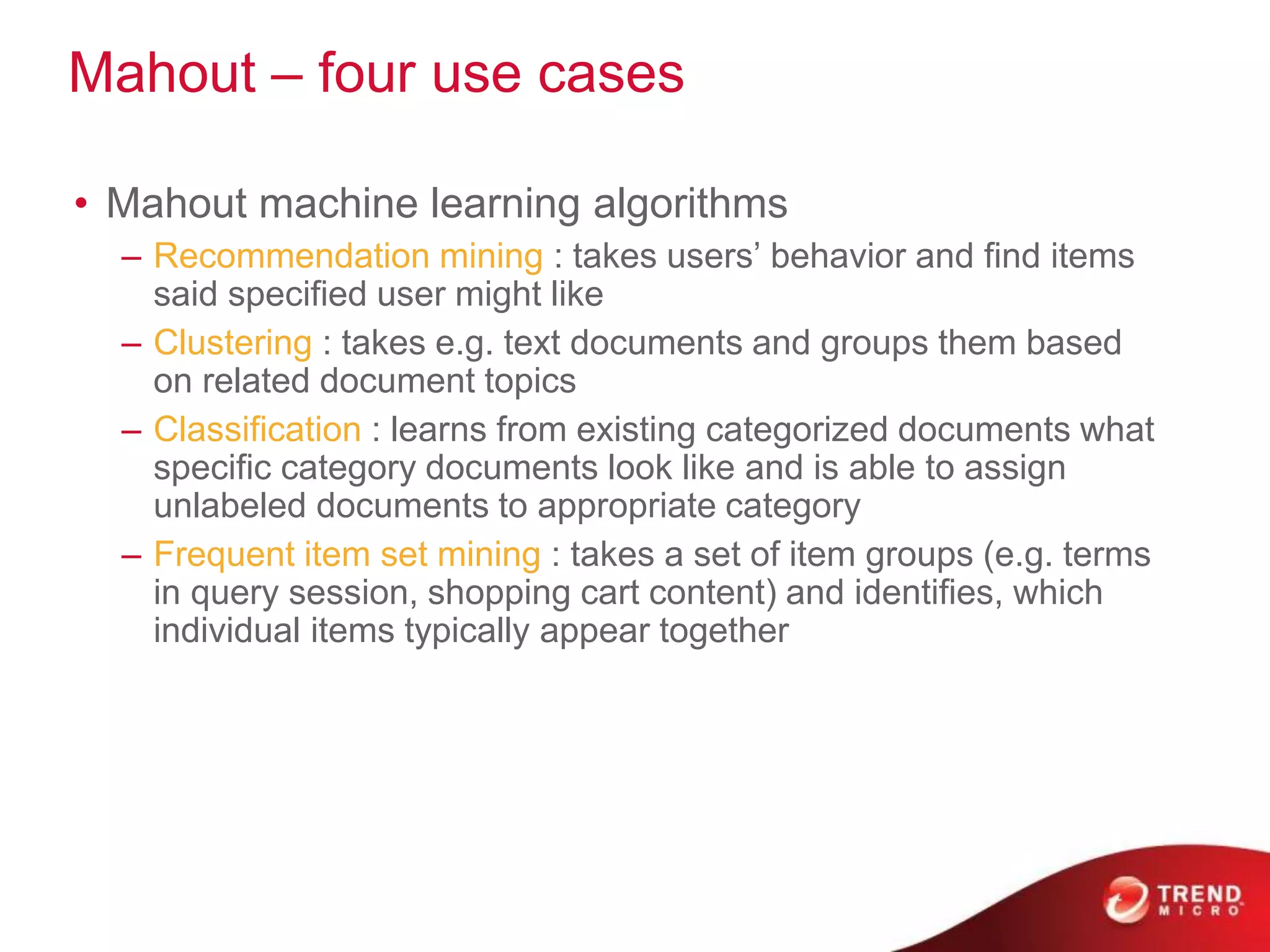
Mahout – four use cases
• Mahout machine learning algorithms
– Recommendation mining : takes users’ behavior and find items
said specified user might like
– Clustering : takes e.g. text documents and groups them based
on related document topics
– Classification : learns from existing categorized documents what
specific category documents look like and is able to assign
unlabeled documents to appropriate category
– Frequent item set mining : takes a set of item groups (e.g. terms
in query session, shopping cart content) and identifies, which
individual items typically appear together
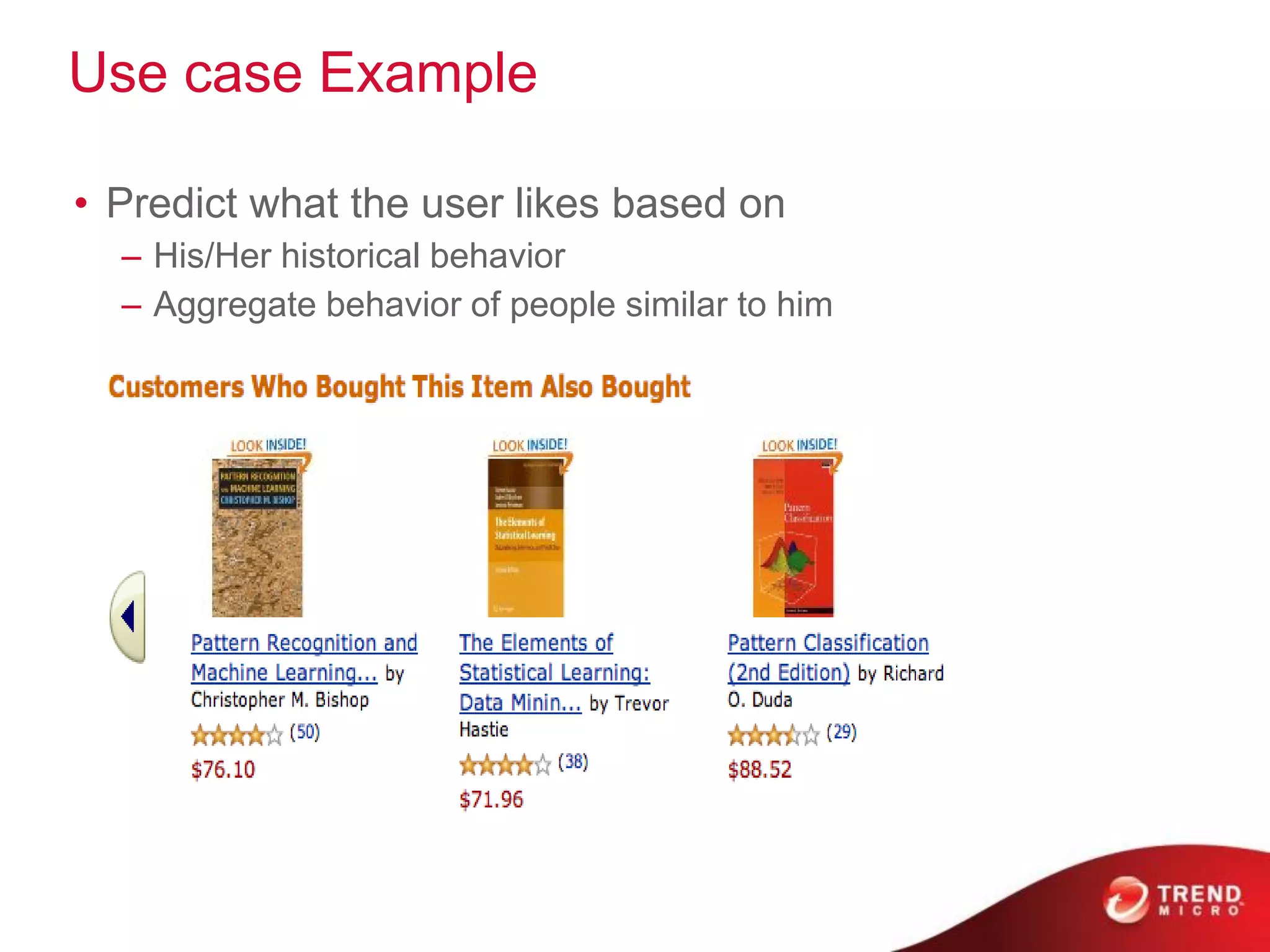
Use case Example
• Predict what the user likes based on
– His/Her historical behavior
– Aggregate behavior of people similar to him
Conclusion
• Big Data Opportunities
– The market still growing
• Hadoop 2.0
– Federation
– HA
– YARN
• What’s next for Hadoop
– Real-time query
– Data encryption
• What other projects are included in the Hadoop
ecosystem
– Different project for different purpose
– Choose right tools for your needs
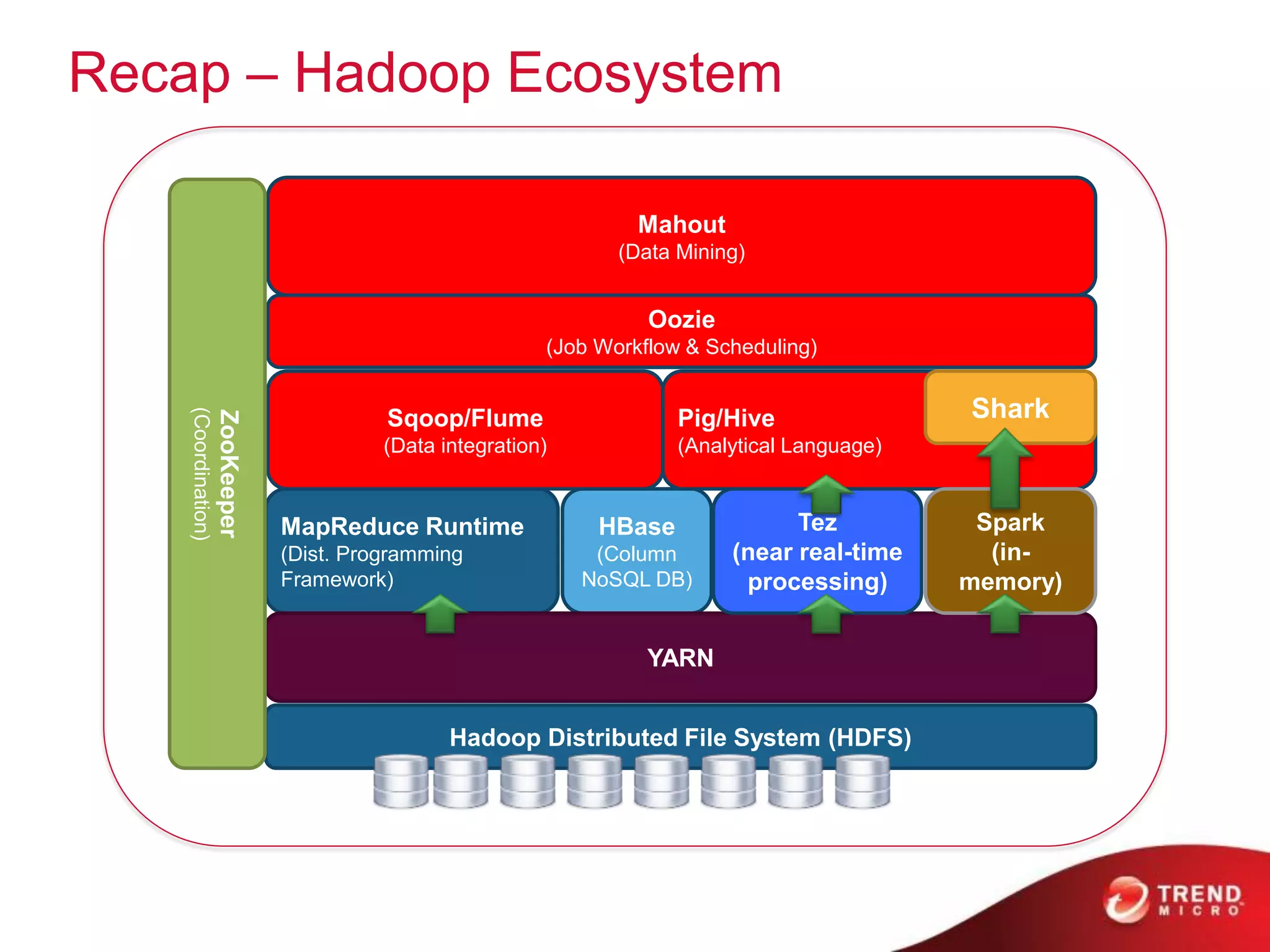
Recap – Hadoop Ecosystem
MapReduce Runtime
(Dist. Programming
Framework)
Hadoop Distributed File System (HDFS)
HBase
(Column
NoSQL DB)
Sqoop/Flume
(Data integration)
Oozie
(Job Workflow & Scheduling)
Pig/Hive
(Analytical Language)
Mahout
(Data Mining)
YARN
ZooKeeper
(Coordination)
Tez
(near real-time
processing)
Spark
(in-
memory)
Shark
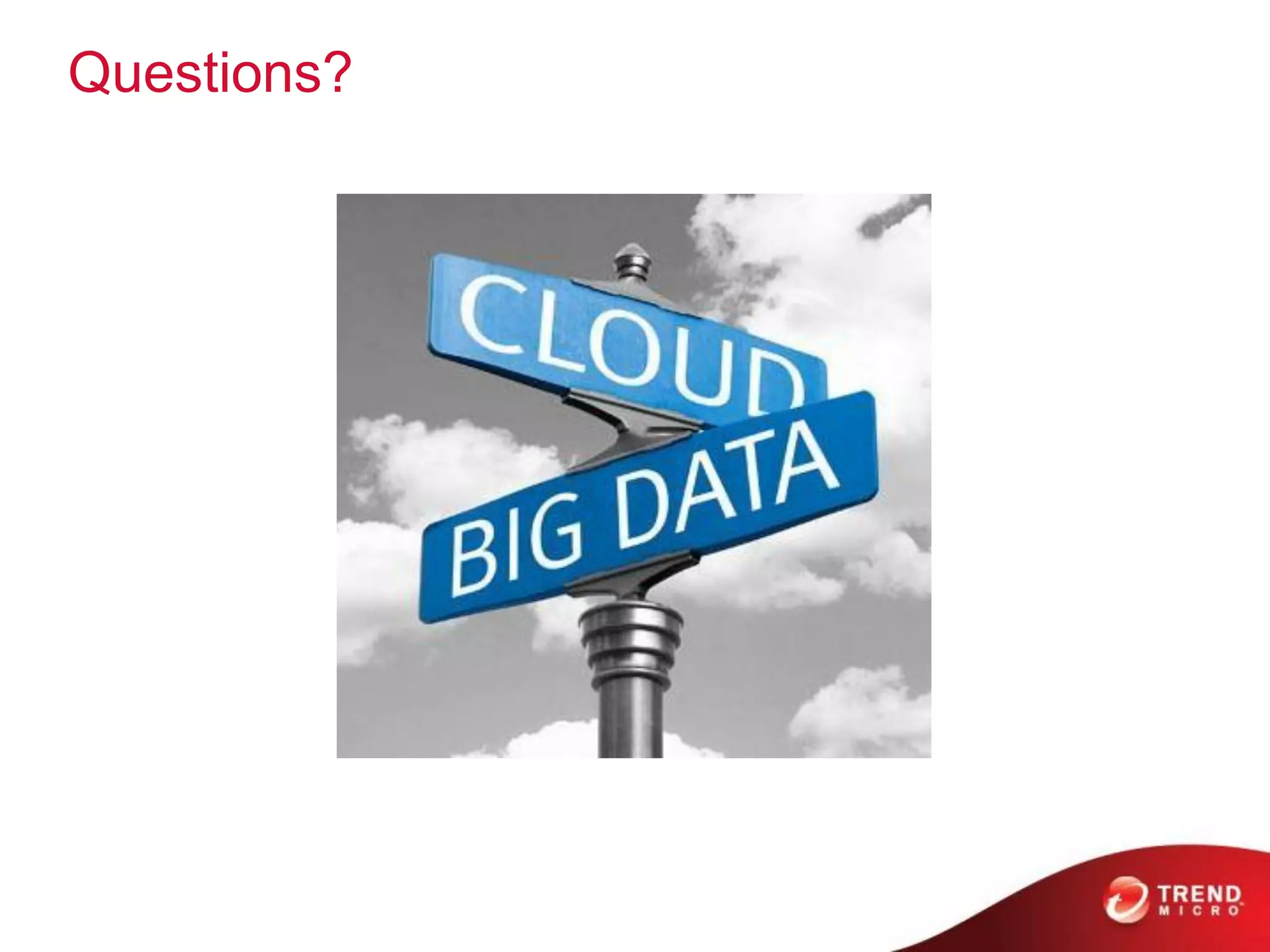
Questions?
Thank you!

Tcloud Computing Hadoop Family and Ecosystem Service 2013.Q3

  • 1.
    TCloud Computing, Inc. HadoopProduct Family and Ecosystem
  • 2.
    Agenda • What isBig Data? • Big Data Opportunities • Hadoop – Introduction to Hadoop – Hadoop 2.0 – What’s next for Hadoop? • Hadoop ecosystem • Conclusion
  • 3.
    What is BigData? A set of files A database A single file
  • 4.
    4 V’s ofBig Data http://www.datasciencecentral.com/profiles/blogs/data-veracity
  • 5.
    Big data Expandson 4 fronts Velocity Volume Variety Veracity MB GB TB PB batch periodic near Real-Time Real-Time http://whatis.techtarget.com/definition/3Vs
  • 6.
  • 7.
    Big Data Revenueby Market Segment 2012 • 1 http://wikibon.org/wiki/v/Big_Data_Vendor_Revenue_and_Market_Forecast_2012-2017
  • 8.
    Big Data MarketForecast 2012-2017 • 1 http://wikibon.org/wiki/v/Big_Data_Vendor_Revenue_and_Market_Forecast_2012-2017
  • 9.
    Hadoop Solutions The mostcommon problems Hadoop can solve
  • 10.
    Threat Analysis/Trade Surveillance •Challenge: – Detecting threats in the form of fraudulent activity or attacks • Large data volumes involved • Like looking for a needle in a haystack • Solution with Hadoop: – Parallel processing over huge datasets – Pattern recognition to identify anomalies • – i.e., threats • Typical Industry: – Security, Financial Services
  • 11.
    Recommendation Engine • Challenge: –Using user data to predict which products to recommend • Solution with Hadoop: – Batch processing framework • Allow execution in in parallel over large datasets – Collaborative filtering • Collecting ‘taste’ information from many users • Utilizing information to predict what similar users like • Typical Industry – ISP, Advertising
  • 12.
  • 13.
  • 14.
  • 15.
    • Apache Hadoopproject – inspired by Google's MapReduce and Google File System papers. • Open sourced, flexible and available architecture for large scale computation and data processing on a network of commodity hardware • Open Source Software + Hardware Commodity – IT Costs Reduction – inspired by
  • 16.
    Hadoop Concepts • Distributethe data as it is initially stored in the system • Moving Computation is Cheaper than Moving Data • Individual nodes can work on data local to those nodes • Users can focus on developing applications.
  • 17.
    Hadoop 2.0 • Hadoop2.2.0 is expected to GA in Fall 2013 • HDFS Federation • HDFS High Availability (HA) • Hadoop YARN (MapReduce 2.0)
  • 18.
    HDFS Federation -Limitation of Hadoop 1.0 • Scalability – Storage scales horizontally - namespace doesn’t • Performance – File system operations throughput limited by a single node • Poor isolation – All the tenants share a single namespace
  • 19.
    HDFS Federation • Multipleindependent NameNodes and Namespace Volumes in a cluster – Namespace Volume = Namespace + Block Pool • Block Storage as generic storage service – Set of blocks for a Namespace Volume is called a Block Pool – DNs store blocks for all the Namespace Volumes – no partitioning
  • 20.
    HDFS Federation Hadoop Hadoop2.0 http://hortonworks.com/blog/an-introduction-to-hdfs-federation/ /home//app/Hive /app/HBase
  • 21.
    HDFS High Availability(HA) • Secondary Name Node is not Name Node • http://www.youtube.com/watch?v=hEqQMLSXQlY
  • 22.
    HDFS High Availability(HA) https://issues.apache.org/jira/browse/HDFS-1623
  • 23.
    Why do weneed YARN • Scalability – Maximum Cluster size – 4,000 nodes – Maximum concurrent tasks – 40,000 • Single point of failure – Failure kills all queued and running jobs • Lacks support for alternate paradigms – Iterative applications implemented using MapReduce are 10x slower – Example: K-Means, PageRank
  • 24.
  • 25.
    Role of YARN •Resource Manager – Per-cluster – Global resource scheduler – Hierarchical queues • Node Manager – Per-machine agent – Manages the life-cycle of container – Container resource monitoring • Application Master – Per-application – Manages application scheduling and task execution – E.g. MapReduce Application Master Job Tracker Resource Manager Application Master
  • 26.
    Hadoop YARN architectural http://hortonworks.com/blog/apache-hadoop-yarn-background-and-an-overview/ •Container – Basic unit of allocation – Ex. Container A = 2GB, 1CPU – Fine-grained resource allocation – Replace the fixed map/reduce slots
  • 27.
    What’s next forHadoop? • Real-time – Apache Tez • Part of Stinger – Spark • SQL in Hadoop – Stinger • An immediate aim of 100x performance increase for Hive is more ambitious than any other effort. • Based on industry standard SQL, the Stinger Initiative improves HiveQL to deliver SQL compatibility. – Shark
  • 28.
    What’s next forHadoop? • Security: Data encryption – hadoop-9331: Hadoop crypto codec framework and crypto codec implementations • hadoop-9332: Crypto codec implementations for AES • hadoop-9333: Hadoop crypto codec framework based on compression codec • mapreduce-5025: Key Distribution and Management for supporting crypto codec in Map Reduce • 2013/09/28 Hadoop in Taiwan 2013 – Hadoop Security: Now and future – Session B, 16:00~16:40
  • 29.
  • 30.
    Growing Hadoop Ecosystem •The term ‘Hadoop’ is taken to be the combination of HDFS and MapReduce • There are numerous other projects surrounding Hadoop – Typically referred to as the ‘Hadoop Ecosystem’ • Zookeeper • Hive and Pig • HBase • Flume • Other Ecosystem Projects – Sqoop – Oozie – Mahout
  • 31.
    The Ecosystem isthe System • Hadoop has become the kernel of the distributed operating system for Big Data • No one uses the kernel alone • A collection of projects at Apache
  • 32.
    Relation Map MapReduce Runtime (Dist.Programming Framework) Hadoop Distributed File System (HDFS) HBase (Column NoSQL DB) Sqoop/Flume (Data integration) Oozie (Job Workflow & Scheduling) Pig/Hive (Analytical Language) Mahout (Data Mining) YARN ZooKeeper (Coordination) Tez (near real-time processing) Spark (in- memory) Shark
  • 33.
    ZooKeeper – CoordinationFramework MapReduce Runtime (Dist. Programming Framework) Hadoop Distributed File System (HDFS) HBase (Column NoSQL DB) Sqoop/Flume (Data integration) Oozie (Job Workflow & Scheduling) Pig/Hive (Analytical Language) Mahout (Data Mining) YARN ZooKeeper (Coordination) Tez (near real-time processing) Spark (in- memory) Shark
  • 34.
    What is ZooKeeper •A centralized service for maintaining – Configuration information – Providing distributed synchronization • A set of tools to build distributed applications that can safely handle partial failures • ZooKeeper was designed to store coordination data – Status information – Configuration – Location information
  • 35.
    Why use ZooKeeper? •Manage configuration across nodes • Implement reliable messaging • Implement redundant services • Synchronize process execution
  • 36.
    ZooKeeper Architecture – Allservers store a copy of the data (in memory) – A leader is elected at startup – 2 roles – leader and follower • Followers service clients, all updates go through leader • Update responses are sent when a majority of servers have persisted the change – HA support
  • 37.
    HBase – ColumnNoSQL DB MapReduce Runtime (Dist. Programming Framework) Hadoop Distributed File System (HDFS) HBase (Column NoSQL DB) Sqoop/Flume (Data integration) Oozie (Job Workflow & Scheduling) Pig/Hive (Analytical Language) Mahout (Data Mining) YARN ZooKeeper (Coordination) Tez (near real-time processing) Spark (in- memory) Shark
  • 38.
  • 39.
    I – Inspiredby • Apache open source project • Inspired from Google Big Table • Non-relational, distributed database written in Java • Coordinated by Zookeeper
  • 40.
    Row & ColumnOriented
  • 41.
    HBase – DataModel • Cells are “versioned” • Table rows are sorted by row key • Region – a row range [start-key:end-key]
  • 42.
    When to useHBase • Need random, low latency access to the data • Application has a flexible schema where each row is slightly different – Add columns on the fly • Most of columns are NULL in each row
  • 43.
    Flume / Sqoop– Data Integration Framework MapReduce Runtime (Dist. Programming Framework) Hadoop Distributed File System (HDFS) HBase (Column NoSQL DB) Sqoop/Flume (Data integration) Oozie (Job Workflow & Scheduling) Pig/Hive (Analytical Language) Mahout (Data Mining) YARN ZooKeeper (Coordination) Tez (near real-time processing) Spark (in- memory) Shark
  • 44.
    What’s the problemfor data collection • Data collection is currently a priori and ad hoc • A priori – decide what you want to collect ahead of time • Ad hoc – each kind of data source goes through its own collection path
  • 45.
    (and how canit help?) • A distributed data collection service • It efficiently collecting, aggregating, and moving large amounts of data • Fault tolerant, many failover and recovery mechanism • One-stop solution for data collection of all formats
  • 46.
  • 47.
    Sqoop • Easy, paralleldatabase import/export • What you want do? – Insert data from RDBMS to HDFS – Export data from HDFS back into RDBMS
  • 48.
    What is Sqoop •A suite of tools that connect Hadoop and database systems • Import tables from databases into HDFS for deep analysis • Export MapReduce results back to a database for presentation to end-users • Provides the ability to import from SQL databases straight into your Hive data warehouse
  • 49.
    How Sqoop helps •The Problem – Structured data in traditional databases cannot be easily combined with complex data stored in HDFS • Sqoop (SQL-to-Hadoop) – Easy import of data from many databases to HDFS – Generate code for use in MapReduce applications
  • 50.
    Why Sqoop • JDBC-basedimplementation – Works with many popular database vendors • Auto-generation of tedious user-side code – Write MapReduce applications to work with your data, faster • Integration with Hive – Allows you to stay in a SQL-based environment
  • 51.
    Pig / Hive– Analytical Language MapReduce Runtime (Dist. Programming Framework) Hadoop Distributed File System (HDFS) HBase (Column NoSQL DB) Sqoop/Flume (Data integration) Oozie (Job Workflow & Scheduling) Pig/Hive (Analytical Language) Mahout (Data Mining) YARN ZooKeeper (Coordination) Tez (near real-time processing) Spark (in- memory) Shark
  • 52.
    Why Hive andPig? • Although MapReduce is very powerful, it can also be complex to master • Many organizations have business or data analysts who are skilled at writing SQL queries, but not at writing Java code • Many organizations have programmers who are skilled at writing code in scripting languages • Hive and Pig are two projects which evolved separately to help such people analyze huge amounts of data via MapReduce – Hive was initially developed at Facebook, Pig at Yahoo!
  • 53.
    Hive – Developedby • What is Hive? – An SQL-like interface to Hadoop • Data Warehouse infrastructure that provides data summarization and ad hoc querying on top of Hadoop – MapRuduce for execution – HDFS for storage • Hive Query Language – Basic-SQL : Select, From, Join, Group-By – Equi-Join, Muti-Table Insert, Multi-Group-By – Batch query SELECT * FROM purchases WHERE price > 100 GROUP BY storeid
  • 54.
  • 55.
    Pig • A high-levelscripting language (Pig Latin) • Process data one step at a time • Simple to write MapReduce program • Easy understand • Easy debug A = load ‘a.txt’ as (id, name, age, ...) B = load ‘b.txt’ as (id, address, ...) C = JOIN A BY id, B BY id;STORE C into ‘c.txt’ – Initiated by
  • 56.
    Hive vs. Pig HivePig Language HiveQL (SQL-like) Pig Latin, a scripting language Schema Table definitions that are stored in a metastore A schema is optionally defined at runtime Programmait Access JDBC, ODBC PigServer
  • 57.
    • Input • Forthe given sample input the map emits • the reduce just sums up the values Hello World Bye World Hello Hadoop Goodbye Hadoop < Hello, 1> < World, 1> < Bye, 1> < World, 1> < Hello, 1> < Hadoop, 1> < Goodbye, 1> < Hadoop, 1> < Bye, 1> < Goodbye, 1> < Hadoop, 2> < Hello, 2> < World, 2> WordCount Example
  • 58.
    WordCount Example InMapReduce public class WordCount { public static class Map extends Mapper<LongWritable, Text, Text, IntWritable> { private final static IntWritable one = new IntWritable(1); private Text word = new Text(); public void map(LongWritable key, Text value, Context context) throws IOException, InterruptedException { String line = value.toString(); StringTokenizer tokenizer = new StringTokenizer(line); while (tokenizer.hasMoreTokens()) { word.set(tokenizer.nextToken()); context.write(word, one); } } } public static class Reduce extends Reducer<Text, IntWritable, Text, IntWritable> { public void reduce(Text key, Iterable<IntWritable> values, Context context) throws IOException, InterruptedException { int sum = 0; for (IntWritable val : values) { sum += val.get(); } context.write(key, new IntWritable(sum)); } } public static void main(String[] args) throws Exception { Configuration conf = new Configuration(); Job job = new Job(conf, "wordcount"); job.setOutputKeyClass(Text.class); job.setOutputValueClass(IntWritable.class); job.setMapperClass(Map.class); job.setReducerClass(Reduce.class); job.setInputFormatClass(TextInputFormat.class); job.setOutputFormatClass(TextOutputFormat.class); FileInputFormat.addInputPath(job, new Path(args[0])); FileOutputFormat.setOutputPath(job, new Path(args[1])); job.waitForCompletion(true); }
  • 59.
    WordCount Example ByPig A = LOAD 'wordcount/input' USING PigStorage as (token:chararray); B = GROUP A BY token; C = FOREACH B GENERATE group, COUNT(A) as count; DUMP C;
  • 60.
    WordCount Example ByHive CREATE TABLE wordcount (token STRING); LOAD DATA LOCAL INPATH ’wordcount/input' OVERWRITE INTO TABLE wordcount; SELECT count(*) FROM wordcount GROUP BY token;
  • 61.
    Spark / Shark- Analytical Language MapReduce Runtime (Dist. Programming Framework) Hadoop Distributed File System (HDFS) HBase (Column NoSQL DB) Sqoop/Flume (Data integration) Oozie (Job Workflow & Scheduling) Pig/Hive (Analytical Language) Mahout (Data Mining) YARN ZooKeeper (Coordination) Tez (near real-time processing) Spark (in- memory) Shark
  • 62.
    Why • MapReduce istoo slow • Aims to make data analytics fast — both fast to run and fast to write. • When you have the request: iterative algorithms
  • 63.
    What is • In-memorydistributed computing framework • Create by UC Berkeley AMP Lab in 2010 • Target Problem that Hadoop MR is bad at – Iterative algorithm (Machine Learning ) – Interactive data mining • More general purpose than Hadoop MR • Active contributions from ~15 companies
  • 64.
    BDAS, the BerkeleyData Analytics Stack https://amplab.cs.berkeley.edu/software/
  • 65.
    What Different betweenHadoop and Spark Data Source Map() Data Source 2 Join() Cache()Transform http://spark.incubator.apache.org HDFS Map Reduce Map Reduce
  • 66.
    What is Shark •A data analytic (warehouse) system that – Port of Apache Hive to run on Spark – Compatible with existing Hive data, metastores, and query(Hive, UDFs,etc) – Similar speedup of up to 40x than hive – Scale out and is fault-tolerant – Support low-latency, interactive query through in-memory computing
  • 67.
    Shark Architecture Hive Meta Store HDFS/HBase Spark SQL Parser Query OptimizerPhysical Plan Execution Cache Mgr. CLI Thrift/JDBC Driver
  • 68.
    Oozie – JobWorkflow & Scheduling MapReduce Runtime (Dist. Programming Framework) Hadoop Distributed File System (HDFS) HBase (Column NoSQL DB) Sqoop/Flume (Data integration) Oozie (Job Workflow & Scheduling) Pig/Hive (Analytical Language) Mahout (Data Mining) YARN ZooKeeper (Coordination) Tez (near real-time processing) Spark (in- memory) Shark
  • 69.
    What is ? •A Java Web Application • Oozie is a workflow scheduler for Hadoop • Crond for Hadoop Job 1 Job 3 Job 2 Job 4 Job 5
  • 70.
    Why • Why useOozie instead of just cascading a jobs one after another • Major flexibility – Start, Stop, Suspend, and re-run jobs • Oozie allows you to restart from a failure – You can tell Oozie to restart a job from a specific node in the graph or to skip specific failed nodes
  • 71.
    How it triggered •Time – Execute your workflow every 15 minutes • Time and Data – Materialize your workflow every hour, but only run them when the input data is ready. 00:15 00:30 00:45 01:00 01:00 02:00 03:00 04:00 Hadoop Input Data Exists?
  • 72.
    Oozie use criteria •Need Launch, control, and monitor jobs from your Java Apps – Java Client API/Command Line Interface • Need control jobs from anywhere – Web Service API • Have jobs that you need to run every hour, day, week • Need receive notification when a job done – Email when a job is complete
  • 73.
    Mahout – DataMining MapReduce Runtime (Dist. Programming Framework) Hadoop Distributed File System (HDFS) HBase (Column NoSQL DB) Sqoop/Flume (Data integration) Oozie (Job Workflow & Scheduling) Pig/Hive (Analytical Language) Mahout (Data Mining) YARN ZooKeeper (Coordination) Tez (near real-time processing) Spark (in- memory) Shark
  • 74.
    What is • Machine-learningtool • Distributed and scalable machine learning algorithms on the Hadoop platform • Building intelligent applications easier and faster
  • 75.
    Why • Current stateof ML libraries – Lack Community – Lack Documentation and Examples – Lack Scalability – Are Research oriented
  • 76.
    Mahout – scale •Scale to large datasets – Hadoop MapReduce implementations that scales linearly with data • Scalable to support your business case – Mahout is distributed under a commercially friendly Apache Software license • Scalable community – Vibrant, responsive and diverse
  • 77.
    Mahout – fouruse cases • Mahout machine learning algorithms – Recommendation mining : takes users’ behavior and find items said specified user might like – Clustering : takes e.g. text documents and groups them based on related document topics – Classification : learns from existing categorized documents what specific category documents look like and is able to assign unlabeled documents to appropriate category – Frequent item set mining : takes a set of item groups (e.g. terms in query session, shopping cart content) and identifies, which individual items typically appear together
  • 78.
    Use case Example •Predict what the user likes based on – His/Her historical behavior – Aggregate behavior of people similar to him
  • 79.
    Conclusion • Big DataOpportunities – The market still growing • Hadoop 2.0 – Federation – HA – YARN • What’s next for Hadoop – Real-time query – Data encryption • What other projects are included in the Hadoop ecosystem – Different project for different purpose – Choose right tools for your needs
  • 80.
    Recap – HadoopEcosystem MapReduce Runtime (Dist. Programming Framework) Hadoop Distributed File System (HDFS) HBase (Column NoSQL DB) Sqoop/Flume (Data integration) Oozie (Job Workflow & Scheduling) Pig/Hive (Analytical Language) Mahout (Data Mining) YARN ZooKeeper (Coordination) Tez (near real-time processing) Spark (in- memory) Shark
  • 81.
  • 82.