NAMASKAR
1
1. Basic of Solar Pumps
2
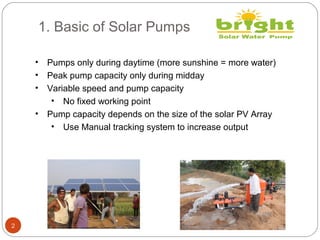
• Pumps only during daytime (more sunshine = more water)
• Peak pump capacity only during midday
• Variable speed and pump capacity
• No fixed working point
• Pump capacity depends on the size of the solar PV Array
• Use Manual tracking system to increase output
2. Water Volume and Lift
3
• The pump is defined by its volume [Q] and lift [H]
• Volume = [Q = m3/day]
• Max. flow [q = l/min]
• Lift = [H = m]
• Pressure [bar]
3. Theory of Solar Irrigation
4
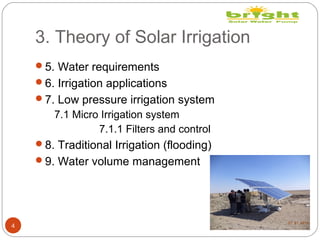
5. Water requirements
6. Irrigation applications
7. Low pressure irrigation system
7.1 Micro Irrigation system
7.1.1 Filters and control
8. Traditional Irrigation (flooding)
9. Water volume management
4. Water Requirements
5
• Water losses by plants and environment
• Depends on crops and their development
• Soil type
• Latitude and altitude
• Evapotranspiration losses
• [ET = mm/day]
• Evaporation = by open surfaces
• Transpiration = by plants
• high = < 6.5 mm/day (tropical region)
• medium = 5 -6.5 mm/day
• low = < 5 mm/day (moderate region)
• e.g. 5.5 mm/day = 5.5 L/m2/day
5. Irrigation Applications
6
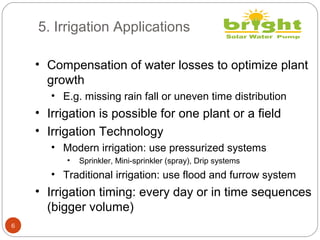
• Compensation of water losses to optimize plant
growth
• E.g. missing rain fall or uneven time distribution
• Irrigation is possible for one plant or a field
• Irrigation Technology
• Modern irrigation: use pressurized systems
• Sprinkler, Mini-sprinkler (spray), Drip systems
• Traditional irrigation: use flood and furrow system
• Irrigation timing: every day or in time sequences
(bigger volume)
6. Low Pressure Irrigation Systems
7
• From 0.5 to 2 bars (reduced energy
requirements)
• Low pressures means
• more water outlets
• more dense water distribution system
• mainly use plastic pipe and outlets (emitters)
• mainly fixed installation
7.1 Micro Irrigation System
8
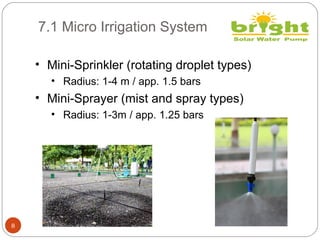
• Mini-Sprinkler (rotating droplet types)
• Radius: 1-4 m / app. 1.5 bars
• Mini-Sprayer (mist and spray types)
• Radius: 1-3m / app. 1.25 bars
7.1 Micro Irrigation System – Drip System
9
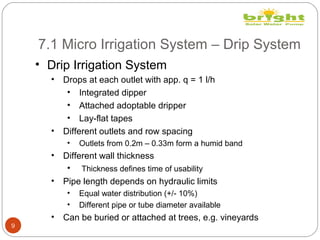
• Drip Irrigation System
• Drops at each outlet with app. q = 1 l/h
• Integrated dipper
• Attached adoptable dripper
• Lay-flat tapes
• Different outlets and row spacing
• Outlets from 0.2m – 0.33m form a humid band
• Different wall thickness
• Thickness defines time of usability
• Pipe length depends on hydraulic limits
• Equal water distribution (+/- 10%)
• Different pipe or tube diameter available
• Can be buried or attached at trees, e.g. vineyards
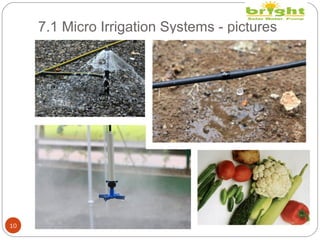
7.1 Micro Irrigation Systems - pictures
10
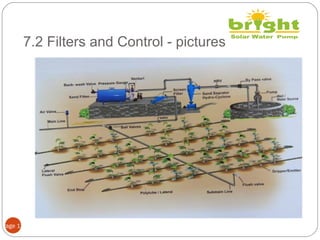
7.2 Filters and Control
11
• Each system must have a filter (or several)
• Otherwise the small outlets are blocked
• Use bigger model to reduce hydraulic losses
• Disc filter is better than screen filters
• Clean the filters and pipes regularly
• Control the irrigation system at the head unit
• Install control and measurement devise for volume
and pressure
• Add an inlet to the head unit for liquid fertilizer
7.2 Filters and Control - pictures
Page 12
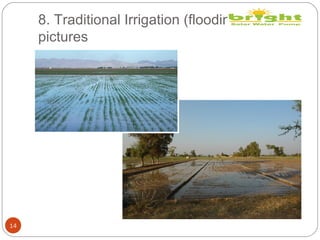
8. Traditional Irrigation (Flooding)
13
• Solar pumps lift water
• Also from rivers and canals (floating version)
• Water distribution through free outlet
• Only lifting, no pressure required
• High volume with minimum head
• App. 1-6m only
8. Traditional Irrigation (flooding) -
pictures
14
9. Water Volume Mangament
15
• Flow control only by volumetric meters (water
meter)
• Time control not common in Solar-Irrigation-Systems
• Manual control is standard (automatic optional)
• Divide the irrigation plot in sections
• Section (field) sizes must be equal
• Irrigation plot must be rotated each time
• Irrigation time (volume) due to crop development
and Evapotranspiration [ET]
• Add 2nd drip-line for further crop development
and water requirement
IV. Application and Design
criteria
16
10. BRIGHT Solar Pumps System and Irrigation
11. Design criteria
12. Examples for BRIGHT Solar Irrigations Systems
10. BRIGHT Solar Pumps System and
Irrigation
17
• BRIGHT SOLAR pumps can easily be connected with
many irrigation systems
• Match BRIGHT SOLAR pump with your irrigation system
(hydraulic requirements)
• Low pressure systems are cost efficient (Drip)
• Use water tank (min 3m) or direct connection
11. Design Criteria Step 1
18
• Check your water source and look for limitations
• Define lift and pressure [H] (TDH)
• Select the crops (plants) and water needs [ET]
• Define water volume [Q]
• Select BRIGHT Solar Pumps
• Determine size of the solar array
• Select BRIGHT Solar Modules
• Select BRIGHT SolarTracker
11. Design Criteria Step 2
19
• Determine low pressure irrigation system (Drip)
• Calculate hydraulic parameter (friction losses)
• Use bigger filters and pipe diameters
• Calculate max. drip line length (adopt field size )
• Define drip line row spacing (distance) and out let
spacing
• Select water meter and head unit for control and
management
• Except variation in [Q & H] during the day (no water in
the night)
• Use [Q = m3/day] and peak (max.) flow [q = l/min]
• In summer more Solar Power = more water for irrigation
12. Application Sizing and Examples (1)
20
• Example 1 (Greenhouse Irrigation):
• 1PM4SS-HR07 (900Wp -1 H.P. - Tracked)
• 17m³/day at 60m lift
• Medium ET: 5mm/day (~5l/m²/day)
-> Drip irrigation area 2720m² (using 80% eff.)
Greenhouse: 9m*55m = 540m² -> app. 5 greenhouses
12. Application Sizing and Examples (2)
21
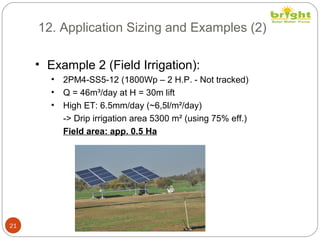
• Example 2 (Field Irrigation):
• 2PM4-SS5-12 (1800Wp – 2 H.P. - Not tracked)
• Q = 46m³/day at H = 30m lift
• High ET: 6.5mm/day (~6,5l/m²/day)
-> Drip irrigation area 5300 m² (using 75% eff.)
Field area: app. 0.5 Ha
12. Application Sizing and Examples (3)
22
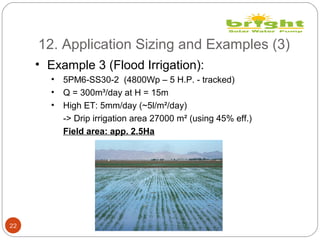
• Example 3 (Flood Irrigation):
• 5PM6-SS30-2 (4800Wp – 5 H.P. - tracked)
• Q = 300m³/day at H = 15m
• High ET: 5mm/day (~5l/m²/day)
-> Drip irrigation area 27000 m² (using 45% eff.)
Field area: app. 2.5Ha
12. Application Sizing and Examples (4)
23
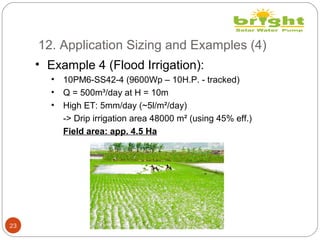
• Example 4 (Flood Irrigation):
• 10PM6-SS42-4 (9600Wp – 10H.P. - tracked)
• Q = 500m³/day at H = 10m
• High ET: 5mm/day (~5l/m²/day)
-> Drip irrigation area 48000 m² (using 45% eff.)
Field area: app. 4.5 Ha
V. Final Conclusion
24
1. Select low pressure irrigation system (micro irrigation system)
• Preferable drip irrigation system with app. 0.5 bar working pressure
2. If possible use tank with app. 5 m tower
• Optional direct system (set pressure for irrigation at app. 1 bar)
3. Match water use for irrigation with the BRIGHT solar pump capacity
• Check for the appropriate pump model
• Irrigation area depends on pump parameters [Q / H]
• [Q / H] defines the size of the solar generator
4. Control the irrigation system on volume basis (water meter)
• Subdivide the fields into equal plots
• Calculate drip line length with a +/- 10% variation in water volume
• Use bigger filters and distribution pipes to reduce friction losses
5. Use BRIGHT SOLAR power pack for peak (max) water needs in summer
• Night time irrigation
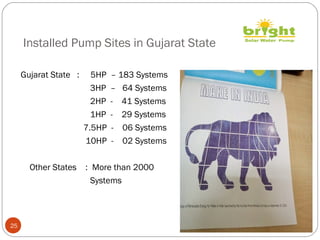
Installed Pump Sites in Gujarat State
Gujarat State : 5HP – 183 Systems
3HP – 64 Systems
2HP - 41 Systems
1HP - 29 Systems
7.5HP - 06 Systems
10HP - 02 Systems
Other States : More than 2000
Systems
25
26

Bright solar water pump irrigation

  • 1.
  • 2.
    1. Basic ofSolar Pumps 2 • Pumps only during daytime (more sunshine = more water) • Peak pump capacity only during midday • Variable speed and pump capacity • No fixed working point • Pump capacity depends on the size of the solar PV Array • Use Manual tracking system to increase output
  • 3.
    2. Water Volumeand Lift 3 • The pump is defined by its volume [Q] and lift [H] • Volume = [Q = m3/day] • Max. flow [q = l/min] • Lift = [H = m] • Pressure [bar]
  • 4.
    3. Theory ofSolar Irrigation 4 5. Water requirements 6. Irrigation applications 7. Low pressure irrigation system 7.1 Micro Irrigation system 7.1.1 Filters and control 8. Traditional Irrigation (flooding) 9. Water volume management
  • 5.
    4. Water Requirements 5 •Water losses by plants and environment • Depends on crops and their development • Soil type • Latitude and altitude • Evapotranspiration losses • [ET = mm/day] • Evaporation = by open surfaces • Transpiration = by plants • high = < 6.5 mm/day (tropical region) • medium = 5 -6.5 mm/day • low = < 5 mm/day (moderate region) • e.g. 5.5 mm/day = 5.5 L/m2/day
  • 6.
    5. Irrigation Applications 6 •Compensation of water losses to optimize plant growth • E.g. missing rain fall or uneven time distribution • Irrigation is possible for one plant or a field • Irrigation Technology • Modern irrigation: use pressurized systems • Sprinkler, Mini-sprinkler (spray), Drip systems • Traditional irrigation: use flood and furrow system • Irrigation timing: every day or in time sequences (bigger volume)
  • 7.
    6. Low PressureIrrigation Systems 7 • From 0.5 to 2 bars (reduced energy requirements) • Low pressures means • more water outlets • more dense water distribution system • mainly use plastic pipe and outlets (emitters) • mainly fixed installation
  • 8.
    7.1 Micro IrrigationSystem 8 • Mini-Sprinkler (rotating droplet types) • Radius: 1-4 m / app. 1.5 bars • Mini-Sprayer (mist and spray types) • Radius: 1-3m / app. 1.25 bars
  • 9.
    7.1 Micro IrrigationSystem – Drip System 9 • Drip Irrigation System • Drops at each outlet with app. q = 1 l/h • Integrated dipper • Attached adoptable dripper • Lay-flat tapes • Different outlets and row spacing • Outlets from 0.2m – 0.33m form a humid band • Different wall thickness • Thickness defines time of usability • Pipe length depends on hydraulic limits • Equal water distribution (+/- 10%) • Different pipe or tube diameter available • Can be buried or attached at trees, e.g. vineyards
  • 10.
    7.1 Micro IrrigationSystems - pictures 10
  • 11.
    7.2 Filters andControl 11 • Each system must have a filter (or several) • Otherwise the small outlets are blocked • Use bigger model to reduce hydraulic losses • Disc filter is better than screen filters • Clean the filters and pipes regularly • Control the irrigation system at the head unit • Install control and measurement devise for volume and pressure • Add an inlet to the head unit for liquid fertilizer
  • 12.
    7.2 Filters andControl - pictures Page 12
  • 13.
    8. Traditional Irrigation(Flooding) 13 • Solar pumps lift water • Also from rivers and canals (floating version) • Water distribution through free outlet • Only lifting, no pressure required • High volume with minimum head • App. 1-6m only
  • 14.
    8. Traditional Irrigation(flooding) - pictures 14
  • 15.
    9. Water VolumeMangament 15 • Flow control only by volumetric meters (water meter) • Time control not common in Solar-Irrigation-Systems • Manual control is standard (automatic optional) • Divide the irrigation plot in sections • Section (field) sizes must be equal • Irrigation plot must be rotated each time • Irrigation time (volume) due to crop development and Evapotranspiration [ET] • Add 2nd drip-line for further crop development and water requirement
  • 16.
    IV. Application andDesign criteria 16 10. BRIGHT Solar Pumps System and Irrigation 11. Design criteria 12. Examples for BRIGHT Solar Irrigations Systems
  • 17.
    10. BRIGHT SolarPumps System and Irrigation 17 • BRIGHT SOLAR pumps can easily be connected with many irrigation systems • Match BRIGHT SOLAR pump with your irrigation system (hydraulic requirements) • Low pressure systems are cost efficient (Drip) • Use water tank (min 3m) or direct connection
  • 18.
    11. Design CriteriaStep 1 18 • Check your water source and look for limitations • Define lift and pressure [H] (TDH) • Select the crops (plants) and water needs [ET] • Define water volume [Q] • Select BRIGHT Solar Pumps • Determine size of the solar array • Select BRIGHT Solar Modules • Select BRIGHT SolarTracker
  • 19.
    11. Design CriteriaStep 2 19 • Determine low pressure irrigation system (Drip) • Calculate hydraulic parameter (friction losses) • Use bigger filters and pipe diameters • Calculate max. drip line length (adopt field size ) • Define drip line row spacing (distance) and out let spacing • Select water meter and head unit for control and management • Except variation in [Q & H] during the day (no water in the night) • Use [Q = m3/day] and peak (max.) flow [q = l/min] • In summer more Solar Power = more water for irrigation
  • 20.
    12. Application Sizingand Examples (1) 20 • Example 1 (Greenhouse Irrigation): • 1PM4SS-HR07 (900Wp -1 H.P. - Tracked) • 17m³/day at 60m lift • Medium ET: 5mm/day (~5l/m²/day) -> Drip irrigation area 2720m² (using 80% eff.) Greenhouse: 9m*55m = 540m² -> app. 5 greenhouses
  • 21.
    12. Application Sizingand Examples (2) 21 • Example 2 (Field Irrigation): • 2PM4-SS5-12 (1800Wp – 2 H.P. - Not tracked) • Q = 46m³/day at H = 30m lift • High ET: 6.5mm/day (~6,5l/m²/day) -> Drip irrigation area 5300 m² (using 75% eff.) Field area: app. 0.5 Ha
  • 22.
    12. Application Sizingand Examples (3) 22 • Example 3 (Flood Irrigation): • 5PM6-SS30-2 (4800Wp – 5 H.P. - tracked) • Q = 300m³/day at H = 15m • High ET: 5mm/day (~5l/m²/day) -> Drip irrigation area 27000 m² (using 45% eff.) Field area: app. 2.5Ha
  • 23.
    12. Application Sizingand Examples (4) 23 • Example 4 (Flood Irrigation): • 10PM6-SS42-4 (9600Wp – 10H.P. - tracked) • Q = 500m³/day at H = 10m • High ET: 5mm/day (~5l/m²/day) -> Drip irrigation area 48000 m² (using 45% eff.) Field area: app. 4.5 Ha
  • 24.
    V. Final Conclusion 24 1.Select low pressure irrigation system (micro irrigation system) • Preferable drip irrigation system with app. 0.5 bar working pressure 2. If possible use tank with app. 5 m tower • Optional direct system (set pressure for irrigation at app. 1 bar) 3. Match water use for irrigation with the BRIGHT solar pump capacity • Check for the appropriate pump model • Irrigation area depends on pump parameters [Q / H] • [Q / H] defines the size of the solar generator 4. Control the irrigation system on volume basis (water meter) • Subdivide the fields into equal plots • Calculate drip line length with a +/- 10% variation in water volume • Use bigger filters and distribution pipes to reduce friction losses 5. Use BRIGHT SOLAR power pack for peak (max) water needs in summer • Night time irrigation
  • 25.
    Installed Pump Sitesin Gujarat State Gujarat State : 5HP – 183 Systems 3HP – 64 Systems 2HP - 41 Systems 1HP - 29 Systems 7.5HP - 06 Systems 10HP - 02 Systems Other States : More than 2000 Systems 25
  • 26.