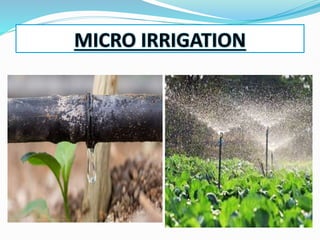
Definition
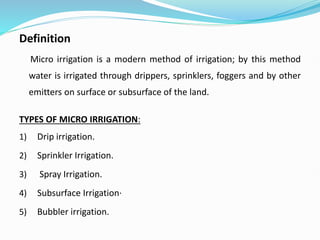
Micro irrigation is a modern method of irrigation; by this method
water is irrigated through drippers, sprinklers, foggers and by other
emitters on surface or subsurface of the land.
TYPES OF MICRO IRRIGATION:
1) Drip irrigation.
2) Sprinkler Irrigation.
3) Spray Irrigation.
4) Subsurface Irrigation·
5) Bubbler irrigation.
Why Modern Irrigation methods?
 To improve the Productivity of he Irrigation Land.
 To improve the productivity of irrigated land
 To improve use-efficiencies of Water, Energy, Nutrients and
Human Efforts in Agriculture.
 To conserve scarce resources such as Water and Electricity.
 To facilitate better crop management through Fertigation
Advantages of Micro Irrigation
 Crop Yield Enhancement, 30-200%
 Saving of Irrigation Water, 30-70%
 Saving in Energy for pumping
 Savings in Fertilizers, 30-40%.
 Uniformity of Water Application
 Improvement in Quality of Produce
 Improved Pest and Disease Control
 Improves Soil Health
 Reduced Weed Growth
 Reduced Labour Costs
 Ideal for Difficult Land Terrain (hilly, undulating) and Marginal lands
 Suitable for inferior quality water
 Highest water use efficiency, 90-95%
Components of Micro Irrigation System
1) Pumping unit
2) Filters
3) Mainline
4) Submain lines /Laterals
5) Emitters
6) Drip / Sprinkler
7) Riser pipe
8) Flow control valves
9) Non return valve
10) Air release valve
11) Fittings and accessorie
Design of Micro Irrigation System
 Calculation of Crop Water Requirements
 Selection of Drippers
 Design of Laterals
 Design and Selection of Sub-mains
 Design and Selection of Main lines
 Selection of Filters & Fertilizer Equipments
 Selection of Pump
 Selection of other Fittings and Accessorie
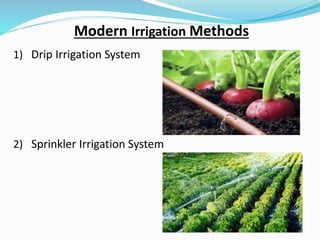
Modern Irrigation Methods
1) Drip Irrigation System
2) Sprinkler Irrigation System
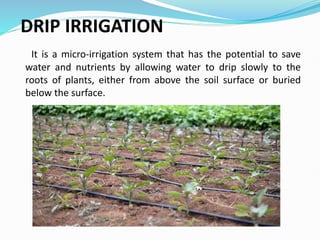
DRIP IRRIGATION
It is a micro-irrigation system that has the potential to save
water and nutrients by allowing water to drip slowly to the
roots of plants, either from above the soil surface or buried
below the surface.
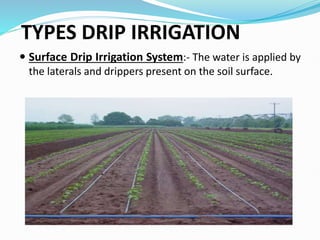
TYPES DRIP IRRIGATION
 Surface Drip Irrigation System:- The water is applied by
the laterals and drippers present on the soil surface.
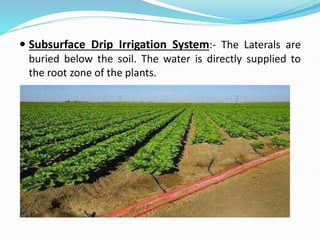
 Subsurface Drip Irrigation System:- The Laterals are
buried below the soil. The water is directly supplied to
the root zone of the plants.
Basic data required for Drip Irrigation system design
 Survey map of the area- measurement of field, ground slope,
contours
 Water source detail – type of water source, capacity
 Water quality – TSS, pH, hardness
 Soil type detail – water holding capacity, infiltration rate,
texture, structure, bulk density etc.
 Crop detail – crop variety, spacing, age, and water requirement
 Wind speed and direction
 Availability of electricity
 Climatic records- Rainfall. Humidity, Temperature, Evaporation
Drip Irrigation System Layout
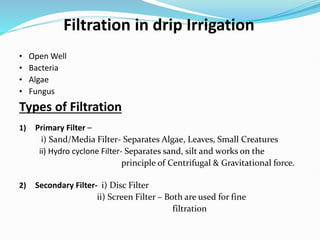
Filtration in drip Irrigation
• Open Well
• Bacteria
• Algae
• Fungus
Types of Filtration
1) Primary Filter –
i) Sand/Media Filter- Separates Algae, Leaves, Small Creatures
ii) Hydro cyclone Filter- Separates sand, silt and works on the
principle of Centrifugal & Gravitational force.
2) Secondary Filter- i) Disc Filter
ii) Screen Filter – Both are used for fine
filtration
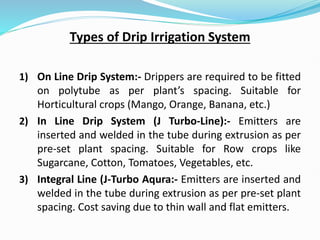
Types of Drip Irrigation System
1) On Line Drip System:- Drippers are required to be fitted
on polytube as per plant’s spacing. Suitable for
Horticultural crops (Mango, Orange, Banana, etc.)
2) In Line Drip System (J Turbo-Line):- Emitters are
inserted and welded in the tube during extrusion as per
pre-set plant spacing. Suitable for Row crops like
Sugarcane, Cotton, Tomatoes, Vegetables, etc.
3) Integral Line (J-Turbo Aqura:- Emitters are inserted and
welded in the tube during extrusion as per pre-set plant
spacing. Cost saving due to thin wall and flat emitters.
CROPS COVERED UNDER MIS
• FRUIT CROPS : Almond, Apple, Arecanut, Indian Gooseberry, Ber
(Zizyphus), Banana, Cashew, Custard Apple, Cherry, Durian, Fig, Guava,
Grape, Litchi, Lemon, Sweet Lime, Mango, Orange, Olive, Papaya,
Pomegranate, Pear, Peach, Pistachio, Pineapple, Sapota, Strawberry, Star
Fruit, Jack Fruit, Tamarind, Water Melon, Musk Melon.
• VEGETABLE CROPS : Brinjal, Cucumber, Lettuce, Pepper, Potato, Pea,
Tomato.
• FIELD & OTHER CROPS: Corn, Cotton, Sugarcane, Tobacco, Betel vine,
Mulberry.
• OIL SEEDS : Groundnut, Sunflower, Jojoba, Castor.
• FORAGE CROPS : Lucerne, Pastures, Turfs, Fodder.
• PLANTATION CROPS : Cardamom, Coffee, Tea, Rubber, Spices, Oil Palm,
Coconut.
• ORNAMENTALS : Floricultural Plants; Rose, Gerbera, Carnation, Gladioli,
Poinsettias, Chrysanthemum.
• FOREST TREES : Teak, Bamboo, Neem, Acacia, Eucalyptus, Casuarinas,
Dalbergia.
DESIGN INPUTS
 Engineering Survey:- Measurement of field, ground
slope and contours.
 Assessment of irrigation water:- Assessment of
water source and availability of water.
 Agricultures details:- Crop spacing, type, age, crop
geometry
 Climate data:- Evapotranspiration
 Soil and water analysis:- Collection of soil and water
sample and analyzing.
PIPES DETAILS
• Mains: PVC or HDPE. - Size 50 mm, 63 mm, 75 mm &
above
• Submain: PVC or HDPE. Size 40 mm, 50 mm, 63 mm, 75
mm, 90 mm.
• Laterals (Polytube): LLDPE (Linear Low Density
Polyethylene), Size 12 mm, 16 mm, 20 mm, 25 mm, 32
mm.
Maintenance of drip system
 Back washing and sand filters has to be cleaned.
 Frequent cleaning of emitters and drippers.
 Flushing at every irrigation.
 Cleaning of sub main and main pipes.
 Cleaning of PVC pipes and laterals and acid or
chlorine may be used to remove clogging.
Advantages of drip irrigation system
• Increased yield
• Early Maturity
• Water saving
• Fertilizer savings
• Energy saving
• Labour saving
• Marginal land & undulated land can be irrigated
• Use of saline water is possible for irrigation
• Reduce weed growth
• Less problem of disease and pest
• Makes intercultural operations easy
Disadvantages of drip irrigation system
• High initial investment
• If the water is not properly filtered and the equipment not properly
maintained, it can result in clogging
• Possible damage of system components due to animals, etc.,
Thank you

MICRO IRRIGATION in detail with example.pptx

  • 2.
    Definition Micro irrigation isa modern method of irrigation; by this method water is irrigated through drippers, sprinklers, foggers and by other emitters on surface or subsurface of the land. TYPES OF MICRO IRRIGATION: 1) Drip irrigation. 2) Sprinkler Irrigation. 3) Spray Irrigation. 4) Subsurface Irrigation· 5) Bubbler irrigation.
  • 3.
    Why Modern Irrigationmethods?  To improve the Productivity of he Irrigation Land.  To improve the productivity of irrigated land  To improve use-efficiencies of Water, Energy, Nutrients and Human Efforts in Agriculture.  To conserve scarce resources such as Water and Electricity.  To facilitate better crop management through Fertigation
  • 4.
    Advantages of MicroIrrigation  Crop Yield Enhancement, 30-200%  Saving of Irrigation Water, 30-70%  Saving in Energy for pumping  Savings in Fertilizers, 30-40%.  Uniformity of Water Application  Improvement in Quality of Produce  Improved Pest and Disease Control  Improves Soil Health  Reduced Weed Growth  Reduced Labour Costs  Ideal for Difficult Land Terrain (hilly, undulating) and Marginal lands  Suitable for inferior quality water  Highest water use efficiency, 90-95%
  • 5.
    Components of MicroIrrigation System 1) Pumping unit 2) Filters 3) Mainline 4) Submain lines /Laterals 5) Emitters 6) Drip / Sprinkler 7) Riser pipe 8) Flow control valves 9) Non return valve 10) Air release valve 11) Fittings and accessorie
  • 6.
    Design of MicroIrrigation System  Calculation of Crop Water Requirements  Selection of Drippers  Design of Laterals  Design and Selection of Sub-mains  Design and Selection of Main lines  Selection of Filters & Fertilizer Equipments  Selection of Pump  Selection of other Fittings and Accessorie
  • 7.
    Modern Irrigation Methods 1)Drip Irrigation System 2) Sprinkler Irrigation System
  • 8.
    DRIP IRRIGATION It isa micro-irrigation system that has the potential to save water and nutrients by allowing water to drip slowly to the roots of plants, either from above the soil surface or buried below the surface.
  • 9.
    TYPES DRIP IRRIGATION Surface Drip Irrigation System:- The water is applied by the laterals and drippers present on the soil surface.
  • 10.
     Subsurface DripIrrigation System:- The Laterals are buried below the soil. The water is directly supplied to the root zone of the plants.
  • 11.
    Basic data requiredfor Drip Irrigation system design  Survey map of the area- measurement of field, ground slope, contours  Water source detail – type of water source, capacity  Water quality – TSS, pH, hardness  Soil type detail – water holding capacity, infiltration rate, texture, structure, bulk density etc.  Crop detail – crop variety, spacing, age, and water requirement  Wind speed and direction  Availability of electricity  Climatic records- Rainfall. Humidity, Temperature, Evaporation
  • 12.
  • 13.
    Filtration in dripIrrigation • Open Well • Bacteria • Algae • Fungus Types of Filtration 1) Primary Filter – i) Sand/Media Filter- Separates Algae, Leaves, Small Creatures ii) Hydro cyclone Filter- Separates sand, silt and works on the principle of Centrifugal & Gravitational force. 2) Secondary Filter- i) Disc Filter ii) Screen Filter – Both are used for fine filtration
  • 14.
    Types of DripIrrigation System 1) On Line Drip System:- Drippers are required to be fitted on polytube as per plant’s spacing. Suitable for Horticultural crops (Mango, Orange, Banana, etc.) 2) In Line Drip System (J Turbo-Line):- Emitters are inserted and welded in the tube during extrusion as per pre-set plant spacing. Suitable for Row crops like Sugarcane, Cotton, Tomatoes, Vegetables, etc. 3) Integral Line (J-Turbo Aqura:- Emitters are inserted and welded in the tube during extrusion as per pre-set plant spacing. Cost saving due to thin wall and flat emitters.
  • 15.
    CROPS COVERED UNDERMIS • FRUIT CROPS : Almond, Apple, Arecanut, Indian Gooseberry, Ber (Zizyphus), Banana, Cashew, Custard Apple, Cherry, Durian, Fig, Guava, Grape, Litchi, Lemon, Sweet Lime, Mango, Orange, Olive, Papaya, Pomegranate, Pear, Peach, Pistachio, Pineapple, Sapota, Strawberry, Star Fruit, Jack Fruit, Tamarind, Water Melon, Musk Melon. • VEGETABLE CROPS : Brinjal, Cucumber, Lettuce, Pepper, Potato, Pea, Tomato. • FIELD & OTHER CROPS: Corn, Cotton, Sugarcane, Tobacco, Betel vine, Mulberry. • OIL SEEDS : Groundnut, Sunflower, Jojoba, Castor. • FORAGE CROPS : Lucerne, Pastures, Turfs, Fodder. • PLANTATION CROPS : Cardamom, Coffee, Tea, Rubber, Spices, Oil Palm, Coconut. • ORNAMENTALS : Floricultural Plants; Rose, Gerbera, Carnation, Gladioli, Poinsettias, Chrysanthemum. • FOREST TREES : Teak, Bamboo, Neem, Acacia, Eucalyptus, Casuarinas, Dalbergia.
  • 16.
    DESIGN INPUTS  EngineeringSurvey:- Measurement of field, ground slope and contours.  Assessment of irrigation water:- Assessment of water source and availability of water.  Agricultures details:- Crop spacing, type, age, crop geometry  Climate data:- Evapotranspiration  Soil and water analysis:- Collection of soil and water sample and analyzing.
  • 17.
    PIPES DETAILS • Mains:PVC or HDPE. - Size 50 mm, 63 mm, 75 mm & above • Submain: PVC or HDPE. Size 40 mm, 50 mm, 63 mm, 75 mm, 90 mm. • Laterals (Polytube): LLDPE (Linear Low Density Polyethylene), Size 12 mm, 16 mm, 20 mm, 25 mm, 32 mm.
  • 18.
    Maintenance of dripsystem  Back washing and sand filters has to be cleaned.  Frequent cleaning of emitters and drippers.  Flushing at every irrigation.  Cleaning of sub main and main pipes.  Cleaning of PVC pipes and laterals and acid or chlorine may be used to remove clogging.
  • 19.
    Advantages of dripirrigation system • Increased yield • Early Maturity • Water saving • Fertilizer savings • Energy saving • Labour saving • Marginal land & undulated land can be irrigated • Use of saline water is possible for irrigation • Reduce weed growth • Less problem of disease and pest • Makes intercultural operations easy Disadvantages of drip irrigation system • High initial investment • If the water is not properly filtered and the equipment not properly maintained, it can result in clogging • Possible damage of system components due to animals, etc.,
  • 20.