BRIDGING GAP IN LITERACY
DEVELOPMENT THROUGH
ACTIVITY BASED LEARNING
Presented by-
Mr. santosh d yadav
Head of department
KLID, Teacher’s training college, bhavnagar
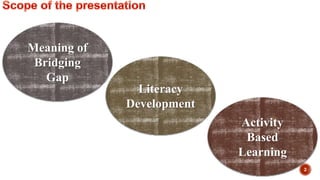
Meaning of
Bridging
Gap
Activity
Based
Learning
Literacy
Development
2
From our observation, many gaps identified in the
communication between the two schools, the
curriculum, teaching pedagogy and students’
learning.
To enhance a smooth interface, we provided an
opportunity for the professional exchange between
the two schools’ teachers and students and we
worked with teachers to facilitate the better
curriculum planning and pedagogical adaptation. 3
Means to connect two things or to make the
difference between them smaller: The leader
role out education as a vital tool in bridging
the gap between rich and poor, school and
family, illiteracy to literacy, unemployment to
employment, unknown to known about the
ability of impaired person.
4
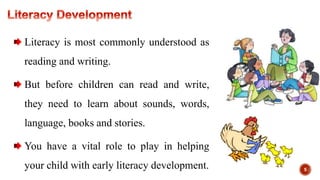
Literacy is most commonly understood as
reading and writing.
But before children can read and write,
they need to learn about sounds, words,
language, books and stories.
You have a vital role to play in helping
your child with early literacy development. 5
The growth of literacy skills is a vital part of our
child’s overall development.
It’s the foundation for doing well at school, socializing
with others, developing independence, managing
money and working.
You can help your child’s literacy development
by communicating with her, reading with her
and teaching his/her about sounds in ways that are
fun for both of you.
6
Acceptance
Rejection
Indifference
Overprotection
7
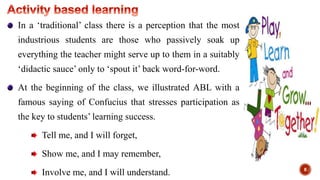
In a ‘traditional’ class there is a perception that the most
industrious students are those who passively soak up
everything the teacher might serve up to them in a suitably
‘didactic sauce’ only to ‘spout it’ back word-for-word.
At the beginning of the class, we illustrated ABL with a
famous saying of Confucius that stresses participation as
the key to students’ learning success.
Tell me, and I will forget,
Show me, and I may remember,
Involve me, and I will understand. 8
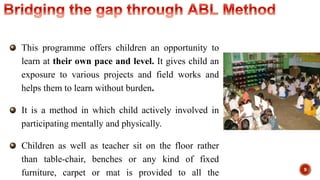
This programme offers children an opportunity to
learn at their own pace and level. It gives child an
exposure to various projects and field works and
helps them to learn without burden.
It is a method in which child actively involved in
participating mentally and physically.
Children as well as teacher sit on the floor rather
than table-chair, benches or any kind of fixed
furniture, carpet or mat is provided to all the 9
Group 1
Teacher Supported
Children require full
support of the
teacher
Group 2
Partially Teacher
Supported
Children require
Partially support of the
teacher
Group 3
Peer Learning
Children learn with
peers
Group 4
Partially Peer
Learning
Children learn
through partial peers
support
Group 5
Self Learning
Children learn
through self
Group 6
Assessment
Assessment of
children by the
teacher
10
11
opportunity to learn at their own pace and level.
provides children a platform to learn through
experience
offers a chance to learn from teachers and peers
exposure to various project and field works
Learns with least stress 12
Probing (खोज)- - gathering knowledge, concept and skill
Productive (लाभकारी)- getting experience through creative work
Presentations (प्रस्तुतत)-Expressional
13
Classroom
Subject Classroom
14
Seating Arrangement:
Rack
15
Physical Environment of Pragna Classroom
Balpothi
Parents
Meeting
C.D
Progress
Report Chart
Portfolio
16
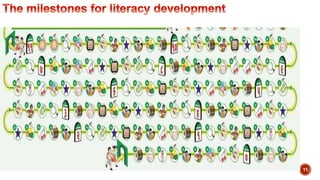
1. Competencies are split into different parts/units and converted into different
activities.
2. Each part/unit is called a milestone.
3. In each subject, the relevant milestones are clustered and linked as chain and
this chain of milestones is called LADDER.
4. Milestones are arranged in a logical sequence from simple to complex and
also activities in each milestone.
5. To enable the children to organize in groups group cards are used.
6. Evaluation is inbuilt in the system. Separate cards / activities are used for17
Children learn on their pace.
Provision of more time for self-directed learning and teacher directed learning
is reduced considerably.
Group learning, mutual learning and self learning are promoted.
Children's participation in every step is ensured in the process of learning.
Evaluation is inbuilt in the system it is done without the child knowing it.
Rote learning is discouraged and almost no scope for rote learning. 18
1. Get down to the child’s eye level
2. Speak in normal volume and speed
3. Speak clearly and specifically
4. Use the same sentence structure
5. Repeat, rephrase, or demonstrate
6. Encourage other children to imitate you
7. Use gestures and facial expressions
8. Provide classification games and puzzles
9. Use a picture poster to point to the upcoming activity 19
 Always consider alternative forms of assessment
where necessary.
 When their range of literacy is an issue, students may
require the use of a vocabulary or dictionary during
exams.
 Provide alternatives to those assignments which are
based on interviews or questionnaires.
 Provide extra time in examinations, particularly extra
20
The activity based learning method gives the opportunity to bridge the
gap between Classroom transaction is based on child's needs and
interests. It is also gives the Freedom to child in learning as he
chooses his activity in multi grade and multilevel in learning is
effectively addressed. The hearing impaired children will feel of
security as they sit in rounds in the groups.
21
 ASHA. (1989). Communication-Based Services for Infants, Toddlers, and Their Families.
Technical Report.
 EFA Global Monitoring Report, (2013). Teaching and Learning: Achieving quality for all, Paris:
UNESCO p. 289-294 Retrieved on December 05, 2014
fromhttp://unesco.nl/sites/default/files/dossier/gmr_2013-.pdf?download=1
 EFA Global Monitoring Report, (2013). Teaching and Learning: Achieving quality for all, Paris:
UNESCO p. 289-294 Retrieved on December 05, 2014
fromhttp://unesco.nl/sites/default/files/dossier/gmr_2013-.pdf?download=1
 GCEE, (2015). 52nd Meeting of the Executive Committee, Gujarat, 4th June, 2015; Retrieved
from http://gujarat-
education.gov.in/ssa/images/52nd%20E.C._Minutes_ssa_gujarat_1_1.pdf
 SAJCH. (2010). Bridging the gap between early identification and intervention in the
paediatric population with hearing impairments . SAJCH, DEC 2010 VOL. 4 NO. 4
22
23

Bridging Gap in Literacy Development through Activity Based Learning

  • 1.
    BRIDGING GAP INLITERACY DEVELOPMENT THROUGH ACTIVITY BASED LEARNING Presented by- Mr. santosh d yadav Head of department KLID, Teacher’s training college, bhavnagar
  • 2.
  • 3.
    From our observation,many gaps identified in the communication between the two schools, the curriculum, teaching pedagogy and students’ learning. To enhance a smooth interface, we provided an opportunity for the professional exchange between the two schools’ teachers and students and we worked with teachers to facilitate the better curriculum planning and pedagogical adaptation. 3
  • 4.
    Means to connecttwo things or to make the difference between them smaller: The leader role out education as a vital tool in bridging the gap between rich and poor, school and family, illiteracy to literacy, unemployment to employment, unknown to known about the ability of impaired person. 4
  • 5.
    Literacy is mostcommonly understood as reading and writing. But before children can read and write, they need to learn about sounds, words, language, books and stories. You have a vital role to play in helping your child with early literacy development. 5
  • 6.
    The growth ofliteracy skills is a vital part of our child’s overall development. It’s the foundation for doing well at school, socializing with others, developing independence, managing money and working. You can help your child’s literacy development by communicating with her, reading with her and teaching his/her about sounds in ways that are fun for both of you. 6
  • 7.
  • 8.
    In a ‘traditional’class there is a perception that the most industrious students are those who passively soak up everything the teacher might serve up to them in a suitably ‘didactic sauce’ only to ‘spout it’ back word-for-word. At the beginning of the class, we illustrated ABL with a famous saying of Confucius that stresses participation as the key to students’ learning success. Tell me, and I will forget, Show me, and I may remember, Involve me, and I will understand. 8
  • 9.
    This programme offerschildren an opportunity to learn at their own pace and level. It gives child an exposure to various projects and field works and helps them to learn without burden. It is a method in which child actively involved in participating mentally and physically. Children as well as teacher sit on the floor rather than table-chair, benches or any kind of fixed furniture, carpet or mat is provided to all the 9
  • 10.
    Group 1 Teacher Supported Childrenrequire full support of the teacher Group 2 Partially Teacher Supported Children require Partially support of the teacher Group 3 Peer Learning Children learn with peers Group 4 Partially Peer Learning Children learn through partial peers support Group 5 Self Learning Children learn through self Group 6 Assessment Assessment of children by the teacher 10
  • 11.
  • 12.
    opportunity to learnat their own pace and level. provides children a platform to learn through experience offers a chance to learn from teachers and peers exposure to various project and field works Learns with least stress 12
  • 13.
    Probing (खोज)- -gathering knowledge, concept and skill Productive (लाभकारी)- getting experience through creative work Presentations (प्रस्तुतत)-Expressional 13
  • 14.
  • 15.
  • 16.
    Physical Environment ofPragna Classroom Balpothi Parents Meeting C.D Progress Report Chart Portfolio 16
  • 17.
    1. Competencies aresplit into different parts/units and converted into different activities. 2. Each part/unit is called a milestone. 3. In each subject, the relevant milestones are clustered and linked as chain and this chain of milestones is called LADDER. 4. Milestones are arranged in a logical sequence from simple to complex and also activities in each milestone. 5. To enable the children to organize in groups group cards are used. 6. Evaluation is inbuilt in the system. Separate cards / activities are used for17
  • 18.
    Children learn ontheir pace. Provision of more time for self-directed learning and teacher directed learning is reduced considerably. Group learning, mutual learning and self learning are promoted. Children's participation in every step is ensured in the process of learning. Evaluation is inbuilt in the system it is done without the child knowing it. Rote learning is discouraged and almost no scope for rote learning. 18
  • 19.
    1. Get downto the child’s eye level 2. Speak in normal volume and speed 3. Speak clearly and specifically 4. Use the same sentence structure 5. Repeat, rephrase, or demonstrate 6. Encourage other children to imitate you 7. Use gestures and facial expressions 8. Provide classification games and puzzles 9. Use a picture poster to point to the upcoming activity 19
  • 20.
     Always consideralternative forms of assessment where necessary.  When their range of literacy is an issue, students may require the use of a vocabulary or dictionary during exams.  Provide alternatives to those assignments which are based on interviews or questionnaires.  Provide extra time in examinations, particularly extra 20
  • 21.
    The activity basedlearning method gives the opportunity to bridge the gap between Classroom transaction is based on child's needs and interests. It is also gives the Freedom to child in learning as he chooses his activity in multi grade and multilevel in learning is effectively addressed. The hearing impaired children will feel of security as they sit in rounds in the groups. 21
  • 22.
     ASHA. (1989).Communication-Based Services for Infants, Toddlers, and Their Families. Technical Report.  EFA Global Monitoring Report, (2013). Teaching and Learning: Achieving quality for all, Paris: UNESCO p. 289-294 Retrieved on December 05, 2014 fromhttp://unesco.nl/sites/default/files/dossier/gmr_2013-.pdf?download=1  EFA Global Monitoring Report, (2013). Teaching and Learning: Achieving quality for all, Paris: UNESCO p. 289-294 Retrieved on December 05, 2014 fromhttp://unesco.nl/sites/default/files/dossier/gmr_2013-.pdf?download=1  GCEE, (2015). 52nd Meeting of the Executive Committee, Gujarat, 4th June, 2015; Retrieved from http://gujarat- education.gov.in/ssa/images/52nd%20E.C._Minutes_ssa_gujarat_1_1.pdf  SAJCH. (2010). Bridging the gap between early identification and intervention in the paediatric population with hearing impairments . SAJCH, DEC 2010 VOL. 4 NO. 4 22
  • 23.