Introduction to Bridge Engineering
 A bridge is a structure providing passage over an obstacle
without closing the way beneath. The required passage may
be for a road, a railway, pedestrians, a canal or a pipeline. The
obstacle to be crossed may be a river, a road, railway or a
valley.
 In other words, bridge is a structure for carrying the road traffic
or other moving loads over a depression or obstruction such
as channel, road or railway.
 A bridge is an arrangement made to cross an obstacle in the
form of a low ground or a stream or a river without closing the
way beneath.
What is a Bridge?
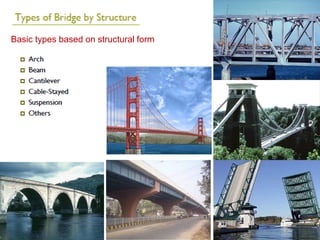
Basic types based on structural form
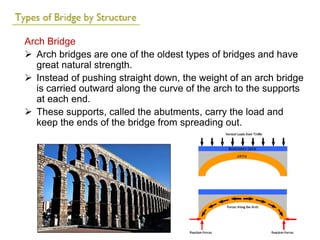
Arch Bridge
 Arch bridges are one of the oldest types of bridges and have
great natural strength.
 Instead of pushing straight down, the weight of an arch bridge
is carried outward along the curve of the arch to the supports
at each end.
 These supports, called the abutments, carry the load and
keep the ends of the bridge from spreading out.
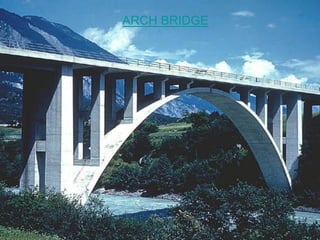
ARCH BRIDGE
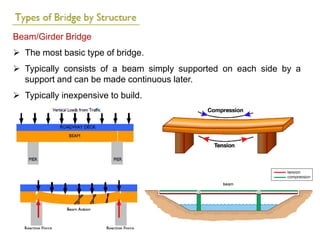
Beam/Girder Bridge
 The most basic type of bridge.
 Typically consists of a beam simply supported on each side by a
support and can be made continuous later.
 Typically inexpensive to build.
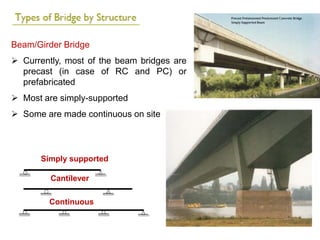
Beam/Girder Bridge
 Currently, most of the beam bridges are
precast (in case of RC and PC) or
prefabricated
 Most are simply-supported
 Some are made continuous on site
Simply supported
Cantilever
Continuous
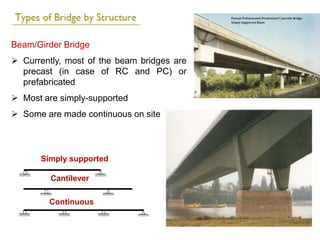
Beam/Girder Bridge
 Currently, most of the beam bridges are
precast (in case of RC and PC) or
prefabricated
 Most are simply-supported
 Some are made continuous on site
Simply supported
Cantilever
Continuous
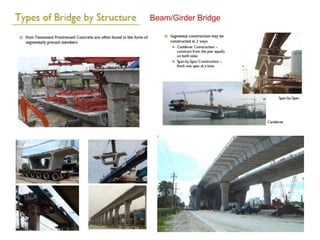
Beam/Girder Bridge
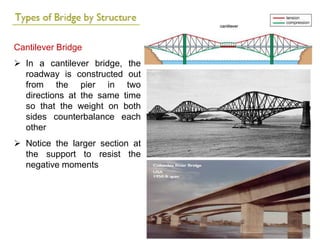
Cantilever Bridge
 In a cantilever bridge, the
roadway is constructed out
from the pier in two
directions at the same time
so that the weight on both
sides counterbalance each
other
 Notice the larger section at
the support to resist the
negative moments
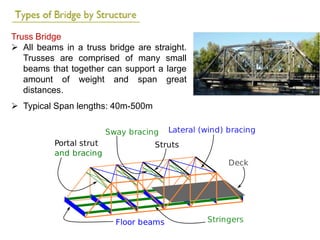
Truss Bridge
 All beams in a truss bridge are straight.
Trusses are comprised of many small
beams that together can support a large
amount of weight and span great
distances.
 Typical Span lengths: 40m-500m
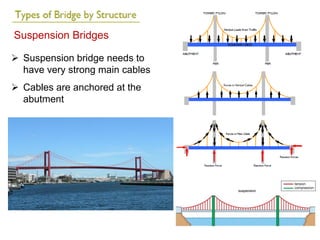
 Suspension bridge needs to
have very strong main cables
 Cables are anchored at the
abutment
Suspension Bridges
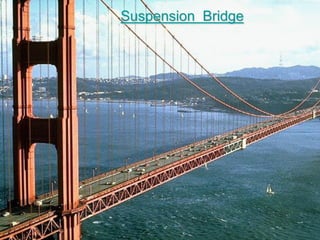
Suspension Bridge
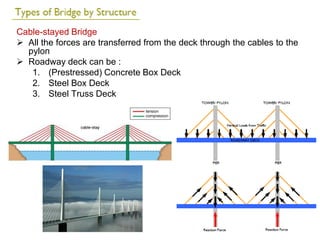
Cable-stayed Bridge
 All the forces are transferred from the deck through the cables to the
pylon
 Roadway deck can be :
1. (Prestressed) Concrete Box Deck
2. Steel Box Deck
3. Steel Truss Deck
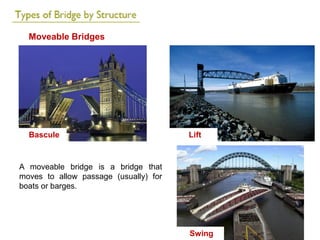
Moveable Bridges
Bascule Lift
Swing
A moveable bridge is a bridge that
moves to allow passage (usually) for
boats or barges.
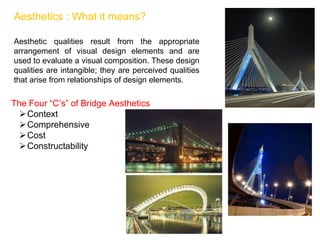
Aesthetics : What it means?
The Four “C’s” of Bridge Aesthetics
Context
Comprehensive
Cost
Constructability
Aesthetic qualities result from the appropriate
arrangement of visual design elements and are
used to evaluate a visual composition. These design
qualities are intangible; they are perceived qualities
that arise from relationships of design elements.
 Context
All projects from a simple creek bridge to the longest multi span water
crossing must first be considered with a view to the context in which it is
located.
 Comprehensive
The designs that work best are those that take aesthetics in to account
right from start.
 Cost
No discussion of design considerations can be conducted realistically
without asking “How much is it going to cost?”.
 Constructability
No discussion of aesthetics is complete without considering
constructability.
Aesthetics : What it means?
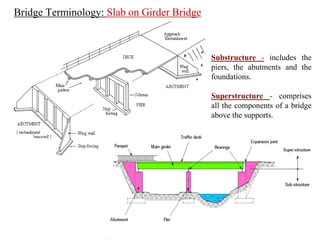
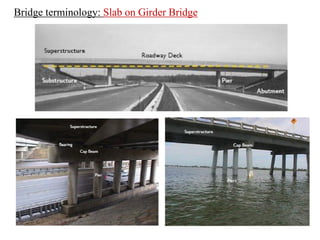
Substructure - includes the
piers, the abutments and the
foundations.
Superstructure - comprises
all the components of a bridge
above the supports.
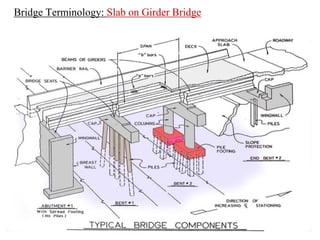
Bridge Terminology: Slab on Girder Bridge
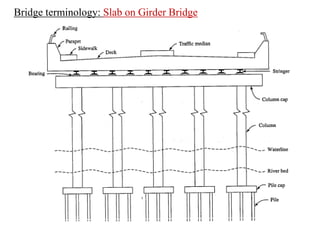
Bridge terminology: Slab on Girder Bridge
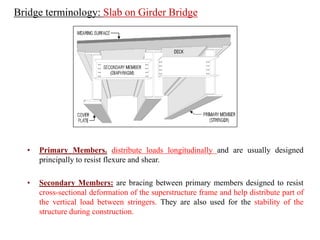
• Primary Members. distribute loads longitudinally and are usually designed
principally to resist flexure and shear.
• Secondary Members: are bracing between primary members designed to resist
cross-sectional deformation of the superstructure frame and help distribute part of
the vertical load between stringers. They are also used for the stability of the
structure during construction.
Bridge terminology: Slab on Girder Bridge
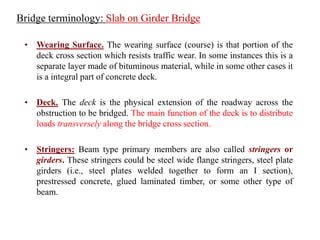
• Wearing Surface. The wearing surface (course) is that portion of the
deck cross section which resists traffic wear. In some instances this is a
separate layer made of bituminous material, while in some other cases it
is a integral part of concrete deck.
• Deck. The deck is the physical extension of the roadway across the
obstruction to be bridged. The main function of the deck is to distribute
loads transversely along the bridge cross section.
• Stringers: Beam type primary members are also called stringers or
girders. These stringers could be steel wide flange stringers, steel plate
girders (i.e., steel plates welded together to form an I section),
prestressed concrete, glued laminated timber, or some other type of
beam.
Bridge terminology: Slab on Girder Bridge
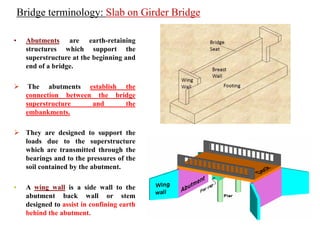
• Abutments are earth-retaining
structures which support the
superstructure at the beginning and
end of a bridge.
 The abutments establish the
connection between the bridge
superstructure and the
embankments.
 They are designed to support the
loads due to the superstructure
which are transmitted through the
bearings and to the pressures of the
soil contained by the abutment.
• A wing wall is a side wall to the
abutment back wall or stem
designed to assist in confining earth
behind the abutment.
Bridge terminology: Slab on Girder Bridge
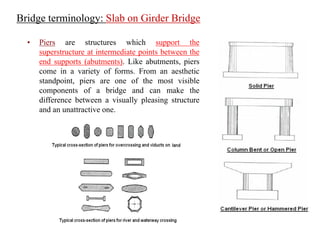
• Piers are structures which support the
superstructure at intermediate points between the
end supports (abutments). Like abutments, piers
come in a variety of forms. From an aesthetic
standpoint, piers are one of the most visible
components of a bridge and can make the
difference between a visually pleasing structure
and an unattractive one.
Bridge terminology: Slab on Girder Bridge
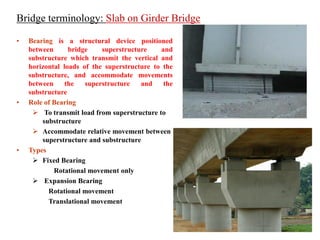
• Bearing is a structural device positioned
between bridge superstructure and
substructure which transmit the vertical and
horizontal loads of the superstructure to the
substructure, and accommodate movements
between the superstructure and the
substructure
• Role of Bearing
 To transmit load from superstructure to
substructure
 Accommodate relative movement between
superstructure and substructure
• Types
 Fixed Bearing
Rotational movement only
 Expansion Bearing
Rotational movement
Translational movement
Bridge terminology: Slab on Girder Bridge
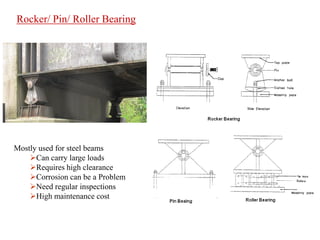
Rocker/ Pin/ Roller Bearing
Mostly used for steel beams
Can carry large loads
Requires high clearance
Corrosion can be a Problem
Need regular inspections
High maintenance cost
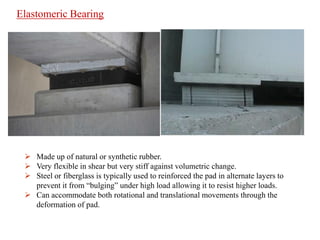
 Made up of natural or synthetic rubber.
 Very flexible in shear but very stiff against volumetric change.
 Steel or fiberglass is typically used to reinforced the pad in alternate layers to
prevent it from “bulging” under high load allowing it to resist higher loads.
 Can accommodate both rotational and translational movements through the
deformation of pad.
Elastomeric Bearing
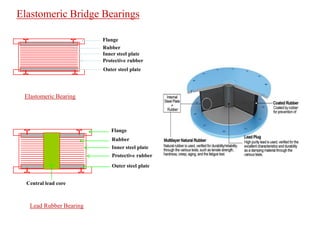
Rubber
Inner steel plate
Outer steel plate
Protective rubber
Flange
Central lead core
Rubber
Inner steel plate
Outer steel plate
Protective rubber
Flange
Elastomeric Bridge Bearings
Elastomeric Bearing
Lead Rubber Bearing

Introduction-to-bridge-engineering.pdf

  • 1.
  • 2.
     A bridgeis a structure providing passage over an obstacle without closing the way beneath. The required passage may be for a road, a railway, pedestrians, a canal or a pipeline. The obstacle to be crossed may be a river, a road, railway or a valley.  In other words, bridge is a structure for carrying the road traffic or other moving loads over a depression or obstruction such as channel, road or railway.  A bridge is an arrangement made to cross an obstacle in the form of a low ground or a stream or a river without closing the way beneath. What is a Bridge?
  • 8.
    Basic types basedon structural form
  • 9.
    Arch Bridge  Archbridges are one of the oldest types of bridges and have great natural strength.  Instead of pushing straight down, the weight of an arch bridge is carried outward along the curve of the arch to the supports at each end.  These supports, called the abutments, carry the load and keep the ends of the bridge from spreading out.
  • 10.
  • 11.
    Beam/Girder Bridge  Themost basic type of bridge.  Typically consists of a beam simply supported on each side by a support and can be made continuous later.  Typically inexpensive to build.
  • 12.
    Beam/Girder Bridge  Currently,most of the beam bridges are precast (in case of RC and PC) or prefabricated  Most are simply-supported  Some are made continuous on site Simply supported Cantilever Continuous
  • 13.
    Beam/Girder Bridge  Currently,most of the beam bridges are precast (in case of RC and PC) or prefabricated  Most are simply-supported  Some are made continuous on site Simply supported Cantilever Continuous
  • 14.
  • 15.
    Cantilever Bridge  Ina cantilever bridge, the roadway is constructed out from the pier in two directions at the same time so that the weight on both sides counterbalance each other  Notice the larger section at the support to resist the negative moments
  • 16.
    Truss Bridge  Allbeams in a truss bridge are straight. Trusses are comprised of many small beams that together can support a large amount of weight and span great distances.  Typical Span lengths: 40m-500m
  • 17.
     Suspension bridgeneeds to have very strong main cables  Cables are anchored at the abutment Suspension Bridges
  • 18.
  • 19.
    Cable-stayed Bridge  Allthe forces are transferred from the deck through the cables to the pylon  Roadway deck can be : 1. (Prestressed) Concrete Box Deck 2. Steel Box Deck 3. Steel Truss Deck
  • 20.
    Moveable Bridges Bascule Lift Swing Amoveable bridge is a bridge that moves to allow passage (usually) for boats or barges.
  • 27.
    Aesthetics : Whatit means? The Four “C’s” of Bridge Aesthetics Context Comprehensive Cost Constructability Aesthetic qualities result from the appropriate arrangement of visual design elements and are used to evaluate a visual composition. These design qualities are intangible; they are perceived qualities that arise from relationships of design elements.
  • 28.
     Context All projectsfrom a simple creek bridge to the longest multi span water crossing must first be considered with a view to the context in which it is located.  Comprehensive The designs that work best are those that take aesthetics in to account right from start.  Cost No discussion of design considerations can be conducted realistically without asking “How much is it going to cost?”.  Constructability No discussion of aesthetics is complete without considering constructability. Aesthetics : What it means?
  • 29.
    Substructure - includesthe piers, the abutments and the foundations. Superstructure - comprises all the components of a bridge above the supports. Bridge Terminology: Slab on Girder Bridge
  • 30.
    Bridge Terminology: Slabon Girder Bridge
  • 31.
    Bridge terminology: Slabon Girder Bridge
  • 32.
    Bridge terminology: Slabon Girder Bridge
  • 33.
    • Primary Members.distribute loads longitudinally and are usually designed principally to resist flexure and shear. • Secondary Members: are bracing between primary members designed to resist cross-sectional deformation of the superstructure frame and help distribute part of the vertical load between stringers. They are also used for the stability of the structure during construction. Bridge terminology: Slab on Girder Bridge
  • 34.
    • Wearing Surface.The wearing surface (course) is that portion of the deck cross section which resists traffic wear. In some instances this is a separate layer made of bituminous material, while in some other cases it is a integral part of concrete deck. • Deck. The deck is the physical extension of the roadway across the obstruction to be bridged. The main function of the deck is to distribute loads transversely along the bridge cross section. • Stringers: Beam type primary members are also called stringers or girders. These stringers could be steel wide flange stringers, steel plate girders (i.e., steel plates welded together to form an I section), prestressed concrete, glued laminated timber, or some other type of beam. Bridge terminology: Slab on Girder Bridge
  • 35.
    • Abutments areearth-retaining structures which support the superstructure at the beginning and end of a bridge.  The abutments establish the connection between the bridge superstructure and the embankments.  They are designed to support the loads due to the superstructure which are transmitted through the bearings and to the pressures of the soil contained by the abutment. • A wing wall is a side wall to the abutment back wall or stem designed to assist in confining earth behind the abutment. Bridge terminology: Slab on Girder Bridge
  • 36.
    • Piers arestructures which support the superstructure at intermediate points between the end supports (abutments). Like abutments, piers come in a variety of forms. From an aesthetic standpoint, piers are one of the most visible components of a bridge and can make the difference between a visually pleasing structure and an unattractive one. Bridge terminology: Slab on Girder Bridge
  • 37.
    • Bearing isa structural device positioned between bridge superstructure and substructure which transmit the vertical and horizontal loads of the superstructure to the substructure, and accommodate movements between the superstructure and the substructure • Role of Bearing  To transmit load from superstructure to substructure  Accommodate relative movement between superstructure and substructure • Types  Fixed Bearing Rotational movement only  Expansion Bearing Rotational movement Translational movement Bridge terminology: Slab on Girder Bridge
  • 38.
    Rocker/ Pin/ RollerBearing Mostly used for steel beams Can carry large loads Requires high clearance Corrosion can be a Problem Need regular inspections High maintenance cost
  • 39.
     Made upof natural or synthetic rubber.  Very flexible in shear but very stiff against volumetric change.  Steel or fiberglass is typically used to reinforced the pad in alternate layers to prevent it from “bulging” under high load allowing it to resist higher loads.  Can accommodate both rotational and translational movements through the deformation of pad. Elastomeric Bearing
  • 40.
    Rubber Inner steel plate Outersteel plate Protective rubber Flange Central lead core Rubber Inner steel plate Outer steel plate Protective rubber Flange Elastomeric Bridge Bearings Elastomeric Bearing Lead Rubber Bearing