Rakesh bhatt
masonry
An assembly or combination of small building units
made of clay, shale, concrete, glass, gypsum, or stone
that are set in mortar.
Masonry consists entirely or partially of hollow or solid
units laid contiguously in mortar.
Brick masonry
 Brick masonry is widely used in many forms of
construction, landscaping and hardscaping industries.
 Ever since the days of the Mesopotamians, brick masonry
has been used to build houses and other forms of shelter,
as well as pathways, decks, steps and walls. Amongst all the
different types of building materials available, brick
masonry is the most popular.
Main Constituents
Brick
Water
mortar
BRICKS (IS:1077-1992)
 A solid masonry unit of clay or shale, formed into a
rectangular prism while plastic and burned or fired in
a kiln.
Standard size of modular brick is 190×90×90 mm
and non modular brick is 229×111×760 mm but
taken as 230×110× 70 as per IS:1077.
Weight of brick is about 3kg.
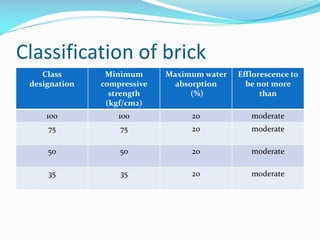
Classification of brick
Class
designation
Minimum
compressive
strength
(kgf/cm2)
Maximum water
absorption
(%)
Efflorescence to
be not more
than
100 100 20 moderate
75 75 20 moderate
50 50 20 moderate
35 35 20 moderate
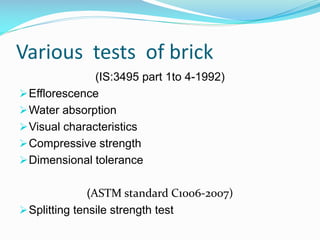
Various tests of brick
(IS:3495 part 1to 4-1992)
Efflorescence
Water absorption
Visual characteristics
Compressive strength
Dimensional tolerance
(ASTM standard C1006-2007)
Splitting tensile strength test
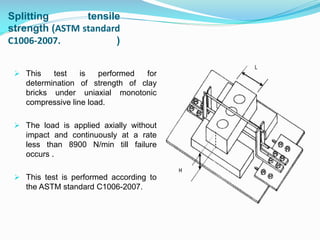
Splitting tensile
strength (ASTM standard
C1006-2007. )
 This test is performed for
determination of strength of clay
bricks under uniaxial monotonic
compressive line load.
 The load is applied axially without
impact and continuously at a rate
less than 8900 N/min till failure
occurs .
 This test is performed according to
the ASTM standard C1006-2007.
Terminology
• Bat
• Lap
• Arris
• Bond
• Closer
• Header
• Stretcher
• King closer
• Queen closer
• Header bond
• English bond
• Stretcher bond
WATER (IS:3025-1986)
Water used for mixing and curing should be
clean and free from injurious quantities and
substances that may be deleterious to brick.
Potable water is generally used (ph not less than
6).
Before use all the care related to water should be
done as per IS 3025.
Mortar ( IS:2116, IS: 2250)
Mortar is a mixture of : water , cement or lime
and sand , form a smooth pest.
Key to forming a strong and durable bond with
masonry units
It binds the units together into one mass, so that
masonry may effectively perform its function.
In general, it is 3-types :cement mortar, lime
mortar, cement lime mortar.
Properties of mortar
• Strength
• Durability
• Workability
• Water retentivity
• Rate of stiffening
• Resistance to rain penetration
Main tests on brick masonry
 flexural bond strength test
 Compressive strength test
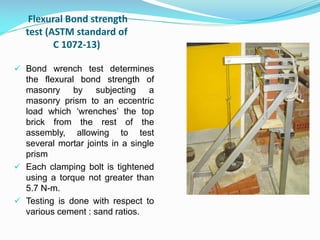
Flexural Bond strength
test (ASTM standard of
C 1072-13)
 Bond wrench test determines
the flexural bond strength of
masonry by subjecting a
masonry prism to an eccentric
load which ‘wrenches’ the top
brick from the rest of the
assembly, allowing to test
several mortar joints in a single
prism
 Each clamping bolt is tightened
using a torque not greater than
5.7 N-m.
 Testing is done with respect to
various cement : sand ratios.
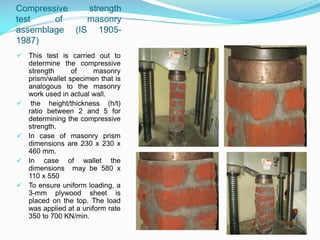
Compressive strength
test of masonry
assemblage (IS 1905-
1987)
 This test is carried out to
determine the compressive
strength of masonry
prism/wallet specimen that is
analogous to the masonry
work used in actual wall.
 the height/thickness (h/t)
ratio between 2 and 5 for
determining the compressive
strength.
 In case of masonry prism
dimensions are 230 x 230 x
460 mm.
 In case of wallet the
dimensions may be 580 x
110 x 550
 To ensure uniform loading, a
3-mm plywood sheet is
placed on the top. The load
was applied at a uniform rate
350 to 700 KN/min.
Why bricks and brick masonry
 The raw materials in brick are chemically inert so it does
not contribute to any air pollution in your home.
 Studies show that homes made with brick lower heating
and cooling costs .
 Brick typically will not require painting and so can provide
a structure with reduced life-cycle costs.
 Masonry is very heat resistant and thus provides good
fire protection.
 Masonry structures built in compression preferably with
lime mortar can have a useful life of more than 500 years
as compared to 30 to 100 for structures of steel or
reinforced concrete.
 Brick is a load bearing material.
 Brick is one of the oldest building materials.
 is pest, weather and fire resistant.
 Aesthetic aspect.
 Thermal & Acoustic Insulation.
 Zero Maintenance Cost.
 Fire Resistance.
 Temperature Control.
 Easy Maintenance.
 Increased Home Value.
Thank You
Rakesh bhatt civil
Rakesh bhatt civil

Brick masonry

  • 1.
  • 2.
    masonry An assembly orcombination of small building units made of clay, shale, concrete, glass, gypsum, or stone that are set in mortar. Masonry consists entirely or partially of hollow or solid units laid contiguously in mortar.
  • 3.
    Brick masonry  Brickmasonry is widely used in many forms of construction, landscaping and hardscaping industries.  Ever since the days of the Mesopotamians, brick masonry has been used to build houses and other forms of shelter, as well as pathways, decks, steps and walls. Amongst all the different types of building materials available, brick masonry is the most popular.
  • 4.
  • 5.
    BRICKS (IS:1077-1992)  Asolid masonry unit of clay or shale, formed into a rectangular prism while plastic and burned or fired in a kiln. Standard size of modular brick is 190×90×90 mm and non modular brick is 229×111×760 mm but taken as 230×110× 70 as per IS:1077. Weight of brick is about 3kg.
  • 6.
    Classification of brick Class designation Minimum compressive strength (kgf/cm2) Maximumwater absorption (%) Efflorescence to be not more than 100 100 20 moderate 75 75 20 moderate 50 50 20 moderate 35 35 20 moderate
  • 7.
    Various tests ofbrick (IS:3495 part 1to 4-1992) Efflorescence Water absorption Visual characteristics Compressive strength Dimensional tolerance (ASTM standard C1006-2007) Splitting tensile strength test
  • 8.
    Splitting tensile strength (ASTMstandard C1006-2007. )  This test is performed for determination of strength of clay bricks under uniaxial monotonic compressive line load.  The load is applied axially without impact and continuously at a rate less than 8900 N/min till failure occurs .  This test is performed according to the ASTM standard C1006-2007.
  • 9.
    Terminology • Bat • Lap •Arris • Bond • Closer • Header • Stretcher • King closer • Queen closer • Header bond • English bond • Stretcher bond
  • 10.
    WATER (IS:3025-1986) Water usedfor mixing and curing should be clean and free from injurious quantities and substances that may be deleterious to brick. Potable water is generally used (ph not less than 6). Before use all the care related to water should be done as per IS 3025.
  • 11.
    Mortar ( IS:2116,IS: 2250) Mortar is a mixture of : water , cement or lime and sand , form a smooth pest. Key to forming a strong and durable bond with masonry units It binds the units together into one mass, so that masonry may effectively perform its function. In general, it is 3-types :cement mortar, lime mortar, cement lime mortar.
  • 12.
    Properties of mortar •Strength • Durability • Workability • Water retentivity • Rate of stiffening • Resistance to rain penetration
  • 13.
    Main tests onbrick masonry  flexural bond strength test  Compressive strength test
  • 14.
    Flexural Bond strength test(ASTM standard of C 1072-13)  Bond wrench test determines the flexural bond strength of masonry by subjecting a masonry prism to an eccentric load which ‘wrenches’ the top brick from the rest of the assembly, allowing to test several mortar joints in a single prism  Each clamping bolt is tightened using a torque not greater than 5.7 N-m.  Testing is done with respect to various cement : sand ratios.
  • 15.
    Compressive strength test ofmasonry assemblage (IS 1905- 1987)  This test is carried out to determine the compressive strength of masonry prism/wallet specimen that is analogous to the masonry work used in actual wall.  the height/thickness (h/t) ratio between 2 and 5 for determining the compressive strength.  In case of masonry prism dimensions are 230 x 230 x 460 mm.  In case of wallet the dimensions may be 580 x 110 x 550  To ensure uniform loading, a 3-mm plywood sheet is placed on the top. The load was applied at a uniform rate 350 to 700 KN/min.
  • 16.
    Why bricks andbrick masonry
  • 17.
     The rawmaterials in brick are chemically inert so it does not contribute to any air pollution in your home.  Studies show that homes made with brick lower heating and cooling costs .  Brick typically will not require painting and so can provide a structure with reduced life-cycle costs.  Masonry is very heat resistant and thus provides good fire protection.  Masonry structures built in compression preferably with lime mortar can have a useful life of more than 500 years as compared to 30 to 100 for structures of steel or reinforced concrete.  Brick is a load bearing material.
  • 18.
     Brick isone of the oldest building materials.  is pest, weather and fire resistant.  Aesthetic aspect.  Thermal & Acoustic Insulation.  Zero Maintenance Cost.  Fire Resistance.  Temperature Control.  Easy Maintenance.  Increased Home Value.
  • 19.
  • 20.
  • 21.