Anatomy of Breast
Dr. Animesh Agrawal
Dr Ram Manohar Lohia Institute of Medical Sciences, Lucknow
Topics covered
• Anatomy
• Radiological anatomy
• Radiotherapy planning associated
radiological anatomy
• Modified sweat gland / apocrine gland /
Mammary gland
• Present in both sexes.
• Rudimentary in male, well developed in
female after puberty.
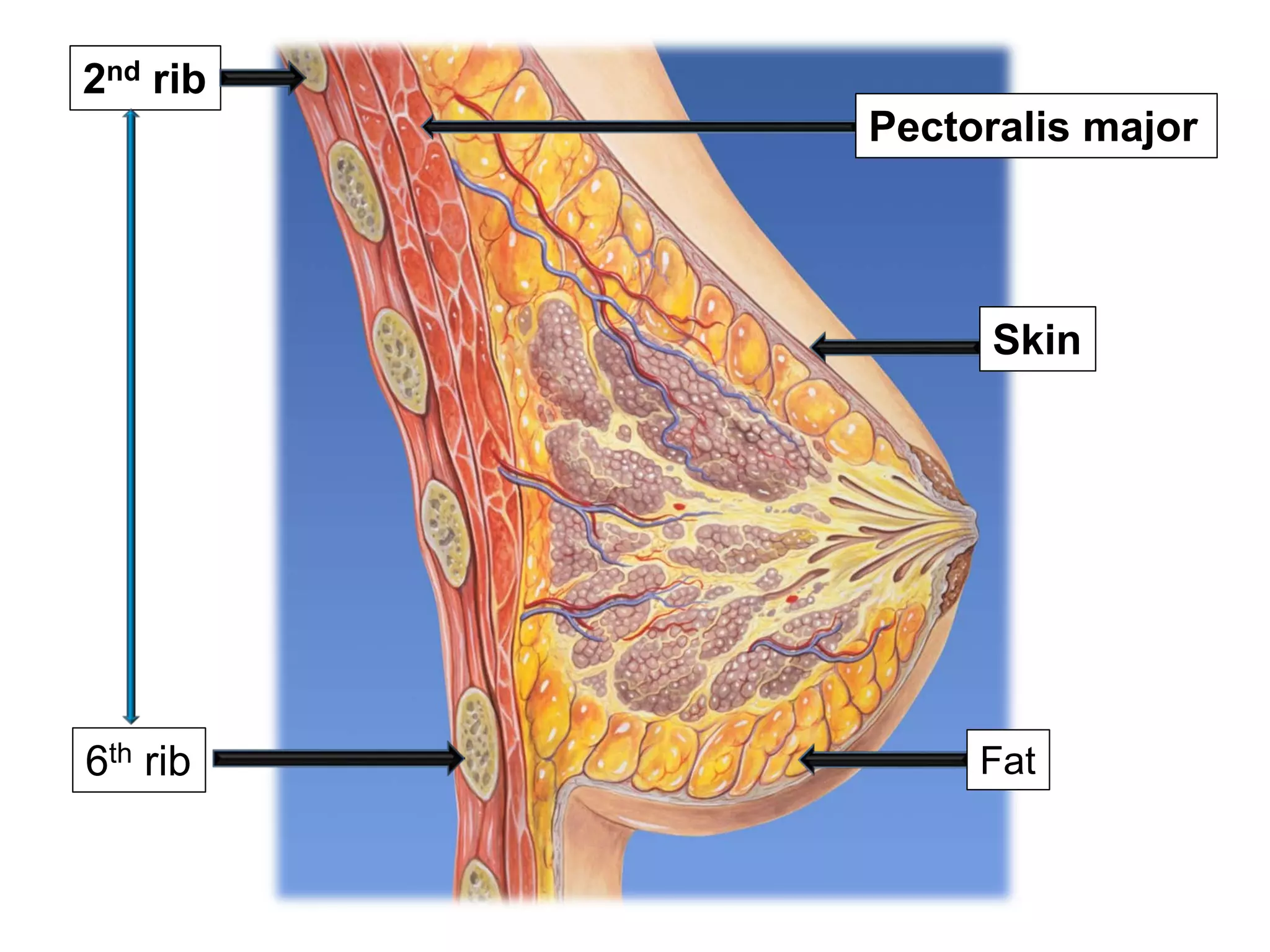
- Situated within the superficial pectoral fascia.
- The superficial fascia splits to enclose the breast to
form the anterior and posterior lamellae.
• Extent:
• Vertically: 2nd to 6th ribs (from the clavicle above to
the 7th/8th rib below
• Horizontally: Midline/lateral border of sternum to
mid-axillary line.
Location and Extent
2nd rib
Pectoralis major
Skin
Fat6th rib
• The floor is formed by the deep pectoral fascia.
• This overlies pectoralis major and serratus anterior
superiorly and external oblique and its aponeurosis
inferiorly.
Floor
Pectoralis
major
Serratus
anterior
External
oblique
Breast in section
Pectoralis minor
Pectoralis major
Pectoral fascia
Suspensory ligament
Submammary space
Deep fascia
Superficial fascia
Adipose tissue
Rib
Secretory lobule
Non lactating
breast
Breast during
lactation
Muscles Anatomical significance Clinical significance
Pectoralis
major
1. Major muscle mass posterior to
breast
2. Lymphatics from breast pierce
and circumvent it.
1. Excised in radical
mastectomy
2. Anterior fascia is
removed in MRM.
Pectoralis
minor
1. Superior portion crosses anterior
to axillary sheath, dividing the axilla
into low, mid and high regions.
2. Interpectoral nodes lie
immediately anterior.
1. Landmark for Axillary
nodal levels.
2. Excised in modified
(Patey’s) mastectomy.
Serratus
anterior
1. Medial wall of axilla
2. Major muscle mass deep to lateral
one-third of breast
1. Responsible for winging
of scapula in long thoracic
nerve injury
Latissimus
dorsi
1. Post wall of axilla
2. Fascia continuous with axillary
fascia
1. Anterior border is lateral
limit of dissection
2. Used as myocutaneous
flap for breast
reconstruction.
* Other muscles like subclavius, rectus abdominis and external oblique may
come into relation and are exposed during mastectomy.
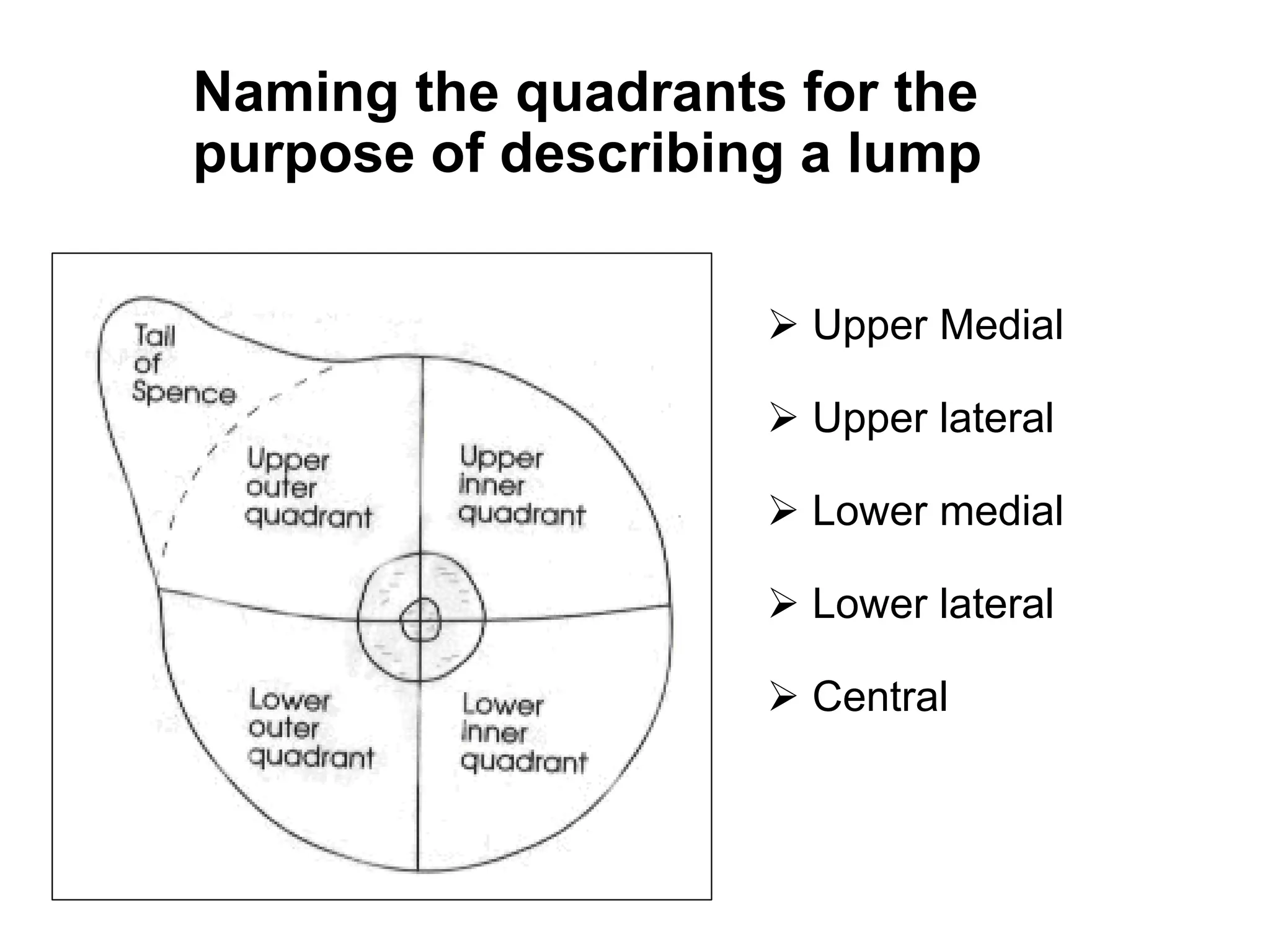
Naming the quadrants for the
purpose of describing a lump
 Upper Medial
 Upper lateral
 Lower medial
 Lower lateral
 Central
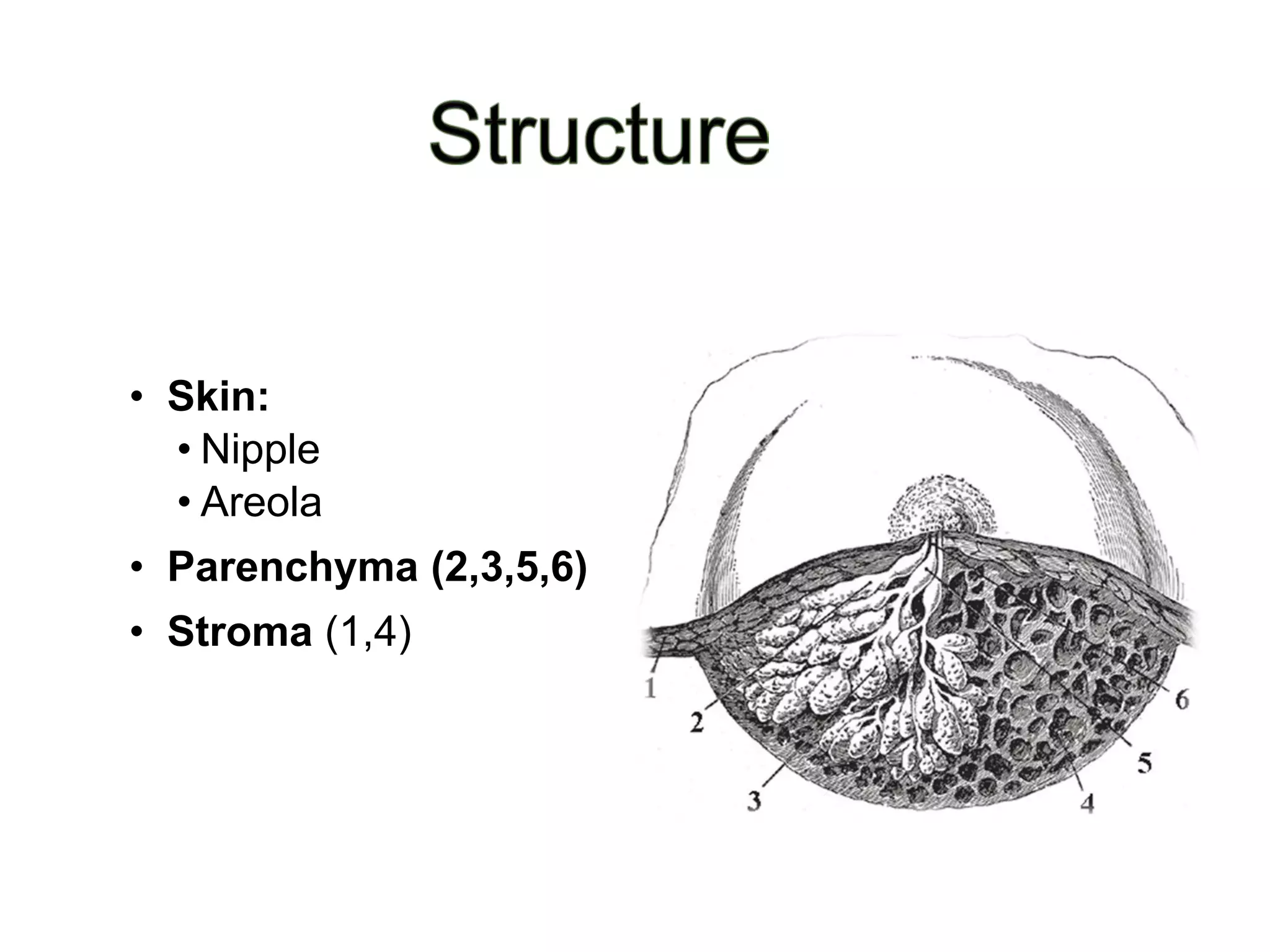
• Skin:
• Nipple
• Areola
• Parenchyma (2,3,5,6)
• Stroma (1,4)
Skin
Tubercle of Montgomery
Nipple
Areola
• The nipple is composed mostly of collagenous dense
connective tissue and contains numerous elastic fibres
which wrinkle the overlying skin.
• Usually lies above the inframammary crease, level with
the 4th rib (just lateral to the midclavicular line).
• The average nipple to sternal notch measurement in a
youthful, well-developed breast is 21-22 cm.
• An equilateral triangle formed between the nipples and
sternal notch measures an average of 21 cm per side.
Maxwell GP, Gabriel A. Breast Reconstruction. Aesthetic Plastic Surgery. (2009)
The Nipple
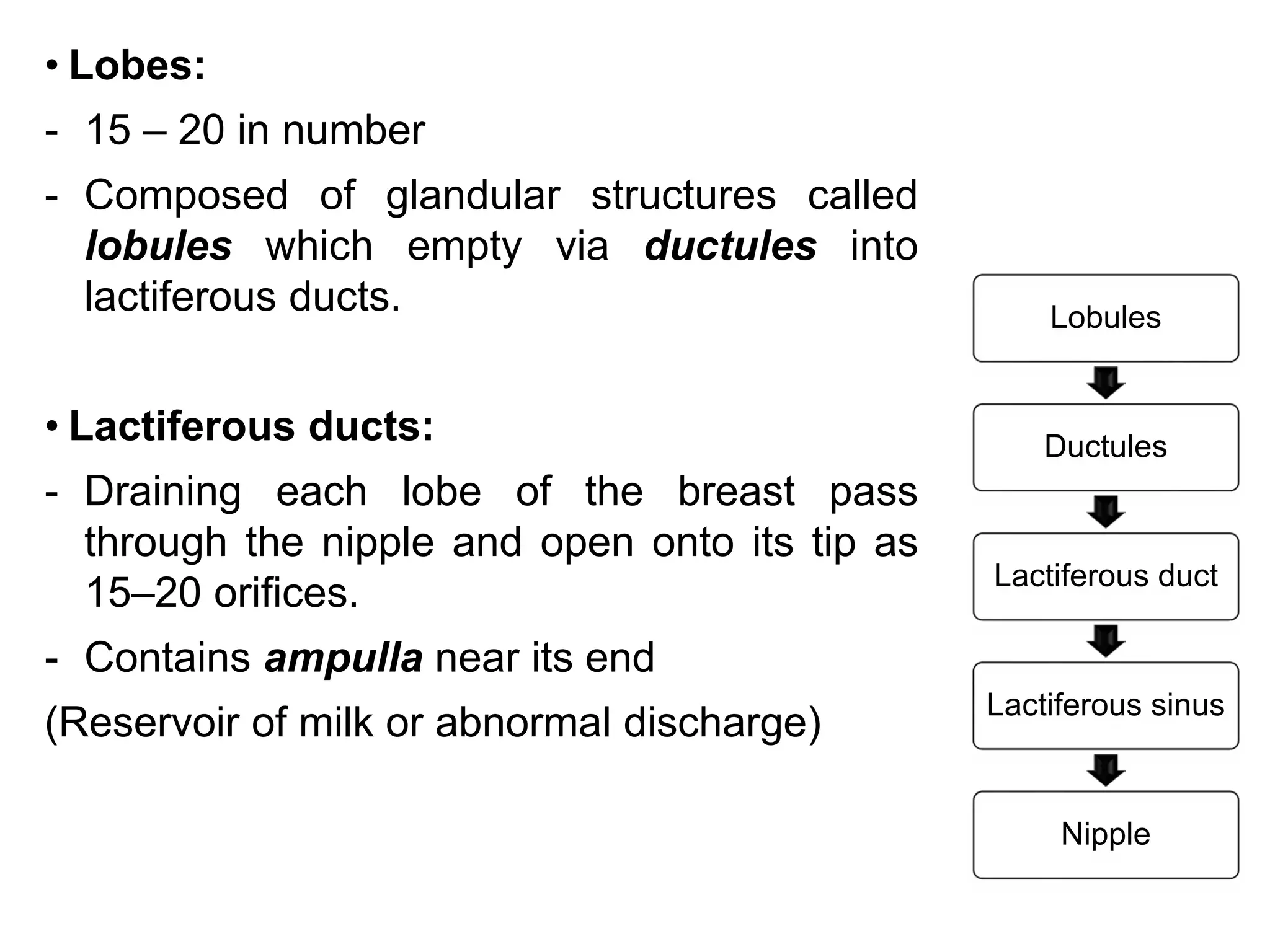
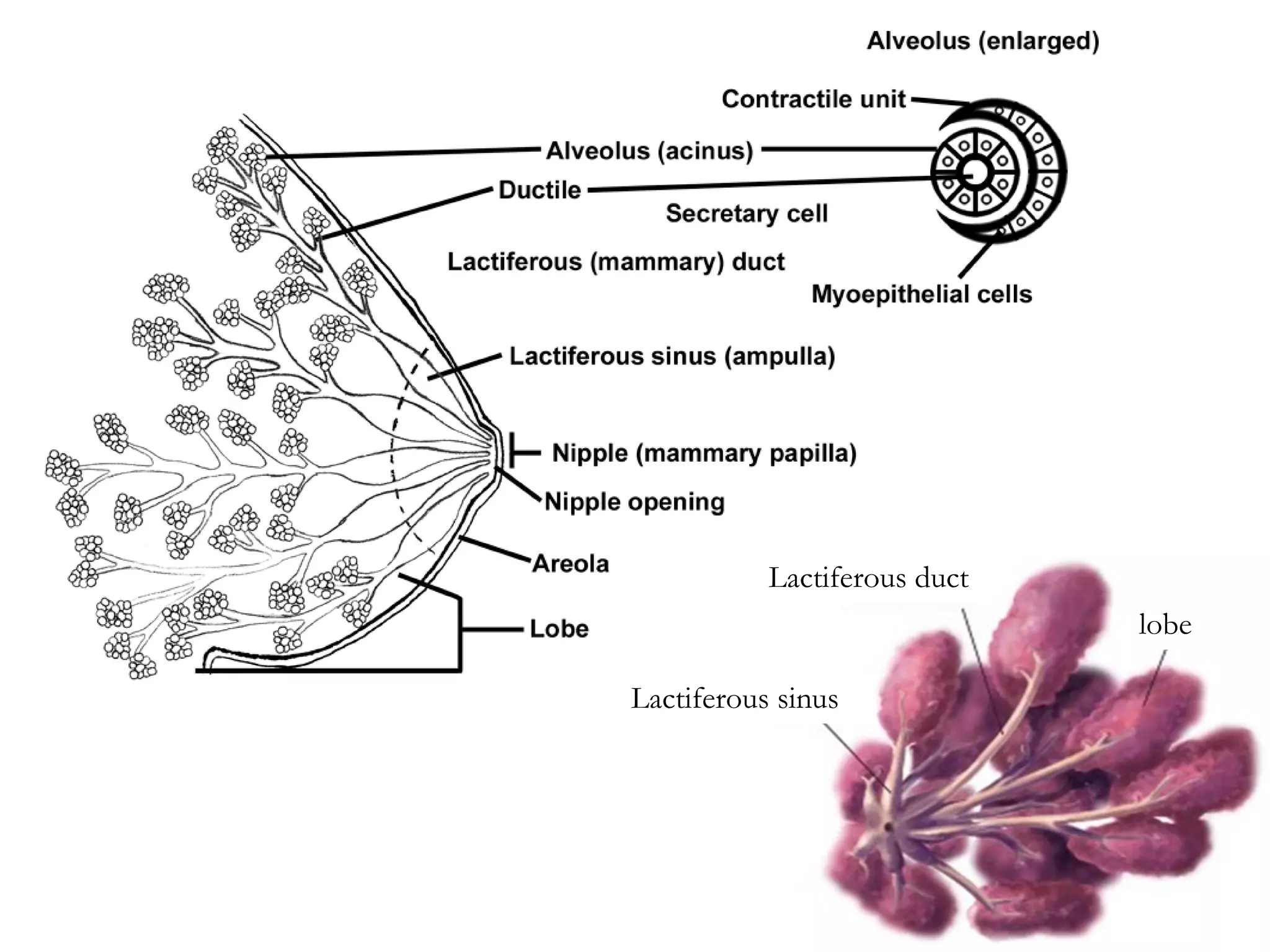
• Lobes:
- 15 – 20 in number
- Composed of glandular structures called
lobules which empty via ductules into
lactiferous ducts.
• Lactiferous ducts:
- Draining each lobe of the breast pass
through the nipple and open onto its tip as
15–20 orifices.
- Contains ampulla near its end
(Reservoir of milk or abnormal discharge)
Lobules
Ductules
Lactiferous duct
Lactiferous sinus
Nipple
lobe
Lactiferous duct
Lactiferous sinus
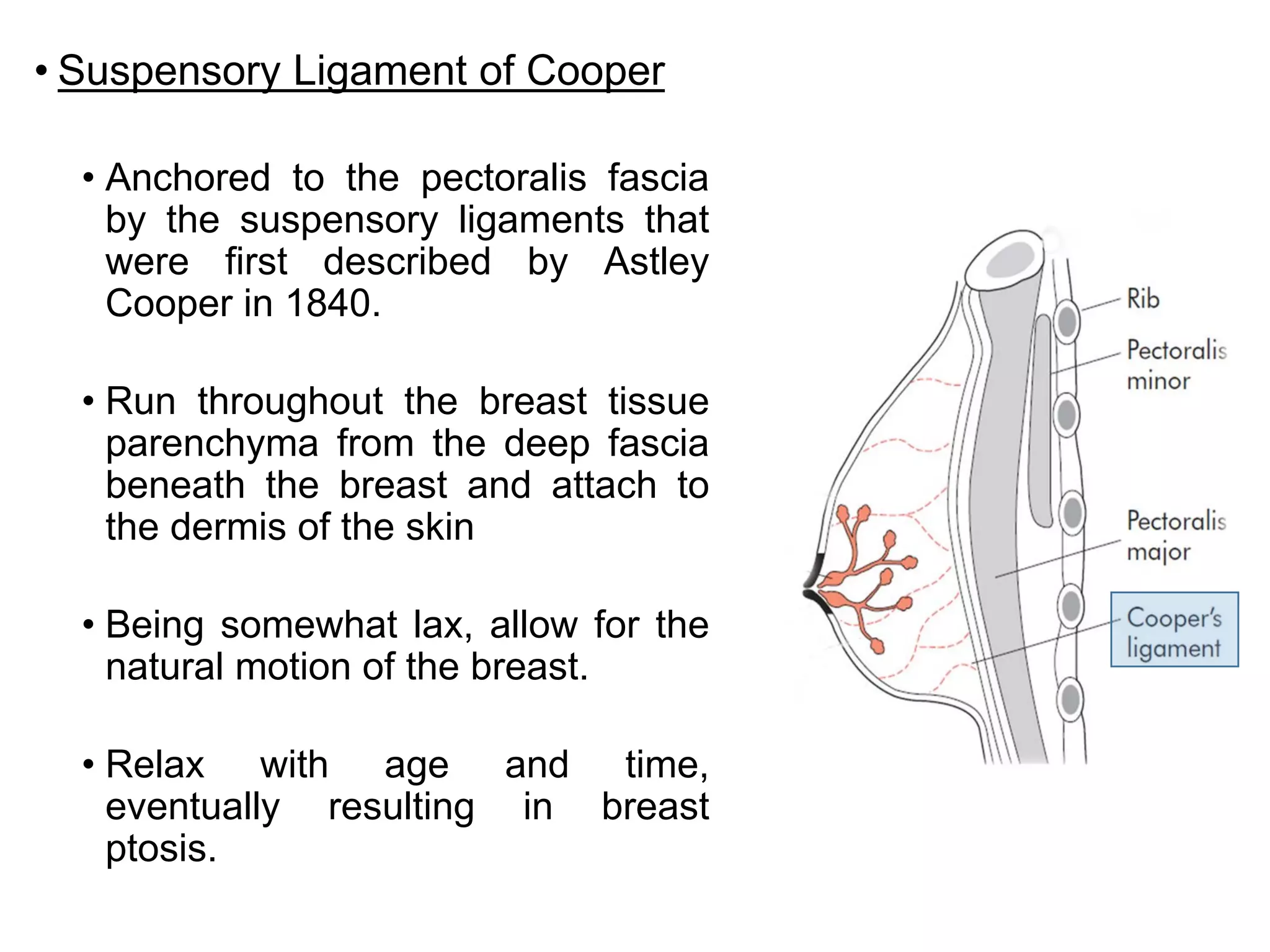
• Suspensory Ligament of Cooper
• Anchored to the pectoralis fascia
by the suspensory ligaments that
were first described by Astley
Cooper in 1840.
• Run throughout the breast tissue
parenchyma from the deep fascia
beneath the breast and attach to
the dermis of the skin
• Being somewhat lax, allow for the
natural motion of the breast.
• Relax with age and time,
eventually resulting in breast
ptosis.
Arterial Supply, Venous drainage,
Nerve supply
• Axillary artery
• Superior thoracic
• Thoracoacromial artery
• Lateral thoracic artery
• Subscapular artery.
• Internal thoracic:
• Perforating branches to the
anteromedial breast.
• The second to fourth anterior
intercostal arteries.
• The second perforating artery
is usually the largest; supplies
the upper region of the breast,
the nipple, areola and
adjacent breast.
Posterior surface is relatively avascular.
Blood Supply
Internal thoracic
artery
Axillary artery
Lateral thoracic
artery
Superior thoracic artery
Acromiothoracic
artery
Posterior intercostal
arteries
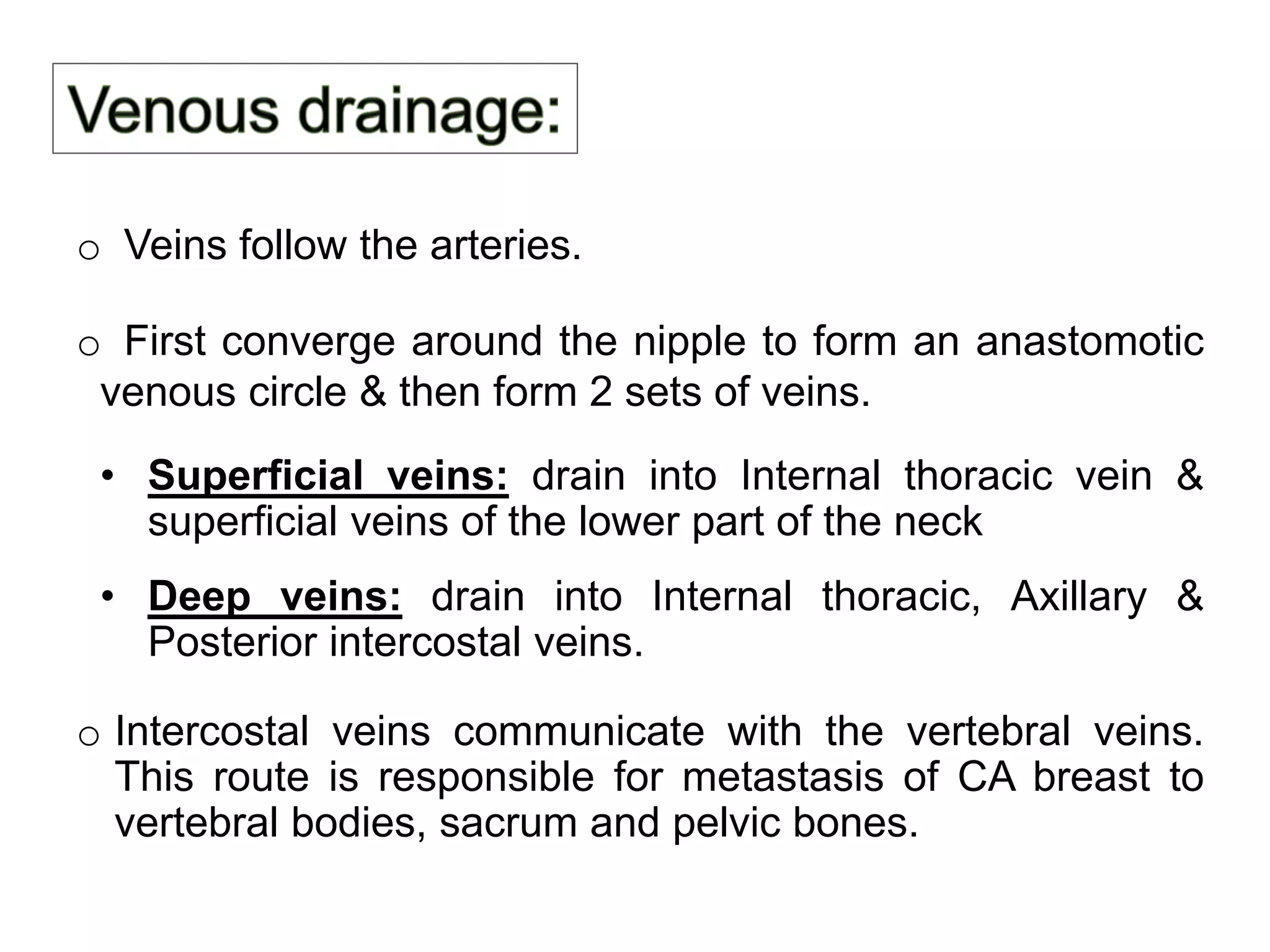
o Veins follow the arteries.
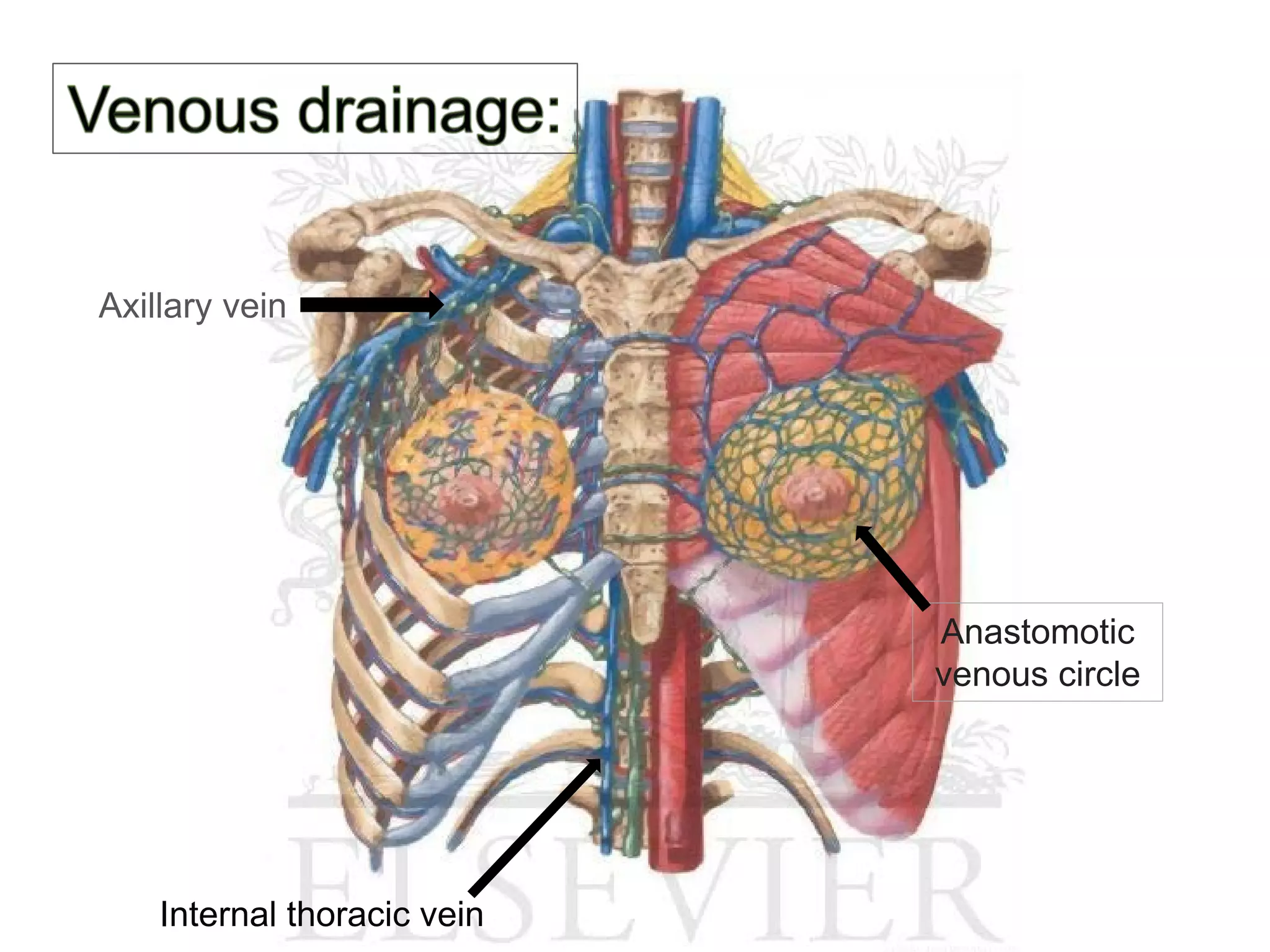
o First converge around the nipple to form an anastomotic
venous circle & then form 2 sets of veins.
• Superficial veins: drain into Internal thoracic vein &
superficial veins of the lower part of the neck
• Deep veins: drain into Internal thoracic, Axillary &
Posterior intercostal veins.
o Intercostal veins communicate with the vertebral veins.
This route is responsible for metastasis of CA breast to
vertebral bodies, sacrum and pelvic bones.
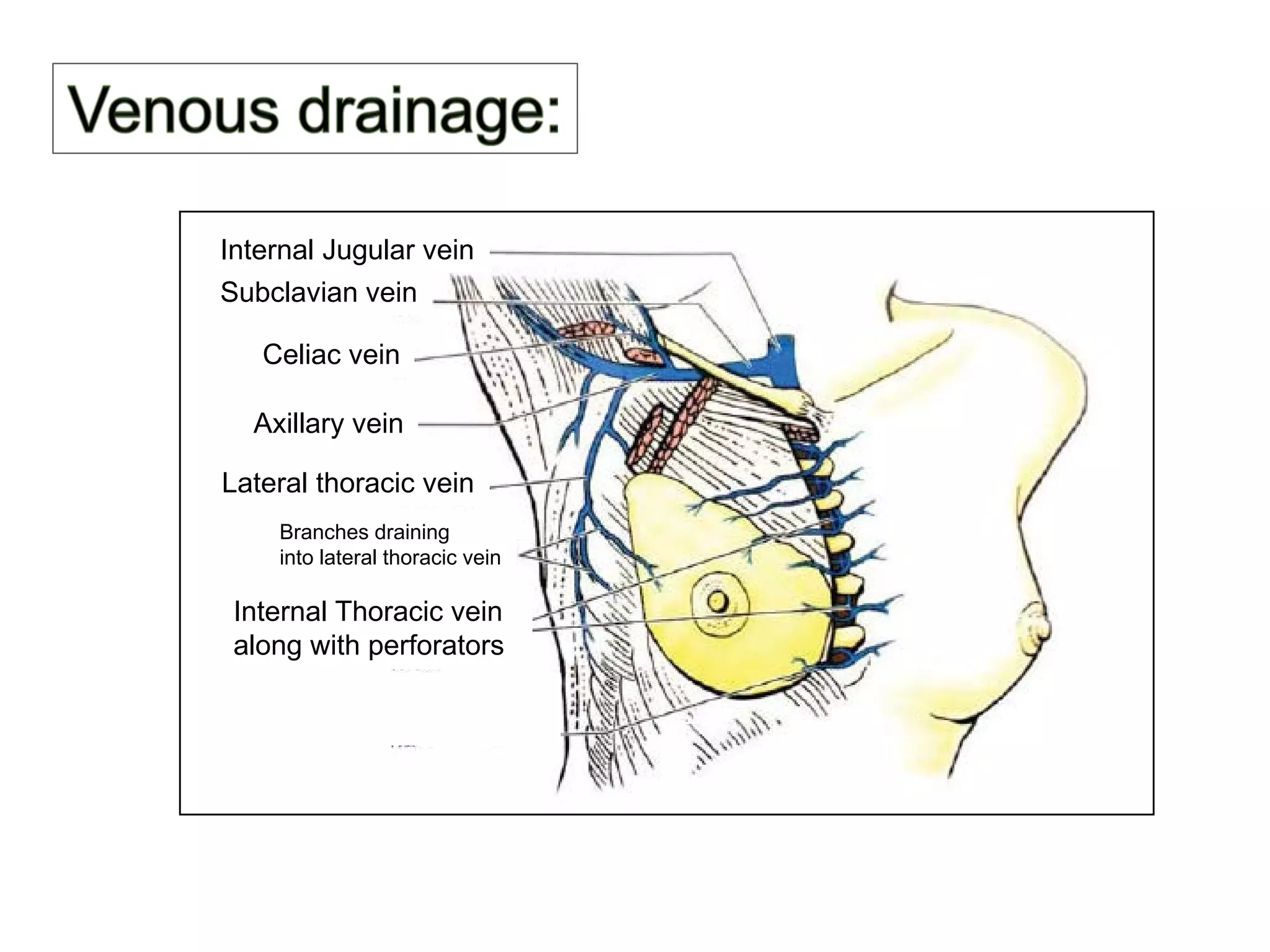
Internal Jugular vein
Subclavian vein
Celiac vein
Axillary vein
Lateral thoracic vein
Branches draining
into lateral thoracic vein
Internal Thoracic vein
along with perforators
Internal thoracic vein
Axillary vein
Anastomotic
venous circle
• 4th to 6th intercostal nerves by their Anterior & Lateral
cutaneous branches
• The nipple is supplied from the anterior branch of the
lateral cutaneous branch of T4
• Forms an extensive plexus within the nipple; its sensory fibres
terminate close to the epithelium as free endings, Meissner
corpuscles and Merkel disc endings. These are essential in
signaling suckling to the central nervous system.
• Secretory activities of the gland are largely controlled by
ovarian and hypophyseal hormones rather than by
efferent motor fibers.
• The areola has fewer sensory endings.
Long thoracic nerve
Posterior branches
lateral abdominal
cutaneous nerves
Anterior branches
lateral abdominal
cutaneous nerves
lateral mammary branch of
lateral pectoral cutaneous
branch of intercostal nerve
T4Intercostobrachial
nerves
Lymphatic Drainage
Introduction
• The breast is originally an ectodermal tissue, thus its
lymphatic drainage is mostly parallel to the lymph flow of
the overlying skin.
• The lymphatic flow of the breast is of great clinical
significance because metastatic dissemination occurs
principally by the lymphatic routes.
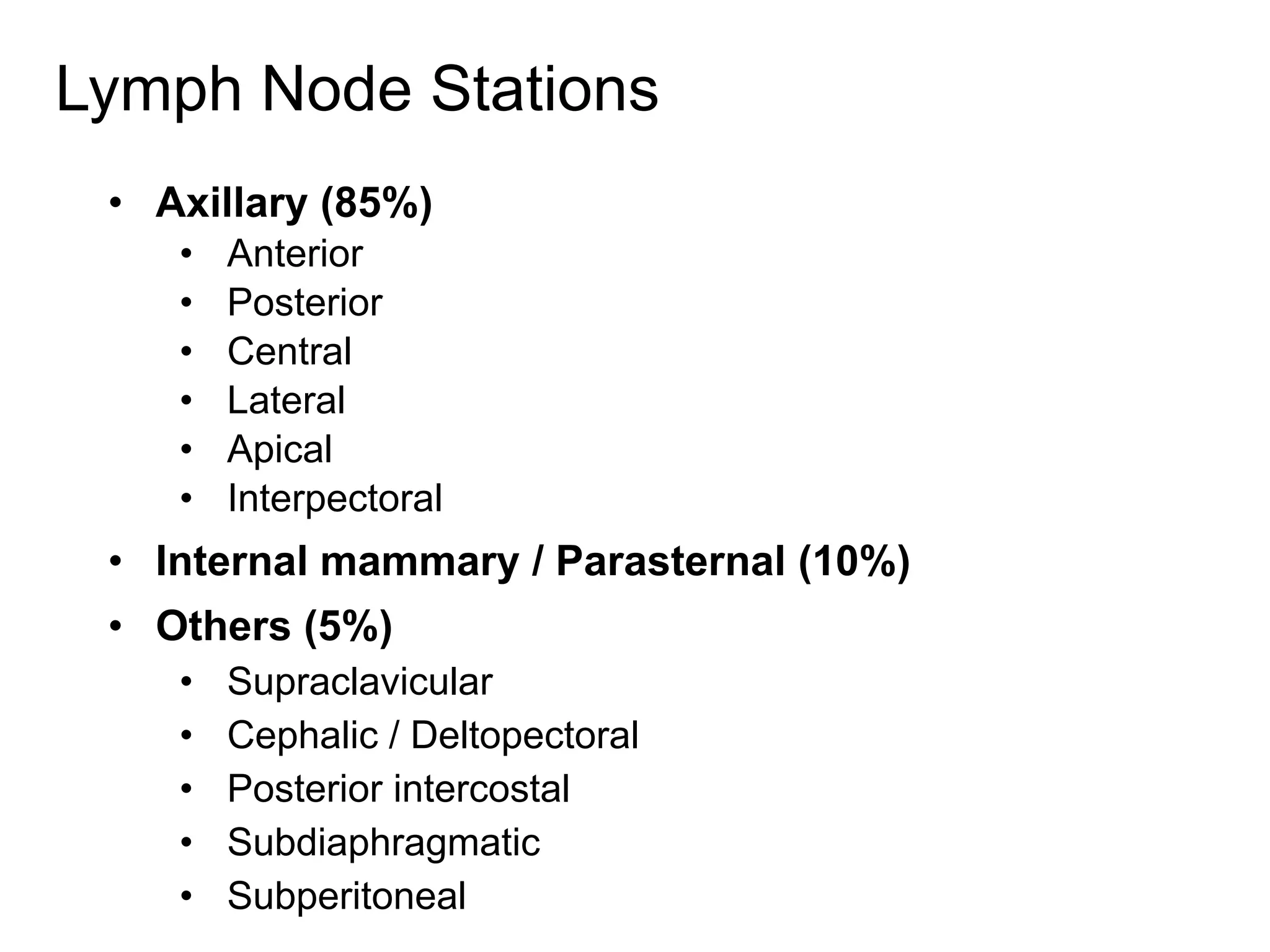
• Axillary (85%)
• Anterior
• Posterior
• Central
• Lateral
• Apical
• Interpectoral
• Internal mammary / Parasternal (10%)
• Others (5%)
• Supraclavicular
• Cephalic / Deltopectoral
• Posterior intercostal
• Subdiaphragmatic
• Subperitoneal
Lymph Node Stations
The axillary lymph nodes
• These are some 20–40 in number, grouped as
• Only the apical group is terminal.
- Anterior (4-5) Lying deep to pectoralis major along the lower border
of pectoralis minor.
- Posterior (6-7) along the subscapular vessels
- Lateral (4-6) along the axillary vein
- Central (3-4) In the axillary fat
- Apical (6-12) Through which all the other axillary nodes drain, at the
apex of the axilla above pectoralis minor and along the
medial side of the axillary vein
Lateral
Central
Posterior
Apical
Anterior
Interpectoral
Internal mammary
• A few efferents from apical nodes usually reach the inferior deep
cervical nodes (supraclavicular nodes).
Other lymph nodes
• Internal mammary or parasternal nodes: They are variable in
number and lie along the internal mammary vessels deep to
the plane of the costal cartilages.
• Most are near the bifurcation of the intercostal and internal
mammary veins.
• Efferents drain into the jugular veins.
• Inter pectoral nodes (rotter’s nodes): A few nodes lying
between the pectoralis major and minor muscles.
• Supraclavicular and other nodes: Some lymph from the
breast also reaches the supraclavicular nodes, deltopectoral
nodes, posterior intercostal nodes, subdiaphragmatic and
sub peritoneal plexuses.
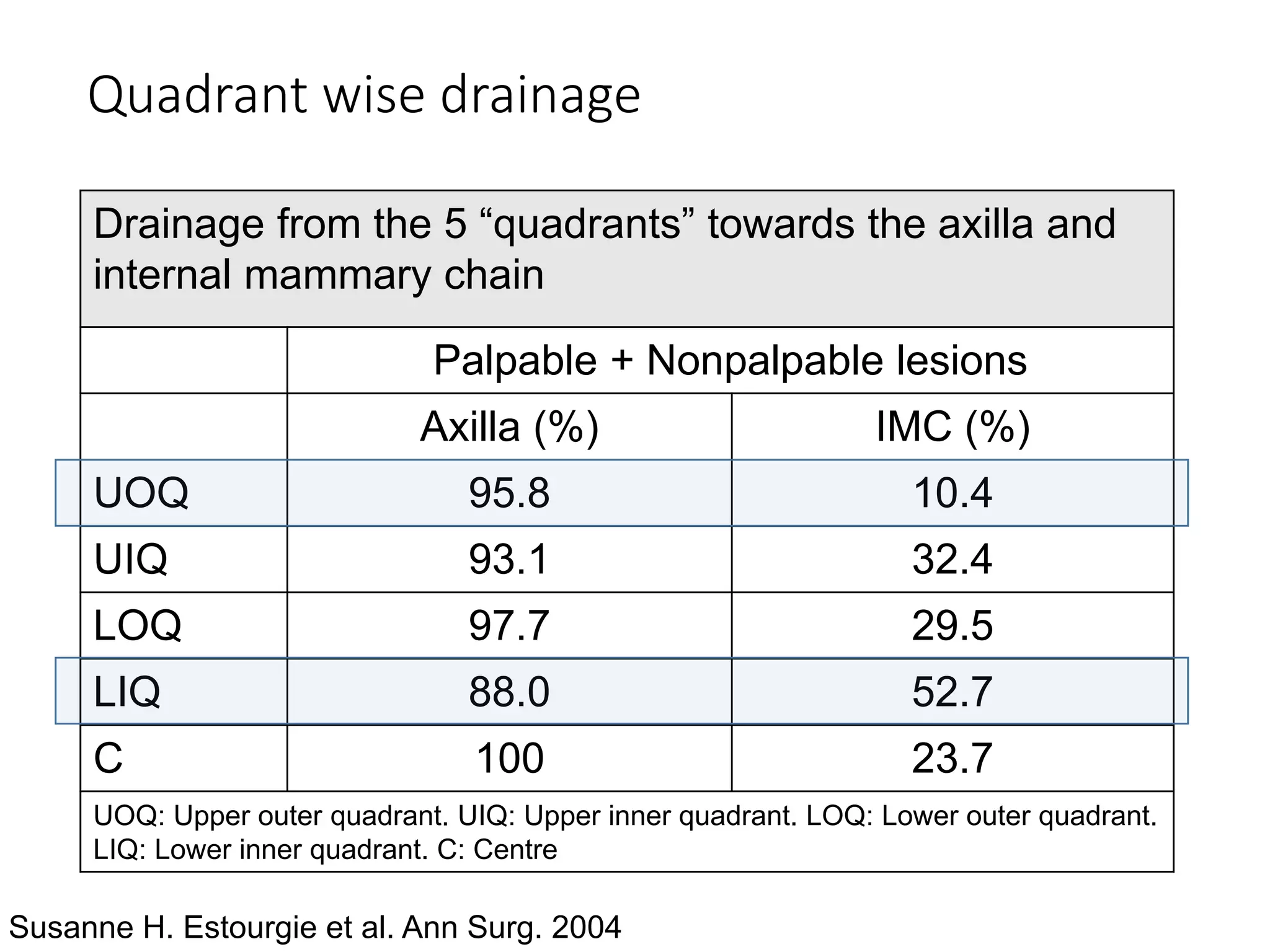
Quadrant wise drainage
Drainage from the 5 “quadrants” towards the axilla and
internal mammary chain
Palpable + Nonpalpable lesions
Axilla (%) IMC (%)
UOQ 95.8 10.4
UIQ 93.1 32.4
LOQ 97.7 29.5
LIQ 88.0 52.7
C 100 23.7
UOQ: Upper outer quadrant. UIQ: Upper inner quadrant. LOQ: Lower outer quadrant.
LIQ: Lower inner quadrant. C: Centre
Susanne H. Estourgie et al. Ann Surg. 2004
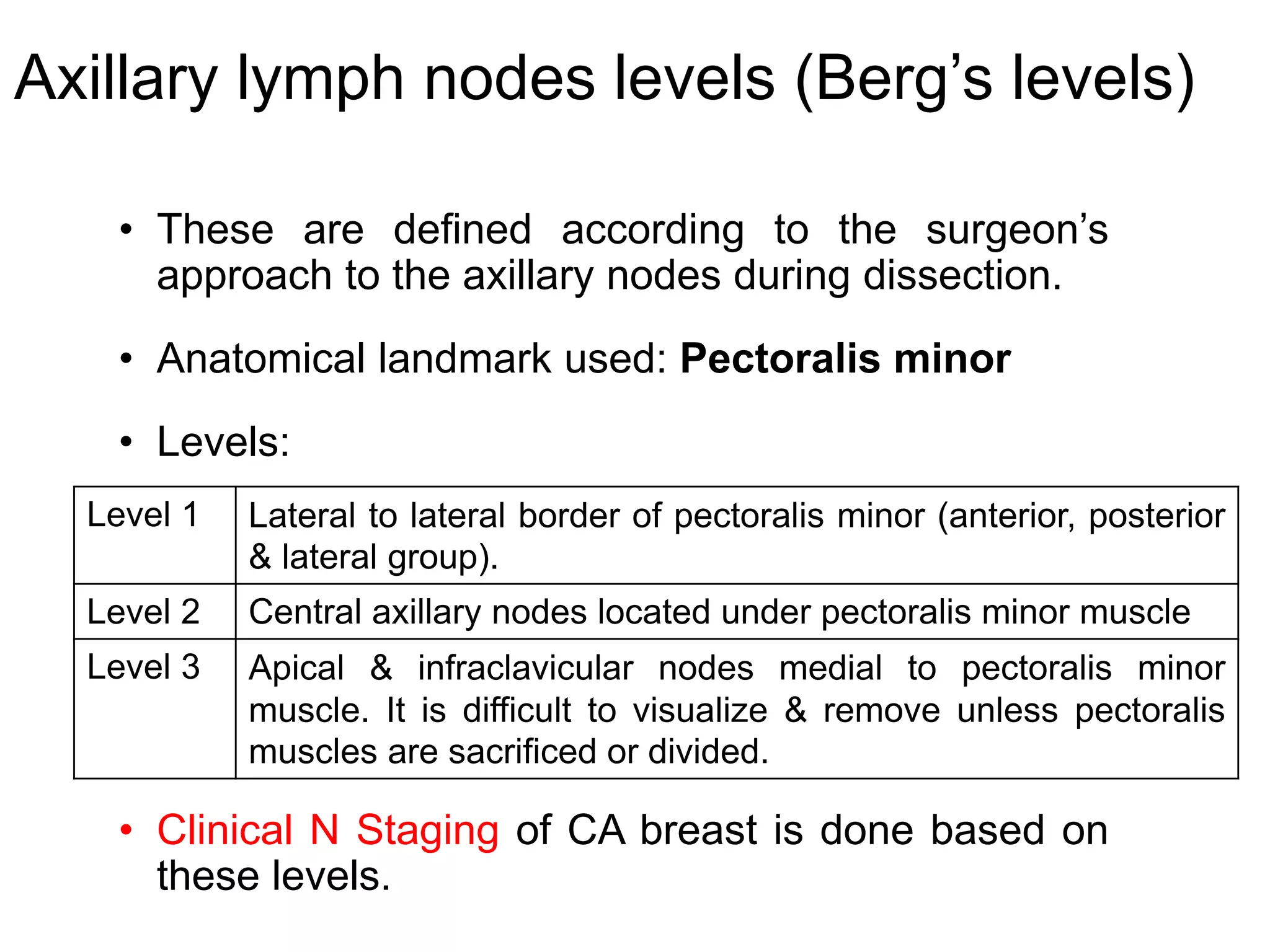
• These are defined according to the surgeon’s
approach to the axillary nodes during dissection.
• Anatomical landmark used: Pectoralis minor
• Levels:
• Clinical N Staging of CA breast is done based on
these levels.
Axillary lymph nodes levels (Berg’s levels)
Level 1 Lateral to lateral border of pectoralis minor (anterior, posterior
& lateral group).
Level 2 Central axillary nodes located under pectoralis minor muscle
Level 3 Apical & infraclavicular nodes medial to pectoralis minor
muscle. It is difficult to visualize & remove unless pectoralis
muscles are sacrificed or divided.
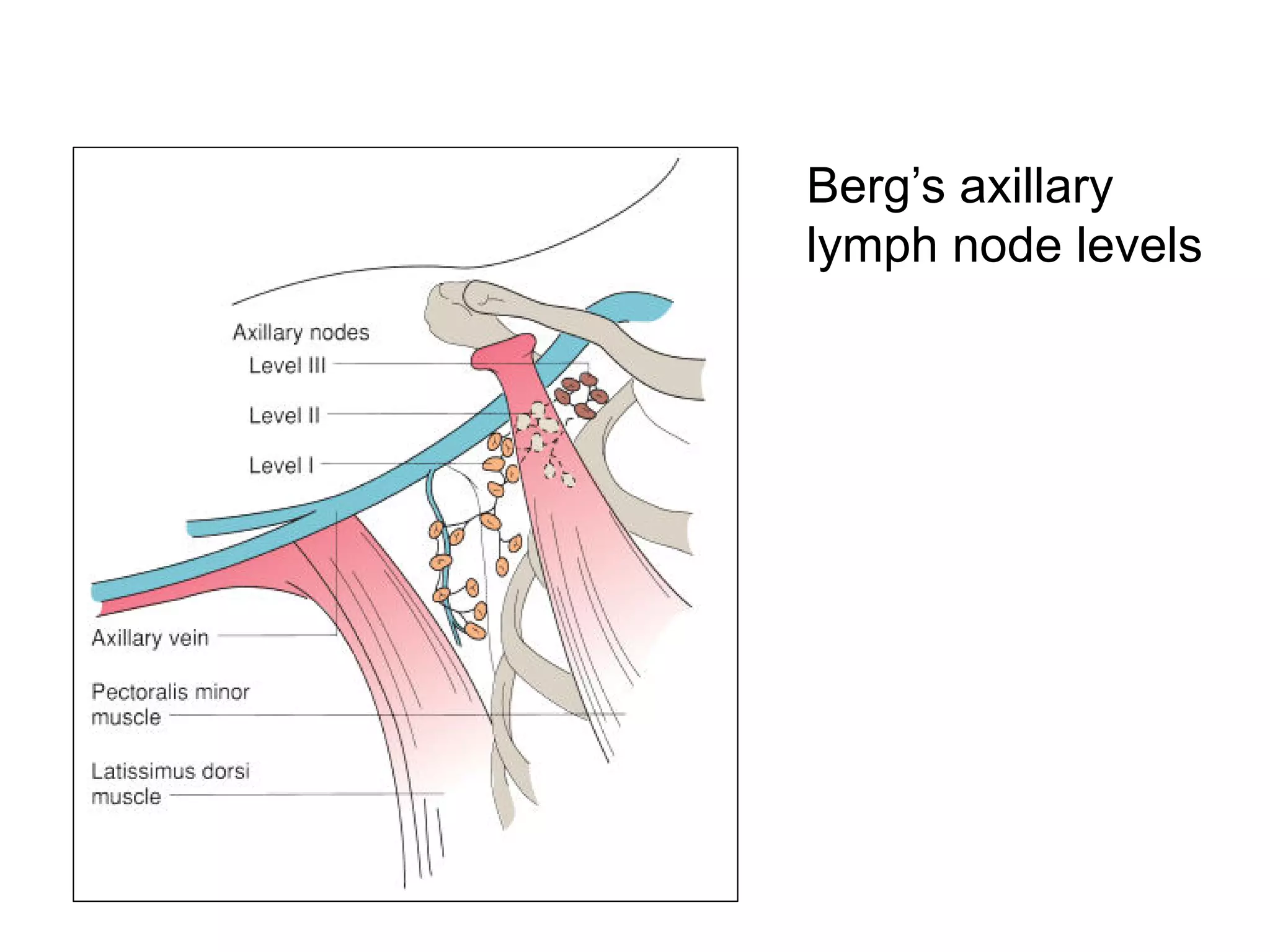
Berg’s axillary
lymph node levels
Fig: Eventual drainage pathways of thoracic lymphatics
• Lymphatics from the left breast terminate in the thoracic
duct and subsequently the left subclavian vein. On the
right, they ultimately drain into the right subclavian vein
near its junction with the internal jugular vein.
• Superficial lymphatics  skin over breast except nipple &
areola
• Deep lymphatics  parenchyma as well as nipple & areola
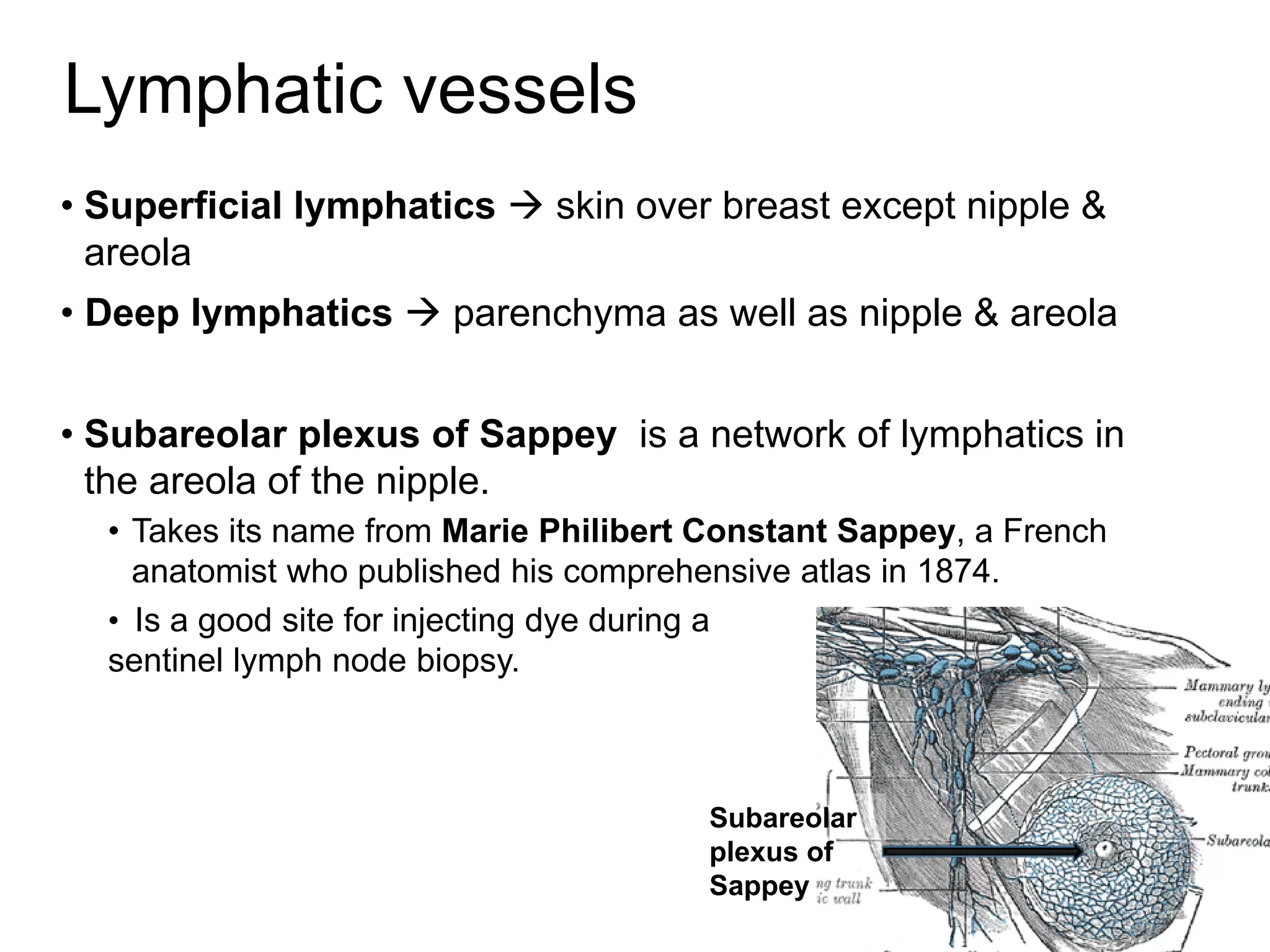
• Subareolar plexus of Sappey is a network of lymphatics in
the areola of the nipple.
• Takes its name from Marie Philibert Constant Sappey, a French
anatomist who published his comprehensive atlas in 1874.
Lymphatic vessels
Subareolar
plexus of
Sappey
• Is a good site for injecting dye during a
sentinel lymph node biopsy.
Sentinel Lymph Node
• Sentinel lymph node (SLN):
• SLN biopsy was first clinically used for penile
carcinomas[2]
. Its utility in CA breast was explored in
a series of studies in the 1970s*.
• The first node in a regional lymphatic basin that
receives lymph flow from the primary tumor.
• The most lateral of the anterior group of lymph
nodes (level I) is the usual site of SLN in CA breast.
• SLN biopsy is indicated in patients with clinically node
negative disease.
* Pieter J Tanis. Breast Cancer Research. 2001
SLN Biopsy
• Localize tumor
• Dermal injection (raise a wheal) of radiocolloid into skin
overlying tumor in 5 locations
• 0.5 mCi Tc sulphur colloid in 0.5cc. After ~1 hour, take
patient to the OR.
• 5 cc of dye is injected, typically isosulfan blue, followed by
massaging for 5 minutes. Methylene blue can also be used.
• Subareolar injection (into Sappey’s plexus) is the best.
• The combination of radioisotope and dye provides the most
accurate means of localizing the sentinel node.[12]
Radiological anatomy
1. CT anatomy and Radiotherapy planning
associated radiological anatomy
Left Serratus
anterior
• CECT thorax showing
a left pectoralis major
hematoma.
(On the opposite side
the muscle is normal.)
• The pectoralis minor
can be seen
underneath.
• The Latissimus dorsi
is seen laterally.
Ascending aorta
Descending aorta
Pulmonary artery
Lung
A left level I Axillary Node
Advanced cancer of the right breast invading the chest wall
Breast & Chest wall Contours: Anatomical Boundaries
[13]
Cranial Caudal Ant Posterior Lateral Medial
Breast Clinical
reference +
2nd rib
insertion
Clinical
reference +
Loss of CT
apparent
breast
Skin Excludes
Pectoralis
chest wall
muscles, &
ribs
Clinical
reference +
mid axillary
line typically,
excludes Lat.
dorsi
Sternal-rib
junction
Breast +
chest
wall
Same Same Same Includes
pectoralis,
chest wall,
ribs
Same Same
Chest
wall
Caudal
border of
the clavicle
head
Clinical
reference +
loss of CT
apparent
breast
Skin Rib-pleural
interface
(includes
pectoralis,
chestwall
muscles, ribs)
Clinical
reference/mi
d axillary line
typically,
excludes Lat.
dorsi
Sternal rib
junction
Cranial Caudal Anterior Posterior Lateral Medial
Supra
Clavivular
Caudal to
cricoid
Junction of
brachio
cephalic veins
/ caudal edge
clavicle head
Sterno-
mastoid
(SCM)
Ant
aspect of
Scalene
Cranial: lat
edge SCM
Caudal:
Junction 1st
rib-clavicle
Exclude
thyroid
and
trachea
Axillary
Level I
Axillary
vessels cross
lat edge of
pect minor
Pectoralis
major insert.
Into ribs
Plane
defined by
ant surface
of pec
major + Lat
dorsi
Ant
surface of
sub-
scapularis
Medial border
of Lat dorsi
Lateral
border
Pec minor
Axillary
Level II
Axilarry
vessels cross
medial edge
of pect minor
Axillary
vessels cross
lat edge of
Pec minor
Ant surface
Pec minor
Ribs and
inter-
costal
muscles
Lat border
Pec minor
Medial
border
Pec minor
Axillary
Level III
Pect minor
insert. on
cricoid
Axillary
vessels cross
medial edge
Pec minor
Post
surface
Pect major
Ribs and
inter-
costals
Medial border
Pect minor
Thoracic
inlet
Internal
mammary
Superior aspect
medial 1st rib
Cranial aspect
of 4th rib
- - - -
Regional Node Contours: Anatomical Boundaries
[13]
Radiological anatomy
2. Mammography
BIRADS
• American College of Radiology (ACR) has
devised the Breast Imaging Reporting and Data
System (BI-RADS), a standardized method for
describing the morphology of breast lesions.
• These are described for imaging of the breast.
(Mammography, USG breast and MRI)
Category Description Likelihood of
Malignancy
Next step
0 Incomplete; need
further evaluation
Unknown Further imaging/
comparison
1 Negative No evidence of
malignancy
Routine screening
2 Benign No evidence of
malignancy
Routine screening
3 Probably benign Less than 2% F/U imaging at 6 and at
12 months
4 Suspicious for
malignancy
2-95% Tissue diagnosis
5 Highly suggestive
of malignancy
>95% Tissue diagnosis
6 Known malignancy 100% Treatment
• For mammography and Ultrasound of the breast,
BIRADS category 4 is divided into 3 sub groups:
Category Description Likelihood of
Malignancy
Next step
4 Suspicious
4A: Low
4B: Moderate
4C: High
2-95%
2-10%
10-50%
50-95%
Tissue diagnosis
Mammography
• The following are reported:
1. Categories of breast density
2. Mass descriptors in mammography
a) Shape
b) Margin
c) Density
3. Calcifications
Positioning for Mammography
A. MLO view. The MLO view is obtained with the tube angled at 45° to
the horizontal, with compression applied obliquely across the chest
wall, perpendicular to the long axis of the pectoralis major muscle.
B. CC view. Positioning is achieved by pulling the breast up and
forward, away from the chest wall, with compression applied from
above.
2 Views
Craniocaudal viewMediolateral Oblique view
a to d: ACR categories
of breast parenchymal
density.
a. Breast tissue almost
entirely fatty (little
glandular tissue)
b. Scattered fibroglandular
tissue
c. Heterogeneously dense
parenchyma, which may
obscure small masses
d. The breasts are extremely
dense, which lowers the
sensitivity.
a b
c d
A-D: ACR BI-RADS
descriptors for mass
shape on
mammography.
A. Round
B. Oval
C. Lobulated
D. Irregular
A B
DC
ACR BI-RADS
descriptors for
mass margins on
mammography.
A. Circumscribed
(sharply defined)
B. Obscured
C. Indistinct
D. Spiculated
A
C
B
D
• ACR BI-RADS descriptors for mass density (as compared
to the fibroglandular parenchyma) on mammography.
A. High density mass
B. Isodense mass
C. Low density mass. MLO view showing a large heterogeneous mass
in the breast (arrows) containing areas of fat density within,
consistent with the diagnosis of hamartoma
A B C
Typically benign calcifications.
A. Lucent-centered calcifications consistent with skin
calcifications
B. Vascular calcification
C. Popcorn calcifications within involuted fibroadenoma
D. Rod like ductal calcifications
E. Coarse dystrophic calcifications seen in a postoperative,
irradiated breast
A
B C D E
Calcifications of
intermediate
concern
A. Amorphous
calcifications
B. Coarse
heterogeneous
calcifications
Calcifications having
high probability of
malignancy.
A. Pleomorphic
calcifications
B. Fine heterogeneous
calcifications
A B
A B
Descriptors for distribution of calcifications.
A. Clustered (>5/cc)
B. Ductal (within a duct)
C. Segmental (within a single lobe)
D. Scattered/Diffuse (more than 1 lobe)
A B C D
Mammographic Features of
Breast Cancer:
• Asymmetry
• Architectural distortion
• Heterogenous mass
• Irregular margins
• Areas of skin thickening
• Microcalcifications
Some examples
• Post op screening mammogram
shows the surgical scar. The
ring like opacity is likely a
suture.
Mammography shows nipple
and areolar thickening in right
breast with a subareolar mass:
Paget’s disease
Ductogram
• Performed by injecting contrast
material into an orifice of a
lactiferous duct at the nipple, a
ductogram demonstrates the
complex ramifications of a single
mammary ductal system.
• The primary indication is to
evaluate a single duct which has
a discharge.
• Seldom done now due to advent
of USG and MRI.
Ductogram
Radiological anatomy
3. Ultrasound of Breast
Ultrasound of breast:
• A valuable adjunct to mammography for the diagnosis of
breast diseases.
o Particularly useful in young women with dense breasts
in whom mammograms are difficult to interpret.
o Distinguishes cysts from solid lesions.
o Can be used to localize impalpable breast lumps.
o Can also be used for a guided FNAC/Biopsy.
o Assessment of mammographic abnormality
o Lactating and pregnant women
o Women < 30 years of age
• Normal tissue planes:
• skin 1-3mm
• subcutaneous fat
• Normal ducts
• Solid/cystic
• Size/dimensions
Ultrasound
Benign lesions
• Smooth & regular
• Thin ‘pseudocapsule’
• Uniform internal echoes
• Cystic
• Tissue planes preserved
Ultrasound
Suspicious
• Irregular margins (A)
• Spiculation
• Taller than wide (B)
(anti-parallel)
• shadowing
• Posterior acoustic shadowing
• disruption of tissue planes
A
B
Ultrasound
Posterior acoustic enhancement (A) vs Posterior acoustic shadowing (B)
A B
• Disadvantages:
o Operator dependent
o Time consuming
Radiological anatomy
3. MRI
MRI of Breast
• A recent meta-analysis of 44 studies has estimated the
sensitivity and specificity of MRI for the diagnosis of
breast cancer as 90% & 72%.[10]
• It is particularly useful in
• Dense breasts
• Palpable abnormality with normal mammogram
• Augmented breasts
• To stage a tumor (eg chest wall invasion)
A. Mammogram shows a plane of
cleavage between the large
stellate irregular tumor and the
pectoralis muscle.
B. MRI shows that the tumor is
attached to the pectoral fascia,
and the images show some
underlying muscle and fascial
enhancement.
A. Only 1 lesion - a focal,
spiculated, small nodule was
found in mammography.
B. MRI shows 2 strongly
enhancing irregular nodules,
both of which were consistent
with malignancy.
Mass shape
characteristics:
A. Round
B. Oval
C. Irregular
D. Spiculated
A B
C D
Descriptors for internal enhancement characteristics
A. Homogeneous
B. Heterogeneous
C. Rim enhancement
A B C
• Non-mass like enhancement.
Enhancement occurs in an
area of the fibroglandular
tissue that otherwise appears
normal in precontrast images.
A. Mammogram shows a high density, irregular, spiculated mass
B. Ultrasound shows a hypoechoic, irregular, spiculated mass with
distal acoustic shadowing
C. Contrast enhanced T1-weighted MRI shows a spiculated, intensely
enhancing mass
Newer techniques
• Molecular Breast Imaging
• Digital Breast Tomosynthesis
• Electrical impedance imaging
Experimental
• Optical imaging tests
Molecular Breast Imaging
• New Technique using targeted molecules (eg. FES for the
estrogen receptor).
• Has been shown to be a good complementary technique to
conventional mammography, especially for women with a
dense breast.[4, 5]
• Especially useful for imaging patients who cannot have an
MRI.[6]
• More cost effective and less time consuming than MRI.[6,7]
Digital Breast Tomosynthesis
• Developed to improve detection and characterization of
breast lesions especially in women with dense breasts
• In this technique, multiple projection images are
reconstructed allowing visual review of thin breast
sections.
• Potential to unmask cancers obscured by normal tissue
located above and below the lesion, but no randomized
evidence of advantage over mammograms yet.[8]
Conventional mediolateral oblique mammography view (A) of a
patient with invasive ductal cancer. Vaguely apparent on the
conventional mammogram, the lesion is much better visualized on
the 1 mm thick tomosynthesis image (B).
A B
Digital Breast Tomosynthesis
Thank You

Breast anatomy

  • 1.
    Anatomy of Breast Dr.Animesh Agrawal Dr Ram Manohar Lohia Institute of Medical Sciences, Lucknow
  • 2.
    Topics covered • Anatomy •Radiological anatomy • Radiotherapy planning associated radiological anatomy
  • 3.
    • Modified sweatgland / apocrine gland / Mammary gland • Present in both sexes. • Rudimentary in male, well developed in female after puberty.
  • 4.
    - Situated withinthe superficial pectoral fascia. - The superficial fascia splits to enclose the breast to form the anterior and posterior lamellae. • Extent: • Vertically: 2nd to 6th ribs (from the clavicle above to the 7th/8th rib below • Horizontally: Midline/lateral border of sternum to mid-axillary line. Location and Extent
  • 5.
  • 6.
    • The flooris formed by the deep pectoral fascia. • This overlies pectoralis major and serratus anterior superiorly and external oblique and its aponeurosis inferiorly. Floor Pectoralis major Serratus anterior External oblique
  • 7.
    Breast in section Pectoralisminor Pectoralis major Pectoral fascia Suspensory ligament Submammary space Deep fascia Superficial fascia Adipose tissue Rib Secretory lobule Non lactating breast Breast during lactation
  • 8.
    Muscles Anatomical significanceClinical significance Pectoralis major 1. Major muscle mass posterior to breast 2. Lymphatics from breast pierce and circumvent it. 1. Excised in radical mastectomy 2. Anterior fascia is removed in MRM. Pectoralis minor 1. Superior portion crosses anterior to axillary sheath, dividing the axilla into low, mid and high regions. 2. Interpectoral nodes lie immediately anterior. 1. Landmark for Axillary nodal levels. 2. Excised in modified (Patey’s) mastectomy. Serratus anterior 1. Medial wall of axilla 2. Major muscle mass deep to lateral one-third of breast 1. Responsible for winging of scapula in long thoracic nerve injury Latissimus dorsi 1. Post wall of axilla 2. Fascia continuous with axillary fascia 1. Anterior border is lateral limit of dissection 2. Used as myocutaneous flap for breast reconstruction. * Other muscles like subclavius, rectus abdominis and external oblique may come into relation and are exposed during mastectomy.
  • 9.
    Naming the quadrantsfor the purpose of describing a lump  Upper Medial  Upper lateral  Lower medial  Lower lateral  Central
  • 11.
    • Skin: • Nipple •Areola • Parenchyma (2,3,5,6) • Stroma (1,4)
  • 12.
  • 13.
    • The nippleis composed mostly of collagenous dense connective tissue and contains numerous elastic fibres which wrinkle the overlying skin. • Usually lies above the inframammary crease, level with the 4th rib (just lateral to the midclavicular line). • The average nipple to sternal notch measurement in a youthful, well-developed breast is 21-22 cm. • An equilateral triangle formed between the nipples and sternal notch measures an average of 21 cm per side. Maxwell GP, Gabriel A. Breast Reconstruction. Aesthetic Plastic Surgery. (2009) The Nipple
  • 14.
    • Lobes: - 15– 20 in number - Composed of glandular structures called lobules which empty via ductules into lactiferous ducts. • Lactiferous ducts: - Draining each lobe of the breast pass through the nipple and open onto its tip as 15–20 orifices. - Contains ampulla near its end (Reservoir of milk or abnormal discharge) Lobules Ductules Lactiferous duct Lactiferous sinus Nipple
  • 15.
  • 16.
    • Suspensory Ligamentof Cooper • Anchored to the pectoralis fascia by the suspensory ligaments that were first described by Astley Cooper in 1840. • Run throughout the breast tissue parenchyma from the deep fascia beneath the breast and attach to the dermis of the skin • Being somewhat lax, allow for the natural motion of the breast. • Relax with age and time, eventually resulting in breast ptosis.
  • 17.
    Arterial Supply, Venousdrainage, Nerve supply
  • 18.
    • Axillary artery •Superior thoracic • Thoracoacromial artery • Lateral thoracic artery • Subscapular artery. • Internal thoracic: • Perforating branches to the anteromedial breast. • The second to fourth anterior intercostal arteries. • The second perforating artery is usually the largest; supplies the upper region of the breast, the nipple, areola and adjacent breast. Posterior surface is relatively avascular. Blood Supply
  • 19.
    Internal thoracic artery Axillary artery Lateralthoracic artery Superior thoracic artery Acromiothoracic artery Posterior intercostal arteries
  • 20.
    o Veins followthe arteries. o First converge around the nipple to form an anastomotic venous circle & then form 2 sets of veins. • Superficial veins: drain into Internal thoracic vein & superficial veins of the lower part of the neck • Deep veins: drain into Internal thoracic, Axillary & Posterior intercostal veins. o Intercostal veins communicate with the vertebral veins. This route is responsible for metastasis of CA breast to vertebral bodies, sacrum and pelvic bones.
  • 21.
    Internal Jugular vein Subclavianvein Celiac vein Axillary vein Lateral thoracic vein Branches draining into lateral thoracic vein Internal Thoracic vein along with perforators
  • 22.
    Internal thoracic vein Axillaryvein Anastomotic venous circle
  • 23.
    • 4th to6th intercostal nerves by their Anterior & Lateral cutaneous branches • The nipple is supplied from the anterior branch of the lateral cutaneous branch of T4 • Forms an extensive plexus within the nipple; its sensory fibres terminate close to the epithelium as free endings, Meissner corpuscles and Merkel disc endings. These are essential in signaling suckling to the central nervous system. • Secretory activities of the gland are largely controlled by ovarian and hypophyseal hormones rather than by efferent motor fibers. • The areola has fewer sensory endings.
  • 24.
    Long thoracic nerve Posteriorbranches lateral abdominal cutaneous nerves Anterior branches lateral abdominal cutaneous nerves lateral mammary branch of lateral pectoral cutaneous branch of intercostal nerve T4Intercostobrachial nerves
  • 25.
  • 26.
    Introduction • The breastis originally an ectodermal tissue, thus its lymphatic drainage is mostly parallel to the lymph flow of the overlying skin. • The lymphatic flow of the breast is of great clinical significance because metastatic dissemination occurs principally by the lymphatic routes.
  • 27.
    • Axillary (85%) •Anterior • Posterior • Central • Lateral • Apical • Interpectoral • Internal mammary / Parasternal (10%) • Others (5%) • Supraclavicular • Cephalic / Deltopectoral • Posterior intercostal • Subdiaphragmatic • Subperitoneal Lymph Node Stations
  • 28.
    The axillary lymphnodes • These are some 20–40 in number, grouped as • Only the apical group is terminal. - Anterior (4-5) Lying deep to pectoralis major along the lower border of pectoralis minor. - Posterior (6-7) along the subscapular vessels - Lateral (4-6) along the axillary vein - Central (3-4) In the axillary fat - Apical (6-12) Through which all the other axillary nodes drain, at the apex of the axilla above pectoralis minor and along the medial side of the axillary vein
  • 29.
    Lateral Central Posterior Apical Anterior Interpectoral Internal mammary • Afew efferents from apical nodes usually reach the inferior deep cervical nodes (supraclavicular nodes).
  • 30.
    Other lymph nodes •Internal mammary or parasternal nodes: They are variable in number and lie along the internal mammary vessels deep to the plane of the costal cartilages. • Most are near the bifurcation of the intercostal and internal mammary veins. • Efferents drain into the jugular veins. • Inter pectoral nodes (rotter’s nodes): A few nodes lying between the pectoralis major and minor muscles. • Supraclavicular and other nodes: Some lymph from the breast also reaches the supraclavicular nodes, deltopectoral nodes, posterior intercostal nodes, subdiaphragmatic and sub peritoneal plexuses.
  • 31.
    Quadrant wise drainage Drainagefrom the 5 “quadrants” towards the axilla and internal mammary chain Palpable + Nonpalpable lesions Axilla (%) IMC (%) UOQ 95.8 10.4 UIQ 93.1 32.4 LOQ 97.7 29.5 LIQ 88.0 52.7 C 100 23.7 UOQ: Upper outer quadrant. UIQ: Upper inner quadrant. LOQ: Lower outer quadrant. LIQ: Lower inner quadrant. C: Centre Susanne H. Estourgie et al. Ann Surg. 2004
  • 32.
    • These aredefined according to the surgeon’s approach to the axillary nodes during dissection. • Anatomical landmark used: Pectoralis minor • Levels: • Clinical N Staging of CA breast is done based on these levels. Axillary lymph nodes levels (Berg’s levels) Level 1 Lateral to lateral border of pectoralis minor (anterior, posterior & lateral group). Level 2 Central axillary nodes located under pectoralis minor muscle Level 3 Apical & infraclavicular nodes medial to pectoralis minor muscle. It is difficult to visualize & remove unless pectoralis muscles are sacrificed or divided.
  • 33.
  • 34.
    Fig: Eventual drainagepathways of thoracic lymphatics • Lymphatics from the left breast terminate in the thoracic duct and subsequently the left subclavian vein. On the right, they ultimately drain into the right subclavian vein near its junction with the internal jugular vein.
  • 35.
    • Superficial lymphatics skin over breast except nipple & areola • Deep lymphatics  parenchyma as well as nipple & areola • Subareolar plexus of Sappey is a network of lymphatics in the areola of the nipple. • Takes its name from Marie Philibert Constant Sappey, a French anatomist who published his comprehensive atlas in 1874. Lymphatic vessels Subareolar plexus of Sappey • Is a good site for injecting dye during a sentinel lymph node biopsy.
  • 37.
    Sentinel Lymph Node •Sentinel lymph node (SLN): • SLN biopsy was first clinically used for penile carcinomas[2] . Its utility in CA breast was explored in a series of studies in the 1970s*. • The first node in a regional lymphatic basin that receives lymph flow from the primary tumor. • The most lateral of the anterior group of lymph nodes (level I) is the usual site of SLN in CA breast. • SLN biopsy is indicated in patients with clinically node negative disease. * Pieter J Tanis. Breast Cancer Research. 2001
  • 38.
    SLN Biopsy • Localizetumor • Dermal injection (raise a wheal) of radiocolloid into skin overlying tumor in 5 locations • 0.5 mCi Tc sulphur colloid in 0.5cc. After ~1 hour, take patient to the OR. • 5 cc of dye is injected, typically isosulfan blue, followed by massaging for 5 minutes. Methylene blue can also be used. • Subareolar injection (into Sappey’s plexus) is the best. • The combination of radioisotope and dye provides the most accurate means of localizing the sentinel node.[12]
  • 40.
    Radiological anatomy 1. CTanatomy and Radiotherapy planning associated radiological anatomy
  • 41.
  • 42.
    • CECT thoraxshowing a left pectoralis major hematoma. (On the opposite side the muscle is normal.) • The pectoralis minor can be seen underneath. • The Latissimus dorsi is seen laterally.
  • 47.
  • 49.
    A left levelI Axillary Node
  • 50.
    Advanced cancer ofthe right breast invading the chest wall
  • 51.
    Breast & Chestwall Contours: Anatomical Boundaries [13] Cranial Caudal Ant Posterior Lateral Medial Breast Clinical reference + 2nd rib insertion Clinical reference + Loss of CT apparent breast Skin Excludes Pectoralis chest wall muscles, & ribs Clinical reference + mid axillary line typically, excludes Lat. dorsi Sternal-rib junction Breast + chest wall Same Same Same Includes pectoralis, chest wall, ribs Same Same Chest wall Caudal border of the clavicle head Clinical reference + loss of CT apparent breast Skin Rib-pleural interface (includes pectoralis, chestwall muscles, ribs) Clinical reference/mi d axillary line typically, excludes Lat. dorsi Sternal rib junction
  • 58.
    Cranial Caudal AnteriorPosterior Lateral Medial Supra Clavivular Caudal to cricoid Junction of brachio cephalic veins / caudal edge clavicle head Sterno- mastoid (SCM) Ant aspect of Scalene Cranial: lat edge SCM Caudal: Junction 1st rib-clavicle Exclude thyroid and trachea Axillary Level I Axillary vessels cross lat edge of pect minor Pectoralis major insert. Into ribs Plane defined by ant surface of pec major + Lat dorsi Ant surface of sub- scapularis Medial border of Lat dorsi Lateral border Pec minor Axillary Level II Axilarry vessels cross medial edge of pect minor Axillary vessels cross lat edge of Pec minor Ant surface Pec minor Ribs and inter- costal muscles Lat border Pec minor Medial border Pec minor Axillary Level III Pect minor insert. on cricoid Axillary vessels cross medial edge Pec minor Post surface Pect major Ribs and inter- costals Medial border Pect minor Thoracic inlet Internal mammary Superior aspect medial 1st rib Cranial aspect of 4th rib - - - - Regional Node Contours: Anatomical Boundaries [13]
  • 66.
  • 67.
    BIRADS • American Collegeof Radiology (ACR) has devised the Breast Imaging Reporting and Data System (BI-RADS), a standardized method for describing the morphology of breast lesions. • These are described for imaging of the breast. (Mammography, USG breast and MRI)
  • 68.
    Category Description Likelihoodof Malignancy Next step 0 Incomplete; need further evaluation Unknown Further imaging/ comparison 1 Negative No evidence of malignancy Routine screening 2 Benign No evidence of malignancy Routine screening 3 Probably benign Less than 2% F/U imaging at 6 and at 12 months 4 Suspicious for malignancy 2-95% Tissue diagnosis 5 Highly suggestive of malignancy >95% Tissue diagnosis 6 Known malignancy 100% Treatment
  • 69.
    • For mammographyand Ultrasound of the breast, BIRADS category 4 is divided into 3 sub groups: Category Description Likelihood of Malignancy Next step 4 Suspicious 4A: Low 4B: Moderate 4C: High 2-95% 2-10% 10-50% 50-95% Tissue diagnosis
  • 70.
    Mammography • The followingare reported: 1. Categories of breast density 2. Mass descriptors in mammography a) Shape b) Margin c) Density 3. Calcifications
  • 71.
    Positioning for Mammography A.MLO view. The MLO view is obtained with the tube angled at 45° to the horizontal, with compression applied obliquely across the chest wall, perpendicular to the long axis of the pectoralis major muscle. B. CC view. Positioning is achieved by pulling the breast up and forward, away from the chest wall, with compression applied from above.
  • 72.
  • 73.
    a to d:ACR categories of breast parenchymal density. a. Breast tissue almost entirely fatty (little glandular tissue) b. Scattered fibroglandular tissue c. Heterogeneously dense parenchyma, which may obscure small masses d. The breasts are extremely dense, which lowers the sensitivity. a b c d
  • 74.
    A-D: ACR BI-RADS descriptorsfor mass shape on mammography. A. Round B. Oval C. Lobulated D. Irregular A B DC
  • 75.
    ACR BI-RADS descriptors for massmargins on mammography. A. Circumscribed (sharply defined) B. Obscured C. Indistinct D. Spiculated A C B D
  • 76.
    • ACR BI-RADSdescriptors for mass density (as compared to the fibroglandular parenchyma) on mammography. A. High density mass B. Isodense mass C. Low density mass. MLO view showing a large heterogeneous mass in the breast (arrows) containing areas of fat density within, consistent with the diagnosis of hamartoma A B C
  • 77.
    Typically benign calcifications. A.Lucent-centered calcifications consistent with skin calcifications B. Vascular calcification C. Popcorn calcifications within involuted fibroadenoma D. Rod like ductal calcifications E. Coarse dystrophic calcifications seen in a postoperative, irradiated breast A B C D E
  • 78.
    Calcifications of intermediate concern A. Amorphous calcifications B.Coarse heterogeneous calcifications Calcifications having high probability of malignancy. A. Pleomorphic calcifications B. Fine heterogeneous calcifications A B A B
  • 79.
    Descriptors for distributionof calcifications. A. Clustered (>5/cc) B. Ductal (within a duct) C. Segmental (within a single lobe) D. Scattered/Diffuse (more than 1 lobe) A B C D
  • 80.
    Mammographic Features of BreastCancer: • Asymmetry • Architectural distortion • Heterogenous mass • Irregular margins • Areas of skin thickening • Microcalcifications
  • 81.
  • 82.
    • Post opscreening mammogram shows the surgical scar. The ring like opacity is likely a suture. Mammography shows nipple and areolar thickening in right breast with a subareolar mass: Paget’s disease
  • 83.
    Ductogram • Performed byinjecting contrast material into an orifice of a lactiferous duct at the nipple, a ductogram demonstrates the complex ramifications of a single mammary ductal system. • The primary indication is to evaluate a single duct which has a discharge. • Seldom done now due to advent of USG and MRI.
  • 84.
  • 85.
  • 86.
    Ultrasound of breast: •A valuable adjunct to mammography for the diagnosis of breast diseases. o Particularly useful in young women with dense breasts in whom mammograms are difficult to interpret. o Distinguishes cysts from solid lesions. o Can be used to localize impalpable breast lumps. o Can also be used for a guided FNAC/Biopsy. o Assessment of mammographic abnormality o Lactating and pregnant women o Women < 30 years of age
  • 87.
    • Normal tissueplanes: • skin 1-3mm • subcutaneous fat • Normal ducts • Solid/cystic • Size/dimensions Ultrasound
  • 88.
    Benign lesions • Smooth& regular • Thin ‘pseudocapsule’ • Uniform internal echoes • Cystic • Tissue planes preserved Ultrasound
  • 89.
    Suspicious • Irregular margins(A) • Spiculation • Taller than wide (B) (anti-parallel) • shadowing • Posterior acoustic shadowing • disruption of tissue planes A B Ultrasound
  • 90.
    Posterior acoustic enhancement(A) vs Posterior acoustic shadowing (B) A B • Disadvantages: o Operator dependent o Time consuming
  • 91.
  • 92.
    MRI of Breast •A recent meta-analysis of 44 studies has estimated the sensitivity and specificity of MRI for the diagnosis of breast cancer as 90% & 72%.[10] • It is particularly useful in • Dense breasts • Palpable abnormality with normal mammogram • Augmented breasts • To stage a tumor (eg chest wall invasion)
  • 93.
    A. Mammogram showsa plane of cleavage between the large stellate irregular tumor and the pectoralis muscle. B. MRI shows that the tumor is attached to the pectoral fascia, and the images show some underlying muscle and fascial enhancement. A. Only 1 lesion - a focal, spiculated, small nodule was found in mammography. B. MRI shows 2 strongly enhancing irregular nodules, both of which were consistent with malignancy.
  • 94.
    Mass shape characteristics: A. Round B.Oval C. Irregular D. Spiculated A B C D
  • 95.
    Descriptors for internalenhancement characteristics A. Homogeneous B. Heterogeneous C. Rim enhancement A B C • Non-mass like enhancement. Enhancement occurs in an area of the fibroglandular tissue that otherwise appears normal in precontrast images.
  • 96.
    A. Mammogram showsa high density, irregular, spiculated mass B. Ultrasound shows a hypoechoic, irregular, spiculated mass with distal acoustic shadowing C. Contrast enhanced T1-weighted MRI shows a spiculated, intensely enhancing mass
  • 97.
    Newer techniques • MolecularBreast Imaging • Digital Breast Tomosynthesis • Electrical impedance imaging Experimental • Optical imaging tests
  • 98.
    Molecular Breast Imaging •New Technique using targeted molecules (eg. FES for the estrogen receptor). • Has been shown to be a good complementary technique to conventional mammography, especially for women with a dense breast.[4, 5] • Especially useful for imaging patients who cannot have an MRI.[6] • More cost effective and less time consuming than MRI.[6,7]
  • 101.
    Digital Breast Tomosynthesis •Developed to improve detection and characterization of breast lesions especially in women with dense breasts • In this technique, multiple projection images are reconstructed allowing visual review of thin breast sections. • Potential to unmask cancers obscured by normal tissue located above and below the lesion, but no randomized evidence of advantage over mammograms yet.[8]
  • 102.
    Conventional mediolateral obliquemammography view (A) of a patient with invasive ductal cancer. Vaguely apparent on the conventional mammogram, the lesion is much better visualized on the 1 mm thick tomosynthesis image (B). A B Digital Breast Tomosynthesis
  • 103.