

Brand strategy to communication
The fifth and last in the series of guides on brand building
by Geeta Sundaram
In previous presentations, I explained how brand strategy is a route map to achieve the brand
positioning we would like for a brand. And that the brand promise is what helps consumers believe
the brand positioning.
A brand’s cultural values, yet another building block, provides the guiding principles for the
brand’s journey.
Brand communication, the third building block, persuades consumers to buy the product or service
and helps the brand reach its desired positioning. In the following pages, we will see how brand
strategy is converted into brand communication.
Before the communication is created, there’s one more important step to complete in the
process. Distilling the strategy down into a concise communication briefing document.
Brand strategy and the brief are not substitutes for each other.
The key components of a communication brief are
- Objective
- Target audience description
- Competitive environment
- What we want consumers to believe about our brand (brand positioning)
- What benefit our brand offers (brand promise)
- Rationale for the brand promise
- Tone and manner (distilled version of the brand’s cultural values)
Brand strategy to communication brief
- Based on the brief, ideas are developed which capture the brand promise in engaging and relevant ways
- Ideas can be expressed differently in film, print, outdoor, direct marketing, radio, PR, etc because each
medium offers its own advantages that helps us communicate the same idea in the way best suited to that
medium
- Client organisations often insist on researching campaigns with consumers, which I am against. I would
always recommend that consumer research is done to better understand their needs and consumption
patterns before even creating a brand strategy. In addition, I would prefer that brand positioning concepts
are tested for relevance, differentiation, comprehension, etc rather than testing the campaign idea.
Communication development
A brand communication campaign works in stages to persuade consumers, often called AIDA
Attention – capture the audience’s attention first with idea
Interest – generate enough interest in audience’s mind to make the consumer read on, and know more
Desire – persuade consumers and create a desire to own the product in the consumer’s heart and mind
Action – spur the consumer to buy the product or visit the store or website for more information
Communication brief to campaign
A general rule of thumb when creating campaigns for the print medium:
- Headline and visual together communicate the brand promise through an idea
- Body copy provides the rationale for the promise and seeks to persuade the
consumer
- Tagline is a creative expression of the brand positioning. The most enduring of all
the elements of a brand’s journey; it does not change with time, even though
campaigns might
- Tone and style are captured through the idea, language, typography, visualization,
layout, colours, etc which together create the personality for the brand
Communication brief to campaign - Print
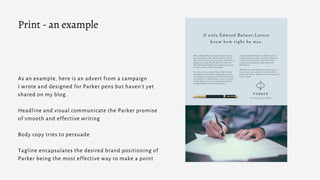
As an example, here is an advert from a campaign
I wrote and designed for Parker pens but haven't yet
shared on my blog.
Headline and visual communicate the Parker promise
of smooth and effective writing
Body copy tries to persuade
Tagline encapsulates the desired brand positioning of
Parker being the most effective way to make a point
Print - an example
- Brand promise is captured through the idea and storyline
- Tagline is an expression of the brand positioning
- Tone and manner are communicated through storyline, casting, setting, the
language and visual treatment
- Being a visual medium, film helps to create an image for the brand. However, it
is usually not able to impart much information about the product or persuade with
any great conviction
- That’s why many FMCG brands insist on a “product window” in the commercial,
which shows how the product works
- It's also why automobile brands still need print to do the persuading, though
most automobile advertising has been awful for the past several years.
Film
- Neither like print or film, it communicates the brand promise through idea
expressed in headline and visual
- Must lead reader to website to share more information about the product and
convince him/her
- Provides better targeting of consumers to begin lead generation for direct
marketing campaign
- In my opinion, it is best suited to direct marketing
- Videos in the digital medium allow brands to share other dimensions of their brand
story, for greater engagement
- Has the danger of being too intrusive and puts off many readers/consumers
Digital
- A support medium to TV and print if necessary, to reach the target
audience
- Idea is captured through script and storyline in audio terms
- Not much scope for persuasion, so best as reminder medium
- Tone and manner of brand communicated through script, language,
music, voice over delivery
- Provides scope for developing radio content for relevant audiences
like the youth, rural consumers, retirees, etc. who might be regular
radio listeners
Radio
- Again, best as reminder medium, for certain categories such as
telecom, travel, automobiles, retail
- Brand promise communicated through headline and visual idea
- Tagline expresses brand positioning
- Tone and style communicated through visualization of idea,
language, typography, and colours
- These days, a lot of outdoor advertising is electronic, with use
of even videos
- Still, a visual medium to work as reminder at best.
Out of home
- Like I say, almost all of digital advertising is a new form of direct marketing
- Allows lead generation and email marketing of brands with better targeting
- Allows for compelling and persuasive brand stories as well as relationship
building with customers
- Can be used to great effect by niche and luxury brands
- Headline and visual convey the brand promise, while text does the persuading
- There is usually a strong call to action
- In my view, delivers best on AIDA, next to print, and also allows videos to be
shared
Direct marketing
Like direct marketing, a separate communication discipline used to build relationships
with stakeholders. It brings third-party credibility to companies’ statements since it
relies on the media.
Unfortunately, it is too often used only for crisis management.
In line with the overall brand strategy, PR can be used
- To announce new product/brand launches, new corporate initiatives
- To share a corporate leader’s world view of his business and brand
- To provide an expert commentator’s review of new products, especially in consumer
electronics, automobiles, as well as tech
- To hold events such as conferences, award ceremonies, etc
- To connect with special audiences such as employees, investors, suppliers, and
dealers through specially devised outreach programmes.
Public Relations
After the team has converted the brand strategy into communication ideas, how do
we evaluate which idea is the best?
According to the method we used at Ogilvy, we asked ourselves:
- Is the idea on strategy and message?
- Is it relevant for the target audience and does it persuade?
- Does it have legs? Can the idea run for a long period of time and are campaign
extensions possible in future?
- Can it be extended across several media?
- Does it lead to other ideas in content – blogs, vlogs, short films, podcasts,
experiential marketing, etc.
Evaluating communication ideas
- The starting point of a brand’s journey is in the brand strategy and the
communication brief must be inspiring enough to lead to a great campaign
- The brand differentiation happens at the strategy and briefing stages
- Ideas are what bring the brand differentiation to life in imaginative, yet
believable ways
- Ideas can be executed in a variety of ways across several media to convey a single
brand promise and positioning for a brand
- Communication helps build relationships with consumers, which is what brands
are all about
To conclude
For more on brands visit the Business and Brands page
on my blog, www.peripateticperch.com

Brand strategy to communication

  • 1.
    Brand strategy tocommunication The fifth and last in the series of guides on brand building by Geeta Sundaram
  • 2.
    In previous presentations,I explained how brand strategy is a route map to achieve the brand positioning we would like for a brand. And that the brand promise is what helps consumers believe the brand positioning. A brand’s cultural values, yet another building block, provides the guiding principles for the brand’s journey. Brand communication, the third building block, persuades consumers to buy the product or service and helps the brand reach its desired positioning. In the following pages, we will see how brand strategy is converted into brand communication.
  • 3.
    Before the communicationis created, there’s one more important step to complete in the process. Distilling the strategy down into a concise communication briefing document. Brand strategy and the brief are not substitutes for each other. The key components of a communication brief are - Objective - Target audience description - Competitive environment - What we want consumers to believe about our brand (brand positioning) - What benefit our brand offers (brand promise) - Rationale for the brand promise - Tone and manner (distilled version of the brand’s cultural values) Brand strategy to communication brief
  • 4.
    - Based onthe brief, ideas are developed which capture the brand promise in engaging and relevant ways - Ideas can be expressed differently in film, print, outdoor, direct marketing, radio, PR, etc because each medium offers its own advantages that helps us communicate the same idea in the way best suited to that medium - Client organisations often insist on researching campaigns with consumers, which I am against. I would always recommend that consumer research is done to better understand their needs and consumption patterns before even creating a brand strategy. In addition, I would prefer that brand positioning concepts are tested for relevance, differentiation, comprehension, etc rather than testing the campaign idea. Communication development
  • 5.
    A brand communicationcampaign works in stages to persuade consumers, often called AIDA Attention – capture the audience’s attention first with idea Interest – generate enough interest in audience’s mind to make the consumer read on, and know more Desire – persuade consumers and create a desire to own the product in the consumer’s heart and mind Action – spur the consumer to buy the product or visit the store or website for more information Communication brief to campaign
  • 6.
    A general ruleof thumb when creating campaigns for the print medium: - Headline and visual together communicate the brand promise through an idea - Body copy provides the rationale for the promise and seeks to persuade the consumer - Tagline is a creative expression of the brand positioning. The most enduring of all the elements of a brand’s journey; it does not change with time, even though campaigns might - Tone and style are captured through the idea, language, typography, visualization, layout, colours, etc which together create the personality for the brand Communication brief to campaign - Print
  • 7.
    As an example,here is an advert from a campaign I wrote and designed for Parker pens but haven't yet shared on my blog. Headline and visual communicate the Parker promise of smooth and effective writing Body copy tries to persuade Tagline encapsulates the desired brand positioning of Parker being the most effective way to make a point Print - an example
  • 8.
    - Brand promiseis captured through the idea and storyline - Tagline is an expression of the brand positioning - Tone and manner are communicated through storyline, casting, setting, the language and visual treatment - Being a visual medium, film helps to create an image for the brand. However, it is usually not able to impart much information about the product or persuade with any great conviction - That’s why many FMCG brands insist on a “product window” in the commercial, which shows how the product works - It's also why automobile brands still need print to do the persuading, though most automobile advertising has been awful for the past several years. Film
  • 9.
    - Neither likeprint or film, it communicates the brand promise through idea expressed in headline and visual - Must lead reader to website to share more information about the product and convince him/her - Provides better targeting of consumers to begin lead generation for direct marketing campaign - In my opinion, it is best suited to direct marketing - Videos in the digital medium allow brands to share other dimensions of their brand story, for greater engagement - Has the danger of being too intrusive and puts off many readers/consumers Digital
  • 10.
    - A supportmedium to TV and print if necessary, to reach the target audience - Idea is captured through script and storyline in audio terms - Not much scope for persuasion, so best as reminder medium - Tone and manner of brand communicated through script, language, music, voice over delivery - Provides scope for developing radio content for relevant audiences like the youth, rural consumers, retirees, etc. who might be regular radio listeners Radio
  • 11.
    - Again, bestas reminder medium, for certain categories such as telecom, travel, automobiles, retail - Brand promise communicated through headline and visual idea - Tagline expresses brand positioning - Tone and style communicated through visualization of idea, language, typography, and colours - These days, a lot of outdoor advertising is electronic, with use of even videos - Still, a visual medium to work as reminder at best. Out of home
  • 12.
    - Like Isay, almost all of digital advertising is a new form of direct marketing - Allows lead generation and email marketing of brands with better targeting - Allows for compelling and persuasive brand stories as well as relationship building with customers - Can be used to great effect by niche and luxury brands - Headline and visual convey the brand promise, while text does the persuading - There is usually a strong call to action - In my view, delivers best on AIDA, next to print, and also allows videos to be shared Direct marketing
  • 13.
    Like direct marketing,a separate communication discipline used to build relationships with stakeholders. It brings third-party credibility to companies’ statements since it relies on the media. Unfortunately, it is too often used only for crisis management. In line with the overall brand strategy, PR can be used - To announce new product/brand launches, new corporate initiatives - To share a corporate leader’s world view of his business and brand - To provide an expert commentator’s review of new products, especially in consumer electronics, automobiles, as well as tech - To hold events such as conferences, award ceremonies, etc - To connect with special audiences such as employees, investors, suppliers, and dealers through specially devised outreach programmes. Public Relations
  • 14.
    After the teamhas converted the brand strategy into communication ideas, how do we evaluate which idea is the best? According to the method we used at Ogilvy, we asked ourselves: - Is the idea on strategy and message? - Is it relevant for the target audience and does it persuade? - Does it have legs? Can the idea run for a long period of time and are campaign extensions possible in future? - Can it be extended across several media? - Does it lead to other ideas in content – blogs, vlogs, short films, podcasts, experiential marketing, etc. Evaluating communication ideas
  • 15.
    - The startingpoint of a brand’s journey is in the brand strategy and the communication brief must be inspiring enough to lead to a great campaign - The brand differentiation happens at the strategy and briefing stages - Ideas are what bring the brand differentiation to life in imaginative, yet believable ways - Ideas can be executed in a variety of ways across several media to convey a single brand promise and positioning for a brand - Communication helps build relationships with consumers, which is what brands are all about To conclude
  • 16.
    For more onbrands visit the Business and Brands page on my blog, www.peripateticperch.com