Definitions
1
Jargon Busting
Definitions
2
Jargon Busting
1. Strategy vs. Tactics
2. Insight vs. Observation
3. Product Proposition vs. Campaign Platform vs.
Creative idea
4. Brands & branding
5. Brand Identity vs. look & feel
6. Creative Vehicle
7. Segmentation vs. Targeting
8. Types of Segmentation
9. Types of Targeting
10. Media terminology
Definitions
3
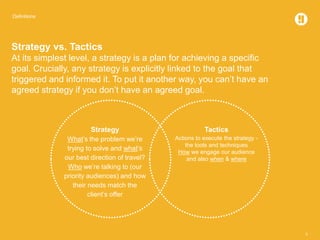
Tactics
Actions to execute the strategy -
the tools and techniques
How we engage our audience
and also when & where
Strategy
What’s the problem we’re
trying to solve and what’s
our best direction of travel?
Who we’re talking to (our
priority audiences) and how
their needs match the
client’s offer
Strategy vs. Tactics
At its simplest level, a strategy is a plan for achieving a specific
goal. Crucially, any strategy is explicitly linked to the goal that
triggered and informed it. To put it another way, you can’t have an
agreed strategy if you don’t have an agreed goal.
Definitions
4
Insight vs. Observation
An Insight is an understanding of cause and effect, i.e. not simply
knowing a fact, but knowing what causes that fact to be true and
how it fits into a wider context
For example, Pampers mistakenly believed parents were most
concerned about nappies keeping babies dry - it turned out their
real underlying concern was the interrupted sleep that resulted from
leaks
A true insight answers ‘why’ rather than ‘what’ – why do people think
/ behave the way they do as opposed to what they do (i.e. merely
an Observation)?
Definitions
5
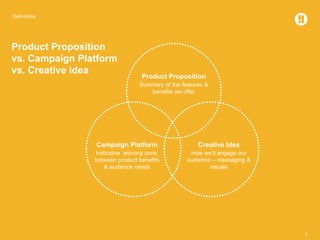
Product Proposition
Summary of the features &
benefits we offer
Creative Idea
How we’ll engage our
audience – messaging &
visuals
Campaign Platform
Indicative ‘winning zone’
between product benefits
& audience needs
Product Proposition
vs. Campaign Platform
vs. Creative idea
6
Definitions
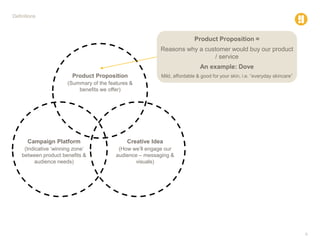
Product Proposition
(Summary of the features &
benefits we offer)
Creative Idea
(How we’ll engage our
audience – messaging &
visuals)
Campaign Platform
(Indicative ‘winning zone’
between product benefits &
audience needs)
Product Proposition =
Reasons why a customer would buy our product
/ service
An example: Dove
Mild, affordable & good for your skin, i.e. “everyday skincare”
7
Definitions
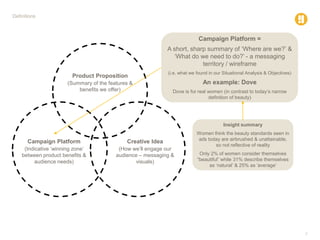
Product Proposition
(Summary of the features &
benefits we offer)
Creative Idea
(How we’ll engage our
audience – messaging &
visuals)
Campaign Platform
(Indicative ‘winning zone’
between product benefits &
audience needs)
Campaign Platform =
A short, sharp summary of ‘Where are we?’ &
‘What do we need to do?’ - a messaging
territory / wireframe
(i.e. what we found in our Situational Analysis & Objectives)
An example: Dove
Dove is for real women (in contrast to today’s narrow
definition of beauty)
Insight summary
Women think the beauty standards seen in
ads today are airbrushed & unattainable,
so not reflective of reality
Only 2% of women consider themselves
“beautiful” while 31% describe themselves
as ‘natural’ & 25% as ‘average’
8
Definitions
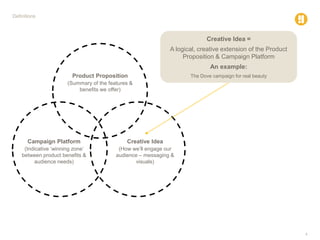
Product Proposition
(Summary of the features &
benefits we offer)
Creative Idea
(How we’ll engage our
audience – messaging &
visuals)
Campaign Platform
(Indicative ‘winning zone’
between product benefits &
audience needs)
Creative Idea =
A logical, creative extension of the Product
Proposition & Campaign Platform
An example:
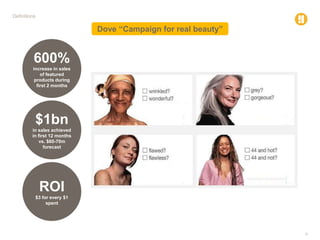
The Dove campaign for real beauty
9
Definitions
Dove “Campaign for real beauty”
600%
increase in sales
of featured
products during
first 2 months
$1bn
in sales achieved
in first 12 months
vs. $60-70m
forecast
ROI
$3 for every $1
spent
Definitions
10
Brands & branding
• A brand is a set of associations that people make with a company,
product, service, individual or organisation, e.g. Coca Cola –
youthful, energetic, refreshing, unmistakable logo, red & white
corporate colours, uniquely shaped glass bottles
• Branding is an attempt to harness, generate, influence and control
these associations to help a business perform better
• Organisation can benefit enormously by creating a brand that is
distinctive, trusted, exciting, reliable and is readily recalled at the
time of purchase
• In different industry sectors the audiences, competitors, delivery
and service aspects of branding may differ, but the basic principle
of being clear about what you stand for always applies
Definitions
11
Brand Identity vs. look & feel
• Your brand is shorthand for who you are. It represents what you
stand for as a business and does so to a wide audience. A healthy
brand has longevity and lives beyond trends, fads and campaigns
• A well-developed brand also has a flexible, but enduring, visual
identity system (brand guidelines) which guide and inform the
development of all communications, so that they look and feel
cohesive
• Memory begins with recognition and is encoded through repetition.
Brands that evolve their look & feel from campaign to campaign
hamper the process of matching visual cues against previous
experiences to build up associations and memory structures
Definitions
12
Creative Vehicle
• A repeatable and enduring approach to developing
communications with the aim of gradually building fame for a brand
• The ‘thing’ that your brand is famous for when it comes to cutting
through the comms clutter
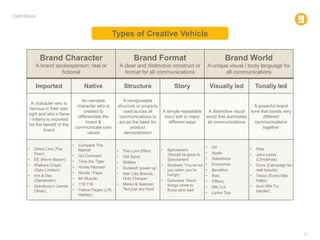
• A creative vehicle can be a character (e.g. EE’s Kevin Bacon or
Frostie’s Tony the Tiger), a consistent structure / story (e.g. the
Lynx Effect or “should’ve gone to Specsavers”) or a distinctive
visual world (e.g. Salesforce)
13
Definitions
Brand Character
A brand spokesperson; real or
fictional
Brand Format
A clear and distinctive construct or
format for all communications
Brand World
A unique visual / body language for
all communications
Imported Native Structure Story Visually led Tonally led
A character who is
famous in their own
right and who’s fame
/ infamy is imported
for the benefit of the
brand
An ownable
character who is
created to
differentiate the
brand &
communicate core
values
A recognisable
structure or property
used across all
communications to
act as the basis for
product
demonstration
A simple repeatable
story told in many
different ways
A distinctive visual
world that dominates
all communications
A powerful brand
tone that bonds very
different
communications
together
• Direct Line (The
Fixer)
• EE (Kevin Bacon)
• Walkers Crisps
(Gary Lineker)
• Ant & Dec
(Santander)
• Sainsbury’s (Jamie
Oliver)
• Compare The
Market
• Go Compare
• Tony the Tiger
• Honey Monster
• Nicole / Papa
• Mr Muscle
• 118 118
• Yellow Pages (J.R.
Hartley)
• The Lynx Effect
• Old Spice
• Skittles
• Duracell ‘power up’
• Aldi ‘Like Brands,
Only Cheaper’
• Marks & Spencer
‘Not just any food’
• Specsavers
‘Should’ve gone to
Specsavers’
• Snickers ‘You’re not
you when you’re
hungry’
• Guinness ‘Good
things come to
those who wait’
• O2
• Apple
• Salesforce
• Economist
• Benetton
• Ikea
• Tiffany
• Silk Cut
• Lipton Tea
• Nike
• John Lewis
(Christmas)
• Dove (Campaign for
real beauty)
• Tesco (Every little
helps)
• Avis (We Try
Harder)
Types of Creative Vehicle
Definitions
14
Segmentation vs. Targeting
• Segmentation is about dividing the marketplace into groups of
customers which are definable, accessible and actionable
• Targeting is about trying to understand identified differences
between groups / segments to inform message nuance & channel
tactics to ensure campaigns resonate more strongly
15
Definitions
Types of Segmentation
Behavioural segmentation
• dividing customers into groups according to product usage, purchase patterns (loyal vs.
occasional use)
• Lead Scoring is a form of Behavioural segmentation (unengaged vs. engaged)
Demographic segmentation
• segmenting the market based on characteristics of the audience: age/lifestage, gender, income,
marital status, occupation, education level
• in B2B, common demographics include company size, industry, turnover, job role
Geographic segmentation
• targeting an audience based on where they’re located
Firmographics
• dividing the market by industry / sector / focus of business, revenue / growth, employee / fleet size
Psychographic segmentation
• dividing the market by lifestyle, beliefs/values, social class, personality, e.g. budget conscious
shoppers
• this requires a clearly defined ideal buyer persona for the product or service and developing
relationships with the customer base
16
Definitions
Types of Targeting
Targeting can be used for a variety of reasons, including:
• To reach loyal customers
• To open doors to other segments
• To aid brand positioning / differentiation
• Because the brand doesn’t have the budget to go after everyone
It’s worth noting that in Paid Media, the more targeted the space, the more the
brand will pay – for example, B2B space / cost-per-thousand impressions is
typically 3x the cost of equivalent B2C space
17
Definitions
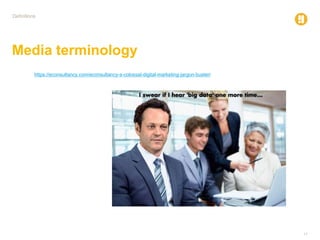
Media terminology
https://econsultancy.com/econsultancy-s-colossal-digital-marketing-jargon-buster/

Marketing Definitions

  • 1.
  • 2.
    Definitions 2 Jargon Busting 1. Strategyvs. Tactics 2. Insight vs. Observation 3. Product Proposition vs. Campaign Platform vs. Creative idea 4. Brands & branding 5. Brand Identity vs. look & feel 6. Creative Vehicle 7. Segmentation vs. Targeting 8. Types of Segmentation 9. Types of Targeting 10. Media terminology
  • 3.
    Definitions 3 Tactics Actions to executethe strategy - the tools and techniques How we engage our audience and also when & where Strategy What’s the problem we’re trying to solve and what’s our best direction of travel? Who we’re talking to (our priority audiences) and how their needs match the client’s offer Strategy vs. Tactics At its simplest level, a strategy is a plan for achieving a specific goal. Crucially, any strategy is explicitly linked to the goal that triggered and informed it. To put it another way, you can’t have an agreed strategy if you don’t have an agreed goal.
  • 4.
    Definitions 4 Insight vs. Observation AnInsight is an understanding of cause and effect, i.e. not simply knowing a fact, but knowing what causes that fact to be true and how it fits into a wider context For example, Pampers mistakenly believed parents were most concerned about nappies keeping babies dry - it turned out their real underlying concern was the interrupted sleep that resulted from leaks A true insight answers ‘why’ rather than ‘what’ – why do people think / behave the way they do as opposed to what they do (i.e. merely an Observation)?
  • 5.
    Definitions 5 Product Proposition Summary ofthe features & benefits we offer Creative Idea How we’ll engage our audience – messaging & visuals Campaign Platform Indicative ‘winning zone’ between product benefits & audience needs Product Proposition vs. Campaign Platform vs. Creative idea
  • 6.
    6 Definitions Product Proposition (Summary ofthe features & benefits we offer) Creative Idea (How we’ll engage our audience – messaging & visuals) Campaign Platform (Indicative ‘winning zone’ between product benefits & audience needs) Product Proposition = Reasons why a customer would buy our product / service An example: Dove Mild, affordable & good for your skin, i.e. “everyday skincare”
  • 7.
    7 Definitions Product Proposition (Summary ofthe features & benefits we offer) Creative Idea (How we’ll engage our audience – messaging & visuals) Campaign Platform (Indicative ‘winning zone’ between product benefits & audience needs) Campaign Platform = A short, sharp summary of ‘Where are we?’ & ‘What do we need to do?’ - a messaging territory / wireframe (i.e. what we found in our Situational Analysis & Objectives) An example: Dove Dove is for real women (in contrast to today’s narrow definition of beauty) Insight summary Women think the beauty standards seen in ads today are airbrushed & unattainable, so not reflective of reality Only 2% of women consider themselves “beautiful” while 31% describe themselves as ‘natural’ & 25% as ‘average’
  • 8.
    8 Definitions Product Proposition (Summary ofthe features & benefits we offer) Creative Idea (How we’ll engage our audience – messaging & visuals) Campaign Platform (Indicative ‘winning zone’ between product benefits & audience needs) Creative Idea = A logical, creative extension of the Product Proposition & Campaign Platform An example: The Dove campaign for real beauty
  • 9.
    9 Definitions Dove “Campaign forreal beauty” 600% increase in sales of featured products during first 2 months $1bn in sales achieved in first 12 months vs. $60-70m forecast ROI $3 for every $1 spent
  • 10.
    Definitions 10 Brands & branding •A brand is a set of associations that people make with a company, product, service, individual or organisation, e.g. Coca Cola – youthful, energetic, refreshing, unmistakable logo, red & white corporate colours, uniquely shaped glass bottles • Branding is an attempt to harness, generate, influence and control these associations to help a business perform better • Organisation can benefit enormously by creating a brand that is distinctive, trusted, exciting, reliable and is readily recalled at the time of purchase • In different industry sectors the audiences, competitors, delivery and service aspects of branding may differ, but the basic principle of being clear about what you stand for always applies
  • 11.
    Definitions 11 Brand Identity vs.look & feel • Your brand is shorthand for who you are. It represents what you stand for as a business and does so to a wide audience. A healthy brand has longevity and lives beyond trends, fads and campaigns • A well-developed brand also has a flexible, but enduring, visual identity system (brand guidelines) which guide and inform the development of all communications, so that they look and feel cohesive • Memory begins with recognition and is encoded through repetition. Brands that evolve their look & feel from campaign to campaign hamper the process of matching visual cues against previous experiences to build up associations and memory structures
  • 12.
    Definitions 12 Creative Vehicle • Arepeatable and enduring approach to developing communications with the aim of gradually building fame for a brand • The ‘thing’ that your brand is famous for when it comes to cutting through the comms clutter • A creative vehicle can be a character (e.g. EE’s Kevin Bacon or Frostie’s Tony the Tiger), a consistent structure / story (e.g. the Lynx Effect or “should’ve gone to Specsavers”) or a distinctive visual world (e.g. Salesforce)
  • 13.
    13 Definitions Brand Character A brandspokesperson; real or fictional Brand Format A clear and distinctive construct or format for all communications Brand World A unique visual / body language for all communications Imported Native Structure Story Visually led Tonally led A character who is famous in their own right and who’s fame / infamy is imported for the benefit of the brand An ownable character who is created to differentiate the brand & communicate core values A recognisable structure or property used across all communications to act as the basis for product demonstration A simple repeatable story told in many different ways A distinctive visual world that dominates all communications A powerful brand tone that bonds very different communications together • Direct Line (The Fixer) • EE (Kevin Bacon) • Walkers Crisps (Gary Lineker) • Ant & Dec (Santander) • Sainsbury’s (Jamie Oliver) • Compare The Market • Go Compare • Tony the Tiger • Honey Monster • Nicole / Papa • Mr Muscle • 118 118 • Yellow Pages (J.R. Hartley) • The Lynx Effect • Old Spice • Skittles • Duracell ‘power up’ • Aldi ‘Like Brands, Only Cheaper’ • Marks & Spencer ‘Not just any food’ • Specsavers ‘Should’ve gone to Specsavers’ • Snickers ‘You’re not you when you’re hungry’ • Guinness ‘Good things come to those who wait’ • O2 • Apple • Salesforce • Economist • Benetton • Ikea • Tiffany • Silk Cut • Lipton Tea • Nike • John Lewis (Christmas) • Dove (Campaign for real beauty) • Tesco (Every little helps) • Avis (We Try Harder) Types of Creative Vehicle
  • 14.
    Definitions 14 Segmentation vs. Targeting •Segmentation is about dividing the marketplace into groups of customers which are definable, accessible and actionable • Targeting is about trying to understand identified differences between groups / segments to inform message nuance & channel tactics to ensure campaigns resonate more strongly
  • 15.
    15 Definitions Types of Segmentation Behaviouralsegmentation • dividing customers into groups according to product usage, purchase patterns (loyal vs. occasional use) • Lead Scoring is a form of Behavioural segmentation (unengaged vs. engaged) Demographic segmentation • segmenting the market based on characteristics of the audience: age/lifestage, gender, income, marital status, occupation, education level • in B2B, common demographics include company size, industry, turnover, job role Geographic segmentation • targeting an audience based on where they’re located Firmographics • dividing the market by industry / sector / focus of business, revenue / growth, employee / fleet size Psychographic segmentation • dividing the market by lifestyle, beliefs/values, social class, personality, e.g. budget conscious shoppers • this requires a clearly defined ideal buyer persona for the product or service and developing relationships with the customer base
  • 16.
    16 Definitions Types of Targeting Targetingcan be used for a variety of reasons, including: • To reach loyal customers • To open doors to other segments • To aid brand positioning / differentiation • Because the brand doesn’t have the budget to go after everyone It’s worth noting that in Paid Media, the more targeted the space, the more the brand will pay – for example, B2B space / cost-per-thousand impressions is typically 3x the cost of equivalent B2C space
  • 17.