How does advertising work as
      communication?

• Effective advertising is a message to a consumer about
  a brand.

• It gets attention, provides information, and sometimes
  entertains.

• It seeks to create a response, such as an inquiry, a sale,
  or Web site visit.


  The Communication Model
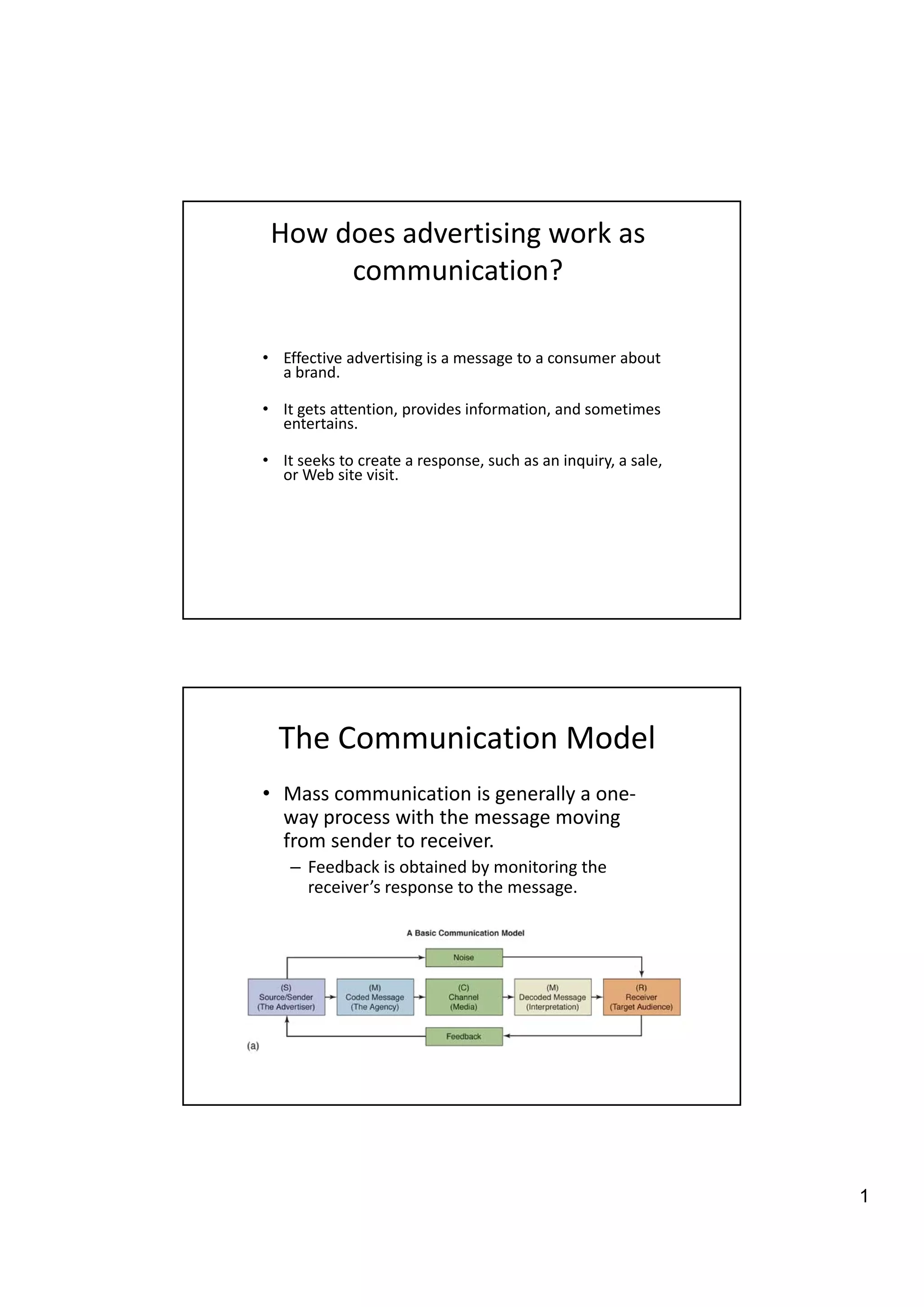
• Mass communication is generally a one-
  way process with the message moving
     yp                     g        g
  from sender to receiver.
    – Feedback is obtained by monitoring the
      receiver’s response to the message.


                                                               1
The Communication Model
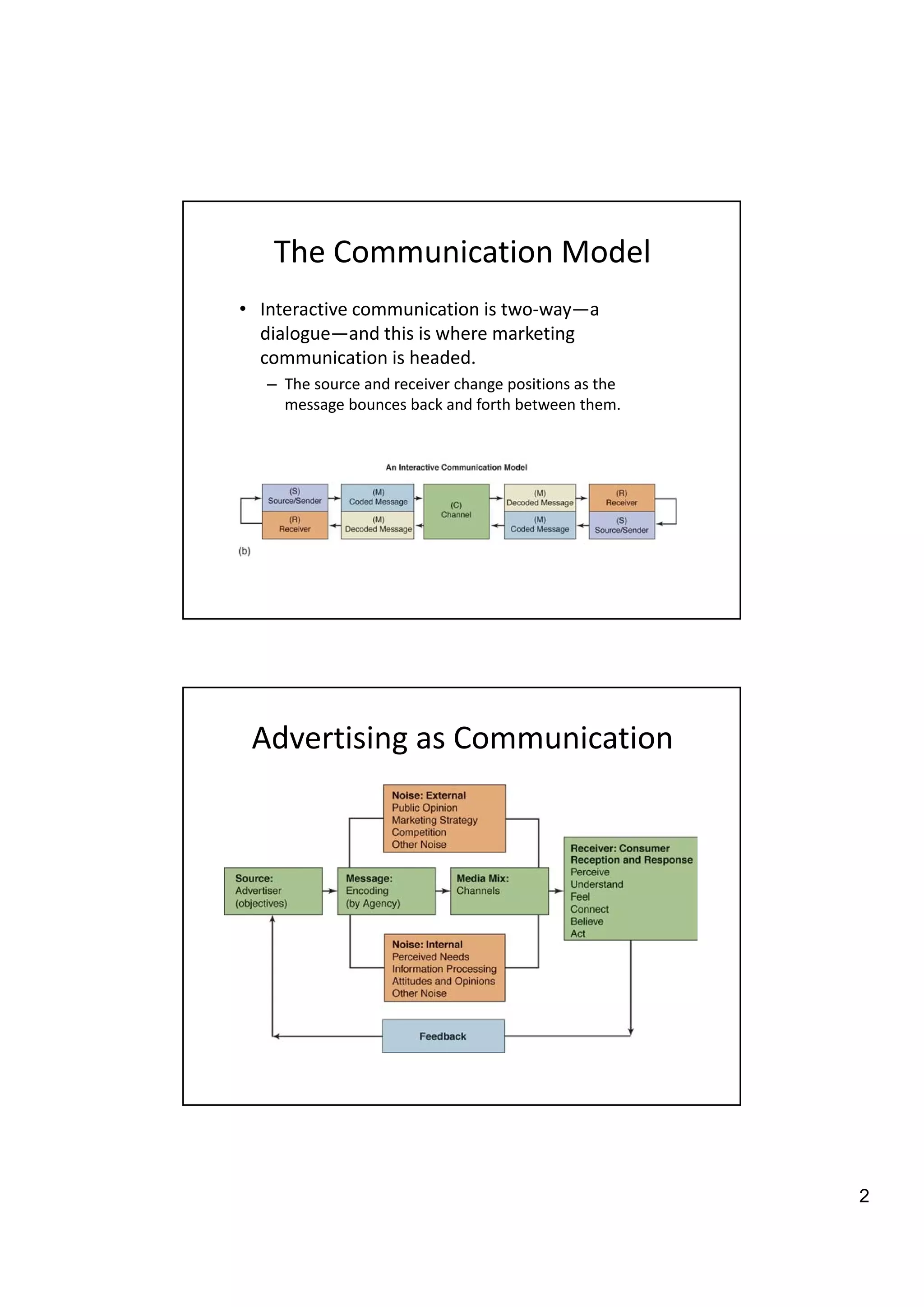
• Interactive communication is two-way—a
  dialogue—and this is where marketing
       g                             g
  communication is headed.
   – The source and receiver change positions as the
     message bounces back and forth between them.


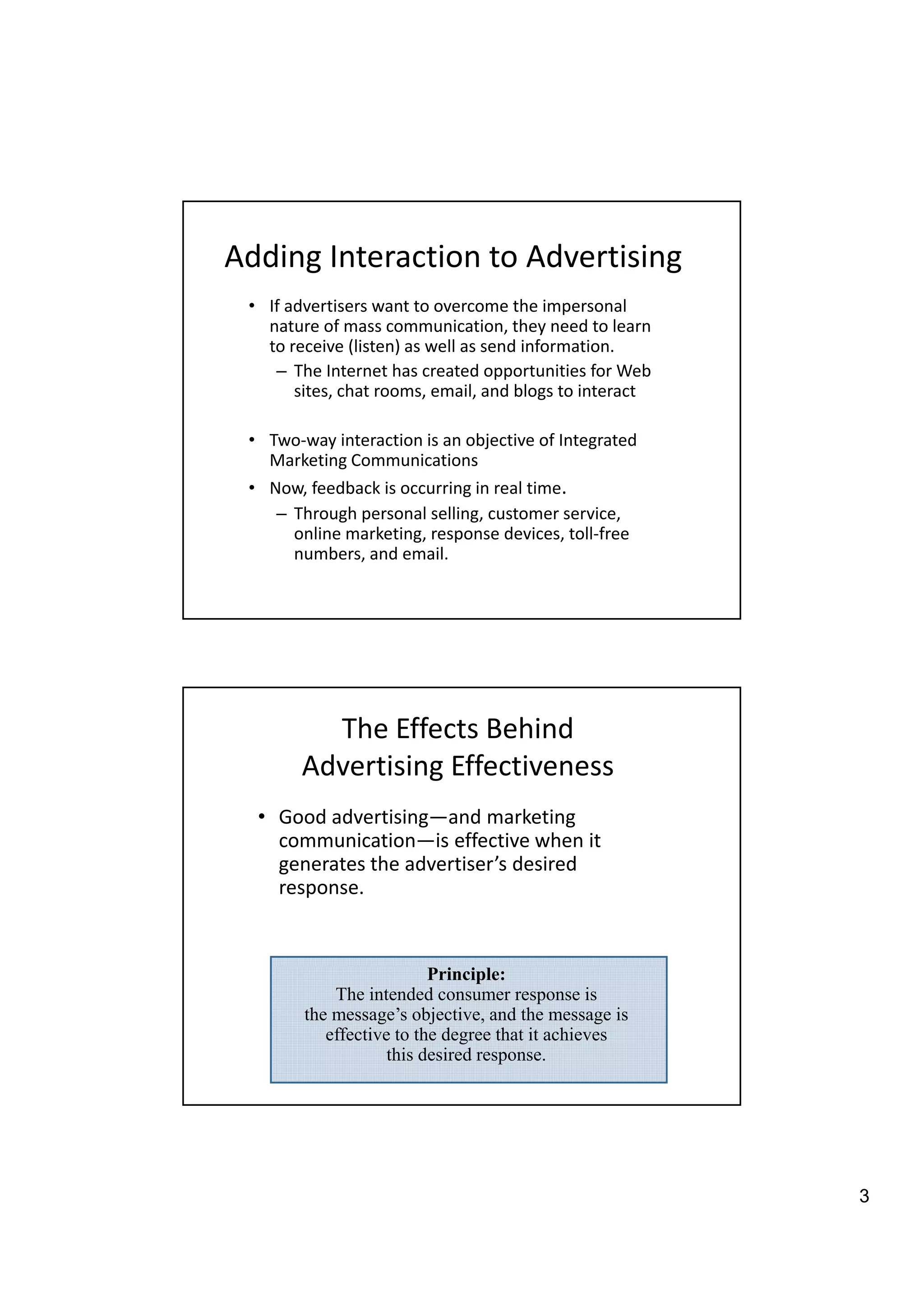
 Advertising as Communication


                                                       2
Adding Interaction to Advertising
 • If advertisers want to overcome the impersonal
   nature of mass communication, they need to learn
   to receive (li
           i (listen) as well as send i f
                     )     ll       d information.
                                               i
    – The Internet has created opportunities for Web
       sites, chat rooms, email, and blogs to interact

 • Two-way interaction is an objective of Integrated
   Marketing Communications
 • Now, feedback is occurring in real time.
    – Through personal selling, customer service,
      online marketing, response devices, toll-free
      numbers, and email.


          The Effects Behind
        Advertising Effectiveness
  • Good advertising—and marketing
                   g                 g
    communication—is effective when it
    generates the advertiser’s desired
    response.


                          Principle:
            The intended consumer response is
        the message’s objective, and the message is
           effective to the degree that it achieves
                    this desired response.


                                                         3
Simple Answer/ Traditional
            Approaches
• AIDA (Attention, Interest,
  Desire, Action)
   – Assumes a predictable set
     of steps
• Think-Feel-Do
   – Think about the message,
     feel something about the
     brand, then do something
     like try it
• Domains
   – Messages have various
     impacts on consumers
     simultaneously
     (perception, learning, and
     persuasion)


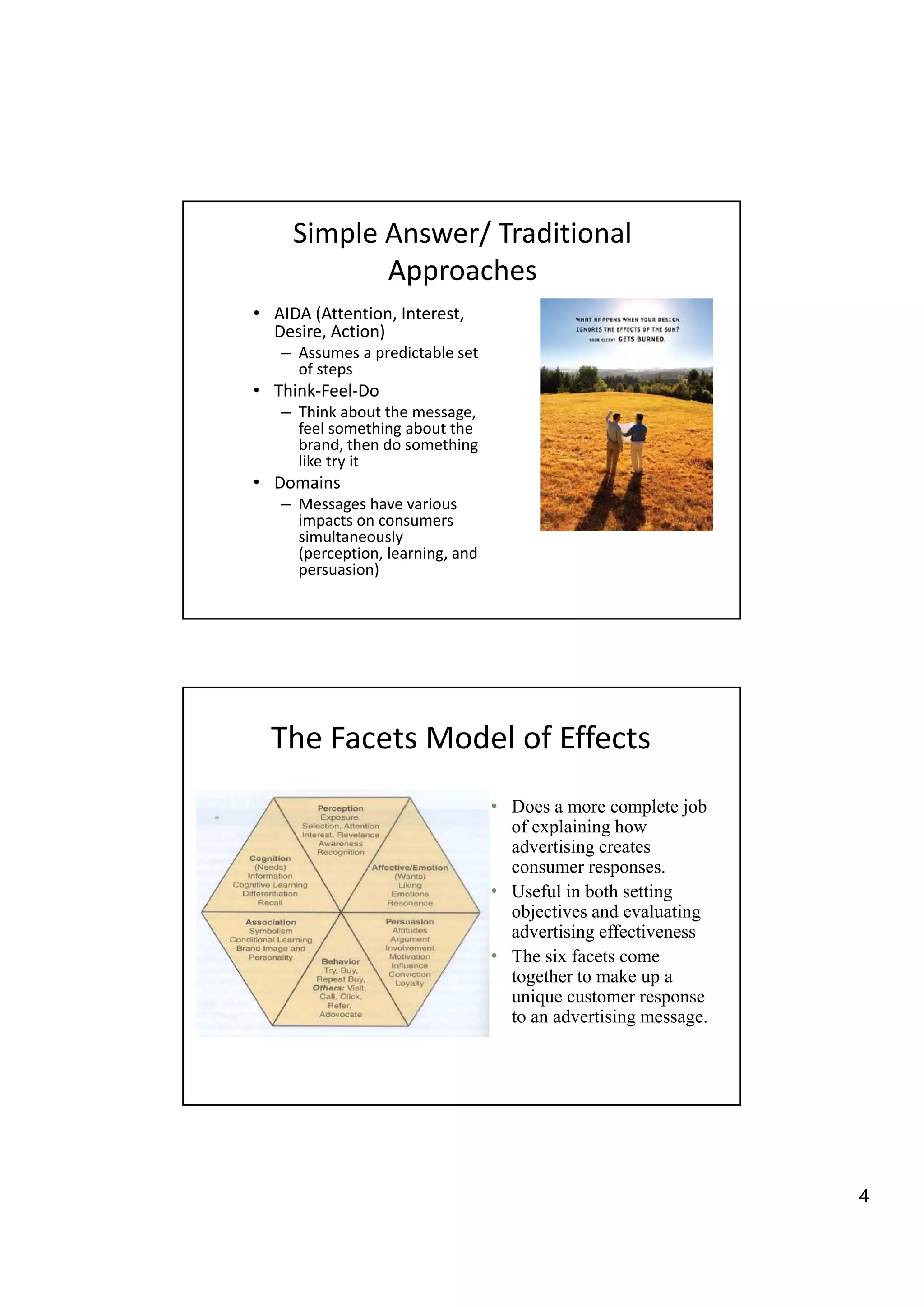
  The Facets Model of Effects
                                  • Does a more complete job
                                    of explaining how
                                    advertising creates
                                    consumer responses.
                                  • Useful in both setting
                                    objectives and evaluating
                                    advertising effectiveness
                                  • The six facets come
                                    together to make up a
                                    unique customer response
                                    to an advertising message.


                                                                 4
The Perception Facet
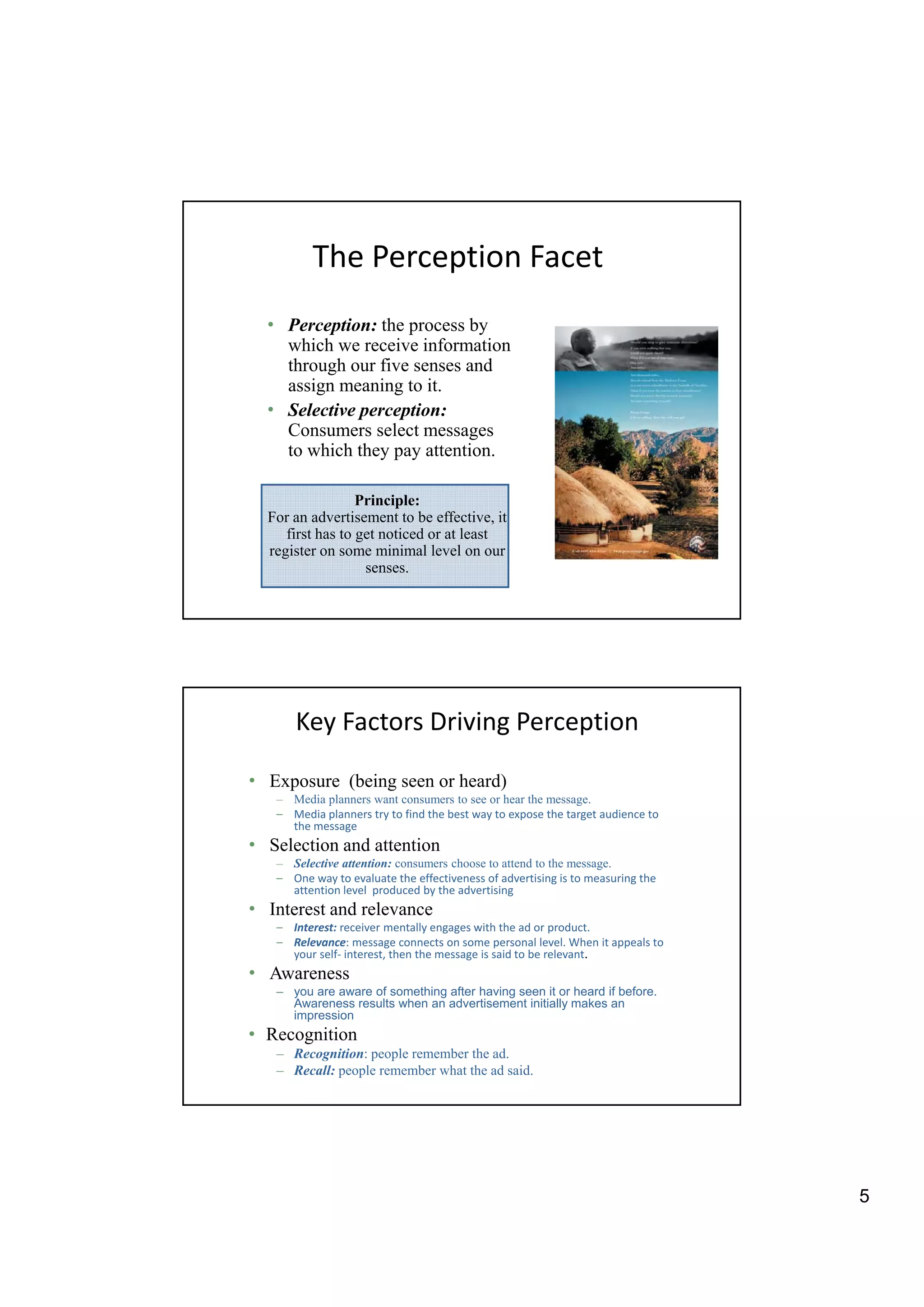
  • Perception: the process by
    which we receive information
      hi h        i i f       ti
    through our five senses and
    assign meaning to it.
  • Selective perception:
    Consumers select messages
    to which they pay attention.

                  Principle:
  For an advertisement to be effective, it
     first has to get noticed or at least
  register on some minimal level on our
                   senses.


      Key Factors Driving Perception

• Exposure (being seen or heard)
   – Media planners want consumers to see or hear the message.
   – Media planners try to find the best way to expose the target audience to
     the message
• Selection and attention
   – Selective attention: consumers choose to attend to the message.
   – One way to evaluate the effectiveness of advertising is to measuring the
     attention level produced by the advertising
• Interest and relevance
   – Interest: receiver mentally engages with the ad or product.
   – Relevance: message connects on some personal level. When it appeals to
     your self- interest, then the message is said to be relevant.
• Awareness
   – you are aware of something after having seen it or heard if before.
     Awareness results when an advertisement initially makes an
     impression
• Recognition
   – Recognition: people remember the ad.
   – Recall: people remember what the ad said.


                                                                                5
The Affective or Emotional Facet

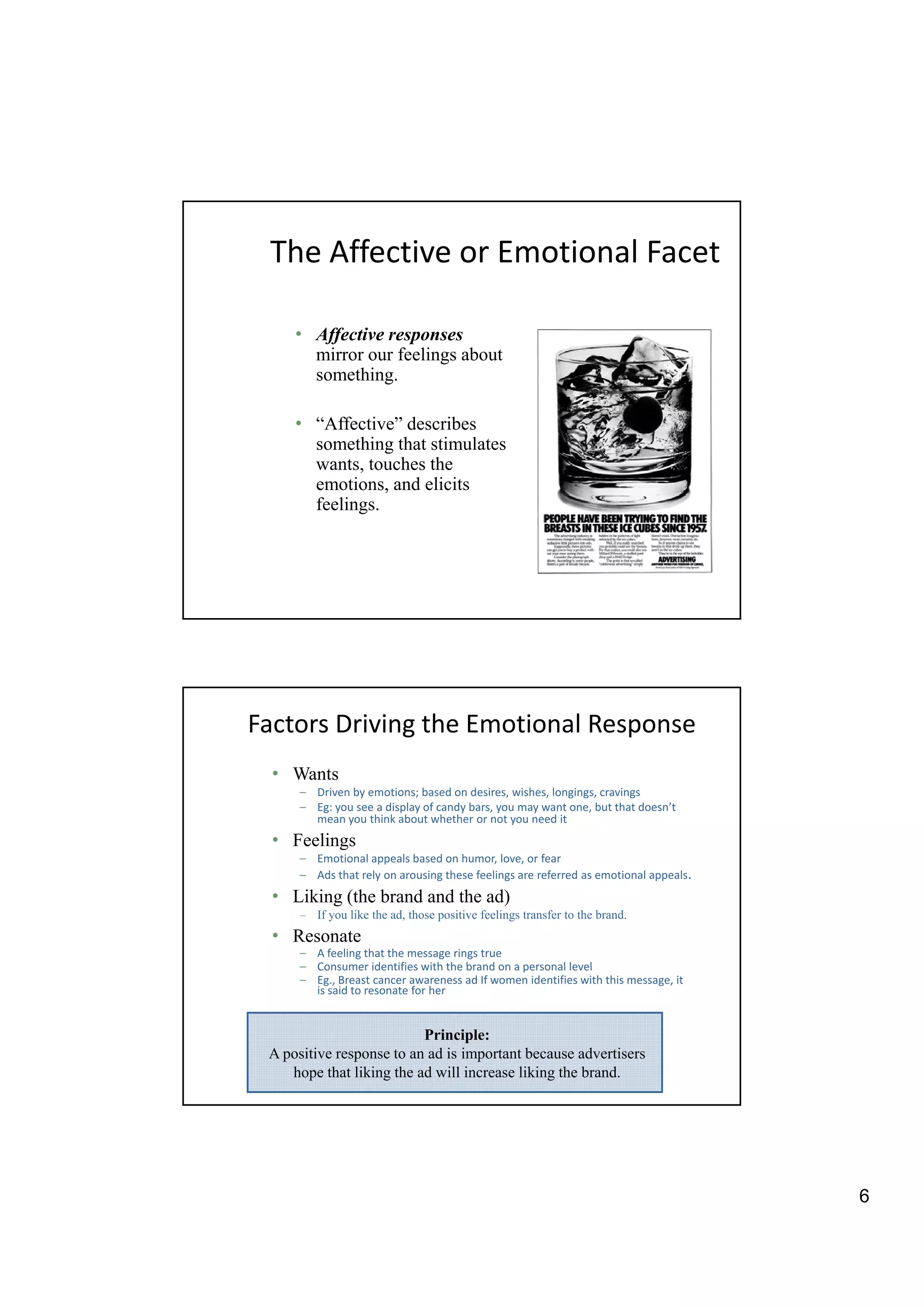
     • Affective responses
         ffective esponses
       mirror our feelings about
       something.

     • “Affective” describes
       something that stimulates
       wants, touches the
       emotions, and elicits
            ti     d li it
       feelings.


Factors Driving the Emotional Response
  • Wants
      – Driven by emotions; based on desires, wishes, longings, cravings
      – Eg: you see a display of candy bars, you may want one, but that doesn’t
        mean you think about whether or not you need it
  • Feelings
      – Emotional appeals based on humor, love, or fear
      – Ads that rely on arousing these feelings are referred as emotional appeals.
  • Liking (the brand and the ad)
      – If you like the ad, those positive feelings transfer to the brand.
  • Resonate
      – A feeling that the message rings true
      – Consumer identifies with the brand on a personal level
      – Eg., Breast cancer awareness ad If women identifies with this message, it
        is said to resonate for her


                          Principle:
 A positive response to an ad is important because advertisers
    hope that liking the ad will increase liking the brand.


                                                                                      6
The Cognitive Facet
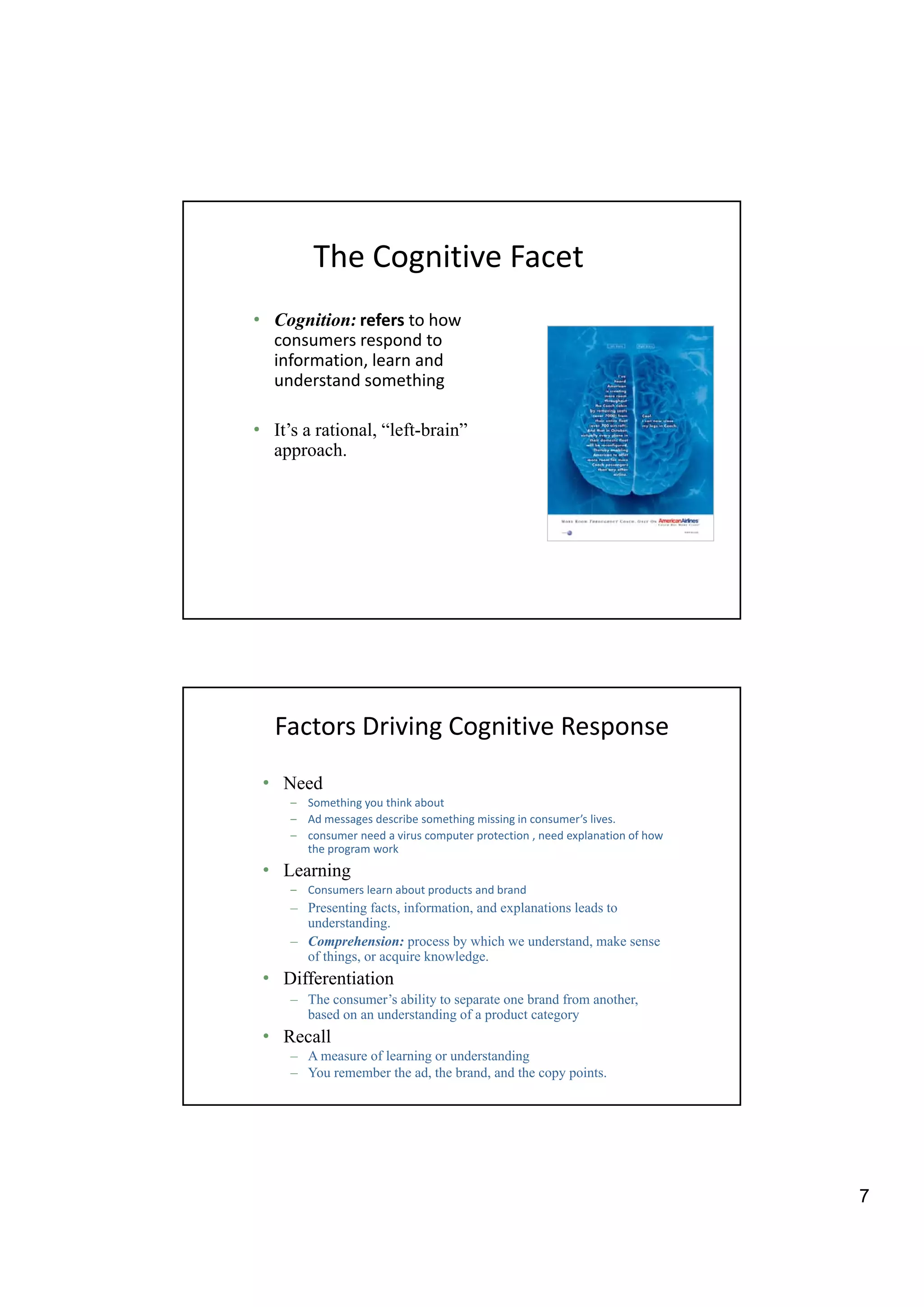
• Cognition: refers to how
  consumers respond to
  information, learn and
  understand something

• It’s a rational, “left-brain”
  approach.


   Factors Driving Cognitive Response
 • Need
     – Something you think about
     – Ad messages describe something missing in consumer’s lives.
     – consumer need a virus computer protection , need explanation of how
       the program work
 • Learning
     – Consumers learn about products and brand
     – Presenting facts, information, and explanations leads to
       understanding.
     – Comprehension: process by which we understand, make sense
       of things, or acquire knowledge.
 • Differentiation
     – The consumer’s ability to separate one brand from another,
       based on an understanding of a product category
 • Recall
     – A measure of learning or understanding
     – You remember the ad, the brand, and the copy points.


                                                                             7
The Association Facet
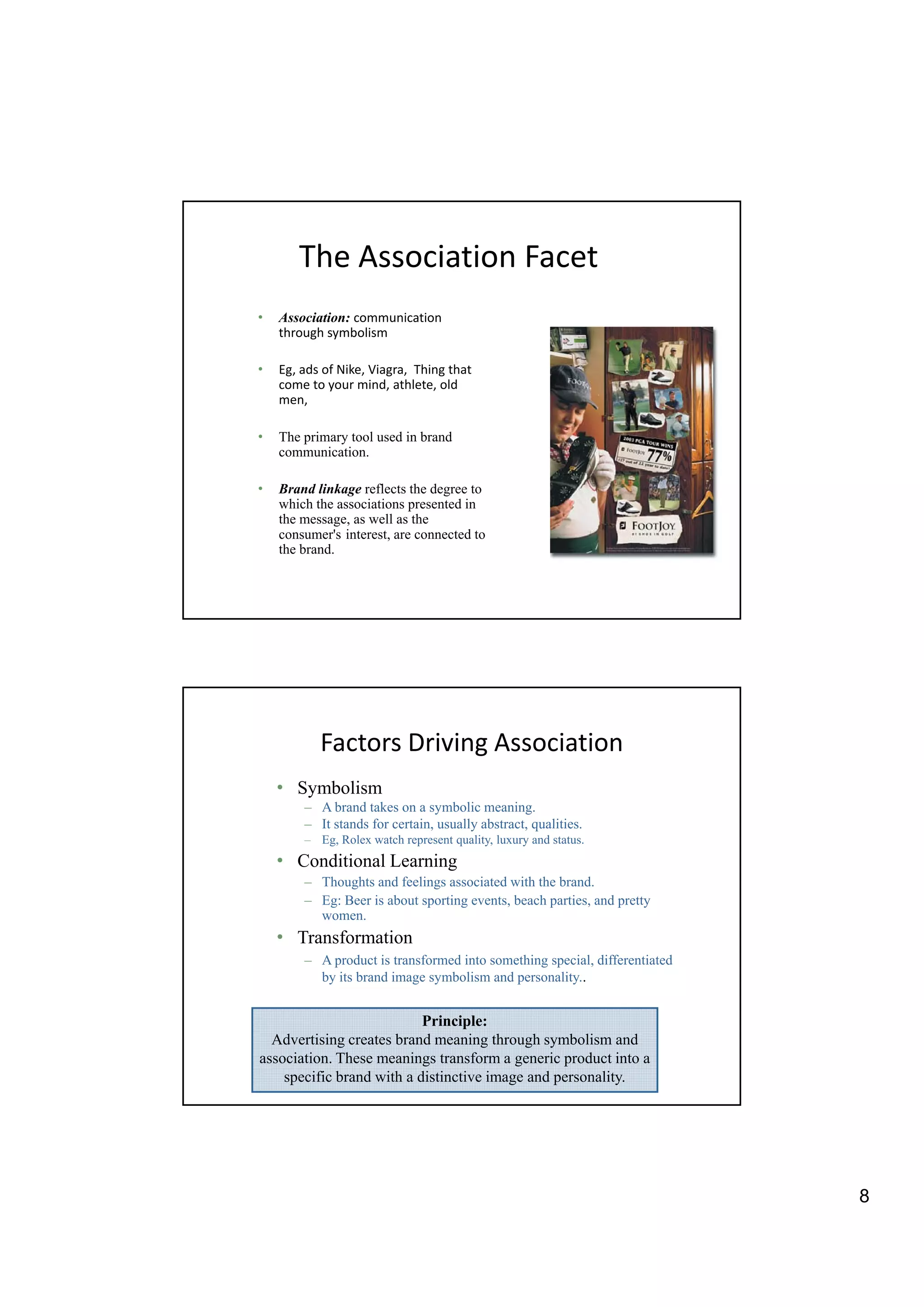
•   Association: communication
    through symbolism

•   Eg, ads of Nike, Viagra, Thing that
    come to your mind, athlete, old
    men,

•   The primary tool used in brand
    communication.

•   Brand linkage reflects the degree to
    which the associations presented in
    the message, as well as the
    consumer's interest, are connected to
    the brand.


           Factors Driving Association
    • Symbolism
        – A brand takes on a symbolic meaning.
        – It stands for certain, usually abstract, qualities.
                        certain          abstract qualities
        – Eg, Rolex watch represent quality, luxury and status.
    • Conditional Learning
        – Thoughts and feelings associated with the brand.
        – Eg: Beer is about sporting events, beach parties, and pretty
          women.
    • Transformation
        – A product is transformed into something special, differentiated
            p                                   g p      ,
          by its brand image symbolism and personality..


                           Principle:
  Advertising creates brand meaning through symbolism and
association. These meanings transform a generic product into a
    specific brand with a distinctive image and personality.


                                                                            8
The Persuasion Facet
• Persuasion: influencing or                                                 Principle:
  motivating the receiver of a                                        Advertising employs both
  message to believe or do                                             rational arguments and
  something                                                         compelling emotions to create
                                                                        persuasive messages.
                                                                                i

                       Factors Driving Persuasion
              Attitude (positive, neutral, negative):
                     -is mental readiness to react to a situation in a given way

       •    Motivation
             -Something (e.g., hunger) prompts one to act in a certain way.

       •    Influence
              –   Opinion leaders may influence other peoples’ attitudes.
              –   Bandwagon appeals: messages say “everyone is doing it.”
              –   Word of mouth is created by strategies that engage influencers.


       •    Involvement
              –   How engaged you are in paying attention.
              –   The process you go through in responding to a message and making a product
                  decision.
              –   High involvement vs. low involvement.


                    Factors Driving Persuasion

    • Conviction
           – Consumers agree with a message and achieve a state of
             certainty—a belief—about a brand.
    • Loyalty
           – Brand loyalty is both attitude (liking, respect, preference)
             and action (repeat purchases).
           – It’s built on customer satisfaction.
    • Believability and Credibility
           – Believability: the credibility of the arguments in a message.
           – Credibility: indication of the trustworthiness of the source.
           – Source credibility: the person delivering the message is
             respected, trusted, and believable.


                                                                                                    9
The Behavior Facet
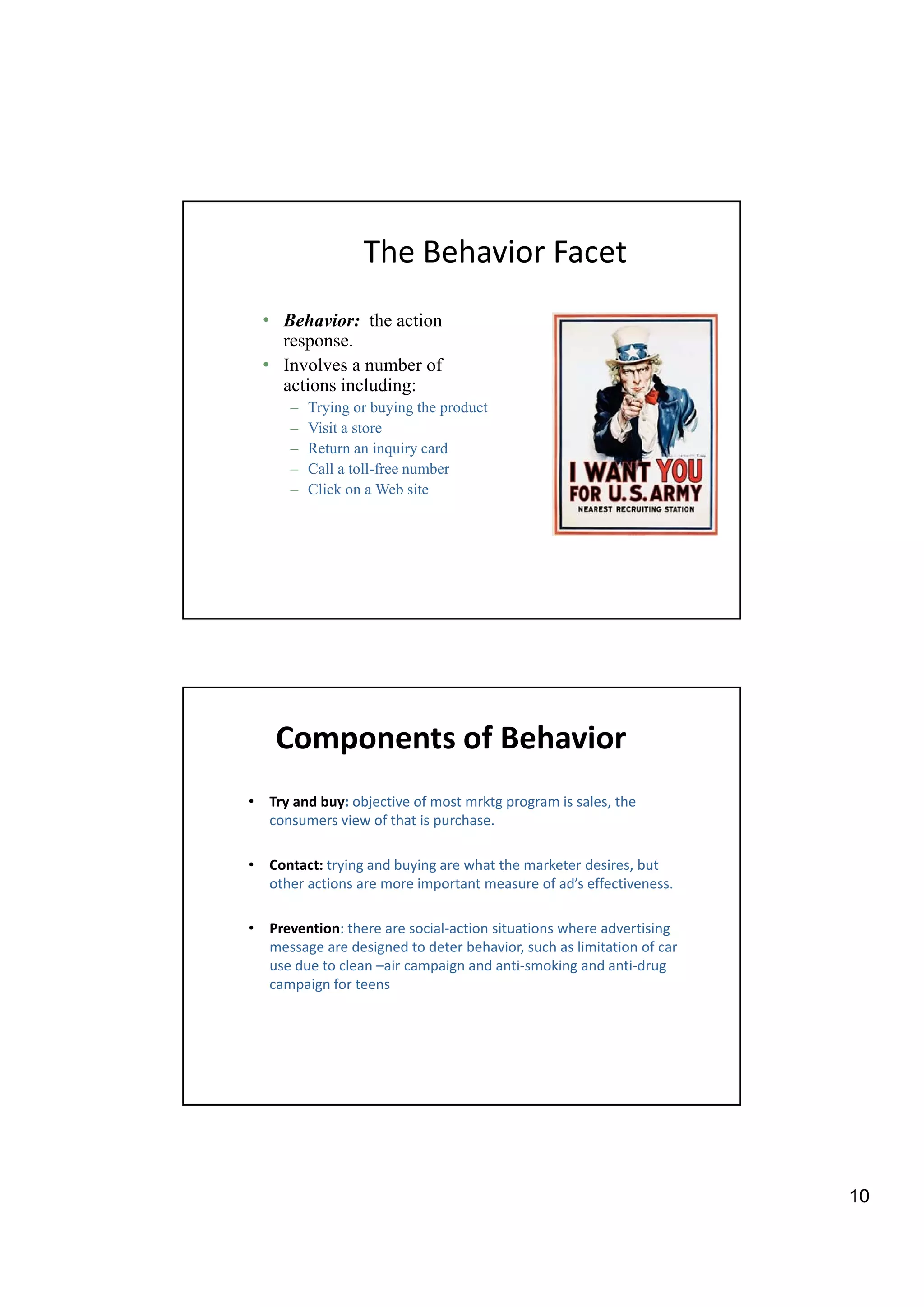
  • Behavior: the action
    response.
    response
  • Involves a number of
    actions including:
      –   Trying or buying the product
      –   Visit a store
      –   Return an inquiry card
      –   Call a toll-free number
      –   Click on a Web site


    Components of Behavior
• Try and buy: objective of most mrktg program is sales, the
  consumers view of that is purchase.
                            p

• Contact: trying and buying are what the marketer desires, but
  other actions are more important measure of ad’s effectiveness.

• Prevention: there are social-action situations where advertising
  message are designed to deter behavior, such as limitation of car
  use due to clean –air campaign and anti-smoking and anti-drug
  campaign for teens


                                                                      10

How does Advertising Communication Work?

  • 1.
    How does advertisingwork as communication? • Effective advertising is a message to a consumer about a brand. • It gets attention, provides information, and sometimes entertains. • It seeks to create a response, such as an inquiry, a sale, or Web site visit. The Communication Model • Mass communication is generally a one- way process with the message moving yp g g from sender to receiver. – Feedback is obtained by monitoring the receiver’s response to the message. 1
  • 2.
    The Communication Model •Interactive communication is two-way—a dialogue—and this is where marketing g g communication is headed. – The source and receiver change positions as the message bounces back and forth between them. Advertising as Communication 2
  • 3.
    Adding Interaction toAdvertising • If advertisers want to overcome the impersonal nature of mass communication, they need to learn to receive (li i (listen) as well as send i f ) ll d information. i – The Internet has created opportunities for Web sites, chat rooms, email, and blogs to interact • Two-way interaction is an objective of Integrated Marketing Communications • Now, feedback is occurring in real time. – Through personal selling, customer service, online marketing, response devices, toll-free numbers, and email. The Effects Behind Advertising Effectiveness • Good advertising—and marketing g g communication—is effective when it generates the advertiser’s desired response. Principle: The intended consumer response is the message’s objective, and the message is effective to the degree that it achieves this desired response. 3
  • 4.
    Simple Answer/ Traditional Approaches • AIDA (Attention, Interest, Desire, Action) – Assumes a predictable set of steps • Think-Feel-Do – Think about the message, feel something about the brand, then do something like try it • Domains – Messages have various impacts on consumers simultaneously (perception, learning, and persuasion) The Facets Model of Effects • Does a more complete job of explaining how advertising creates consumer responses. • Useful in both setting objectives and evaluating advertising effectiveness • The six facets come together to make up a unique customer response to an advertising message. 4
  • 5.
    The Perception Facet • Perception: the process by which we receive information hi h i i f ti through our five senses and assign meaning to it. • Selective perception: Consumers select messages to which they pay attention. Principle: For an advertisement to be effective, it first has to get noticed or at least register on some minimal level on our senses. Key Factors Driving Perception • Exposure (being seen or heard) – Media planners want consumers to see or hear the message. – Media planners try to find the best way to expose the target audience to the message • Selection and attention – Selective attention: consumers choose to attend to the message. – One way to evaluate the effectiveness of advertising is to measuring the attention level produced by the advertising • Interest and relevance – Interest: receiver mentally engages with the ad or product. – Relevance: message connects on some personal level. When it appeals to your self- interest, then the message is said to be relevant. • Awareness – you are aware of something after having seen it or heard if before. Awareness results when an advertisement initially makes an impression • Recognition – Recognition: people remember the ad. – Recall: people remember what the ad said. 5
  • 6.
    The Affective orEmotional Facet • Affective responses ffective esponses mirror our feelings about something. • “Affective” describes something that stimulates wants, touches the emotions, and elicits ti d li it feelings. Factors Driving the Emotional Response • Wants – Driven by emotions; based on desires, wishes, longings, cravings – Eg: you see a display of candy bars, you may want one, but that doesn’t mean you think about whether or not you need it • Feelings – Emotional appeals based on humor, love, or fear – Ads that rely on arousing these feelings are referred as emotional appeals. • Liking (the brand and the ad) – If you like the ad, those positive feelings transfer to the brand. • Resonate – A feeling that the message rings true – Consumer identifies with the brand on a personal level – Eg., Breast cancer awareness ad If women identifies with this message, it is said to resonate for her Principle: A positive response to an ad is important because advertisers hope that liking the ad will increase liking the brand. 6
  • 7.
    The Cognitive Facet •Cognition: refers to how consumers respond to information, learn and understand something • It’s a rational, “left-brain” approach. Factors Driving Cognitive Response • Need – Something you think about – Ad messages describe something missing in consumer’s lives. – consumer need a virus computer protection , need explanation of how the program work • Learning – Consumers learn about products and brand – Presenting facts, information, and explanations leads to understanding. – Comprehension: process by which we understand, make sense of things, or acquire knowledge. • Differentiation – The consumer’s ability to separate one brand from another, based on an understanding of a product category • Recall – A measure of learning or understanding – You remember the ad, the brand, and the copy points. 7
  • 8.
    The Association Facet • Association: communication through symbolism • Eg, ads of Nike, Viagra, Thing that come to your mind, athlete, old men, • The primary tool used in brand communication. • Brand linkage reflects the degree to which the associations presented in the message, as well as the consumer's interest, are connected to the brand. Factors Driving Association • Symbolism – A brand takes on a symbolic meaning. – It stands for certain, usually abstract, qualities. certain abstract qualities – Eg, Rolex watch represent quality, luxury and status. • Conditional Learning – Thoughts and feelings associated with the brand. – Eg: Beer is about sporting events, beach parties, and pretty women. • Transformation – A product is transformed into something special, differentiated p g p , by its brand image symbolism and personality.. Principle: Advertising creates brand meaning through symbolism and association. These meanings transform a generic product into a specific brand with a distinctive image and personality. 8
  • 9.
    The Persuasion Facet •Persuasion: influencing or Principle: motivating the receiver of a Advertising employs both message to believe or do rational arguments and something compelling emotions to create persuasive messages. i Factors Driving Persuasion Attitude (positive, neutral, negative): -is mental readiness to react to a situation in a given way • Motivation -Something (e.g., hunger) prompts one to act in a certain way. • Influence – Opinion leaders may influence other peoples’ attitudes. – Bandwagon appeals: messages say “everyone is doing it.” – Word of mouth is created by strategies that engage influencers. • Involvement – How engaged you are in paying attention. – The process you go through in responding to a message and making a product decision. – High involvement vs. low involvement. Factors Driving Persuasion • Conviction – Consumers agree with a message and achieve a state of certainty—a belief—about a brand. • Loyalty – Brand loyalty is both attitude (liking, respect, preference) and action (repeat purchases). – It’s built on customer satisfaction. • Believability and Credibility – Believability: the credibility of the arguments in a message. – Credibility: indication of the trustworthiness of the source. – Source credibility: the person delivering the message is respected, trusted, and believable. 9
  • 10.
    The Behavior Facet • Behavior: the action response. response • Involves a number of actions including: – Trying or buying the product – Visit a store – Return an inquiry card – Call a toll-free number – Click on a Web site Components of Behavior • Try and buy: objective of most mrktg program is sales, the consumers view of that is purchase. p • Contact: trying and buying are what the marketer desires, but other actions are more important measure of ad’s effectiveness. • Prevention: there are social-action situations where advertising message are designed to deter behavior, such as limitation of car use due to clean –air campaign and anti-smoking and anti-drug campaign for teens 10