12.1
CHAPTER 12:CHAPTER 12:
INTRODUCING AND NAMING NEW PRODUCTSINTRODUCING AND NAMING NEW PRODUCTS
AND BRAND EXTENSIONSAND BRAND EXTENSIONS
Kevin Lane KellerKevin Lane Keller
Tuck School of BusinessTuck School of Business
Dartmouth CollegeDartmouth College
12.2
Leverage the BrandLeverage the Brand
 Firms are seeking to build “power” or “mega”Firms are seeking to build “power” or “mega”
brands that establish a broad market footprint,brands that establish a broad market footprint,
appealing to multiple customer segments withappealing to multiple customer segments with
multiple products all underneath the brandmultiple products all underneath the brand
umbrella.umbrella.
12.3
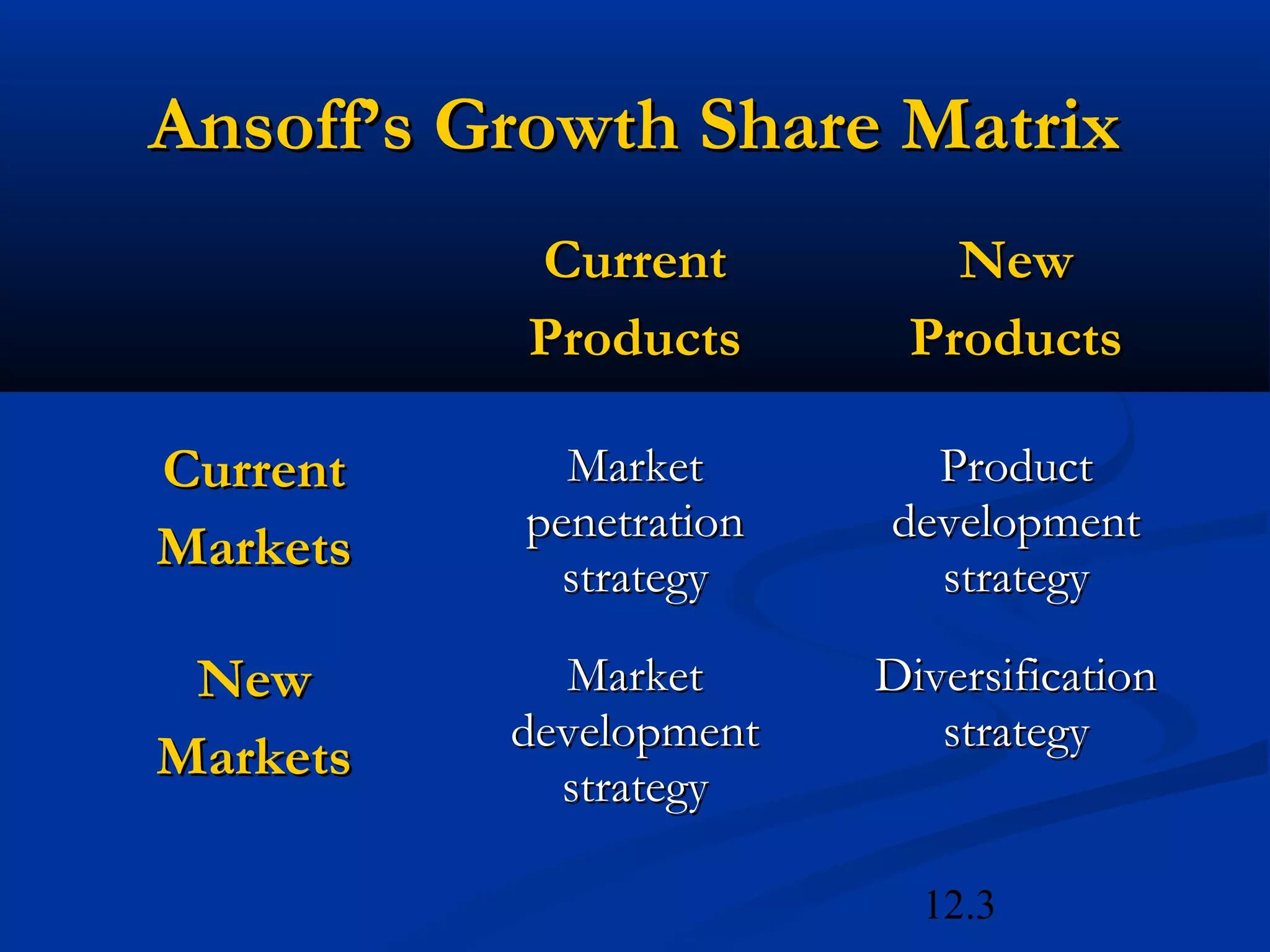
Ansoff’s Growth Share MatrixAnsoff’s Growth Share Matrix
CurrentCurrent
ProductsProducts
NewNew
ProductsProducts
CurrentCurrent
MarketsMarkets
MarketMarket
penetrationpenetration
strategystrategy
ProductProduct
developmentdevelopment
strategystrategy
NewNew
MarketsMarkets
MarketMarket
developmentdevelopment
strategystrategy
DiversificationDiversification
strategystrategy
12.4
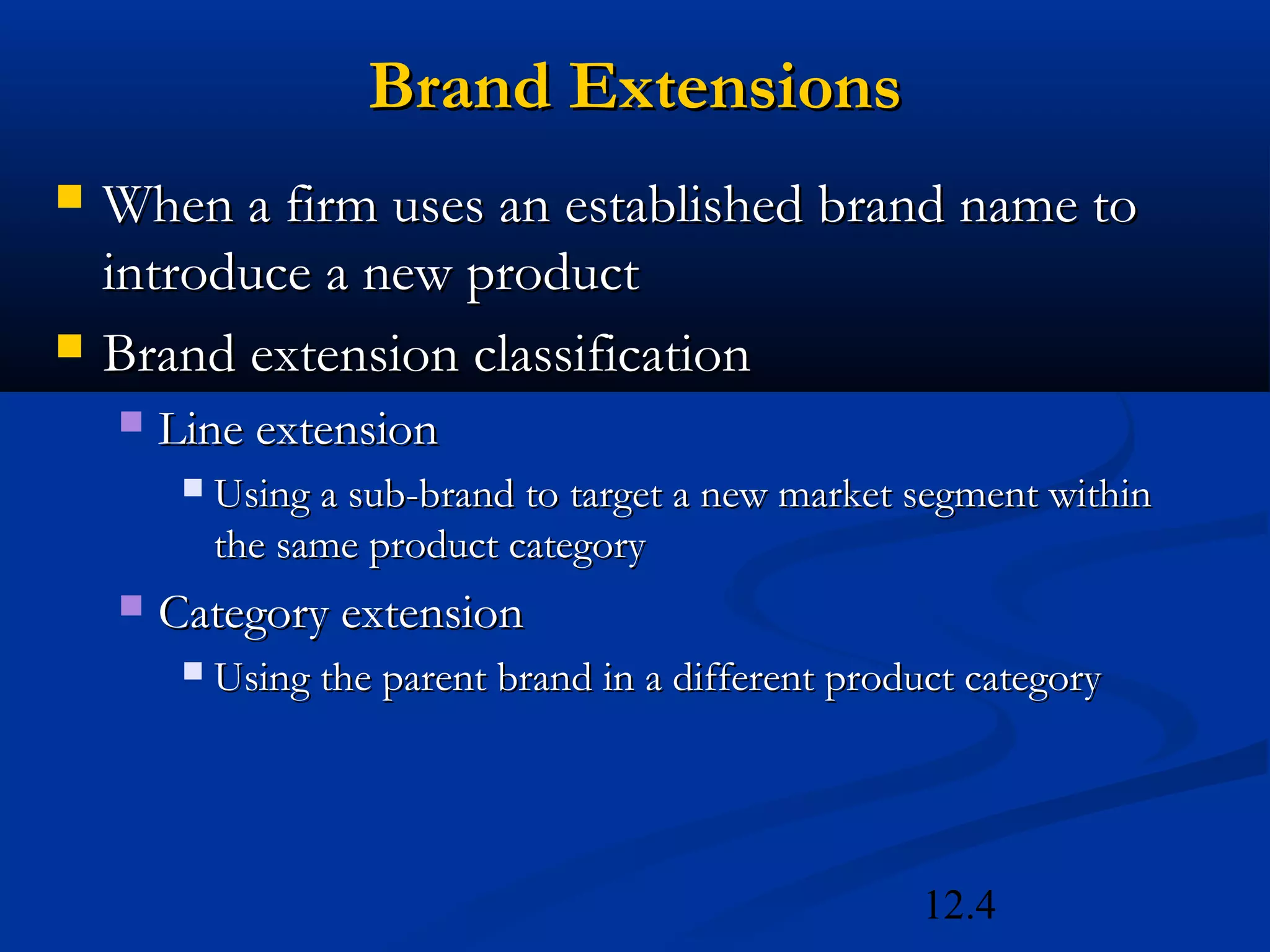
Brand ExtensionsBrand Extensions
 When a firm uses an established brand name toWhen a firm uses an established brand name to
introduce a new productintroduce a new product
 Brand extension classificationBrand extension classification
 Line extensionLine extension
 Using a sub-brand to target a new market segment withinUsing a sub-brand to target a new market segment within
the same product categorythe same product category
 Category extensionCategory extension
 Using the parent brand in a different product categoryUsing the parent brand in a different product category
12.5
General Strategies for Establishing a CategoryGeneral Strategies for Establishing a Category
Tauber’s Franchise—ExtensionTauber’s Franchise—Extension
 Introduce the same product in a different form.Introduce the same product in a different form. Example: Ocean SprayExample: Ocean Spray
Cranberry Juice CocktailCranberry Juice Cocktail
 IIntroduce products that contain the brand’s distinctive taste, ingredient, orntroduce products that contain the brand’s distinctive taste, ingredient, or
component.component. Example: Philadelphia cream cheese salad dressingExample: Philadelphia cream cheese salad dressing
 Introduce companion products for the brand.Introduce companion products for the brand. Example: ColemanExample: Coleman
camping equipmentcamping equipment
 Introduce products relevant to the customer franchise of the brand.Introduce products relevant to the customer franchise of the brand.
Example: Gerber insuranceExample: Gerber insurance
 Introduce products that capitalize on the firm’s perceived expertise.Introduce products that capitalize on the firm’s perceived expertise.
Example: Honda lawn mowersExample: Honda lawn mowers
 Introduce products that reflect the brand’s distinctive benefit, attribute, orIntroduce products that reflect the brand’s distinctive benefit, attribute, or
feature.feature. Example: Lysol’s “deodorizing” household cleaningExample: Lysol’s “deodorizing” household cleaning
productsproducts
 Introduce products that capitalize on the distinctive image or prestige of theIntroduce products that capitalize on the distinctive image or prestige of the
brand.brand. Example: Calvin Klein clothesExample: Calvin Klein clothes
12.6
Advantages of ExtensionsAdvantages of Extensions
 Facilitate new product acceptanceFacilitate new product acceptance
 Improve brand imageImprove brand image
 Reduce risk perceived by customersReduce risk perceived by customers
 Increase the probability of gaining distribution and trialIncrease the probability of gaining distribution and trial
 Increase efficiency of promotional expendituresIncrease efficiency of promotional expenditures
 Reduce costs of introductory and follow-up marketingReduce costs of introductory and follow-up marketing
programsprograms
 Avoid cost of developing a new brandAvoid cost of developing a new brand
 Allow for packaging and labeling efficienciesAllow for packaging and labeling efficiencies
 Permit consumer variety seekingPermit consumer variety seeking
12.7
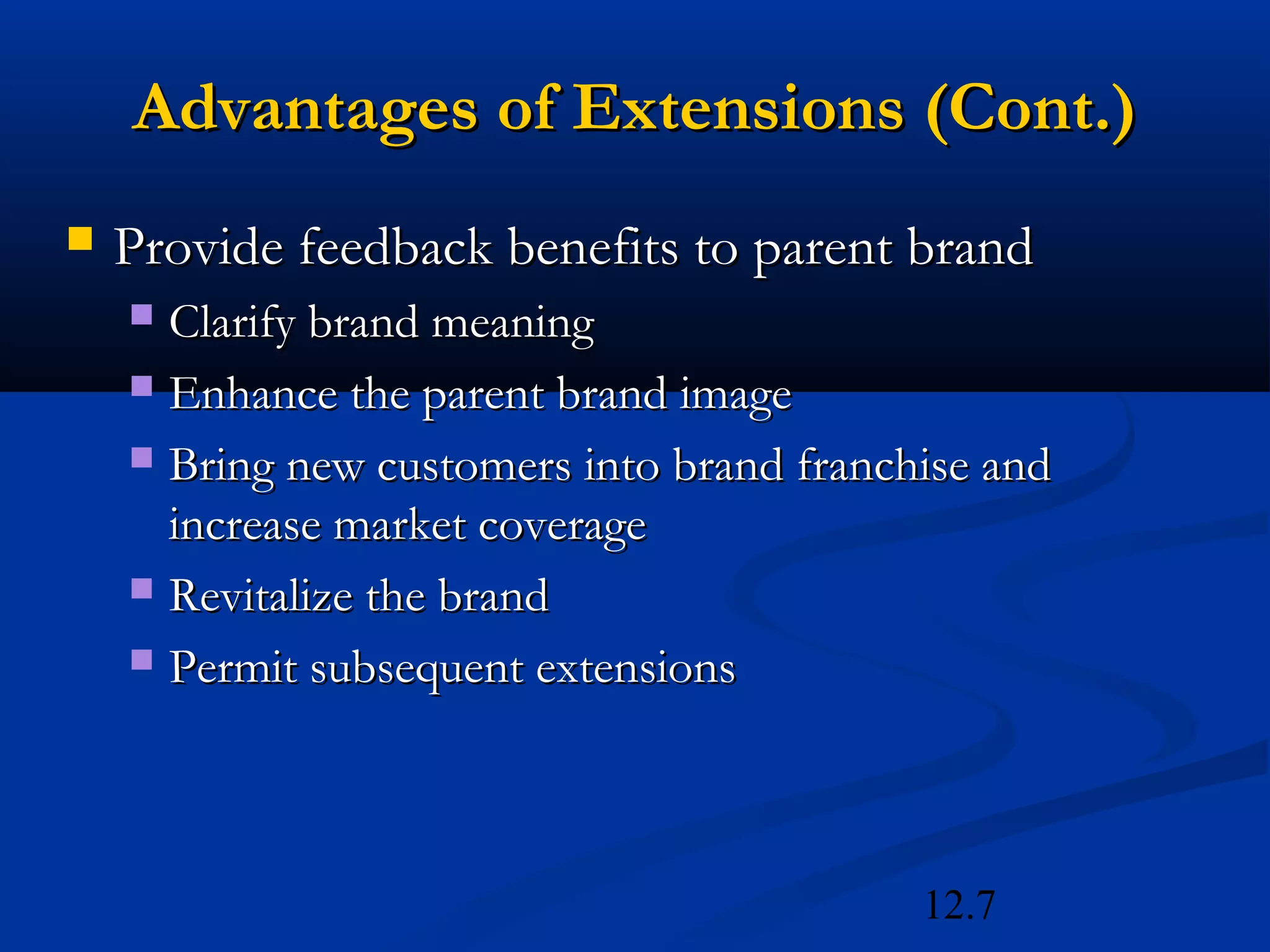
Advantages of Extensions (Cont.)Advantages of Extensions (Cont.)
 Provide feedback benefits to parent brandProvide feedback benefits to parent brand
 Clarify brand meaningClarify brand meaning
 Enhance the parent brand imageEnhance the parent brand image
 Bring new customers into brand franchise andBring new customers into brand franchise and
increase market coverageincrease market coverage
 Revitalize the brandRevitalize the brand
 Permit subsequent extensionsPermit subsequent extensions
12.8
Disadvantages of ExtensionsDisadvantages of Extensions
 Can confuse or frustrate consumersCan confuse or frustrate consumers
 Can encounter retailer resistanceCan encounter retailer resistance
 Can fail and hurt parent brand imageCan fail and hurt parent brand image
 Can succeed but cannibalize sales of parent brandCan succeed but cannibalize sales of parent brand
 Can succeed but diminish identification with any oneCan succeed but diminish identification with any one
categorycategory
 Can succeed but hurt the image of the parent brandCan succeed but hurt the image of the parent brand
 Can dilute brand meaningCan dilute brand meaning
 Can cause the company to forgo the chance to develop aCan cause the company to forgo the chance to develop a
new brandnew brand
12.9
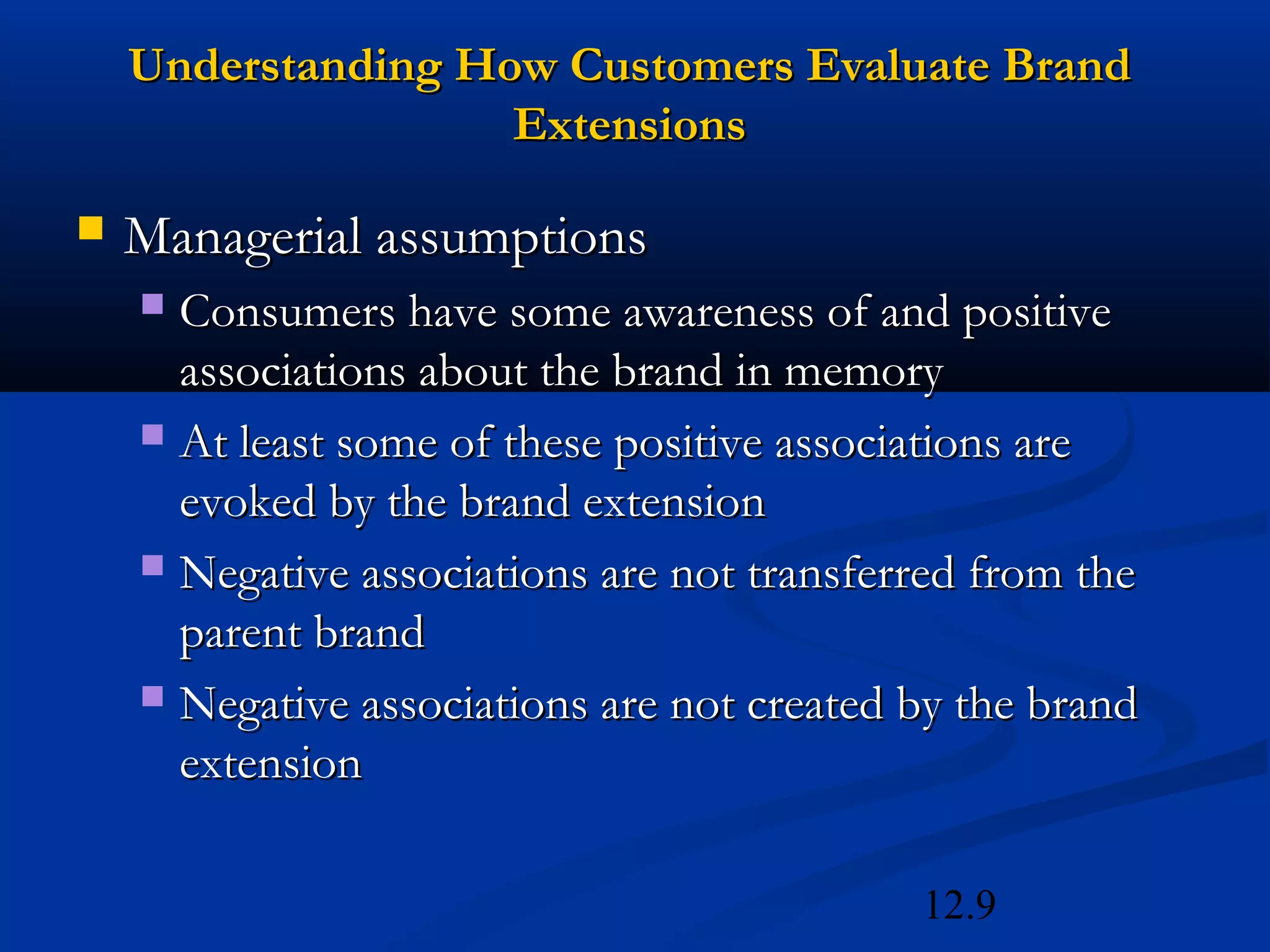
 Managerial assumptionsManagerial assumptions
 Consumers have some awareness of and positiveConsumers have some awareness of and positive
associations about the brand in memoryassociations about the brand in memory
 At least some of these positive associations areAt least some of these positive associations are
evoked by the brand extensionevoked by the brand extension
 Negative associations are not transferred from theNegative associations are not transferred from the
parent brandparent brand
 Negative associations are not created by the brandNegative associations are not created by the brand
extensionextension
Understanding How Customers Evaluate BrandUnderstanding How Customers Evaluate Brand
ExtensionsExtensions
12.10
Creating Extension EquityCreating Extension Equity
1.1. SalienceSalience of parent brand associations in theof parent brand associations in the
minds of consumers in the extension contextminds of consumers in the extension context
2.2. FavorabilityFavorability of any inferred associations in theof any inferred associations in the
extension contextextension context
3.3. UniquenessUniqueness of any inferred associations in theof any inferred associations in the
extension contextextension context
12.11
Contributing to Parent Brand EquityContributing to Parent Brand Equity
 How compelling the evidence is concerning the
corresponding attribute or benefit association in
the extension context
 How relevant or diagnostic the extension evidence
is concerning the attribute or benefit for the
parent brand
 How consistent the extension evidence is with the
corresponding parent brand associations
 How strong existing attribute or benefit
associations are held in consumer memory for
the parent brand
12.12
Successful ExtensionsSuccessful Extensions
 Must create points-of-parity and points-of-Must create points-of-parity and points-of-
difference in extension categorydifference in extension category
 Must recognize competitive reactionsMust recognize competitive reactions
 Must enhance points-of-parity and points-of-Must enhance points-of-parity and points-of-
difference of parent branddifference of parent brand
 Must maximize the advantages and minimizeMust maximize the advantages and minimize
the disadvantages of brand extensionsthe disadvantages of brand extensions
12.13
Successful Category ExtensionsSuccessful Category Extensions
 Ivory shampoo and conditioner
 Vaseline Intensive Care skin lotion
 Hershey chocolate milk
 Jell-O pudding pops
 Visa traveler’s checks
 Sunkist orange soda
 Colgate toothbrushes
 Mars ice cream bars
 Arm & Hammer toothpaste
 Bic disposable lighters
 Aunt Jemima pancake syrup
 Honda lawn mowers
12.14
Unsuccessful Category ExtensionsUnsuccessful Category Extensions
 Campbell’s tomato sauce
 LifeSavers chewing gum
 Cracker Jack cereal
 Harley Davidson wine coolers
 Hidden Valley Ranch frozen entrees
 Bic perfumes
 Ben-Gay aspirin
 Kleenex diapers
 Levi’s Tailored Classics suits
 Nautilus athletic shoes
 Domino’s fruit-flavored bubble gum
 Smucker’s ketchup
 Fruit of the Loom laundry detergent
12.15
Evaluating Brand ExtensionEvaluating Brand Extension
OpportunitiesOpportunities
 Define actual and desired consumer knowledgeDefine actual and desired consumer knowledge
about the brandabout the brand
 Identify possible extension candidatesIdentify possible extension candidates
 Evaluate the potential of the extension candidateEvaluate the potential of the extension candidate
 The likelihood that the extension will realize theThe likelihood that the extension will realize the
advantages and avoid the disadvantages of brandadvantages and avoid the disadvantages of brand
extensions. As with any new product, analysis ofextensions. As with any new product, analysis of
consumer, corporate, and competitive factors can beconsumer, corporate, and competitive factors can be
useful.useful.
12.16
Evaluating Brand ExtensionEvaluating Brand Extension
OpportunitiesOpportunities
 Design marketing programs to launch extensionDesign marketing programs to launch extension
 Building brand equity for a brand extension requiresBuilding brand equity for a brand extension requires
choosing brand elements, designing the optimalchoosing brand elements, designing the optimal
marketing program to launch the extension, andmarketing program to launch the extension, and
leveraging secondary associations.leveraging secondary associations.
 Evaluate extension success and effects on parentEvaluate extension success and effects on parent
brand equitybrand equity
12.17
When are brand extensions appropriate?When are brand extensions appropriate?
 If they see some basis of “fit” or similarityIf they see some basis of “fit” or similarity
between the proposed extension and parentbetween the proposed extension and parent
brandbrand
 The major mistake in evaluating extensionThe major mistake in evaluating extension
opportunities is failing to take all of consumers’opportunities is failing to take all of consumers’
brand knowledge structures into account.brand knowledge structures into account.
 Often, marketers mistakenly focus on only oneOften, marketers mistakenly focus on only one
brand association and ignore other potentiallybrand association and ignore other potentially
important brand associations in the process.important brand associations in the process.
12.18
Evaluating Brand Extension OpportunitiesEvaluating Brand Extension Opportunities
 Define actual and desired consumer knowledgeDefine actual and desired consumer knowledge
about the brandabout the brand
 Identify possible extension candidatesIdentify possible extension candidates
 Evaluate the potential of the extensionEvaluate the potential of the extension
candidatecandidate
 Design marketing programs to launch extensionDesign marketing programs to launch extension
 Evaluate extension success and effects on parentEvaluate extension success and effects on parent
brand equitybrand equity

Keller sbm3 12

  • 1.
    12.1 CHAPTER 12:CHAPTER 12: INTRODUCINGAND NAMING NEW PRODUCTSINTRODUCING AND NAMING NEW PRODUCTS AND BRAND EXTENSIONSAND BRAND EXTENSIONS Kevin Lane KellerKevin Lane Keller Tuck School of BusinessTuck School of Business Dartmouth CollegeDartmouth College
  • 2.
    12.2 Leverage the BrandLeveragethe Brand  Firms are seeking to build “power” or “mega”Firms are seeking to build “power” or “mega” brands that establish a broad market footprint,brands that establish a broad market footprint, appealing to multiple customer segments withappealing to multiple customer segments with multiple products all underneath the brandmultiple products all underneath the brand umbrella.umbrella.
  • 3.
    12.3 Ansoff’s Growth ShareMatrixAnsoff’s Growth Share Matrix CurrentCurrent ProductsProducts NewNew ProductsProducts CurrentCurrent MarketsMarkets MarketMarket penetrationpenetration strategystrategy ProductProduct developmentdevelopment strategystrategy NewNew MarketsMarkets MarketMarket developmentdevelopment strategystrategy DiversificationDiversification strategystrategy
  • 4.
    12.4 Brand ExtensionsBrand Extensions When a firm uses an established brand name toWhen a firm uses an established brand name to introduce a new productintroduce a new product  Brand extension classificationBrand extension classification  Line extensionLine extension  Using a sub-brand to target a new market segment withinUsing a sub-brand to target a new market segment within the same product categorythe same product category  Category extensionCategory extension  Using the parent brand in a different product categoryUsing the parent brand in a different product category
  • 5.
    12.5 General Strategies forEstablishing a CategoryGeneral Strategies for Establishing a Category Tauber’s Franchise—ExtensionTauber’s Franchise—Extension  Introduce the same product in a different form.Introduce the same product in a different form. Example: Ocean SprayExample: Ocean Spray Cranberry Juice CocktailCranberry Juice Cocktail  IIntroduce products that contain the brand’s distinctive taste, ingredient, orntroduce products that contain the brand’s distinctive taste, ingredient, or component.component. Example: Philadelphia cream cheese salad dressingExample: Philadelphia cream cheese salad dressing  Introduce companion products for the brand.Introduce companion products for the brand. Example: ColemanExample: Coleman camping equipmentcamping equipment  Introduce products relevant to the customer franchise of the brand.Introduce products relevant to the customer franchise of the brand. Example: Gerber insuranceExample: Gerber insurance  Introduce products that capitalize on the firm’s perceived expertise.Introduce products that capitalize on the firm’s perceived expertise. Example: Honda lawn mowersExample: Honda lawn mowers  Introduce products that reflect the brand’s distinctive benefit, attribute, orIntroduce products that reflect the brand’s distinctive benefit, attribute, or feature.feature. Example: Lysol’s “deodorizing” household cleaningExample: Lysol’s “deodorizing” household cleaning productsproducts  Introduce products that capitalize on the distinctive image or prestige of theIntroduce products that capitalize on the distinctive image or prestige of the brand.brand. Example: Calvin Klein clothesExample: Calvin Klein clothes
  • 6.
    12.6 Advantages of ExtensionsAdvantagesof Extensions  Facilitate new product acceptanceFacilitate new product acceptance  Improve brand imageImprove brand image  Reduce risk perceived by customersReduce risk perceived by customers  Increase the probability of gaining distribution and trialIncrease the probability of gaining distribution and trial  Increase efficiency of promotional expendituresIncrease efficiency of promotional expenditures  Reduce costs of introductory and follow-up marketingReduce costs of introductory and follow-up marketing programsprograms  Avoid cost of developing a new brandAvoid cost of developing a new brand  Allow for packaging and labeling efficienciesAllow for packaging and labeling efficiencies  Permit consumer variety seekingPermit consumer variety seeking
  • 7.
    12.7 Advantages of Extensions(Cont.)Advantages of Extensions (Cont.)  Provide feedback benefits to parent brandProvide feedback benefits to parent brand  Clarify brand meaningClarify brand meaning  Enhance the parent brand imageEnhance the parent brand image  Bring new customers into brand franchise andBring new customers into brand franchise and increase market coverageincrease market coverage  Revitalize the brandRevitalize the brand  Permit subsequent extensionsPermit subsequent extensions
  • 8.
    12.8 Disadvantages of ExtensionsDisadvantagesof Extensions  Can confuse or frustrate consumersCan confuse or frustrate consumers  Can encounter retailer resistanceCan encounter retailer resistance  Can fail and hurt parent brand imageCan fail and hurt parent brand image  Can succeed but cannibalize sales of parent brandCan succeed but cannibalize sales of parent brand  Can succeed but diminish identification with any oneCan succeed but diminish identification with any one categorycategory  Can succeed but hurt the image of the parent brandCan succeed but hurt the image of the parent brand  Can dilute brand meaningCan dilute brand meaning  Can cause the company to forgo the chance to develop aCan cause the company to forgo the chance to develop a new brandnew brand
  • 9.
    12.9  Managerial assumptionsManagerialassumptions  Consumers have some awareness of and positiveConsumers have some awareness of and positive associations about the brand in memoryassociations about the brand in memory  At least some of these positive associations areAt least some of these positive associations are evoked by the brand extensionevoked by the brand extension  Negative associations are not transferred from theNegative associations are not transferred from the parent brandparent brand  Negative associations are not created by the brandNegative associations are not created by the brand extensionextension Understanding How Customers Evaluate BrandUnderstanding How Customers Evaluate Brand ExtensionsExtensions
  • 10.
    12.10 Creating Extension EquityCreatingExtension Equity 1.1. SalienceSalience of parent brand associations in theof parent brand associations in the minds of consumers in the extension contextminds of consumers in the extension context 2.2. FavorabilityFavorability of any inferred associations in theof any inferred associations in the extension contextextension context 3.3. UniquenessUniqueness of any inferred associations in theof any inferred associations in the extension contextextension context
  • 11.
    12.11 Contributing to ParentBrand EquityContributing to Parent Brand Equity  How compelling the evidence is concerning the corresponding attribute or benefit association in the extension context  How relevant or diagnostic the extension evidence is concerning the attribute or benefit for the parent brand  How consistent the extension evidence is with the corresponding parent brand associations  How strong existing attribute or benefit associations are held in consumer memory for the parent brand
  • 12.
    12.12 Successful ExtensionsSuccessful Extensions Must create points-of-parity and points-of-Must create points-of-parity and points-of- difference in extension categorydifference in extension category  Must recognize competitive reactionsMust recognize competitive reactions  Must enhance points-of-parity and points-of-Must enhance points-of-parity and points-of- difference of parent branddifference of parent brand  Must maximize the advantages and minimizeMust maximize the advantages and minimize the disadvantages of brand extensionsthe disadvantages of brand extensions
  • 13.
    12.13 Successful Category ExtensionsSuccessfulCategory Extensions  Ivory shampoo and conditioner  Vaseline Intensive Care skin lotion  Hershey chocolate milk  Jell-O pudding pops  Visa traveler’s checks  Sunkist orange soda  Colgate toothbrushes  Mars ice cream bars  Arm & Hammer toothpaste  Bic disposable lighters  Aunt Jemima pancake syrup  Honda lawn mowers
  • 14.
    12.14 Unsuccessful Category ExtensionsUnsuccessfulCategory Extensions  Campbell’s tomato sauce  LifeSavers chewing gum  Cracker Jack cereal  Harley Davidson wine coolers  Hidden Valley Ranch frozen entrees  Bic perfumes  Ben-Gay aspirin  Kleenex diapers  Levi’s Tailored Classics suits  Nautilus athletic shoes  Domino’s fruit-flavored bubble gum  Smucker’s ketchup  Fruit of the Loom laundry detergent
  • 15.
    12.15 Evaluating Brand ExtensionEvaluatingBrand Extension OpportunitiesOpportunities  Define actual and desired consumer knowledgeDefine actual and desired consumer knowledge about the brandabout the brand  Identify possible extension candidatesIdentify possible extension candidates  Evaluate the potential of the extension candidateEvaluate the potential of the extension candidate  The likelihood that the extension will realize theThe likelihood that the extension will realize the advantages and avoid the disadvantages of brandadvantages and avoid the disadvantages of brand extensions. As with any new product, analysis ofextensions. As with any new product, analysis of consumer, corporate, and competitive factors can beconsumer, corporate, and competitive factors can be useful.useful.
  • 16.
    12.16 Evaluating Brand ExtensionEvaluatingBrand Extension OpportunitiesOpportunities  Design marketing programs to launch extensionDesign marketing programs to launch extension  Building brand equity for a brand extension requiresBuilding brand equity for a brand extension requires choosing brand elements, designing the optimalchoosing brand elements, designing the optimal marketing program to launch the extension, andmarketing program to launch the extension, and leveraging secondary associations.leveraging secondary associations.  Evaluate extension success and effects on parentEvaluate extension success and effects on parent brand equitybrand equity
  • 17.
    12.17 When are brandextensions appropriate?When are brand extensions appropriate?  If they see some basis of “fit” or similarityIf they see some basis of “fit” or similarity between the proposed extension and parentbetween the proposed extension and parent brandbrand  The major mistake in evaluating extensionThe major mistake in evaluating extension opportunities is failing to take all of consumers’opportunities is failing to take all of consumers’ brand knowledge structures into account.brand knowledge structures into account.  Often, marketers mistakenly focus on only oneOften, marketers mistakenly focus on only one brand association and ignore other potentiallybrand association and ignore other potentially important brand associations in the process.important brand associations in the process.
  • 18.
    12.18 Evaluating Brand ExtensionOpportunitiesEvaluating Brand Extension Opportunities  Define actual and desired consumer knowledgeDefine actual and desired consumer knowledge about the brandabout the brand  Identify possible extension candidatesIdentify possible extension candidates  Evaluate the potential of the extensionEvaluate the potential of the extension candidatecandidate  Design marketing programs to launch extensionDesign marketing programs to launch extension  Evaluate extension success and effects on parentEvaluate extension success and effects on parent brand equitybrand equity

Editor's Notes