8.1
CHAPTER 8:CHAPTER 8:
DEVELOPING A BRAND EQUITYDEVELOPING A BRAND EQUITY
MEASUREMENT AND MANAGEMENT SYSTEMMEASUREMENT AND MANAGEMENT SYSTEM
Kevin Lane KellerKevin Lane Keller
Tuck School of BusinessTuck School of Business
Dartmouth CollegeDartmouth College
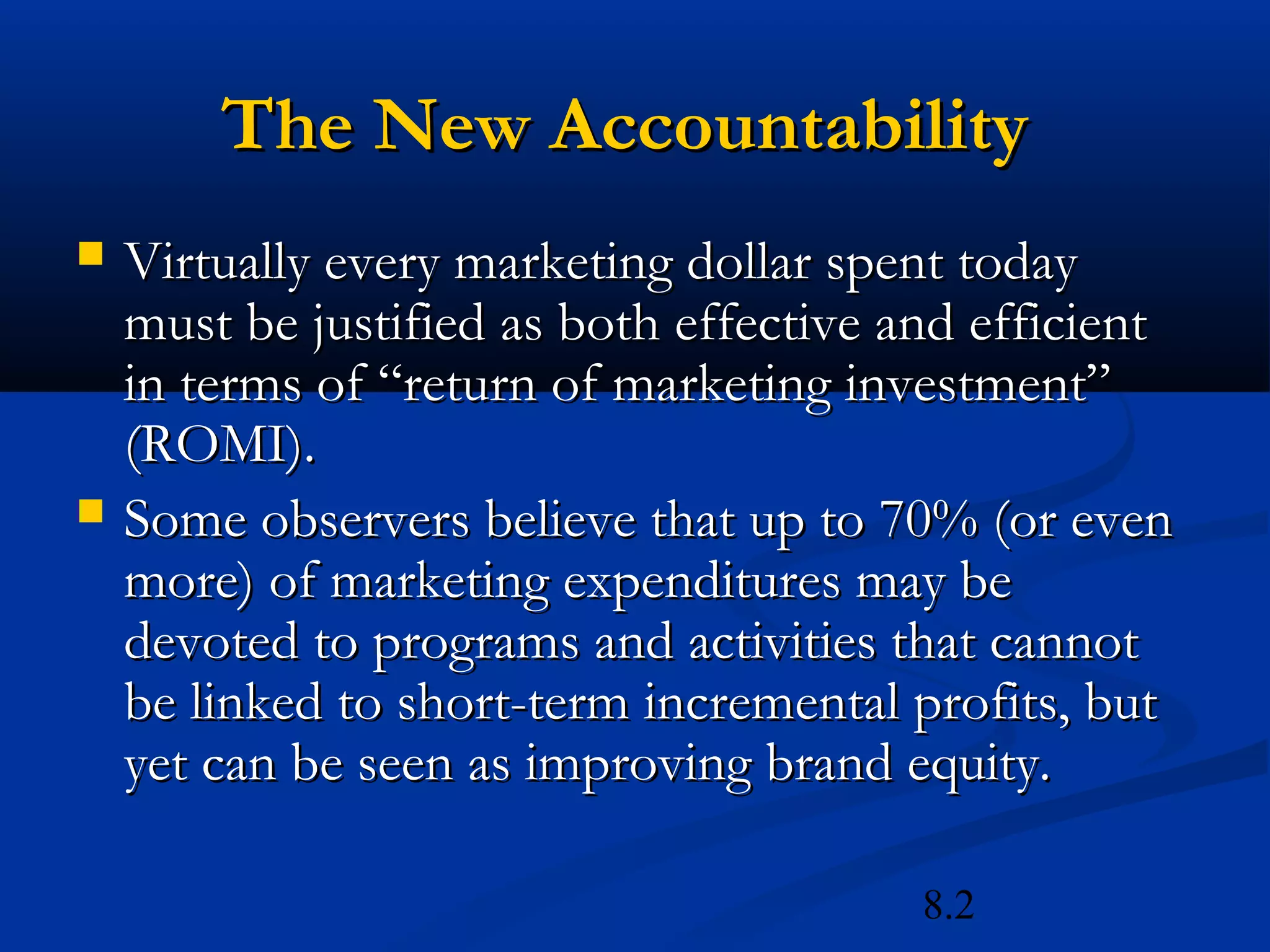
8.2
The New AccountabilityThe New Accountability
 Virtually every marketing dollar spent todayVirtually every marketing dollar spent today
must be justified as both effective and efficientmust be justified as both effective and efficient
in terms of “return of marketing investment”in terms of “return of marketing investment”
(ROMI).(ROMI).
 Some observers believe that up to 70% (or evenSome observers believe that up to 70% (or even
more) of marketing expenditures may bemore) of marketing expenditures may be
devoted to programs and activities that cannotdevoted to programs and activities that cannot
be linked to short-term incremental profits, butbe linked to short-term incremental profits, but
yet can be seen as improving brand equity.yet can be seen as improving brand equity.
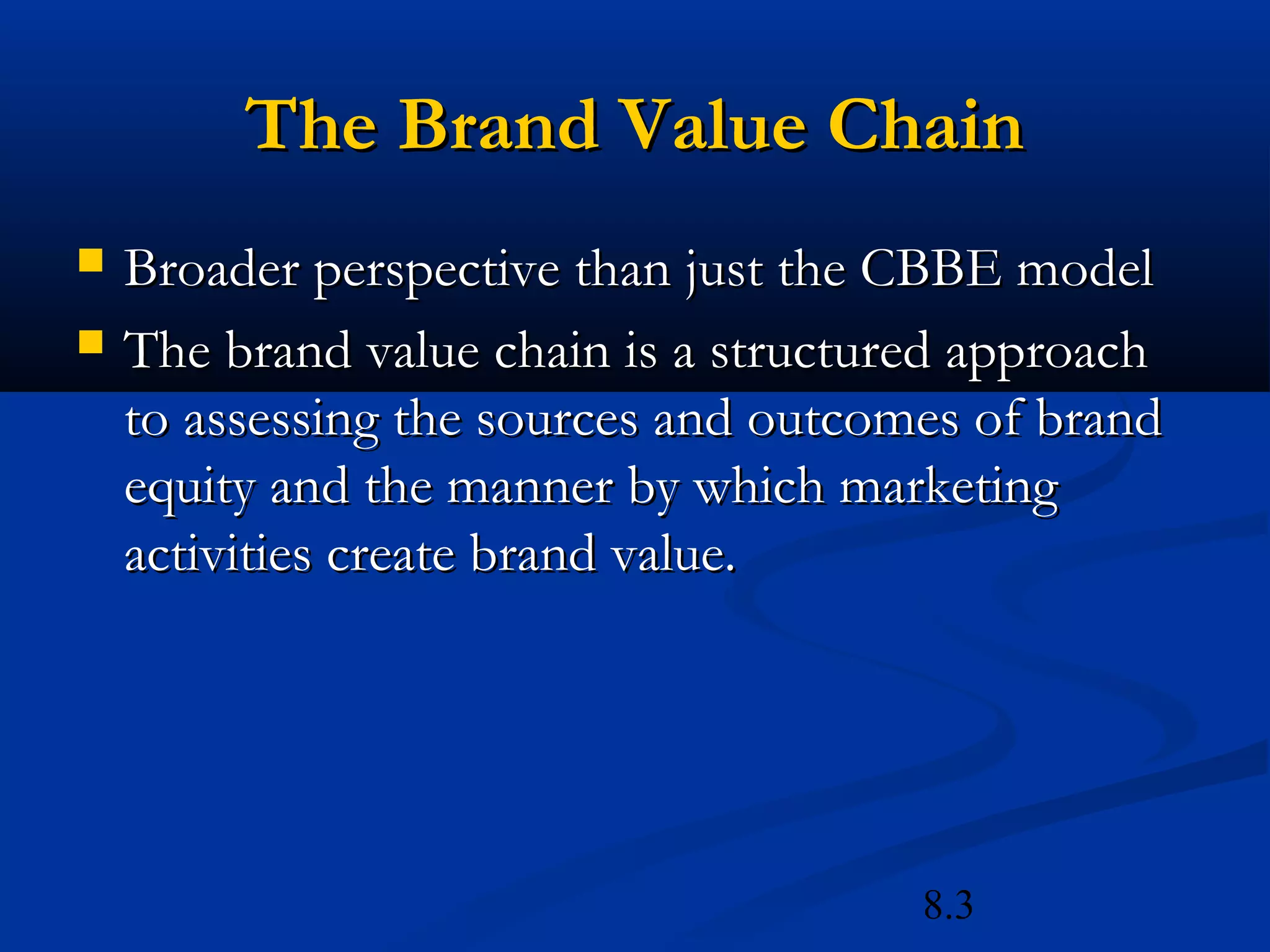
8.3
The Brand Value ChainThe Brand Value Chain
 Broader perspective than just the CBBE modelBroader perspective than just the CBBE model
 The brand value chain is a structured approachThe brand value chain is a structured approach
to assessing the sources and outcomes of brandto assessing the sources and outcomes of brand
equity and the manner by which marketingequity and the manner by which marketing
activities create brand value.activities create brand value.
Brand Value ChainBrand Value Chain
Program
Multiplier
Marketing
Program
Investment
Customer
Mindset
Market
Performance
Shareholder
ValueVALUE
STAGES
- Product
- Communications
- Trade
- Employee
- Other
- Awareness
- Associations
- Attitudes
- Attachment
- Activity
- Price premiums
- Price elasticity
- Market share
- Expansion success
- Cost structure
- Profitability
- Stock price
- P/E ratio
- Market capitalization
Consumer
MultiplierFILTERS
- Clarity
- Relevance
- Distinctiveness
- Consistency
- Channel support
- Consumer size and profile
- Competitive reactions
- Market dynamics
- Growth potential
- Risk profile
- Brand contribution
Market
Multiplier
8.5
Value StagesValue Stages
 Marketing program investmentMarketing program investment
 Any marketing program that can be attributed toAny marketing program that can be attributed to
brand value developmentbrand value development
 Customer mindsetCustomer mindset
 In what way have customers been changed as a resultIn what way have customers been changed as a result
of the marketing program?of the marketing program?
 Market performanceMarket performance
 How do customers respond in the marketplace?How do customers respond in the marketplace?
 Shareholder valueShareholder value
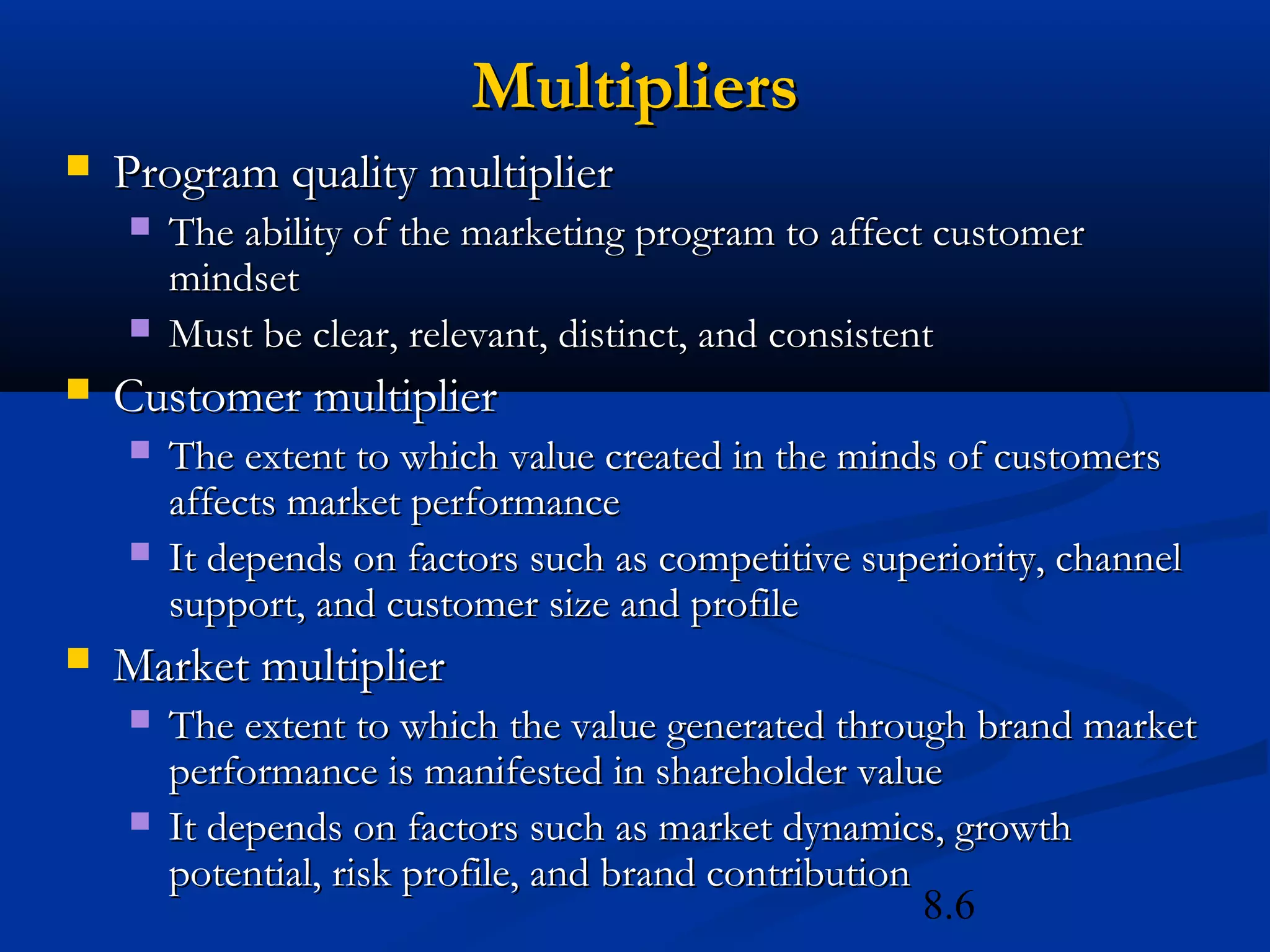
8.6
MultipliersMultipliers
 Program quality multiplierProgram quality multiplier
 The ability of the marketing program to affect customerThe ability of the marketing program to affect customer
mindsetmindset
 Must be clear, relevant, distinct, and consistentMust be clear, relevant, distinct, and consistent
 Customer multiplierCustomer multiplier
 The extent to which value created in the minds of customersThe extent to which value created in the minds of customers
affects market performanceaffects market performance
 It depends on factors such as competitive superiority, channelIt depends on factors such as competitive superiority, channel
support, and customer size and profilesupport, and customer size and profile
 Market multiplierMarket multiplier
 The extent to which the value generated through brand marketThe extent to which the value generated through brand market
performance is manifested in shareholder valueperformance is manifested in shareholder value
 It depends on factors such as market dynamics, growthIt depends on factors such as market dynamics, growth
potential, risk profile, and brand contributionpotential, risk profile, and brand contribution
8.7
Brand Equity Measurement SystemBrand Equity Measurement System
 A set of research procedures that is designedA set of research procedures that is designed
to provide timely, accurate, and actionableto provide timely, accurate, and actionable
information for marketers so that they can makeinformation for marketers so that they can make
the best possible tactical decisions in the shortthe best possible tactical decisions in the short
run and strategic decisions in the long runrun and strategic decisions in the long run
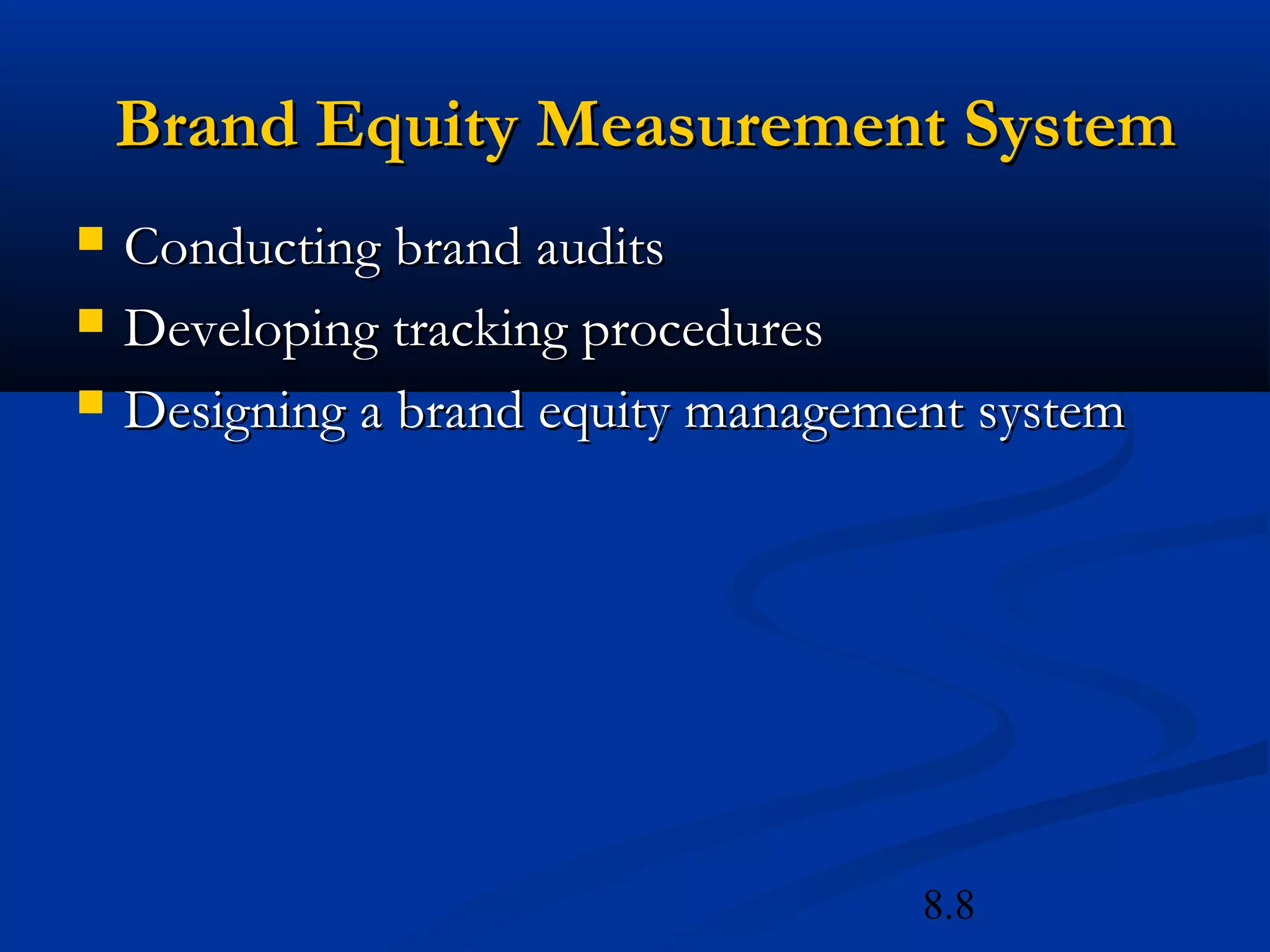
8.8
Brand Equity Measurement SystemBrand Equity Measurement System
 Conducting brand auditsConducting brand audits
 Developing tracking proceduresDeveloping tracking procedures
 Designing a brand equity management systemDesigning a brand equity management system
8.9
Designing Brand Tracking StudiesDesigning Brand Tracking Studies
 Tracking studies involve information collectedTracking studies involve information collected
from consumers on a routine basis over timefrom consumers on a routine basis over time
 Often done on a “continuous” basisOften done on a “continuous” basis
 Provide descriptive and diagnostic informationProvide descriptive and diagnostic information
8.10
What to TrackWhat to Track
 Customize tracking surveys to address theCustomize tracking surveys to address the
specific issues faced by the brandspecific issues faced by the brand
 Product-brand trackingProduct-brand tracking
 Corporate or family brand trackingCorporate or family brand tracking
 Global trackingGlobal tracking
8.11
How to Conduct Tracking StudiesHow to Conduct Tracking Studies
 Who to track (target market)Who to track (target market)
 When and where to track (how frequently)When and where to track (how frequently)
 How to interpret brand trackingHow to interpret brand tracking
8.12
Brand Equity Management SystemBrand Equity Management System
 AA brand equity management systembrand equity management system is a set ofis a set of
organizational processes designed to improveorganizational processes designed to improve
the understanding and use of the brand equitythe understanding and use of the brand equity
concept within a firm:concept within a firm:
 Brand equity charterBrand equity charter
 Brand equity reportBrand equity report
 Brand equity responsibilitiesBrand equity responsibilities
8.13
Brand Equity CharterBrand Equity Charter
 Provides general guidelines to marketingProvides general guidelines to marketing
managers within the company as well as keymanagers within the company as well as key
marketing partners outside the companymarketing partners outside the company
 Should be updated annuallyShould be updated annually
8.14
Brand Equity Charter ComponentsBrand Equity Charter Components
 Define the firm’s view of the brand equityDefine the firm’s view of the brand equity
 Describe the scope of the key brandsDescribe the scope of the key brands
 Specify actual and desired equity for the brandSpecify actual and desired equity for the brand
 Explain how brand equity is measuredExplain how brand equity is measured
 Suggest how brand equity should be measuredSuggest how brand equity should be measured
 Outline how marketing programs should be devisedOutline how marketing programs should be devised
 Specify the proper treatment for the brand in terms ofSpecify the proper treatment for the brand in terms of
trademark usage, packaging, and communicationtrademark usage, packaging, and communication
8.15
The
Knicks
The Fans
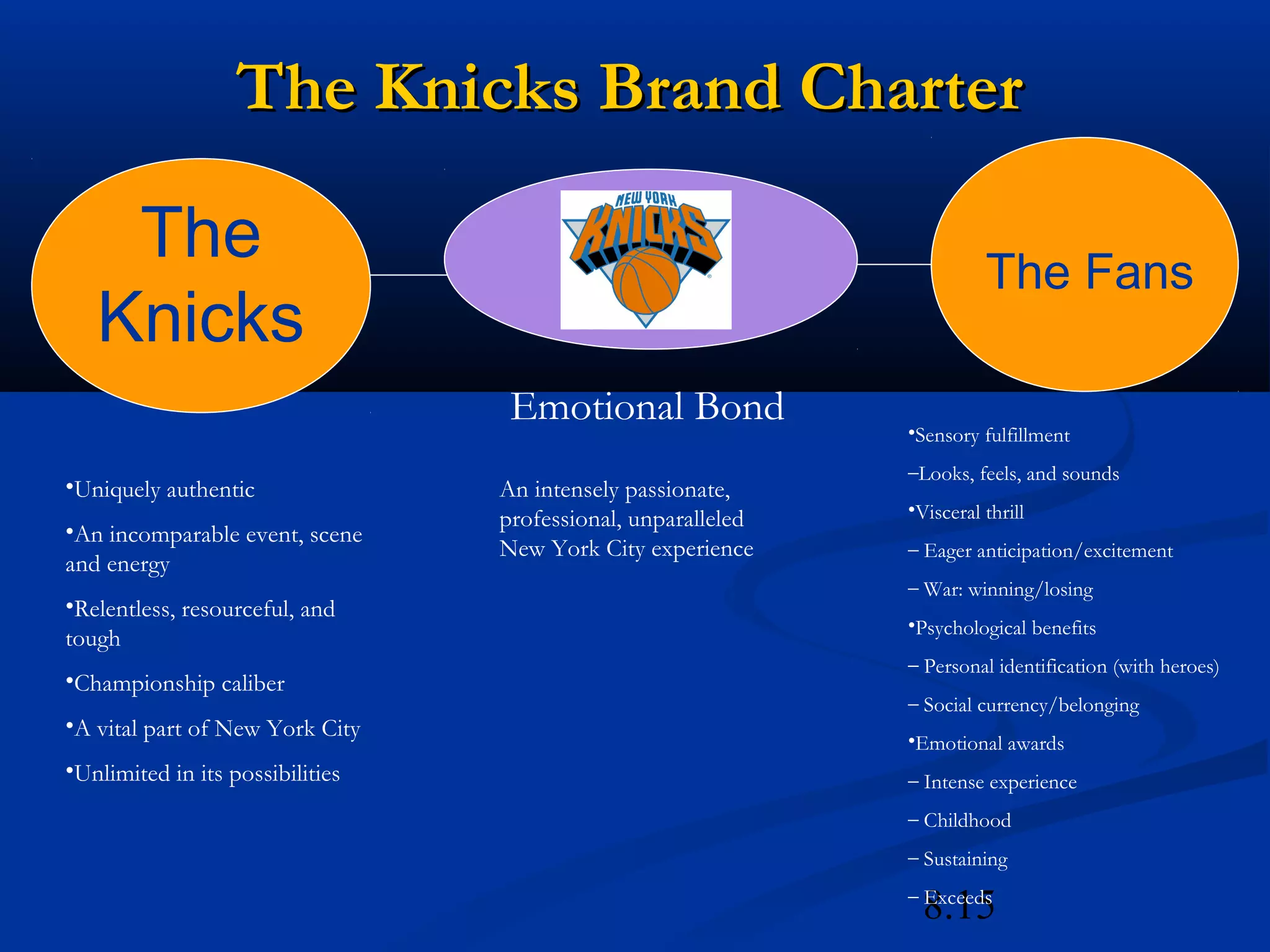
The Knicks Brand CharterThe Knicks Brand Charter
Emotional Bond
•Uniquely authentic
•An incomparable event, scene
and energy
•Relentless, resourceful, and
tough
•Championship caliber
•A vital part of New York City
•Unlimited in its possibilities
•Sensory fulfillment
–Looks, feels, and sounds
•Visceral thrill
– Eager anticipation/excitement
– War: winning/losing
•Psychological benefits
– Personal identification (with heroes)
– Social currency/belonging
•Emotional awards
– Intense experience
– Childhood
– Sustaining
– Exceeds
An intensely passionate,
professional, unparalleled
New York City experience
8.16
Brand Equity ReportBrand Equity Report
 Assembles the results of the tracking survey andAssembles the results of the tracking survey and
other relevant performance measuresother relevant performance measures
 To be developed monthly, quarterly, or annuallyTo be developed monthly, quarterly, or annually
 Provides descriptive information as to what isProvides descriptive information as to what is
happening with the brand as well as diagnostichappening with the brand as well as diagnostic
information on why it is happeninginformation on why it is happening
8.17
Brand Equity ResponsibilitiesBrand Equity Responsibilities
 Organizational responsibilities and processesOrganizational responsibilities and processes
that aim to maximize long-term brand equitythat aim to maximize long-term brand equity
 Establish position of VP or Director of EquityEstablish position of VP or Director of Equity
Management to oversee implementation of BrandManagement to oversee implementation of Brand
Equity Charter and ReportsEquity Charter and Reports
 Ensure that, as much as possible, marketing ofEnsure that, as much as possible, marketing of
the brand is done in a way that reflects the spiritthe brand is done in a way that reflects the spirit
of the charter and the substance of the reportof the charter and the substance of the report

Keller sbm3 08

  • 1.
    8.1 CHAPTER 8:CHAPTER 8: DEVELOPINGA BRAND EQUITYDEVELOPING A BRAND EQUITY MEASUREMENT AND MANAGEMENT SYSTEMMEASUREMENT AND MANAGEMENT SYSTEM Kevin Lane KellerKevin Lane Keller Tuck School of BusinessTuck School of Business Dartmouth CollegeDartmouth College
  • 2.
    8.2 The New AccountabilityTheNew Accountability  Virtually every marketing dollar spent todayVirtually every marketing dollar spent today must be justified as both effective and efficientmust be justified as both effective and efficient in terms of “return of marketing investment”in terms of “return of marketing investment” (ROMI).(ROMI).  Some observers believe that up to 70% (or evenSome observers believe that up to 70% (or even more) of marketing expenditures may bemore) of marketing expenditures may be devoted to programs and activities that cannotdevoted to programs and activities that cannot be linked to short-term incremental profits, butbe linked to short-term incremental profits, but yet can be seen as improving brand equity.yet can be seen as improving brand equity.
  • 3.
    8.3 The Brand ValueChainThe Brand Value Chain  Broader perspective than just the CBBE modelBroader perspective than just the CBBE model  The brand value chain is a structured approachThe brand value chain is a structured approach to assessing the sources and outcomes of brandto assessing the sources and outcomes of brand equity and the manner by which marketingequity and the manner by which marketing activities create brand value.activities create brand value.
  • 4.
    Brand Value ChainBrandValue Chain Program Multiplier Marketing Program Investment Customer Mindset Market Performance Shareholder ValueVALUE STAGES - Product - Communications - Trade - Employee - Other - Awareness - Associations - Attitudes - Attachment - Activity - Price premiums - Price elasticity - Market share - Expansion success - Cost structure - Profitability - Stock price - P/E ratio - Market capitalization Consumer MultiplierFILTERS - Clarity - Relevance - Distinctiveness - Consistency - Channel support - Consumer size and profile - Competitive reactions - Market dynamics - Growth potential - Risk profile - Brand contribution Market Multiplier
  • 5.
    8.5 Value StagesValue Stages Marketing program investmentMarketing program investment  Any marketing program that can be attributed toAny marketing program that can be attributed to brand value developmentbrand value development  Customer mindsetCustomer mindset  In what way have customers been changed as a resultIn what way have customers been changed as a result of the marketing program?of the marketing program?  Market performanceMarket performance  How do customers respond in the marketplace?How do customers respond in the marketplace?  Shareholder valueShareholder value
  • 6.
    8.6 MultipliersMultipliers  Program qualitymultiplierProgram quality multiplier  The ability of the marketing program to affect customerThe ability of the marketing program to affect customer mindsetmindset  Must be clear, relevant, distinct, and consistentMust be clear, relevant, distinct, and consistent  Customer multiplierCustomer multiplier  The extent to which value created in the minds of customersThe extent to which value created in the minds of customers affects market performanceaffects market performance  It depends on factors such as competitive superiority, channelIt depends on factors such as competitive superiority, channel support, and customer size and profilesupport, and customer size and profile  Market multiplierMarket multiplier  The extent to which the value generated through brand marketThe extent to which the value generated through brand market performance is manifested in shareholder valueperformance is manifested in shareholder value  It depends on factors such as market dynamics, growthIt depends on factors such as market dynamics, growth potential, risk profile, and brand contributionpotential, risk profile, and brand contribution
  • 7.
    8.7 Brand Equity MeasurementSystemBrand Equity Measurement System  A set of research procedures that is designedA set of research procedures that is designed to provide timely, accurate, and actionableto provide timely, accurate, and actionable information for marketers so that they can makeinformation for marketers so that they can make the best possible tactical decisions in the shortthe best possible tactical decisions in the short run and strategic decisions in the long runrun and strategic decisions in the long run
  • 8.
    8.8 Brand Equity MeasurementSystemBrand Equity Measurement System  Conducting brand auditsConducting brand audits  Developing tracking proceduresDeveloping tracking procedures  Designing a brand equity management systemDesigning a brand equity management system
  • 9.
    8.9 Designing Brand TrackingStudiesDesigning Brand Tracking Studies  Tracking studies involve information collectedTracking studies involve information collected from consumers on a routine basis over timefrom consumers on a routine basis over time  Often done on a “continuous” basisOften done on a “continuous” basis  Provide descriptive and diagnostic informationProvide descriptive and diagnostic information
  • 10.
    8.10 What to TrackWhatto Track  Customize tracking surveys to address theCustomize tracking surveys to address the specific issues faced by the brandspecific issues faced by the brand  Product-brand trackingProduct-brand tracking  Corporate or family brand trackingCorporate or family brand tracking  Global trackingGlobal tracking
  • 11.
    8.11 How to ConductTracking StudiesHow to Conduct Tracking Studies  Who to track (target market)Who to track (target market)  When and where to track (how frequently)When and where to track (how frequently)  How to interpret brand trackingHow to interpret brand tracking
  • 12.
    8.12 Brand Equity ManagementSystemBrand Equity Management System  AA brand equity management systembrand equity management system is a set ofis a set of organizational processes designed to improveorganizational processes designed to improve the understanding and use of the brand equitythe understanding and use of the brand equity concept within a firm:concept within a firm:  Brand equity charterBrand equity charter  Brand equity reportBrand equity report  Brand equity responsibilitiesBrand equity responsibilities
  • 13.
    8.13 Brand Equity CharterBrandEquity Charter  Provides general guidelines to marketingProvides general guidelines to marketing managers within the company as well as keymanagers within the company as well as key marketing partners outside the companymarketing partners outside the company  Should be updated annuallyShould be updated annually
  • 14.
    8.14 Brand Equity CharterComponentsBrand Equity Charter Components  Define the firm’s view of the brand equityDefine the firm’s view of the brand equity  Describe the scope of the key brandsDescribe the scope of the key brands  Specify actual and desired equity for the brandSpecify actual and desired equity for the brand  Explain how brand equity is measuredExplain how brand equity is measured  Suggest how brand equity should be measuredSuggest how brand equity should be measured  Outline how marketing programs should be devisedOutline how marketing programs should be devised  Specify the proper treatment for the brand in terms ofSpecify the proper treatment for the brand in terms of trademark usage, packaging, and communicationtrademark usage, packaging, and communication
  • 15.
    8.15 The Knicks The Fans The KnicksBrand CharterThe Knicks Brand Charter Emotional Bond •Uniquely authentic •An incomparable event, scene and energy •Relentless, resourceful, and tough •Championship caliber •A vital part of New York City •Unlimited in its possibilities •Sensory fulfillment –Looks, feels, and sounds •Visceral thrill – Eager anticipation/excitement – War: winning/losing •Psychological benefits – Personal identification (with heroes) – Social currency/belonging •Emotional awards – Intense experience – Childhood – Sustaining – Exceeds An intensely passionate, professional, unparalleled New York City experience
  • 16.
    8.16 Brand Equity ReportBrandEquity Report  Assembles the results of the tracking survey andAssembles the results of the tracking survey and other relevant performance measuresother relevant performance measures  To be developed monthly, quarterly, or annuallyTo be developed monthly, quarterly, or annually  Provides descriptive information as to what isProvides descriptive information as to what is happening with the brand as well as diagnostichappening with the brand as well as diagnostic information on why it is happeninginformation on why it is happening
  • 17.
    8.17 Brand Equity ResponsibilitiesBrandEquity Responsibilities  Organizational responsibilities and processesOrganizational responsibilities and processes that aim to maximize long-term brand equitythat aim to maximize long-term brand equity  Establish position of VP or Director of EquityEstablish position of VP or Director of Equity Management to oversee implementation of BrandManagement to oversee implementation of Brand Equity Charter and ReportsEquity Charter and Reports  Ensure that, as much as possible, marketing ofEnsure that, as much as possible, marketing of the brand is done in a way that reflects the spiritthe brand is done in a way that reflects the spirit of the charter and the substance of the reportof the charter and the substance of the report

Editor's Notes