Business Process Reengineering
and Information Technology
Objectives
   The impact of IT
   The reengineering of work
   IT and Business Process Redesign
The role of information technology
   Information technology (IT) has historically played an important role in the
    reengineering concept.[10] It is considered by some as a major enabler for new
    forms of working and collaborating within an organization and across
    organizational borders[
   Early BPR literature [11] identified several so called disruptive technologies that
    were supposed to challenge traditional wisdom about how work should be
    performed.
   Shared databases, making information available at many places
   Expert systems, allowing generalists to perform specialist tasks
   Telecommunication networks, allowing organizations to be centralized and
    decentralized at the same time
   Decision-support tools, allowing decision-making to be a part of everybody's job
   Wireless data communication and portable computers, allowing field personnel to
    work office independent
   Interactive videodisk, to get in immediate contact with potential buyers
   Automatic identification and tracking, allowing things to tell where they are,
    instead of requiring to be found
   High performance computing, allowing on-the-fly planning and revisioning
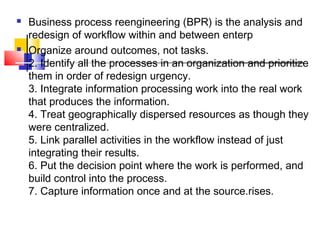
   Business process reengineering (BPR) is the analysis and
    redesign of workflow within and between enterp
   Organize around outcomes, not tasks.
    2. Identify all the processes in an organization and prioritize
    them in order of redesign urgency.
    3. Integrate information processing work into the real work
    that produces the information.
    4. Treat geographically dispersed resources as though they
    were centralized.
    5. Link parallel activities in the workflow instead of just
    integrating their results.
    6. Put the decision point where the work is performed, and
    build control into the process.
    7. Capture information once and at the source.rises. 
   Business process re-engineering is a business
    management strategy, originally pioneered in the early
    1990s, focusing on the analysis and design of workflows and
    processes within an organization. BPR aimed to help
    organizations fundamentally rethink how they do their work
    in order to dramatically improve customer service, cut
    operational costs, and become world-class competitors. [1] In
    the mid-1990s, as many as 60% of the Fortune 500
    companies claimed to either have initiated reengineering
    efforts, or to have plans to do so.
   Business process re-engineering is also known as business
    process redesign, business transformation, or business
    process change management.
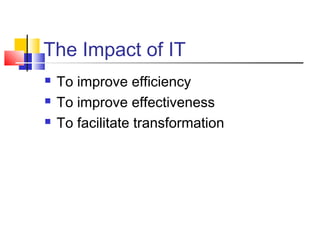
The Impact of IT
   To improve efficiency
   To improve effectiveness
   To facilitate transformation
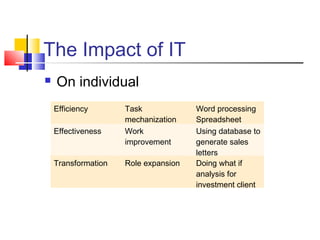
The Impact of IT
   On individual
    Efficiency       Task             Word processing
                     mechanization    Spreadsheet
    Effectiveness    Work             Using database to
                     improvement      generate sales
                                      letters
    Transformation   Role expansion   Doing what if
                                      analysis for
                                      investment client
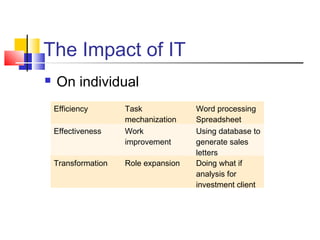
The Impact of IT
   On individual
    Efficiency       Task             Word processing
                     mechanization    Spreadsheet
    Effectiveness    Work             Using database to
                     improvement      generate sales
                                      letters
    Transformation   Role expansion   Doing what if
                                      analysis for
                                      investment client
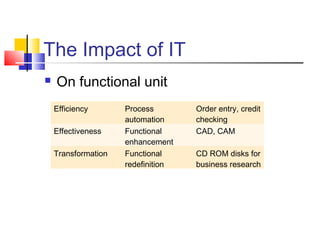
The Impact of IT
   On functional unit
    Efficiency       Process        Order entry, credit
                     automation     checking
    Effectiveness    Functional     CAD, CAM
                     enhancement
    Transformation   Functional     CD ROM disks for
                     redefinition   business research
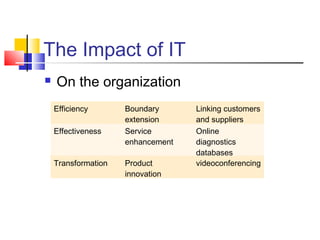
The Impact of IT
   On the organization
    Efficiency       Boundary      Linking customers
                     extension     and suppliers
    Effectiveness    Service       Online
                     enhancement   diagnostics
                                   databases
    Transformation   Product       videoconferencing
                     innovation
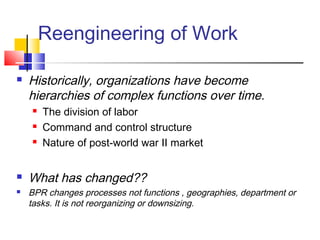
Reengineering of Work

   Historically, organizations have become
    hierarchies of complex functions over time.
       The division of labor
       Command and control structure
       Nature of post-world war II market


   What has changed??
   BPR changes processes not functions , geographies, department or
    tasks. It is not reorganizing or downsizing.
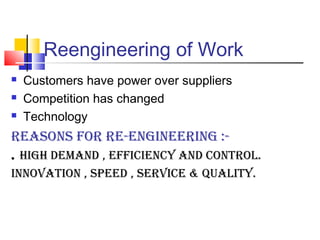
Reengineering of Work
   Customers have power over suppliers
   Competition has changed
   Technology
REASONS FOR RE-ENGINEERING :-
. HIGH dEmANd , EFFIcIENcy ANd cONtROl.
INNOvAtION , SpEEd , SERvIcE & quAlIty.
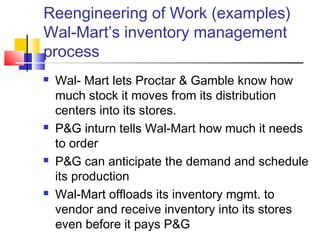
Reengineering of Work (examples)
Wal-Mart’s inventory management
process
   Wal- Mart lets Proctar & Gamble know how
    much stock it moves from its distribution
    centers into its stores.
   P&G inturn tells Wal-Mart how much it needs
    to order
   P&G can anticipate the demand and schedule
    its production
   Wal-Mart offloads its inventory mgmt. to
    vendor and receive inventory into its stores
    even before it pays P&G
Reengineering of Work (examples)
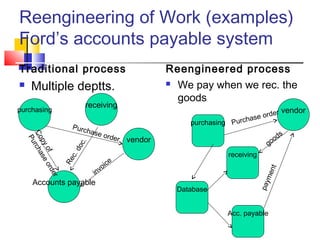
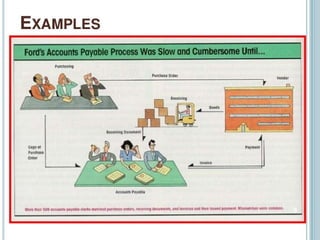
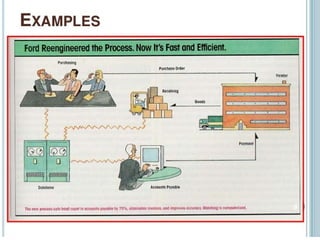
Ford’s accounts payable system
Traditional process                                    Reengineered process
    Multiple deptts.                                     We pay when we rec. the
                                                           goods
                          receiving
purchasing                                                                              vendor
                                                                              ase order
                                                              purchasing Purch
                     Purc
                            hase                                                          s
                                   orde
                                                                                        od
    Co rcha


                                          r   vendor                                  go
     Pu
      py s e


                       c.
                     do
         of


                                                                        receiving
                     c.


                                   ice
                   Re


                                 o
             ord


                              inv


                                                                                     ent
             er


                                                                                       m
      Accounts payable


                                                                                    pay
                                                           Database


                                                                        Acc. payable
Reengineering of Work (examples)
Ford’s accounts payable system
    Technology is an important part of the
     new process.
        The shared purchasing/ rec./accounts
         payable database integrates the three
         functions to accomplish the overall
         business process, order procurement,
         successfully
Reengineering Principles
    Organize around outcomes and not
     around tasks
        Assigning a person or a team to
         accomplish a task, rather than using
         assembly line approach
    Have those who use the output of the
     process actually perform the process
Reengineering Principles
    Have those who use the output of the
     process actually perform the process
        Why does a marketing manager have to be
         a customer of the purchasing deptt?
Reengineering Principles
    Treat geographically dispersed units as
     if they are centralized
        Greatest inefficiencies occur because
         decentralized divisions maintain their own
         information systems
Reengineering Principles
   Link parallel activities during the
    process rather than at the end
   Capture information once at the source
       At mutual benefit life, the same information
        was entered into as many as five different
        databases. When the process was
        reengineered, integrated databases were
        designed.
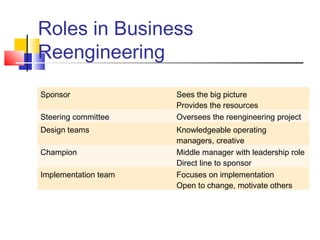
Roles in Business
Reengineering
Sponsor               Sees the big picture
                      Provides the resources
Steering committee    Oversees the reengineering project
Design teams          Knowledgeable operating
                      managers, creative
Champion              Middle manager with leadership role
                      Direct line to sponsor
Implementation team   Focuses on implementation
                      Open to change, motivate others
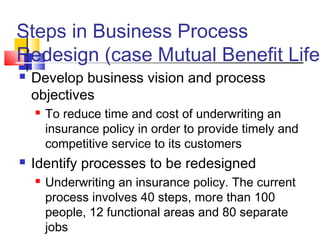
Steps in Business Process
Redesign (case Mutual Benefit Life)
   Develop business vision and process
    objectives
       To reduce time and cost of underwriting an
        insurance policy in order to provide timely and
        competitive service to its customers
   Identify processes to be redesigned
       Underwriting an insurance policy. The current
        process involves 40 steps, more than 100
        people, 12 functional areas and 80 separate
        jobs
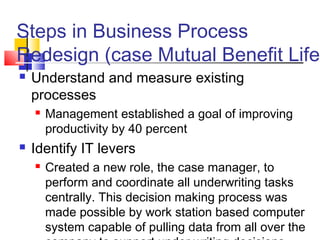
Steps in Business Process
Redesign (case Mutual Benefit Life)
   Understand and measure existing
    processes
       Management established a goal of improving
        productivity by 40 percent
   Identify IT levers
       Created a new role, the case manager, to
        perform and coordinate all underwriting tasks
        centrally. This decision making process was
        made possible by work station based computer
        system capable of pulling data from all over the
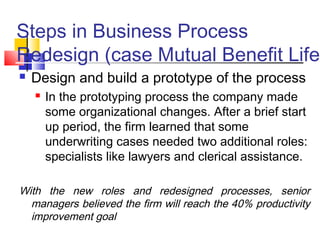
Steps in Business Process
Redesign (case Mutual Benefit Life)
   Design and build a prototype of the process
       In the prototyping process the company made
        some organizational changes. After a brief start
        up period, the firm learned that some
        underwriting cases needed two additional roles:
        specialists like lawyers and clerical assistance.

With the new roles and redesigned processes, senior
  managers believed the firm will reach the 40% productivity
  improvement goal
Management challenges in
Business Process Redesign


          ?
THANK YOU!!

Reference Book: MIS by Mary Summer and Robert

Bpr

  • 1.
    Business Process Reengineering andInformation Technology
  • 2.
    Objectives  The impact of IT  The reengineering of work  IT and Business Process Redesign
  • 3.
    The role ofinformation technology  Information technology (IT) has historically played an important role in the reengineering concept.[10] It is considered by some as a major enabler for new forms of working and collaborating within an organization and across organizational borders[  Early BPR literature [11] identified several so called disruptive technologies that were supposed to challenge traditional wisdom about how work should be performed.  Shared databases, making information available at many places  Expert systems, allowing generalists to perform specialist tasks  Telecommunication networks, allowing organizations to be centralized and decentralized at the same time  Decision-support tools, allowing decision-making to be a part of everybody's job  Wireless data communication and portable computers, allowing field personnel to work office independent  Interactive videodisk, to get in immediate contact with potential buyers  Automatic identification and tracking, allowing things to tell where they are, instead of requiring to be found  High performance computing, allowing on-the-fly planning and revisioning
  • 4.
    Business process reengineering (BPR) is the analysis and redesign of workflow within and between enterp  Organize around outcomes, not tasks. 2. Identify all the processes in an organization and prioritize them in order of redesign urgency. 3. Integrate information processing work into the real work that produces the information. 4. Treat geographically dispersed resources as though they were centralized. 5. Link parallel activities in the workflow instead of just integrating their results. 6. Put the decision point where the work is performed, and build control into the process. 7. Capture information once and at the source.rises. 
  • 5.
    Business process re-engineering is a business management strategy, originally pioneered in the early 1990s, focusing on the analysis and design of workflows and processes within an organization. BPR aimed to help organizations fundamentally rethink how they do their work in order to dramatically improve customer service, cut operational costs, and become world-class competitors. [1] In the mid-1990s, as many as 60% of the Fortune 500 companies claimed to either have initiated reengineering efforts, or to have plans to do so.  Business process re-engineering is also known as business process redesign, business transformation, or business process change management.
  • 6.
    The Impact ofIT  To improve efficiency  To improve effectiveness  To facilitate transformation
  • 7.
    The Impact ofIT  On individual Efficiency Task Word processing mechanization Spreadsheet Effectiveness Work Using database to improvement generate sales letters Transformation Role expansion Doing what if analysis for investment client
  • 8.
    The Impact ofIT  On individual Efficiency Task Word processing mechanization Spreadsheet Effectiveness Work Using database to improvement generate sales letters Transformation Role expansion Doing what if analysis for investment client
  • 9.
    The Impact ofIT  On functional unit Efficiency Process Order entry, credit automation checking Effectiveness Functional CAD, CAM enhancement Transformation Functional CD ROM disks for redefinition business research
  • 10.
    The Impact ofIT  On the organization Efficiency Boundary Linking customers extension and suppliers Effectiveness Service Online enhancement diagnostics databases Transformation Product videoconferencing innovation
  • 11.
    Reengineering of Work  Historically, organizations have become hierarchies of complex functions over time.  The division of labor  Command and control structure  Nature of post-world war II market  What has changed??  BPR changes processes not functions , geographies, department or tasks. It is not reorganizing or downsizing.
  • 12.
    Reengineering of Work  Customers have power over suppliers  Competition has changed  Technology REASONS FOR RE-ENGINEERING :- . HIGH dEmANd , EFFIcIENcy ANd cONtROl. INNOvAtION , SpEEd , SERvIcE & quAlIty.
  • 13.
    Reengineering of Work(examples) Wal-Mart’s inventory management process  Wal- Mart lets Proctar & Gamble know how much stock it moves from its distribution centers into its stores.  P&G inturn tells Wal-Mart how much it needs to order  P&G can anticipate the demand and schedule its production  Wal-Mart offloads its inventory mgmt. to vendor and receive inventory into its stores even before it pays P&G
  • 14.
    Reengineering of Work(examples) Ford’s accounts payable system Traditional process Reengineered process  Multiple deptts.  We pay when we rec. the goods receiving purchasing vendor ase order purchasing Purch Purc hase s orde od Co rcha r vendor go Pu py s e c. do of receiving c. ice Re o ord inv ent er m Accounts payable pay Database Acc. payable
  • 17.
    Reengineering of Work(examples) Ford’s accounts payable system  Technology is an important part of the new process.  The shared purchasing/ rec./accounts payable database integrates the three functions to accomplish the overall business process, order procurement, successfully
  • 18.
    Reengineering Principles  Organize around outcomes and not around tasks  Assigning a person or a team to accomplish a task, rather than using assembly line approach  Have those who use the output of the process actually perform the process
  • 19.
    Reengineering Principles  Have those who use the output of the process actually perform the process  Why does a marketing manager have to be a customer of the purchasing deptt?
  • 20.
    Reengineering Principles  Treat geographically dispersed units as if they are centralized  Greatest inefficiencies occur because decentralized divisions maintain their own information systems
  • 21.
    Reengineering Principles  Link parallel activities during the process rather than at the end  Capture information once at the source  At mutual benefit life, the same information was entered into as many as five different databases. When the process was reengineered, integrated databases were designed.
  • 22.
    Roles in Business Reengineering Sponsor Sees the big picture Provides the resources Steering committee Oversees the reengineering project Design teams Knowledgeable operating managers, creative Champion Middle manager with leadership role Direct line to sponsor Implementation team Focuses on implementation Open to change, motivate others
  • 23.
    Steps in BusinessProcess Redesign (case Mutual Benefit Life)  Develop business vision and process objectives  To reduce time and cost of underwriting an insurance policy in order to provide timely and competitive service to its customers  Identify processes to be redesigned  Underwriting an insurance policy. The current process involves 40 steps, more than 100 people, 12 functional areas and 80 separate jobs
  • 24.
    Steps in BusinessProcess Redesign (case Mutual Benefit Life)  Understand and measure existing processes  Management established a goal of improving productivity by 40 percent  Identify IT levers  Created a new role, the case manager, to perform and coordinate all underwriting tasks centrally. This decision making process was made possible by work station based computer system capable of pulling data from all over the
  • 25.
    Steps in BusinessProcess Redesign (case Mutual Benefit Life)  Design and build a prototype of the process  In the prototyping process the company made some organizational changes. After a brief start up period, the firm learned that some underwriting cases needed two additional roles: specialists like lawyers and clerical assistance. With the new roles and redesigned processes, senior managers believed the firm will reach the 40% productivity improvement goal
  • 26.
  • 27.
    THANK YOU!! Reference Book:MIS by Mary Summer and Robert