IS5600 - 5 IT Based Organisational Transformation:  BPR and Organisational Structures
Business Process Re-engineering “ The fundamental rethinking and radical redesign of business processes to achieve dramatic improvements in critical, contemporary measures of performance...”. Hammer and Champy (1993)
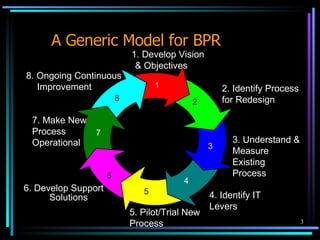
A Generic Model for BPR 8 7 6 5 4 3 2 1 4. Identify IT  Levers 5. Pilot/Trial New  Process 1. Develop Vision  & Objectives 8. Ongoing Continuous  Improvement 2. Identify Process  for Redesign 3. Understand &  Measure  Existing  Process 6. Develop Support  Solutions 7. Make New  Process  Operational
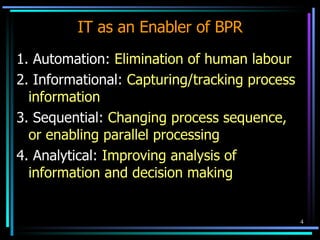
IT as an Enabler of BPR 1. Automation:  Elimination of human labour 2. Informational:  Capturing/tracking process information 3. Sequential:  Changing process sequence, or enabling parallel processing 4. Analytical:  Improving analysis of information and decision making
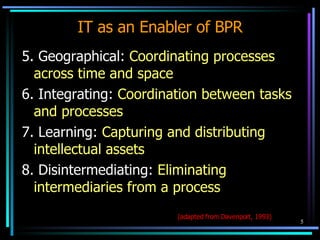
IT as an Enabler of BPR 5. Geographical:  Coordinating processes across time and space 6. Integrating:  Coordination between tasks and processes 7. Learning:  Capturing and distributing intellectual assets 8. Disintermediating:  Eliminating intermediaries from a process (adapted from Davenport, 1993)
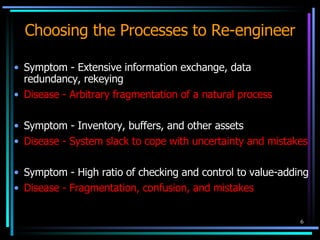
Choosing the Processes to Re-engineer Symptom - Extensive information exchange, data redundancy, rekeying Disease - Arbitrary fragmentation of a natural process Symptom - Inventory, buffers, and other assets Disease - System slack to cope with uncertainty and mistakes Symptom - High ratio of checking and control to value-adding Disease - Fragmentation, confusion, and mistakes
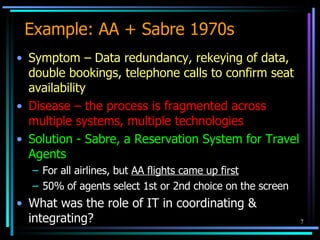
Example: AA + Sabre 1970s Symptom – Data redundancy, rekeying of data, double bookings, telephone calls to confirm seat availability Disease – the process is fragmented across multiple systems, multiple technologies Solution - Sabre, a Reservation System for Travel Agents For all airlines, but  AA flights came up first 50% of agents select 1st or 2nd choice on the screen What was the role of IT in coordinating & integrating?
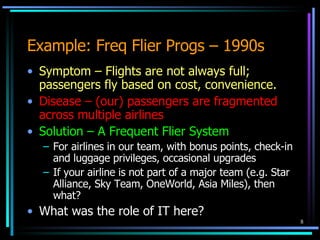
Example: Freq Flier Progs – 1990s Symptom – Flights are not always full; passengers fly based on cost, convenience. Disease – (our) passengers are fragmented across multiple airlines Solution – A Frequent Flier System For airlines in our team, with bonus points, check-in and luggage privileges, occasional upgrades If your airline is not part of a major team (e.g. Star Alliance, Sky Team, OneWorld, Asia Miles), then what? What was the role of IT here?
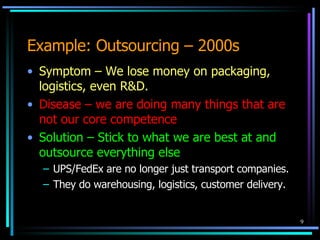
Example: Outsourcing – 2000s Symptom – We lose money on packaging, logistics, even R&D. Disease – we are doing many things that are not our core competence Solution – Stick to what we are best at and outsource everything else UPS/FedEx are no longer just transport companies. They do warehousing, logistics, customer delivery.
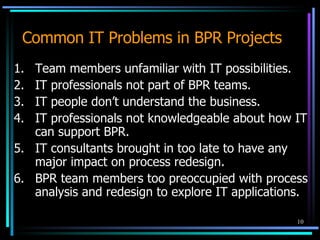
Common IT Problems in BPR Projects 1. Team members unfamiliar with IT possibilities. 2. IT professionals not part of BPR teams. 3. IT people don’t understand the business. 4. IT professionals not knowledgeable about how IT can support BPR. 5. IT consultants brought in too late to have any major impact on process redesign. 6. BPR team members too preoccupied with process analysis and redesign to explore IT applications.
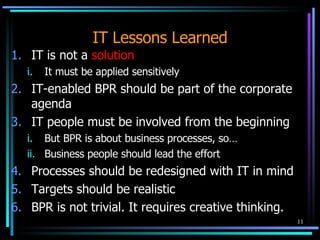
IT Lessons Learned IT is not a  solution It must be applied sensitively  IT-enabled BPR should be part of the corporate agenda IT people must be involved from the beginning But BPR is about business processes, so… Business people should lead the effort Processes should be redesigned with IT in mind Targets should be realistic BPR is not trivial. It requires creative thinking.
Getting Serious about BPR 1. What is likely to be the  hardest part  of reengineering for our company? 2. How can we  develop our people  so that they can do the jobs that re-engineering will create, and use the IT appropriately? 3. Are we prepared to  adapt our HR policies  to the needs of a reengineered environment? 4. How may we have to  adapt our organizational structure  for the aftermath of re-engineering?
Will Re-engineering work in China? Does anyone have experience of process improvement in China?
Changes to the  Organisational Structure The extension of organisational boundaries Including customers, suppliers & partners Not just process redesign, but structural redesign X-engineering (BPR-II)(Champy, 2002) Realisation that success involves managing dependencies (with IT), and perhaps changing our culture
WalMart US$4B investment in IT to develop the “Retail Link” private exchange All manufacturers/suppliers wishing to do business with WalMart must buy and use it Top 100 suppliers must use  RFID  as well. Huge cost advantage over competitors – because they integrate with IT.
But IT is not just for the big Anyone can leverage IT to their advantage IT is for both radical & incremental change IT can be used to transform an industry IT can be used to drive up the competitive advantage of the traditionally small and weak.
Case: TAL Group (talgroup.com) Founded in 1947, HQ in Hong Kong Turnover of US$590M in 02/03 11 factories 23,000 employees 50M garments a year  78% of sales in the US market
TAL’s IT Investments Integrating ERP + SCM systems (US$10M) End-to-end fully integrated system for Capacity planning  Production scheduling  Inventory management Raw material purchases Finished garment sales Extensive R&D > manufacturing patents
Vendor Managed Inventory Persuade the customers (retailers) to let TAL control the Inventory Management. TAL is the sole supplier for those goods TAL has total control of inventory monitoring & replenishment; no more ‘purchase orders’ TAL’s systems constantly monitor inventories at the store level Reduce stock levels (and wastage); On-demand production; Rapid stock replacement
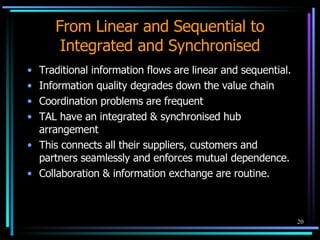
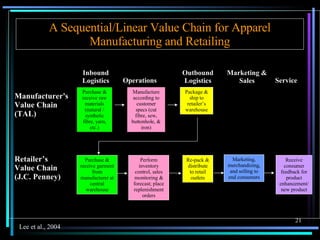
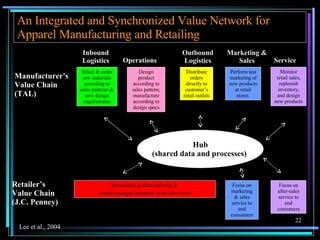
From Linear and Sequential to Integrated and Synchronised Traditional information flows are linear and sequential. Information quality degrades down the value chain Coordination problems are frequent TAL have an integrated & synchronised hub arrangement This connects all their suppliers, customers and partners seamlessly and enforces mutual dependence. Collaboration & information exchange are routine.
Inbound   Logistics Operations   Outbound Logistics Marketing & Sales Service Manufacturer's Value  Chain   (TAL) Retailer’s Value Chain (J.C. Penney) Purchase & receive raw materials (natural   /   synthetic fibre, yarn, etc.) Manufacture according to customer specs (cut fibre, sew, buttonhole, & iron) Package & ship to retailer’s warehouse Receive consumer feedback for product enhancement/ new product Marketing, merchandizing, and selling to end consumers Re-pack & distribute to retail outlets Perform inventory control, sales monitoring & forecast; place replenishment orders Purchase & receive garment from manufacturer at central warehouse A Sequential/Linear Value Chain for Apparel Manufacturing and Retailing Lee et al., 2004
Inbound Logistics Operations  Outbound Logistics Marketing & Sales Service Manufacturer's Value  Chain   (TAL) Retailer’s Value Chain (J.C. Penney) Select & order raw materials according to sales patterns & new design requirements Design product according to sales pattern; manufacture according to design specs Distribute orders directly to customer’s retail outlets Focus on after - sales service to end consumers Focus on marketing & sales service to end consumers Streamlined product delivery &  vendor-managed inventory at the store level  Perform test marketing of new products at retail stores  An Integrated and Synchronized Value Network for Apparel Manufacturing and Retailin g Monitor retail sales, replenish inventory, and design new products Hub (shared data and processes)  Lee et al., 2004
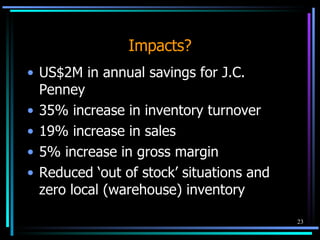
Impacts? US$2M in annual savings for J.C. Penney 35% increase in inventory turnover 19% increase in sales 5% increase in gross margin Reduced ‘out of stock’ situations and zero local (warehouse) inventory
Implications? Radically transformed industry structure & new rules of competition Much higher switching costs for customers. Access to real-time sales data at the store level Useful for TAL as it seeks new customers.
Lessons Innovation can be driven by a weak member Strong networks, manufacturing expertise Use IT to leverage strengths IT changes the value chain Develop an integrated and synchronised value network Shared data, systems, processes and performance indicators
Lessons for IT Based Org Change Top Management must be the change architects IT cannot transform an organisation – IT enables transformation Enterprise-wide business-IT Partnerships are needed  The pace of change must match the rate of acceptance Individual transformation is as important as organisational transformation Change champions must be diverse, yet work together Offshoring IT development sounds attractive, but it is not just an IT project.
Consequences of Transformation Organisational culture and identity There will be pressure for change here too People who support ‘the old way’ will feel left out,  marginalised  or discriminated against A new, more flexible set of cultural norms may be necessary Guided by new principles, new values, … and perhaps new managers? A Culture of Blogging? The CEO’s blog-desk?
The Value of IT? IT can enable transformation But IT is not cost-free The price is the price of change, the acceptability of change If management doesn’t want change, then handle IT carefully IT is only IT, but IT enables people to do things that were previously impossible Even email can produce radical changes in organisations
Whiteboard Questions What kinds of barriers would normally exist to hinder companies like TAL to leverage and re-engineer the supply chain? What is the strategic advantage for TAL? Why should JC Penney trust TAL? Can TAL replicate its success in other  industries? Imagine you are an IT consultant. How would you try to persuade CEOs to make more of their IT investments?

08a S5

  • 1.
    IS5600 - 5IT Based Organisational Transformation: BPR and Organisational Structures
  • 2.
    Business Process Re-engineering“ The fundamental rethinking and radical redesign of business processes to achieve dramatic improvements in critical, contemporary measures of performance...”. Hammer and Champy (1993)
  • 3.
    A Generic Modelfor BPR 8 7 6 5 4 3 2 1 4. Identify IT Levers 5. Pilot/Trial New Process 1. Develop Vision & Objectives 8. Ongoing Continuous Improvement 2. Identify Process for Redesign 3. Understand & Measure Existing Process 6. Develop Support Solutions 7. Make New Process Operational
  • 4.
    IT as anEnabler of BPR 1. Automation: Elimination of human labour 2. Informational: Capturing/tracking process information 3. Sequential: Changing process sequence, or enabling parallel processing 4. Analytical: Improving analysis of information and decision making
  • 5.
    IT as anEnabler of BPR 5. Geographical: Coordinating processes across time and space 6. Integrating: Coordination between tasks and processes 7. Learning: Capturing and distributing intellectual assets 8. Disintermediating: Eliminating intermediaries from a process (adapted from Davenport, 1993)
  • 6.
    Choosing the Processesto Re-engineer Symptom - Extensive information exchange, data redundancy, rekeying Disease - Arbitrary fragmentation of a natural process Symptom - Inventory, buffers, and other assets Disease - System slack to cope with uncertainty and mistakes Symptom - High ratio of checking and control to value-adding Disease - Fragmentation, confusion, and mistakes
  • 7.
    Example: AA +Sabre 1970s Symptom – Data redundancy, rekeying of data, double bookings, telephone calls to confirm seat availability Disease – the process is fragmented across multiple systems, multiple technologies Solution - Sabre, a Reservation System for Travel Agents For all airlines, but AA flights came up first 50% of agents select 1st or 2nd choice on the screen What was the role of IT in coordinating & integrating?
  • 8.
    Example: Freq FlierProgs – 1990s Symptom – Flights are not always full; passengers fly based on cost, convenience. Disease – (our) passengers are fragmented across multiple airlines Solution – A Frequent Flier System For airlines in our team, with bonus points, check-in and luggage privileges, occasional upgrades If your airline is not part of a major team (e.g. Star Alliance, Sky Team, OneWorld, Asia Miles), then what? What was the role of IT here?
  • 9.
    Example: Outsourcing –2000s Symptom – We lose money on packaging, logistics, even R&D. Disease – we are doing many things that are not our core competence Solution – Stick to what we are best at and outsource everything else UPS/FedEx are no longer just transport companies. They do warehousing, logistics, customer delivery.
  • 10.
    Common IT Problemsin BPR Projects 1. Team members unfamiliar with IT possibilities. 2. IT professionals not part of BPR teams. 3. IT people don’t understand the business. 4. IT professionals not knowledgeable about how IT can support BPR. 5. IT consultants brought in too late to have any major impact on process redesign. 6. BPR team members too preoccupied with process analysis and redesign to explore IT applications.
  • 11.
    IT Lessons LearnedIT is not a solution It must be applied sensitively IT-enabled BPR should be part of the corporate agenda IT people must be involved from the beginning But BPR is about business processes, so… Business people should lead the effort Processes should be redesigned with IT in mind Targets should be realistic BPR is not trivial. It requires creative thinking.
  • 12.
    Getting Serious aboutBPR 1. What is likely to be the hardest part of reengineering for our company? 2. How can we develop our people so that they can do the jobs that re-engineering will create, and use the IT appropriately? 3. Are we prepared to adapt our HR policies to the needs of a reengineered environment? 4. How may we have to adapt our organizational structure for the aftermath of re-engineering?
  • 13.
    Will Re-engineering workin China? Does anyone have experience of process improvement in China?
  • 14.
    Changes to the Organisational Structure The extension of organisational boundaries Including customers, suppliers & partners Not just process redesign, but structural redesign X-engineering (BPR-II)(Champy, 2002) Realisation that success involves managing dependencies (with IT), and perhaps changing our culture
  • 15.
    WalMart US$4B investmentin IT to develop the “Retail Link” private exchange All manufacturers/suppliers wishing to do business with WalMart must buy and use it Top 100 suppliers must use RFID as well. Huge cost advantage over competitors – because they integrate with IT.
  • 16.
    But IT isnot just for the big Anyone can leverage IT to their advantage IT is for both radical & incremental change IT can be used to transform an industry IT can be used to drive up the competitive advantage of the traditionally small and weak.
  • 17.
    Case: TAL Group(talgroup.com) Founded in 1947, HQ in Hong Kong Turnover of US$590M in 02/03 11 factories 23,000 employees 50M garments a year 78% of sales in the US market
  • 18.
    TAL’s IT InvestmentsIntegrating ERP + SCM systems (US$10M) End-to-end fully integrated system for Capacity planning Production scheduling Inventory management Raw material purchases Finished garment sales Extensive R&D > manufacturing patents
  • 19.
    Vendor Managed InventoryPersuade the customers (retailers) to let TAL control the Inventory Management. TAL is the sole supplier for those goods TAL has total control of inventory monitoring & replenishment; no more ‘purchase orders’ TAL’s systems constantly monitor inventories at the store level Reduce stock levels (and wastage); On-demand production; Rapid stock replacement
  • 20.
    From Linear andSequential to Integrated and Synchronised Traditional information flows are linear and sequential. Information quality degrades down the value chain Coordination problems are frequent TAL have an integrated & synchronised hub arrangement This connects all their suppliers, customers and partners seamlessly and enforces mutual dependence. Collaboration & information exchange are routine.
  • 21.
    Inbound Logistics Operations Outbound Logistics Marketing & Sales Service Manufacturer's Value Chain (TAL) Retailer’s Value Chain (J.C. Penney) Purchase & receive raw materials (natural / synthetic fibre, yarn, etc.) Manufacture according to customer specs (cut fibre, sew, buttonhole, & iron) Package & ship to retailer’s warehouse Receive consumer feedback for product enhancement/ new product Marketing, merchandizing, and selling to end consumers Re-pack & distribute to retail outlets Perform inventory control, sales monitoring & forecast; place replenishment orders Purchase & receive garment from manufacturer at central warehouse A Sequential/Linear Value Chain for Apparel Manufacturing and Retailing Lee et al., 2004
  • 22.
    Inbound Logistics Operations Outbound Logistics Marketing & Sales Service Manufacturer's Value Chain (TAL) Retailer’s Value Chain (J.C. Penney) Select & order raw materials according to sales patterns & new design requirements Design product according to sales pattern; manufacture according to design specs Distribute orders directly to customer’s retail outlets Focus on after - sales service to end consumers Focus on marketing & sales service to end consumers Streamlined product delivery & vendor-managed inventory at the store level Perform test marketing of new products at retail stores An Integrated and Synchronized Value Network for Apparel Manufacturing and Retailin g Monitor retail sales, replenish inventory, and design new products Hub (shared data and processes) Lee et al., 2004
  • 23.
    Impacts? US$2M inannual savings for J.C. Penney 35% increase in inventory turnover 19% increase in sales 5% increase in gross margin Reduced ‘out of stock’ situations and zero local (warehouse) inventory
  • 24.
    Implications? Radically transformedindustry structure & new rules of competition Much higher switching costs for customers. Access to real-time sales data at the store level Useful for TAL as it seeks new customers.
  • 25.
    Lessons Innovation canbe driven by a weak member Strong networks, manufacturing expertise Use IT to leverage strengths IT changes the value chain Develop an integrated and synchronised value network Shared data, systems, processes and performance indicators
  • 26.
    Lessons for ITBased Org Change Top Management must be the change architects IT cannot transform an organisation – IT enables transformation Enterprise-wide business-IT Partnerships are needed The pace of change must match the rate of acceptance Individual transformation is as important as organisational transformation Change champions must be diverse, yet work together Offshoring IT development sounds attractive, but it is not just an IT project.
  • 27.
    Consequences of TransformationOrganisational culture and identity There will be pressure for change here too People who support ‘the old way’ will feel left out, marginalised or discriminated against A new, more flexible set of cultural norms may be necessary Guided by new principles, new values, … and perhaps new managers? A Culture of Blogging? The CEO’s blog-desk?
  • 28.
    The Value ofIT? IT can enable transformation But IT is not cost-free The price is the price of change, the acceptability of change If management doesn’t want change, then handle IT carefully IT is only IT, but IT enables people to do things that were previously impossible Even email can produce radical changes in organisations
  • 29.
    Whiteboard Questions Whatkinds of barriers would normally exist to hinder companies like TAL to leverage and re-engineer the supply chain? What is the strategic advantage for TAL? Why should JC Penney trust TAL? Can TAL replicate its success in other industries? Imagine you are an IT consultant. How would you try to persuade CEOs to make more of their IT investments?