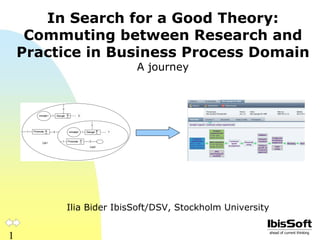
In Search for a Good Theory: Commuting between Research and Practice in Business Process Domain  A journey Ilia Bider IbisSoft/DSV, Stockholm University
Theory For each item  Ordered = Delivered To pay = Total + Freight + Tax Ordered  >  Delivered  shipment  To pay  >  Invoiced   invoicing   Invoiced = To pay Paid = Invoiced State- oriented view on business processes
Starting point – objects-connectors model Model consisting of Atoms Objects Laws Connectors Connector awakes checks restores falls asleep
Ending point – BP-support with shared spaces architecture  Process shared space – a place in the “cloud” where each process participant goes to fetch information and place the results Process map – the upper level of the shared space structure Step form – the low level of details of one part of the shared space
Continuation – what it is good for? Business/Enterprise agility  -  way of survival in the dynamic world Quickly adjust to the changes in the constantly changing business world – affects product/service development Employ new opportunities constantly appearing in the dynamic world for launching completely new products/services
Product and service development – traditional cycle  Risks Requirements specification do not catch the needs properly Requirements specifications are not converted into a proper design Product/service manufacturing does not follow the design exactly The new product/service is not properly understood by the stakeholders and is rejected or used in the wrong fashion Each product embeds knowledge A good regulator is a model of the system it regulates Conant & Ashby A good solution is a model of the problem it solves A good key is a model of the lock it opens  Requirements change during the development -> outdated wrong product/service Learning  to use in own practice  Requirements engineering   Manufacturing/ Implementation Design Tacit knowledge Tacit knowledge Explicit knowledge Explicit knowledge Problems/needs Design specifications Requirements specifications Embedded knowledge Product/Service
Minimizing the risks – how?  The development team having the tacit knowledge on the actual business needs/problems Agile development Cross-manning of business processes
Product and service development – agile style  Risk minimization via Not translating to explicit knowledge Short but multiple development cycles What if we can't use agile ? Tacit understanding of problems/needs Problems/needs Manufacturing Learning  to use in own practice Requirements engineering Agile approach Going agile Product/service The design phase is merged with manufacturing Learning  to use in own practice  Requirements engineering   Manufacturing Design Problems/needs Design specifications Requirements specifications Product/service Traditional approach
Manning of business processes - traditional style Knowledge on current needs/problems can be obtained by participants of the  boundary processes who not normally participate in the development process Shall we arrange additional processes for the to transfer knowledge?
Manning of business processes - cross-manning Main characteristics Multiple goals Heterogeneous teams
Process support for cross-manning Focus on collaboration instead of optimization Support should be adjusted to the needs of particular team – the team itself should be responsible for designing the process it wants to use and be able to change it as needed
Focus on collaboration - Shared spaces architecture  Process shared space – a place in the “cloud” where each process participant goes to fetch information and place the results Process map – the upper level of the shared space structure Step form – the low level of details of one part of the shared space
Customized processes - agile development of business processes  A good business process support system is a model of the business  process it supports Each product embeds knowledge A good regulator is a model of the system it regulates A good solution is a model of the problem it solves  A good key is a model of the lock it opens Problems/needs Learning  to use in own practice  Business process identification and  modeling Support system  manufacturing Support system  design Design specifications Business process models (maps) Business process support system Traditional approach Problems/needs Going agile Tacit understanding of processes Support system manufacturing Learning  to use in own practice Business process identification Agile approach Business process support system With agile technique and tools you can start here
Agile process development What is needed to achieve it?  A tool (process cutting machine) – to make changes quickly The tool should be understandable for the team creating the process – no complicated diagrams and rules
Thank   you  for  your   attention ! Ilia Bider ,  IbisSoft/Stockholm University Email: ilia@ibissoft.se Additional resources: http://processplatsen.ibissoft.se/en/ http://processplatsen.ibissoft.se/en/node/27

BPMDS'11

  • 1.
    In Search fora Good Theory: Commuting between Research and Practice in Business Process Domain A journey Ilia Bider IbisSoft/DSV, Stockholm University
  • 2.
    Theory For eachitem Ordered = Delivered To pay = Total + Freight + Tax Ordered > Delivered shipment To pay > Invoiced invoicing Invoiced = To pay Paid = Invoiced State- oriented view on business processes
  • 3.
    Starting point –objects-connectors model Model consisting of Atoms Objects Laws Connectors Connector awakes checks restores falls asleep
  • 4.
    Ending point –BP-support with shared spaces architecture Process shared space – a place in the “cloud” where each process participant goes to fetch information and place the results Process map – the upper level of the shared space structure Step form – the low level of details of one part of the shared space
  • 5.
    Continuation – whatit is good for? Business/Enterprise agility - way of survival in the dynamic world Quickly adjust to the changes in the constantly changing business world – affects product/service development Employ new opportunities constantly appearing in the dynamic world for launching completely new products/services
  • 6.
    Product and servicedevelopment – traditional cycle Risks Requirements specification do not catch the needs properly Requirements specifications are not converted into a proper design Product/service manufacturing does not follow the design exactly The new product/service is not properly understood by the stakeholders and is rejected or used in the wrong fashion Each product embeds knowledge A good regulator is a model of the system it regulates Conant & Ashby A good solution is a model of the problem it solves A good key is a model of the lock it opens Requirements change during the development -> outdated wrong product/service Learning to use in own practice Requirements engineering Manufacturing/ Implementation Design Tacit knowledge Tacit knowledge Explicit knowledge Explicit knowledge Problems/needs Design specifications Requirements specifications Embedded knowledge Product/Service
  • 7.
    Minimizing the risks– how? The development team having the tacit knowledge on the actual business needs/problems Agile development Cross-manning of business processes
  • 8.
    Product and servicedevelopment – agile style Risk minimization via Not translating to explicit knowledge Short but multiple development cycles What if we can't use agile ? Tacit understanding of problems/needs Problems/needs Manufacturing Learning to use in own practice Requirements engineering Agile approach Going agile Product/service The design phase is merged with manufacturing Learning to use in own practice Requirements engineering Manufacturing Design Problems/needs Design specifications Requirements specifications Product/service Traditional approach
  • 9.
    Manning of businessprocesses - traditional style Knowledge on current needs/problems can be obtained by participants of the boundary processes who not normally participate in the development process Shall we arrange additional processes for the to transfer knowledge?
  • 10.
    Manning of businessprocesses - cross-manning Main characteristics Multiple goals Heterogeneous teams
  • 11.
    Process support forcross-manning Focus on collaboration instead of optimization Support should be adjusted to the needs of particular team – the team itself should be responsible for designing the process it wants to use and be able to change it as needed
  • 12.
    Focus on collaboration- Shared spaces architecture Process shared space – a place in the “cloud” where each process participant goes to fetch information and place the results Process map – the upper level of the shared space structure Step form – the low level of details of one part of the shared space
  • 13.
    Customized processes -agile development of business processes A good business process support system is a model of the business process it supports Each product embeds knowledge A good regulator is a model of the system it regulates A good solution is a model of the problem it solves A good key is a model of the lock it opens Problems/needs Learning to use in own practice Business process identification and modeling Support system manufacturing Support system design Design specifications Business process models (maps) Business process support system Traditional approach Problems/needs Going agile Tacit understanding of processes Support system manufacturing Learning to use in own practice Business process identification Agile approach Business process support system With agile technique and tools you can start here
  • 14.
    Agile process developmentWhat is needed to achieve it? A tool (process cutting machine) – to make changes quickly The tool should be understandable for the team creating the process – no complicated diagrams and rules
  • 15.
    Thank you for your attention ! Ilia Bider , IbisSoft/Stockholm University Email: ilia@ibissoft.se Additional resources: http://processplatsen.ibissoft.se/en/ http://processplatsen.ibissoft.se/en/node/27