More important than ever:
  The Business Analysts’ role in
    Agile software development
IIBA Conference, September 2009
IIBA Nottingham, May 2010
                                     Allan Kelly
Big Airline, June 2010      allan@allankelly.net
Skills Matter, July 2010
                     http://www.allankelly.net

                           Software Strategy
           http://www.softwarestrategy.co.uk1
Allan Kelly, BSc, MBA
  Consulting, Training & Coaching
   for Agile adoption and deepening
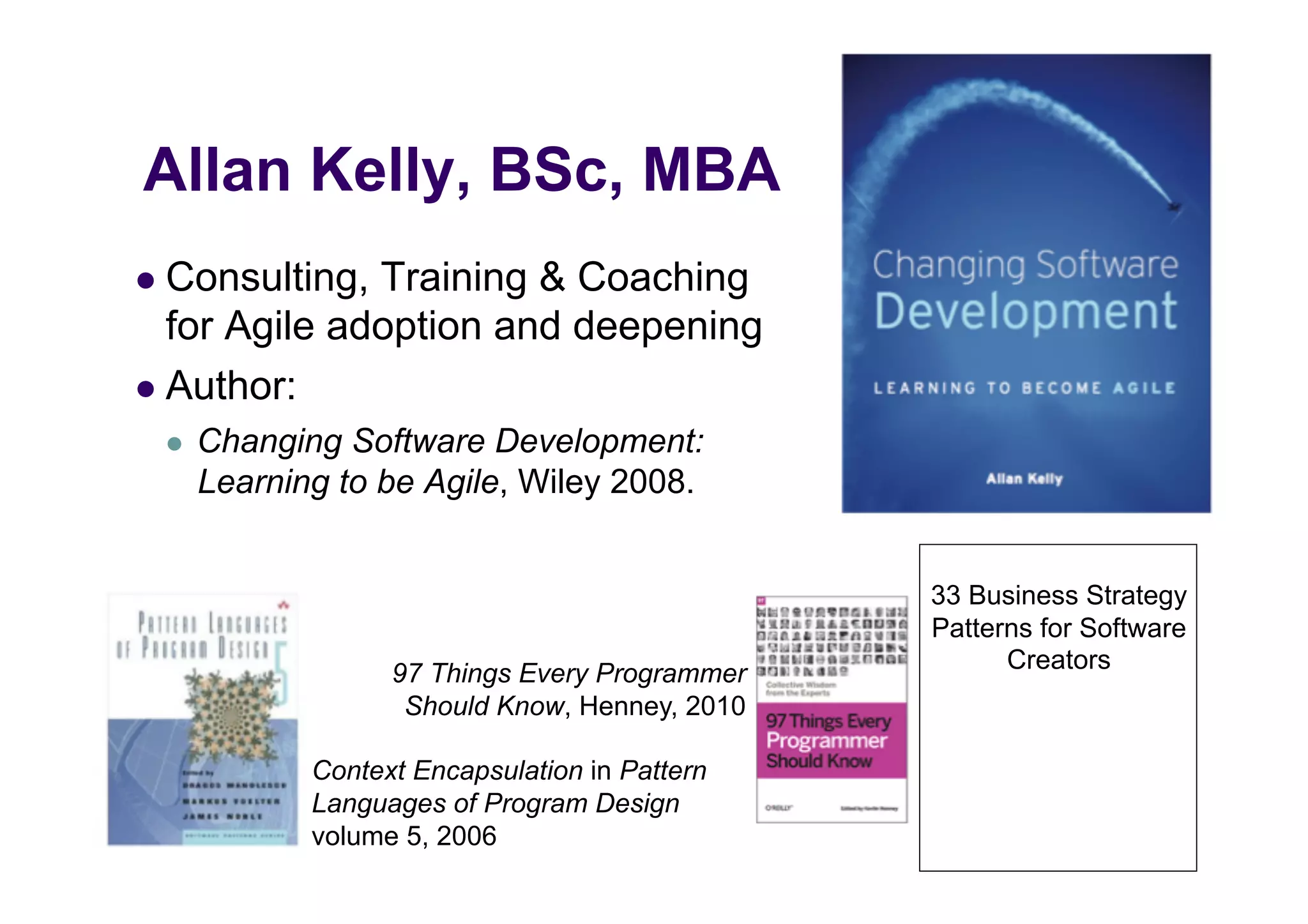
  Author:
     Changing Software Development:
      Learning to be Agile, Wiley 2008.


                                                33 Business Strategy
                                                Patterns for Software
                   97 Things Every Programmer         Creators
                    Should Know, Henney, 2010

             Context Encapsulation in Pattern
             Languages of Program Design
             volume 5, 2006
Agile
  What   is it?
   and   Lean?


                   3
“Agile processes promise
                                                   to react flexibly to
   What is Agility?                             changing requirements,
Jim Highsmith,                                     thus providing the
   2002          “Agility is the ability to      highest business value
                      both create and           to the customer at any
                   respond to change in              point in time”
                    order to profit in a
                    turbulent business
                       environment.”
                                                  Jutta Eckstein 2004

    Today:      Agile as Better
       Respond  to changing (business) environment
       Faster, more productive, higher quality

    Tomorrow:        Agile creates new business models
       Opportunities    for those not confined by traditional IT4
Agile
  Its   the business need, stupid


                                     5
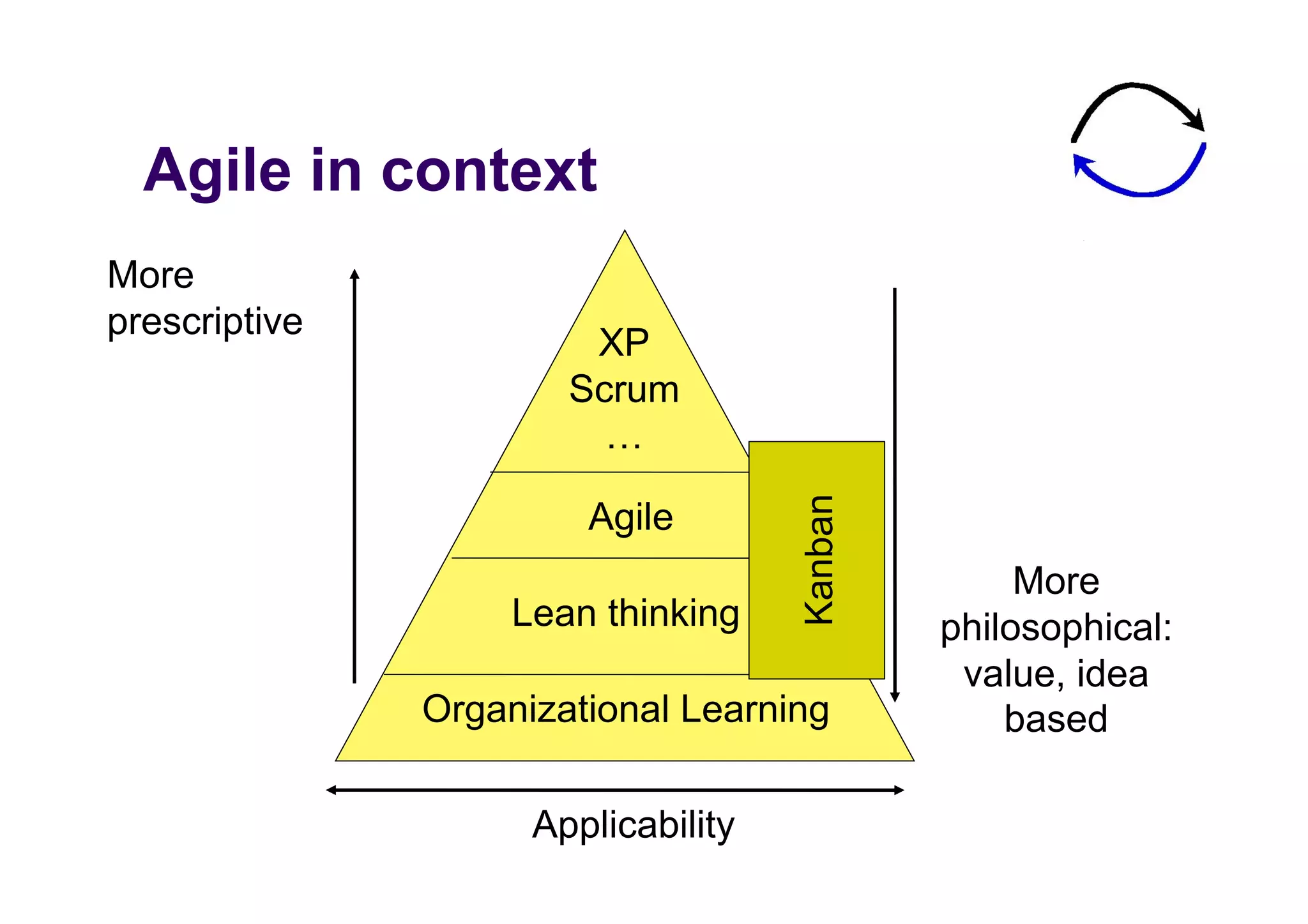
Agile in context
More
prescriptive
                        XP
                       Scrum
                         …


                                     Kanban
                        Agile
                                                   More
                    Lean thinking             philosophical:
                                               value, idea
               Organizational Learning            based

                     Applicability
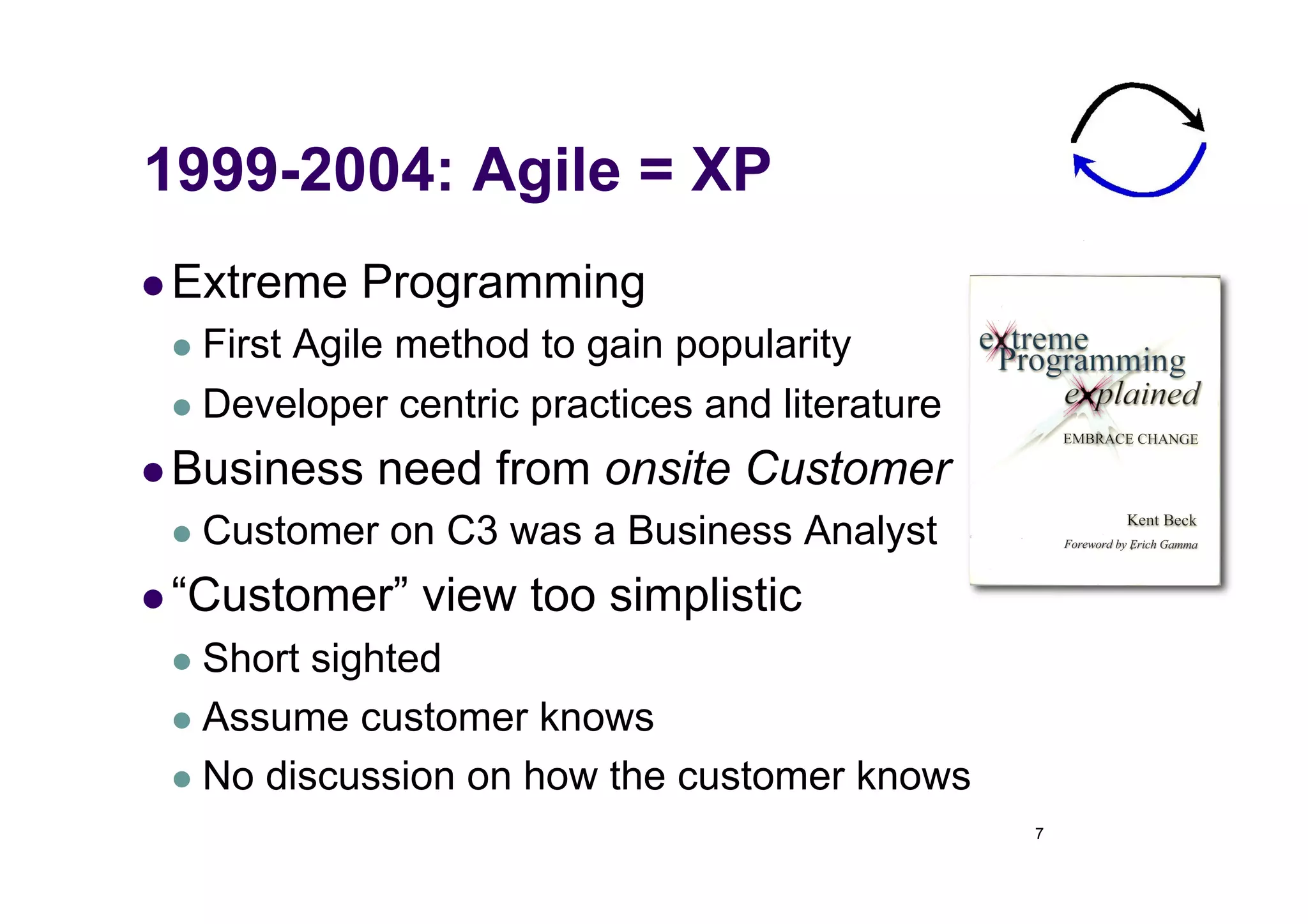
1999-2004: Agile = XP
  Extreme   Programming
   First
        Agile method to gain popularity
   Developer centric practices and literature

  Business   need from onsite Customer
   Customer   on C3 was a Business Analyst
  “Customer”   view too simplistic
   Short sighted
   Assume customer knows

   No discussion on how the customer knows
                                                 7
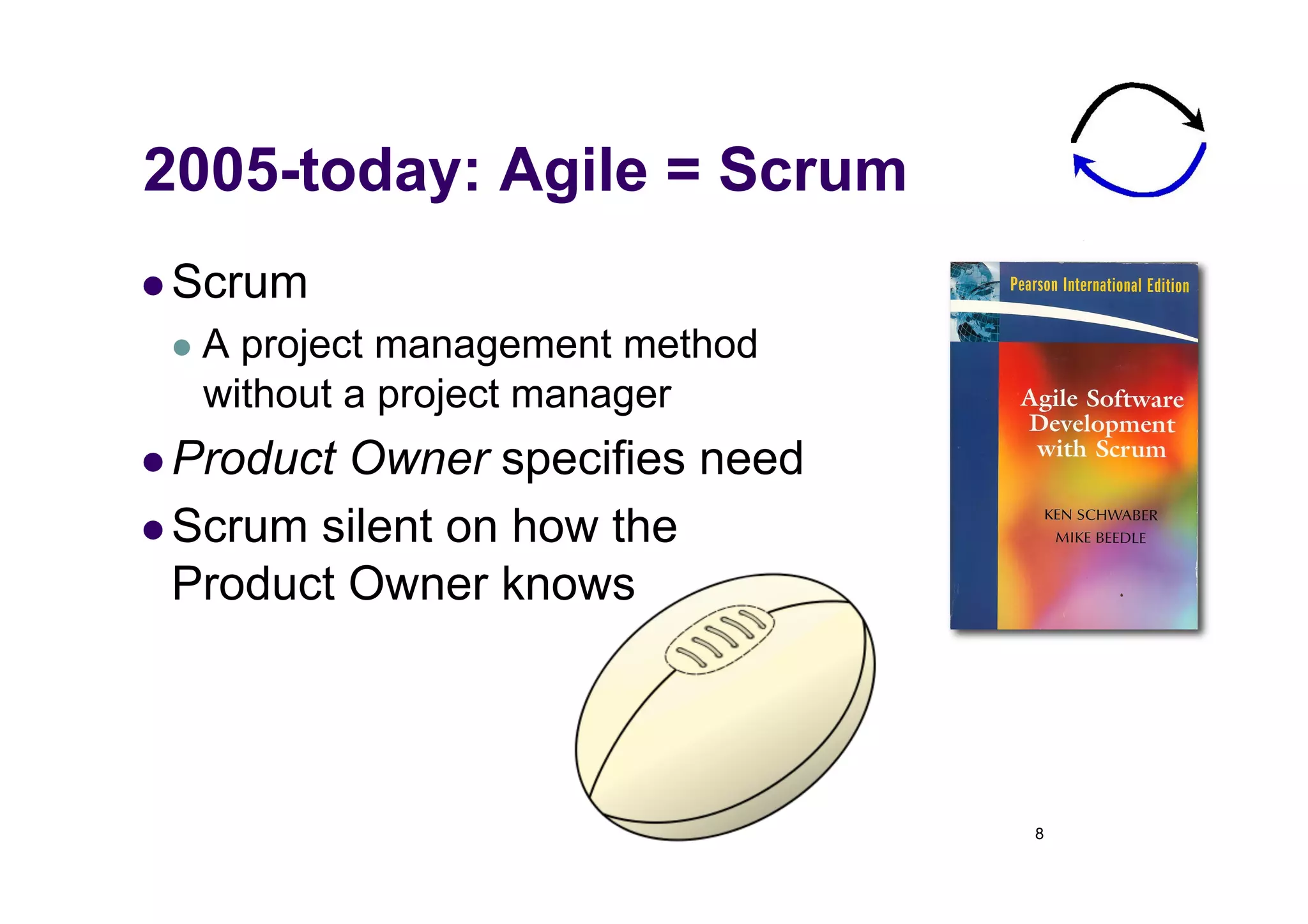
2005-today: Agile = Scrum
  Scrum
   Aproject management method
   without a project manager
  Product Owner specifies need
  Scrum silent on how the
   Product Owner knows


                                  8
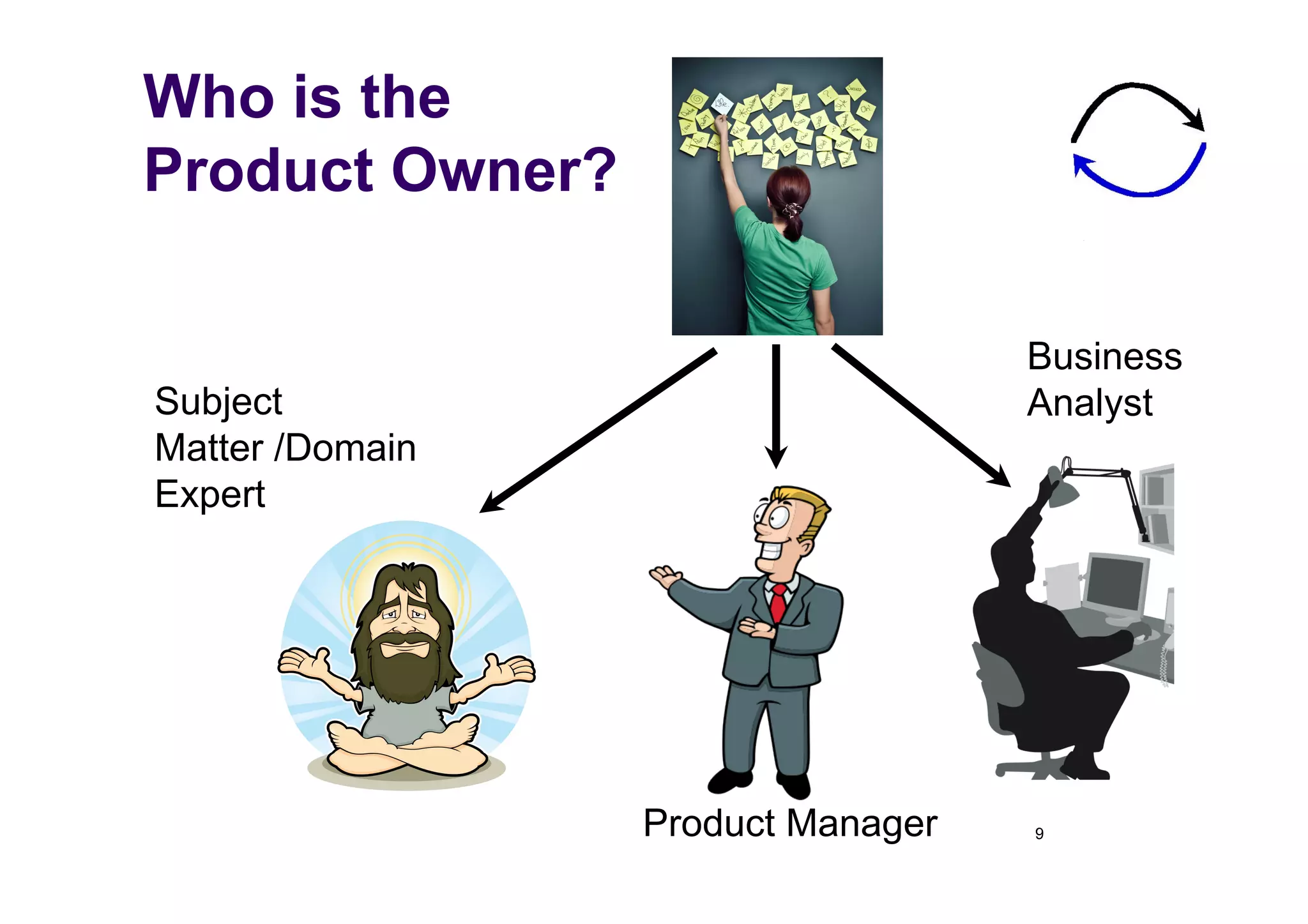
Who is the
Product Owner?

                                   Business
Subject                            Analyst
Matter /Domain
Expert


                 Product Manager   9
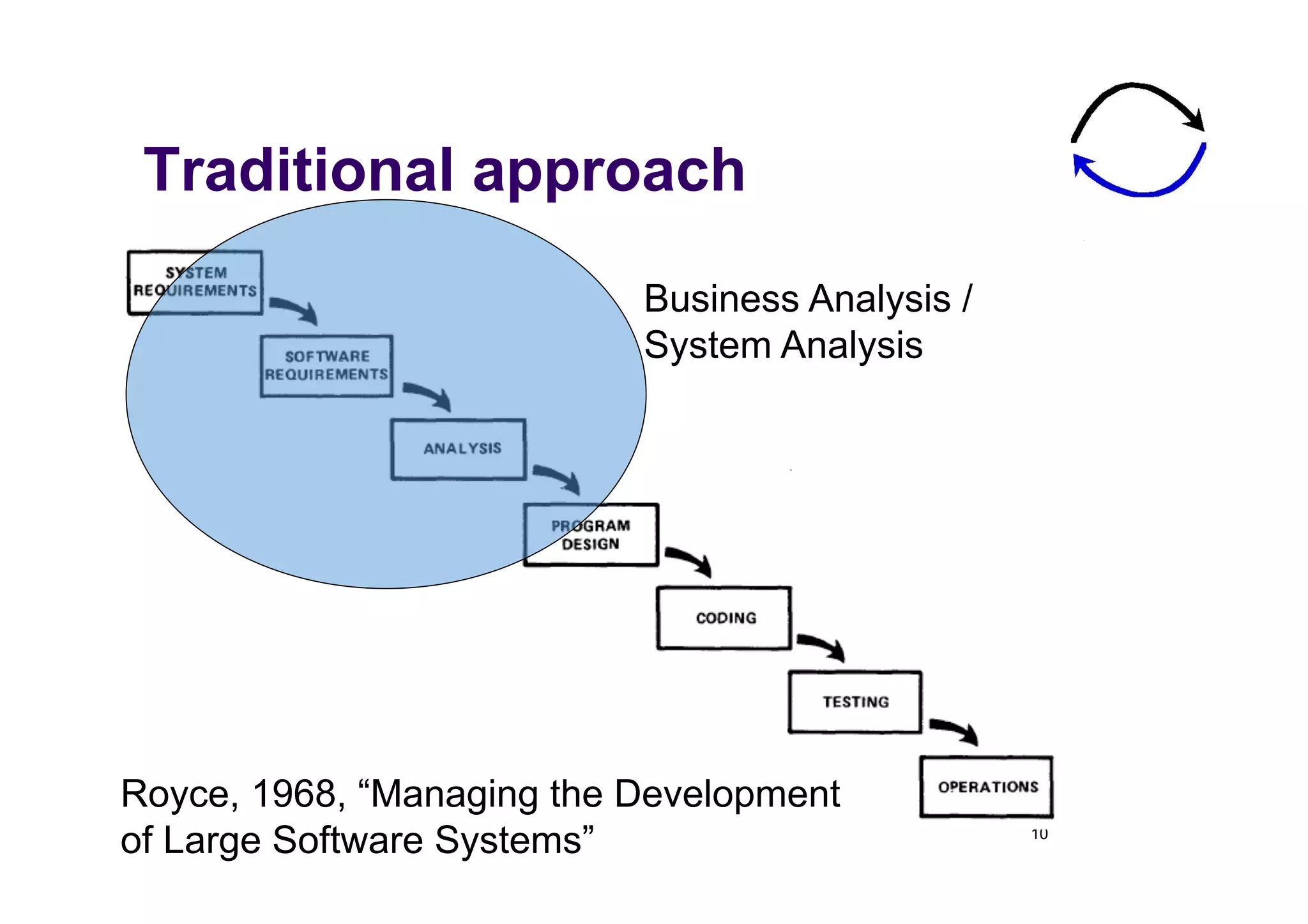
Traditional approach
                           Business Analysis /
                           System Analysis


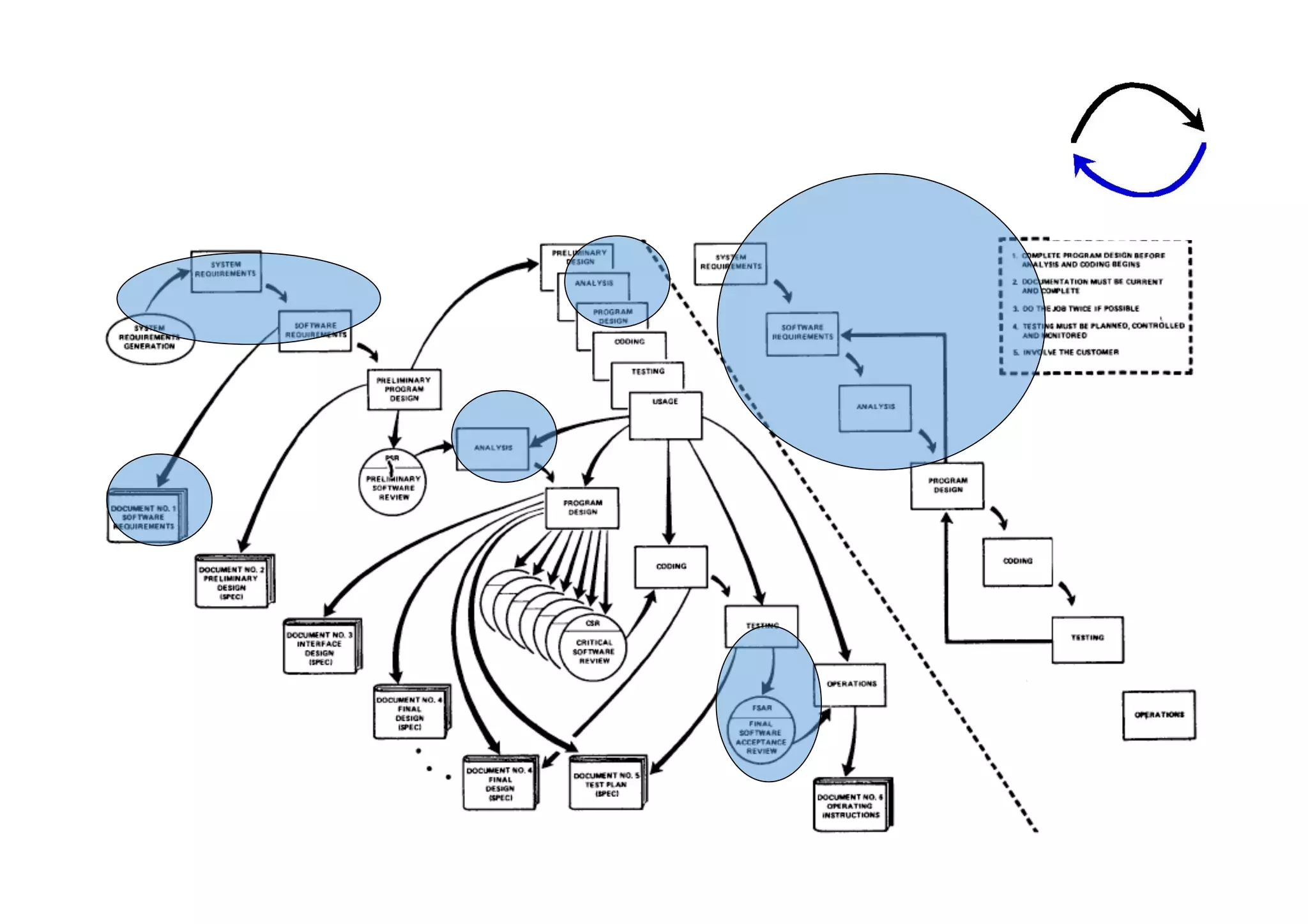
Royce, 1968, “Managing the Development
of Large Software Systems”                       10
11
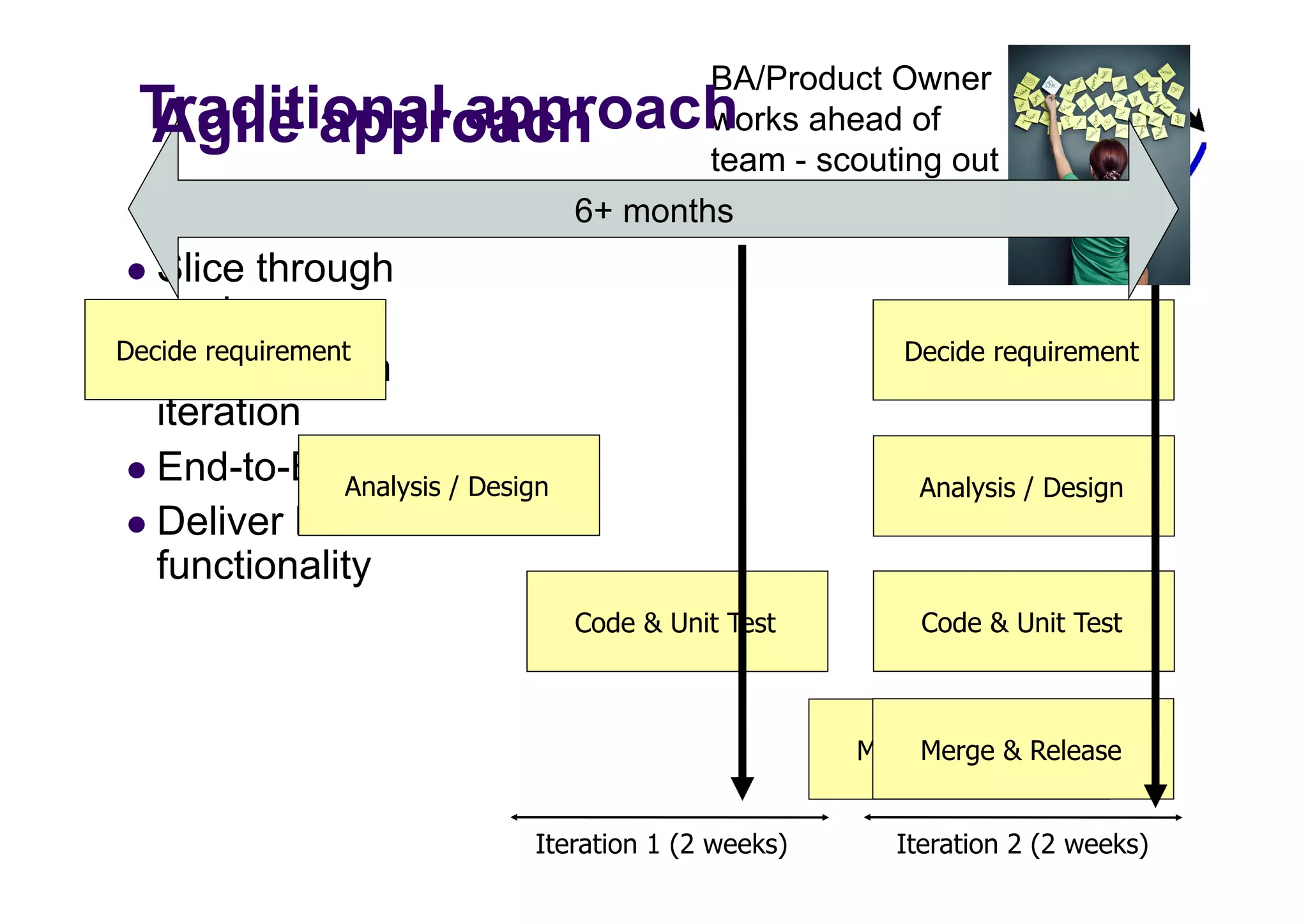
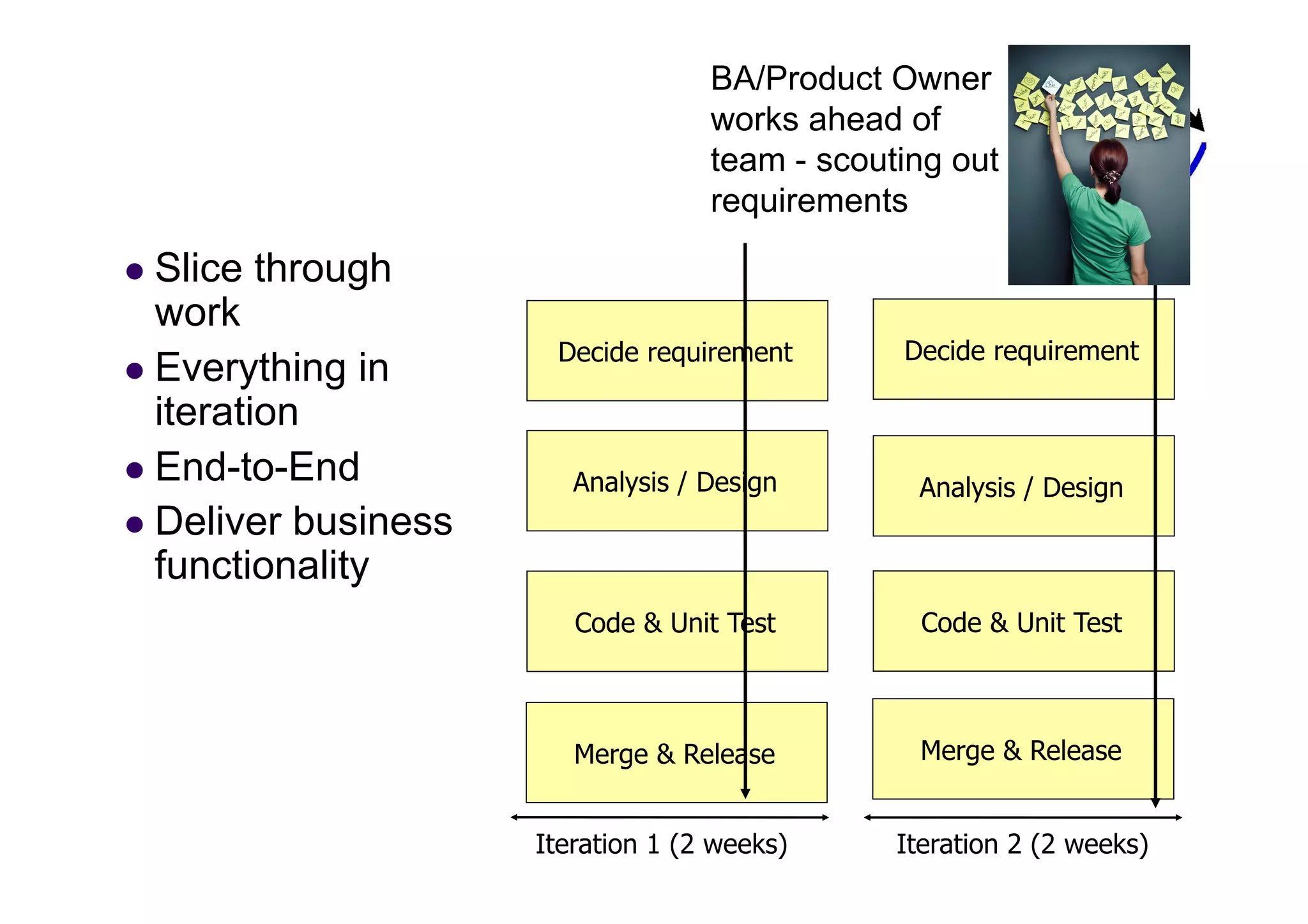
BA/Product Owner
 Traditional approach
 Agile approach                              works ahead of
                                             team - scouting out
                                             requirements
                                     6+ months
  Slice   through
    work
Decide requirement                                         Decide requirement
   Everything in
    iteration
   End-to-End
                 Analysis / Design                          Analysis / Design
   Deliver business
    functionality
                                     Code & Unit Test       Code & Unit Test


                                                            Merge & Release
                                                        Merge & Release


                                Iteration 1 (2 weeks)     Iteration 2 (2 weeks)
BA/Product Owner
                                    works ahead of
                                    team - scouting out
                                    requirements

  Slice   through
   work
                       Decide requirement       Decide requirement
  Everything in
   iteration
  End-to-End            Analysis / Design       Analysis / Design
  Deliver business
   functionality
                         Code & Unit Test         Code & Unit Test


                         Merge & Release          Merge & Release


                      Iteration 1 (2 weeks)     Iteration 2 (2 weeks)
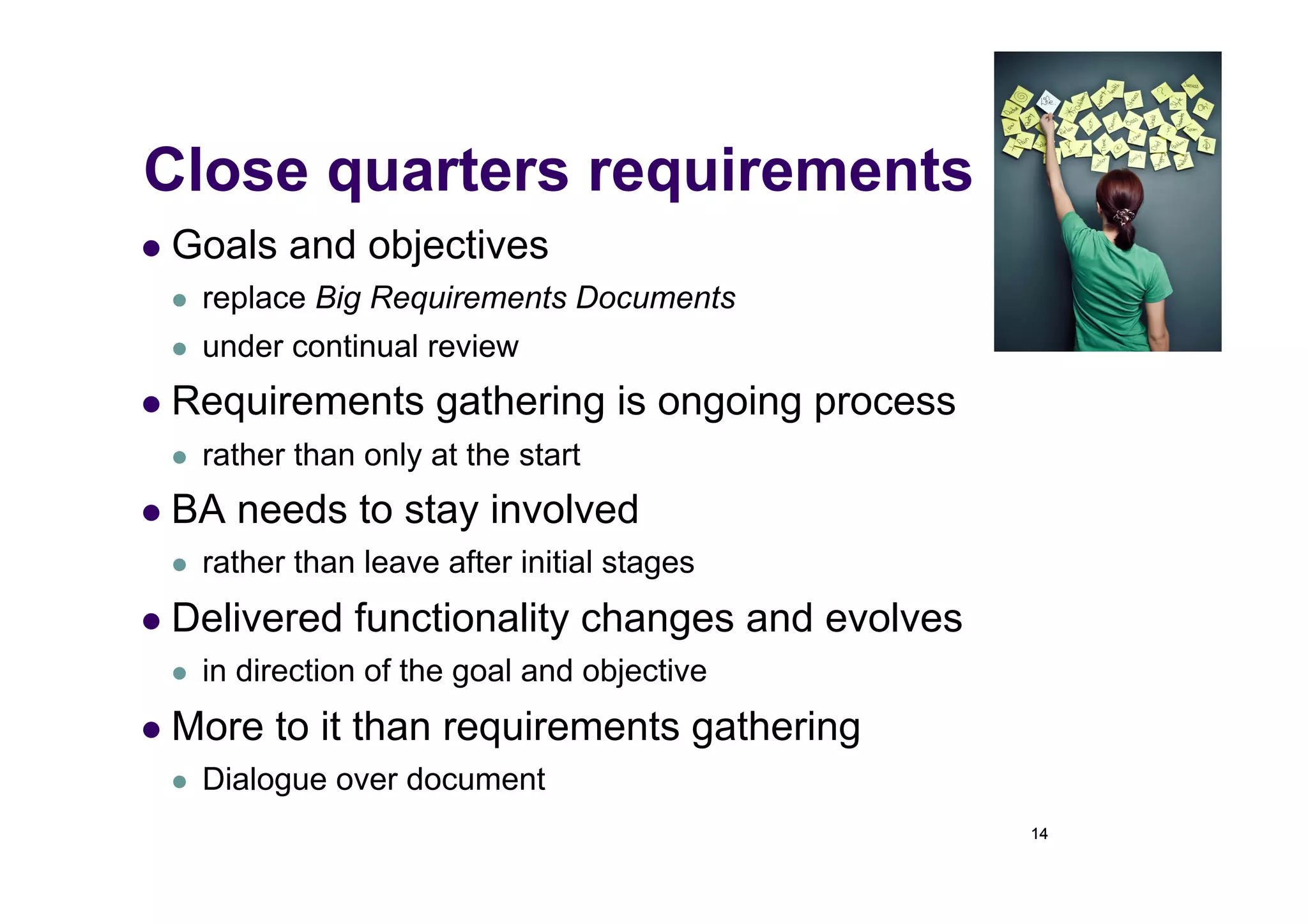
Close quarters requirements
  Goals    and objectives
     replace Big Requirements Documents
     under continual review
  Requirements         gathering is ongoing process
     rather than only at the start
  BA   needs to stay involved
     rather than leave after initial stages
  Delivered     functionality changes and evolves
     in direction of the goal and objective
  More    to it than requirements gathering
     Dialogue over document
                                                       14
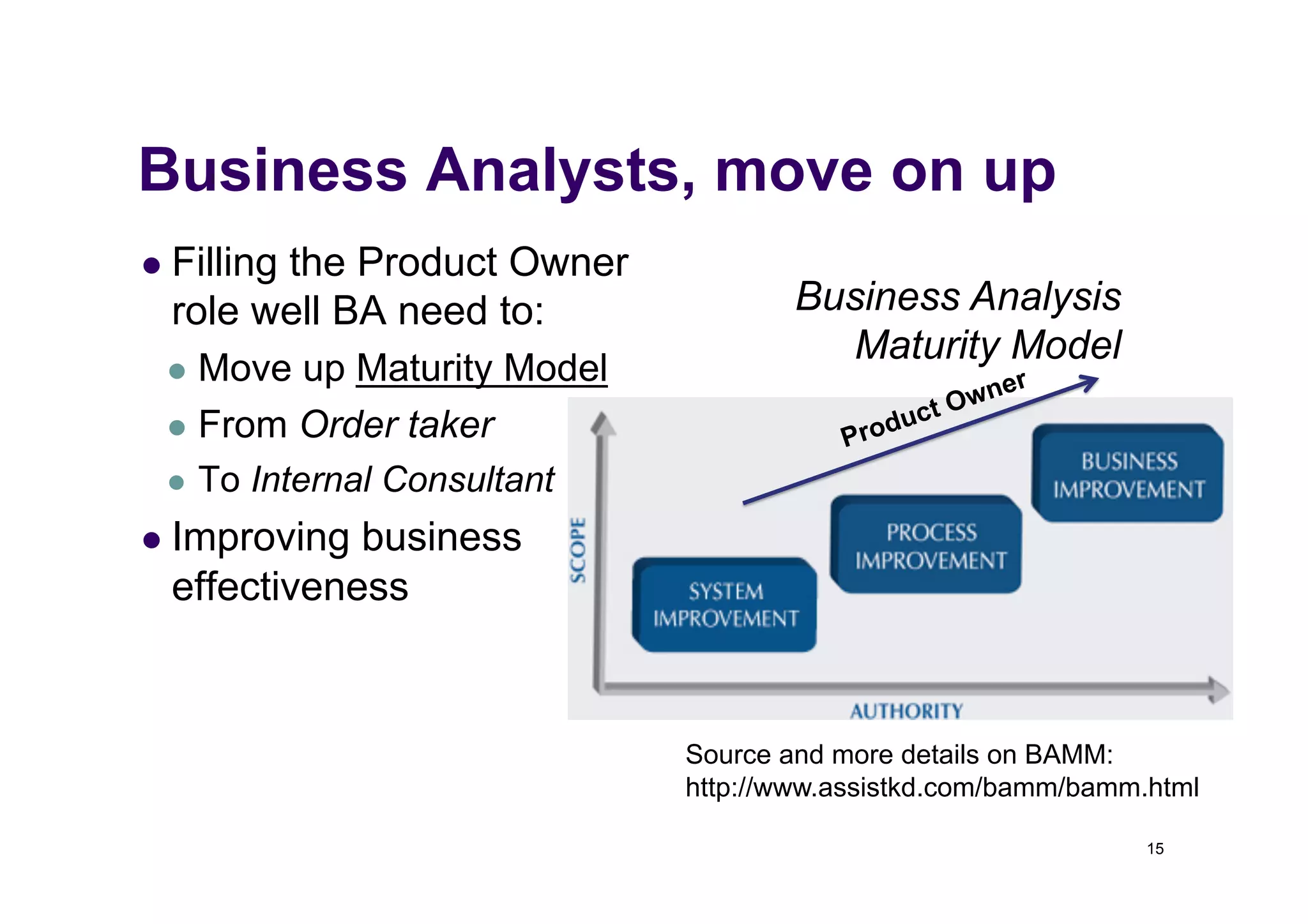
Business Analysts, move on up
  Filling
        the Product Owner
  role well BA need to:                Business Analysis
                                         Maturity Model
   Move up Maturity Model                             r
                                                 tOwne
   From Order taker                         duc
                                          Pro
     To Internal Consultant
  Improving business
  effectiveness


                               Source and more details on BAMM:
                               http://www.assistkd.com/bamm/bamm.html

                                                                 15
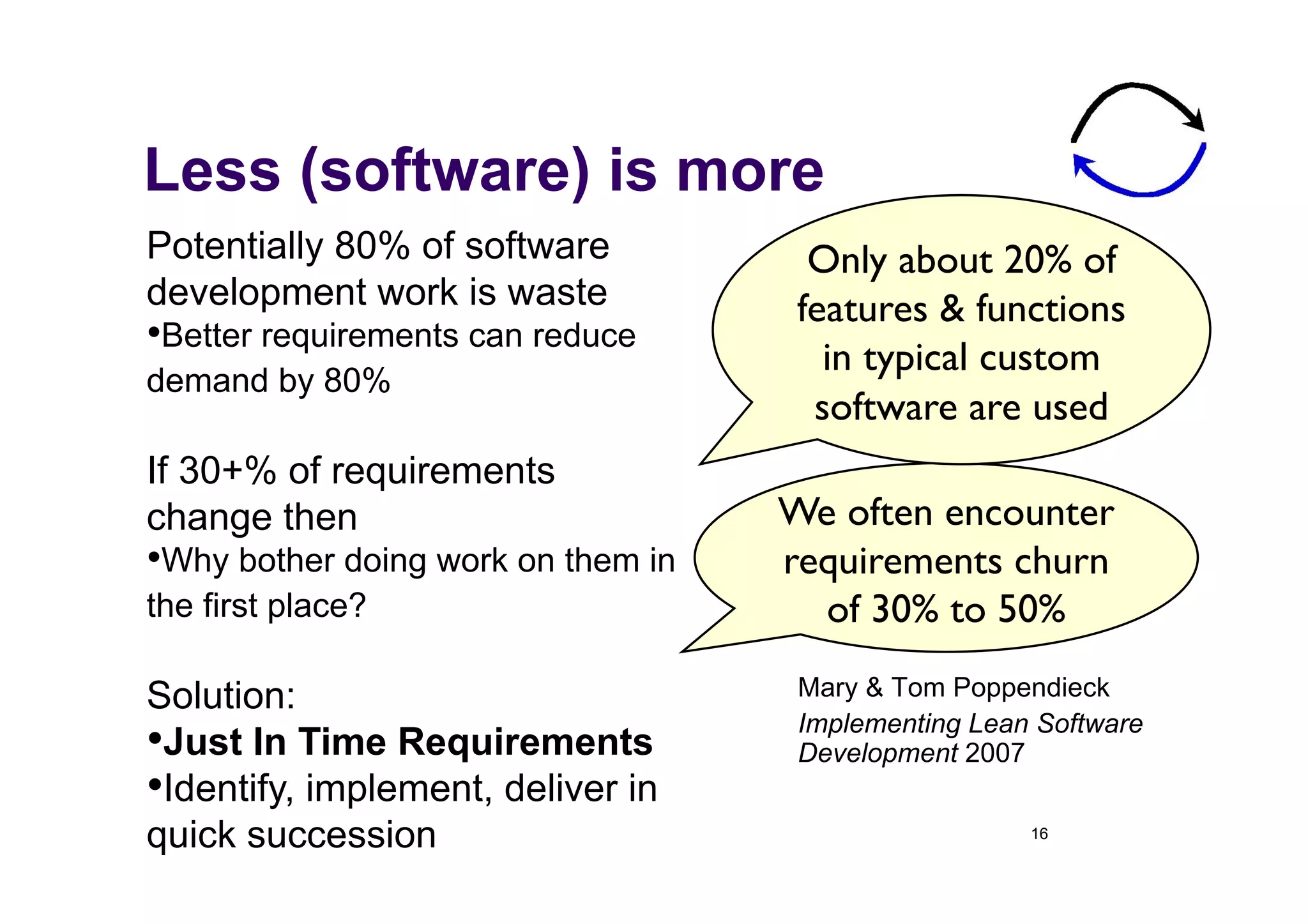
Less (software) is more
Potentially 80% of software            Only about 20% of
development work is waste             features & functions
• Better requirements can reduce
                                        in typical custom
demand by 80%
                                       software are used	

If 30+% of requirements
change then                          We often encounter
• Why bother doing work on them in   requirements churn
the first place?                       of 30% to 50%	


Solution:                             Mary & Tom Poppendieck
                                      Implementing Lean Software
• Just In Time Requirements           Development 2007
• Identify, implement, deliver in
quick succession                                       16
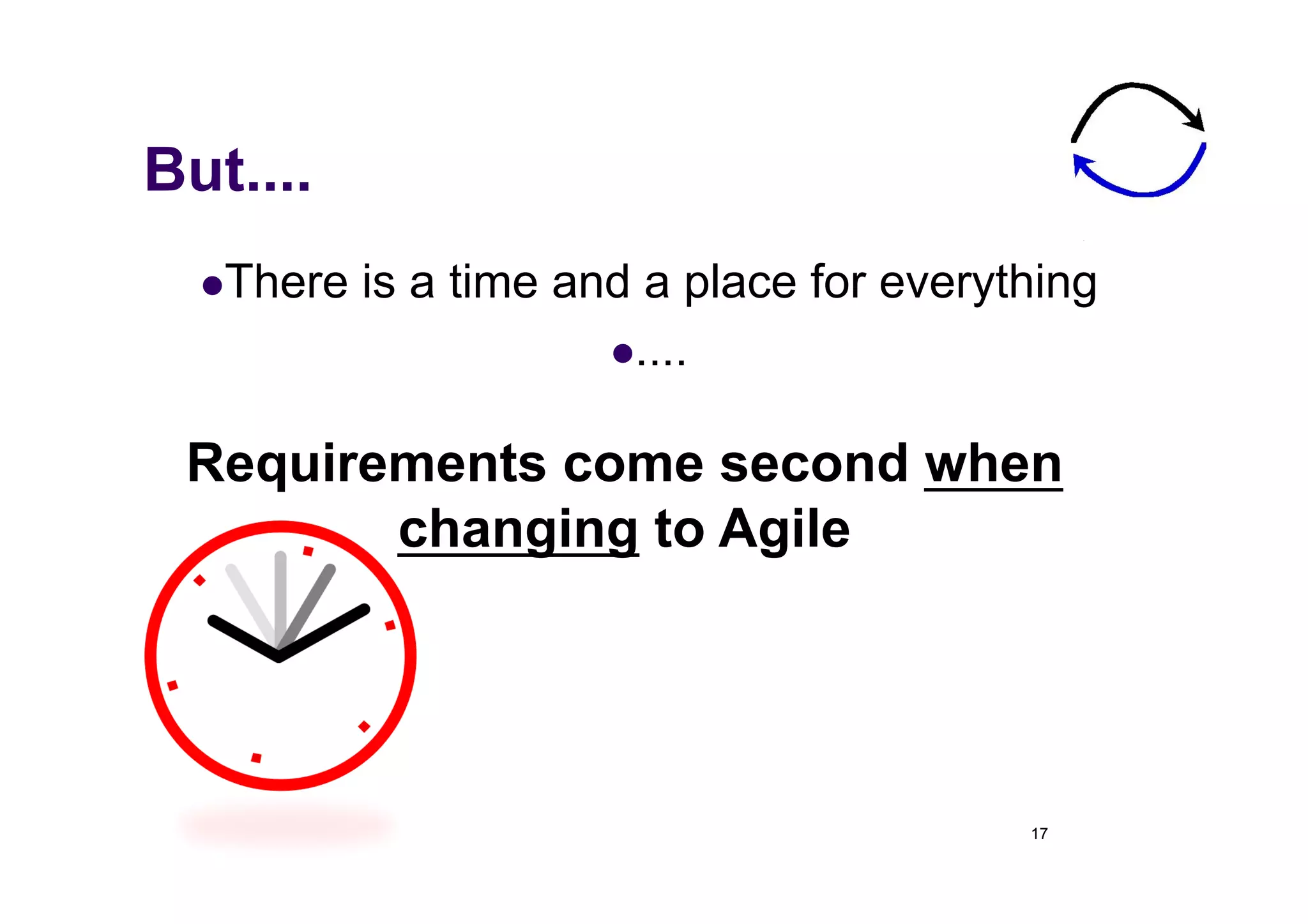
But....
   There   is a time and a place for everything
                         ....


 Requirements come second when
        changing to Agile


                                            17
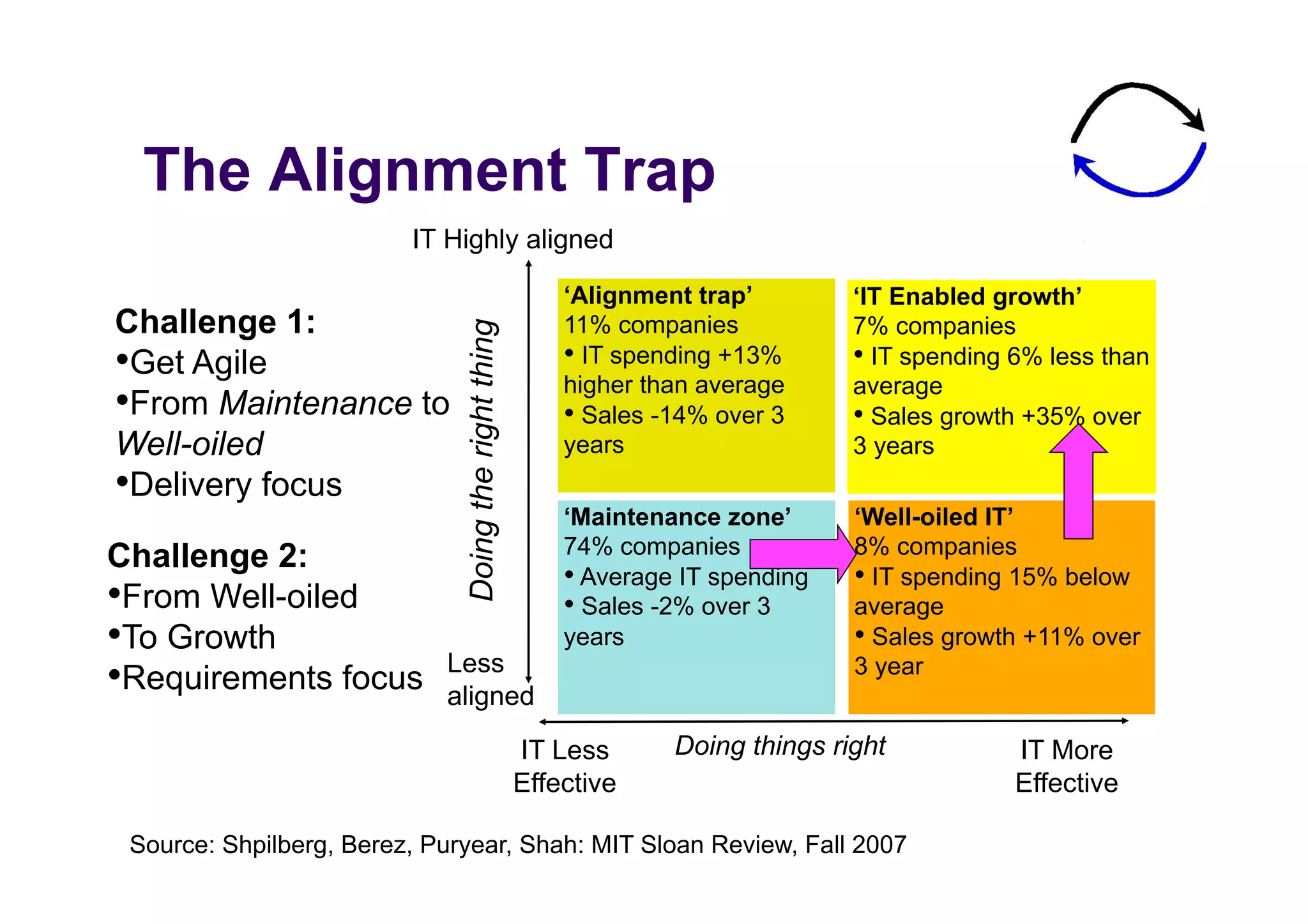
The Alignment Trap
                         IT Highly aligned

                                                          ‘Alignment trap’         ‘IT Enabled growth’
Challenge 1:                                              11% companies            7% companies


                              Doing the right thing
• Get Agile                                               •  IT spending +13%
                                                          higher than average
                                                                                   •  IT spending 6% less than
                                                                                   average
• From Maintenance to                                     •  Sales -14% over 3     •  Sales growth +35% over
Well-oiled                                                years                    3 years
• Delivery focus
                                                          ‘Maintenance zone’       ‘Well-oiled IT’
                                                          74% companies            8% companies
Challenge 2:
                                                          •  Average IT spending   •  IT spending 15% below
• From Well-oiled                                         •  Sales -2% over 3      average
• To Growth                                               years                    •  Sales growth +11% over
• Requirements focus Less
                     aligned
                                                                                   3 year


                                                      IT Less       Doing things right           IT More
                                                      Effective                                  Effective

 Source: Shpilberg, Berez, Puryear, Shah: MIT Sloan Review, Fall 2007
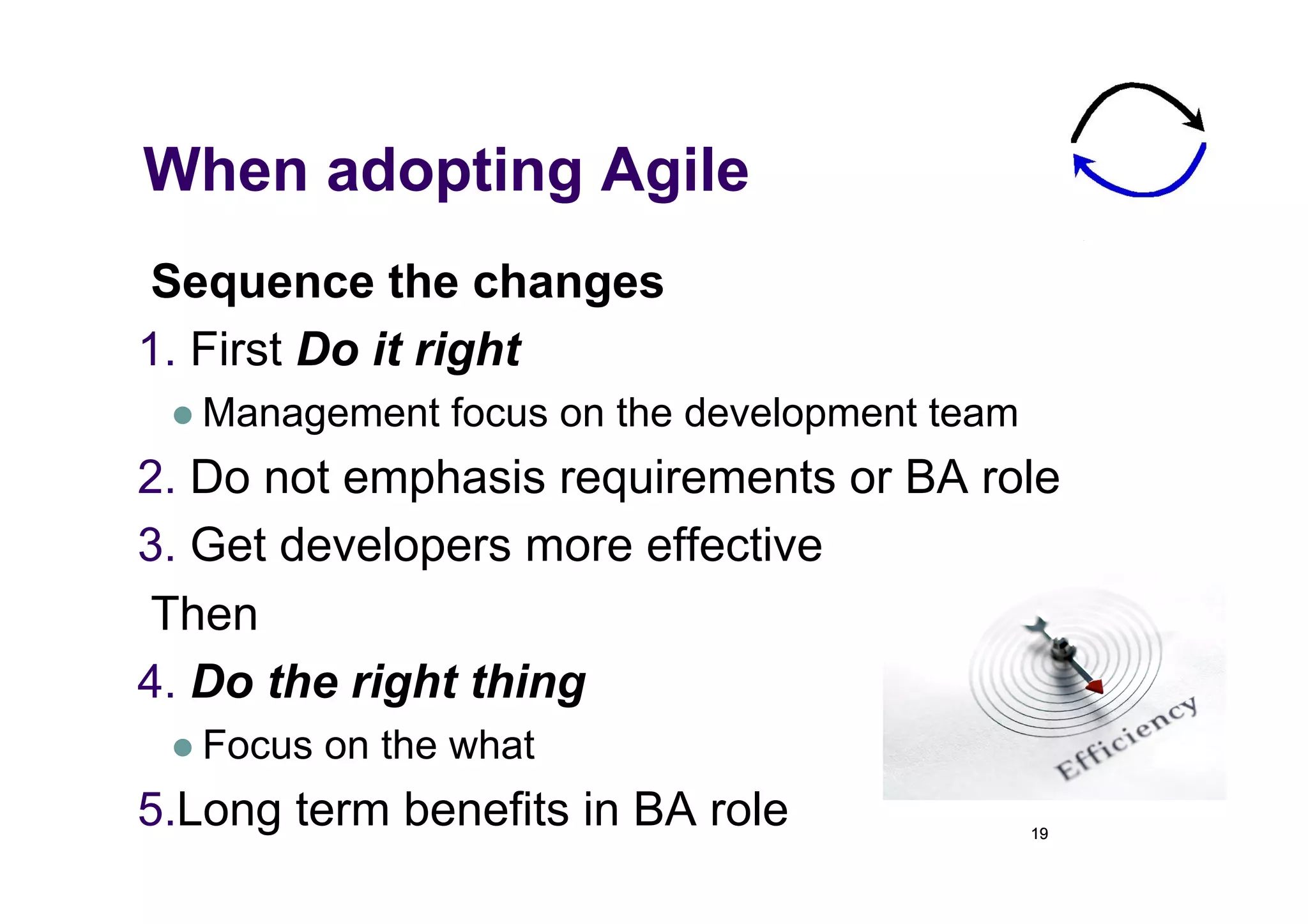
When adopting Agile
 Sequence the changes
1.  First Do it right
   Management    focus on the development team
2.  Do not emphasis requirements or BA role
3.  Get developers more effective
 Then
4.  Do the right thing
   Focus   on the what
5. Long term benefits in BA role                  19
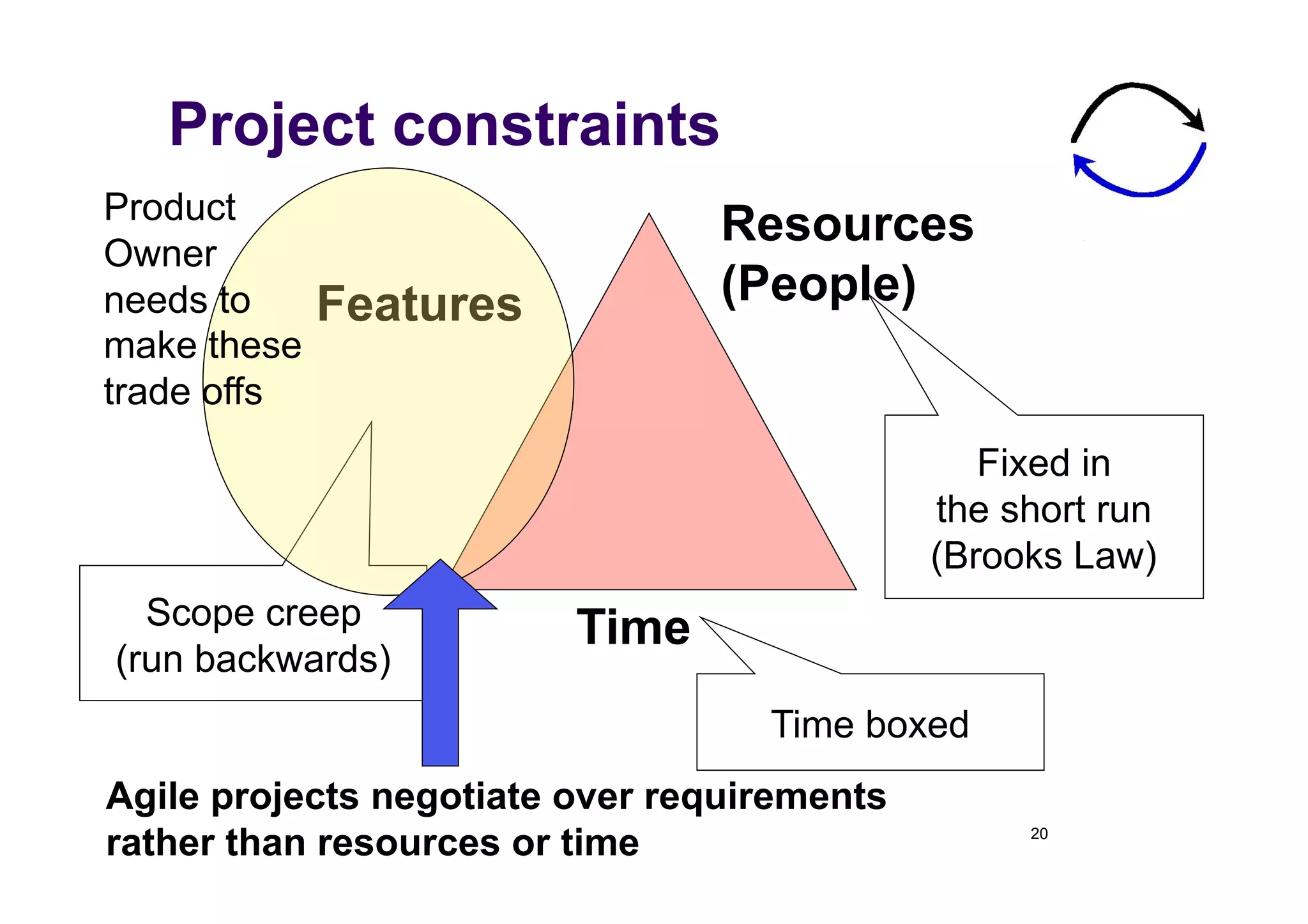
Project constraints
Product
                                 Resources
Owner
needs to     Features            (People)
make these
trade offs
                                                Fixed in
                                             the short run
                                             (Brooks Law)
  Scope creep            Time
(run backwards)
                                   Time boxed
Agile projects negotiate over requirements
rather than resources or time                     20
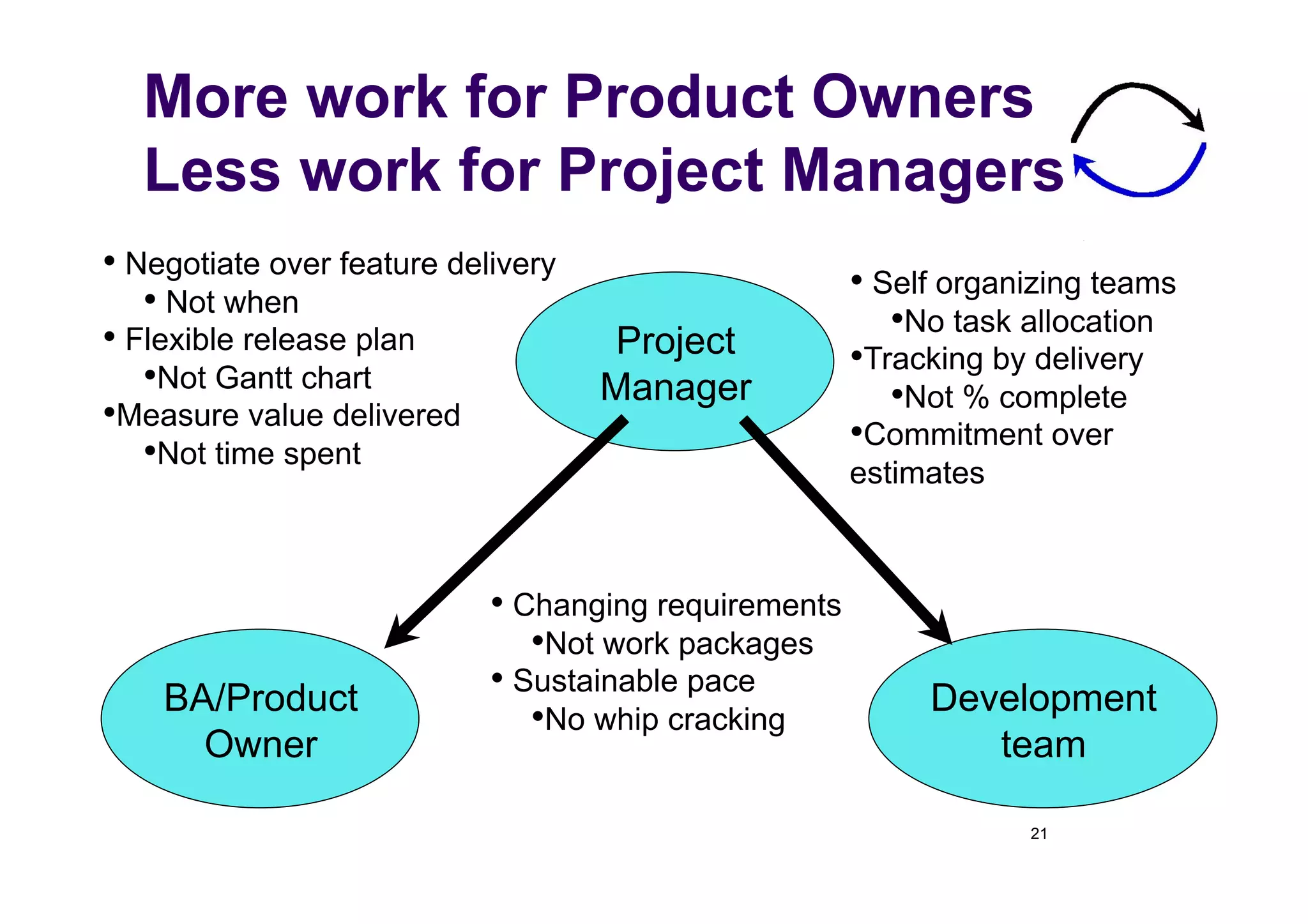
More work for Product Owners
   Less work for Project Managers
•  Negotiate over feature delivery                      •  Self organizing teams
    •  Not when                                             • No task allocation
•  Flexible release plan              Project           • Tracking by delivery
    • Not Gantt chart                Manager                • Not % complete
• Measure value delivered                               • Commitment over
    • Not time spent                                    estimates


                             •  Changing requirements
                                 • Not work packages
    BA/Product
                             •  Sustainable pace             Development
                                 • No whip cracking
      Owner                                                     team

                                                                     21
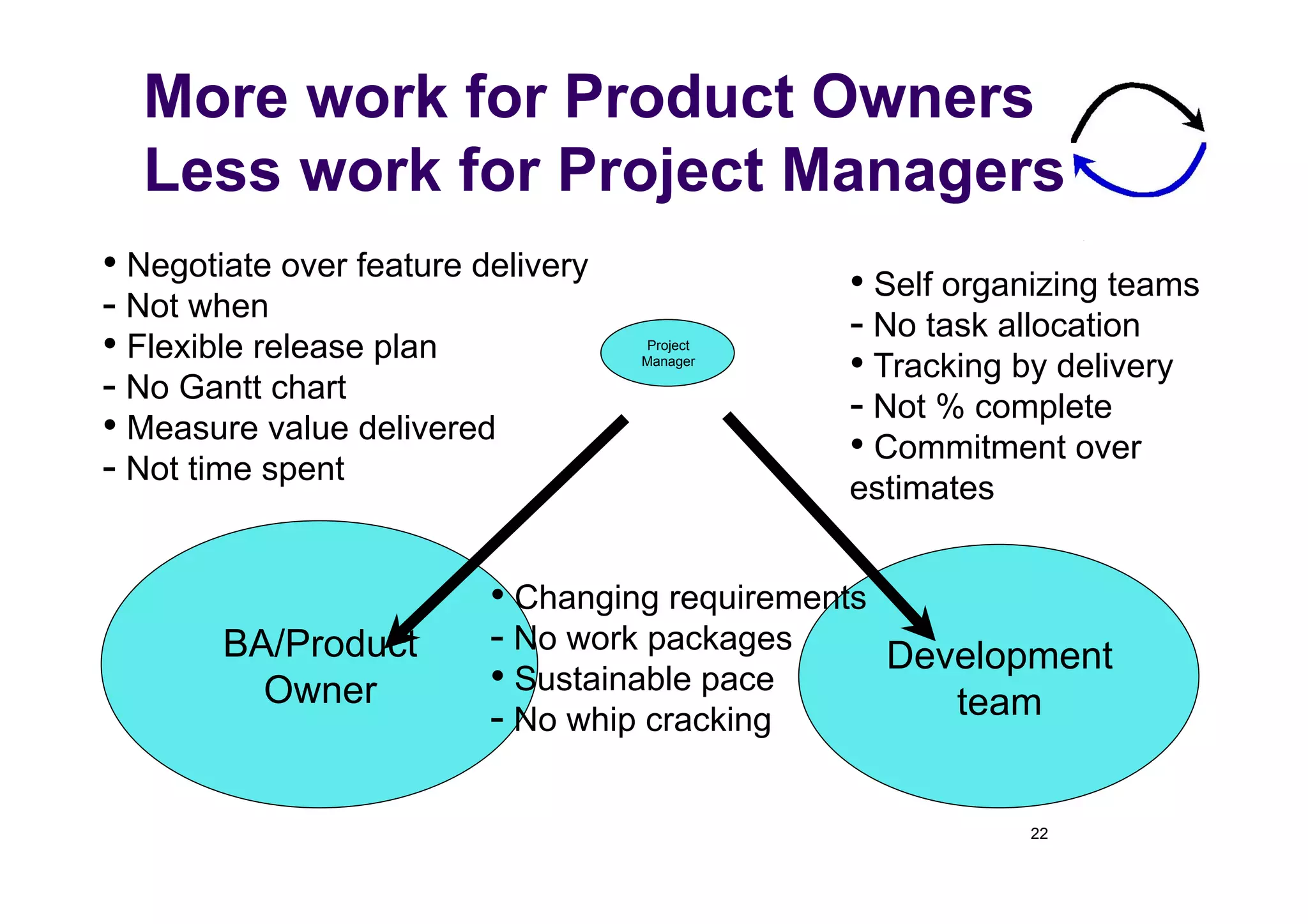
More work for Product Owners
  Less work for Project Managers
•  Negotiate over feature delivery              •  Self organizing teams
-  Not when                                     -  No task allocation
•  Flexible release plan              Project
                                     Manager
                                                •  Tracking by delivery
-  No Gantt chart                               -  Not % complete
•  Measure value delivered                      •  Commitment over
-  Not time spent                               estimates


                           •  Changing requirements
        BA/Product         -  No work packages      Development
          Owner            •  Sustainable pace
                           -  No whip cracking         team


                                                            22
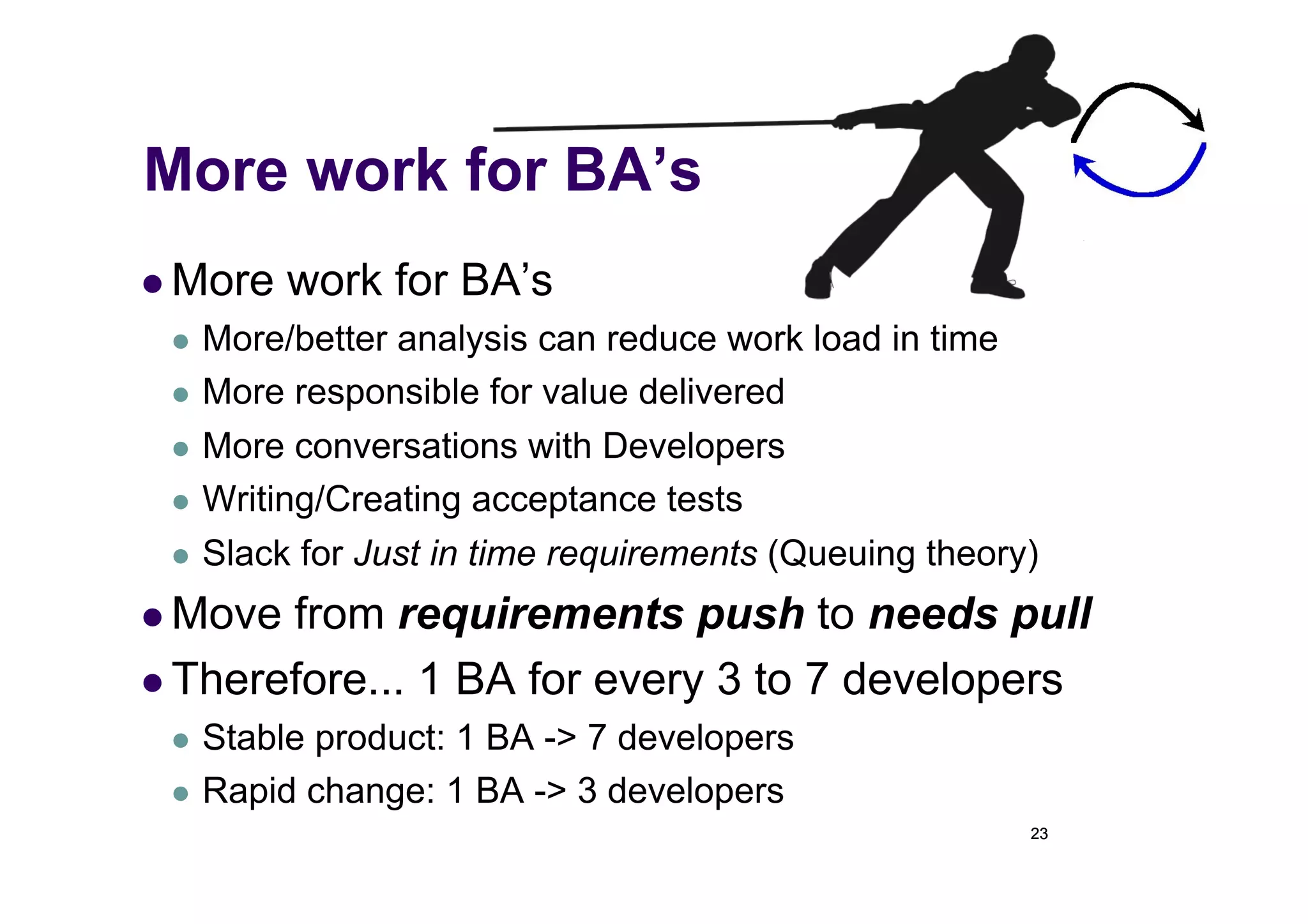
More work for BA’s
  More    work for BA’s
   More/better analysis can reduce work load in time
   More responsible for value delivered

   More conversations with Developers
   Writing/Creating acceptance tests

     Slack for Just in time requirements (Queuing theory)
  Move from requirements push to needs pull
  Therefore... 1 BA for every 3 to 7 developers
   Stable product: 1 BA -> 7 developers
   Rapid change: 1 BA -> 3 developers
                                                         23
Take aways
1.  Being Agile means delivering business needs
2.  Product Owner is often a BA
     Agile process does not remove need for needs
3.  BA take a back seat in early transition
   Step forward as team becomes effective
   Key in reducing work to be done

4.  Product Owner role is larger than BA role
   Need   greater staffing
   Shift from Requirements Push to Need Pull
                                                24
Thank you
allan@allankelly.net
http://www.allankelly.net
http://blog.allankelly.net
http://www.softwarestrategy.co.uk


         1 3 -1    BA t
                5 Se rainin
        24-2        p       g
              6 No – www course
                   v–w     .skil       s
                        ww.s     lsma
                             killsm tter.co
                                    atter   m
                                         .com
                                                25

The BA role in Agile software development

  • 1.
    More important thanever: The Business Analysts’ role in Agile software development IIBA Conference, September 2009 IIBA Nottingham, May 2010 Allan Kelly Big Airline, June 2010 allan@allankelly.net Skills Matter, July 2010 http://www.allankelly.net Software Strategy http://www.softwarestrategy.co.uk1
  • 2.
    Allan Kelly, BSc,MBA   Consulting, Training & Coaching for Agile adoption and deepening   Author:   Changing Software Development: Learning to be Agile, Wiley 2008. 33 Business Strategy Patterns for Software 97 Things Every Programmer Creators Should Know, Henney, 2010 Context Encapsulation in Pattern Languages of Program Design volume 5, 2006
  • 3.
    Agile   What is it?   and Lean? 3
  • 4.
    “Agile processes promise to react flexibly to What is Agility? changing requirements, Jim Highsmith, thus providing the 2002 “Agility is the ability to highest business value both create and to the customer at any respond to change in point in time” order to profit in a turbulent business environment.” Jutta Eckstein 2004   Today: Agile as Better   Respond to changing (business) environment   Faster, more productive, higher quality   Tomorrow: Agile creates new business models   Opportunities for those not confined by traditional IT4
  • 5.
    Agile   Its the business need, stupid 5
  • 6.
    Agile in context More prescriptive XP Scrum … Kanban Agile More Lean thinking philosophical: value, idea Organizational Learning based Applicability
  • 7.
    1999-2004: Agile =XP   Extreme Programming   First Agile method to gain popularity   Developer centric practices and literature   Business need from onsite Customer   Customer on C3 was a Business Analyst   “Customer” view too simplistic   Short sighted   Assume customer knows   No discussion on how the customer knows 7
  • 8.
    2005-today: Agile =Scrum   Scrum   Aproject management method without a project manager   Product Owner specifies need   Scrum silent on how the Product Owner knows 8
  • 9.
    Who is the ProductOwner? Business Subject Analyst Matter /Domain Expert Product Manager 9
  • 10.
    Traditional approach Business Analysis / System Analysis Royce, 1968, “Managing the Development of Large Software Systems” 10
  • 11.
  • 12.
    BA/Product Owner Traditionalapproach Agile approach works ahead of team - scouting out requirements 6+ months   Slice through work Decide requirement Decide requirement   Everything in iteration   End-to-End Analysis / Design Analysis / Design   Deliver business functionality Code & Unit Test Code & Unit Test Merge & Release Merge & Release Iteration 1 (2 weeks) Iteration 2 (2 weeks)
  • 13.
    BA/Product Owner works ahead of team - scouting out requirements   Slice through work Decide requirement Decide requirement   Everything in iteration   End-to-End Analysis / Design Analysis / Design   Deliver business functionality Code & Unit Test Code & Unit Test Merge & Release Merge & Release Iteration 1 (2 weeks) Iteration 2 (2 weeks)
  • 14.
    Close quarters requirements  Goals and objectives   replace Big Requirements Documents   under continual review   Requirements gathering is ongoing process   rather than only at the start   BA needs to stay involved   rather than leave after initial stages   Delivered functionality changes and evolves   in direction of the goal and objective   More to it than requirements gathering   Dialogue over document 14
  • 15.
    Business Analysts, moveon up   Filling the Product Owner role well BA need to: Business Analysis Maturity Model   Move up Maturity Model r tOwne   From Order taker duc Pro   To Internal Consultant   Improving business effectiveness Source and more details on BAMM: http://www.assistkd.com/bamm/bamm.html 15
  • 16.
    Less (software) ismore Potentially 80% of software Only about 20% of development work is waste features & functions • Better requirements can reduce in typical custom demand by 80% software are used If 30+% of requirements change then We often encounter • Why bother doing work on them in requirements churn the first place? of 30% to 50% Solution: Mary & Tom Poppendieck Implementing Lean Software • Just In Time Requirements Development 2007 • Identify, implement, deliver in quick succession 16
  • 17.
    But....  There is a time and a place for everything  .... Requirements come second when changing to Agile 17
  • 18.
    The Alignment Trap IT Highly aligned ‘Alignment trap’ ‘IT Enabled growth’ Challenge 1: 11% companies 7% companies Doing the right thing • Get Agile •  IT spending +13% higher than average •  IT spending 6% less than average • From Maintenance to •  Sales -14% over 3 •  Sales growth +35% over Well-oiled years 3 years • Delivery focus ‘Maintenance zone’ ‘Well-oiled IT’ 74% companies 8% companies Challenge 2: •  Average IT spending •  IT spending 15% below • From Well-oiled •  Sales -2% over 3 average • To Growth years •  Sales growth +11% over • Requirements focus Less aligned 3 year IT Less Doing things right IT More Effective Effective Source: Shpilberg, Berez, Puryear, Shah: MIT Sloan Review, Fall 2007
  • 19.
    When adopting Agile Sequence the changes 1.  First Do it right   Management focus on the development team 2.  Do not emphasis requirements or BA role 3.  Get developers more effective Then 4.  Do the right thing   Focus on the what 5. Long term benefits in BA role 19
  • 20.
    Project constraints Product Resources Owner needs to Features (People) make these trade offs Fixed in the short run (Brooks Law) Scope creep Time (run backwards) Time boxed Agile projects negotiate over requirements rather than resources or time 20
  • 21.
    More work forProduct Owners Less work for Project Managers •  Negotiate over feature delivery •  Self organizing teams •  Not when • No task allocation •  Flexible release plan Project • Tracking by delivery • Not Gantt chart Manager • Not % complete • Measure value delivered • Commitment over • Not time spent estimates •  Changing requirements • Not work packages BA/Product •  Sustainable pace Development • No whip cracking Owner team 21
  • 22.
    More work forProduct Owners Less work for Project Managers •  Negotiate over feature delivery •  Self organizing teams -  Not when -  No task allocation •  Flexible release plan Project Manager •  Tracking by delivery -  No Gantt chart -  Not % complete •  Measure value delivered •  Commitment over -  Not time spent estimates •  Changing requirements BA/Product -  No work packages Development Owner •  Sustainable pace -  No whip cracking team 22
  • 23.
    More work forBA’s   More work for BA’s   More/better analysis can reduce work load in time   More responsible for value delivered   More conversations with Developers   Writing/Creating acceptance tests   Slack for Just in time requirements (Queuing theory)   Move from requirements push to needs pull   Therefore... 1 BA for every 3 to 7 developers   Stable product: 1 BA -> 7 developers   Rapid change: 1 BA -> 3 developers 23
  • 24.
    Take aways 1.  BeingAgile means delivering business needs 2.  Product Owner is often a BA   Agile process does not remove need for needs 3.  BA take a back seat in early transition   Step forward as team becomes effective   Key in reducing work to be done 4.  Product Owner role is larger than BA role   Need greater staffing   Shift from Requirements Push to Need Pull 24
  • 25.
    Thank you allan@allankelly.net http://www.allankelly.net http://blog.allankelly.net http://www.softwarestrategy.co.uk 1 3 -1 BA t 5 Se rainin 24-2 p g 6 No – www course v–w .skil s ww.s lsma killsm tter.co atter m .com 25