1
Requirement Practices
The shift towards Agile
Arthur de Snaijer
2008
Topics
1. Acquaintance
2. Trends, why Agile?
3. Agile Architecture
4. Requirements Landscape
5. Framing a Requirement Galaxy
6. Project Approaches
7. Agile Practices
ANY ROAD - PICK A STORY
METAFOR FOR SHARED MEMORY
– Acquire  Connect  Collaborate  Goals –
4
Trends
type hier de datum
Trends
Making aquitance – it’s personal
© F. Van der Reep
http://www.wikidigitalworld.net
ILL DEFINED
PROBLEMS
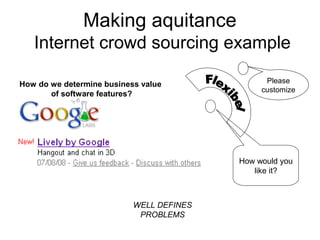
Making aquitance
Internet crowd sourcing example
How would you
like it?
Please
customize
How do we determine business value
of software features?
WELL DEFINES
PROBLEMS
Realize
these
features in
a timebox
Why these trends important?
• Agile requirements is about participation
• Agile requirements is about team learning
• Agile requirements is about feature trade-off
http://en.wikipedia.org/wiki/Shuhari
9
Agile Architecture
Where is the network company?
Henderson en Venkatraman
business
goals
products
/ services
processes
Technical
infrastructure
Information
Agile business with Agile development
Business in
operation
Business
opportunities
business
goals
products
/ services
processes
Technische
infrastructure
Information
System Product
opportunities System Product
in operation
Customer
Goals
Architecture trend off valuechains
Coördination
business
goals
producten
/ diensten
processen
Technische
infrastructuur
Informatie-
voorziening
Customer
Goals
business
goals
producten
/ diensten
processen
Technische
infrastructuur
Informatie-
voorziening
Customer
Goals
GAIN SHARING
END-Customer
Goals
END-Business
Goals
Value chain
Challenges
13
Requirement
Landscape
Business Analist - Mindmap
Requirements Mindmap
Discovery Solution Design
Good practice: Scenario with solution visualization
The requirement paradox
• Requirements must be stable
• Requirements always change
Use a practice that cope
with the requirement paradox
use participation, teamlearning as a base!
Realize
these
features in
a timebox
CyclemodeRequirements
divergentie mode
Soft
Vaque
Gather Analyse Build Hard
Strict
Requirements
convergentie mode
from course-grain to fine
20
Agile
type hier de datum
Cycle ref: Agile Adoption Patterns, Amr Elssamadisy
1.Goal
3.Test,
Stop,and
Learn
4. Apply
Lessons
Learned
2.Process
• Business; Agility is the ability to both
create and respond to change in order to
profit in a turbelent business environment.
(Jim Highsmith)
• Engineering; Agile software
development is an approach to software
development that is people oriented, that
enables people to respond effectively to
change, and that results in the creation of
working systems that meets the needs of
its stakeholders. (Scott W. Ambler)
Agile business - Nokia versus
Apple battle
Nokia 6021 Nokia 6230 Nokia 6310 Qtek9100
business phones - 2007
Agile business - Nokia versus
Apple battle
Is the iPhone software a threat?
Agile business - Nokia versus iPhone battle
Resilience
Time to market
Agile business - Nokia versus iPhone battle
Nokia has launched it’s ‘iPhone
killer‘ product, N96 few months
before the expected date (as
iPhone launch is on Aug 22).
How did they respond so quickly?
2 year
1 year
0,5 year
Q1
weekly
montly
Agile with SCRUM - business value
software releases?
27
Framing a Requirement
Galaxy
Good practise: Start with Glossary – key terms
© Clariteq Systems Consulting Ltd
Framing a Requirement Galaxy
What’s your goal?
Project start-up
Context / Environment
(Domains of intrest)
Context / Environment
(Domains of intrest)
Problem
Space
Solution
Space
Requirement
Space
Context / Environment
(Domains of intrest)
Problem
Space
Solution
Space
Requirement
Need Stakeholder Requirement system
(functioneel en non-functional)
Feature
Business
requirement
User requirement
SystemperspectiveUserperspective
Use case step
Software
requirement
Nicole de Swart
Context / Environment
(Domains of intrest)
Negative
Goals
Positive
Goals
Stakeholder
Space
Context / Environment
(Domains of intrest)
Problem
Space
Solution
Space
Requirement
Behoefte belanghebbende Eis aan het systeem
(functioneel en niet-functioneel)
Feature
Business requirement
User requirement
SysteemperspectiefGebruikersperspectief
Use case stap
Software requirement
In context C a solution S has effect E that
satisfies goals G
Roel Wieringa
Reality – individual Stakeholders
Requirement =
Stakeholder
SpaceNegative
Goals
Positive
Goals
Muppets, The Walt Disney Company
Reality – Small world
Stakeholders - Groups
Business
Technology
Marketing
Retail
Requirement
Engineer
Project Framing
Problem
Space
Solution
Space
Project team
Business
in
operation
Business
opportunities
How to get there?
39
Project
Approaches
Typical project requirements
discovery flow
© Clariteq Systems Consulting Ltd
Good practise: Start with Glossary – Key terms
© Clariteq Systems Consulting Ltd
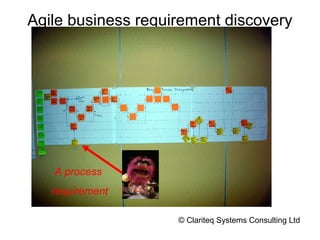
Agile business requirement discovery
A process
requirement
© Clariteq Systems Consulting Ltd
Strict process in BPMN
Example: Scenario based approach
User Goals
User story of a business proces
Stakeholder
Results
Stakeholder
Result
Stakeholder
Result
from course-grain to fine
Requirements
divergentie mode
Soft
Vaque
Gather Analyse Build Hard
Strict
Requirements
convergentie mode
From user stories into use Cases
Ian F.Alexander and Neil Maiden
Discovery Solution Design
47
Agile Requirement
Practices
Agile
Core Principles
– Assume Simplicity
– Embrace Change
– Enabling the Next Effort is
Your Secondary Goal
– Incremental Change
– Model With a Purpose
– Multiple Models
– Maximize Stakeholder
Investment
– Quality Work
– Rapid Feedback
– Software Is Your Primary
Goal
– Travel Light
Collaborate
Iterate
Serve the Team
Consider Context
Practice Excellence
Reflect and Adapt
Deliver Value
Agile versus requirements
Agile Core Practices
– Active Stakeholder Participation
– Apply the Right Artifact(s)
– Collective Ownership
– Consider Testability
– Create Several Models in Parallel
– Create Simple Content
– Depict Models Simply
– Display Models Publicly
– Iterate to Another Artifact
– Model in Small Increments
– Model With Others
– Prove it With Code
– Use the Simplest Tools
BABOK Knowledge area’s:
Enterprise Analysis
Requirements Planning and
Management
Requirements Elicitation
Requirements Analysis and
Documentation
Requirements Communication
•Solution Assessment and Validation
The Agile Requirements Person
• Peoples person
• Champions Business Value
• Facilitates the definition of problems and
description of solutions
• Understands most available tools - > Uses the
appropriate tool
• Knows context (assumptions) and effects on
business and technology
• Is a language Coach, not a translator
Kent J. McDonald
Central Iowa IIBA, Thursday January 25, 2007
Agile Practises
1. Starts with business value (People goals and business drivers )
2. Learning is the bottleneck ( Context is key, recognition of real
problems and solutions)
3. Cycles for recognizing and responding/creating change
4. Cycle practices value the left more than the right
– Individuals and interactions over processes and tools
– Working software over comprehensive documentation
– Customer collaboration over contract negotiation
– Responding to change over following a plan

DevOps Requirement practises - the shift to agile

  • 1.
    1 Requirement Practices The shifttowards Agile Arthur de Snaijer 2008
  • 2.
    Topics 1. Acquaintance 2. Trends,why Agile? 3. Agile Architecture 4. Requirements Landscape 5. Framing a Requirement Galaxy 6. Project Approaches 7. Agile Practices
  • 3.
    ANY ROAD -PICK A STORY METAFOR FOR SHARED MEMORY – Acquire  Connect  Collaborate  Goals –
  • 4.
  • 5.
    Making aquitance –it’s personal © F. Van der Reep http://www.wikidigitalworld.net ILL DEFINED PROBLEMS
  • 6.
    Making aquitance Internet crowdsourcing example How would you like it? Please customize How do we determine business value of software features? WELL DEFINES PROBLEMS
  • 7.
  • 8.
    Why these trendsimportant? • Agile requirements is about participation • Agile requirements is about team learning • Agile requirements is about feature trade-off http://en.wikipedia.org/wiki/Shuhari
  • 9.
  • 10.
    Where is thenetwork company? Henderson en Venkatraman business goals products / services processes Technical infrastructure Information
  • 11.
    Agile business withAgile development Business in operation Business opportunities business goals products / services processes Technische infrastructure Information System Product opportunities System Product in operation Customer Goals
  • 12.
    Architecture trend offvaluechains Coördination business goals producten / diensten processen Technische infrastructuur Informatie- voorziening Customer Goals business goals producten / diensten processen Technische infrastructuur Informatie- voorziening Customer Goals GAIN SHARING END-Customer Goals END-Business Goals Value chain Challenges
  • 13.
  • 14.
  • 15.
  • 16.
  • 17.
    Good practice: Scenariowith solution visualization
  • 18.
    The requirement paradox •Requirements must be stable • Requirements always change Use a practice that cope with the requirement paradox use participation, teamlearning as a base! Realize these features in a timebox
  • 19.
    CyclemodeRequirements divergentie mode Soft Vaque Gather AnalyseBuild Hard Strict Requirements convergentie mode from course-grain to fine
  • 20.
    20 Agile type hier dedatum Cycle ref: Agile Adoption Patterns, Amr Elssamadisy 1.Goal 3.Test, Stop,and Learn 4. Apply Lessons Learned 2.Process
  • 21.
    • Business; Agilityis the ability to both create and respond to change in order to profit in a turbelent business environment. (Jim Highsmith) • Engineering; Agile software development is an approach to software development that is people oriented, that enables people to respond effectively to change, and that results in the creation of working systems that meets the needs of its stakeholders. (Scott W. Ambler)
  • 22.
    Agile business -Nokia versus Apple battle Nokia 6021 Nokia 6230 Nokia 6310 Qtek9100 business phones - 2007
  • 23.
    Agile business -Nokia versus Apple battle Is the iPhone software a threat?
  • 24.
    Agile business -Nokia versus iPhone battle Resilience Time to market
  • 25.
    Agile business -Nokia versus iPhone battle Nokia has launched it’s ‘iPhone killer‘ product, N96 few months before the expected date (as iPhone launch is on Aug 22). How did they respond so quickly?
  • 26.
    2 year 1 year 0,5year Q1 weekly montly Agile with SCRUM - business value software releases?
  • 27.
  • 28.
    Good practise: Startwith Glossary – key terms © Clariteq Systems Consulting Ltd
  • 29.
    Framing a RequirementGalaxy What’s your goal?
  • 30.
    Project start-up Context /Environment (Domains of intrest)
  • 31.
    Context / Environment (Domainsof intrest) Problem Space Solution Space Requirement Space
  • 32.
    Context / Environment (Domainsof intrest) Problem Space Solution Space Requirement Need Stakeholder Requirement system (functioneel en non-functional) Feature Business requirement User requirement SystemperspectiveUserperspective Use case step Software requirement Nicole de Swart
  • 33.
    Context / Environment (Domainsof intrest) Negative Goals Positive Goals Stakeholder Space
  • 34.
    Context / Environment (Domainsof intrest) Problem Space Solution Space Requirement Behoefte belanghebbende Eis aan het systeem (functioneel en niet-functioneel) Feature Business requirement User requirement SysteemperspectiefGebruikersperspectief Use case stap Software requirement In context C a solution S has effect E that satisfies goals G Roel Wieringa
  • 35.
    Reality – individualStakeholders Requirement = Stakeholder SpaceNegative Goals Positive Goals Muppets, The Walt Disney Company
  • 36.
    Reality – Smallworld Stakeholders - Groups Business Technology Marketing Retail Requirement Engineer
  • 37.
  • 38.
    How to getthere?
  • 39.
  • 40.
    Typical project requirements discoveryflow © Clariteq Systems Consulting Ltd
  • 41.
    Good practise: Startwith Glossary – Key terms © Clariteq Systems Consulting Ltd
  • 42.
    Agile business requirementdiscovery A process requirement © Clariteq Systems Consulting Ltd
  • 43.
  • 44.
    Example: Scenario basedapproach User Goals User story of a business proces Stakeholder Results Stakeholder Result Stakeholder Result
  • 45.
    from course-grain tofine Requirements divergentie mode Soft Vaque Gather Analyse Build Hard Strict Requirements convergentie mode
  • 46.
    From user storiesinto use Cases Ian F.Alexander and Neil Maiden Discovery Solution Design
  • 47.
  • 48.
    Agile Core Principles – AssumeSimplicity – Embrace Change – Enabling the Next Effort is Your Secondary Goal – Incremental Change – Model With a Purpose – Multiple Models – Maximize Stakeholder Investment – Quality Work – Rapid Feedback – Software Is Your Primary Goal – Travel Light Collaborate Iterate Serve the Team Consider Context Practice Excellence Reflect and Adapt Deliver Value
  • 49.
    Agile versus requirements AgileCore Practices – Active Stakeholder Participation – Apply the Right Artifact(s) – Collective Ownership – Consider Testability – Create Several Models in Parallel – Create Simple Content – Depict Models Simply – Display Models Publicly – Iterate to Another Artifact – Model in Small Increments – Model With Others – Prove it With Code – Use the Simplest Tools BABOK Knowledge area’s: Enterprise Analysis Requirements Planning and Management Requirements Elicitation Requirements Analysis and Documentation Requirements Communication •Solution Assessment and Validation
  • 50.
    The Agile RequirementsPerson • Peoples person • Champions Business Value • Facilitates the definition of problems and description of solutions • Understands most available tools - > Uses the appropriate tool • Knows context (assumptions) and effects on business and technology • Is a language Coach, not a translator Kent J. McDonald Central Iowa IIBA, Thursday January 25, 2007
  • 51.
    Agile Practises 1. Startswith business value (People goals and business drivers ) 2. Learning is the bottleneck ( Context is key, recognition of real problems and solutions) 3. Cycles for recognizing and responding/creating change 4. Cycle practices value the left more than the right – Individuals and interactions over processes and tools – Working software over comprehensive documentation – Customer collaboration over contract negotiation – Responding to change over following a plan

Editor's Notes

  • #2 Informatieve structuur uit
  • #3 PICK A STORY ( METAFOR VOOR SHARED MEMORY )
  • #5 Informatieve structuur uit
  • #10 Informatieve structuur uit
  • #14 Informatieve structuur uit
  • #21 Informatieve structuur uit
  • #28 Informatieve structuur uit
  • #38 Plaatje context problems and solutions
  • #40 Informatieve structuur uit
  • #48 Informatieve structuur uit