

We help you become more effective and efficient, including having more fun at work
Operations and Development in the best
              of worlds
                     How Agile can support ITIL


”To deliver what you’re told may be a good thing,
but to deliver what is needed is better.”
mPeira
• We help you become more effective and efficient,
  including having more fun at work

• To do this we
   – focus on the practically usable


• Through
   – training, consultancy, resourcing


• Our delivery is really about:
   – a measureable effect (a goal fulfilled)


• Our tools are
   – Practical knowledge of industry best practice
                                                     1
Terms and acronyms we work with …
CMMI                                   testing             XP                MoSCoW

    Agile                              Lean                         ITIL
                                                                requirements management
             business benefit
                                                 PMI PMP
                        process                                     business case

              KPI                 EA       ROI                  efficiency      release
    architecture

ISO 20 000
                                        UML
                                                    modelling
                                                                             SOA
                workshop
                                automisation
                                                   GAP                 XML
 user stories
IT management
                            SCRUM                                  application management


                                       and more …                    DSDM/Atern

                                                                                            2
Current deliverables
•   Book
•   Conference talks
•   The agile enterprise
•   Agile certification
•   Scrum, Lean and much more Agile
•   ITIL training
•   Consulting, coaching
                                                 Follow us on twitter:
                                                 twitter.com/pmskoogh
Check our agile blog out at:                     twitter.com/mats_roland
www.magile.org/pmblog
Writing books and sharing our Scrum-agile experience:
www.magile.org

                                                                           3
A possible problem


              Bye, Bye!             It’s not working!


Development               Product                       Operations


    Project


                                                                     5
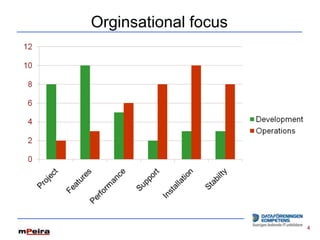
Orginsational focus


                      4
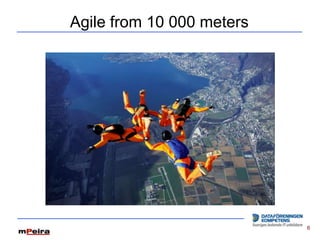
Agile from 10 000 meters


                           6
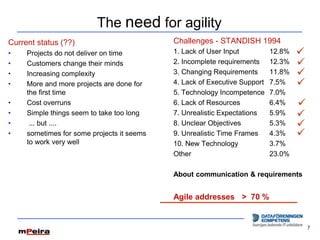
The need for agility
Current status (??)                         Challenges - STANDISH 1994
•    Projects do not deliver on time        1. Lack of User Input          12.8%   
•    Customers change their minds           2. Incomplete requirements     12.3%   
•    Increasing complexity                  3. Changing Requirements       11.8%   
•    More and more projects are done for    4. Lack of Executive Support   7.5%    
     the first time                         5. Technology Incompetence     7.0%
•    Cost overruns                          6. Lack of Resources           6.4%    
•    Simple things seem to take too long    7. Unrealistic Expectations    5.9%    
•     ... but ....                          8. Unclear Objectives          5.3%    
•    sometimes for some projects it seems   9. Unrealistic Time Frames     4.3%    
     to work very well                      10. New Technology             3.7%
                                            Other                          23.0%

                                            About communication & requirements


                                            Agile addresses > 70 %


                                                                                       7
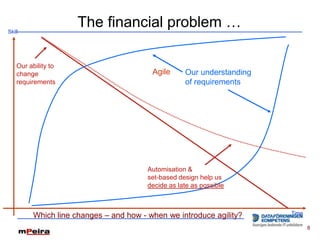
Skill
                      The financial problem …

    Our ability to
    change                                Agile      Our understanding
    requirements                                     of requirements


                                         Automisation &
                                         set-based design help us
                                         decide as late as possible


          Which line changes – and how - when we introduce agility?      Time

                                                                                8
Agile core values
We are uncovering better ways of developing software by
doing it and helping others do it. Through this work we have
come to value:
•   Individuals and interactions over processes and tools
•   Working software over comprehensive documentation
•   Customer collaboration over contract negotiation
•   Responding to change over following a plan

            Kent Beck           James Grenning   Robert C. Martin
            Mike Beedle         Jim Highsmith    Steve Mellor
            Arie van Bennekum   Andrew Hunt      Ken Schwaber
            Alistair Cockburn   Ron Jeffries     Jeff Sutherland
            Ward Cunningham     Jon Kern         Dave Thomas
            Martin Fowler       Brian Marick

                                                                    9
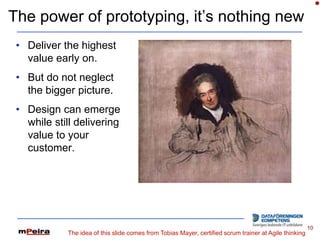
The power of prototyping, it’s nothing new
 • Deliver the highest
   value early on.
 • But do not neglect
   the bigger picture.
 • Design can emerge
   while still delivering
   value to your
   customer.


                                                                                                        10
            The idea of this slide comes from Tobias Mayer, certified scrum trainer at Agile thinking
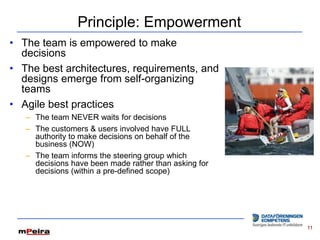
Principle: Empowerment
• The team is empowered to make
  decisions
• The best architectures, requirements, and
  designs emerge from self-organizing
  teams
• Agile best practices
   – The team NEVER waits for decisions
   – The customers & users involved have FULL
     authority to make decisions on behalf of the
     business (NOW)
   – The team informs the steering group which
     decisions have been made rather than asking for
     decisions (within a pre-defined scope)


                                                       11
Anti-thesis
What we do not:
• Write detailed specifications early
• Produce detailed plans that cover a long time period
• Perform product test & verification afterwards
• Ask for permission
• Produce and send documents to people and expect
  that to be communication
• Sit in different cubicles in different buildings
• Do stuff tomorrow or next week


                                                         12
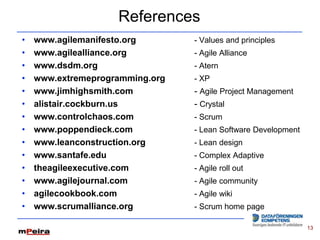
References
•   www.agilemanifesto.org       - Values and principles
•   www.agilealliance.org        - Agile Alliance
•   www.dsdm.org                 - Atern
•   www.extremeprogramming.org   - XP
•   www.jimhighsmith.com         - Agile Project Management
•   alistair.cockburn.us         - Crystal
•   www.controlchaos.com         - Scrum
•   www.poppendieck.com          - Lean Software Development
•   www.leanconstruction.org     - Lean design
•   www.santafe.edu              - Complex Adaptive
•   theagileexecutive.com        - Agile roll out
•   www.agilejournal.com         - Agile community
•   agilecookbook.com            - Agile wiki
•   www.scrumalliance.org        - Scrum home page

                                                               13
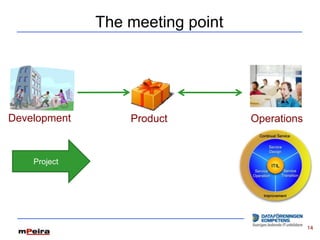
The meeting point


Development       Product         Operations


    Project


                                               14
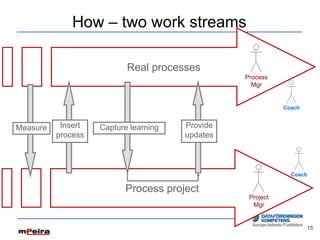
How – two work streams

                           Real processes
                                                 Process
                                                   Mgr


                                                            Coach


Measure    Insert   Capture learning   Provide
          process                      updates


                                                              Coach

                          Process project
                                                  Project
                                                   Mgr


                                                                    15
What ITIL can get from Agile done right
• Testability in minutes
    – due to automatic builds.
• Automatic regression tests,
    – due to automatic tests created already during development.
• Installation in zero time
    – due to automatic installation.
• Emergency patches without risk
    – due to automatic build + installation + test + installation
• Reduced risks in change projects
    – due to agile principles, values and tools
• Better service solutions
    – due to strong multi disciplinary involvement.
• Much higher quality of service and process
    – due to the great continuous improvement focus


                                                                    16
What you need to do
• Development must do agile right, no cheating!
   – discipline
   – automation
   – real customer involvement
• Operations must participate in development
• Operations must be fast and allow frequent changes to operations
• Operations must focus on automating and stop bureaucratic
  procedures
• Status accounting need to include development
• CM must be a core development skill
• and … most important …
• stop “the them and us” attitude … we are ONE team !
   – Operations, development, business and whatever …


                                                                     17
mPeira summary advice
• Process change is a fuzzy business
   – All details cannot be defined up front - a step-wise Agile
     implementation process is necessary.


• Process owner and process manager
   – Both roles are important - make sure they are both there.


• Secure time and resources
   – The pay-off of a good process is great - but it does not come for free.


• Use projects
   – Implement the process through a project using a project manager
     who uses an Agile model.


                                                                               18
Almost the last page


  Questions ?


                       19
The last page


Thank you and welcome back!


                              20

Agile marries itil

  • 1.
    We help youbecome more effective and efficient, including having more fun at work Operations and Development in the best of worlds How Agile can support ITIL ”To deliver what you’re told may be a good thing, but to deliver what is needed is better.”
  • 2.
    mPeira • We helpyou become more effective and efficient, including having more fun at work • To do this we – focus on the practically usable • Through – training, consultancy, resourcing • Our delivery is really about: – a measureable effect (a goal fulfilled) • Our tools are – Practical knowledge of industry best practice 1
  • 3.
    Terms and acronymswe work with … CMMI testing XP MoSCoW Agile Lean ITIL requirements management business benefit PMI PMP process business case KPI EA ROI efficiency release architecture ISO 20 000 UML modelling SOA workshop automisation GAP XML user stories IT management SCRUM application management and more … DSDM/Atern 2
  • 4.
    Current deliverables • Book • Conference talks • The agile enterprise • Agile certification • Scrum, Lean and much more Agile • ITIL training • Consulting, coaching Follow us on twitter: twitter.com/pmskoogh Check our agile blog out at: twitter.com/mats_roland www.magile.org/pmblog Writing books and sharing our Scrum-agile experience: www.magile.org 3
  • 5.
    A possible problem Bye, Bye! It’s not working! Development Product Operations Project 5
  • 6.
  • 7.
    Agile from 10000 meters 6
  • 8.
    The need foragility Current status (??) Challenges - STANDISH 1994 • Projects do not deliver on time 1. Lack of User Input 12.8%  • Customers change their minds 2. Incomplete requirements 12.3%  • Increasing complexity 3. Changing Requirements 11.8%  • More and more projects are done for 4. Lack of Executive Support 7.5%  the first time 5. Technology Incompetence 7.0% • Cost overruns 6. Lack of Resources 6.4%  • Simple things seem to take too long 7. Unrealistic Expectations 5.9%  • ... but .... 8. Unclear Objectives 5.3%  • sometimes for some projects it seems 9. Unrealistic Time Frames 4.3%  to work very well 10. New Technology 3.7% Other 23.0% About communication & requirements Agile addresses > 70 % 7
  • 9.
    Skill The financial problem … Our ability to change Agile Our understanding requirements of requirements Automisation & set-based design help us decide as late as possible Which line changes – and how - when we introduce agility? Time 8
  • 10.
    Agile core values Weare uncovering better ways of developing software by doing it and helping others do it. Through this work we have come to value: • Individuals and interactions over processes and tools • Working software over comprehensive documentation • Customer collaboration over contract negotiation • Responding to change over following a plan Kent Beck James Grenning Robert C. Martin Mike Beedle Jim Highsmith Steve Mellor Arie van Bennekum Andrew Hunt Ken Schwaber Alistair Cockburn Ron Jeffries Jeff Sutherland Ward Cunningham Jon Kern Dave Thomas Martin Fowler Brian Marick 9
  • 11.
    The power ofprototyping, it’s nothing new • Deliver the highest value early on. • But do not neglect the bigger picture. • Design can emerge while still delivering value to your customer. 10 The idea of this slide comes from Tobias Mayer, certified scrum trainer at Agile thinking
  • 12.
    Principle: Empowerment • Theteam is empowered to make decisions • The best architectures, requirements, and designs emerge from self-organizing teams • Agile best practices – The team NEVER waits for decisions – The customers & users involved have FULL authority to make decisions on behalf of the business (NOW) – The team informs the steering group which decisions have been made rather than asking for decisions (within a pre-defined scope) 11
  • 13.
    Anti-thesis What we donot: • Write detailed specifications early • Produce detailed plans that cover a long time period • Perform product test & verification afterwards • Ask for permission • Produce and send documents to people and expect that to be communication • Sit in different cubicles in different buildings • Do stuff tomorrow or next week 12
  • 14.
    References • www.agilemanifesto.org - Values and principles • www.agilealliance.org - Agile Alliance • www.dsdm.org - Atern • www.extremeprogramming.org - XP • www.jimhighsmith.com - Agile Project Management • alistair.cockburn.us - Crystal • www.controlchaos.com - Scrum • www.poppendieck.com - Lean Software Development • www.leanconstruction.org - Lean design • www.santafe.edu - Complex Adaptive • theagileexecutive.com - Agile roll out • www.agilejournal.com - Agile community • agilecookbook.com - Agile wiki • www.scrumalliance.org - Scrum home page 13
  • 15.
    The meeting point Development Product Operations Project 14
  • 16.
    How – twowork streams Real processes Process Mgr Coach Measure Insert Capture learning Provide process updates Coach Process project Project Mgr 15
  • 17.
    What ITIL canget from Agile done right • Testability in minutes – due to automatic builds. • Automatic regression tests, – due to automatic tests created already during development. • Installation in zero time – due to automatic installation. • Emergency patches without risk – due to automatic build + installation + test + installation • Reduced risks in change projects – due to agile principles, values and tools • Better service solutions – due to strong multi disciplinary involvement. • Much higher quality of service and process – due to the great continuous improvement focus 16
  • 18.
    What you needto do • Development must do agile right, no cheating! – discipline – automation – real customer involvement • Operations must participate in development • Operations must be fast and allow frequent changes to operations • Operations must focus on automating and stop bureaucratic procedures • Status accounting need to include development • CM must be a core development skill • and … most important … • stop “the them and us” attitude … we are ONE team ! – Operations, development, business and whatever … 17
  • 19.
    mPeira summary advice •Process change is a fuzzy business – All details cannot be defined up front - a step-wise Agile implementation process is necessary. • Process owner and process manager – Both roles are important - make sure they are both there. • Secure time and resources – The pay-off of a good process is great - but it does not come for free. • Use projects – Implement the process through a project using a project manager who uses an Agile model. 18
  • 20.
    Almost the lastpage Questions ? 19
  • 21.
    The last page Thankyou and welcome back! 20

Editor's Notes

  • #5 Vi är bland dem som har hållt på längst i Sverige med Agile.Ett tusen-tal personer utbildade i ITIL sedan starten 2004.
  • #6 Problembilden:Vi ibland svårt att skilja på projekt och produkt.Itil kan inte projekt, Itil har valt bort projekt medvetet och kan inte användas för projekt. Kommer från England och där använder man Prince2Itil och utvecklingsavdelning har inte samma bild av hur produkten skall hanteras i drift. Ganska tydliga gränser.Exempel på där de pratar med varandra är ärendehanteringen, där man hanterar förändringar och fel.Men det kanske kärvar en del i förståelsen och det kan finnas revirtänk och rädsla för annorlunda arbetssätt.
  • #7 Två världar som möts; utvecklingsavdelning och drift & förvaltning.Dessa har olika fokus och värderingar som beror på en rad saker; vilka krav som ställs, problem som kan uppstå och naturligtvis från den kultur och tradition man har med sig. Agile ITIL? For many, that sounds utterly oxymoronic—like "jumbo shrimp" or "unbiased opinion." Agile: Lean, automated, adaptive. ITIL: Lumbering, bureaucratic and rigid. These are mutually contradictory, nonsensically combined concepts. More oil and water than peanut butter and chocolate. Right? ITIL is about control, compliance and predictability. It's about uptime and stability. Agile? It's about speed and change—the mortal enemies of uptime and stability. So, what happens when Agile meets ITIL? Today, worlds collide. Part of the issue is rooted in the divergent cultures and motivations of dev and ops: • Dev: freewheeling, ideological, collaborative, self-organizing, and organic • Ops: policy-driven, command-and-control, focused on uptime and compliance When dev meets ops—when Agile meets ITIL—the velocity gains in application development are lost, caught in the purgatory of long, cumbersome release cycles. Worse still is change. For IT, change portends nothing but punctuated pain and a passel of unintended consequences. Change is empowering for dev and dispiriting for IT. According to Israel Gat, who, together with Michael Cote, blog as The Agile Executive: 1. The business needs to respond to change quicker than ever. 2. Various traditional IT management methods tend to discourage change and slow it down. 3. Competent Agile dev/test teams are now able to respond much quicker to the changes required by the business. The time gained in dev/test, however, could be completely wasted if IT Service Management fails to become (more) agile. And there's the key: When IT puts on the breaks, velocity gains—responsiveness, agility—are nothing but false hopes and empty promises. Agile becomes fragile.
  • #18 För er som vi läsa mer finns denna sida med
  • #19 ITIL kunskap om hantering av produkten i drift tillföra eftersom de flesta utvecklingsavdelningar inte fattar det och behöver lyssna lite på ITIL.Dessutom behöver driftavdelningen lyssna på utvecklingsavdelningen, vad krävs för att leverera affärsnytta kontinuerligt.Måste stödja varandra.!Drift behöver ställa upp på att leverera nytta hela tiden.Ta bort gränser, det här är ju ett team.Exempel på där de pratar med varandra är ärendehanteringen, där man hanterar förändringar och fel.
  • #21 Vi antar att vi har en utvecklingsavdelning som funkar och levererar med affärsnytta med kvalitet. Har disciplin och autotester. Inte har en driftavdelning som kan ta emot frekventa leveranser.Ta med features som gör produkten lättare att underhålla.
  • #22 Inte vattentäta skott mellan utvecklingsavdelningen.ITIL är till för verksamheten inte bara drift och förvaltning precis som Agile är till för verksamheten inte bara för utvecklingsavdelning.