


Framgångsfaktorer för Agil Utveckling av
Mycket Stora Programvaruprodukter
PMI Sweden Chapter
Passion for projects 2013


Svante Lidman, Senior Productivity Expert
svante.lidman@hansoft.se
@svante_lidman
www.slideshare.net/SvanteLidman
?
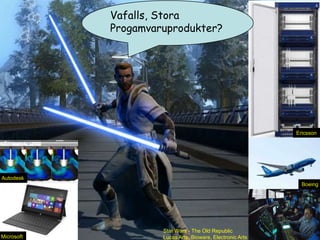
Vafalls, Stora
            Large Products?
                         Progamvaruprodukter?


                                                                         Ericsson


Autodesk
                                                                           Boeing


                                  Star Wars - The Old Republic
Microsoft                         Lucas Arts, Bioware, Electronic Arts
Why Agile?
• Are we and customers happy
  with the lead time from idea
  to volume deployment?
• Are we and customers happy
  with product quality?
• Are we happy with R&D
  efficiency?
• What will our situation look
  like tomorrow if we continue
  as we do?
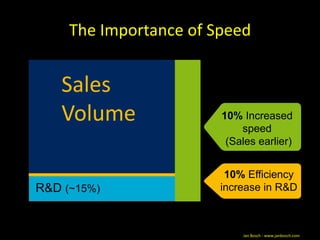
The Importance of Speed


    Sales
    Volume              10% Increased
                            speed
                         (Sales earlier)


                         10% Efficiency
R&D (~15%)              increase in R&D


                            Jan Bosch - www.janbosch.com
Conclusion
       • Conformance to original budget is secondary
       • Conformance to original scope is secondary
       • Time to market and Quality is key!!


http://commons.wikimedia.org/wiki/File:PenroseTriangle.png
The Themes of this Talk
• Look at product development holistically
• All development work is not the same
• Self-organization
Holistically Speaking...

                                                            8
   http://commons.wikimedia.org/wiki/File:Whole_onion.jpg
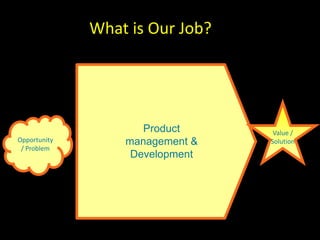
What is Our Job?


                     Product      Value /
Opportunity       management &   Solution
 / Problem
                   Development
What we set out for


     Feature X
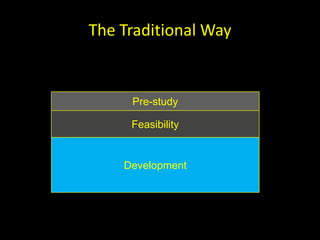
The Traditional Way


     Pre-study
     Prestudy

     Feasability
     Feasibility


    Development
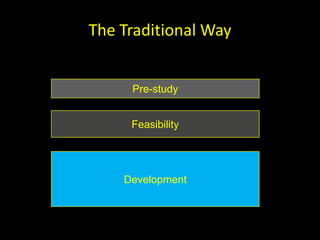
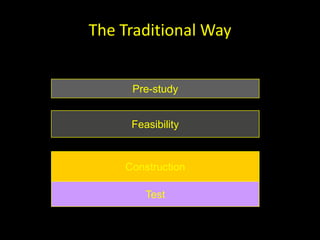
The Traditional Way


     Pre-study


     Feasability
     Feasibility


    Development
The Traditional Way


     Pre-study


     Feasability
     Feasibility


    Construction

        Test
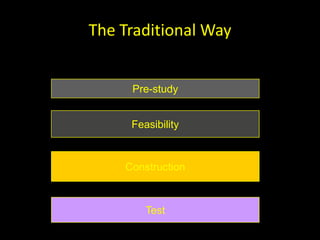
The Traditional Way


     Pre-study


     Feasability
     Feasibility


    Construction


        Test
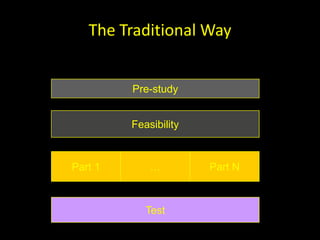
The Traditional Way


         Pre-study


         Feasability
         Feasibility


Part 1       …         Part N


            Test
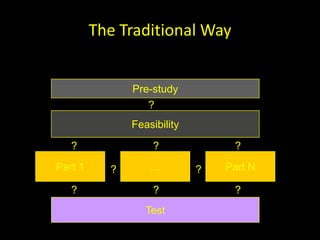
The Traditional Way


               Pre-study
                  ?
               Feasability
               Feasibility

   ?                ?             ?
Part 1     ?       …         ?   Part N

   ?                ?             ?
                  Test
Common Challenges
•   Time slicing of people
•   Handovers of documents resulting in distortion
•   Coordination issues
•   Quality issues uncovered too late
•   Lead-time too long
•   Very few people understand the overall system
•   Too many meetings
•   Blame games

Claim: The fragmentation of value(work)is the single
       most important root cause for these issues
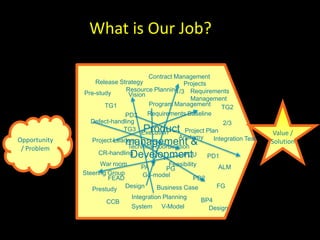
What is Our Job?

                                    Contract Management
                  Release Strategy               Projects
                            Resource Planning 1/3 Requirements
              Pre-study      Vision
                                                    Management
                     TG1            Program Management          TG2
                            PD3     Requirements Baseline
                Defect-handling                                  2/3
                           TG3  Product
                                  Execution       Project Plan                   Value /
Opportunity                                    Anatomy       Integration Test
                             management &
                Project Leaders
                             Technical coordination
                                                                                Solution
 / Problem
                   CR-handlingDevelopment        PDU      PD1
                    War room           Feasibility
                               PA     PG                       ALM
              Steering Group   Go-model
                       FEAD                      PD2
                 Prestudy Design   Business Case              FG
                               Integration Planning
                      CCB                               BP4
                               System     V-Model         Design
Key Ideas
• Focus on flow, customer-to-customer
   – Optimize for short end-to-end lead-time
   – Stop-the-line mentality regarding faults
• This will expose inefficiencies and force:
   – Removal of handovers
   – Removal of overly detailed studies
     and gold-plated designs
   – Removal of late and non-repeatable testing

• The focus on flow and lead-time will act as a
  forcing function to address impediments to
  quality and efficiency

                                    http://commons.wikimedia.org/wiki/File:Bulbgraph.svg
Key Concepts
       •     End-2-End Cross Functional Teams for Development
       •     Pull based approach
       •     Continuous programs rather than finite projects
       •     Continuous Integration (and Testing)
               – Automated, continuous, fast and reliable feedback to teams
       • Requirement Areas (RA) as scaling concept
               – Yearly budgeting (in terms of teams) per RA coupled to business strategy
               – Independent prioritization per RA
               – Limits competence challenge for Teams without code ownership


http://commons.wikimedia.org/wiki/File:Stock_keyring.svg
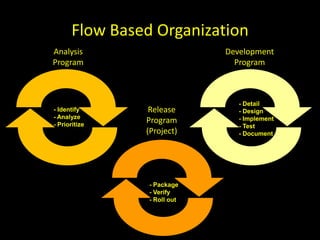
Flow Based Organization
Analysis                      Development
Program                         Program


                                 - Detail
- Identify       Release         - Design
- Analyze                        - Implement
- Prioritize
                Program
                                 - Test
                (Project)        - Document


                 - Package
                 - Verify
                 - Roll out
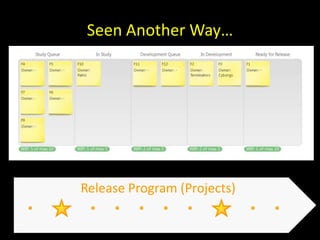
Seen Another Way…


Release Program (Projects)
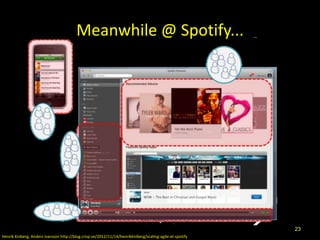
Meanwhile @ Spotify...


                                                                                                         23
Henrik Kniberg, Anders Ivarsson http://blog.crisp.se/2012/11/14/henrikkniberg/scaling-agile-at-spotify
http://commons.wikimedia.org/wiki/File:Pears_%26_Apples.jpg


                                                              25
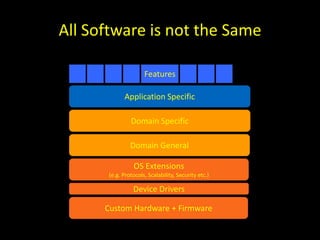
All Software is not the Same

                      Features

             Application Specific

                Domain Specific

                Domain General

                 OS Extensions
       (e.g. Protocols, Scalability, Security etc.)

                 Device Drivers

      Custom Hardware + Firmware
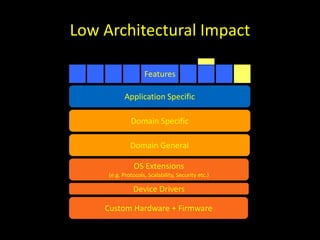
Low Architectural Impact

                    Features

           Application Specific

              Domain Specific

              Domain General

               OS Extensions
     (e.g. Protocols, Scalability, Security etc.)

               Device Drivers

    Custom Hardware + Firmware
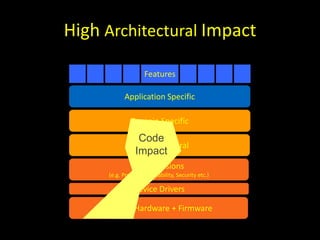
High Architectural Impact

                     Features

            Application Specific

               Domain Specific
                 Code
               Domain General
                Impact
                OS Extensions
      (e.g. Protocols, Scalability, Security etc.)

                Device Drivers

     Custom Hardware + Firmware
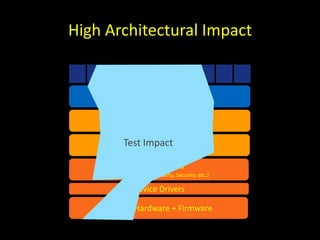
High Architectural Impact

                    Features

           Application Specific

              Domain Specific

           Test Impact
            Domain General

               OS Extensions
     (e.g. Protocols, Scalability, Security etc.)

               Device Drivers

    Custom Hardware + Firmware
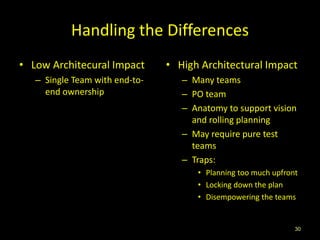
Handling the Differences
• Low Architecural Impact       • High Architectural Impact
   – Single Team with end-to-      – Many teams
     end ownership                 – PO team
                                   – Anatomy to support vision
                                     and rolling planning
                                   – May require pure test
                                     teams
                                   – Traps:
                                      • Planning too much upfront
                                      • Locking down the plan
                                      • Disempowering the teams


                                                                30
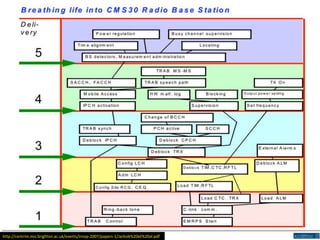
31
http://centrim.mis.brighton.ac.uk/events/irnop-2007/papers-1/Jarkvik%20et%20al.pdf
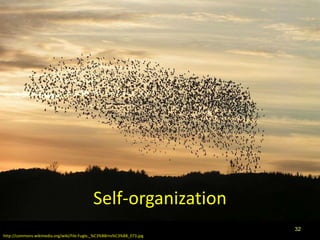
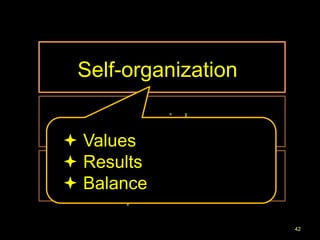
Self-organization
                                                                        32
http://commons.wikimedia.org/wiki/File:Fugle,_%C3%B8rns%C3%B8_073.jpg
Why do we want Self-organizing
          Teams?


                                 33
A team is a group of people with
      complementary talents and
skills, aligned to a common objective.


                                         34
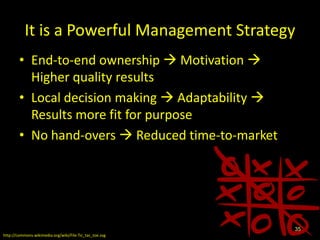
It is a Powerful Management Strategy
        • End-to-end ownership  Motivation 
          Higher quality results
        • Local decision making  Adaptability 
          Results more fit for purpose
        • No hand-overs  Reduced time-to-market


                                                         35
http://commons.wikimedia.org/wiki/File:Tic_tac_toe.svg
Typical Advice on Self-organization
•   Don’t assign roles
•   Don’t assign leadership
•   Don’t assign tasks
•   Don’t say how


                                                                                              36
                              http://commons.wikimedia.org/wiki/File:Stop_hand_nuvola_alternate.svg
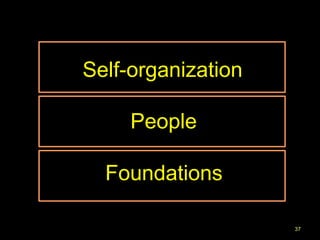
Self-organization

     People

  Foundations

                    37
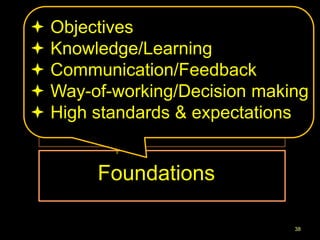
 Objectives
 Knowledge/Learning
 Communication/Feedback
       Självorganisati
 Way-of-working/Decision making
       on
 High standards & expectations
        Människo
        r
       Foundations

                              38
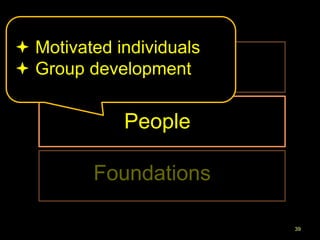
 Motivated individuals
 Group development
         Självorganisati
         on
              People

         Foundations

                           39
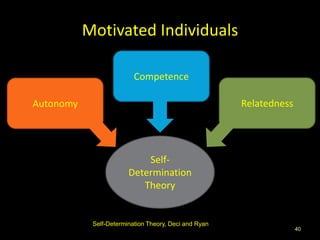
Motivated Individuals

                          Competence

Autonomy                                               Relatedness


                            Self-
                        Determination
                           Theory


            Self-Determination Theory, Deci and Ryan
                                                                     40
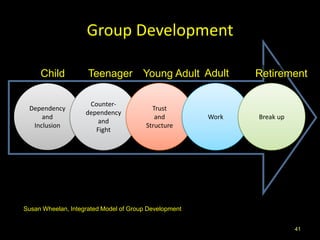
Group Development

     Child           Teenager Young Adult Adult               Retirement

                     Counter-
 Dependency                               Trust
                    dependency
     and                                   and         Work   Break up
                        and
  Inclusion                             Structure
                       Fight


Susan Wheelan, Integrated Model of Group Development


                                                                         41
Self-organization

      Människo
 Values
      r
 Results
        Grunde
 Balance
        r
                     42
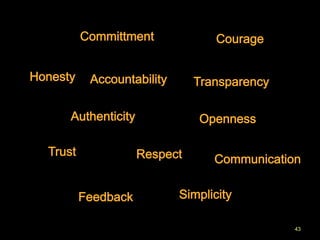
43
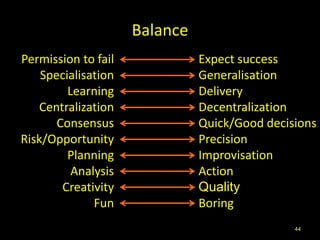
Balance
Permission to fail             Expect success
    Specialisation             Generalisation
         Learning              Delivery
   Centralization              Decentralization
       Consensus               Quick/Good decisions
Risk/Opportunity               Precision
         Planning              Improvisation
          Analysis             Action
        Creativity             Quality
              Fun              Boring
                                               44
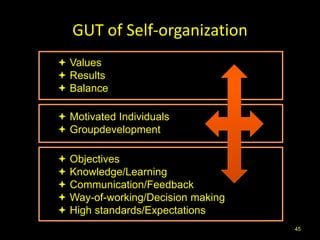
GUT of Self-organization
 Values
 Results
 Balance

 Motivated Individuals
 Groupdevelopment

 Objectives
 Knowledge/Learning
 Communication/Feedback
 Way-of-working/Decision making
 High standards/Expectations
                                   45
Summary
• Focus on end-to-end flow
• Focus on product evolution rather than
  running projects
• Distinguish functional enhancements from
  architectural evolution
• Foster self-organization consciously


                                             46
Frågor på det?


                                                                        47
http://commons.wikimedia.org/wiki/File:Ostrich2010_2.jpg
Selected References
•   Creating Effective Teams (Wheelan) - http://www.amazon.com/Creating-Effective-Teams-Members-
    Leaders/dp/1452217076/ref=sr_1_1?s=books&ie=UTF8&qid=1362513243&sr=1-
    1&keywords=susan+wheelan
•   Agile Software Requirements (Leffingwell) - http://www.amazon.com/Agile-Software-Requirements-
    Enterprise-Development/dp/0321635841/ref=sr_1_1?s=books&ie=UTF8&qid=1362513353&sr=1-
    1&keywords=leffingwell
•   Drive (Pink) - http://www.amazon.com/Drive-Surprising-Truth-About-
    Motivates/dp/1594484805/ref=sr_1_2?s=books&ie=UTF8&qid=1362513408&sr=1-2&keywords=dan+pink
•   Corps Business (Freedman) - http://www.amazon.com/Corps-Business-Management-Principles-
    Marines/dp/0066619793/ref=sr_1_1?s=books&ie=UTF8&qid=1362513452&sr=1-
    1&keywords=corps+business+the+30+management+principles+of+the+u.s.+marines
•   The Principles of Product Development Flow (Reinertsen) - http://www.amazon.com/Principles-Product-
    Development-Flow-Generation/dp/1935401009/ref=sr_1_1?s=books&ie=UTF8&qid=1362513506&sr=1-
    1&keywords=reinertsen
•   Scaling Lean & Agile Development (Larman) - http://www.amazon.com/Scaling-Lean-Agile-Development-
    Organizational/dp/0321480961/ref=sr_1_1?s=books&ie=UTF8&qid=1362513556&sr=1-
    1&keywords=larman+vodde
•   The System Anatomy (Taxén ed.) - http://www.amazon.com/System-Anatomy-Lars-
    Taxen/dp/9144070748/ref=sr_1_3?s=books&ie=UTF8&qid=1362513689&sr=1-3&keywords=lars+taxen
•   The Essence of Software Engineering (Jacobson, Ng, McMahon, Spence, Lidman) - http://www.amazon.com/The-
    Essence-Software-Engineering-Applying/dp/0321885953
Thanks!

Svante Lidman, Sr Productivity Expert
svante.lidman@hansoft.se
@svante_lidman
www.slideshare.net/SvanteLidman
Licensing of this Presentation

The artwork in this presentation is licensed under the terms defined by each
respective source as indicated on each respective slide. If no source is
given, then the artwork is in the public domain.

Trademarks and books, depicted in the presentation are owned by the
respective tradmark owner and are only included for reference purposes and
is not in any way an endorsement of the presentation contents.

 If you make use of this material in whole or part, you should clearly state
the source.

All original art work and the presentation as such is is licensed under
Creative Commons Attribution-Share Alike 3.0 Unported license.
See: http://creativecommons.org/licenses/by-sa/3.0/deed.en
                                                                               50

My talk at PMI Sweden Congress 2013 on Agile and Large Software Products

  • 1.
    Framgångsfaktorer för AgilUtveckling av Mycket Stora Programvaruprodukter PMI Sweden Chapter Passion for projects 2013 Svante Lidman, Senior Productivity Expert svante.lidman@hansoft.se @svante_lidman www.slideshare.net/SvanteLidman
  • 2.
  • 3.
    Vafalls, Stora Large Products? Progamvaruprodukter? Ericsson Autodesk Boeing Star Wars - The Old Republic Microsoft Lucas Arts, Bioware, Electronic Arts
  • 4.
    Why Agile? • Arewe and customers happy with the lead time from idea to volume deployment? • Are we and customers happy with product quality? • Are we happy with R&D efficiency? • What will our situation look like tomorrow if we continue as we do?
  • 5.
    The Importance ofSpeed Sales Volume 10% Increased speed (Sales earlier) 10% Efficiency R&D (~15%) increase in R&D Jan Bosch - www.janbosch.com
  • 6.
    Conclusion • Conformance to original budget is secondary • Conformance to original scope is secondary • Time to market and Quality is key!! http://commons.wikimedia.org/wiki/File:PenroseTriangle.png
  • 7.
    The Themes ofthis Talk • Look at product development holistically • All development work is not the same • Self-organization
  • 8.
    Holistically Speaking... 8 http://commons.wikimedia.org/wiki/File:Whole_onion.jpg
  • 9.
    What is OurJob? Product Value / Opportunity management & Solution / Problem Development
  • 10.
    What we setout for Feature X
  • 11.
    The Traditional Way Pre-study Prestudy Feasability Feasibility Development
  • 12.
    The Traditional Way Pre-study Feasability Feasibility Development
  • 13.
    The Traditional Way Pre-study Feasability Feasibility Construction Test
  • 14.
    The Traditional Way Pre-study Feasability Feasibility Construction Test
  • 15.
    The Traditional Way Pre-study Feasability Feasibility Part 1 … Part N Test
  • 16.
    The Traditional Way Pre-study ? Feasability Feasibility ? ? ? Part 1 ? … ? Part N ? ? ? Test
  • 17.
    Common Challenges • Time slicing of people • Handovers of documents resulting in distortion • Coordination issues • Quality issues uncovered too late • Lead-time too long • Very few people understand the overall system • Too many meetings • Blame games Claim: The fragmentation of value(work)is the single most important root cause for these issues
  • 18.
    What is OurJob? Contract Management Release Strategy Projects Resource Planning 1/3 Requirements Pre-study Vision Management TG1 Program Management TG2 PD3 Requirements Baseline Defect-handling 2/3 TG3 Product Execution Project Plan Value / Opportunity Anatomy Integration Test management & Project Leaders Technical coordination Solution / Problem CR-handlingDevelopment PDU PD1 War room Feasibility PA PG ALM Steering Group Go-model FEAD PD2 Prestudy Design Business Case FG Integration Planning CCB BP4 System V-Model Design
  • 19.
    Key Ideas • Focuson flow, customer-to-customer – Optimize for short end-to-end lead-time – Stop-the-line mentality regarding faults • This will expose inefficiencies and force: – Removal of handovers – Removal of overly detailed studies and gold-plated designs – Removal of late and non-repeatable testing • The focus on flow and lead-time will act as a forcing function to address impediments to quality and efficiency http://commons.wikimedia.org/wiki/File:Bulbgraph.svg
  • 20.
    Key Concepts • End-2-End Cross Functional Teams for Development • Pull based approach • Continuous programs rather than finite projects • Continuous Integration (and Testing) – Automated, continuous, fast and reliable feedback to teams • Requirement Areas (RA) as scaling concept – Yearly budgeting (in terms of teams) per RA coupled to business strategy – Independent prioritization per RA – Limits competence challenge for Teams without code ownership http://commons.wikimedia.org/wiki/File:Stock_keyring.svg
  • 21.
    Flow Based Organization Analysis Development Program Program - Detail - Identify Release - Design - Analyze - Implement - Prioritize Program - Test (Project) - Document - Package - Verify - Roll out
  • 22.
    Seen Another Way… ReleaseProgram (Projects)
  • 23.
    Meanwhile @ Spotify... 23 Henrik Kniberg, Anders Ivarsson http://blog.crisp.se/2012/11/14/henrikkniberg/scaling-agile-at-spotify
  • 25.
  • 26.
    All Software isnot the Same Features Application Specific Domain Specific Domain General OS Extensions (e.g. Protocols, Scalability, Security etc.) Device Drivers Custom Hardware + Firmware
  • 27.
    Low Architectural Impact Features Application Specific Domain Specific Domain General OS Extensions (e.g. Protocols, Scalability, Security etc.) Device Drivers Custom Hardware + Firmware
  • 28.
    High Architectural Impact Features Application Specific Domain Specific Code Domain General Impact OS Extensions (e.g. Protocols, Scalability, Security etc.) Device Drivers Custom Hardware + Firmware
  • 29.
    High Architectural Impact Features Application Specific Domain Specific Test Impact Domain General OS Extensions (e.g. Protocols, Scalability, Security etc.) Device Drivers Custom Hardware + Firmware
  • 30.
    Handling the Differences •Low Architecural Impact • High Architectural Impact – Single Team with end-to- – Many teams end ownership – PO team – Anatomy to support vision and rolling planning – May require pure test teams – Traps: • Planning too much upfront • Locking down the plan • Disempowering the teams 30
  • 31.
  • 32.
    Self-organization 32 http://commons.wikimedia.org/wiki/File:Fugle,_%C3%B8rns%C3%B8_073.jpg
  • 33.
    Why do wewant Self-organizing Teams? 33
  • 34.
    A team isa group of people with complementary talents and skills, aligned to a common objective. 34
  • 35.
    It is aPowerful Management Strategy • End-to-end ownership  Motivation  Higher quality results • Local decision making  Adaptability  Results more fit for purpose • No hand-overs  Reduced time-to-market 35 http://commons.wikimedia.org/wiki/File:Tic_tac_toe.svg
  • 36.
    Typical Advice onSelf-organization • Don’t assign roles • Don’t assign leadership • Don’t assign tasks • Don’t say how 36 http://commons.wikimedia.org/wiki/File:Stop_hand_nuvola_alternate.svg
  • 37.
    Self-organization People Foundations 37
  • 38.
     Objectives  Knowledge/Learning Communication/Feedback Självorganisati  Way-of-working/Decision making on  High standards & expectations Människo r Foundations 38
  • 39.
     Motivated individuals Group development Självorganisati on People Foundations 39
  • 40.
    Motivated Individuals Competence Autonomy Relatedness Self- Determination Theory Self-Determination Theory, Deci and Ryan 40
  • 41.
    Group Development Child Teenager Young Adult Adult Retirement Counter- Dependency Trust dependency and and Work Break up and Inclusion Structure Fight Susan Wheelan, Integrated Model of Group Development 41
  • 42.
    Self-organization Människo  Values r  Results Grunde  Balance r 42
  • 43.
  • 44.
    Balance Permission to fail Expect success Specialisation Generalisation Learning Delivery Centralization Decentralization Consensus Quick/Good decisions Risk/Opportunity Precision Planning Improvisation Analysis Action Creativity Quality Fun Boring 44
  • 45.
    GUT of Self-organization Values  Results  Balance  Motivated Individuals  Groupdevelopment  Objectives  Knowledge/Learning  Communication/Feedback  Way-of-working/Decision making  High standards/Expectations 45
  • 46.
    Summary • Focus onend-to-end flow • Focus on product evolution rather than running projects • Distinguish functional enhancements from architectural evolution • Foster self-organization consciously 46
  • 47.
    Frågor på det? 47 http://commons.wikimedia.org/wiki/File:Ostrich2010_2.jpg
  • 48.
    Selected References • Creating Effective Teams (Wheelan) - http://www.amazon.com/Creating-Effective-Teams-Members- Leaders/dp/1452217076/ref=sr_1_1?s=books&ie=UTF8&qid=1362513243&sr=1- 1&keywords=susan+wheelan • Agile Software Requirements (Leffingwell) - http://www.amazon.com/Agile-Software-Requirements- Enterprise-Development/dp/0321635841/ref=sr_1_1?s=books&ie=UTF8&qid=1362513353&sr=1- 1&keywords=leffingwell • Drive (Pink) - http://www.amazon.com/Drive-Surprising-Truth-About- Motivates/dp/1594484805/ref=sr_1_2?s=books&ie=UTF8&qid=1362513408&sr=1-2&keywords=dan+pink • Corps Business (Freedman) - http://www.amazon.com/Corps-Business-Management-Principles- Marines/dp/0066619793/ref=sr_1_1?s=books&ie=UTF8&qid=1362513452&sr=1- 1&keywords=corps+business+the+30+management+principles+of+the+u.s.+marines • The Principles of Product Development Flow (Reinertsen) - http://www.amazon.com/Principles-Product- Development-Flow-Generation/dp/1935401009/ref=sr_1_1?s=books&ie=UTF8&qid=1362513506&sr=1- 1&keywords=reinertsen • Scaling Lean & Agile Development (Larman) - http://www.amazon.com/Scaling-Lean-Agile-Development- Organizational/dp/0321480961/ref=sr_1_1?s=books&ie=UTF8&qid=1362513556&sr=1- 1&keywords=larman+vodde • The System Anatomy (Taxén ed.) - http://www.amazon.com/System-Anatomy-Lars- Taxen/dp/9144070748/ref=sr_1_3?s=books&ie=UTF8&qid=1362513689&sr=1-3&keywords=lars+taxen • The Essence of Software Engineering (Jacobson, Ng, McMahon, Spence, Lidman) - http://www.amazon.com/The- Essence-Software-Engineering-Applying/dp/0321885953
  • 49.
    Thanks! Svante Lidman, SrProductivity Expert svante.lidman@hansoft.se @svante_lidman www.slideshare.net/SvanteLidman
  • 50.
    Licensing of thisPresentation The artwork in this presentation is licensed under the terms defined by each respective source as indicated on each respective slide. If no source is given, then the artwork is in the public domain. Trademarks and books, depicted in the presentation are owned by the respective tradmark owner and are only included for reference purposes and is not in any way an endorsement of the presentation contents. If you make use of this material in whole or part, you should clearly state the source. All original art work and the presentation as such is is licensed under Creative Commons Attribution-Share Alike 3.0 Unported license. See: http://creativecommons.org/licenses/by-sa/3.0/deed.en 50

Editor's Notes

  • #2 -Vadmenar vi med framgångsfaktorer?Vadmenar vi med agilutveckling?Vadmenar vi med programvaruprodukter?Vadmenar vi med mycketstora?Organizations developing large software-intensive products need to look at their software development in a life cycle perspective toget full benefit from adopting agile and lean. Naïve adoption can cause as much damage as benefit. Over the last couple of years I haveworked with several large scale software product development organizations around the world that are in various stages of adoption ofagile/lean practices. These are organizations that involve hundreds of software developers. In this presentation I will talk about typicalchallenges, solution patterns and transition strategies for this kind of development.KEY TAKE AWAY: How to build a large lean/agile software product developmentorganizati on
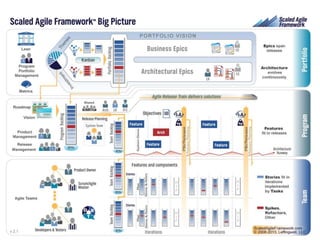
  • #25 The problem with this is not the ideas or the principles that there is so much terminology and to some extent structure that is somewhat arbitrary. This will typically lead to terminology adoption rather than adoption of principles, annd values/behaviors which is what counts in the end. Remember Continuous Improvement....
  • #41 Här kan vi läsa på i Kandidatuppsatsen
  • #50 -Vadmenar vi med framgångsfaktorer?Vadmenar vi med agilutveckling?Vadmenar vi med programvaruprodukter?Vadmenar vi med mycketstora?Organizations developing large software-intensive products need to look at their software development in a life cycle perspective toget full benefit from adopting agile and lean. Naïve adoption can cause as much damage as benefit. Over the last couple of years I haveworked with several large scale software product development organizations around the world that are in various stages of adoption ofagile/lean practices. These are organizations that involve hundreds of software developers. In this presentation I will talk about typicalchallenges, solution patterns and transition strategies for this kind of development.KEY TAKE AWAY: How to build a large lean/agile software product developmentorganizati on