
Business Process Management
Nuts and Bolts


                              Murali Darapureddy
Contents

    1      What is BPM ?

    2      Why do you need BPM ?

    3      Industry Areas that need BPM

    4    BPM Life cycle
    5    BPM Flavors

     6     BPM Product suite components & Architecture

     7     Components description
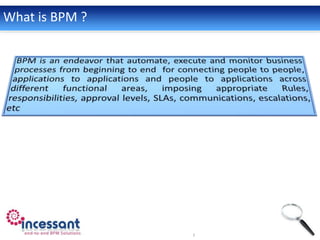
What is BPM ?
Why do you need BPM ?
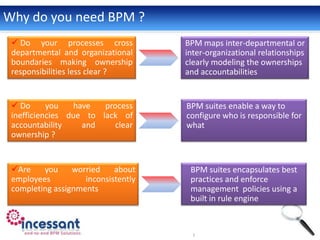
  Do your processes cross           BPM maps inter-departmental or
 departmental and organizational     inter-organizational relationships
 boundaries making ownership         clearly modeling the ownerships
 responsibilities less clear ?       and accountabilities


  Do      you   have   process      BPM suites enable a way to
 inefficiencies due to lack of       configure who is responsible for
 accountability    and    clear      what
 ownership ?


 Are    you     worried    about     BPM suites encapsulates best
 employees          inconsistently    practices and enforce
 completing assignments               management policies using a
                                      built in rule engine
Why do you need BPM ? ( Continued.. 2 )
Do you fear that your processes    BPM suites enable in-flight process
are not adapting to changing       modifications so that managers
business requirements and          can change the business processes
hence lacking the agility          and underlying rules very quickly


Do your processes frequently       BPM     suites     ship         with
involve documents and forms as     documentation    and          forms
well as other structured and       management capabilities
unstructured content ?

Do you lack clear, measurable,     BPM suites provide real time
metrics for gauging for employee   analytics capabilities for assessing
performance ?                      task completion time and other
                                   performance metrics
BPM Benefits in Nutshell

  Streamline Operations & Processes


  Improved Operational efficiency


  End to End performnace visibility and Optimizaiton


  Compliance and Control


  Agility / Facilitate change


  Create accountability in processes

  Drive policies, practices and business constraints
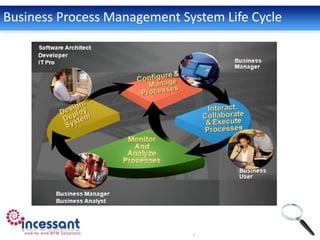
Business Process Management System Life Cycle
Industry areas that need BPM
     Health Care
        Case Management
        Admittance processes
        Compliance with federal and state regulations
        Managing physician productivity
        Streamlining customer support services
        Clinical trails management
        Case Report form ( CRF ) routing and tracking
        HIPPA and patient protections compliance
        FDB & IRB regulatory monitoring
        Contract research and alliance management

     Travel and Hospitality
         Reservations and back office automation
         Cross process top percentile loyalty
         Scheduling and capacity Management
         Customer call center operations
Industry areas that need BPM ( Continued .. 2)

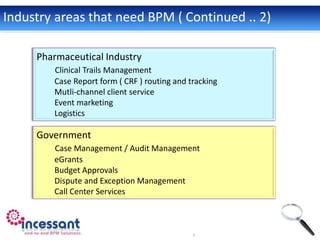
     Pharmaceutical Industry
        Clinical Trails Management
        Case Report form ( CRF ) routing and tracking
        Mutli-channel client service
        Event marketing
        Logistics

     Government
        Case Management / Audit Management
        eGrants
        Budget Approvals
        Dispute and Exception Management
        Call Center Services
Industry areas that need BPM ( Continued .. 3)
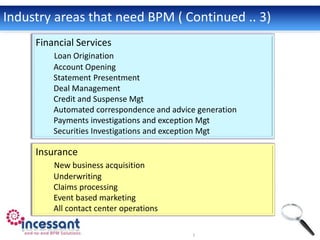
     Financial Services
         Loan Origination
         Account Opening
         Statement Presentment
         Deal Management
         Credit and Suspense Mgt
         Automated correspondence and advice generation
         Payments investigations and exception Mgt
         Securities Investigations and exception Mgt

     Insurance
         New business acquisition
         Underwriting
         Claims processing
         Event based marketing
         All contact center operations
Industry areas that need BPM ( Continued .. 4)
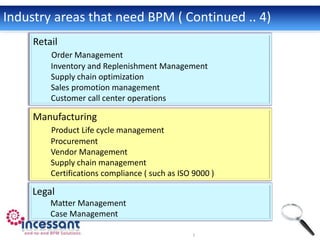
     Retail
         Order Management
         Inventory and Replenishment Management
         Supply chain optimization
         Sales promotion management
         Customer call center operations

     Manufacturing
         Product Life cycle management
         Procurement
         Vendor Management
         Supply chain management
         Certifications compliance ( such as ISO 9000 )

     Legal
         Matter Management
         Case Management
BPM Flavors – Integration Intensive

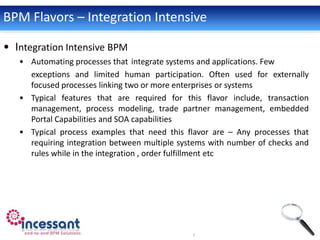
• Integration Intensive BPM
   • Automating processes that integrate systems and applications. Few
     exceptions and limited human participation. Often used for externally
     focused processes linking two or more enterprises or systems
   • Typical features that are required for this flavor include, transaction
     management, process modeling, trade partner management, embedded
     Portal Capabilities and SOA capabilities
   • Typical process examples that need this flavor are – Any processes that
     requiring integration between multiple systems with number of checks and
     rules while in the integration , order fulfillment etc
BPM Flavors – People Intensive
• People Intensive BPMs
   • Strong focus on automating people intensive activities such as servicing
     customers, operating call centers, managing sales operations, Supporting
     field based agents, employee services and customer claims and applications
   • Typical features that are required for this flavor include, Tasks List / Work List
     capabilities, strong UI development, SLA, Work routing and bulk processing
     capabilities, integration with third party portals and e-forms
   • Typical process examples that need this flavor are – employee onboarding,
     claims processing, exception handlings, customer service request handling
     and IT Requests etc
BPM Flavors – Decision Intensive
• Decision Intensive BPMs
   • Strong focus on automating processes that require employees to make
     mission-critical decisions using information and business rules. Also to
     automate the processes in which the decision criteria and the process rules
     change frequently.
   • Typical features that are required for this flavor include, business rules
     management, procedural and declarative business rules, business analytics,
     nit just the process analytics , integration with BI tools etc
   • Typical process examples that need this flavor are – mortgage loan
     origination, insurance underwriting, retail inventory management, sales
     promotions and rebates etc
BPM Flavors – Document Intensive
• Document Intensive BPMs
   • Strong focus on automating processes that require to track and obtain
     information from documents.
   • Typical features that are required for this flavor include, documentation
     imaging, document management, record management, task list / work list,
     portal integration with desktop applications and event management for
     changes to the documents
   • Typical process examples that need this flavor are – Paper based claims
     processing, contract management, proposal management, mortgage loan
     origination etc
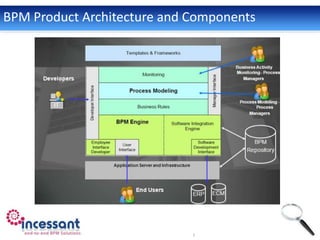
BPM Product Architecture and Components
BPM Components – Process Engine
• Process Engine
   • Process Engine executes the business processes defined by the Process
     Modeler.
   • Process Models are stored in the database and the process is run and move
     forward by Process Engines in accordance with action from external people
     and systems
   • Process Engine executes the processes, escalating unresolved issues,
     ensuring process integrity, and collecting data necessary to resolving
     exceptions as they occur.
   • Process Engine also provides a complete history and audit trail of user
     interactions, which can be used to improve processes and retaining best
     practices.
BPM Components – Process Modeler
• Process Modeler
   • Business process modeling tools provide business users with the ability to
     model their business processes, so that the these processes can be executed
     by process engines
   • Typical Process Modeler capabilities should include
      • Ability to model collecting data from forms
      • Ability to set thresholds and send alerts or take automated actions
      • Ability to model required approvals and verifications
      • Apply Business Rules in the process paths
      • Input and Retrieve Data from ODBC Databases within process paths
      • Interact with e-mail within process paths
      • Ability to build process by drag and drop of components
      • Ability to reuse process templates across multiple functions
BPM Components – Business Rule Engine
• Business Rule Engine
   • Acts as central repository of the business rules at your organization / division
     level
   • Promotes high reuse of rules across different LOBs and divisions
   • Business rules from rule repository are frequently called and used in the
     process flows.
   • Typical Business Rule Engine capabilities should include
      • Ability to define the rules in the form based configurations
      • Ability to delegate rules to the managers so as they make in flight
          changes at business run times
      • Versioning of rules
      • Rule bulk change and movements utilities.
BPM Components – Business Rule Engine ( Continued)
• Rule Categories that a BRE handles
   • Inferred Knowledge Rules
       • Examples : If a Customer Spending per month is > $5K and the average
         account balance is >$20K, Customer = “Gold”
   • Computation Rules
       • Examples : Examples include definitions, declarative and procedural
         computations ( Ex : Salary = Basic + HRA + Travel Allowance )
   • Constraint / Guidelines / Process Rules
      • Examples : Decisions in the flows, form validations, routing rules, claims
          auto adjudication rules, exception handling rules etc
   • Event Correlation Rules
       • Examples : SLA management, Threshold value management ( Ex : Notify
         the distributor for replenishment when the stock level comes down
         below the stock level
BPM Components – Business Activity Monitoring
• Business Activity Monitoring
   • BAM provides performance management dashboards
   • Graphs to show metrics versus their target
   • Provides Business Process visibility for managers
   • They also provide real-time alerts and automated escalation procedures
     when the KPIs go off the track
   • Actual performance data can be fed back to refine process models and begin
     a new cycle of incremental process improvement.
Thank You


            www.incessanttechnologies.com

Bpm nuts & bolts

  • 1.
    Business Process Management Nutsand Bolts Murali Darapureddy
  • 2.
    Contents 1 What is BPM ? 2 Why do you need BPM ? 3 Industry Areas that need BPM 4 BPM Life cycle 5 BPM Flavors 6 BPM Product suite components & Architecture 7 Components description
  • 3.
  • 4.
    Why do youneed BPM ?  Do your processes cross BPM maps inter-departmental or departmental and organizational inter-organizational relationships boundaries making ownership clearly modeling the ownerships responsibilities less clear ? and accountabilities  Do you have process BPM suites enable a way to inefficiencies due to lack of configure who is responsible for accountability and clear what ownership ? Are you worried about BPM suites encapsulates best employees inconsistently practices and enforce completing assignments management policies using a built in rule engine
  • 5.
    Why do youneed BPM ? ( Continued.. 2 ) Do you fear that your processes BPM suites enable in-flight process are not adapting to changing modifications so that managers business requirements and can change the business processes hence lacking the agility and underlying rules very quickly Do your processes frequently BPM suites ship with involve documents and forms as documentation and forms well as other structured and management capabilities unstructured content ? Do you lack clear, measurable, BPM suites provide real time metrics for gauging for employee analytics capabilities for assessing performance ? task completion time and other performance metrics
  • 6.
    BPM Benefits inNutshell Streamline Operations & Processes Improved Operational efficiency End to End performnace visibility and Optimizaiton Compliance and Control Agility / Facilitate change Create accountability in processes Drive policies, practices and business constraints
  • 7.
    Business Process ManagementSystem Life Cycle
  • 8.
    Industry areas thatneed BPM Health Care Case Management Admittance processes Compliance with federal and state regulations Managing physician productivity Streamlining customer support services Clinical trails management Case Report form ( CRF ) routing and tracking HIPPA and patient protections compliance FDB & IRB regulatory monitoring Contract research and alliance management Travel and Hospitality Reservations and back office automation Cross process top percentile loyalty Scheduling and capacity Management Customer call center operations
  • 9.
    Industry areas thatneed BPM ( Continued .. 2) Pharmaceutical Industry Clinical Trails Management Case Report form ( CRF ) routing and tracking Mutli-channel client service Event marketing Logistics Government Case Management / Audit Management eGrants Budget Approvals Dispute and Exception Management Call Center Services
  • 10.
    Industry areas thatneed BPM ( Continued .. 3) Financial Services Loan Origination Account Opening Statement Presentment Deal Management Credit and Suspense Mgt Automated correspondence and advice generation Payments investigations and exception Mgt Securities Investigations and exception Mgt Insurance New business acquisition Underwriting Claims processing Event based marketing All contact center operations
  • 11.
    Industry areas thatneed BPM ( Continued .. 4) Retail Order Management Inventory and Replenishment Management Supply chain optimization Sales promotion management Customer call center operations Manufacturing Product Life cycle management Procurement Vendor Management Supply chain management Certifications compliance ( such as ISO 9000 ) Legal Matter Management Case Management
  • 12.
    BPM Flavors –Integration Intensive • Integration Intensive BPM • Automating processes that integrate systems and applications. Few exceptions and limited human participation. Often used for externally focused processes linking two or more enterprises or systems • Typical features that are required for this flavor include, transaction management, process modeling, trade partner management, embedded Portal Capabilities and SOA capabilities • Typical process examples that need this flavor are – Any processes that requiring integration between multiple systems with number of checks and rules while in the integration , order fulfillment etc
  • 13.
    BPM Flavors –People Intensive • People Intensive BPMs • Strong focus on automating people intensive activities such as servicing customers, operating call centers, managing sales operations, Supporting field based agents, employee services and customer claims and applications • Typical features that are required for this flavor include, Tasks List / Work List capabilities, strong UI development, SLA, Work routing and bulk processing capabilities, integration with third party portals and e-forms • Typical process examples that need this flavor are – employee onboarding, claims processing, exception handlings, customer service request handling and IT Requests etc
  • 14.
    BPM Flavors –Decision Intensive • Decision Intensive BPMs • Strong focus on automating processes that require employees to make mission-critical decisions using information and business rules. Also to automate the processes in which the decision criteria and the process rules change frequently. • Typical features that are required for this flavor include, business rules management, procedural and declarative business rules, business analytics, nit just the process analytics , integration with BI tools etc • Typical process examples that need this flavor are – mortgage loan origination, insurance underwriting, retail inventory management, sales promotions and rebates etc
  • 15.
    BPM Flavors –Document Intensive • Document Intensive BPMs • Strong focus on automating processes that require to track and obtain information from documents. • Typical features that are required for this flavor include, documentation imaging, document management, record management, task list / work list, portal integration with desktop applications and event management for changes to the documents • Typical process examples that need this flavor are – Paper based claims processing, contract management, proposal management, mortgage loan origination etc
  • 16.
  • 17.
    BPM Components –Process Engine • Process Engine • Process Engine executes the business processes defined by the Process Modeler. • Process Models are stored in the database and the process is run and move forward by Process Engines in accordance with action from external people and systems • Process Engine executes the processes, escalating unresolved issues, ensuring process integrity, and collecting data necessary to resolving exceptions as they occur. • Process Engine also provides a complete history and audit trail of user interactions, which can be used to improve processes and retaining best practices.
  • 18.
    BPM Components –Process Modeler • Process Modeler • Business process modeling tools provide business users with the ability to model their business processes, so that the these processes can be executed by process engines • Typical Process Modeler capabilities should include • Ability to model collecting data from forms • Ability to set thresholds and send alerts or take automated actions • Ability to model required approvals and verifications • Apply Business Rules in the process paths • Input and Retrieve Data from ODBC Databases within process paths • Interact with e-mail within process paths • Ability to build process by drag and drop of components • Ability to reuse process templates across multiple functions
  • 19.
    BPM Components –Business Rule Engine • Business Rule Engine • Acts as central repository of the business rules at your organization / division level • Promotes high reuse of rules across different LOBs and divisions • Business rules from rule repository are frequently called and used in the process flows. • Typical Business Rule Engine capabilities should include • Ability to define the rules in the form based configurations • Ability to delegate rules to the managers so as they make in flight changes at business run times • Versioning of rules • Rule bulk change and movements utilities.
  • 20.
    BPM Components –Business Rule Engine ( Continued) • Rule Categories that a BRE handles • Inferred Knowledge Rules • Examples : If a Customer Spending per month is > $5K and the average account balance is >$20K, Customer = “Gold” • Computation Rules • Examples : Examples include definitions, declarative and procedural computations ( Ex : Salary = Basic + HRA + Travel Allowance ) • Constraint / Guidelines / Process Rules • Examples : Decisions in the flows, form validations, routing rules, claims auto adjudication rules, exception handling rules etc • Event Correlation Rules • Examples : SLA management, Threshold value management ( Ex : Notify the distributor for replenishment when the stock level comes down below the stock level
  • 21.
    BPM Components –Business Activity Monitoring • Business Activity Monitoring • BAM provides performance management dashboards • Graphs to show metrics versus their target • Provides Business Process visibility for managers • They also provide real-time alerts and automated escalation procedures when the KPIs go off the track • Actual performance data can be fed back to refine process models and begin a new cycle of incremental process improvement.
  • 22.
    Thank You www.incessanttechnologies.com