PRESERVATION OF
HISTORICAL CONCRETE
STRUCTURES
Maria Bostenaru, Researcher, Foundation ERGOROM ’99
and “Ion Mincu” University of Architecture and Urbanism
Early reinforced concrete is not recognized as much as masonry is to be a material of
historic structures.
Like for 20th century architecture: not old enough
Early reinforced concrete was a place for innovation in structural solutions for
innovative architecture. Not only were special structures possible, but also
innovation was possible in the spatiality of less spectacular structures, such as the
multistory buildings.
Introduction
Preservation of historical concrete structures
Maria Bostenaru
CA’REDIVIVUS “Preservation of historic reinforced housing buildings in Europe”
(2005-2007), funded by the European Commission (Marie Curie Individual Fellowship)
Research on historic reinforced concrete
Fellow: architecture graduate
Scientist-in-charge: structural engineer
Preservation on the threat of natural hazards, such as earthquakes
Research on the spread of such housing types in earthquake prone areas of Europe
Earthquake resilient features and deficiencies, simulations
Criteria from the point of view of different actors such as architect, engineer, user and
investor for chosen retrofit systems and strategies
Such approach is rare
2nd fib (Federation Internationalle du Beton) Congress in 2006 in Naples
need for criteria for selecting the structures which need to be preserved, for reasons
of structural innovation, in service of architecture
The Framework of the CA’REDIVIVUS Project and European Context
Preservation of historical concrete structures
Maria Bostenaru
Frampton (1996) “…any review of modern construction culture must recognize the
crucial role played by structural engineering…” – tectonics
seismic retrofit performed together with rehabilitation
Greece
Not the blocks of flats
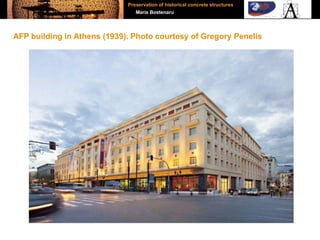
Army Pension Fund, architects Vassilios Kassandras and Leonidas Bonis (1939)
Only interwar building listed under monument protection in Athens
Revival as CityLink undertaken by the Piraeus Bank, architect Stelios Aghistratitis
For the seismic retrofit a combination of traditional and innovative methods was
employed: Fibre Reinforced Polymers (FRP) for slabs and beams and concrete
jacketing for the columns. Also reinforced concrete structural walls were added.
Hotel Erminio (1933), Kozani, monument protected
designed by the German engineer Max Ruthven, who also designed buildings in Nice,
buildings with which the hotel presents common architecture features
Damaged in 1995 so not to be further used
Retrofit: combination of traditional concrete jacketing for the vertical load bearing
elements with FRP for the horizontal road bearing elements
Review of Practical Approaches for the Conservation of Reinforced
Concrete Heritage
Preservation of historical concrete structures
Maria Bostenaru
Germany
interventions on 20th century heritage are being done since the 1980s
-Scharoun. Haus Schminke
-Gropius Meisterhaus Muche/Schlemmer
-buildings in the Weißenhof Siedlung by Mies van der Rohe
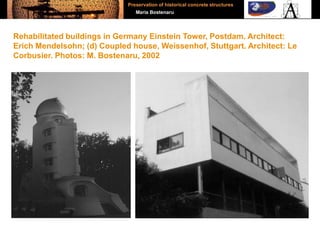
-Coupled house, Weissenhof, Stuttgart. Architect: Le Corbusier (mix steel-concrete)
-Einstein Tower, Potsdam, architect Erich Mendelsohn (1919-21)
reinforced concrete, the material per choice for the form thought by the architect, was
employed only limitedly way for economic reasons
Dammerstock and Weissenhof, steel skeleton preponderent for multistorey housing
Steel played a different role in the economic development of Germany than concrete
Hungary
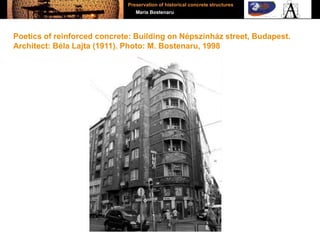
Building on Népszinház street, Budapest. Architect: Béla Lajta (1911)
Brick, despite the architecture history interpretation that this is a form suitable for
reinforced concrete
The presence of this somehow “ruin” of WWII permits such an analysis of the
construction materials through Rapid Visual Screening – the state preserved is the
postwar one, although ruins by catastrophes, different of those given by aging, as is
the case of those presented in the German books, tend to be ruins of the moment:
created in a moment and then disposed or renovated, to erase that traumatic memory.
Review of Practical Approaches for the Conservation of Reinforced
Concrete Heritage
Preservation of historical concrete structures
Maria Bostenaru
seismic retrofit performed together with rehabilitation
Italy
2nd fib (Federation Internationalle du Beton) Congress in 2006 in Naples
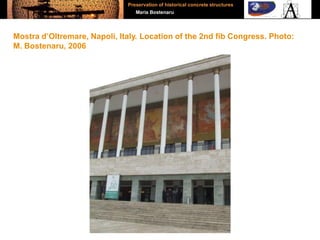
Mostra d’Oltremare
Left without proper maintenance
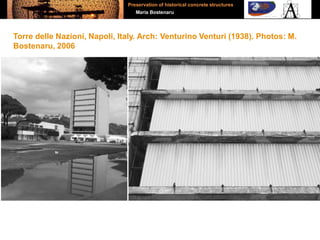
Tower of Nations, architect: Venturino Venturi (1938)
A Modernist building featuring impressive interior spaces with half-level difference
between the floors in the two sides
retrofit based on carbon FRP was proposed
Research on criteria
-Bostenaru
-Cristiana Chiorino
Porcheddu society
Planned Conservation conference in Como
Ivrea
Olivetti
International School
Review of Practical Approaches for the Conservation of Reinforced
Concrete Heritage
Preservation of historical concrete structures
Maria Bostenaru
AFP building in Athens (1939). Photo courtesy of Gregory Penelis
Preservation of historical concrete structures
Maria Bostenaru
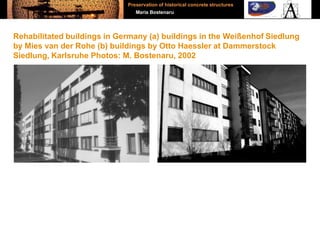
Rehabilitated buildings in Germany (a) buildings in the Weißenhof Siedlung
by Mies van der Rohe (b) buildings by Otto Haessler at Dammerstock
Siedlung, Karlsruhe Photos: M. Bostenaru, 2002
Preservation of historical concrete structures
Maria Bostenaru
Rehabilitated buildings in Germany Einstein Tower, Postdam. Architect:
Erich Mendelsohn; (d) Coupled house, Weissenhof, Stuttgart. Architect: Le
Corbusier. Photos: M. Bostenaru, 2002
Preservation of historical concrete structures
Maria Bostenaru
Poetics of reinforced concrete: Building on Népszinház street, Budapest.
Architect: Béla Lajta (1911). Photo: M. Bostenaru, 1998
Preservation of historical concrete structures
Maria Bostenaru
Mostra d’Oltremare, Napoli, Italy. Location of the 2nd fib Congress. Photo:
M. Bostenaru, 2006
Preservation of historical concrete structures
Maria Bostenaru
Torre delle Nazioni, Napoli, Italy. Arch: Venturino Venturi (1938). Photos: M.
Bostenaru, 2006
Preservation of historical concrete structures
Maria Bostenaru
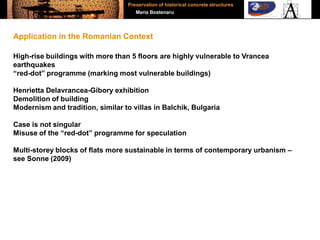
High-rise buildings with more than 5 floors are highly vulnerable to Vrancea
earthquakes
“red-dot” programme (marking most vulnerable buildings)
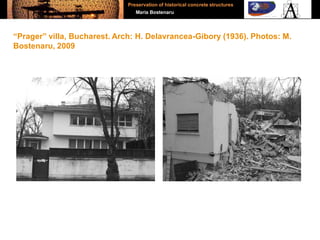
Henrietta Delavrancea-Gibory exhibition
Demolition of building
Modernism and tradition, similar to villas in Balchik, Bulgaria
Case is not singular
Misuse of the “red-dot” programme for speculation
Multi-storey blocks of flats more sustainable in terms of contemporary urbanism –
see Sonne (2009)
Application in the Romanian Context
Preservation of historical concrete structures
Maria Bostenaru
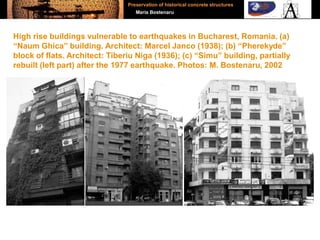
High rise buildings vulnerable to earthquakes in Bucharest, Romania. (a)
“Naum Ghica” building. Architect: Marcel Janco (1938); (b) “Pherekyde”
block of flats. Architect: Tiberiu Niga (1936); (c) “Simu” building, partially
rebuilt (left part) after the 1977 earthquake. Photos: M. Bostenaru, 2002
Preservation of historical concrete structures
Maria Bostenaru
“Prager” villa, Bucharest. Arch: H. Delavrancea-Gibory (1936). Photos: M.
Bostenaru, 2009
Preservation of historical concrete structures
Maria Bostenaru
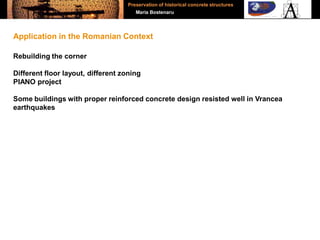
Rebuilding the corner
Different floor layout, different zoning
PIANO project
Some buildings with proper reinforced concrete design resisted well in Vrancea
earthquakes
Application in the Romanian Context
Preservation of historical concrete structures
Maria Bostenaru
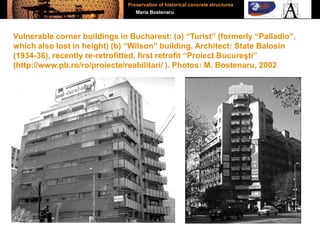
Vulnerable corner buildings in Bucharest: (a) “Turist” (formerly “Palladio”,
which also lost in height) (b) “Wilson” building. Architect: State Balosin
(1934-36), recently re-retrofitted, first retrofit “Proiect Bucureşti”
(http://www.pb.ro/ro/proiecte/reabilitari/ ). Photos: M. Bostenaru, 2002
Preservation of historical concrete structures
Maria Bostenaru
From the case studies across Europe lessons can be learned for application in
Romania
-Greek models – similar earthquake hazard conditions
-Italian models – similar materials
-German models – solving conflicts between the actors (in Romania unilateral choice,
without the architect; mainly economic reasons)
Sonne (2009) research on regional characteristics and distribution of multi-storey
buildings in Western civilisation
Romania and Greece are missing, although related to Milanese Novecento
Romania and Greece
Architectural typology from France
Structure computation models from Germany
Both not earthquake prone
Today in France: “Urban System Exposure” method
Discussion
Preservation of historical concrete structures
Maria Bostenaru
Interwar time – one of experiments
Buildings are not so well conserved today
Germany: aging
Romania, Greece, Italy: seismic threat
Difference in ruins of aging and those of natural hazards
The architectural restoration must be integrated with architectural conservation in
order to obtain an optimal result.
To be investigated is the role tradition plays, not only in combination with Modernist
theories, or seismic culture, but also in order to sustain preservation of heritage
against speculative development.
Romania and Greece – “other Modernisms”
Instead of Avant-Garde the sustainable block of flats of Sonne (2009)
Conclusion
Preservation of historical concrete structures
Maria Bostenaru
The financial support of the European Commission, in form of a Marie Curie
Reintegration Grants, for the project PIANO “The innovation in the plan of the current
floor: Zoning in blocks of flats for the middle class in the first half of the 20th
century”, grant agreement MERG-CT-2007-200636, at the host institution Foundation
ERGOROM ’99, are gratefully acknowledged.
THANK YOU FOR YOUR ATTENTION!
Acknowledgements
Preservation of historical concrete structures
Maria Bostenaru

Bostenaru2 Icsa2010

  • 1.
    PRESERVATION OF HISTORICAL CONCRETE STRUCTURES MariaBostenaru, Researcher, Foundation ERGOROM ’99 and “Ion Mincu” University of Architecture and Urbanism
  • 2.
    Early reinforced concreteis not recognized as much as masonry is to be a material of historic structures. Like for 20th century architecture: not old enough Early reinforced concrete was a place for innovation in structural solutions for innovative architecture. Not only were special structures possible, but also innovation was possible in the spatiality of less spectacular structures, such as the multistory buildings. Introduction Preservation of historical concrete structures Maria Bostenaru
  • 3.
    CA’REDIVIVUS “Preservation ofhistoric reinforced housing buildings in Europe” (2005-2007), funded by the European Commission (Marie Curie Individual Fellowship) Research on historic reinforced concrete Fellow: architecture graduate Scientist-in-charge: structural engineer Preservation on the threat of natural hazards, such as earthquakes Research on the spread of such housing types in earthquake prone areas of Europe Earthquake resilient features and deficiencies, simulations Criteria from the point of view of different actors such as architect, engineer, user and investor for chosen retrofit systems and strategies Such approach is rare 2nd fib (Federation Internationalle du Beton) Congress in 2006 in Naples need for criteria for selecting the structures which need to be preserved, for reasons of structural innovation, in service of architecture The Framework of the CA’REDIVIVUS Project and European Context Preservation of historical concrete structures Maria Bostenaru
  • 4.
    Frampton (1996) “…anyreview of modern construction culture must recognize the crucial role played by structural engineering…” – tectonics seismic retrofit performed together with rehabilitation Greece Not the blocks of flats Army Pension Fund, architects Vassilios Kassandras and Leonidas Bonis (1939) Only interwar building listed under monument protection in Athens Revival as CityLink undertaken by the Piraeus Bank, architect Stelios Aghistratitis For the seismic retrofit a combination of traditional and innovative methods was employed: Fibre Reinforced Polymers (FRP) for slabs and beams and concrete jacketing for the columns. Also reinforced concrete structural walls were added. Hotel Erminio (1933), Kozani, monument protected designed by the German engineer Max Ruthven, who also designed buildings in Nice, buildings with which the hotel presents common architecture features Damaged in 1995 so not to be further used Retrofit: combination of traditional concrete jacketing for the vertical load bearing elements with FRP for the horizontal road bearing elements Review of Practical Approaches for the Conservation of Reinforced Concrete Heritage Preservation of historical concrete structures Maria Bostenaru
  • 5.
    Germany interventions on 20thcentury heritage are being done since the 1980s -Scharoun. Haus Schminke -Gropius Meisterhaus Muche/Schlemmer -buildings in the Weißenhof Siedlung by Mies van der Rohe -Coupled house, Weissenhof, Stuttgart. Architect: Le Corbusier (mix steel-concrete) -Einstein Tower, Potsdam, architect Erich Mendelsohn (1919-21) reinforced concrete, the material per choice for the form thought by the architect, was employed only limitedly way for economic reasons Dammerstock and Weissenhof, steel skeleton preponderent for multistorey housing Steel played a different role in the economic development of Germany than concrete Hungary Building on Népszinház street, Budapest. Architect: Béla Lajta (1911) Brick, despite the architecture history interpretation that this is a form suitable for reinforced concrete The presence of this somehow “ruin” of WWII permits such an analysis of the construction materials through Rapid Visual Screening – the state preserved is the postwar one, although ruins by catastrophes, different of those given by aging, as is the case of those presented in the German books, tend to be ruins of the moment: created in a moment and then disposed or renovated, to erase that traumatic memory. Review of Practical Approaches for the Conservation of Reinforced Concrete Heritage Preservation of historical concrete structures Maria Bostenaru
  • 6.
    seismic retrofit performedtogether with rehabilitation Italy 2nd fib (Federation Internationalle du Beton) Congress in 2006 in Naples Mostra d’Oltremare Left without proper maintenance Tower of Nations, architect: Venturino Venturi (1938) A Modernist building featuring impressive interior spaces with half-level difference between the floors in the two sides retrofit based on carbon FRP was proposed Research on criteria -Bostenaru -Cristiana Chiorino Porcheddu society Planned Conservation conference in Como Ivrea Olivetti International School Review of Practical Approaches for the Conservation of Reinforced Concrete Heritage Preservation of historical concrete structures Maria Bostenaru
  • 7.
    AFP building inAthens (1939). Photo courtesy of Gregory Penelis Preservation of historical concrete structures Maria Bostenaru
  • 8.
    Rehabilitated buildings inGermany (a) buildings in the Weißenhof Siedlung by Mies van der Rohe (b) buildings by Otto Haessler at Dammerstock Siedlung, Karlsruhe Photos: M. Bostenaru, 2002 Preservation of historical concrete structures Maria Bostenaru
  • 9.
    Rehabilitated buildings inGermany Einstein Tower, Postdam. Architect: Erich Mendelsohn; (d) Coupled house, Weissenhof, Stuttgart. Architect: Le Corbusier. Photos: M. Bostenaru, 2002 Preservation of historical concrete structures Maria Bostenaru
  • 10.
    Poetics of reinforcedconcrete: Building on Népszinház street, Budapest. Architect: Béla Lajta (1911). Photo: M. Bostenaru, 1998 Preservation of historical concrete structures Maria Bostenaru
  • 11.
    Mostra d’Oltremare, Napoli,Italy. Location of the 2nd fib Congress. Photo: M. Bostenaru, 2006 Preservation of historical concrete structures Maria Bostenaru
  • 12.
    Torre delle Nazioni,Napoli, Italy. Arch: Venturino Venturi (1938). Photos: M. Bostenaru, 2006 Preservation of historical concrete structures Maria Bostenaru
  • 13.
    High-rise buildings withmore than 5 floors are highly vulnerable to Vrancea earthquakes “red-dot” programme (marking most vulnerable buildings) Henrietta Delavrancea-Gibory exhibition Demolition of building Modernism and tradition, similar to villas in Balchik, Bulgaria Case is not singular Misuse of the “red-dot” programme for speculation Multi-storey blocks of flats more sustainable in terms of contemporary urbanism – see Sonne (2009) Application in the Romanian Context Preservation of historical concrete structures Maria Bostenaru
  • 14.
    High rise buildingsvulnerable to earthquakes in Bucharest, Romania. (a) “Naum Ghica” building. Architect: Marcel Janco (1938); (b) “Pherekyde” block of flats. Architect: Tiberiu Niga (1936); (c) “Simu” building, partially rebuilt (left part) after the 1977 earthquake. Photos: M. Bostenaru, 2002 Preservation of historical concrete structures Maria Bostenaru
  • 15.
    “Prager” villa, Bucharest.Arch: H. Delavrancea-Gibory (1936). Photos: M. Bostenaru, 2009 Preservation of historical concrete structures Maria Bostenaru
  • 16.
    Rebuilding the corner Differentfloor layout, different zoning PIANO project Some buildings with proper reinforced concrete design resisted well in Vrancea earthquakes Application in the Romanian Context Preservation of historical concrete structures Maria Bostenaru
  • 17.
    Vulnerable corner buildingsin Bucharest: (a) “Turist” (formerly “Palladio”, which also lost in height) (b) “Wilson” building. Architect: State Balosin (1934-36), recently re-retrofitted, first retrofit “Proiect Bucureşti” (http://www.pb.ro/ro/proiecte/reabilitari/ ). Photos: M. Bostenaru, 2002 Preservation of historical concrete structures Maria Bostenaru
  • 18.
    From the casestudies across Europe lessons can be learned for application in Romania -Greek models – similar earthquake hazard conditions -Italian models – similar materials -German models – solving conflicts between the actors (in Romania unilateral choice, without the architect; mainly economic reasons) Sonne (2009) research on regional characteristics and distribution of multi-storey buildings in Western civilisation Romania and Greece are missing, although related to Milanese Novecento Romania and Greece Architectural typology from France Structure computation models from Germany Both not earthquake prone Today in France: “Urban System Exposure” method Discussion Preservation of historical concrete structures Maria Bostenaru
  • 19.
    Interwar time –one of experiments Buildings are not so well conserved today Germany: aging Romania, Greece, Italy: seismic threat Difference in ruins of aging and those of natural hazards The architectural restoration must be integrated with architectural conservation in order to obtain an optimal result. To be investigated is the role tradition plays, not only in combination with Modernist theories, or seismic culture, but also in order to sustain preservation of heritage against speculative development. Romania and Greece – “other Modernisms” Instead of Avant-Garde the sustainable block of flats of Sonne (2009) Conclusion Preservation of historical concrete structures Maria Bostenaru
  • 20.
    The financial supportof the European Commission, in form of a Marie Curie Reintegration Grants, for the project PIANO “The innovation in the plan of the current floor: Zoning in blocks of flats for the middle class in the first half of the 20th century”, grant agreement MERG-CT-2007-200636, at the host institution Foundation ERGOROM ’99, are gratefully acknowledged. THANK YOU FOR YOUR ATTENTION! Acknowledgements Preservation of historical concrete structures Maria Bostenaru