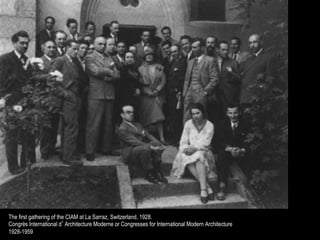
The first gathering of the CIAM at La Sarraz, Switzerland, 1928.
Congrès International d’Architecture Moderne or Congresses for International Modern Architecture
1928-1959
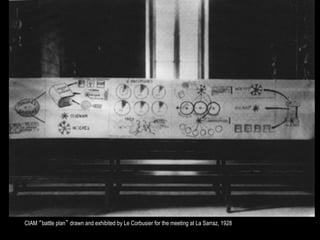
CIAM “battle plan” drawn and exhibited by Le Corbusier for the meeting at La Sarraz, 1928
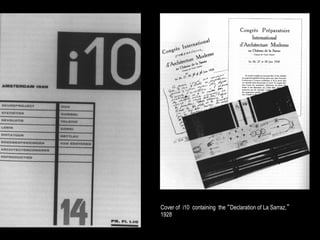
Cover of i10 containing the “Declaration of La Sarraz,”
1928
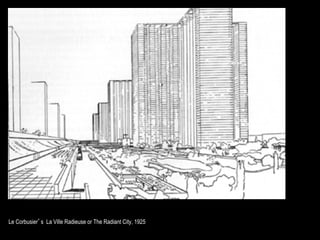
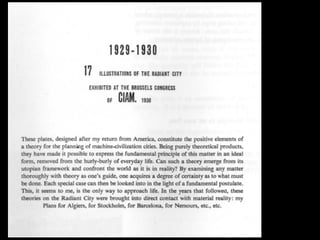
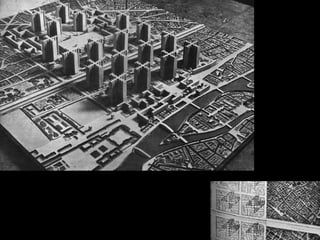
Le Corbusier’s La Ville Radieuse or The Radiant City, 1925
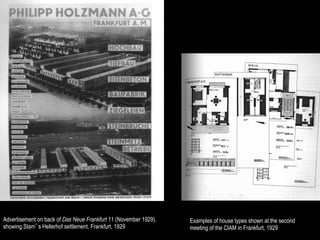
Advertisement on back of Das Neue Frankfurt 11 (November 1929),   Examples of house types shown at the second
showing Stam’s Hellerhof settlement, Frankfurt, 1929              meeting of the CIAM in Frankfurt, 1929
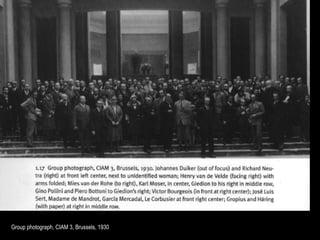
Group photograph, CIAM 3, Brussels, 1930
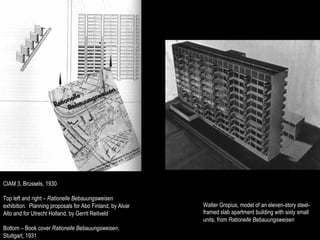
CIAM 3, Brussels, 1930

Top left and right – Rationelle Bebauungsweisen
exhibition. Planning proposals for Abo Finland, by Alvar   Walter Gropius, model of an eleven-story steel-
Alto and for Utrecht Holland, by Gerrit Reitveld           framed slab apartment building with sixty small
                                                           units, from Rationelle Bebauungsweisen
Bottom – Book cover Rationelle Bebauungsweisen,
Stuttgart, 1931
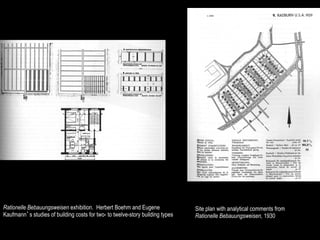
Rationelle Bebauungsweisen exhibition. Herbert Boehm and Eugene                Site plan with analytical comments from
Kaufmann’s studies of building costs for two- to twelve-story building types   Rationelle Bebauungsweisen, 1930
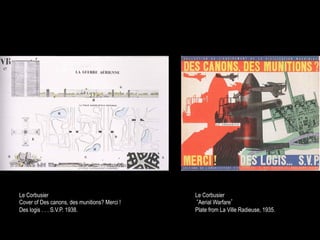
Le Corbusier                                  Le Corbusier
Cover of Des canons, des munitions? Merci !   ‘Aerial Warfare’
Des logis . . . S.V.P. 1938.                  Plate from La Ville Radieuse, 1935.
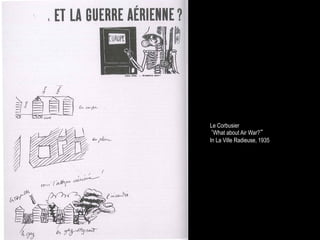
Le Corbusier
‘What about Air War?”
In La Ville Radieuse, 1935
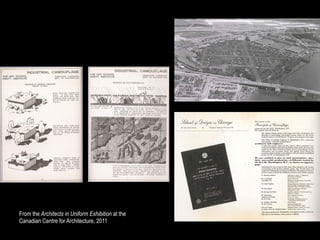
From the Architects in Uniform Exhibition at the
Canadian Centre for Architecture, 2011
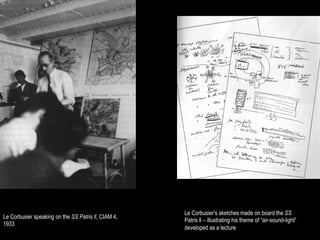
Le Corbusier’s sketches made on board the SS
Le Corbusier speaking on the SS Patris ll, CIAM 4,
                                                     Patris ll – illustrating his theme of “air-sound-light”
1933
                                                     developed as a lecture
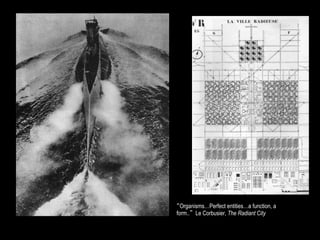
“Organisms…Perfect entities…a function, a
form..” Le Corbusier, The Radiant City
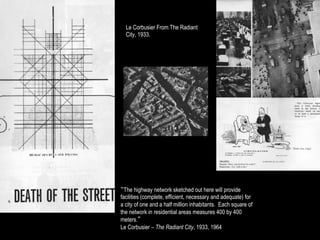
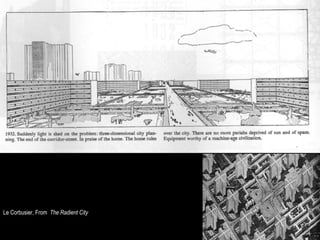
Le Corbusier From The Radiant
  City, 1933.


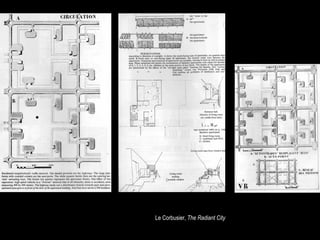
“The highway network sketched out here will provide
facilities (complete, efficient, necessary and adequate) for
a city of one and a half million inhabitants. Each square of
the network in residential areas measures 400 by 400
meters.”
Le Corbusier – The Radiant City, 1933, 1964
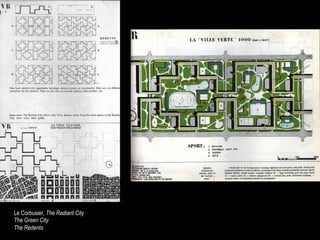
Le Corbusier, The Radiant City
The Green City
The Redents
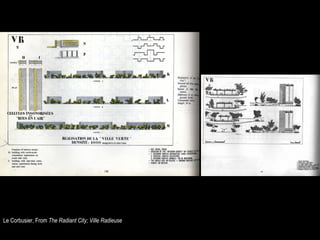
Le Corbusier, From The Radiant City; Ville Radieuse
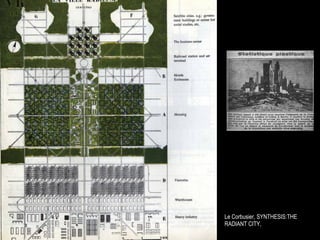
Le Corbusier, SYNTHESIS:THE
RADIANT CITY,
Le Corbusier, From The Radient City
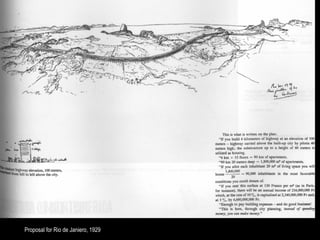
Proposal for Rio de Janiero, 1929
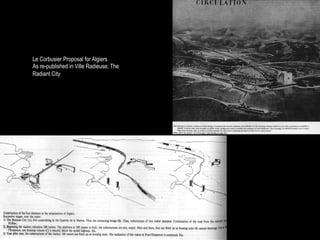
Le Corbusier Proposal for Algiers
As re-published in Ville Radieuse; The
Radiant City
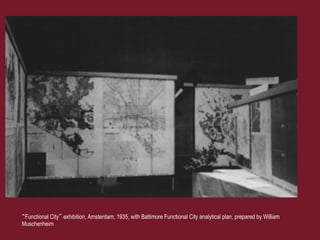
“Functional City” exhibition, Amsterdam, 1935, with Baltimore Functional City analytical plan, prepared by William
Muschenheim
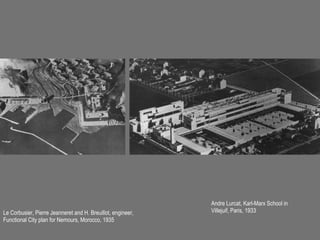
Andre Lurcat, Karl-Marx School in
Le Corbusier, Pierre Jeanneret and H. Breuillot, engineer,   Villejuif, Paris, 1933
Functional City plan for Nemours, Morocco, 1935
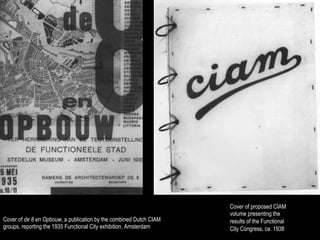
Cover of proposed CIAM
                                                                    volume presenting the
Cover of de 8 en Opbouw, a publication by the combined Dutch CIAM   results of the Functional
groups, reporting the 1935 Functional City exhibition, Amsterdam    City Congress, ca. 1938
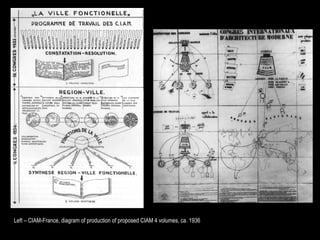
Left – CIAM-France, diagram of production of proposed CIAM 4 volumes, ca. 1936
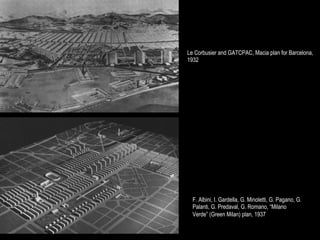
Le Corbusier and GATCPAC, Macia plan for Barcelona,
1932


  F. Albini, I. Gardella, G. Minoletti, G. Pagano, G.
  Palanti, G. Predaval, G. Romano, “Milano
  Verde” (Green Milan) plan, 1937
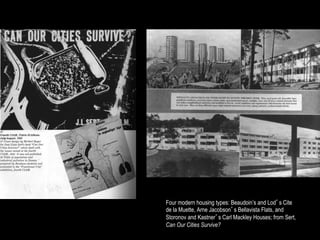
Four modern housing types: Beaudoin’s and Lod’s Cite
de la Muette, Arne Jacobson’s Bellavista Flats, and
Storonov and Kastner’s Carl Mackley Houses; from Sert,
Can Our Cities Survive?
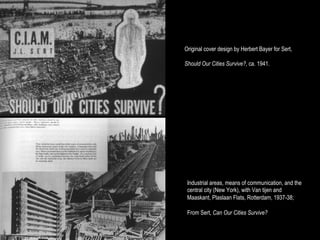
Original cover design by Herbert Bayer for Sert,

Should Our Cities Survive?, ca. 1941.


 Industrial areas, means of communication, and the
 central city (New York), with Van tijen and
 Maaskant, Plaslaan Flats, Rotterdam, 1937-38;

 From Sert, Can Our Cities Survive?
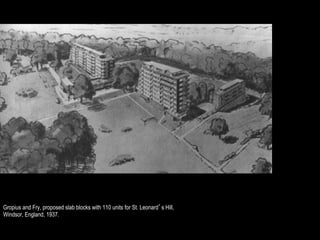
Gropius and Fry, proposed slab blocks with 110 units for St. Leonard’s Hill,
Windsor, England, 1937.
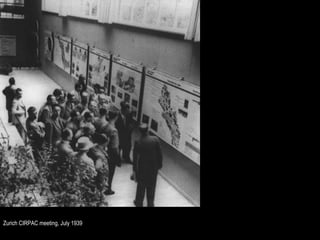
Zurich CIRPAC meeting, July 1939
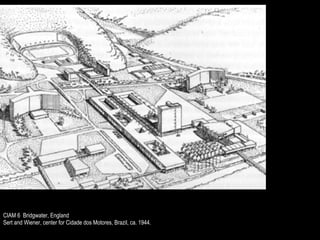
CIAM 6 Bridgwater, England
Sert and Wiener, center for Cidade dos Motores, Brazil, ca. 1944.
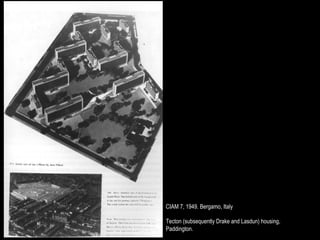
CIAM 7, 1949. Bergamo, Italy

Tecton (subsequently Drake and Lasdun) housing,
Paddington.
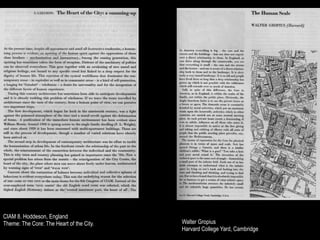
CIAM 8. Hoddeson, England
Theme: The Core: The Heart of the City.   Walter Gropius
                                          Harvard College Yard, Cambridge
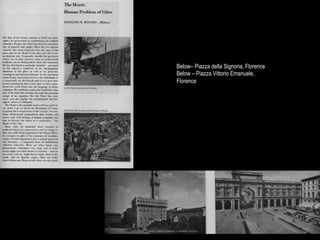
Below– Piazza della Signoria, Florence
Below – Piazza Vittorio Emanuele,
Florence
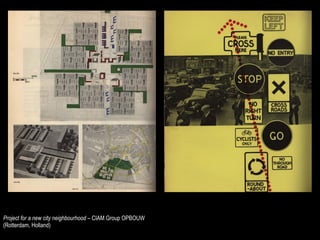
Project for a new city neighbourhood – CIAM Group OPBOUW
(Rotterdam, Holland)
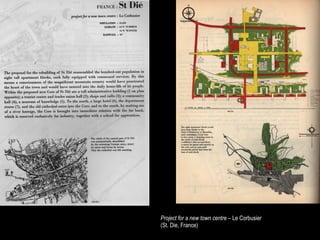
Project for a new town centre – Le Corbusier
(St. Die, France)
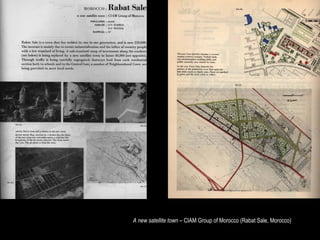
A new satellite town – CIAM Group of Morocco (Rabat Sale, Morocco)
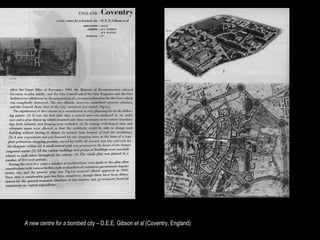
A new centre for a bombed city – D.E.E. Gibson et al (Coventry, England)
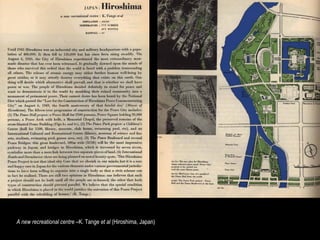
A new recreational centre –K. Tange et al (Hiroshima, Japan)
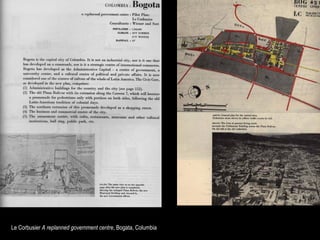
Le Corbusier A replanned government centre, Bogata, Columbia)
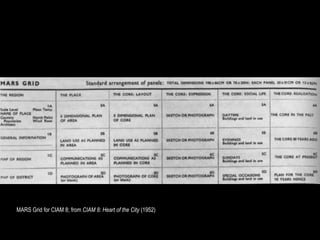
MARS Grid for CIAM 8; from CIAM 8: Heart of the City (1952)
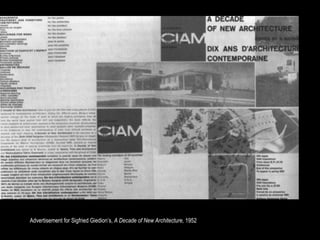
Advertisement for Sigfried Giedion’s, A Decade of New Architecture, 1952
Sven Backstrom, Lief Reinius,
          Rosta Housing Estate, 1946,
                Orebro Sweden


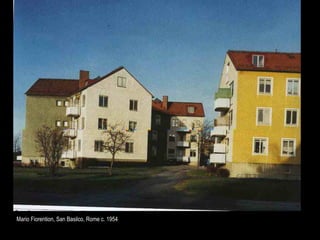
Mario Fiorention, San Basilco, Rome c. 1954
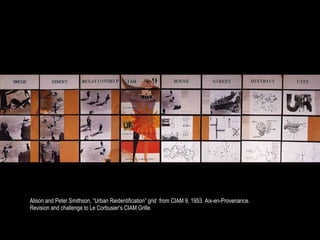
Alison and Peter Smithson, “Urban Reidentification” grid from CIAM 9, 1953. Aix-en-Provenance.
Revision and challenge to Le Corbusier’s CIAM Grille
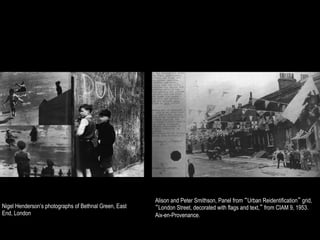
Alison and Peter Smithson, Panel from “Urban Reidentification” grid,
Nigel Henderson’s photographs of Bethnal Green, East   “London Street, decorated with flags and text,” from CIAM 9, 1953.
End, London                                            Aix-en-Provenance.
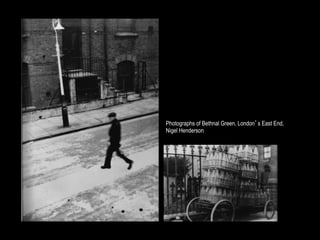
Photographs of Bethnal Green, London’s East End,
Nigel Henderson
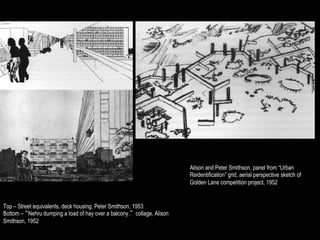
Alison and Peter Smithson, panel from “Urban
                                                                         Reidentification” grid, aerial perspective sketch of
                                                                         Golden Lane competition project, 1952


Top – Street equivalents, deck housing, Peter Smithson, 1953
Bottom – “Nehru dumping a load of hay over a balcony.” collage, Alison
Smithson, 1952
Smithsons, 1952

Golden Lane, 1952. Section with partial elevation.
P. Smithson
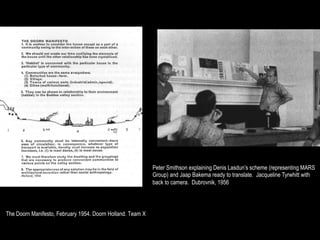
Peter Smithson explaining Denis Lasdun’s scheme (representing MARS
                                                            Group) and Jaap Bakema ready to translate. Jacqueline Tyrwhitt with
                                                            back to camera. Dubrovnik, 1956


The Doorn Manifesto, February 1954. Doorn Holland. Team X
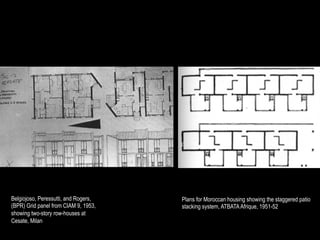
Belgiojoso, Peressutti, and Rogers,   Plans for Moroccan housing showing the staggered patio
(BPR) Grid panel from CIAM 9, 1953,   stacking system, ATBATA Afrique, 1951-52
showing two-story row-houses at
Cesate, Milan
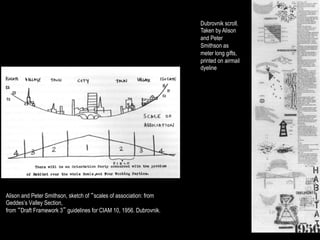
Dubrovnik scroll.
                                                                    Taken by Alison
                                                                    and Peter
                                                                    Smithson as
                                                                    meter long gifts,
                                                                    printed on airmail
                                                                    dyeline


Alison and Peter Smithson, sketch of “scales of association: from
Geddes’s Valley Section,
from “Draft Framework 3” guidelines for CIAM 10, 1956. Dubrovnik.
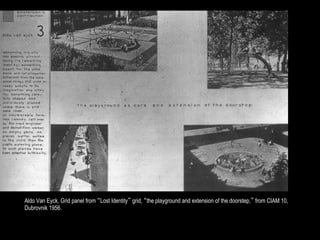
Aldo Van Eyck, Grid panel from “Lost Identity” grid, “the playground and extension of the doorstep,” from CIAM 10,
Dubrovnik 1956.
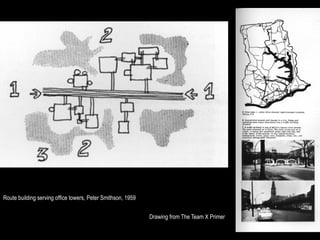
Route building serving office towers, Peter Smithson, 1959


                                                             Drawing from The Team X Primer
From the Team X Primer


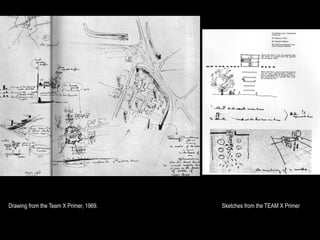
Drawing from the Team X Primer, 1969.   Sketches from the TEAM X Primer
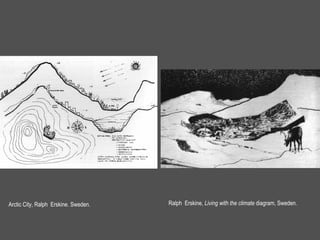
Arctic City, Ralph Erskine. Sweden.   Ralph Erskine, Living with the climate diagram, Sweden.
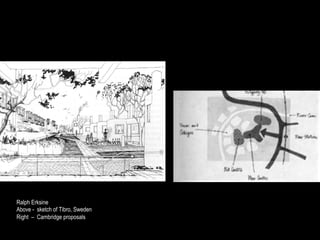
Ralph Erksine
Above - sketch of Tibro, Sweden
Right – Cambridge proposals
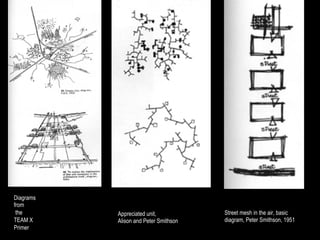
Diagrams
from
 the       Appreciated unit,           Street mesh in the air, basic
TEAM X     Alison and Peter Smithson   diagram, Peter Smithson, 1951
Primer
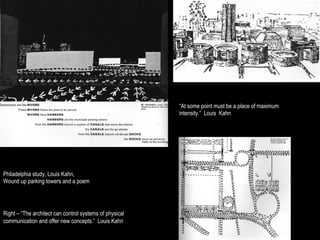
“At some point must be a place of maximum
                                                         intensity.” Louis Kahn


Philadelphia study, Louis Kahn,
Wound up parking towers and a poem


Right – “The architect can control systems of physical
communication and offer new concepts.” Louis Kahn
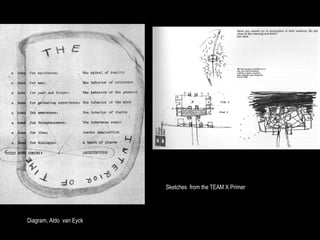
Sketches from the TEAM X Primer


Diagram, Aldo van Eyck
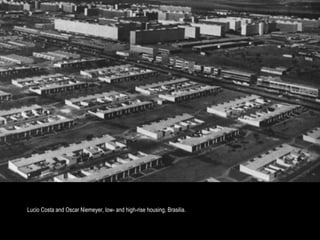
Lucio Costa and Oscar Niemeyer, low- and high-rise housing, Brasilia.
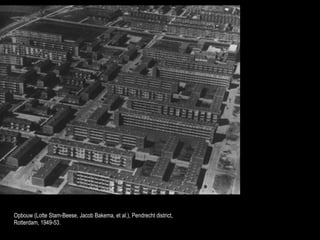
Opbouw (Lotte Stam-Beese, Jacob Bakema, et al.), Pendrecht district,
Rotterdam, 1949-53.
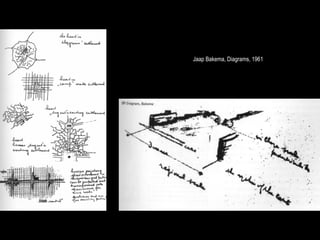
Jaap Bakema, Diagrams, 1961
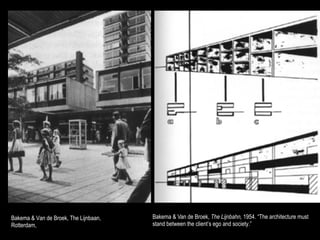
Bakema & Van de Broek, The Lijnbaan,   Bakema & Van de Broek, The Lijnbahn, 1954. “The architecture must
Rotterdam,                             stand between the client’s ego and society.”
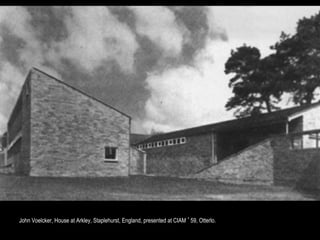
John Voelcker, House at Arkley, Staplehurst, England, presented at CIAM ’59, Otterlo.
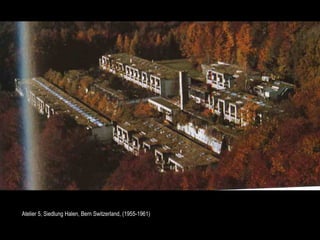
Atlier 5, Siedlung, Berne, 1961


Atelier 5, Siedlung Halen, Bern Switzerland, (1955-1961)
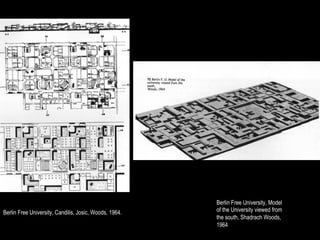
Berlin Free University, Model
Berlin Free University, Candilis, Josic, Woods, 1964.   of the University viewed from
                                                        the south, Shadrach Woods,
                                                        1964
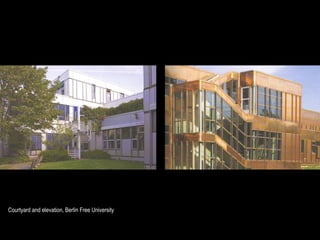
Courtyard and elevation, Berlin Free University

1032.432.3.2013

  • 1.
    The first gatheringof the CIAM at La Sarraz, Switzerland, 1928. Congrès International d’Architecture Moderne or Congresses for International Modern Architecture 1928-1959
  • 2.
    CIAM “battle plan”drawn and exhibited by Le Corbusier for the meeting at La Sarraz, 1928
  • 3.
    Cover of i10containing the “Declaration of La Sarraz,” 1928
  • 4.
    Le Corbusier’s LaVille Radieuse or The Radiant City, 1925
  • 5.
    Advertisement on backof Das Neue Frankfurt 11 (November 1929), Examples of house types shown at the second showing Stam’s Hellerhof settlement, Frankfurt, 1929 meeting of the CIAM in Frankfurt, 1929
  • 6.
    Group photograph, CIAM3, Brussels, 1930
  • 7.
    CIAM 3, Brussels,1930 Top left and right – Rationelle Bebauungsweisen exhibition. Planning proposals for Abo Finland, by Alvar Walter Gropius, model of an eleven-story steel- Alto and for Utrecht Holland, by Gerrit Reitveld framed slab apartment building with sixty small units, from Rationelle Bebauungsweisen Bottom – Book cover Rationelle Bebauungsweisen, Stuttgart, 1931
  • 8.
    Rationelle Bebauungsweisen exhibition.Herbert Boehm and Eugene Site plan with analytical comments from Kaufmann’s studies of building costs for two- to twelve-story building types Rationelle Bebauungsweisen, 1930
  • 9.
    Le Corbusier Le Corbusier Cover of Des canons, des munitions? Merci ! ‘Aerial Warfare’ Des logis . . . S.V.P. 1938. Plate from La Ville Radieuse, 1935.
  • 10.
    Le Corbusier ‘What aboutAir War?” In La Ville Radieuse, 1935
  • 11.
    From the Architectsin Uniform Exhibition at the Canadian Centre for Architecture, 2011
  • 12.
    Le Corbusier’s sketchesmade on board the SS Le Corbusier speaking on the SS Patris ll, CIAM 4, Patris ll – illustrating his theme of “air-sound-light” 1933 developed as a lecture
  • 15.
    “Organisms…Perfect entities…a function,a form..” Le Corbusier, The Radiant City
  • 16.
    Le Corbusier FromThe Radiant City, 1933. “The highway network sketched out here will provide facilities (complete, efficient, necessary and adequate) for a city of one and a half million inhabitants. Each square of the network in residential areas measures 400 by 400 meters.” Le Corbusier – The Radiant City, 1933, 1964
  • 17.
    Le Corbusier, TheRadiant City
  • 18.
    Le Corbusier, TheRadiant City The Green City The Redents
  • 19.
    Le Corbusier, FromThe Radiant City; Ville Radieuse
  • 20.
  • 21.
    Le Corbusier, FromThe Radient City
  • 23.
    Proposal for Riode Janiero, 1929
  • 24.
    Le Corbusier Proposalfor Algiers As re-published in Ville Radieuse; The Radiant City
  • 25.
    “Functional City” exhibition,Amsterdam, 1935, with Baltimore Functional City analytical plan, prepared by William Muschenheim
  • 26.
    Andre Lurcat, Karl-MarxSchool in Le Corbusier, Pierre Jeanneret and H. Breuillot, engineer, Villejuif, Paris, 1933 Functional City plan for Nemours, Morocco, 1935
  • 27.
    Cover of proposedCIAM volume presenting the Cover of de 8 en Opbouw, a publication by the combined Dutch CIAM results of the Functional groups, reporting the 1935 Functional City exhibition, Amsterdam City Congress, ca. 1938
  • 28.
    Left – CIAM-France,diagram of production of proposed CIAM 4 volumes, ca. 1936
  • 29.
    Le Corbusier andGATCPAC, Macia plan for Barcelona, 1932 F. Albini, I. Gardella, G. Minoletti, G. Pagano, G. Palanti, G. Predaval, G. Romano, “Milano Verde” (Green Milan) plan, 1937
  • 30.
    Four modern housingtypes: Beaudoin’s and Lod’s Cite de la Muette, Arne Jacobson’s Bellavista Flats, and Storonov and Kastner’s Carl Mackley Houses; from Sert, Can Our Cities Survive?
  • 31.
    Original cover designby Herbert Bayer for Sert, Should Our Cities Survive?, ca. 1941. Industrial areas, means of communication, and the central city (New York), with Van tijen and Maaskant, Plaslaan Flats, Rotterdam, 1937-38; From Sert, Can Our Cities Survive?
  • 32.
    Gropius and Fry,proposed slab blocks with 110 units for St. Leonard’s Hill, Windsor, England, 1937.
  • 33.
  • 34.
    CIAM 6 Bridgwater,England Sert and Wiener, center for Cidade dos Motores, Brazil, ca. 1944.
  • 35.
    CIAM 7, 1949.Bergamo, Italy Tecton (subsequently Drake and Lasdun) housing, Paddington.
  • 36.
    CIAM 8. Hoddeson,England Theme: The Core: The Heart of the City. Walter Gropius Harvard College Yard, Cambridge
  • 37.
    Below– Piazza dellaSignoria, Florence Below – Piazza Vittorio Emanuele, Florence
  • 38.
    Project for anew city neighbourhood – CIAM Group OPBOUW (Rotterdam, Holland)
  • 39.
    Project for anew town centre – Le Corbusier (St. Die, France)
  • 40.
    A new satellitetown – CIAM Group of Morocco (Rabat Sale, Morocco)
  • 41.
    A new centrefor a bombed city – D.E.E. Gibson et al (Coventry, England)
  • 42.
    A new recreationalcentre –K. Tange et al (Hiroshima, Japan)
  • 43.
    Le Corbusier Areplanned government centre, Bogata, Columbia)
  • 44.
    MARS Grid forCIAM 8; from CIAM 8: Heart of the City (1952)
  • 45.
    Advertisement for SigfriedGiedion’s, A Decade of New Architecture, 1952
  • 46.
    Sven Backstrom, LiefReinius, Rosta Housing Estate, 1946, Orebro Sweden Mario Fiorention, San Basilco, Rome c. 1954
  • 47.
    Alison and PeterSmithson, “Urban Reidentification” grid from CIAM 9, 1953. Aix-en-Provenance. Revision and challenge to Le Corbusier’s CIAM Grille
  • 48.
    Alison and PeterSmithson, Panel from “Urban Reidentification” grid, Nigel Henderson’s photographs of Bethnal Green, East “London Street, decorated with flags and text,” from CIAM 9, 1953. End, London Aix-en-Provenance.
  • 49.
    Photographs of BethnalGreen, London’s East End, Nigel Henderson
  • 50.
    Alison and PeterSmithson, panel from “Urban Reidentification” grid, aerial perspective sketch of Golden Lane competition project, 1952 Top – Street equivalents, deck housing, Peter Smithson, 1953 Bottom – “Nehru dumping a load of hay over a balcony.” collage, Alison Smithson, 1952
  • 51.
    Smithsons, 1952 Golden Lane,1952. Section with partial elevation. P. Smithson
  • 52.
    Peter Smithson explainingDenis Lasdun’s scheme (representing MARS Group) and Jaap Bakema ready to translate. Jacqueline Tyrwhitt with back to camera. Dubrovnik, 1956 The Doorn Manifesto, February 1954. Doorn Holland. Team X
  • 53.
    Belgiojoso, Peressutti, andRogers, Plans for Moroccan housing showing the staggered patio (BPR) Grid panel from CIAM 9, 1953, stacking system, ATBATA Afrique, 1951-52 showing two-story row-houses at Cesate, Milan
  • 54.
    Dubrovnik scroll. Taken by Alison and Peter Smithson as meter long gifts, printed on airmail dyeline Alison and Peter Smithson, sketch of “scales of association: from Geddes’s Valley Section, from “Draft Framework 3” guidelines for CIAM 10, 1956. Dubrovnik.
  • 55.
    Aldo Van Eyck,Grid panel from “Lost Identity” grid, “the playground and extension of the doorstep,” from CIAM 10, Dubrovnik 1956.
  • 56.
    Route building servingoffice towers, Peter Smithson, 1959 Drawing from The Team X Primer
  • 57.
    From the TeamX Primer Drawing from the Team X Primer, 1969. Sketches from the TEAM X Primer
  • 58.
    Arctic City, RalphErskine. Sweden. Ralph Erskine, Living with the climate diagram, Sweden.
  • 59.
    Ralph Erksine Above -sketch of Tibro, Sweden Right – Cambridge proposals
  • 60.
    Diagrams from the Appreciated unit, Street mesh in the air, basic TEAM X Alison and Peter Smithson diagram, Peter Smithson, 1951 Primer
  • 61.
    “At some pointmust be a place of maximum intensity.” Louis Kahn Philadelphia study, Louis Kahn, Wound up parking towers and a poem Right – “The architect can control systems of physical communication and offer new concepts.” Louis Kahn
  • 62.
    Sketches from theTEAM X Primer Diagram, Aldo van Eyck
  • 63.
    Lucio Costa andOscar Niemeyer, low- and high-rise housing, Brasilia.
  • 64.
    Opbouw (Lotte Stam-Beese,Jacob Bakema, et al.), Pendrecht district, Rotterdam, 1949-53.
  • 65.
  • 66.
    Bakema & Vande Broek, The Lijnbaan, Bakema & Van de Broek, The Lijnbahn, 1954. “The architecture must Rotterdam, stand between the client’s ego and society.”
  • 67.
    John Voelcker, Houseat Arkley, Staplehurst, England, presented at CIAM ’59, Otterlo.
  • 68.
    Atlier 5, Siedlung,Berne, 1961 Atelier 5, Siedlung Halen, Bern Switzerland, (1955-1961)
  • 69.
    Berlin Free University,Model Berlin Free University, Candilis, Josic, Woods, 1964. of the University viewed from the south, Shadrach Woods, 1964
  • 70.
    Courtyard and elevation,Berlin Free University